What's inside
- Key Takeaways
- Quick Picks
- How We Chose These Picks
- Comparison Table
- Why would anyone choose a separate sprayer over a pull-down?
- How many holes does your sink actually have, and why does it rule this category?
- What actually wears out in a separate sprayer system, and how do you stay ahead of it?
- How do you use a separate sprayer like a professional?
- What should you check on delivery day?
- How does a separate sprayer change washing-up technique?
- Why do four-hole sinks deserve fittings designed for them?
- How do you fit a separate sprayer faucet without leaks or regrets?
- Common Mistakes
- Final Recommendation
- Frequently Asked Questions
- Related Guides
As an Amazon Associate I earn from qualifying purchases. This post may contain affiliate links at no extra cost to you.
cottageverdict.com is reader-supported. When you buy through links on our site, we may earn an affiliate commission.
Where to buy: all six faucets below are sold through Amazon, and the names in the Quick Picks table, the review headings and the comparison table link to the matching listing, so you can check price on Amazon and confirm deck holes, handles and sprayer details before ordering. The best kitchen faucets separate spayer shoppers look for are built on an arrangement the industry nearly talked itself out of: the sprayer as its own fitting, standing in its own hole at the sink’s edge, independent of the spout. Pull-down designs hid the sprayer inside the arc and called it progress, and for many kitchens it was. But the separate sprayer kept a loyal constituency for reasons this guide will argue are physical, not nostalgic.
A separate sprayer is already where the work is. It parks at the basin’s edge aimed at the bowl, its hose travels to corners, counters and floor-level buckets, and it can be replaced, serviced or upgraded without touching the faucet it serves. The main spout, relieved of sprayer duty, returns to being a simple fixed or swivelling arc with nothing to dock and nothing to retract. Kitchens with four-hole sinks, which is to say a generation of the world’s kitchens, are plumbed and drilled for exactly this arrangement, and these six picks honour that geography.
The field divides by handle philosophy and by paperwork. Three single-handle designs serve the modern habit; two-handle centersets from Cinwiny and VALISY serve the traditional one; and the listings vary from the Peerless’s three-line honesty to the Aqua Vista’s full specification. All wear finishes a working kitchen can live with, and every review below states plainly what its listing declares and what it leaves for you to verify.
One mechanical idea runs beneath the whole guide and deserves naming early: the diverter. When a separate sprayer is squeezed, a small valve inside the faucet body redirects the water from spout to sprayer, and that humble component decides whether the arrangement feels seamless or sulky. A healthy diverter switches cleanly and returns the spout to full flow the moment the sprayer rests; a tired one dribbles from both. Every pick here was chosen from listings whose makers treat the sprayer as a first-class citizen, because in this category the diverter is the difference between a system and a compromise.
Read the reviews with your sink’s hole count in your hand. Four holes is the native map, and while plates and plugs can disguise other geographies, the separate sprayer is at its best, visually and mechanically, on the deck it was designed for.
Key Takeaways
- Every pick pairs its faucet with a sprayer that lives in its own deck hole, independent of the spout.
- Four-hole sinks are this category’s native geography; two picks are two-handle centersets and three are single-handle designs.
- The Aqua Vista and Cinwiny publish their flow rates; the VALISY publishes an NSF certification, unique in this lineup.
- A separate sprayer can be serviced or replaced without disturbing the faucet body it serves.
- The diverter inside the body decides how cleanly water switches between spout and sprayer, so buy the system, not the silhouette.
Quick Picks
| Pick | Badge | Why it earns its place |
|---|---|---|
| Peerless Kitchen Faucet With Side Sprayer | Best Classic Chrome Single-Handle | The traditional arrangement in its purest form: one handle, a chrome body and a separate sprayer standing in its own deck hole. |
| Moen Wetherly Kitchen Faucet | Best High-Arc From an Established Maker | A high arc in stainless from Moen, for cooks whose tallest pots defeat ordinary spouts and who buy brands with service networks. |
| Delta Foundations Kitchen Faucet | Best Four-Hole Foundations Buy | A contemporary four-hole layout with side sprayer and single handle, in brushed nickel from Delta’s Foundations line. |
| Aqua Vista Kitchen Faucet With Side Spray | Best Published Flow and Materials | A high arc with side spray in chrome, publishing its flow rate, its lead-free brass and its drip-free cartridge in the title. |
| Cinwiny Kitchen Faucet With Sprayer | Best Two-Handle Centreset | Two handles on an eight-inch centerset, a spout that swivels full circle, a sprayer, and SUS304 steel declared in the listing. |
| VALISY Kitchen Faucet With Side Sprayer | Best Farmhouse and RV Versatility | An NSF-certified two-handle centerset whose listing names farmhouse and RV sinks, with swivel spout and side sprayer in brushed nickel. |
How We Chose These Picks
Completeness came first, as it did throughout this batch: a pick qualified only if its listing presented a faucet and a separate sprayer as one proposition, not a spout hoping you would buy its partner later. Within that rule we required the deck story to be legible, hole count and handle count stated or unmistakable, because this category lives or dies on the geography of the sink it must fit.
Next we weighed the two halves independently, the way an owner will. The spout half was judged on arc, swivel where offered, and finish; the sprayer half on its independence, its hose-borne reach and the realism of its service story. A pairing that excelled in one half and apologised in the other did not survive, because a separate-sprayer system is used as a system every single day.
Finally we honoured the category’s diversity of households: the traditionalist, the brand loyalist, the specification reader, the two-handle family and the farmhouse or RV owner each have a first choice below. A guide to a heritage category that only served one temperament would misunderstand why the heritage survived.

Peerless Kitchen Faucet With Side Sprayer — Best Classic Chrome Single-Handle
Before pull-down sprayers colonised the kitchen, this was the arrangement that worked: a single-handle faucet for the daily water and a separate sprayer, parked in its own hole beside it, for everything the spout could not reach. The Peerless keeps that arrangement in its classic chrome form, and its listing says exactly what it is and nothing it is not, which in this category counts as a kind of honesty worth rewarding.
The separate sprayer’s virtues are physical. It lives at the sink’s edge, already aimed at the basin, and its hose lets it travel to the corners, across to a pot standing on the counter, or down to the bucket on the floor that no spout will ever reach. Because the sprayer is its own fitting, the main spout stays a simple, fixed, honest arc: nothing to dock, nothing to retract, nothing hanging inside the faucet’s neck waiting to tire.
Chrome and a single handle date the design in the best sense: every plumber alive has serviced its relatives, every household member understands it in one glance, and its parts belong to the most widely stocked family in plumbing. Choose it for a kitchen that values the proven over the novel, a rental that must survive tenants, or a farmhouse sink whose whole aesthetic argues that the old arrangement was never actually broken.
There is an economy of attention in this pick that newer designs rarely match. The sprayer is either in your hand or in its holder; the spout is either running or not; and the handle’s position tells the room the water’s story at a glance. Kitchens generate enough complexity at the stove, and a faucet that refuses to add any at the sink is a small daily mercy that compounds across years of breakfasts.
It also forgives rough treatment with grace. A sprayer knocked against a pot, a handle worked by a wet elbow, a finish wiped with whatever cloth is nearest: the classic pattern has survived all of it in a million kitchens, and its survival is documented in the only laboratory that matters, which is time.
Think of the households this faucet has quietly served: the farmhouse where the sprayer washes canning jars in September, the rental where it survives a new tenant every year, the family kitchen where it rinses a decade of birthday cake bowls. None of those kitchens needed their faucet to be interesting. They needed it to be there, working, every day, and the Peerless’s entire design is a promise to be exactly that.
- Sprayer: separate side sprayer
- Handles: single handle
- Finish: chrome
- Line: Peerless P115LF
- Form: classic deck arrangement
Strengths
- Separate sprayer reaches pots and buckets the spout cannot
- Fixed spout has no dock or retraction mechanism to tire
- Classic pattern is universally understood and serviced
Trade-offs
- Chrome shows water spots and asks for regular wiping
- Traditional look will not satisfy a modernising kitchen
- Sprayer occupies its own deck hole, which must exist
Best for: a traditional kitchen, rental or farmhouse sink that wants the proven separate-sprayer arrangement.
Not suited for: a deck without a fourth hole and no appetite for drilling one.

Moen Wetherly Kitchen Faucet — Best High-Arc From an Established Maker
Height is this pick’s whole argument, and at a working sink height is not a styling preference. A high arc admits the stockpot, the preserving pan, the tall vase and the bucket that a standard spout forces you to fill in the bathtub or with a jug relay. The Wetherly raises that arc in Moen’s stainless finish, and in this separate-sprayer lineup it represents the established maker’s answer: composed, serviceable and proportioned for a serious sink.
Moen’s presence in a kitchen buys a particular kind of future. Cartridges, sprayer components and small hardware for a current Moen line are the fittings a local merchant is likeliest to stock and a local plumber likeliest to know by feel, and a kitchen faucet is serviced often enough across a long life that this network is a product feature, not a corporate footnote. The stainless finish supports the same philosophy, muting the spots that a high, visible arc would otherwise advertise.
Read its listing with the honesty this guide applies everywhere: the title speaks of arc and finish rather than enumerating accessories, so confirm the box’s full contents on the listing page before ordering, as you should with any pick. What is not in doubt is the proposition itself, a high, graceful arc from a maker whose kitchen lines have been rinsing pots for decades, standing in a lineup of separate-sprayer designs as the choice for buyers who rank pedigree beside performance.
Proportion deserves its paragraph. A high arc changes the sink’s skyline, giving the whole counter a vertical accent that lower faucets leave to the window or the shelves, and in kitchens with tall cabinets and a deep apron sink, that accent completes the room’s geometry. Buy the Wetherly when the sink is a workstation and the faucet is allowed to look like one: upright, capable and entirely unembarrassed about its height.
Its stainless tone also plays well across a mixed-metal kitchen, sitting calmly between chrome appliances and black hardware without demanding that either camp surrender. Rooms evolve fitting by fitting, and a faucet in the diplomatic finish is the one that never has to be replaced for diplomatic reasons.
The Wetherly also rewards the cook who entertains at scale. Holiday cooking fills vessels that laugh at ordinary arcs: the roasting pan soaking, the punch bowl, the flower buckets for the table. A high arc turns the sink into a station that can receive them all without a trip to the bathtub, and that capacity, invisible in April, becomes the whole argument in December.
- Spout: high arc
- Finish: stainless
- Line: Moen Wetherly 87999SRS
- Maker: established kitchen faucet brand
- Role in lineup: high-arc representative
Strengths
- High arc clears the tallest pots and pans at the sink
- Established maker’s parts network supports a long life
- Stainless finish mutes spots on a tall, visible profile
Trade-offs
- Listing title is brief, so verify box contents before ordering
- High arc can splash in a shallow sink if run carelessly
- Brand pedigree positioning applies to this pick
Best for: a serious cook with tall pots who wants an established maker’s high arc at the main sink.
Not suited for: a shallow sink where a tall arc’s falling water will drum and splash.

Delta Foundations Kitchen Faucet — Best Four-Hole Foundations Buy
Four holes is the native geography of the separate sprayer: hot, cold or a shared body, the spout, and the sprayer’s own home at the deck’s edge. The Delta Foundations is drawn for exactly that map, a contemporary single-handle body with its side sprayer, in brushed nickel, from a line whose entire purpose is to deliver a major maker’s competence without decorative excess. For the enormous number of kitchens whose sinks already wear four holes, this is the pick that fits the territory without plates, plugs or apologies.
Foundations is Delta’s plain-spoken range, and plain speech suits a working faucet. The single handle blends and shuts with the unambiguous action a busy cook wants, the brushed nickel mutes the evidence of a day spent filling and rinsing, and the sprayer covers the basin’s corners and the counter’s pots with its hose while the spout minds the centre. Nothing in the proposition requires the household to admire it; everything in it is arranged so the household can rely on it.
That reliability has a service dimension. Delta’s distribution means the diverter, the sprayer and the cartridge live in a parts ecosystem any town can reach, and the four-hole deck means a future replacement, years from now, will find the same geography waiting. Kitchens are renovated in layers, and a faucet that respects the layer beneath it, the drilled steel or stone it stands on, is a faucet chosen with the house’s whole life in mind.
There is a quiet virtue in a faucet drawn for the deck that actually exists. Renovation advice loves to imagine counters replaced and sinks reborn, but most kitchens improve within their inherited geography, and a fitting that honours the four holes already drilled respects the household’s money and the sink’s history at once. The Foundations earns its name in that respect: it is the solid ground on which a kitchen refresh can be built without moving the earth.
Its contemporary shaping also threads a needle that older four-hole designs miss: it looks current without looking fragile, so a kitchen updated around it this year will not find it dating the room in five. Neutrality, in a fitting expected to serve through several decorating fashions, is a design achievement rather than an absence of one.
For landlords and property managers, this pick’s calculus is especially plain. A Foundations faucet in a rental kitchen is a known quantity at every future service call, its sprayer and diverter are orderable by name, and its appearance offends no tenant’s taste. Durability in a rental is measured in avoided visits, and boring competence is the most profitable quality a fitting can have.
- Deck: four hole, contemporary
- Sprayer: side sprayer included
- Handles: single handle
- Finish: brushed nickel
- Line: Delta Foundations B4410LF-SS
Strengths
- Drawn for the four-hole decks most separate-sprayer sinks already have
- Major maker’s parts ecosystem supports sprayer and diverter service
- Brushed nickel forgives a working sink’s daily splashes
Trade-offs
- Requires the fourth hole for the sprayer, like all true separate designs
- Foundations styling is deliberately plain rather than decorative
- Single handle gives less traditional symmetry than two-handle sets
Best for: a four-hole sink in a family kitchen that wants a major maker’s competence without frills.
Not suited for: a three-hole deck whose owner refuses to drill or plate anything.

Aqua Vista Kitchen Faucet With Side Spray — Best Published Flow and Materials
The Aqua Vista’s title reads like a specification sheet, and this guide approves of the habit. A stated flow rate, lead-free brass construction, a drip-free cartridge and a high-arc spout are all declared before purchase, alongside the side spray that earns its place in this lineup. A buyer can argue with the numbers, compare them, and decide, which is a more respectful transaction than being asked to admire a photograph and hope.
That flow figure deserves its translation. At the stated rate, this is a faucet that fills a pot with conviction rather than patience, and the side spray shares that energetic brief for rinsing. Households that cook in volume, filling pasta water nightly and rinsing roasting pans by the sinkful, will feel the difference between a faucet that publishes a generous flow and one that apologises for a conservation-minded trickle. Water-rich regions and big-cooking households are this pick’s natural constituency.
The fit statement needs a careful read, because it teaches how separate sprayers work. The listing speaks of fitting one or three-hole sinks for the faucet body, while the sprayer itself, as a separate fitting, takes its own place at the deck or sink ledge as the installation allows. Confirm your deck’s geography against that arrangement before ordering, and the chrome high arc will deliver exactly the vigorous, declared performance its title promises, with a cartridge story that aims to keep the spout’s shut-off as crisp in year five as on day one.
The drip-free cartridge claim points at the failure mode that ruins more kitchen faucets than any other: the slow, overnight drip that stains the sink, wastes water in a metronome and announces that a seal has begun its retirement. A maker willing to print the promise in the title is at least aiming at the right enemy, and owners can hold the product to that aim with a clear conscience and a dry sink as the evidence.
Chrome, for all its wiping demands, returns one favour in a working kitchen: it shows dirt honestly and cleans completely, with no brushed grain to harbour a film and no dark finish to hide a splash until it hardens. Cooks who clean as they go often prefer exactly that honesty at the sink.
The Aqua Vista’s energy suits one more constituency: the household that washes by hand in earnest, without a dishwasher doing the heavy lifting. Hand-washing is a flow-hungry chore, rinsing suds from a sinkful of pans, and a faucet that publishes a vigorous rate respects that labour instead of rationing it. If your sink is your dishwasher, this pick was specified by someone who understood the assignment.
- Flow stated in listing: 1.8 GPM
- Material named: lead-free brass
- Cartridge: drip-free, per listing
- Spout: high arc
- Finish: chrome, deck mount
Strengths
- Publishes flow, material and cartridge claims in its title
- Energetic flow suits volume cooking and big rinsing jobs
- High arc and side spray cover centre and corners alike
Trade-offs
- Chrome finish shows spots and needs a wiping habit
- Deck fit for the separate sprayer needs confirming before order
- Generous flow is not the choice for strict water conservation
Best for: a high-volume cooking household that wants declared flow and materials in a chrome high arc.
Not suited for: a water-conserving household that prefers a gentler published flow.

Cinwiny Kitchen Faucet With Sprayer — Best Two-Handle Centreset
Two-handle kitchens are a living tradition, not a museum: many cooks set temperature with separate taps the way their hands learned decades ago, and they read a single lever as a riddle rather than a convenience. The Cinwiny serves that tradition in a modern eight-inch centerset across four holes, with the sprayer in its own place, a high arc overhead and brushed nickel calming the whole composition.
Its spout swivels through a full circle, a specification the listing states plainly, and at a kitchen sink that rotation transforms the geography of work. The stream can serve the left bowl, the right bowl, and the pot standing on the counter behind the sink when a preserving day demands it, while the sprayer handles the close work of rinsing and corner-chasing. Add the declared SUS304 stainless construction and the stated flow, and the listing assembles a complete, checkable argument rather than a mood.
The honest costs are the traditional ones. Two handles are two fittings to wipe and two motions to make, the centerset footprint occupies more deck than a single-hole body, and a full-circle swivel is a joint that asks to be used smoothly rather than swung by its spout tip. Households that cook with a partner at the sink often find the two handles a genuine collaboration feature, one person setting water while the other works, and for those kitchens this is the pick that respects how the room actually operates.
The centerset form has a structural kindness worth naming: handles and spout share one coordinated footprint, so the deck’s holes align to a single drawing and the whole fitting reads as one commission. In a kitchen where the sink area has accumulated decades of small mismatches, that visual unity, three pieces speaking one brushed-nickel sentence, can calm the entire counter more than a costlier, lonelier faucet would.
It is also the pick that visiting cooks understand fastest. Anyone who has ever used a kitchen anywhere can work two handles and a sprayer without a briefing, which matters in houses where holidays draft every relative into service and the faucet becomes a shared tool rather than a personal one.
Two-handle operation also has a safety dialect worth respecting: a carer can set the cold running before adding warmth for a child’s hands, and a cook can kill the hot with one decisive twist without hunting a lever’s middle. Households that think in those sequences are not behind the times; they are fluent in a grammar the single lever simplified away, and this faucet speaks it fluently.
- Deck: four hole, eight-inch centerset
- Handles: two
- Spout: high arc, 360-degree swivel stated
- Flow stated in listing: 1.8 GPM
- Material named: SUS304 stainless steel, lead-free
Strengths
- Two handles suit cooks who set temperature by tradition and touch
- Full-circle swivel serves both bowls and the counter behind
- Materials and flow are declared in the listing
Trade-offs
- Two handles mean two fittings to clean and operate
- Centerset footprint needs a deck with room to breathe
- Swivel joint rewards smooth handling rather than yanks
Best for: a two-handle household with a double sink and a partner-cooking rhythm.
Not suited for: a minimalist single-hole deck that wants one small body only.
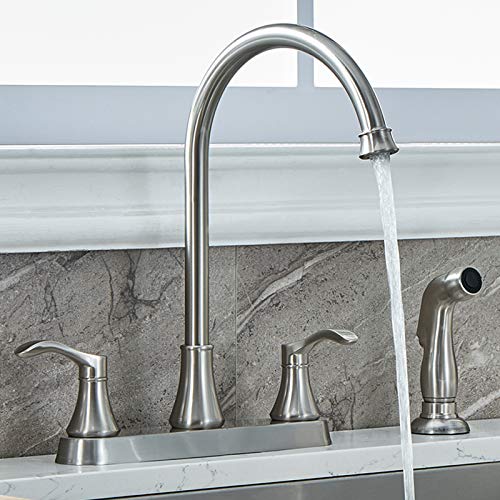
VALISY Kitchen Faucet With Side Sprayer — Best Farmhouse and RV Versatility
Listings rarely tell you where they imagine themselves living, but the VALISY names its homes: farmhouse kitchens and RV sinks, two territories that share more than they appear to. Both work hard in compact or characterful spaces, both value fittings that can be understood and serviced without a specialist, and both punish pretension. Into those territories this two-handle, four-hole centerset brings an NSF certification in its title, a high arc that swivels fully, and a side sprayer for the corners.
The certification deserves its sentence, because it is the only one of its kind in this lineup’s titles. NSF language speaks to materials and lead standards tested by a third party, and for households that read water-contact declarations closely, a printed certification is worth more than a paragraph of reassurance. Combined with the lead-free statement beside it, the VALISY makes the most paperwork-forward case here for buyers whose first question is what the water touches on its way to the glass.
In the RV and the farmhouse alike, the practical virtues compound: two handles that can be worked with cold or gloved fingers, a swivel that serves a wide single bowl or a compact double, and a sprayer whose hose reaches the odd corners that small and characterful sinks specialise in. Brushed nickel forgives the splashes of both lifestyles. If your sink lives in a rolling kitchen or a working farmhouse, this is the pick whose listing was quite literally written with your address in mind.
The RV angle teaches a lesson the farmhouse already knows: in a small kitchen, every fitting must earn its footprint twice, and a faucet whose sprayer can rinse the sink, fill the kettle on the counter and wash the dog’s bowl on the step is not one tool but three. Compact living rewards exactly that kind of multiplication, and it is why this pick’s versatility is a considered feature rather than a marketing garnish.
Its brushed nickel also travels well between the two worlds it names, traditional enough for a farmhouse’s timber and enamel, quiet enough for an RV’s fitted interior, and forgiving of the water spots that both lifestyles produce in abundance. Finishes that can cross contexts are rarer than finishes that merely photograph well.
The VALISY’s farmhouse brief includes one more reality: well water and variable pressure, the conditions of half the countryside. A straightforward two-handle system with a swivel and a sprayer behaves predictably when pressure wanders, and its certification paperwork matters most exactly where the supply is private and the household is its own water authority. Rural readers will recognise their kitchen in this pick’s priorities.
- Deck: four hole, eight-inch centerset
- Handles: two
- Certification named: NSF, lead-free
- Spout: high arc, 360-degree swivel
- Named for: farmhouse and RV sinks, per listing
Strengths
- NSF certification and lead-free statement lead its paperwork
- Two handles work with cold, gloved or arthritic hands
- Listing explicitly addresses farmhouse and RV installations
Trade-offs
- Two-handle centerset occupies generous deck space
- Smaller label means a thinner service network
- Swivel and sprayer add joints a fixed faucet avoids
Best for: a farmhouse kitchen or an RV whose owners read water-contact certifications first.
Not suited for: a compact modern deck chasing a single-hole, single-lever silhouette.
Comparison Table
| Feature | Peerless Kitchen Faucet With Side Sprayer | Moen Wetherly Kitchen Faucet | Delta Foundations Kitchen Faucet | Aqua Vista Kitchen Faucet With Side Spray | Cinwiny Kitchen Faucet With Sprayer | VALISY Kitchen Faucet With Side Sprayer |
|---|---|---|---|---|---|---|
| Handles | Single | Single | Single | Single | Two | Two |
| Deck story | Classic with sprayer hole | High-arc body | Four hole | Deck mount | 4 hole centerset | 4 hole centerset |
| Spout note | Fixed classic arc | High arc | Contemporary arc | High arc | 360-degree swivel | 360-degree swivel |
| Paperwork highlight | Plain and brief | Brand line | Foundations line | Flow and materials stated | Flow and steel stated | NSF certified |
Why would anyone choose a separate sprayer over a pull-down?
Reach, in a word, and independence in a second. A pull-down sprayer travels on a hose that lives inside the faucet’s neck, and its world is the sink and the arc’s immediate neighbourhood. A separate sprayer’s hose answers to no neck: it crosses to the pot on the counter, descends to the bucket beside the cabinet, and rinses the far corner of a wide farmhouse bowl without the spout’s geometry negotiating every inch. For kitchens that fill, soak and rinse beyond the basin’s rim, that freedom is a daily fact, not a brochure claim.
Independence cuts the other way too, in the owner’s favour. When a separate sprayer tires, and sprayers live harder lives than spouts, it can be swapped as a component while the faucet body serves on, and when a diverter needs attention it is a defined, serviceable part rather than an excavation inside a designer neck. The arrangement’s very old-fashionedness is a maintenance strategy: every piece is reachable, replaceable and understood by every plumber who has ever knelt in a kitchen.
Consider the sink’s second shift as well: the evening clean-down, when the basin itself is the object being washed. A spout can only rain on the territory beneath it, while a sprayer in hand can walk the walls, flush the drain’s shoulders and chase the last of the day’s debris in a deliberate circuit. Restaurants end service with exactly that circuit, and a home kitchen equipped to perform it stays fresher with less chemistry and less effort than one limited to a sponge and optimism.
The honest counter-case belongs in this guide too. A separate sprayer costs a deck hole, adds a fitting to wipe, and cannot match a pull-down’s party trick of becoming the spout itself. Kitchens with three holes, minimal decks or a cook who rinses only within the bowl should take the other road without regret. This guide serves the kitchens, and there are millions, where the work regularly leaves the basin and the fourth hole already exists.
How many holes does your sink actually have, and why does it rule this category?
Lift the faucet’s deck plate, or simply look: a separate-sprayer sink traditionally presents four holes, three for the faucet’s body and handles in some arrangement and a fourth, at the edge, for the sprayer. Sinks in stainless steel usually carry them visibly; stone and composite decks carry them as drilling decided at fabrication. That fourth hole is the category’s passport. With it, every pick here is a candidate; without it, the honest options are drilling, which some decks allow and some forbid, or choosing a different sprayer philosophy entirely.
Hole spacing matters beside hole count. The two-handle picks here are eight-inch centersets, a spread that must match the deck’s drilling for the handles to land where the holes live, while single-handle bodies with plates forgive more variation. Measure centre to centre with a ruler rather than an assumption, because eight inches described from memory has ruined more Saturday installations than any defective product ever shipped.
Photograph the deck from above with a ruler in frame before you order, and keep that photograph open beside the listing while you choose. Hole counts, spreads and the sprayer’s station all declare themselves in that single image, and the number of installations saved by one honest photograph, taken in daylight with the old faucet still in place, would fill a warehouse of returned boxes.
If your count comes up at three, do not despair of the room, only of this category’s purest form. Some owners place a sprayer through a soap-dispenser hole’s position or accept a deck alteration by a professional, and others take the hint and buy the pull-down their sink was asking for. What this guide will not do is pretend a four-hole system is a three-hole product, and the reviews flag each pick’s geography so your ruler can vote before your money does.
What actually wears out in a separate sprayer system, and how do you stay ahead of it?
Three components live the hardest lives. The diverter, switching water between spout and sprayer thousands of times, tires first in hard-working kitchens, announcing itself with a spout that dribbles while the sprayer runs. The sprayer’s own head and trigger endure drops, knocks and mineral film. The hose, flexed daily, eventually asks for retirement at its connections. None of these is a catastrophe; all are defined parts with defined replacements, which is precisely the system’s advantage over integrated designs.
Water quality writes its signature on this system faster than on any other in the kitchen, because the sprayer’s fine passages are the first to narrow when mineral or sediment is on the move. A household on a private well or an older municipal line should treat the sprayer’s screen as a gauge: clean it, read what it caught, and let its condition schedule the rest of the system’s attention. The sprayer, in that sense, is the canary of the whole faucet, and owners who heed it rarely meet a surprise.
Staying ahead is a matter of noticing early and acting small. A sprayer pattern that feathers wants a vinegar soak, not a replacement. A diverter that begins to hesitate wants attention while it is a component swap, not after it has taught the household to live with a sulky switch. A hose that weeps at its crimp wants replacing before it chooses a holiday weekend to finish the conversation. Owners who treat these as servicing, the way they treat a knife’s edge, find that a separate-sprayer faucet outlasts several generations of fashion.
Storage under the sink conspires against the hose in most houses, because the cabinet is also the cleaning cupboard, the bin’s home and the spare bottles’ dormitory. A hose that must thread that obstacle course daily will find every edge, so give it the cabinet’s clearest wall and move the archaeology elsewhere if you can. The system’s reliability is decided as much by that housekeeping choice as by anything the manufacturer built into it.
Keep the sprayer’s dock honest as well. A holder clogged with the sink’s daily archaeology lets the sprayer sit at an angle that strains its hose at rest, and a weekly rinse of that humble socket is the cheapest maintenance in this entire guide. Small fidelities, repeated, are what separate the kitchens whose ten-year-old faucets feel new from those whose two-year-old faucets feel tired.
How do you use a separate sprayer like a professional?
Professionals rinse in a pattern: start at the sink’s far wall, walk the stream down and toward the drain, and let gravity carry the debris rather than chasing it in circles. The separate sprayer’s hose makes that pattern available to a home cook exactly as it is to a dishwasher in a bistro, and learning it once will shorten every washing-up session that follows. Use the spout for filling, the sprayer for everything with a direction, and the division of labour will start to feel inevitable.
Fill beyond the sink without apology. The kettle on the counter, the mop bucket on the floor, the vase that cannot tilt under the arc: these are the separate sprayer’s home fixtures, the jobs its pull-down cousins perform awkwardly or not at all. A household that discovers its sprayer can water the counter’s herb pots has understood the category better than most showrooms do.
What should you check on delivery day?
Open the box with the listing open beside it and account for the system as a system: body, handles where separate, sprayer, hose, diverter hardware and the small fittings that catalogues forget and installations cannot. Confirm the sprayer’s hose length against your sink’s geography by laying the arrangement out on the counter before a single connection is made, because a hose that reaches on paper and strains in the cabinet is a return discovered one day too late.
Dry-fit the deck geography as well, seating each piece in its hole without sealant, and stand back. Four-hole arrangements declare their symmetry or their error instantly at that moment, and a sprayer socket placed a fraction off the sink’s visual axis will catch the eye for a decade. Two unhurried minutes at the dry-fit stage are the highest-value minutes in the whole installation.
How does a separate sprayer change washing-up technique?
It restores direction to the chore. Under a spout alone, rinsing is passive: objects are held in falling water and turned until chance has covered them. With a sprayer in hand, rinsing becomes active and anatomical, the stream aimed into the mug’s shoulder, along the pan’s seam, under the chopping board’s juice groove. The difference in results is visible in the drying rack, and the difference in time is visible on the clock, because aimed water finishes jobs that falling water merely attends.
Height and handedness enter the technique as well. A sprayer can be aimed upward into a colander held high, downward into a bucket that lives on the floor, or sideways along a roasting tray too wide for the basin, and each of those journeys would require moving the object to the water if only a spout existed. Moving water to the object, rather than the object to the water, is the whole ergonomic thesis of the separate fitting, and once a household has filled a heavy pot where it stands, the thesis stops sounding theoretical.
It also changes who can help. A child who cannot yet judge a full sink can be trusted with the sprayer and a stack of rinsed plates, because the tool is point-and-shoot in a way a spout never is. Kitchens that draft their young into washing up, which is to say kitchens that teach cooking properly, find the separate sprayer is the training instrument the chore was missing.
Why do four-hole sinks deserve fittings designed for them?
Because disguising geography always shows. A plate covering unused holes announces its compromise at the sink’s most visible address, and a sprayer squeezed into an arrangement it was not drawn for sits at an angle the eye catches daily. A four-hole sink wearing a four-hole system, by contrast, looks inevitable, and inevitability is the quality that separates kitchens that feel finished from kitchens that feel adapted. The six picks here exist to give that large, inherited installed base its inevitability back.
How do you fit a separate sprayer faucet without leaks or regrets?
Shut off the supplies, remove the old system whole, and clean the deck to bare material so the new geography can be judged honestly. Dry-fit body, handles and sprayer in their holes, check the sprayer’s hose run through the cabinet for a smooth, unkinked path, and confirm the diverter’s orientation from the instructions before any sealant appears, because diverters installed backwards produce exactly the sulky switching this guide has warned about.
Connect the sprayer’s hose with its weight or spring arranged so the sprayer seats home by itself, then fit supplies, flush the lines into a bucket before the sprayer’s head is attached, and let the new system meet clean water first. Test the switch a dozen times: spout alone, sprayer alone, the return to the spout, watching underneath with a dry hand for the weep that only pressure reveals.
Finish at the sink rather than under it. Rinse the basin’s four corners with the sprayer, fill a pot on the counter, set a bucket on the floor and reach it, and confirm that every journey this category promises is actually available in your kitchen’s geometry. An installation is not complete when it stops leaking; it is complete when it has performed its whole repertoire once, on purpose, in front of a witness.
Common Mistakes
- Counting holes from memory. Eight inches remembered is not eight inches measured. Put a ruler on the deck before ordering any centerset in this guide.
- Strangling the sprayer hose. A hose kinked around cabinet clutter will seat badly and wear early. Give it a clear, smooth run and room to travel.
- Skipping the flush before fitting the sprayer head. Installation grit lodges in sprayer faces and diverters. Flush the body into a bucket first, then attach the head.
- Ignoring a hesitating diverter. A spout that dribbles during spraying is asking for a small service now. Left alone, it teaches the household to tolerate a broken switch.
- Judging the sprayer only inside the sink. Its whole point is reach beyond the basin. Test it at the counter pot and the floor bucket before calling the job done.
Final Recommendation
Start with the deck, because this category always does. A classic single-handle kitchen in chrome belongs to the Peerless pick at the head of this guide, whose separate sprayer and fixed spout are the arrangement in its purest, most serviceable form. The Delta Foundations Kitchen Faucet serves the same four-hole geography with a contemporary single handle and a major maker’s parts ecosystem, and between those two bookends most four-hole kitchens will find their temperament.
The Moen Wetherly Kitchen Faucet raises the arc for tall-pot cooks who buy pedigree, while the Aqua Vista publishes the flow and materials for specification readers, the Cinwiny hands two-handle households a full swivel and a declared steel, and the VALISY carries its certification into farmhouse and RV territories by name. Six different answers, from the Peerless P115LF at one end to the certified VALISY at the other, one shared conviction: that a sprayer with its own home, its own hose and its own service story is not a relic but a system.
If you take one idea from this guide into the shop, take the system idea: body, diverter, hose and sprayer judged together, serviced together, and chosen for the deck they will actually stand on. Fittings bought as systems age as systems, gracefully and repairably, and that is the deepest reason this supposedly old arrangement keeps its place in serious kitchens.
Measure your deck tonight, ruler in hand rather than memory in charge, and let the holes your sink already owns introduce you to the faucet they were drilled for. Fit it with a clear hose run and a flushed line, and the oldest arrangement in the kitchen will quietly outperform the novelties at the jobs that actually fill a cooking day.
Frequently Asked Questions
Can I add a separate sprayer to a three-hole sink?
Only if a fourth opening exists or can be professionally created, since the sprayer is its own fitting needing its own home. Some soap dispenser positions can be repurposed. If no fourth hole is possible, a pull-down faucet is the honest alternative rather than a compromised installation.
What is a diverter and why does it matter?
It is the small valve inside the faucet body that redirects water from the spout to the sprayer when the sprayer is used. Its health decides how cleanly the system switches, and because it is a defined, replaceable part, a tired diverter is a service visit rather than a new faucet.
Is a separate sprayer better than a pull-down?
Better at reach beyond the basin and at component-level servicing; less tidy on the deck and dependent on a fourth hole. The right answer is the one your sink’s geography and your cooking’s habits agree on, which is why this guide argues the case rather than declaring a universal winner.
Can I replace just the sprayer later?
In most separate systems, yes: the sprayer and its hose are components that can be renewed while the body serves on. Match the replacement’s connection and finish to the existing system, and keep the old diverter’s health in mind if switching behaviour has also tired.
Why do two picks have two handles?
Because many cooks set temperature by separate touch, work with gloved or cold hands, or share the sink between two people. The Cinwiny and VALISY serve that tradition in modern centerset form, with swivels and certifications their ancestors never offered.
Does a separate sprayer waste water?
It can save it, because aimed rinsing finishes faster than holding objects under a falling stream and hoping. The discipline is the user’s: spray in a pattern, from the far wall toward the drain, and stop when the job is done rather than letting the sprayer run as background music for the washing up.
How long should the sprayer hose reach?
Far enough to serve the sink’s corners, a pot on the adjacent counter and, ideally, a bucket at the cabinet’s base, without straining at any of those stations. Lay the run out on delivery day and judge the reach in your kitchen’s real geometry before installation.
Related Guides
Once the sink’s sprayer has its own home again, the rest of the kitchen list can be worked through with the same respect for fit and function, beginning with Best Kitchen Faucets for Hard Water, Best Tea Kettles for Gas Ranges and Best Duvet Covers for Weighted Blankets.


