What's inside
- Key Takeaways
- Quick Picks
- How Did We Choose These Hide Moccasins?
- How Do the Six Hide Slippers Compare?
- Buffalo Hide Versus Cowhide: What Is the Real Difference?
- Leather Sole or Rubber Sole: Which Should You Choose?
- How Do You Break In and Care for Hide Slippers?
- How Should Hide Moccasins Fit When They Are New?
- How Is a Traditional Moccasin Actually Made?
- What Is Patina, and Why Do Hide Owners Learn to Love It?
- Lined or Unlined: Which Moccasin Interior Suits You?
- How Do Hide Slippers Behave Across the Seasons?
- Can Hide Slippers Be Repaired, and Is That the Point?
- How Do You Buy Hide Slippers for Someone Else?
- What Should You Know About Hide Smell, Colour, and Variation?
- How Do Hide Slippers Suit Older Wearers and Tender Feet?
- Why Do Moccasins Cost What They Cost?
- What Is the Difference Between a Moccasin and a Leather Slipper?
- How Should You Store Hide Slippers When They Are Not Being Worn?
- What Does “Handcrafted in Canada” Actually Signal in This Category?
- How Do You Decide Between the Two Laurentian Chief Pairs?
- What Should You Check in the First Month of Ownership?
- Why Do Hide Slippers Keep Their Owners for Decades?
- How Do You Travel With Hide Slippers?
- What Mistakes Do Buyers Make With Leather Slippers?
- Final Recommendation
- Frequently Asked Questions
- Related Guides
As an Amazon Associate I earn from qualifying purchases. This post may contain affiliate links at no extra cost to you.
cottageverdict.com is reader-supported. When you buy through links on our site, we may earn an affiliate commission.
Where to buy: Amazon carries every moccasin in this guide. Follow a linked pick name to its listing to check price on Amazon, confirm the current size run, and read the maker’s own notes on hide and sole before ordering.
The best buffalo hide slippers are bought on a completely different clock from ordinary slippers. A foam slipper is at its best on day one and declines from there; a hide moccasin is at its stiffest, plainest, and least comfortable on day one, and then spends years becoming yours. Buffalo hide is thick, strong, and faintly wild-smelling in the way real leather is, and a moccasin cut from it will break in to the shape of your foot, darken where your hands touch it, and outlast a parade of cheaper pairs. This guide is for the reader who finds that bargain attractive — and it will be honest about what it demands in return.
Two of the six pairs below are buffalo hide in the strict sense, both from Laurentian Chief, a Canadian maker working in the traditional moccasin pattern. The other four are genuine leather moccasins — cowhide and leather builds from Canadian and other makers — included because most shoppers searching for buffalo hide are really searching for a class: real hide, traditionally made, repairable in spirit, and built for years. Each review states plainly which hide you are getting, because in this category the material is the entire point and blurring it would betray the reader.
Comfort note, stated once and plainly: these are slippers, judged here on fit, warmth, materials, and longevity. Leather-soled moccasins are sometimes marketed with grounding or “earthing” language; we make no health claims for any pair in this guide, and we recommend them for how they feel and how long they last, nothing more.
Key Takeaways
- Buffalo hide is thicker and more rugged than cowhide, with a pronounced grain — expect a firm first fortnight and a superb fit by the second month.
- Leather soles belong indoors and on dry ground; a rubber sole is what turns a moccasin into an indoor-outdoor shoe.
- Never machine wash hide slippers: wipe, air, and condition occasionally, and they will repay you in years.
- Buy hide moccasins snug — leather gives with wear across the width, and a pair that starts loose ends sloppy, shuffling, and quietly resented every single cold evening by the very feet it was bought to serve so very well indeed.
- Handcrafted Canadian moccasins in this guide follow traditional patterns: minimal lining, honest stitching, and nothing synthetic pretending to be hide — a standard worth insisting on in a category where imitation leather borrows the silhouette and none of the ageing.
Quick Picks
| Pick | Badge | Why it earns its place |
|---|---|---|
| Laurentian Chief Buffalo Hide Moccasins | Best Pure Buffalo Hide | The genuine article: thick buffalo hide in a traditional earthing-style moccasin with a leather sole. |
| Laurentian Chief Buffalo Ballerina Moccasins | Best Low-Profile Buffalo Hide | The same hide in a lighter, lower ballerina cut for a closer, more flexible fit. |
| Canadian Leather Moccasin Slippers | Best Handcrafted House Moccasin | Made in Canada with a plaid-lined insole and a soft leather sole for all-day indoor comfort. |
| Canadian Leather Moccasins Rubber Sole | Best Indoor-Outdoor Leather | Handcrafted Canadian leather with a brown rubber sole that handles the porch and the driveway. |
| PEDOQU Leather Moccasin Slippers | Best Adjustable Fit | Genuine leather with adjustable laces and a durable rubber outsole for a dialled-in fit. |
| JOOFAN Cowhide Leather Slippers | Best Cowhide All-Rounder | Genuine cowhide in a gentleman’s house-shoe cut, non-slip and ready for daily wear. |
How Did We Choose These Hide Moccasins?
Material honesty came first: every pair here is genuine hide — buffalo where the listing says buffalo, cowhide or leather where it does not — with no bonded leather, no faux substitutes, and no vague “leather-look” language tolerated. Second came construction in the traditional moccasin pattern, where the hide wraps under the foot so you stand on the material itself rather than on a synthetic sandwich. Third, sole truth: each review states whether the sole is leather or rubber and what ground that permits, because the wrong sole in the wrong place ruins good hide faster than anything else. Fourth, break-in character — we favoured hides and cuts whose first weeks promise a moulded fit rather than a permanent fight.
We also weighed the maker’s grounding in the craft. Laurentian Chief and the Canadian makers here work in a living moccasin tradition, and it shows in the details that listings bother to mention: handcrafted construction, real linings, soles chosen for purpose. A hide slipper is a decade-scale purchase; the hands that made it matter.

Laurentian Chief Buffalo Hide Moccasins — Best Pure Buffalo Hide
This is the pair the search term was invented for. Laurentian Chief cuts this moccasin from genuine buffalo hide — a leather noticeably thicker and more coarsely grained than cowhide, with the toughness that made buffalo hide the traditional choice for moccasin soles and uppers alike. The pattern is the classic one: hide wrapping beneath the foot, a leather sole in direct conversation with the ground, and nothing between you and the material the maker chose. The listing describes the style as an earthing moccasin; we recommend it, in our own words, for readers who like the feel of a thin leather sole indoors — responsive, quiet, and increasingly personal as it moulds.
Set expectations honestly. The first days will feel firm, even stubborn, because thick hide does not negotiate quickly. By the second or third week of evening wear, the insole carries your footprint like a signature, the upper relaxes around your toes, and the pair begins the long middle age in which a good moccasin is simply the most comfortable object you own. Keep the leather sole off wet ground and out of the garden; treat it as indoor equipment with occasional dry-porch privileges, and it will serve for years.
- Hide: genuine buffalo hide
- Maker: Laurentian Chief, Canada
- Sole: leather sole, traditional moccasin construction
- Style: men’s sizing, classic moccasin pattern
- Care: wipe clean, air dry, never machine wash
Strengths
- True buffalo hide with the thickness and grain the category promises.
- Traditional construction moulds into a genuinely personal fit.
- Built for years of indoor service rather than a season.
Trade-offs
- Firm break-in period while the thick hide learns your foot.
- Leather sole excludes wet ground, gardens, and winter porches.
- Minimal cushioning — the comfort is moulded fit, not padding.
Best for: traditionalists who want the real buffalo hide experience indoors. Not suited for: anyone needing a cushioned sole or outdoor versatility.

Laurentian Chief Buffalo Ballerina Moccasins — Best Low-Profile Buffalo Hide
The ballerina cut is the moccasin with its collar lowered: less hide around the ankle, a closer and more flexible fit, and a lighter presence on the foot while keeping the same buffalo hide and the same traditional construction as its sibling above. For wearers who find a classic moccasin’s higher, gathered upper too much shoe for indoor life — or whose feet run warm — this is the buffalo hide experience with the volume turned down.
The lower cut changes the break-in conversation, too. There is less material to mould, so the fit settles sooner, and the flexibility arrives earlier; what you give up is some of the classic pair’s enveloping, almost boot-like security around the foot. Choose between the two Laurentian Chief pairs by temperament: the full moccasin for the traditionalist who wants the complete ritual, the ballerina for the reader who wants buffalo hide’s durability in a slipper that feels closer to a shoe they already know.
- Hide: genuine buffalo hide
- Maker: Laurentian Chief, Canada
- Cut: low-profile ballerina style
- Sole: leather moccasin sole
- Care: wipe clean, air dry, condition occasionally
Strengths
- Real buffalo hide in a lighter, more flexible silhouette.
- Settles into its fit faster than the full moccasin cut.
- Cooler and less bulky for warm houses and warm feet.
Trade-offs
- Less ankle coverage and less of the classic moccasin embrace.
- Still a leather sole with the same indoor-only discipline.
- The low cut can feel less secure on narrow heels.
Best for: buffalo hide seekers who prefer a lighter, lower slipper. Not suited for: anyone wanting maximum coverage or a rugged outdoor sole.
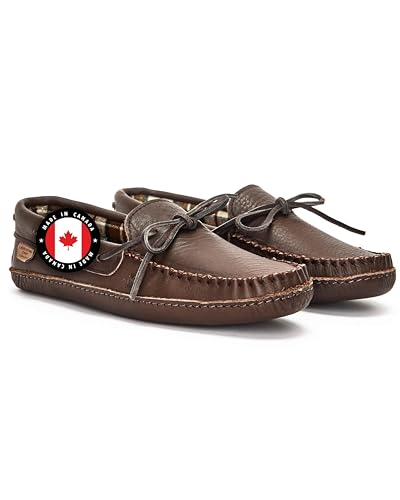
Canadian Leather Moccasin Slippers — Best Handcrafted House Moccasin
Where the Laurentian Chief pairs are ascetic — hide, sole, stitching, done — this Canadian-made moccasin adds one considered comfort: a plaid-lined insole that gives the foot a softer landing while the leather sole beneath keeps the traditional feel. The listing emphasises handcrafted construction and high-quality leather, and the result reads as the house moccasin perfected rather than reinvented: the pair you wear from the first coffee to the last chapter of the evening, every day, for years.
It is leather rather than buffalo hide, and this guide says so in the open; what it offers instead is accessibility. The break-in is gentler, the lined insole forgives feet that dislike standing directly on hide, and the whole shoe suits readers who love the moccasin idea but want their comfort sooner and softer. Think of it as the friendly door into the category — many owners of pairs like this graduate to buffalo hide later, and just as many never feel the need.
- Hide: genuine leather, made in Canada
- Lining: plaid insole lining
- Sole: soft leather sole
- Construction: handcrafted
- Use: all-day indoor wear
Strengths
- Lined insole softens the traditional moccasin feel from day one.
- Handcrafted Canadian build with honest materials throughout.
- The easiest break-in of the leather-soled pairs here.
Trade-offs
- Leather, not buffalo hide — thinner and less rugged than the Laurentian Chief pairs.
- Leather sole keeps it an indoor shoe.
- The lining adds warmth some summer wearers will not want.
Best for: all-day indoor wearers who want handcrafted leather with a softer start. Not suited for: buffalo hide purists or outdoor use.

Canadian Leather Moccasins Rubber Sole — Best Indoor-Outdoor Leather
A leather sole is a promise to stay indoors, and this Canadian-made pair renegotiates the promise with a brown rubber sole. The upper remains the handcrafted leather moccasin — soft lining, classic gathered toe, the whole traditional silhouette — but the rubber beneath it unlocks the porch, the driveway, the mailbox run, and the quick step onto wet grass that would begin the ruin of a leather sole. For households whose slippers live by the door and work in both worlds, this is the pragmatic champion of the guide.
The trade is feel. Rubber insulates you from the ground in a way leather never does, so the moulded, connected sensation of a leather sole is exchanged for durability and freedom. Most owners judge the exchange happily within a week, because the freedom gets used daily while the lost sensation was always a connoisseur’s pleasure. If your moccasin dreams are mostly domestic with outdoor errands woven through them, stop deliberating: this is your pair.
- Hide: genuine leather, made in Canada
- Sole: brown rubber sole for indoor-outdoor wear
- Lining: soft lining
- Construction: handcrafted, classic moccasin design
- Use: house, porch, errands, light outdoor
Strengths
- Rubber sole frees the moccasin for real indoor-outdoor life.
- Handcrafted leather upper keeps the traditional look and moulding fit.
- The most versatile pair in this guide by a wide margin.
Trade-offs
- Loses the ground-feel that leather-sole devotees prize.
- Leather upper still dislikes soaking — rubber sole or not, it is not a rain shoe.
- Slightly heavier on the foot than leather-soled pairs.
Best for: door-side households wanting one pair for house and errands. Not suited for: purists seeking the traditional leather-sole experience.

PEDOQU Leather Moccasin Slippers — Best Adjustable Fit
Leather moulds, but it moulds on its own schedule, and the PEDOQU adds a small mechanism of control: adjustable textile laces that let you set the fit across the instep today, loosen it for swollen evening feet tomorrow, and snug it again as the leather gives over the months. Combined with a comfortable lining and a durable rubber outsole, the result is the most accommodating genuine-leather moccasin here — the pair for feet that other slippers fit only approximately.
That adjustability also makes the PEDOQU the natural recommendation for gift buyers in this category, where a wrong guess about a moulding material is usually fatal. The laces forgive a half-size of optimism in either direction, and the rubber outsole forgives the recipient’s unknown floor habits. It is a modernised moccasin — the tradition respected, the tolerances widened — and there is no shame in that trade; it is how old designs survive into new households.
- Hide: genuine leather
- Fit: adjustable textile laces
- Sole: durable rubber outsole
- Lining: comfortable lining
- Use: indoor and outdoor house wear
Strengths
- Adjustable laces solve the fit uncertainty of moulding leather.
- Rubber outsole suits real household movement in and out.
- The most giftable pair here for feet you cannot measure.
Trade-offs
- Laces need occasional retying — a small tax on the adjustability.
- Leather rather than buffalo hide, with a faster break-in and a shorter legend.
- Styling leans practical over traditional.
Best for: hard-to-fit feet and gift buyers who need forgiveness built in. Not suited for: traditionalists who want an unadorned hide moccasin.

JOOFAN Cowhide Leather Slippers — Best Cowhide All-Rounder
The JOOFAN closes the list as the everyday diplomat: genuine cowhide in a gentleman’s house-shoe cut, non-slip underfoot, cosy without ceremony, and shaped for the man who wants real leather’s durability without the moccasin ritual of break-in weeks and leather-sole rules. Cowhide is the hide most leather goods are made from for good reason — consistent, supple, quicker to soften than buffalo — and in slipper form it delivers most of the category’s longevity with the least of its demands.
Choose it when the household’s real brief is “leather slippers that simply work”: on mixed floors, in and out of the garden door within reason, morning after morning. It will not develop the buffalo hide pair’s iron character, and it makes no claim to. What it offers instead is the highest comfort-per-effort ratio in the guide, and for many readers that is the honest definition of best.
- Hide: genuine cowhide leather
- Style: men’s house shoe / bedroom slipper
- Sole: non-slip sole
- Profile: cosy, ready-to-wear leather
- Use: indoor and light outdoor home wear
Strengths
- Genuine cowhide softens quickly with minimal break-in fuss.
- Non-slip sole suits mixed household floors.
- The easiest genuine-leather pair here to live with daily.
Trade-offs
- Cowhide is thinner and less rugged than buffalo hide.
- Less traditional moccasin character than the Canadian pairs.
- Comfort-first design will not satisfy hide purists.
Best for: everyday wearers wanting real leather without the ritual. Not suited for: shoppers specifically seeking buffalo hide’s thickness.
How Do the Six Hide Slippers Compare?
| Pick | Hide | Sole | Break-in | Best role |
|---|---|---|---|---|
| Laurentian Chief Buffalo | Buffalo hide | Leather | Firm, weeks | Pure traditional indoor |
| Laurentian Chief Ballerina | Buffalo hide | Leather | Moderate | Low-profile buffalo hide |
| Canadian Leather Plaid | Leather | Leather | Gentle | All-day house comfort |
| Canadian Rubber Sole | Leather | Rubber | Gentle | Indoor-outdoor errands |
| PEDOQU | Leather | Rubber | Adjustable | Hard-to-fit feet, gifts |
| JOOFAN | Cowhide | Non-slip | Minimal | Everyday leather ease |
Buffalo Hide Versus Cowhide: What Is the Real Difference?
Both are genuine leather, and the difference is character rather than quality grade. Buffalo hide is thicker, with a coarser, more visible grain and a denser feel in the hand; it resists scuffs and stretching, moulds slowly, and keeps its structure for years, which is why traditional moccasins — footwear expected to be resoled in spirit and worn for a decade — so often chose it. Cowhide is finer-grained and more supple from the start, softens within days, and suits slippers designed for immediate comfort; it will not match buffalo’s stubbornness over a decade, and it does not need to for most households.
The practical translation: choose buffalo hide when the purchase is an heirloom decision and you accept a firm first fortnight as the entry fee. Choose cowhide or the lighter leathers when comfort this week matters more than character in year five. Neither answer is a compromise — they are different goods wearing similar silhouettes, and this guide’s six pairs divide honestly along that line.
Leather Sole or Rubber Sole: Which Should You Choose?
A leather sole is the traditionalist’s instrument. It is quiet on wood, it flexes exactly with the foot, it polishes smoother and more personal with wear, and it confines the slipper to dry indoor life absolutely — water swells it, grit scores it, and winter salt attacks it. Wearers describe the sensation as grounded and connected; we describe it, carefully, as a feel many people love and no one should buy for health promises. It is a pleasure, not a therapy.
A rubber sole is the pragmatist’s answer: grip on tile, tolerance of damp porches, survival of the driveway, at the cost of that connected feel and a slightly heavier step. Households should choose by map, not by ideology. If your slippers will live between bedroom, bathroom, and fireside, leather soles reward you daily. If they will live by the door and cross thresholds hourly, rubber is not a compromise but the correct engineering — as the Canadian rubber-sole pair and the PEDOQU both demonstrate.
How Do You Break In and Care for Hide Slippers?
Break hide in gradually: an hour or two of evening wear for the first days, building as the leather relaxes, with socks if any point rubs while the moulding is young. Thick buffalo hide may take two to three weeks to reach its personal fit; thinner leathers settle within days. Never accelerate the process with water — soaking leather to force a fit distorts and stiffens it permanently, the one irreversible error in this category.
Care thereafter is a short liturgy. Wipe dirt away with a barely damp cloth and let the pair air dry at room temperature, never on a radiator, whose heat cracks hide. Brush dust from seams, keep the pair out of prolonged sunlight, and apply a small amount of leather conditioner a few times a year if the hide looks dry — sparingly, since over-conditioning softens structure you want to keep. Never machine wash, never tumble dry, and store the pair stuffed loosely or on their sides in air, not sealed in plastic. Follow that and a hide slipper’s ageing runs in your favour: every year it fits better than the year before.
How Should Hide Moccasins Fit When They Are New?
Snug — uncomfortably snug by the standards of ordinary shoes, though never toe-curling or numb. Leather gives across the width and moulds around the foot’s shape, but it does not shrink in length, so judge the fit by length first: toes close to the end without pressing hard against it. Width that feels tight across the instep in week one is usually perfect by week four; width that feels comfortable in week one is often sloppy by month three, which is the single most expensive sizing error in this category.
Walk in them on a clean floor and watch the heel. A whisper of movement is normal in a new moccasin; a heel that lifts clear of the insole with every step forecasts a loose future the laces — on the PEDOQU — can only partly correct. Between sizes, take the smaller in buffalo hide and the Canadian leather pairs, whose giving is generous, and consult each maker’s own chart, because handcrafted sizing follows the maker’s last rather than a universal scale. When in doubt, the maker’s guidance for that model outranks any general rule, including this one.
How Is a Traditional Moccasin Actually Made?
The moccasin is one of the oldest footwear patterns in continuous use, and its logic explains everything about how the pairs above behave. In the traditional construction, a single piece of hide wraps under the foot and gathers up around it, so the wearer stands on the hide itself rather than on a separate insole, and the gathered seam at the toe — the puckered “plug” — is both the pattern’s signature and its most skilled stitch. There is no synthetic midsole to delaminate, no foam to compress into sadness; the structure is the material, which is why a moccasin’s lifespan is measured against the hide’s own considerable endurance.
Modern variations adjust the pattern at the margins. The Canadian plaid-lined pair adds a fabric insole layer for softness; the rubber-soled pairs attach a modern outsole beneath the traditional upper; the PEDOQU threads laces through for adjustability. None of these betray the pattern — they are negotiations between an old design and new floors. When you read a listing in this category, look for that negotiation described honestly: what the hide is, what the sole is, what has been added and why. The makers above all pass that test, which is not a coincidence but a selection criterion.
What Is Patina, and Why Do Hide Owners Learn to Love It?
Patina is the visible biography of leather: the darkening where hands grip the heel, the soft sheen across the toe, the insole’s perfect footprint, the small scuffs that buff into the grain rather than sitting on it as damage. Buffalo hide develops patina with particular character because its grain is bold to begin with — a year-old Laurentian Chief pair looks richer than a new one, which is a sentence almost no other footwear category can honestly print. Owners who understand this stop seeing marks as flaws around month two and start reading them as the slipper becoming theirs.
The distinction that matters is between patina and damage. Patina is surface change on sound hide: colour, sheen, moulding. Damage is structural: cracked leather from heat, a swollen sole from water, stitching torn by neglect. Everything in the care section of this guide exists to maximise the first and prevent the second, and the encouraging truth is how little effort the balance requires — a wipe, some air, an occasional conditioning, and dry ground underfoot.
Lined or Unlined: Which Moccasin Interior Suits You?
An unlined moccasin puts your foot directly against hide, and devotees defend the arrangement fiercely: the interior moulds as truly as the exterior, breathes with the material, and develops the smoothest possible patina against the skin. It is also the firmest and coolest start, and the least forgiving of tender feet. The Laurentian Chief pairs represent this school, and their break-in is the price of admission to it.
Linings exist along a spectrum. The Canadian pair’s plaid insole adds a textile softness underfoot while leaving the upper’s behaviour traditional; the PEDOQU’s comfortable lining wraps more of the foot; fleece and shearling linings — absent from this guide’s six, and common elsewhere in the category — convert a moccasin into a winter garment outright. Choose by honesty about your feet and your house: cold floors and tender soles argue for lining, while the purist’s moulded intimacy argues against. Neither school is wrong, and many households end up owning one of each for different seasons.
How Do Hide Slippers Behave Across the Seasons?
Leather is a four-season material with two honest limits. In winter, a hide moccasin on a heated or carpeted floor is close to perfect — warm without sweat, structured without weight — and the rubber-soled pairs handle the season’s threshold crossings to fetch wood or post. On unheated stone or tile, leather’s thinness tells: the sole transmits cold faithfully, and a pair of socks becomes part of the system, as it does for the category’s traditional northern wearers, who never pretended otherwise.
Summer tests the other direction. Hide breathes better than synthetic fleece and does not hold odour the way foam slippers do, but a lined pair in a heatwave is still a warm shoe, and the ballerina-cut Laurentian Chief — less hide, more air — earns its place in July. Wet seasons are the true enemy in any month: a household that keeps a cheap pair of clogs by the door for rainy errands will extend its moccasins’ lives by years, because every avoided soaking is ageing that never happens.
Can Hide Slippers Be Repaired, and Is That the Point?
Partly, and increasingly. A leather sole worn smooth can be roughed back to grip with a brush; stitching that loosens at the plug can be restitched by any competent cobbler, a trade that still exists in most towns precisely because footwear like this sustains it; a rubber outsole, when it finally wears, is a standard resoling job. The upper hide itself, kept from water and heat, rarely fails before the sole does — which inverts the economics of foam slippers, where the upper outlives a sole that was never replaceable at all.
This repairability is the quiet environmental argument of the whole category. One pair of buffalo hide moccasins, resoled once and conditioned occasionally, displaces a decade of disposable slippers and their foam, glue, and packaging. Nobody should buy footwear as a moral performance — but when the durable choice is also the most comfortable choice by year two, the argument makes itself, and the cobbler’s continued existence suggests plenty of households have already been persuaded.
How Do You Buy Hide Slippers for Someone Else?
Gifting hide is gifting a break-in, so the gift rules differ from ordinary slippers. Measure if you possibly can — a traced foot or a known size in a comparable leather shoe beats a guess, because moulding leather forgives width but never length. If you cannot measure, choose the designs with forgiveness engineered in: the PEDOQU’s adjustable laces first, the rubber-soled Canadian pair second, since both tolerate a half-size of error that would doom an unlined buffalo hide pair to the returns process.
Include the care story with the gift, briefly and without lecturing: dry ground, no machine, a wipe and air. A small note saying the pair will feel firm for a fortnight and wonderful for years converts the recipient’s week-one doubt into anticipation — the single most valuable sentence a giver can add. And buy the giver’s own size temptation out of the equation: a moccasin that fits the wrong foot teaches nothing except that hide keeps its promises only to the feet it was sized for.
What Should You Know About Hide Smell, Colour, and Variation?
Real hide announces itself. A new pair of buffalo hide moccasins carries the deep, earthy smell of vegetable-tanned leather, which fades over the first weeks into the faint, pleasant background scent owners associate with a good pair of gloves. Readers who find any leather smell objectionable should know that it is strongest exactly when the pair is newest and that airing — not perfuming — is the remedy; scented sprays sit on hide the way softener sits on towels, as a coating the material never asked for.
Colour variation is the other signature of the genuine. No two buffalo hides take dye identically, so a pair may show gentle variation across the vamp or between left and right that a synthetic would be manufactured never to display. This is not a defect to be returned but the material’s certificate of authenticity, and it evens out as patina develops. Buyers who need laboratory uniformity between the two feet are shopping in the wrong category, and the honest service a guide can do them is to say so before the purchase rather than after the disappointment.
How Do Hide Slippers Suit Older Wearers and Tender Feet?
With selection, well. The virtues are real: a moulded fit that distributes pressure personally rather than generically, natural materials against skin, and — in the rubber-soled pairs — a stable, grippy platform that does not slide on bathroom tile. The cautions are equally real: an unlined, firm buffalo hide pair is the wrong first prescription for tender feet, and any wearer who needs a hand to steady themselves while dressing should choose slip-on ease over lace adjustment.
The lined Canadian pair and the JOOFAN’s ready comfort are this guide’s answers for gentler requirements, with the PEDOQU’s adjustability serving feet whose size changes across the day. One boundary deserves stating plainly: slippers are comfort equipment, not medical devices, and persistent foot pain deserves a professional’s attention rather than a better purchase. Within that boundary, a well-chosen hide pair gives older wearers something foam rarely does — a shoe that fits better in year three than it did in week one.
Why Do Moccasins Cost What They Cost?
Three honest components set the tier of a hide slipper, and understanding them protects you at both ends of the market. The hide itself is the first: buffalo and quality cowhide are agricultural materials with real scarcity and grading, and a thick, clean hide costs what it costs. Handwork is the second: the gathered toe of a true moccasin resists mechanisation, so Canadian handcrafted pairs carry labour that a moulded foam slipper never pays for. Small production is the third — traditional makers produce in hundreds where foam factories produce in hundreds of thousands.
The value calculation runs over years rather than the checkout. A premium-tier hide pair worn for five years costs less per winter than a budget foam pair replaced annually, and it fits better in every one of those years. That arithmetic fails only if the pair is mistreated — water, heat, and radiators can bankrupt any tier in a month — which is why this guide repeats its care rules like a liturgy. The price buys the potential; the owner’s habits decide whether the potential is collected.
What Is the Difference Between a Moccasin and a Leather Slipper?
The words overlap in shops, but the patterns differ. A moccasin is defined by its construction — hide wrapping under the foot, gathered at the toe — and it produces that category’s signature behaviour: standing on the material itself, minimal structure, moulding everywhere. A leather slipper in the general sense may be built like a shoe, with a separate insole, a shaped last, and layers the wearer never feels individually; the JOOFAN sits nearer this pole, and its ready comfort comes from exactly that shoe-like construction.
Neither is superior in the abstract. The moccasin offers intimacy with the material and the longest ageing story; the built leather slipper offers immediacy — comfort today, support structures included. Readers who understand which pattern they are buying stop being disappointed by both, because each design’s famous virtues and famous demands follow directly from how it is put together. Construction is destiny in footwear, and in this category it is also, happily, visible in a single photograph of the toe.
How Should You Store Hide Slippers When They Are Not Being Worn?
Storage is care continued by other means. Keep the pair in open air — a shelf, a basket, the floor beside the bed — rather than sealed in a box or bag, because hide that cannot breathe slowly mildews in humid houses and dries to stiffness in arid ones. If a pair must be stored for a season, stuff the toes loosely with paper to hold the shape the hide worked so hard to learn, condition the leather lightly first, and choose a shelf away from radiators and sunlit windows, the twin enemies of every hide in this guide.
Rotation deserves a sentence even here, in a category famous for single-pair loyalty. A hide slipper worn sixteen hours a day benefits from a rest day, when the material dries fully and recovers its shape; households that own a summer pair and a winter pair — the ballerina cut and a lined moccasin, say — get the rotation benefit automatically while doubling each pair’s calendar life. Loyalty to one pair is romantic; loyalty to two is how the romance lasts a decade.
What Does “Handcrafted in Canada” Actually Signal in This Category?
It signals a living tradition rather than a marketing accent. Canada’s moccasin craft descends directly from Indigenous footwear knowledge — the pattern itself is Indigenous technology, refined over centuries for exactly the conditions of cold ground and long wear — and Canadian makers, Laurentian Chief among them, work inside that inheritance with its materials and methods intact. When a listing in this guide says handcrafted in Canada, it is claiming that lineage: hide cut and gathered by people who make moccasins as a specialism, not as a seasonal product line.
For the buyer, the practical consequences are construction you can inspect — real stitching at the plug, hide that continues under the foot, soles chosen for purpose — and sizing that follows the maker’s own lasts, which is why this guide keeps directing you to each maker’s chart. Treat the phrase as a prompt to verify those things rather than as a verdict in itself, and it will serve you as it should: as the beginning of a maker’s accountability, not a substitute for it.
How Do You Decide Between the Two Laurentian Chief Pairs?
It is the closest decision in this guide, so here is the honest separator. Choose the full Buffalo Hide Moccasins if you want the complete traditional object: maximum hide, maximum moulding, the gathered upper that encloses the foot like the pattern has done for centuries, and a break-in you are willing to treat as an apprenticeship. It is the pair for cold houses, long evenings, and readers who enjoy objects that improve on a schedule measured in seasons.
Choose the Ballerina cut if your life runs warmer or your taste runs lighter: the same hide and honesty with less material, a faster-settling fit, and a profile that slips under a desk or into a weekend bag without announcing itself. Neither is the diluted version of the other. They are two answers to the question of how much moccasin a person wants around their foot, and the correct answer is the one that matches the house, the climate, and the feet that will actually live in them.
What Should You Check in the First Month of Ownership?
Audition a hide pair the way you would a new employee: kindly, but with specific tests. In week one, wear the pair for lengthening evening sessions and note any point that rubs rather than presses — pressing is moulding in progress, rubbing is a fit warning worth adjusting with socks, lacing, or an exchange while the pair is still new. By week two, the insole should show your footprint forming and the upper should have stopped feeling like a stranger’s shoe. Buffalo hide moves slowest; if a buffalo pair still feels entirely unyielding at week three of daily wear, consult the maker’s sizing guidance before assuming more time will fix what may be a size problem.
Inspect the stitching at the toe gather and heel after the first fortnight, since those are the working seams of the pattern; they should sit tight and even, with no looping thread. Check the sole’s surface, too — a leather sole should be polishing smooth in the centre while keeping its edges sound. A pair passing these quiet tests in month one is a pair whose decade has begun properly, and the owner can relax into the long, undemanding middle of the relationship.
Why Do Hide Slippers Keep Their Owners for Decades?
Ask anyone who has worn the same moccasins for ten years and the answer is rarely about specifications. It is about the morning the pair stopped feeling like footwear and started feeling like part of the house’s furniture — known, trusted, and shaped by shared history. Objects that improve with use recruit loyalty that objects in decline never can, and hide is nearly alone among slipper materials in improving: foam flattens, fleece mats, synthetics crack, but leather moulds, deepens, and fits its owner more exactly with every season.
That is the real product this category sells, and it explains the tone of devotion in its reviews everywhere — including, we admit, in parts of this guide. A buffalo hide slipper is a slow purchase in a fast category: a fortnight of patience exchanged for years of a fit no factory can ship. Readers who find that exchange appealing already know which end of this guide belongs to them; readers who do not have been honestly served by the easier pairs, and both groups leave with slippers matched to the lives they actually live.
How Do You Travel With Hide Slippers?
Hide slippers travel differently from the foldable pairs in our travel guide: they do not compress, and they should not be crushed, because a moccasin folded hard in a case spends its first destination evening recovering the shape it left home with. Pack them stuffed with socks — which protects the toe gather and uses the dead space inside the shoe honestly — and placed along the case’s edge where their structure helps rather than suffers. Worn on the journey instead, they make excellent driving and passenger slippers for long road trips, with the leather-soled pairs reserved for the cabin and the rubber-soled pairs free to handle fuel stops.
At the destination, a hide pair does something no travel slipper can: it makes a rented cabin or a family spare room feel inhabited within an evening, because objects with this much presence domesticate a space. Travellers who winter in one place for weeks — the snowbird pattern — often find a moccasin the single best comfort-per-gram decision of the whole packing list, amortised across ninety evenings. The category’s two tribes, foldable and hide, are not rivals; they are answers to the short trip and the long stay respectively.
What Mistakes Do Buyers Make With Leather Slippers?
The champion error is water: machine washing a hide slipper, or wearing a leather sole through wet grass until the sole swells and stiffens into cardboard. Second is sizing for day-one comfort and living with month-three sloppiness, covered above. Third is heat — drying a damp pair on a radiator or beside a fire, which cooks the hide’s natural oils out and cracks the surface in a single evening. Fourth is buying “leather” that is not: bonded leather and leather-look synthetics borrow this category’s silhouette without its ageing, and they peel where hide would merely scuff.
Fifth is expecting cushioning. A traditional moccasin’s comfort is a moulded fit and a flexible sole, not a foam bed; readers whose feet need engineered cushioning should choose the lined, rubber-soled pairs here or a different category entirely, rather than blaming hide for not being foam. Buy hide for what hide does — durability, moulding, character — and it never disappoints.
Final Recommendation
For the reader who came for buffalo hide itself, the Laurentian Chief Buffalo Hide Moccasins are the answer in full — thick, traditional, and built to become more yours every year — with the Ballerina cut as the lighter-hearted route to the same hide. Households that live across the threshold should take the Canadian rubber-sole pair and never think about soles again, while the plaid-lined Canadian moccasin, the adjustable PEDOQU, and the easy JOOFAN cowhide divide the remaining readers by how much ritual they want with their leather. Buy snug, break in patiently, keep them dry, and the pair you choose will still be on your feet, better than new, when a dozen lesser slippers have come and gone.
Frequently Asked Questions
Are buffalo hide slippers worth it over regular leather?
If you value longevity and a moulded fit that keeps improving for years, yes — buffalo hide’s thickness and grain resist wear that thins cowhide sooner. If you want comfort this week with minimal fuss, cowhide pairs like the JOOFAN deliver most of the experience with a fraction of the break-in, and that is a legitimate choice rather than a lesser one.
Can I wear leather-soled moccasins outside?
Only across dry, smooth ground for moments — a dry porch, a doorstep. Wet grass, gravel, rain, and salted winter paths all damage leather soles quickly and permanently. If your routine crosses thresholds often, choose one of the rubber-soled pairs in this guide instead of negotiating with the weather.
How do I clean buffalo hide slippers?
Wipe with a barely damp cloth, air dry at room temperature away from heat, and condition lightly a few times a year if the hide looks dry. Never machine wash, soak, or tumble dry them. Most marks on real hide are not damage but patina — the record of wear that makes the pair yours.
Do hide moccasins stretch?
Yes, across the width and around the foot’s shape, which is why they should start snug. They do not meaningfully stretch in length, so a pair that is short will stay short. Expect buffalo hide to give more slowly than cowhide, and to hold its moulded shape longer once it has given.
Why do my new leather slippers feel stiff?
Because they are unfinished in the best sense: the hide has not yet warmed, flexed, and moulded to your foot. Wear them for short evening sessions, let the material learn you gradually, and judge the fit after two or three weeks — not after two or three minutes. Stiffness at the start is the down payment on the fit that follows.
Are these slippers suitable for people who need arch support?
Traditional moccasins are flat by design, and their comfort is moulded fit rather than structured support. Readers who need pronounced arch support should look at the lined, rubber-soled pairs here as the closest fit, or choose a supportive slipper category — and consult a professional if foot pain, rather than preference, is the question.
How long do buffalo hide slippers last?
With dry indoor use and basic care, a buffalo hide pair is a multi-year purchase — the hide itself commonly outlasts the sole, and a leather sole kept from water ages by polishing rather than disintegrating. Rubber-soled pairs trade some of that tradition for convenience and typically serve until the outsole wears smooth, at which point a cobbler can often resole them. In both cases the lifespan is measured in years, not seasons, which is the category’s founding promise.
Do buffalo hide slippers smell when new?
They smell of leather — deeply and unmistakably — because that is what they are. The scent is strongest in the first days and fades with airing into the faint background smell of a well-kept hide. Air the pair in a ventilated room rather than spraying it with fragrances, which coat the grain and interfere with the natural patina you bought the hide to develop.
Related Guides
Our guide to Best Birkenstock Slippers covers the other great leather-footbed tradition, while the natural-fibre luxury end of the category appears in Best Cashmere Slippers. Readers furnishing the rooms these slippers will pad through can continue with Best Affordable Organic Linens and Towels for certified natural fibres, and Best Bath Towels for a Farmhouse Look for the rustic interiors a good moccasin feels most at home in.


