What's inside
- Key Takeaways
- Quick Picks
- How Did We Choose These Six for Smoke Weeks?
- How Do the Six Compare Side by Side?
- How Do You Build a Clean Room Before the Smoke Arrives?
- What Should the Rest of the House Do During a Smoke Week?
- What Mistakes Do Households Make in Smoke Season?
- How Does a Smoke Week Unfold Inside a House, Day by Day?
- What Does the Filter Look Like After a Heavy Week?
- How Should a Machine Be Stored for the Other Fifty Weeks?
- What About Apartments, Landlords and Shared Buildings?
- How Do You Keep Children and Animals Comfortable in a Sealed House?
- What Should You Check When a Forecast First Mentions Smoke?
- Why Does the Smell Outlast the Smoke by So Long?
- How Should You Read a Coverage Claim When Smoke Is Coming?
- What Role Do Houseplants, Candles and Other Folk Remedies Play?
- How Do You Decide Between One Large Machine and Two Smaller Ones?
- What Is the Machine’s Job on the First Blue Day?
- How Should Work-From-Home Days Be Arranged in a Smoke Week?
- What Should a Buyer Verify on the Listing Before a Spring Purchase?
- How Does a Household Know Its Preparation Worked?
- What If Smoke Season in Your District Is Getting Longer?
- Final Recommendation
- Frequently Asked Questions
- Related Guides
As an Amazon Associate I earn from qualifying purchases. This post may contain affiliate links at no extra cost to you.
cottageverdict.com is reader-supported. When you buy through links on our site, we may earn an affiliate commission.
Where to buy: the six machines in this guide are sold on Amazon, and every pick name in the Quick Picks table, every review heading and every comparison row links to that model’s own listing, where you can check price on Amazon and confirm the coverage claim, the filter arrangement and the control options before the season makes its own announcements. The best air purifiers for wildfire smoke are bought, ideally, in the calm months, by households that have learned what a week of orange skies does to the inside of a home.
Wildfire smoke is an indoor problem delivered from very far away. It arrives as a fine haze that finds every gap in a building, drifts through vents and keyholes, and settles into a house until the rooms carry the smell of a distant fire and a pale film gathers on surfaces. Unlike a room’s own dust, it comes in weather systems: a household may need serious filtration for ten days in a year and none for the rest, which changes how a machine should be chosen, sized and kept.
This guide speaks strictly about particles, odor and comfort. A purifier in smoke season keeps a home’s air visibly clearer and far less laden with the smell of burning; it is not presented here as protection for anyone’s health, and readers with medical concerns should take their guidance from professionals rather than from any product listing. Within that honest frame, the work divides into two parts: trapping the fine particles that make up the haze, which HEPA-class filtration does, and absorbing the acrid smell that outlasts the haze itself, which is carbon’s department.
The six picks span the scales a smoke week can demand. The AZEUS leads with a listing written for this exact subject, naming wildfire smoke, ash and PM2.5 in its own title. The BLUEAIR Blue 211i Max brings a stated reach of 3,235 square feet and a quiet 23 decibels for the largest rooms. The Medify MA-40 and the WINIX 5510 cover the middle ground, the WINIX with a high deodorization carbon filter for the smell that lingers. The Clorox machine serves a single medium room with an auto mode, and the SwitchBot closes the set with smart-home manners, a washable pre-filter and the largest stated coverage of all.
Every figure below is printed in the product’s own listing. Where a maker gives no number, the review says the figure is not stated in the listing, because a purchase made against a smoky forecast deserves facts rather than atmosphere.
Key Takeaways
- Buy and set up before the season; smoke weeks are the worst possible time to shop, learn controls or hunt for spare filters.
- One well-sealed clean room, honestly served, beats a large machine asked to defend a leaky whole house.
- Carbon decides how the house smells after the sky clears; the WINIX 5510 names a high deodorization carbon filter.
- The AZEUS listing addresses wildfire smoke, ash and PM2.5 by name, with a filter alert for the season’s heavy running.
- Stated coverage varies enormously here, from the Clorox’s 1,000 square feet to the SwitchBot’s 3,620.
- Filters loaded by a smoke week should be judged afterwards on their condition, not forgiven automatically into next year.
Quick Picks
| Pick | Badge | Why it earns its place |
|---|---|---|
| AZEUS Air Purifier for Wildfire Smoke | Best Smoke-Season Specialist | A listing written for wildfire smoke and ash, coverage to 2,160 square feet, a smart sensor and a filter alert. |
| BLUEAIR Blue 211i Max | Best for Large Living Spaces | Stated reach to 3,235 square feet, AHAM Verified, WiFi auto mode and a quiet figure of 23 decibels. |
| Medify MA-40 Air Purifier | Best Straightforward Workhorse | Coverage of 1,793 square feet in an hour and filtration described down to 0.3 microns, without smart frills. |
| WINIX 5510 Air Purifier | Best for the Smell Afterwards | True HEPA plus a high deodorization carbon filter and app-supported auto mode for lingering smoke odor. |
| Clorox Medium Room Air Purifier | Best Single-Room Clean Space | True HEPA for a stated 1,000 square feet, an auto mode and a whisper-quiet brief for one defended room. |
| SwitchBot Air Purifier | Best Smart-Home Citizen | Matter connectivity, a washable pre-filter, pet mode and stated coverage to 3,620 square feet at 20 decibels. |
How Did We Choose These Six for Smoke Weeks?
Fine-particle filtration was the entry requirement, because smoke’s visible haze is a particle burden and the listings that named HEPA-class filtration plainly were the ones admitted. Coverage was then read with a smoke week’s realism: a stated figure is a ceiling earned in favourable conditions, and a house under smoke is not favourable, with doors opening, occupants moving and outdoor air pressing at every gap. Machines were favoured whose claims left headroom above an ordinary room.
Carbon was weighed next, for the season’s second act. When the sky clears, the particles leave quickly and the smell stays, soaked into the house’s air and soft furnishings, and the machines that named serious carbon earned their places for that fortnight. Controls mattered in a particular way too: a smoke week asks a machine to run for days at a stretch, so auto modes, sensors and filter alerts, the features that keep a machine honest while its owners are busy with the rest of the emergency, all counted.
Noise was judged for endurance rather than for a single night. A machine that will run in the main room for ten days must be livable at the setting that does the work, and the listings that print a decibel figure made that judgment possible from paper. Where no figure is printed, the review records the silence rather than filling it.

AZEUS Air Purifier for Wildfire Smoke — Best Smoke-Season Specialist
Most purifiers meet wildfire smoke as one item on a long list; this one’s listing puts it in the product’s name. The AZEUS describes itself as an air purifier for wildfire smoke with UV-C and HEPA filtration for large rooms, stating that its HEPA captures 99.97 percent of ash, PM2.5 and pet dander, with an ionic feature, coverage of 2,160 square feet, a smart sensor, a quiet mode and a filter alert, in white. That is a brief written by a maker who expects the machine to be bought against a forecast.
The filter alert is the detail a smoke veteran will underline. During a heavy week a filter can take a season’s loading in days, and a machine that announces its own condition saves its owner from the sad discovery, mid-event, that the box has been moving air through an exhausted element. The smart sensor partners it well, raising the machine’s effort as the haze thickens against the windows rather than waiting for a human to notice and react.
The UV-C and ionic elements are part of the maker’s stated design and are recorded here as such; this guide’s judgment rests on the filtration and the coverage, the parts of the brief a household can watch working as the room’s haze thins and its surfaces stay cleaner. Owners should judge the machine the same way, by the room in front of them, rather than by any technology word in its title.
At a stated 2,160 square feet it is sized for a main living territory rather than a whole leaky house, which matches the clean-room strategy this guide recommends: one generous space, doors managed, the machine running ahead of the smoke rather than behind it. Set up in spring, tested on a dusty afternoon, it will not be a stranger when the sky turns.
- Coverage stated in the listing: 2,160 sq ft
- Filtration named: UV-C and HEPA, with an ionic feature
- Maker’s capture figure: printed as 99.97% for ash and PM2.5
- Features named: smart sensor, quiet mode, filter alert
- Finish named: white
- Noise figure in decibels: not stated in the listing
Strengths
- Brief written for this exact emergency, ash included.
- Filter alert suits the season’s brutal loading pace.
- Sensor automation reacts as conditions worsen.
Trade-offs
- Quiet mode arrives without a printed decibel figure.
- Extra technologies in the title are hard to judge at home.
- Its reach still serves one territory, not a whole house.
Best for: households in smoke country wanting a purpose-aimed main-room machine. Not suited for: buyers who need certified noise figures or whole-house coverage.

BLUEAIR Blue 211i Max — Best for Large Living Spaces
The Blue 211i Max states the largest room ambition among the conventional machines here: large rooms up to 3,235 square feet, with WiFi, an auto mode, a quiet figure of 23 decibels, HEPASilent filtration, AHAM Verified standing and a pre-filter, addressing pet hair, dust and smoke among its targets. Its listing even carries a Wirecutter Pick note, a small piece of social proof this guide records without leaning on.
HEPASilent is the maker’s name for its filtration approach, and the pairing of that name with a printed 23-decibel figure tells the story the brand wants told: serious particle work at a voice a living room can host for a week. In smoke season that pairing is not a luxury. The machine that must run for ten days in the room where the household is sheltering from the outdoors will be switched off if it drones, and a switched-off machine has a filtration rate of zero.
The pre-filter earns a practical mention. Smoke weeks load a machine with fine material, yet the coarse share of household dust still arrives first, and a front layer that can be dealt with separately extends the main filter’s useful life through the event. WiFi and auto mode complete a design that expects to be managed lightly and left running.
Read the coverage as the ceiling it is. In a big, open living space with doors disciplined, this machine has the headroom to hold the room’s air in visibly better shape than the street’s. In a house of many small rooms, its honest territory remains the room it stands in, and the clean-room plan should be built around that room.
- Coverage stated in the listing: up to 3,235 ft²
- Noise stated: 23 dB, described as quiet
- Filtration named: HEPASilent, with a pre-filter
- Verification named: AHAM Verified
- Controls named: WiFi and auto mode
Strengths
- Huge stated reach for open living spaces.
- Printed quiet figure suits week-long running.
- Verified standing and a pre-filter support the main element.
Trade-offs
- Premium scale is wasted on a small clean room.
- No carbon emphasis is named for the odor fortnight.
- Ceiling coverage still shrinks in divided floor plans.
Best for: large open living rooms in regions with recurring smoke weeks. Not suited for: small apartments or odor-first buyers.

Medify MA-40 Air Purifier — Best Straightforward Workhorse
The MA-40 is the set’s plain speaker: a purifier with a HEPA filter, stated coverage of 1,793 square feet in one hour for smoke, wildfires, odors, pollen and pets, and quiet removal down to 0.3 microns, in white, in a one-pack. No app is promised, no light show described. For a household that wants a machine to unpack, place and trust through a bad week, that plainness is a feature with real value.
The 0.3-micron figure deserves a calm reading. It describes the size territory its filtration addresses, which is the territory smoke particles live in, and the listing’s pairing of that figure with wildfires in its own text shows the maker aiming at this use deliberately. Combined with an hourly coverage figure above many living rooms’ size, the MA-40’s paper brief is exactly the shape a clean room wants.
Simplicity has a seasonal virtue. A machine with fewer systems has fewer surprises in storage and fewer behaviours to relearn each year when it is carried out, dusted off and returned to duty. Households that keep their smoke machine in a cupboard for fifty weeks should weigh that virtue honestly against the smarter picks’ charms.
The listing gives no decibel figure and names no carbon stage, so the odor fortnight after a smoke event will lean on ventilation and time more than on this machine. As a particle workhorse for the event itself, though, its stated terms are complete, and its white, tower-like discretion will offend no room it is asked to defend.
- Coverage stated in the listing: 1,793 ft² in 1 hr
- Filter stated: HEPA filter
- Particle size named: removal to 0.3 microns
- Finish named: white, 1-pack
- Noise figure: not stated in the listing
- Carbon stage: not stated in the listing
Strengths
- Direct, complete particle brief for smoke events.
- Simple operation suits a machine stored most of the year.
- Hourly coverage gives a living room real headroom.
Trade-offs
- No stated carbon stage for lingering odor.
- Quietness is claimed without a printed number.
- No sensor or alert features are named.
Best for: households wanting a dependable, uncomplicated clean-room machine. Not suited for: odor-sensitive homes or feature collectors.

WINIX 5510 Air Purifier — Best for the Smell Afterwards
The 5510 arrives as the sibling of the cigar guide’s 5530, the new generation of the 5500-2 line with app support, for large rooms up to a stated 1,881 square feet in one hour, with True HEPA filtration, an auto mode and a high deodorization carbon filter. In a wildfire context, that carbon stage is promoted from supporting actor to co-lead, because every smoke survivor knows the event’s second half: the week when the sky is blue and the house still smells like a campfire’s memory.
Deodorization carbon earns that promotion honestly. Smoke odor is carried by gases and by the finest residue, and a generous carbon bed gives the room’s air somewhere to unload both as the machine recirculates the house’s atmosphere across days. Owners should still expect the soft furnishings to need their wash, yet the machine shortens the room’s own sentence considerably.
App support and auto mode suit an event that develops while people are at work or asleep. A household can raise the machine’s effort from another room as the afternoon haze thickens, and let auto behaviour govern the night. In a season when conditions change by the hour and nobody’s attention is spare, controls that travel with the owner are a genuine operational advantage.
Its stated targets include smoke in general household terms, and its size suits the main living room or a large bedroom chosen as the clean room. Keep its carbon’s age in mind across seasons: a filter that served one heavy summer has spent capacity the next summer will want, and the listing’s silence on intervals means the household’s own morning-after nose must keep the records.
- Coverage stated in the listing: up to 1,881 ft² in 1 hr
- Filter stated: True HEPA
- Carbon described as: high deodorization carbon filter
- Controls named: auto mode and app support
- Lineage named: new generation of the 5500-2
Strengths
- Carbon capacity aimed at smoke’s lingering smell.
- App control follows the household during a changing event.
- Large-room reach covers a main clean space.
Trade-offs
- Carbon spent by one season is gone for the next.
- No decibel figure is printed in the listing.
- Smart setup is surplus for the simplest households.
Best for: homes whose smoke complaint outlasts the smoke itself. Not suited for: buyers wanting a purely mechanical, app-free machine.

Clorox Medium Room Air Purifier — Best Single-Room Clean Space
The Clorox machine makes the clean-room strategy its entire brief: a True HEPA purifier for medium rooms, stated at 1,000 square feet, with an auto mode and a whisper-quiet description, whose listing names wildfire smoke among the burdens it addresses. It does not pretend to govern a house. It defends one room properly, which is what most households actually achieve in a smoke week whether they planned to or not.
That focus has a budgetary honesty. Rather than stretching one large machine across a leaky floor plan, a household can defend the bedroom, the room where a third of life happens and where the night is spent, with a machine sized generously for it. Auto mode then keeps the defence running without administration, answering the evening’s worsening air while its owners are thinking about everything else a smoke week demands.
The listing’s own language reaches toward several targets besides smoke, in the expansive way of its category, and this guide rests its recommendation on the narrower, verifiable ground: True HEPA filtration, a stated room size, an auto mode and a quiet brief. Judged on those, the machine is a coherent answer for the single defended room.
No decibel number and no carbon stage are printed in the listing, so its quietness is a description to be tested in the room and its odor work should be expected to be modest. For the bedroom-first strategy, though, its combination of focus and automation is well aimed, and its maker is a household name many buyers will find reassuring in an emergency purchase.
- Coverage stated in the listing: 1,000 sq ft
- Filter stated: True HEPA filter
- Mode named: auto mode
- Sound described as: whisper quiet
- Noise figure in decibels: not stated in the listing
- Carbon stage: not stated in the listing
Strengths
- Honest single-room focus matches real smoke-week behaviour.
- Auto mode sustains the defence without attention.
- True HEPA brief is plainly stated.
Trade-offs
- Cannot serve a large living territory.
- Odor handling is unquantified and likely modest.
- Quiet claim carries no printed figure.
Best for: defending a bedroom or nursery-sized room through smoke weeks. Not suited for: open-plan living spaces or whole-house hopes.
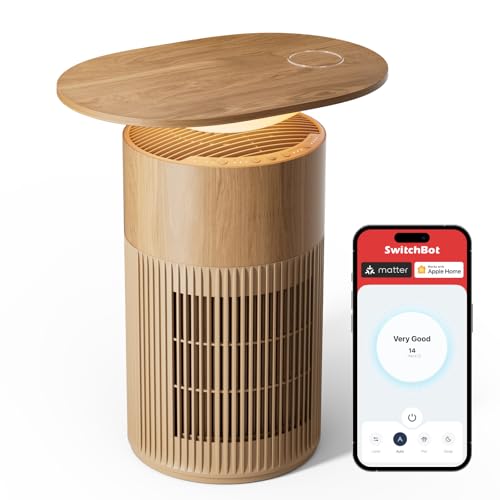
SwitchBot Air Purifier — Best Smart-Home Citizen
The SwitchBot closes the set from the connected end of the market: an air purifier for large rooms and wildfire smoke with Matter connectivity, stated coverage up to 3,620 square feet, a noise figure of 20 decibels, a washable pre-filter, a pet mode, an RGB light and compatibility with Alexa, HomeKit and Google Home. It is the machine for the household whose lights, locks and heating already take instructions, and which sees no reason the air should be the exception.
Matter support is the future-proofing detail. A purifier bought against a seasonal emergency may serve for a decade, and a connectivity standard shared across platforms means the machine can change smart homes without becoming obsolete, a consideration the proprietary apps of rivals cannot promise as confidently. Voice control during a smoke week, when hands are full and the household is busy sealing and settling, is more practical than it sounds in a showroom.
The washable pre-filter suits the season’s rhythm. Smoke weeks load the front of a machine with a mixture of fine haze residue and ordinary household dust, and being able to rinse that layer between events keeps the main filter’s capacity for the days that matter. The pet mode acknowledges that the clean room usually contains the family’s animals too, sheltering with everyone else.
The RGB light will be loved by some households and switched off by others, particularly in a bedroom at night, and it has nothing to do with filtration either way. Judge this machine on its stated coverage, its printed quiet figure and its washable front layer, which are the terms on which it competes, and treat the light as weather.
- Coverage stated in the listing: up to 3,620 ft²
- Noise stated: 20 dB
- Connectivity named: Matter, with Alexa, HomeKit and Google Home
- Pre-filter: washable
- Mode named: pet mode
- Extra named: RGB light
Strengths
- Largest stated reach in the set.
- Matter support protects a long ownership.
- Washable front layer fits the season’s loading.
Trade-offs
- Smart features are wasted on unconnected homes.
- Light features need managing in a bedroom.
- No carbon emphasis is named for odor.
Best for: connected households defending a large main room. Not suited for: buyers who want a machine with no apps, accounts or lights.
How Do the Six Compare Side by Side?
| Pick | Stated coverage | Filtration headline | Notable feature |
|---|---|---|---|
| AZEUS Air Purifier for Wildfire Smoke | 2,160 sq ft | HEPA with UV-C | Filter alert and smart sensor |
| BLUEAIR Blue 211i Max | Up to 3,235 ft² | HEPASilent | AHAM Verified, 23 dB stated |
| Medify MA-40 Air Purifier | 1,793 ft² in 1 hr | HEPA filter | Removal to 0.3 microns stated |
| WINIX 5510 Air Purifier | Up to 1,881 ft² in 1 hr | True HEPA | High deodorization carbon filter |
| Clorox Medium Room Air Purifier | 1,000 sq ft | True HEPA filter | Auto mode, medium-room focus |
| SwitchBot Air Purifier | Up to 3,620 ft² | Filtration with washable pre-filter | Matter connectivity, 20 dB stated |
How Do You Build a Clean Room Before the Smoke Arrives?
Choose the room by its seals, not its size. The best clean room has one door, few windows, no fireplace flue leaking air and enough space for the household’s evenings and nights. The bedroom is the usual winner, with the main living room as the daytime annex if it can be closed off. Then reduce the room’s leaks with the unglamorous materials: door sweeps, window checks, a towel’s worth of attention to the gaps that whistle on windy nights.
Place the machine inside that room with clearance at its intake, run it before the smoke reaches the district rather than after the room smells of fire, and keep the door’s opening and closing to a minimum during the worst days. A clean room is a discipline as much as a purchase, and households that rehearse it once in a calm month execute it without panic in a smoky one.
What Should the Rest of the House Do During a Smoke Week?
Ask less of it. Ventilation habits reverse: windows that would normally be opened stay closed during the hazy hours, exhaust fans that pull house air outward are used sparingly because they invite replacement air through every gap, and cooking that produces its own smoke is kept simple. Trips outside are batched, doors are opened once rather than five times, and the animals’ ins and outs are negotiated with unaccustomed formality.
Surfaces will still gather their film, and the week for deep cleaning is the week after the sky clears, not during the event. A damp cloth over the main room’s hard surfaces at the end is the whole ceremony; everything else is the filters’ work and time’s.
What Mistakes Do Households Make in Smoke Season?
Shopping during the event leads the list, when stock vanishes, prices harden and a machine is learned under pressure. Second is defending everywhere at once with one undersized machine moved room to room like a fire bucket. Third is running a purifier in a room whose window stands open to the haze, asking filtration to out-argue the weather. Fourth is forgetting the filter afterwards, shelving a machine whose element spent itself in July and expecting the same performance next June.
The fifth mistake is subtler: assuming that because the sky has cleared, the house has. The smell’s fortnight is real, and households that keep the machine running, wash the soft furnishings nearest the windows and air the house on the first genuinely clean day close the event properly instead of living in its epilogue.
How Does a Smoke Week Unfold Inside a House, Day by Day?
The first day is mostly smell and surprise. The light changes colour, the sun weakens, and by evening the house’s own air carries a campfire note that no window has been open to admit. This is the day the prepared household simply closes up and switches on, while the unprepared one learns the price of every gap in its building at leisure. Filters work easily on day one; the air’s burden is fresh and the machine is ahead of it.
By the third day the event has become administrative. Surfaces near windows wear a film, laundry decisions change, the animals grow restless with curtailed routines, and the purifier’s steady presence becomes part of the room’s furniture of mind. This is the phase where a machine’s livable noise and automatic behaviour decide whether it is still running on day five, because willpower is a depleting resource in a smoky week and design must carry what resolve cannot.
The clearing, when it comes, is a process rather than a moment. One morning the light is merely pale instead of orange; the next, the horizon returns. Households that keep the machine running through the clearing, air the house on the first truly clean day and wash the window-side textiles close the event in a week. Households that switch everything off at the first blue sky live in the smell’s epilogue for a fortnight and blame the machine for a calendar it never controlled.
What Does the Filter Look Like After a Heavy Week?
Grey, in a word, and instructively so. The element that enters a smoke week white emerges wearing the event, and its condition is the household’s most honest record of what the room’s occupants did not have to breathe around, settle on their furniture or wipe off their shelves. Owners should inspect it once the sky clears, not during the event, and judge replacement by its loading and by the machine’s recovered performance rather than by hope.
Pre-filters and washable front layers should be dealt with first, since they carry the coarse share and their restoration is free. A main element that still performs after that cleaning can serve on; one whose machine labours audibly for ordinary results has given its season and should be thanked and replaced before the machine is stored, so next year’s emergency opens with a ready appliance rather than an archaeology project.
How Should a Machine Be Stored for the Other Fifty Weeks?
Clean, dry and with its filter state known. A machine shelved with a spent element is a promise broken in advance, while one shelved fresh, with its cord coiled and its intake covered against cupboard dust, can be in service within minutes of a forecast turning. Note the filter’s date on a card kept with the machine, because no household remembers in June what it decided the previous September.
Storage position matters more than it sounds. A purifier buried behind the decorations will be excavated too late, on the smoky day itself, by an annoyed owner in a hurry. Keep it where the household keeps its other seasonal readiness, near the torches and the batteries, and the calm-months preparation this guide keeps urging becomes a physical fact rather than a resolution.
What About Apartments, Landlords and Shared Buildings?
Apartment dwellers inherit their building’s envelope: the corridor’s air, the neighbours’ habits and windows that may not open far or seal well. The defended-room strategy adapts gracefully, since a bedroom can be sealed from inside with a door sweep and attention to its own window, and a single-room machine like the Clorox in this set is sized for exactly that sovereignty. What cannot be controlled can at least be declined: a machine in a sealed bedroom governs the third of life spent there, whatever the corridor decides.
Renters should favour machines that move house easily and keep their filters’ part numbers recorded, because a purifier is one of the few smoke defences that is fully portable property. When the lease changes, the preparation travels, and the new home’s clean room can be established in an afternoon rather than a season.
How Do You Keep Children and Animals Comfortable in a Sealed House?
A smoke week confines everyone, and the confined have opinions. Children read the orange light as adventure for a day and as imprisonment by the third, while animals, whose routines are curtailed and whose noses report a world on fire somewhere beyond the walls, may grow unsettled in ways no air machine addresses. The defended room helps indirectly here: it is the space where the household gathers, plays and sleeps, and its cleaner, calmer air makes the confinement feel less like a siege.
Practical mercies matter. Keep the clean room stocked like a den rather than a ward, with the games, chargers and cushions that make a long indoor day pass. Let the machine’s sound become the room’s background rather than a subject of discussion. Children especially take their emotional reading from the adults’ manner, and a household that treats its prepared room as a cosy headquarters will be remembered very differently from one that treats the week as an emergency endured at the kitchen table.
What Should You Check When a Forecast First Mentions Smoke?
Run the calm-months checklist while it is still a forecast and not a sky. Machine out of storage and tested at full voice for ten minutes. Filter inspected and its spare, if the household keeps one, located rather than assumed. Clean room chosen and its door sweep present. Windows in that room checked for their seals. The animals’ supplies, the household’s patience and the machine’s cord all accounted for before the light changes.
Then set the machine running ahead of the arrival, because a room pre-cleaned receives the haze from a position of strength. The difference between starting at the first headline and starting at the first orange sunset is roughly the difference between a room that never quite fills and a room being bailed out, and it costs nothing but a day’s electricity and a little foresight.
Why Does the Smell Outlast the Smoke by So Long?
Because the house drank it. During the event, every absorbent surface in the building, curtains, upholstery, bedding, the paper of books and the fibres of rugs, took up the smoke’s character at leisure, and afterwards those surfaces return it at the same leisurely pace. Airborne particles clear in hours once the sky does; a furnished room’s memory clears in days, and the machine’s carbon stage is the tool that shortens the negotiation by continually offering the room’s air somewhere to unload what the fabrics give back.
This is why the WINIX’s carbon emphasis appears in this guide’s recommendations for the aftermath, and why the final act of a well-run smoke week is laundry rather than machinery. Wash what can be washed once the air outside is clean, and the room’s remaining memory leaves in the wash water instead of across another fortnight of evenings.
How Should You Read a Coverage Claim When Smoke Is Coming?
As a fair-weather figure being asked to work in foul weather. The stated number assumes a room’s air presented to the machine under favourable conditions, while a smoke week adds a continuous inward leak of new burden through every gap the building owns. The practical translation is to choose a claim comfortably above the defended room’s area, ideally by a generous margin, and then to spend the household’s real effort on the seals, which multiply any machine’s effective coverage more cheaply than any upgrade.
Hourly wording deserves the same translation. A figure earned in one hour describes a machine sprinting; a smoke week is a marathon run at the pace the household can sleep beside. The machine whose strong-but-livable setting suits your room will outperform, across ten days, a nominally larger machine that spends the week switched down or off in protest at its own voice.
What Role Do Houseplants, Candles and Other Folk Remedies Play?
A decorative one. Plants are pleasant company in a sealed room and their effect on a smoke week’s particle load is too small to plan around, while candles actively add combustion particles to a room whose entire strategy is their removal, and should stay unlit for the duration whatever their scent promises. Folk remedies fail in smoke season for the same reason they fail everywhere: the burden is measured in a whole house’s air exchanged over days, and only machinery that moves and filters air at scale speaks that language.
The honest comforts are duller: a sealed room, a running machine, washed bedding waiting for the clear day, and meals that do not ask the kitchen to make its own smoke. Households that keep to those find the week passes as an inconvenience with good stories attached, which is the best outcome this subject offers.
How Do You Decide Between One Large Machine and Two Smaller Ones?
By the house’s geography of sleep. If the household lives and sleeps in one territory, one large machine in that territory, honestly sealed in, is the cleaner answer and the simpler maintenance story. If the day’s living and the night’s sleeping happen in separated rooms with closed doors between, two modest machines, each governing its own shift, will serve better than a giant exiled to the hallway between them, treating the corridor to perfection while the bedrooms make their own arrangements.
Budget follows the same split. Two smaller machines divide the filter bills into smaller, staggered events and provide a spare when one is awaiting a part, while one large machine concentrates both the performance and the risk. Neither pattern is wrong; the floor plan, read honestly, decides.
What Is the Machine’s Job on the First Blue Day?
To keep working while the household celebrates. The first clear day tempts everyone to fling the house open and switch the season off, yet the building’s own stored burden is still unloading into its air, and a machine left running through the airing and the laundry day finishes the event properly. Think of the purifier’s season as ending a week after the sky’s season ends, and the house will smell like its own furniture again instead of like a souvenir.
That last week is also the audit. Note how the filter looks, how the room behaved and what the household wished it had done differently, and write it on the card that lives with the machine. Smoke country rewards households with memories, and the written card is how a good season teaches the next one.
How Should Work-From-Home Days Be Arranged in a Smoke Week?
Move the desk into the defended territory rather than defending a second room for it. A laptop at the end of the dining table inside the clean room inherits the machine’s whole benefit, while a study across the hall, however beloved, receives only what leaks under its door. Calls will carry the machine’s murmur if it stands too close to the microphone, so give it a few feet of diplomacy, and let its steadier lower setting govern the working hours with a stronger shift reserved for the evening.
Breaks should be taken indoors without apology during the worst days, and the household that plans its week that way, shopping batched, exercise improvised in the clean room, doors opened rarely and briefly, will find the confinement shorter in memory than the household that fought it hourly.
What Should a Buyer Verify on the Listing Before a Spring Purchase?
Confirm the coverage wording and the hour, if any, attached to it, and measure the defended room rather than the house. Confirm the filter’s replacement arrangement and whether a spare can be ordered at the same time, because mid-season is precisely when such things vanish. Check whether a decibel figure is printed if the machine will share a bedroom, and whether its front layer can be washed, since that small feature pays out during the event itself. Finally, decide the room, the position and the storage place before the box arrives, so the machine’s first season begins as a plan rather than as furniture Tetris.
How Does a Household Know Its Preparation Worked?
By the week’s texture. The prepared house notices the smoke as weather, discussed at breakfast and visible at the windows, while its rooms keep their own smell and its surfaces stay presentable. The unprepared house notices the smoke as an occupant. That difference, felt across ten days of evenings, is the entire return on a spring purchase, a sealed door and a filter changed on time, and households that have lived both versions of the week rarely need persuading twice.
What If Smoke Season in Your District Is Getting Longer?
Then the economics and the habits in this guide both shift from emergency to infrastructure. A household facing six or eight smoky weeks a year should size its machine for endurance, keep a spare filter as a standing policy rather than a panic purchase, and treat the clean room’s seals as permanent home maintenance alongside the gutters and the boiler service. The machine stops being a seasonal guest and becomes part of how the house is run, with its filter dates entered in the same calendar as everything else the building needs to stay itself.
That shift also argues for the connected picks in this set, whose sensors and apps earn more as the season lengthens and conditions vary by the day. A household managing a long season from work, from school runs and from one room to another will use remote control in earnest, where a household facing one bad week every few years can happily own the plainest machine in this guide.
Final Recommendation
For most smoke-country homes, the plan is a defended main room and a machine bought in spring. The AZEUS Air Purifier for Wildfire Smoke is the purpose-aimed anchor for that room, with its sensor and filter alert. Where the smell afterwards is the household’s chief complaint, the WINIX 5510 Air Purifier and its carbon earn the place. A single bedroom defended on a budget of attention belongs to the Clorox Medium Room Air Purifier.
Set the room up before it is needed, run the machine ahead of the haze rather than behind it, and let the season find you prepared, because in smoke country the calm months are not the off-season; they are the preparation.
A last proportion for the household preparing its first season: the goal is a home that stays recognisably itself through a bad week, its rooms smelling of their own furniture, its evenings spent in company rather than in complaint. Every pick and habit in this guide serves that modest standard, and none of them promises more than that standard, which is precisely why they can be trusted to deliver it.
Keep the season’s spare filter, the machine’s part numbers and the clean room’s little checklist together in one labelled place, because the household that can find all three on the morning the forecast turns is the household whose preparation survives contact with the actual week.
And when the season has passed and the machine goes back to its cupboard, let it go with its record updated and its filter’s fate decided, so that next year’s first smoky headline finds a household that only has to open a door and press a switch.
Frequently Asked Questions
How many machines does a house need for smoke season?
One, honestly placed in a defended room, serves most households better than several spread thin. Larger homes with a separate sleeping wing sometimes justify a second, smaller unit for the bedroom, bought on the same spring timetable and maintained on the same calendar.
Should the purifier run all day during a smoke week?
Yes, in the defended room, at the strongest setting the household can live with. Smoke weeks are the machine’s whole purpose, and intermittent running lets the room’s air relapse between sessions as outdoor haze presses in through every gap the building owns.
When should I open the windows again?
When the outdoor air has genuinely cleared, not merely thinned for an hour. A proper airing then, with the machine still running, exchanges the house’s stale, smoke-flavoured atmosphere faster than filtration alone, and marks the household’s return to normal ventilation habits.
Will last year’s filter do for this year’s smoke?
Judge it by its service, not its birthday. A filter that endured a heavy season may be spent even if it looks respectable, while one that sat through a mild year may have capacity left. When in doubt before a forecast event, a fresh element is the cheapest certainty the season offers.
Can a purifier keep the whole house clear if I buy a big enough one?
No honest machine promises that against a leaky building in a week of haze. Big coverage figures describe ideal air in one territory. The defended-room strategy exists precisely because architecture outranks airflow, and households that accept it sleep in cleaner air than those chasing a whole-house number.
Does the machine help with the film that settles on surfaces?
Indirectly and genuinely. Every particle the filter gathers is one that does not land on a shelf, so a room defended from the event’s first day accumulates a fraction of the film an undefended room collects. What has already settled still needs its damp cloth at the end; the machine reduces the deposit, it does not repeal gravity.
Should I run a second machine in the kitchen during a smoke week?
Only if the household genuinely lives in two defended territories at once. For most homes the kitchen’s week is simplified rather than purified: lids on pans, the extractor used thoughtfully rather than heroically, and meals planned to add as little as possible to a house already negotiating with the sky. The defended room’s machine will visit the kitchen’s air eventually through the house’s own slow circulation, and that is enough for a week.
What is the single best day to set everything up?
A quiet weekend day in the calm months, when the machine can be unboxed without urgency, run at every setting, placed, repositioned and listened to at pillow distance if a bedroom is its post. A household that has rehearsed its clean room once in fair weather owns a procedure; a household meeting its machine for the first time under an orange sky owns an appliance and a hope.
Do I need to do anything about the car and the porch?
Accept them as outdoor territory for the week. A porch will wear the event and can be swept and wiped when it ends, and a car’s cabin is its own small problem with its own filter in many models. Concentrate the household’s money and discipline on the rooms where people sleep and spend their evenings, because those are the hours and the air that the season is really about.
What if smoke arrives while we are away on holiday?
A connected machine earns its keep on exactly that week, letting the household set the defended room working from afar so the homecoming is not into a house that has been quietly drinking smoke for a fortnight. Unconnected machines can still be left at a modest setting by kind neighbours, and either way the filters will want their inspection when everyone is home.
Related Guides
For the rest of the home’s air story, begin with Best Air Purifiers for Dorm Rooms for small defended spaces, continue with Best White Kitchen Faucets for readers refreshing the rooms smoke settles in, and finish with Best Bath Mats That Will Not Get Mold for the damp corners of a house kept closed for a week.



[…] the neighbouring heavy-air problem in this batch, read Best Air Purifiers for Wildfire Smoke, then Best Water Coolers Without Plastic Taste for the crew’s hydration station, and Best […]