What's inside
- Key Takeaways
- Quick Picks
- How We Chose These Picks
- What Makes a Turkish Beach Towel Different from a Regular Beach Towel?
- Where Does the Peshtemal Tradition Come From?
- How Do the Six Turkish Towels Compare Side by Side?
- Which Weight and Weave Should You Choose?
- How Do You Wash and Care for Turkish Cotton Towels?
- What Mistakes Do People Make When Buying Turkish Beach Towels?
- How Does a Peshtemal Handle a Full Day at the Beach?
- Which Turkish Towel Suits Which Kind of Beach Trip?
- What Should You Check When Your Towel Arrives?
- Why Does the Cotton’s Origin Matter in a Flat Weave?
- How Do You Pack Turkish Towels for Travel?
- Are Turkish Towels a Good Gift or Wedding Purchase?
- Final Recommendation
- Frequently Asked Questions
- Related Guides
As an Amazon Associate I earn from qualifying purchases. This post may contain affiliate links at no extra cost to you.
cottageverdict.com is reader-supported. When you buy through links on our site, we may earn an affiliate commission.
Where to buy: every towel below is sold through Amazon, and each pick’s name links to its listing in the Quick Picks table, in its detailed section and again in the comparison table, so you can check price on Amazon and confirm the size and colour before you order. If you are shopping for the best turkish cotton beach towels, the first thing to unlearn is the thick hotel towel. A Turkish beach towel in the peshtemal tradition is woven flat rather than looped into terry pile, and that single construction choice explains everything people love and everything that surprises them about this style. Flat-woven cotton packs down to the size of a paperback, shakes sand off in one flick, dries on a balcony rail in a fraction of the time a terry towel needs, and still drinks up a surprising amount of water for something so thin.
The six towels in this guide are all flat-weave or fouta-style cotton, and they divide along honest lines. Two are single oversized towels bought one at a time for personal use, the WETCAT at 38 by 71 inches and the Cacala at 37 by 70. One, the Bazaar Anatolia, leans into pattern with a diamond weave. Two are multi-packs — the HAVLULAND set of six and the HILLFAIR four-pack — built for households, rentals and group trips where towels walk away. And one, the Laguna Beach Textile Co. fouta at 400 GSM, is the weightiest of the group for shoppers who want flat-weave convenience with a little more substance in the hand. None of them is plush. If plush is what you want, a terry beach towel is a different purchase, and this guide will keep saying so rather than pretend otherwise.
Key Takeaways
- Turkish cotton beach towels are flat-woven peshtemal or fouta cloth, not terry: thin, light and fast-drying, with absorbency that works by surface area rather than pile.
- Size is generous across this group — every pick runs roughly 70 inches or longer — so wrapping, lounging and sharing a corner of sand are all realistic.
- Multi-packs change the maths of loss: the HAVLULAND six-set and HILLFAIR four-pack suit rentals, families and beach houses where towels get borrowed and left behind.
- Sand behaviour is the flat weave’s party trick; a single shake clears what would stay ground into terry loops for the whole drive home.
- Wash before first use and skip fabric softener, which coats cotton fibres and dulls the absorbency you bought the towel for.
Quick Picks
| Pick | Badge | Why it earns its place |
|---|---|---|
| WETCAT Turkish Beach Towel Oversized | Best Overall | A single oversized 38×71 towel in 100% Turkish cotton, made in Turkey, that balances size, softness and packability better than anything else here. |
| Cacala Lightweight Thin Turkish Beach Towel | Best for Minimalist Packing | The thinnest, lightest towel in the group at 37×70, built for travellers who count every gram and every litre of bag space. |
| Bazaar Anatolia Turkish Beach Towel Diamond | Best Pattern | A diamond-weave design in black that looks deliberate on the sand and works just as well at the pool, sauna or yoga studio. |
| HAVLULAND Turkish Beach Towels Set of 6 | Best Set for Groups | Six oversized 72×40 peshtemal towels in one purchase, the practical answer for families, rentals and beach houses. |
| HILLFAIR Cotton Turkish Peshtemal Beach Towel | Best Colour Variety | A four-pack in multicolour at 39×72, so each person in the group gets a recognisable towel of their own. |
| Laguna Beach Textile Co. Turkish Fouta Towel | Best Weight and Drape | A 400 GSM fouta with a rainbow stripe, the most substantial cloth here for buyers who find standard peshtemal too wispy. |
How We Chose These Picks
We limited the field to towels whose listings state Turkish cotton or a Turkish peshtemal or fouta construction, because the keyword promises a specific cloth, not any beach towel with a stripe. Towels that were terry on one face or microfiber throughout were set aside for other guides. Within that field we checked the stated dimensions, since a Turkish towel that is not oversized gives up the style’s main advantage, and we favoured listings that describe the weave honestly — flat, lightweight, quick-drying — rather than borrowing terry language like plush or thick. Multi-packs were judged as multi-packs: a set of six competes on cost per towel and on how well it serves a household, not against a single premium towel. Finally we weighed the small print that decides daily satisfaction, such as whether the listing mentions sand behaviour, travel use and care, because a peshtemal lives a harder, more mobile life than a bath towel that never leaves the rail. We also read each listing against the batch’s honesty rule for this category: a Turkish beach towel must be presented as flat-woven cloth, and any listing language drifting toward terry-style plushness was treated as a warning sign rather than a bonus, because buyers misled about texture are the ones who return towels and abandon the style entirely.
What Makes a Turkish Beach Towel Different from a Regular Beach Towel?
The difference is the loom, not the label. A conventional beach towel is terry cloth: thousands of tiny loops stand up from the base fabric, and those loops are what feel plush and what trap water, sand and lint. A peshtemal is woven flat on a loom, the way Turkish hammam towels have been made for centuries, so the surface is smooth like a tablecloth or a good bedsheet. Water is absorbed across the whole surface of the cloth instead of into pile, which is why a thin peshtemal can dry a swimmer effectively while feeling nothing like a bath towel. The flat surface is also why sand sits on top of the cloth instead of working down into loops, and why the towel folds to a fraction of a terry towel’s bulk. The trade is real, though: there is no cushion to lie on over pebbly ground, no lofty warmth when the wind picks up, and the first time you use one it can feel like drying off with a sheet. Most people adjust within a swim or two; some never do, and knowing which camp you are in is the cheapest research you will do for this purchase.
Cotton quality is the second difference. Turkish cotton is a long-staple cotton, and longer fibres spin into smoother, stronger yarn that frays less and softens with washing instead of roughening. In a flat weave there is nowhere for weak yarn to hide, so fibre quality shows up quickly as either a towel that gets better over a season or one that thins at the fold lines. Every pick in this guide states 100% cotton or Turkish cotton in its listing, which is the baseline; beyond that, weight and weave tightness, covered below, separate the towels that feel like cloth from the ones that feel like gauze.
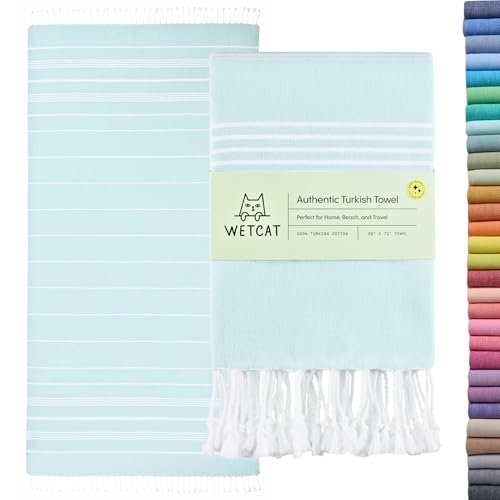
WETCAT Turkish Beach Towel Oversized — Best Overall
The WETCAT is the towel we would hand to someone who asked for a Turkish beach towel with no further questions. At 38 by 71 inches it is genuinely oversized — long enough to lie on without your feet reaching the sand, wide enough to wrap a adult fully after a cold swim. The listing states 100% Turkish cotton and made in Turkey, which matters for this style because the peshtemal is a regional craft and the weaving quality tends to follow the tradition. WETCAT describes the towel as sand free, quick drying, compact and lightweight, and that combination is exactly the peshtemal promise delivered in one product: it behaves like travel gear and feels like cotton, not like the synthetic travel towels that dry you by pushing water around.
In daily use the Aqua colour is a quietly practical choice. It hides salt marks and sunscreen smears better than white, reads clearly as your towel among a row of similar stripes on a crowded beach, and does not heat up in direct sun the way dark colours do. The cloth is soft from the listing’s description — ultra soft is their phrase — and flat-weave cotton does soften further over the first several washes as the fibres relax. Where the WETCAT asks for compromise is the same place every peshtemal does: it will not cushion you on hard ground, and on a windy day its lightness means you will weight the corners with a bag and shoes like everyone else with a flat towel. As a single-towel purchase for one person’s beach bag, though, nothing else in this group balances the variables as evenly.
- Size: 38 x 71 inches, stated in the listing
- Material: 100% Turkish cotton, stated in the listing
- Origin: made in Turkey, stated in the listing
- Colour of this listing: Aqua
- Weave style: flat-woven peshtemal
- Tassels or fringe finish: not stated in the listing
Strengths
- True oversized footprint that works as both wrap and lounger
- Turkish cotton woven in Turkey, matching the style’s tradition
- Packs compactly enough to live in a beach bag permanently
Trade-offs
- Flat weave gives no padding on pebbles or hard pool decks
- Sold singly, so outfitting a family means buying several
- Light cloth needs corners weighted in gusty weather
Best for: solo beachgoers and travellers who want one towel that does everything a peshtemal should. Not suited for: anyone whose beach comfort depends on a thick, cushioned layer under them.

Cacala Lightweight Thin Turkish Beach Towel — Best for Minimalist Packing
Cacala leans all the way into the peshtemal’s defining trait: thinness. The listing calls it lightweight and thin without apology, and at 37 by 70 inches it still gives you a full-size towel’s footprint while rolling down to almost nothing. This is the towel for the carry-on traveller, the cyclist riding to the beach, the hiker whose swimming hole sits at the end of a trail. Where a terry towel would consume a third of a daypack, the Cacala disappears into a corner of it, and it dries fast enough between a morning swim and an afternoon departure to be packed without going musty in the bag.
That thinness is a genuine trade, and we want to be plain about it. A very light flat weave has less cotton per square inch to absorb with, so after a full swim you will press and pat rather than rub once and be done, and as a ground layer it is closer to a sheet than a mat. Cacala positions the towel beyond the beach too — as an extra-large travel towel, a beach accessory or a gift — and that breadth is honest, because a cloth this portable gets used for picnics, festivals, boat days and hostel bunks where a dedicated beach towel would never be carried at all. Buy it for the trips where the alternative is no towel, and it will never disappoint you; buy it expecting bath-towel cosiness and it will.
- Size: 37 x 70 inches, stated in the listing
- Material: 100% cotton, stated in the listing
- Profile: lightweight and thin flat weave
- Sand and drying behaviour: sand-free and quick-drying per the listing
- Weight in grams: not given in the listing
- Colour options for this listing: not given in the listing
Strengths
- Smallest pack size of any towel in this guide
- Full-size footprint despite the minimal cloth weight
- Dries quickly enough for same-day repacking on trips
Trade-offs
- Thinnest absorbency here; needs pressing rather than a quick rub
- Offers the least ground cushioning of the six
- Feels insubstantial to buyers who equate weight with quality
Best for: light packers, travellers and anyone whose towel must earn a tiny corner of a bag. Not suited for: beachgoers who lounge for hours and want padding beneath them.

Bazaar Anatolia Turkish Beach Towel Diamond — Best Pattern
Most peshtemal towels are striped, because stripes are what the looms traditionally produce, so the Bazaar Anatolia stands out for its woven diamond pattern in black. A pattern woven into the cloth rather than printed onto it keeps the surface flat and the sand behaviour intact, and it ages gracefully — there is no print to crack or fade unevenly. At 71 by 39 inches this is the widest single towel in the guide alongside the HILLFAIR pack towels, and that extra width shows when you wrap it as a sarong or spread it for two people to sit on during a shoreline picnic.
The listing spreads its suggested uses wide — beach, pool, travel, camping, sauna and yoga — and unusually, the towel suits the list. A flat cotton cloth with a handsome pattern doubles as a sauna wrap, a yoga layer over a studio mat, a camping towel and a light throw on a cool evening, and the black diamond design looks at home in all of those settings where a candy-striped beach towel would not. The honest cautions are colour and heat: black cotton absorbs sunshine, so on a scorching day the towel itself gets warm to lie on, and dark dyes deserve a separate first wash to keep them off lighter swimwear. If your beach life mixes with studio and sauna life, this is the pick that follows you to all of it.
- Size: 71 x 39 inches, stated in the listing
- Material: 100% cotton, stated in the listing
- Pattern: woven diamond design
- Colour of this listing: Diamond Black
- Suggested uses in listing: beach, pool, travel, camping, sauna, yoga
- GSM weight: none stated in the listing
Strengths
- Woven pattern will not crack or peel like a surface print
- Generous width wraps and shares better than narrower towels
- Design carries into sauna, yoga and home settings gracefully
Trade-offs
- Black cloth heats up in strong direct sun
- Dark dye needs a separate first wash as a precaution
- Pattern-first buyers pay for looks a plain stripe delivers cheaper elsewhere
Best for: buyers who want one handsome flat towel that works from beach to sauna to studio. Not suited for: sunbathers on very hot sand who lie directly on their towel for hours.

HAVLULAND Turkish Beach Towels Set of 6 — Best Set for Groups
Six towels change the question entirely. The HAVLULAND set is not about finding your perfect towel; it is about never running out of towels. Each of the six is oversized at 72 by 40 inches — the largest standard footprint in this guide — in 100% Turkish cotton peshtemal weave, described by the listing as sand free, quick dry, lightweight and super absorbent, and suggested for beach, bath, pool, travel, gym and spa. That spread of uses is the point of a set: some live at the beach house, some rotate through the bathroom as bath sheets, some ride in the car for unplanned swims.
Think about who benefits. A rental property host replaces a season’s worth of stained terry in one order and gains towels guests can shake clean and that dry between turnovers. A family of five stops negotiating over the two good beach towels. A swim club or a boat shared among friends keeps a stack that nobody guards. The compromise in any uniform set is sameness: six matching towels means marking them if ownership matters, and if one is lost the set no longer matches. Peshtemal cloth also asks guests unfamiliar with it to trust a thin towel, which hosts solve by simply letting the towel prove itself after one swim. Per towel, a set like this is the economical way to own Turkish cotton, and it is the only pick here that solves a household problem rather than a personal one.
- Set size: 6 towels, stated in the listing
- Size per towel: 72 x 40 inches, stated in the listing
- Material: 100% Turkish cotton, stated in the listing
- Style: peshtemal flat weave
- Suggested uses in listing: beach, bath, pool, travel, gym, spa
- Individual colour assortment: not stated in the listing
Strengths
- Six oversized towels cover a household or rental in one order
- Large 72×40 footprint works as bath sheet as well as beach towel
- Fast drying suits high-turnover use between guests or swims
Trade-offs
- Uniform set needs marking if family members claim their own
- Storage for six, even compact peshtemals, needs a shelf plan
- Single-style purchase means no variety of weight or pattern
Best for: families, rental hosts and beach houses that burn through towels every weekend. Not suited for: a solo traveller who needs exactly one towel and minimal bulk.

HILLFAIR Cotton Turkish Peshtemal Beach Towel — Best Colour Variety
The HILLFAIR four-pack answers the uniform-set problem directly: the towels come multicolour, so the blue one is dad’s, the green one belongs to the teenager, and the argument ends before it starts. Each towel measures 39 by 72 inches, matching the largest footprints in this guide, and the listing describes them as quick dry, lightweight and sand free peshtemal towels for bath, swim, yoga, pool and travel. Four is a considered number — enough for a couple with spares, or a small family, without committing a whole shelf the way a six-set does.
Colour-coding turns out to matter beyond family peace. On group trips, recognisable towels stop the slow drift of identical white towels into other people’s bags, and at home a colour per person is a small hygiene kindness when towels rotate through a shared bathroom between washes. HILLFAIR’s cloth follows the standard peshtemal pattern of behaviour — shake the sand off, hang it and it dries quickly, roll it and it vanishes into a tote. The cautions mirror the Cacala’s: flat cotton asks you to press dry rather than scrub, and a four-pack in fixed multicolour means the colour assortment is the manufacturer’s choice, not yours, so check the listing images if a particular combination matters to you.
- Pack size: 4 towels, stated in the listing
- Size per towel: 39 x 72 inches, stated in the listing
- Material: cotton peshtemal, per the listing
- Colour scheme: multicolour assortment
- Suggested uses in listing: bath, swim, yoga, pool, travel
- GSM weight: not stated in the listing
Strengths
- Different colours end towel-ownership disputes in families
- Full oversized dimensions on every towel in the pack
- Four-pack size balances coverage against storage space
Trade-offs
- Colour assortment is fixed rather than chosen by the buyer
- Flat weave absorbency technique takes a swim to learn
- Not the cheapest route to a single towel for one person
Best for: families and travel groups who want one towel per person, colour-coded. Not suited for: buyers furnishing a rental who need a uniform, matching stack.

Laguna Beach Textile Co. Turkish Fouta Towel — Best Weight and Drape
Every other pick in this guide competes to be lighter; the Laguna Beach Textile Co. fouta competes to feel like something. Its listing states 400 GSM, a grams-per-square-metre figure none of the other five listings provide, and that weight puts it at the substantial end of flat-weave towels — still a smooth fouta cloth with a rainbow stripe, still quick to dry relative to terry, but with a drape and hand-feel that reassures buyers who pick up a standard peshtemal and think curtain. If you like the peshtemal idea but your hands keep voting for more cloth, this is the towel designed for you.
The extra weight buys small, real things. The towel stays put a little better when a breeze crosses the beach. It wraps with a feeling of coverage rather than cling. As a picnic cloth or an evening wrap it reads as a textile, not a compromise. What it gives back is a slice of the style’s portability: rolled, it is the bulkiest towel here, and it dries the slowest of the six, though still well ahead of terry pile. Note that the listing gives no dimensions, so if an exact footprint matters — a specific beach chair, a specific bag — verify on the listing before ordering. For buyers whose hesitation about Turkish towels has always been the thinness itself, this fouta removes the objection while keeping the flat weave’s sand-shedding, fast-drying character.
- Weight: 400 GSM, stated in the listing
- Style: Turkish fouta flat weave
- Colour of this listing: Rainbow Stripe
- Material: Turkish cotton per the product name; fibre percentage not given in the listing
- Dimensions: not given in the listing
- Tassel finish: none stated in the listing
Strengths
- Heaviest cloth here, with a reassuring drape and hand-feel
- Keeps flat-weave sand behaviour despite the extra weight
- Works convincingly as wrap, throw or picnic cloth off the beach
Trade-offs
- Slowest drying and bulkiest pack of the six picks
- Dimensions are not stated, so size must be confirmed on the listing
- Less suited to ultralight travel than the Cacala or WETCAT
Best for: peshtemal sceptics who want flat-weave benefits with a more substantial cloth. Not suited for: minimalists counting grams or travellers with tiny bags.
Where Does the Peshtemal Tradition Come From?
The peshtemal predates the beach holiday by centuries. In the Turkish hammam — the communal bathhouse — bathers wrapped themselves in flat-woven cotton cloths that could be wrung nearly dry by hand, dried quickly in the bathhouse’s warm air, and carried home in a small bundle. Every trait modern beachgoers praise in these towels is a hammam trait: the flat weave that sheds water and dries fast, the generous size that wraps a body completely, the fringe that finished the loom’s edge, even the stripes, which identified weaving regions and bathhouse sets. The fouta, the Laguna towel’s style name, is the North African cousin of the same idea, carried around the Mediterranean by the same bathing culture. Knowing the lineage is more than trivia when you shop, because it tells you what the cloth is optimised for: repeated daily use, quick turnaround between washes, and carrying. A peshtemal was never designed to be a luxury cushion; it was designed to be a working textile that a person relied on every day, and the best modern versions, whatever their colour or pattern, are the ones that keep that working character intact.
It also explains the size conventions in this guide. Hammam cloths had to wrap an adult fully, so the traditional dimensions cluster around the same 70-by-39-inch territory these listings occupy. When you see a so-called Turkish towel at hand-towel dimensions, you are looking at the name borrowed without the tradition, and it will disappoint in exactly the ways a too-small wrap disappoints at a bathhouse or on a beach.
How Do the Six Turkish Towels Compare Side by Side?
Read the table below as a map of intentions rather than a league table. The three single towels divide by philosophy: the WETCAT balances, the Cacala minimises, the Bazaar Anatolia decorates. The two packs divide by household logic: HAVLULAND maximises coverage with uniformity, HILLFAIR trades two towels of count for colour-coding. The Laguna stands apart as the weight-first option. None of the six is a failed version of another; each is the right answer to a different question, and the comparison is most useful when you start from your question — how many people, how much bag space, how much cloth in the hand — and read across to the towel built for it.
| Pick | Size | Count | Standout trait |
|---|---|---|---|
| WETCAT Turkish Beach Towel Oversized | 38 x 71 in | 1 | Balanced all-rounder in Turkish cotton |
| Cacala Lightweight Thin Turkish Beach Towel | 37 x 70 in | 1 | Thinnest pack size for travel |
| Bazaar Anatolia Turkish Beach Towel Diamond | 71 x 39 in | 1 | Woven diamond pattern, black |
| HAVLULAND Turkish Beach Towels Set of 6 | 72 x 40 in | 6 | Household and rental coverage |
| HILLFAIR Cotton Turkish Peshtemal Beach Towel | 39 x 72 in | 4 | Multicolour, one colour per person |
| Laguna Beach Textile Co. Turkish Fouta Towel | Not stated | 1 | 400 GSM, most substantial cloth |
Which Weight and Weave Should You Choose?
Start with how the towel will spend most of its life. A towel that travels — in a tote, a carry-on, a bike basket — should be one of the light flat weaves, because every gram and litre saved is a trip where the towel actually comes along. A towel that lives at one beach house or pool can afford the Laguna’s 400 GSM substance, since it hangs on a hook rather than riding in a bag. Between those poles, the standard peshtemal weight of the WETCAT, HAVLULAND and HILLFAIR towels is the versatile middle: light enough to carry without thinking, present enough to dry an adult properly.
One more variable deserves a plain explanation, because listings use it loosely: the word fouta versus peshtemal. Both describe flat-woven cotton wrap towels from the same Mediterranean bathing culture, and in modern retail the terms are nearly interchangeable — the Laguna towel here is sold as a fouta, the HAVLULAND set as peshtemals, and the cloth logic is the same. What matters is not which word a brand chose but the measurable facts beside it: dimensions, fibre and, when stated, GSM weight. A buyer who shops by those three numbers will never be misled by terminology, while a buyer who shops by romantic naming alone is gambling on a photograph. Similarly, treat the phrase sand free, which appears across these listings, as a description of behaviour rather than magic: flat cloth releases dry sand on shaking, as the FAQ below explains, and no weave on earth releases wet sand on contact.
Weave tightness matters more than marketing adjectives. Hold a peshtemal to the light when it arrives: a tight weave shows as an even cloth with little visible gapping, and it will absorb better and fray less than a loose, gauzy weave of the same weight. Fringes and tassels are the traditional finish and also the first wear point, so glance at how they are knotted. None of these listings makes detailed fringe claims, which is normal for the category; simply plan to wash the towel gently and avoid snagging tassels on zips and Velcro in the beach bag.
How Do You Wash and Care for Turkish Cotton Towels?
Wash a new peshtemal before its first swim. Loose fibres and loom dressings rinse out in that first wash, and cotton’s absorbency improves noticeably once the fibres are clean and opened up. Use warm water and a normal detergent, and keep fabric softener out of the routine entirely — softeners coat cotton with a waxy film that makes the cloth feel slick and behave water-repellent, which is the exact opposite of what you bought. If towels have absorbed a season of softener already, a wash with a cup of white vinegar in the rinse helps strip the build-up. Tumble dry on low or line dry; flat cotton dries so quickly on a line that the dryer is mostly a softness preference. Wash dark colours like the Bazaar Anatolia’s black separately at first, and treat tassels kindly by using a gentle cycle or a mesh bag when the load is rough company. Store the towels rolled or folded loosely rather than compressed under heavy linen; cotton recovers from either, but loose storage keeps the cloth aired and ready, and a rolled peshtemal in the beach bag is a towel that actually gets used instead of forgotten in a cupboard.
What Mistakes Do People Make When Buying Turkish Beach Towels?
The classic mistake is expecting terry. A buyer orders a peshtemal imagining a plush wrap, receives a thin cloth, and concludes the product is cheap rather than different. Read the weave description before ordering and the disappointment never happens. The second mistake is buying by price alone in multi-packs: a very cheap flat towel is often a loose weave that turns transparent when wet and frays at the fringe within a season, so the set that looked like a bargain becomes the set you replace. Third, shoppers ignore dimensions and shop by photograph; models make any towel look generous, while the stated inches decide whether your feet reach the sand. Fourth, people use fabric softener out of laundry habit and then blame the towel for poor absorbency that the softener caused. Finally, some buyers treat a peshtemal as only a towel and miss half its value — the same cloth works as a sarong, a light blanket on a flight, a picnic layer and a privacy screen on a changing-room-free beach, which is why travellers keep packing them long after the holiday ends.
How Does a Peshtemal Handle a Full Day at the Beach?
Picture the towel’s working day, because that is where flat cotton earns its keep. In the morning it rides to the beach rolled inside a tote that also holds sunscreen, a paperback and a water bottle — a load a terry towel would crowd out. Spread on the sand, it marks your territory at full size, and the first thing you notice is that wind-blown sand skates across it instead of settling in; a flick of one corner resets the surface. After the first swim it dries you with the press-and-pat technique, then goes over a beach umbrella arm or a fence rail, where moving air through a single layer of cotton has it dry again before your second swim. Terry, still damp from the morning at that hour, starts to smell like a wet dog by mid-afternoon; a peshtemal that has dried three times in the sun does not. At packing time the shake test happens — one person, two hands, ten seconds — and the towel goes home nearly sand-free, which means your car boot and your washing machine inherit far less grit than they do after a terry day.
The day also exposes the style’s limits honestly. On a pebbly shore or a hot concrete pool deck, a single flat layer is a boundary marker, not a mattress, and experienced peshtemal users fold the towel double under their hips or pair it with a thin mat when the ground is hostile. When the evening breeze turns cool, the towel works as a wrap or a light shawl — flat cotton over shoulders is genuinely useful — but it will not replace a hoodie. Judged as beach equipment across a whole day rather than as a bath towel that happens to be outdoors, the peshtemal’s thinness stops looking like a compromise and starts looking like the design.
Which Turkish Towel Suits Which Kind of Beach Trip?
Match the towel to the trip and the choice mostly makes itself. For a resort or pool holiday where the towel lives in a tote and laundry is easy, the WETCAT’s balanced cloth and single-towel format fit perfectly, and its Aqua colour survives a week of sunscreen and salt without looking tired. For backpacking, cycle touring or any trip measured in litres of bag space, the Cacala’s extreme thinness is the only rational pick — it is the towel equivalent of a packable rain shell, unremarkable until the moment it saves the day. Couples heading to a rental cottage should consider the HILLFAIR four-pack: two towels in rotation each, so one is always dry, and colours keep the peace. Hosts and big families are HAVLULAND territory, full stop. Buyers who split their time between beach, sauna and yoga studio get the most from the Bazaar Anatolia, whose woven diamond pattern never looks like swim gear in a gym bag. And anyone furnishing a home pool, where towels hang on hooks and never travel, can indulge the Laguna fouta’s heavier cloth without paying its packing penalty.
One more scenario deserves mention: the boat. Flat cotton is close to ideal on deck, because it dries in the wind between stops, takes no space in a crowded locker, and doubles as a wrap when the run back to the marina turns spray-cool. Several of these listings name travel and camping among their uses, and boaters belong in that same family of users — people whose towel must dry fast, pack small and tolerate being used five times between washes.
What Should You Check When Your Towel Arrives?
Unroll the towel and hold it against a window. An even weave with consistent light passing through it signals decent looming; patchy thin spots predict early wear. Run a damp hand across the surface and then dry the hand on the cloth — new cotton often resists the first wetting because of loom dressings, which is exactly why the pre-wash in the care section matters, and absorbency should improve markedly after it. Check the stated dimensions with a tape measure, since shrinkage of a few percent is normal for cotton and a towel bought at exactly your minimum size can end up under it. Inspect the fringe knots or hem stitching at both ends, the highest-stress zones of a flat towel, and give one corner a gentle tug to confirm the weave does not distort easily. Finally, wash it once and dry yourself with it at home before the beach trip that counts; a towel is a small purchase, but the day it fails you is always the day with no backup.
Why Does the Cotton’s Origin Matter in a Flat Weave?
In terry cloth, mediocre yarn can hide inside the pile for a long time; the loops look full even when the fibres are short and weak, and the towel only confesses after months of washing, when it turns rough and thin at once. A flat weave has no such camouflage. Every thread is on the surface, load-bearing and visible, so the quality of the cotton and the spinning shows up in the first month as either a cloth that tightens, softens and stays even, or one that skews, gaps and frays at the fringe. That is the practical meaning of the phrase Turkish cotton on these listings: the region’s long-staple cotton spins into longer, smoother yarns with fewer weak joins, and in a peshtemal that translates directly into a towel that tolerates being rolled, wrung, shaken and washed hundreds of times. It also explains the price ladder within this guide. A single towel woven in Turkey from named-origin cotton, like the WETCAT, carries the cost of better yarn and slower looming. Multi-packs spread that cost across volume. Neither is automatically the smarter buy — the right question is how many towels you need and how hard each one will work — but origin and fibre are the honest reasons one flat cotton towel costs more than another that looks similar in a photograph.
There is a second, quieter benefit to good long-staple yarn: lint. Short fibres shed, and shedding is what leaves a new towel’s first washes full of fluff and its surface progressively barer. Long-staple cloth sheds far less, which matters doubly for a beach towel, because lint and sand together make the gritty paste everyone hates in a beach bag. When a listing like the HAVLULAND’s calls its towels super absorbent and a buyer wonders how a thin cloth earns the word, the answer is the same fibre story — more unbroken fibre surface per square inch, drinking water by contact rather than by pile.
How Do You Pack Turkish Towels for Travel?
Roll, do not fold. A peshtemal rolled tightly becomes a cylinder the size of a water bottle, and rolled towels slot into the dead spaces of a suitcase — along the edges, inside shoes’ neighbourhood, across the top layer — instead of forming a bulky stratum of their own. Two rolled peshtemals take roughly the luggage room of one folded terry towel while giving you a rotation, so one can dry on a balcony rail while the other works. In a day bag, the rolled towel doubles as padding around a camera or a bottle, and at the destination it unrolls into a picnic cloth, a plane blanket, a privacy screen for changing, or an extra layer over a hostel sheet, which is why experienced travellers treat these towels as multi-tools rather than swim accessories. If you are packing the Laguna fouta, budget it as a garment rather than an accessory — its 400 GSM cloth rolls to about the size of a light sweater — while the Cacala disappears so completely that the risk becomes forgetting it is in the bag at all. On the way home, a peshtemal that got a final rinse and an hour of sun can be packed without perfuming the whole suitcase, a small mercy anyone who has travelled with a damp terry towel will appreciate.
Are Turkish Towels a Good Gift or Wedding Purchase?
They are one of the safer textile gifts, for structural reasons. A peshtemal does not demand that the recipient share your taste in home décor, because it lives in a beach bag rather than on a bathroom rail; it does not require size knowledge the way clothing does; and it folds into a package that posts cheaply and presents beautifully, especially the patterned Bazaar Anatolia or the striped Laguna fouta. Listings in this guide gesture at gifting — the Cacala’s own description names it a gift for beach lovers — and the multi-packs split naturally into several gifts, which makes a HAVLULAND or HILLFAIR order a quiet strategy for outfitting a whole list of summer birthdays, housewarmings or wedding-party thank-yous from a single purchase. For a wedding registry or a new-home gift, pair a pair of single towels with a note explaining the press-and-pat technique and the no-softener rule; the explanation is the difference between a recipient who discovers the cloth’s virtues and one who washes it in softener, finds it disappointing and never learns why. The one recipient to steer elsewhere is the devoted terry loyalist, whose idea of luxury is measurable in pile height — for them, a flat towel reads as an economy, not an elegance, and no note will change the verdict of their hands.
Final Recommendation
For most people, the WETCAT Turkish Beach Towel Oversized is the place to start: honest Turkish cotton, a true oversized footprint and the balanced middle weight that suits the widest range of beach days. Households should skip straight to the HAVLULAND Turkish Beach Towels Set of 6 or the colour-coded HILLFAIR Cotton Turkish Peshtemal Beach Towel four-pack, because coverage beats refinement when five people need towels at once. And if your hands have rejected every thin peshtemal you have touched, the 400 GSM Laguna fouta is your bridge into the style. Choose the cloth that matches how you actually reach the water, and a flat Turkish towel will quietly replace the bulky terry one you used to wrestle into your bag — starting with the first morning you shake the sand off it and watch every grain let go.
Frequently Asked Questions
Are Turkish beach towels as absorbent as terry towels?
They absorb differently rather than simply less. Terry holds water in its loops and feels instantly thirsty; flat cotton absorbs across its whole surface and works best with a press-and-pat motion. For drying a person after a swim, a full-size peshtemal does the job well. For mopping a spilled cooler, terry’s pile wins, which is why some households keep both styles for different tasks.
Why does my new Turkish towel feel stiff?
New cotton carries loom dressings and loose surface fibre that wash out over the first few laundry cycles. Wash before first use, skip softener, and expect the cloth to soften steadily across the first season. A towel that still feels board-stiff after five washes was likely a loose, low-grade weave rather than a care problem.
Can Turkish towels go in the dryer?
Yes, on low to medium heat, though they line-dry so quickly that many owners never bother. High heat over time shortens cotton’s life and can tighten the weave unevenly, and tassels tangle less when the towel dries flat or on a line. If you do tumble dry, pull the towel out promptly rather than letting it sit compressed.
Do peshtemal towels really shed sand?
Dry sand, yes — the flat surface gives grains nothing to grip, so a firm shake clears the towel in a way terry never allows. Wet sand clings to any cloth, including these, so the habit that works is to let the towel dry for a few minutes in the sun before shaking it out at packing time.
How long does a good peshtemal towel last?
Years, if the weave is tight and the care is sane. Flat cotton has no pile to crush or mat, so a well-made peshtemal often looks better in its third summer than its first, having softened without thinning. The usual failure points are frayed fringe, a snagged thread pulled into a run, or dye faded by chlorine and sun. Rotate two towels rather than working one daily, wash gently, and keep them away from Velcro and rough zips in the laundry, and a quality Turkish towel easily outlasts the terry towels it replaced.
Can I use a Turkish beach towel as a bath towel at home?
Plenty of people do, and the HAVLULAND listing itself names bath among its uses. At home the flat towel’s virtues change shape: it dries between showers instead of staying damp on the rail, it takes a fraction of a terry towel’s space in the wash and the cupboard, and it works as a generous bath sheet because of its size. The adjustment is the same press-and-pat technique, and guests may need a sentence of explanation so they do not mistake it for a decorative throw.
What size should I buy for a tall adult?
Look for at least 70 inches of length, which every pick in this guide meets or approaches, so the towel works both as a wrap and as a full-length lounger. Width around 38 to 40 inches adds comfortable overlap when wrapping. Tall buyers who also want substance should look at the HAVLULAND dimensions of 72 by 40 inches per towel.
How many Turkish towels should one person own?
Two is the honest number for a regular swimmer: one in use and one drying or in the wash, rotating so neither is worked daily. Occasional beachgoers manage happily with one, because the cloth dries fast enough to be ready again by the next outing. Households should count two per frequent swimmer and then let multi-packs do the arithmetic cheaply, which is precisely the territory of the HAVLULAND and HILLFAIR sets reviewed above.
Related Guides
If sand is your main enemy, our companion guide to flat and microfiber options goes deeper on shake-clean cloth, and the rest of the cottage library covers the house beyond the beach bag. Start with Best Beach Towels That Repel Sand for a dedicated look at sand-shedding designs, then browse Best Hard Sole Slippers for Women for footwear that handles the walk from deck to shoreline, and Best Propane Gas Smokers when the beach day ends with dinner cooked outdoors at home.


