What's inside
- Key Takeaways
- Quick Picks
- How We Chose These Picks
- How Do Sand-Repelling Towels Actually Work?
- How Do the Six Sand-Shedding Picks Compare?
- Microfiber or Cotton: Which Sand-Shedding Surface Fits Your Trips?
- How Do You Keep a Sand-Shedding Towel Working Season After Season?
- What Mistakes Do Shoppers Make with Sand-Free Towels?
- How Does a Sand-Free Setup Change a Family Beach Day?
- Which Size and Format Should You Choose?
- How Do Sand-Shedding Towels Behave Away from the Beach?
- What About Microfiber and the Environment?
- How Should You Test a Sand-Free Towel in Its First Week?
- What Do Lifeguards, Surfers and Beach Regulars Know About Sand?
- How Many Sand-Shedding Towels Does a Household Need?
- What Should You Look for on the Listing Before You Order?
- Why Do Hotels and Swim Schools Choose Smooth Towels?
- How Do These Towels Handle Sunscreen, Salt and Chlorine?
- Final Recommendation
- Frequently Asked Questions
- Related Guides
As an Amazon Associate I earn from qualifying purchases. This post may contain affiliate links at no extra cost to you.
cottageverdict.com is reader-supported. When you buy through links on our site, we may earn an affiliate commission.
Where to buy: the six products below are all sold through Amazon, and each name links to its listing in the Quick Picks table, its detailed section and the comparison table, so you can check price on Amazon and confirm dimensions and colour before ordering. The best beach towels that repel sand share one physical trait, and it is not a coating or a treatment. Sand sticks to beach towels because terry loops and plush fibres give grains edges to lodge against; a smooth, flat surface — microfiber suede or a tight flat cotton weave — gives grains almost nothing to grip, so they slide off with a shake instead of riding home in the cloth. Every pick in this guide works by that mechanism. Five are microfiber or flat-weave towels, and the sixth is a full sandproof beach blanket for groups who want a clean island, not just a clean towel.
Honesty about limits belongs at the top of this guide. No towel sheds wet sand on contact, and no surface is literally one hundred percent sand-proof against a determined toddler with a bucket. What these products genuinely deliver is dry-sand release: shake the towel out and the sand lets go, instead of staying ground into pile through the car ride, the laundry and the next three beach trips. That difference is larger in practice than it sounds. Sand that leaves at the beach does not scratch sunglasses in your bag, does not grit up the washing machine filter, and does not turn the boot of the car into a sandbox by August. The picks divide by traveller type: the ECCOSOPHY and Widdonen are single oversized microfiber towels, the Eunzel and Qinqinamu are two-packs for couples and families, the Sand Cloud is the cotton loyalist’s answer woven in a Turkish flat style, and the WEKAPO is a 7-by-7-foot blanket that anchors with stakes and corner pockets.
Key Takeaways
- Sand release is a surface story: smooth microfiber suede and flat cotton weaves deny grains the loops and pile they normally lodge in.
- Dry sand shakes off these towels in seconds; wet sand clings to any material and needs a few minutes of sun before the shake works.
- Microfiber picks pack far smaller than cotton and dry fastest, which is why travellers dominate this category.
- Two-packs from Eunzel and Qinqinamu solve the couple-and-family problem at once, with a towel per person.
- The WEKAPO is a different tool — a staked 7×7 ft blanket that creates a sand-free base camp rather than drying a swimmer.
- Sand Cloud proves cotton can play this game too, using a flat Turkish weave in certified organic cotton.
Quick Picks
| Pick | Badge | Why it earns its place |
|---|---|---|
| ECCOSOPHY Microfiber Beach Towel | Best Overall | An oversized 71×35 microfiber towel that dries fast, packs small and shakes clean — the reference point for the category. |
| Widdonen Microfiber Beach Towel Compact | Best Compact Single | A thin, light 71×32 towel aimed squarely at campers, hikers and cruisers who pack by the litre. |
| Eunzel 2 Pack Microfiber Beach Towel | Best Two-Pack for Travel | Two 71×32 quick-dry towels in a Palm design, one purchase covering a couple or a parent and child. |
| Sand Cloud Turkish Beach Towel Sand Resistant | Best Cotton Option | Certified organic Turkish cotton in a flat weave, for buyers who want sand release without synthetic fibre. |
| WEKAPO Beach Blanket Sandproof Extra Large | Best Group Base Camp | A 7×7 ft sandproof mat with six stakes and four corner pockets that stays put and stays clean for a whole group. |
| Qinqinamu Microfiber Beach Towel 2 Pack | Best with Carry Bag | Two oversized 71×32 microfiber towels that arrive with a bag, keeping wet gear organised on the way home. |
How We Chose These Picks
We required every pick’s listing to claim sand-free or sand-resistant behaviour and to back the claim with a plausible surface — microfiber suede or flat weave — rather than a spray-on promise. Plush towels with a sand-free badge were excluded on physics alone. We then checked that sizes stayed honestly oversized, because a sand-shedding hand towel solves nobody’s beach problem, and we separated true towels from the one blanket in the group so the comparison stays fair: the WEKAPO is judged as ground equipment, the other five as towels you dry a body with. Pack format mattered next, since this category skews toward travel; two-packs and carry bags were credited as real features, not packaging trivia. Finally we read for care practicality — microfiber that cannot be machine washed or that sheds its smoothness quickly would defeat the purpose — and favoured listings whose own descriptions of use, from cruise decks to campsites, matched how these towels are actually lived with. We also applied this batch’s honesty rule to the sand claims themselves: listings were credited for the mechanism their surface provides, not for absolute language, and the guide’s own wording follows the same discipline — these towels repel and release sand by design, and any claim beyond that belongs to physics, not to a product page.
How Do Sand-Repelling Towels Actually Work?
Hold a grain of sand against two surfaces and the whole category explains itself. Against terry cloth, the grain meets thousands of loop ends, fibre scales and shadowed crevices; friction and static give it purchase, and once a few hundred grains work down between the loops, shaking moves the towel more than it moves the sand. Against microfiber suede — a dense, short, split-fibre surface that feels like a chamois — the grain meets a nearly continuous plane. There is nothing to hook onto, so gravity and a snap of the wrist win immediately. Flat-woven cotton works by the same geometry with a natural fibre: the yarns lie side by side in a smooth sheet, grains rest on top, and a shake clears them. That is why this guide contains no plush towels and why the cotton entry, the Sand Cloud, is a Turkish flat weave rather than a terry towel with optimistic marketing.
Two honest qualifications complete the picture. First, moisture is sand’s glue: a wet towel of any construction holds wet sand, because water bridges grains to fibres. The working habit is to let the towel dry briefly — microfiber’s speed helps here — and then shake. Second, fine dust-like sand behaves worse than coarse sand on every surface, settling into even suede’s shallow texture; a rinse at the beach shower solves what shaking cannot. Buyers who understand these two limits describe these towels as miraculous; buyers promised absolute sand-proofing by sloppy marketing describe the same towels as a scam. The towels are identical. The expectations were not. Keep that sentence in mind while shopping anywhere in this category, because the listings that shout the loudest about total sand-proofing are usually describing the same suede and flat-weave surfaces as the listings that describe them calmly — the surface is the technology, and it has a known, respectable performance envelope that this guide has tried to state exactly.

ECCOSOPHY Microfiber Beach Towel — Best Overall
ECCOSOPHY is the name most travellers meet first in this category, and the listing shows why: oversized at 71 by 35 inches, quick dry, sand free, super absorbent and lightweight, with a use list that runs from swimming, gym and pool to cruise, camping, yoga and travel. That breadth is credible for microfiber suede in a way it would not be for cotton — the same towel genuinely can dry a swimmer at noon, serve as a yoga layer at four and pack into a carry-on at six without smelling like a swamp. The Havana colourway of this listing is a warm, patterned choice that hides the faint grey that white microfiber picks up over a season of beaches.
The ECCOSOPHY’s working character is efficiency. It absorbs by spreading water across its split-fibre surface, so the technique is a smooth wipe rather than a rub, and it wrings out closer to dry than any cotton towel can. Rolled, it occupies roughly a water bottle’s footprint in a bag, which quietly changes behaviour: this is a towel that gets packed for trips where a towel was previously borrowed, rented or skipped. Its trade-offs are the microfiber family’s own. The suede hand-feel divides people — some find it pleasantly smooth, others miss fibre they can grip — and microfiber asks for a wash without softener and without high heat to protect the split fibres. If your beach life involves travel, cruises or spontaneous swims, this is the towel the rest of the guide is measured against.
- Size: 71 x 35 inches, stated in the listing
- Material: microfiber, stated in the listing
- Colour of this listing: Havana
- Behaviour per listing: quick dry, sand free, super absorbent, lightweight
- Suggested uses in listing: swimming, gym, pool, cruise, camping, yoga, travel
- Carry bag included: not stated in the listing
Strengths
- Benchmark pack size and drying speed for the category
- Generous 71×35 footprint wraps and lounges properly
- One towel honestly covers beach, gym, pool and travel duty
Trade-offs
- Suede hand-feel is a love-it-or-tolerate-it texture
- Needs softener-free, moderate-heat washing to protect fibres
- Sold singly; families buy several or choose a two-pack
Best for: travellers and everyday beachgoers who want the category’s standard-setter. Not suited for: buyers who strongly prefer the grip and feel of natural cotton fibre.

Widdonen Microfiber Beach Towel Compact — Best Compact Single
The Widdonen wears its priorities in its name: compact first. At 71 by 32 inches it keeps full adult length while trimming width, and the listing describes it as lightweight, extra large, sand free, thin, absorbent and quick dry, aimed at camping, hiking, swim, pool, bath, picnic, gym and cruise use, and even at adult gifts. Thin is a deliberate engineering choice here. A thinner microfiber towel folds flatter, dries faster after a wring, and disappears into a daypack’s outer pocket — the towel you carry on the hike to the hidden cove rather than the towel you spread at the resort.
What does thin cost you? Mostly lounging comfort and a little absorbency headroom. As a ground layer the Widdonen is a boundary and a sand shield, not padding, and after a long swim you may wring it once mid-dry on a cold day. For its intended life — movement — those are the right sacrifices. Hikers, bikepackers and cruise passengers rationing a small bag will recognise the logic immediately, and the plain Blue of this listing is the kind of colour that survives being borrowed, lost track of and found again across a whole trip. Buy the Widdonen when the alternative towel is the one you would have left behind, because a compact towel at the beach beats a luxurious towel at home every single time.
- Size: 71 x 32 inches, stated in the listing
- Material: microfiber, stated in the listing
- Profile: compact, thin and lightweight per the listing
- Colour of this listing: Blue
- Suggested uses in listing: camping, hiking, swim, pool, bath, picnic, gym, cruise
- Pack format: single towel
Strengths
- Smallest practical pack size among the single towels here
- Full 71-inch length despite the compact brief
- Dries extremely fast, suiting multi-swim travel days
Trade-offs
- Thinner cloth means less lounging cushion on hard ground
- Narrower 32-inch width wraps less generously than 35-inch rivals
- Absorbency headroom is the tightest of the microfiber picks
Best for: hikers, campers and cruisers packing light without giving up a real towel. Not suited for: resort loungers who want maximum width and drape.
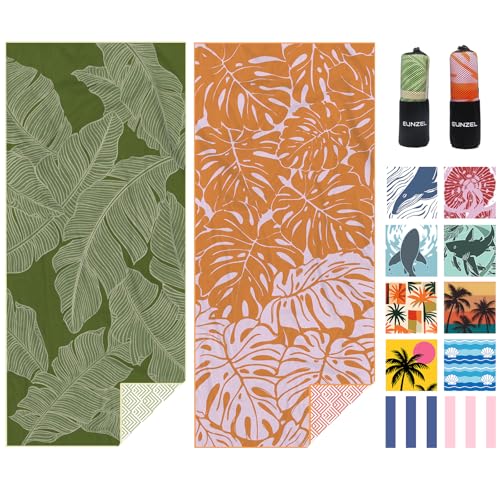
Eunzel 2 Pack Microfiber Beach Towel — Best Two-Pack for Travel
Eunzel sells the obvious solution to the most common microfiber purchase: two towels, because most people beach in pairs. Each towel in the pack measures 71 by 32 inches, quick dry and sand free, in a Palm design, and the listing aims them at beach, camping, swim pool, gym, sports and yoga. A two-pack quietly fixes several frictions at once. Couples stop sharing one damp towel in rotation. A parent gains a dry backup when a child’s towel meets a spilled drink or a mud puddle. Solo travellers gain the rotation that lets one towel dry on a balcony while the other works, which matters on trips where laundry is a weekly event rather than a nightly one.
The Palm pattern does practical work too, marking these as your towels among the identical blues and greys on a shared rack or a cruise deck. Eunzel’s cloth follows the family pattern — smooth suede surface, fast dry, compact roll — so the pair together still packs smaller than a single terry towel. The cautions are the usual microfiber ones, plus one pack-specific note: both towels share the same design, so households that rely on colour-coding to assign towels should look at mixing two packs or choosing the Qinqinamu or a cotton set instead. As a single order that readies two people for a trip, though, this is the most efficient purchase in the guide.
- Pack size: 2 towels, stated in the listing
- Size per towel: 71 x 32 inches, stated in the listing
- Material: microfiber, stated in the listing
- Design of this listing: Palm
- Behaviour per listing: quick dry, sand free
- Carry bag included: not given in the listing
Strengths
- Two full-size towels cover a couple in one purchase
- Rotation pair keeps a dry towel available on trips
- Distinctive Palm design is easy to spot and claim
Trade-offs
- Both towels share one design, limiting colour-coding
- Suede texture and microfiber care rules apply to both
- Groups larger than two still need multiple packs
Best for: couples and travelling pairs who want matched, packable towels. Not suited for: families who assign towels by colour to each child.
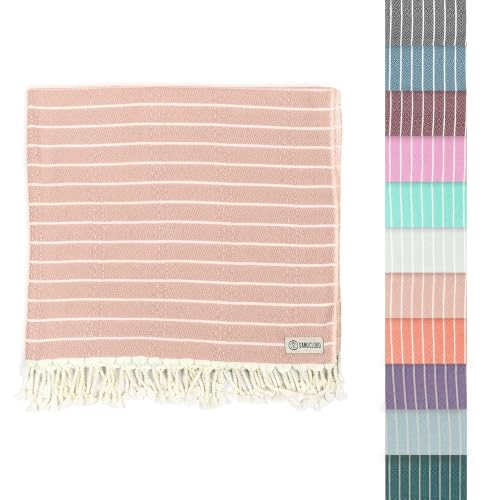
Sand Cloud Turkish Beach Towel Sand Resistant — Best Cotton Option
Sand Cloud is the pick for the buyer who has read this far thinking: I believe the physics, but I do not want plastic fibre on my skin. The towel is 100% certified organic Turkish cotton in a flat weave — the same construction family as the hammam peshtemal — described as sand resistant and quick dry, and sized generously enough that the listing also offers it as a bath towel or a picnic beach blanket. The Gocek colourway of this listing is a warm beige that hides sand visually as well as shedding it physically, and the brand’s Shark Tank appearance, noted in the listing, at least confirms this is an established label rather than a pop-up listing.
Cotton’s version of sand resistance deserves precise language. A flat cotton weave releases dry sand nearly as well as microfiber, because the geometry is the same; where cotton concedes ground is drying speed and pack size, since cotton holds more water in the fibre itself and folds bulkier. In exchange you get a hand-feel most people prefer, no microfiber care anxieties, and a natural fibre story backed by an organic certification stated in the listing. On a home beach — one you drive to, with a house or car nearby — those trades favour Sand Cloud strongly. In a carry-on crossing an ocean, microfiber still wins. Choose by itinerary and the towel will not disappoint you.
- Material: 100% certified organic Turkish cotton, stated in the listing
- Weave: flat Turkish weave
- Colour of this listing: Gocek (Beige)
- Behaviour per listing: sand resistant, quick dry
- Alternative uses in listing: bath towel, picnic beach blanket
- Dimensions: not stated in the listing
Strengths
- Natural organic cotton for buyers avoiding synthetic fibre
- Flat weave delivers genuine dry-sand release
- Doubles as bath towel or picnic blanket at home
Trade-offs
- Dries more slowly than every microfiber pick here
- Packs larger than microfiber for the same footprint
- Dimensions are not stated, so check the listing if size is critical
Best for: cotton loyalists and home-beach users who want sand release without microfiber. Not suited for: ultralight travellers counting every gram and litre.
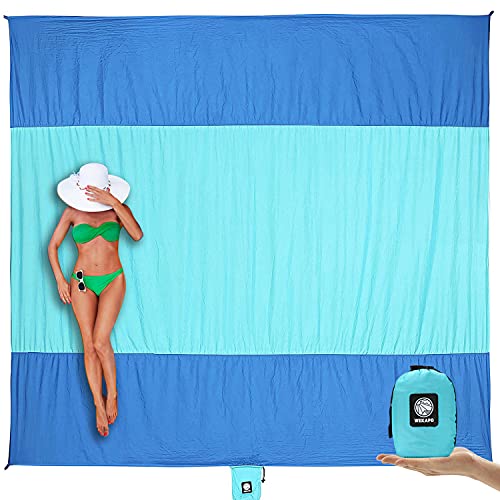
WEKAPO Beach Blanket Sandproof Extra Large — Best Group Base Camp
The WEKAPO is not a towel, and judging it as one would miss its purpose entirely. It is a 7-by-7-foot sandproof beach mat — sized for one to three people per the listing — in a quick-drying, lightweight fabric, supplied with six stakes and four corner pockets. The corner pockets fill with sand to weight the mat; the stakes pin it when the wind argues. Spread it and you have created a clean territory: bags sit on fabric instead of grit, snacks stay out of the sand, babies crawl on a surface you can shake clean in one motion at day’s end. Individual towels then do only the drying, while the blanket does the geography.
Families feel the difference immediately. Without a base camp, every item a group owns migrates into the sand within the hour; with one, there is a defined clean zone that even children learn to respect, because stepping off and back on is a visible act. The WEKAPO’s fabric sheds sand by the same smooth-surface logic as the towels, scaled up, and its size folds back down to a fraction of what a cotton blanket would demand. The honest costs: it dries nobody, it is one more thing to carry and to stake, and on a crowded beach a 7-foot square is a claim you should stake out early and politely. As the group’s foundation beneath the towels in this guide, nothing else here does its job.
- Size: 7 x 7 ft, stated in the listing (1–3 person size)
- Colour of this listing: Blue
- Included hardware: 6 stakes and 4 corner pockets, stated in the listing
- Behaviour per listing: sandproof, sand free, quick drying, lightweight, durable
- Material composition: not given in the listing
- Carry bag included: none stated in the listing
Strengths
- Creates a genuinely clean zone for a group’s gear and food
- Stakes and sand pockets keep it placed in real wind
- Shakes clean at day’s end like the towels, at blanket scale
Trade-offs
- Dries nobody; it complements towels rather than replacing them
- Staking and folding add a few minutes to setup and packing
- Large footprint needs early, considerate placement on busy beaches
Best for: families and groups who want a sand-free headquarters on the beach. Not suited for: solo swimmers who travel with a single small bag.

Qinqinamu Microfiber Beach Towel 2 Pack — Best with Carry Bag
The Qinqinamu two-pack adds the small feature that organises everything else: a bag. Two oversized microfiber towels at 71 by 32 inches, thin and lightweight, sand free, arrive with a carry bag per the listing, and that bag changes the return journey — wet towels go into their own container instead of against dry clothes, and the pair stores as one unit in the cupboard instead of drifting apart. The listing aims the set at pool, swim, yoga, gym, camping and travel, and at gift buyers looking for vacation essentials for women, which the bag supports: this is the most presentable, self-contained package in the guide.
Against the Eunzel two-pack, the Qinqinamu trades a named pattern for logistics. Both give you two full-length microfiber towels with the same shake-clean surface; the Eunzel’s Palm design is the more decorative object, while the Qinqinamu is the better system. Travellers who have ever unpacked a suitcase perfumed by a damp towel wrapped in a plastic bag will price the included bag correctly — it is worth more than it looks. Care remains microfiber standard: wash without softener, keep heat moderate, and the suede surface keeps its smoothness and its sand-shedding manners season after season.
- Pack size: 2 towels with bag, stated in the listing
- Size per towel: 71 x 32 inches, stated in the listing
- Material: microfiber, stated in the listing
- Profile: thin, lightweight, oversized per the listing
- Suggested uses in listing: pool, swim, yoga, gym, camping, travel
- Colour or design name for this listing: not given in the listing
Strengths
- Included bag contains wet towels on the journey home
- Two full-length towels store and travel as one unit
- Gift-ready, self-contained package for vacation giving
Trade-offs
- Design options are plainer than patterned rivals
- Bag is one more component to keep track of
- Microfiber care rules still apply to both towels
Best for: organised travellers and gift buyers who value the complete kit. Not suited for: buyers who want bold patterns as their towels’ main feature.
How Do the Six Sand-Shedding Picks Compare?
| Pick | Material | Size | Count | Standout trait |
|---|---|---|---|---|
| ECCOSOPHY Microfiber Beach Towel | Microfiber | 71 x 35 in | 1 | Widest microfiber single, all-round benchmark |
| Widdonen Microfiber Beach Towel Compact | Microfiber | 71 x 32 in | 1 | Thinnest, most compact carry |
| Eunzel 2 Pack Microfiber Beach Towel | Microfiber | 71 x 32 in | 2 | Couple-ready pair, Palm design |
| Sand Cloud Turkish Beach Towel Sand Resistant | Organic Turkish cotton | Not stated | 1 | Natural fibre flat weave |
| WEKAPO Beach Blanket Sandproof Extra Large | Sandproof fabric | 7 x 7 ft | 1 mat | Staked group base camp |
| Qinqinamu Microfiber Beach Towel 2 Pack | Microfiber | 71 x 32 in | 2 + bag | Carry bag included |
Microfiber or Cotton: Which Sand-Shedding Surface Fits Your Trips?
Decide by asking where the towel dries. If the answer is a hotel balcony, a tent line or the back of a rental car, microfiber’s speed is decisive — it is the only material here that can be swum with in the morning, shaken, and packed dry by lunch. If the towel dries at home, on a real line with a day to spare, cotton’s slower pace stops mattering and its hand-feel and natural-fibre story take the lead, which is the Sand Cloud’s whole case. Pack size follows the same logic: microfiber towels roll to a bottle’s footprint, flat cotton to a folded shirt’s, and the WEKAPO blanket, despite its area, folds flat because its fabric is thin. Care splits the vote the other way — cotton tolerates any wash routine except softener, while microfiber wants softener avoided and heat kept moderate to protect its split fibres. Neither material is the correct one; each is correct for a drying environment, and matching material to environment is the whole skill of buying in this category.
How Do You Keep a Sand-Shedding Towel Working Season After Season?
Shake before you wash, every time, ideally at the beach and again over an outdoor bin at home; sand that reaches the machine abrades fibres and clogs filters, and the entire point of these surfaces is that the sand leaves willingly if you give it the chance. Wash microfiber separately from cotton terry, because terry lint migrates onto suede surfaces and dulls exactly the smoothness you bought. Skip fabric softener for both materials — it films microfiber’s split ends and coats cotton’s yarn — and keep dryer heat moderate. Rinse towels after salt-water days when you can; salt crystals left in any cloth stiffen it and hold moisture against the fibres. Store microfiber rolled or loosely folded rather than compressed under weight for months, and let everything dry fully before cupboard storage, because a sand-free towel put away damp trades a grit problem for a mildew one. Treated this way, the smooth surfaces stay smooth, and smooth is the whole product. One more habit separates owners whose towels last from owners whose towels fade: rotate. Two towels alternating dry fully, rest their fibres and share the ultraviolet and chlorine load, so a two-pack is not only a convenience for couples but a longevity strategy for a solo swimmer who swims often — buy the pair, alternate them, and both will outlast a single towel worked every day of the season.
What Mistakes Do Shoppers Make with Sand-Free Towels?
The first mistake is believing the strongest version of the claim and then feeling cheated by physics: wet sand sticks to everything, and the buyer who shakes a dripping towel, watches sand stay, and writes the product off has tested it in the one state no surface can pass. Dry first, then shake. The second mistake is washing microfiber with the family terry load and softener, which coats and lints the suede until it behaves like ordinary cloth. Third, shoppers buy a blanket expecting a towel or a towel expecting a blanket — the WEKAPO dries nobody, and no 71-inch towel shelters a family’s picnic; the guide separates them for a reason. Fourth, people choose by colour photograph and ignore the stated inches, ending with a travel towel too narrow to wrap in. Finally, some buyers rub microfiber like terry, find the drying action different, and conclude it does not absorb; the wipe-and-press technique takes one swim to learn and is the price of the surface that makes the sand leave.
How Does a Sand-Free Setup Change a Family Beach Day?
Run the day twice in your head. Without sand-shedding gear, every return to the towels is a negotiation with grit: sandwiches acquire texture, the baby’s spare clothes come home sandy, phones and sunglasses share a bag with a terry towel that has been harvesting sand since ten o’clock, and the evening ends with shaking rugs and vacuuming the car. With a WEKAPO staked as base camp and microfiber or flat-cotton towels for drying, the geography flips. The blanket’s clean zone holds the food and the electronics; towels that shake clean stop importing sand into bags; children learn the border of the mat the way they learn any household rule, by seeing it work. At packing time the whole kit — blanket shaken and folded, towels shaken and rolled — leaves the beach’s sand at the beach, which is the entire promise of this category stated as a lived experience rather than a product claim. No single item performs that transformation alone; it is the system of smooth surfaces, each doing its layer of the job, and it is why this guide includes a blanket among towels without apology. Parents in particular will recognise the deepest benefit as an evening one: bedtime after a beach day stops including the archaeological excavation of sand from ears, scalps and the folds of the car seat, because the sand was refused entry at the shoreline instead of being fought room by room at home.
Which Size and Format Should You Choose?
Every towel in this guide is at least 71 inches long, and that length is doing quiet work: it lets the towel serve as a full-body lounger, a wrap with real overlap, and a changing screen in a pinch. Width is where the picks separate. The ECCOSOPHY’s 35 inches wrap a broader adult comfortably and give more lounging territory, while the 32-inch towels from Widdonen, Eunzel and Qinqinamu trim width to buy packability — a trade that travellers feel as pure gain and loungers feel as a small loss. If you are between formats, think about your last three beach trips rather than your ideal one. Towels that were carried in a tote and spread on rented chairs reward width; towels that were stuffed in a daypack and hiked with reward the trimmer cut. The two-packs add a different axis: they are not really about size at all, but about never being the person whose towel is still wet. Rotation is a comfort feature as real as absorbency, and it is why couples who start with a two-pack rarely go back to singles.
Then there is the blanket question, which is really a group-size question. One or two people generate a manageable amount of gear, and towels alone keep it clean. Three or more people — especially with children, coolers, toys and electronics in the mix — generate a small settlement, and settlements need ground rules and ground cover. That is the WEKAPO’s threshold: the moment your beach footprint includes things that must not get sandy, a staked mat stops being an extra and becomes the foundation the rest of the kit stands on.
How Do Sand-Shedding Towels Behave Away from the Beach?
The same surface that releases sand releases other things, and owners quickly find second careers for these towels. At the pool, microfiber’s smoothness shrugs off the gritty dust of concrete decks and dries between swims fast enough to stay pleasant through a long afternoon. At the gym and in yoga, the suede surface grips a mat or a bench differently from cotton — less slide, easy wipe-down — which is why so many of these listings name those uses without stretching. Campers value the wring-dry behaviour most: a microfiber towel wrung hard is nearly serviceable again immediately, so a three-day trip needs one towel where cotton would demand two and a prayer for sun. On boats, quick drying in wind and indifference to spray make these towels deck standards. Even at home, a microfiber towel hung after a shower dries fast enough to dodge the musty smell that haunts cotton in humid bathrooms, though most owners keep their sand towels in the travel kit and their cotton in the bathroom, letting each material work where it is strongest. The Sand Cloud splits the difference, living happily in both worlds for people who prefer one towel with two jobs.
What About Microfiber and the Environment?
A sand guide that recommends synthetic towels owes readers a straight paragraph on the trade. Microfiber is a plastic textile, and washing synthetic fabrics releases microfibres into wastewater; that is established and worth weighing. The counterweights are also real: a microfiber towel lasts for years of hard travel use, needs less water and energy per wash-and-dry cycle than bulky cotton because it is thin and fast-drying, and replaces the disposable or short-lived alternatives travellers might otherwise cycle through. Cotton’s ledger is not spotless either — conventional cotton is thirsty to grow — which is precisely why the Sand Cloud’s certified organic cotton matters to buyers who have chosen the natural-fibre side of the argument. Practical middle steps exist for microfiber owners: wash less often (these towels genuinely need less washing, since they dry fully between uses), wash full loads, and shake sand out outdoors rather than sending grit and fibre down the drain together. Choose the material whose full ledger you can live with; both sides of this guide were selected to be defensible.
How Should You Test a Sand-Free Towel in Its First Week?
Put the claim through three small trials before the towel’s first big trip, while returns are still easy. Trial one is the dry shake: spread the towel on dry sand, walk on it, gather it up and shake. On the microfiber and flat-cotton picks here, the sand should leave in a visible sheet rather than clinging in patches. Trial two is the wet test, done honestly: soak the towel, shake it wet and watch sand stay — that is physics, not failure — then hang it and time how long until the dry shake works again. That interval is the towel’s real working rhythm, and microfiber’s will be far shorter than cotton’s. Trial three is the bag test: roll the towel with a pair of sunglasses and a paperback for an afternoon, then inspect. A genuinely smooth surface leaves the lenses un-gritted and the pages clean, which is the everyday benefit owners actually brag about. A towel that passes trials one and three and posts a drying time you can live with in trial two is a keeper, whatever its brand, and you will have learned its habits before the holiday that counts. Add a fourth informal trial if children are involved: hand the towel to the child. Kids drag towels through sand, wear them as flags and drop them face-down, and a surface that still shakes clean after that treatment — as every smooth pick here should — has passed the only stress test that family life actually administers.
What Do Lifeguards, Surfers and Beach Regulars Know About Sand?
People who spend two hundred days a year on sand stop fighting it and start routing it. Their towel discipline is consistent: the towel is a tool with a dirty side and a clean side, and the dirty side always faces the sand. They dry off standing up, on the mat or at the towel’s edge, rather than sitting down wet — because a wet body on a towel is how sand transfers and stays. They keep a strict border between the towel zone and the play zone, which is the WEKAPO principle at towel scale. They shake out at the waterline or the car park, not at the towel’s home spot, so the day’s collected sand does not rain back onto the clean camp. And they rinse feet last, after the final shake, walking to the car on the driest path available. None of this requires special equipment, but all of it multiplies the value of smooth-surfaced towels, because technique and surface solve the same problem from two directions. Adopt the regulars’ habits with any pick in this guide and the sand in your life drops by an order of magnitude; keep old terry habits with a new microfiber towel and you will still win, just by less.
How Many Sand-Shedding Towels Does a Household Need?
Count swimmers, then count laundry days. A solo regular needs one microfiber towel for daily use and, ideally, a second for the rotation on trips — the Eunzel or Qinqinamu pack is exactly that arithmetic in a box. A couple at a home beach manages with two towels plus the Sand Cloud or a spare for guests, because home laundry resets everything overnight. A family with children should think in terms of one towel per child plus one communal spare, since children’s towels lead harder lives — dragged, buried, used as capes and picnic cloths — and microfiber’s toughness and fast drying are never more valuable than in that service. Add the blanket when the group’s gear footprint justifies it, usually at two children or the first cooler-and-electronics era. The mistake is buying to a single number for every household: a cruise passenger and a beach-house family both need sand-shedding towels, but one needs a bottle-sized roll and the other needs a shelf of them, and this guide’s spread from single compact towels to two-packs to a group blanket is built to cover that whole range without forcing anyone to buy the wrong format.
What Should You Look for on the Listing Before You Order?
Read a sand-free listing the way you would read a weather forecast — for the specifics under the adjectives. Dimensions first: length near 71 inches is the adult standard across this guide, and a listing that hides its size behind photographs is telling you something. Surface second: the words microfiber suede, flat weave or smooth should appear in some form, because a sand claim attached to plush or terry language contradicts itself. Third, pack contents stated plainly — one towel, two towels, a bag, stakes — so the WEKAPO’s six stakes and four pockets or the Qinqinamu’s bag are confirmed rather than assumed from a styled photo. Fourth, care instructions: a listing confident enough to describe washing honestly is usually describing a real product. Finally, colour: pick the colourway you will still enjoy in year three, because these towels last, and the Havana, Palm, Blue and Beige options across this guide exist so that the practical choice does not have to be the dull one. A listing that survives those five checks is very likely the towel its photographs promise.
Why Do Hotels and Swim Schools Choose Smooth Towels?
Commercial settings reached this category’s conclusion years ago, for reasons of pure logistics. A swim school cycling hundreds of towels a week needs cloth that dries between sessions, launders fast, and does not import the pool deck’s grit into the wash — smooth, thin towels win on every count, which is why the listings in this guide so often name gym, pool and spa among their intended uses. Rental properties tell the same story from the other side: a host who stocks microfiber or flat-weave towels finds them returned to the rail dry and shaken clean by guests, while terry comes back damp, sandy and occasionally ruined. None of this means the home buyer should think like a hotelier — comfort and pleasure count at home in ways they cannot in a facility — but when the professionals and the travellers independently converge on a surface, the home buyer can trust that the surface earns its reputation under real workloads. The picks above are the consumer versions of that professional logic, sized and coloured for people rather than institutions.
How Do These Towels Handle Sunscreen, Salt and Chlorine?
Beach chemistry is the quiet test every towel in this guide sits weekly. Sunscreen is the main adversary: its oils sit on microfiber’s surface and, left unwashed for days, can hold odour and dull absorbency, while on cotton they set as faint grease shadows. The fix is boring and effective — rinse the towel in fresh water at the beach shower when you can, and wash it within a day or two of a heavy sunscreen outing rather than letting it ferment in a hot car. Salt water is gentler than its reputation: salt stiffens any cloth as it dries, which owners notice as a board-like towel on day two of a camping trip, but a fresh-water rinse restores softness completely and no fibre damage accumulates from salt alone. Chlorine is the slow fade — pool regulars will watch bright colourways soften over a season, with cotton generally fading a touch faster than microfiber — so dedicated pool towels in darker or patterned designs, like the Havana ECCOSOPHY or the Palm Eunzel, hide the process best. None of these chemicals defeats the sand-shedding surface itself; they attack colour and softness, not geometry, which is another quiet advantage of solving the sand problem with surface structure instead of a coating that chemistry could strip away.
Final Recommendation
Start with the ECCOSOPHY Microfiber Beach Towel if you want the category’s proven all-rounder, or the Eunzel 2 Pack Microfiber Beach Towel if there are two of you and one order should settle it. Cotton loyalists should go directly to the Sand Cloud Turkish Beach Towel Sand Resistant and accept its slower drying as the fair price of natural fibre. And families should treat the WEKAPO blanket as infrastructure, not accessory. Whichever surface you choose, learn the one habit that makes it work — dry, then shake — and the sand will stay where it belongs, on the beach you borrowed for the day, instead of colonising your car, your laundry and your luggage for the rest of the summer.
Frequently Asked Questions
Do sand-free towels really work, or is it marketing?
They work by geometry, within honest limits. A smooth surface gives dry sand nothing to grip, so a shake clears it — that part is simple physics and easy to verify the first time you try. The marketing overreach is the implied absolute: wet sand and fine dust still cling, and drying the towel briefly before shaking is part of the method, not an excuse for it.
How do you dry off with microfiber if it feels like a chamois?
Use a press-and-wipe motion rather than terry’s rub. Microfiber suede absorbs across its surface, so drawing it smoothly over skin moves water into the cloth efficiently. Most people adapt within one swim. Wringing the towel mid-session restores its capacity, since microfiber releases water under pressure better than cotton does.
Can I put microfiber beach towels in the washing machine?
Yes — machine washing is the normal care route. Wash them apart from terry cotton to keep lint off the suede surface, skip fabric softener, and use moderate heat when drying. Shake sand out thoroughly before the load, both to protect the machine’s filter and because washing sand into any fabric works it deeper rather than out.
Is the WEKAPO blanket a substitute for towels?
No, and it is not sold as one. The blanket is ground equipment: a clean, staked territory for people, food and gear. You still dry swimmers with towels. The pairing is the point — the blanket keeps the sand out of your camp while the towels keep it off your skin and out of your bag.
Why does my microfiber towel feel less absorbent after some months?
Almost always, care has filmed the fibres. Fabric softener, dryer sheets and lint from mixed cotton loads coat the split fibres that do the absorbing. A wash in hot water with a plain detergent, run separately, often restores much of the performance. If the surface has gone shiny-smooth from high dryer heat, that damage is harder to reverse, which is why moderate heat is worth the habit.
Which pick is best for a cruise or resort trip?
The ECCOSOPHY for a single traveller, thanks to its width and pack size, and the Qinqinamu two-pack when you want the bag for the return journey with damp gear. Both roll to a fraction of a hotel towel’s bulk, dry on a balcony overnight, and shake clean on deck — the three behaviours travel actually rewards.
Does sand-free fabric work for dogs and kids after the beach?
Surprisingly well, and many households discover this use by accident. A microfiber towel wiped over a sandy dog or a child’s feet before the car removes the loose dry grit that would otherwise transfer to seats, because the same smooth surface that releases sand also picks it up loosely rather than grinding it in. Keep one towel as the designated car towel — the Widdonen’s compact size suits the role — and the family vehicle stays dramatically cleaner across a summer.
Will a sand-shedding towel still work after years of use?
Yes, if its surface survives, and surface survival is mostly a care story. Microfiber kept away from softener films and high heat keeps its split-fibre texture and its release behaviour for years. Flat cotton is even more forgiving, since its smoothness is the weave itself rather than a fibre treatment. The towels that stop shedding sand have usually been coated, linted or scorched out of their original surface, not worn out of it.
Related Guides
When size rather than sand is your deciding factor, our extra-large guide covers the biggest footprints in cotton and microfiber, and the wider library handles the walk back to the house and the cooking that follows a beach day. Between the towel guides, most beach kits settle into a simple division of labour: one sand-shedding towel per swimmer for the water’s edge, and the largest towel you own reserved for the person who reads three chapters without moving. See Best Extra Large Beach Towels for maximum-coverage options, Best Indoor Outdoor Slippers for footwear that survives deck, garden and shoreline paths, and Best Offset Smokers for Bargain for feeding the crew once everyone is home and hungry.



[…] Smoking fuel is a genuine fork in the road, and readers cross-shopping power sources will find our companion piece on the Best Propane Gas Smokers useful for its look at bottle-fed cabinets. Away from the patio, the same household may be sorting out a gentler wake-up with the Best Alarm Clocks with USB, and summer planning continues in our roundup of the Best Beach Towels That Repel Sand. […]