What's inside
- Quick Picks
- How We Chose These Picks
- Key Takeaways
- Detailed Reviews
- Comparison Table
- How to Choose a Cold Tub by Capacity, Insulation and Site
- Ice, Chillers and the Arithmetic of Cold
- Common Mistakes When Buying and Siting a Cold Tub
- Setting Up an Inflatable Tub Without Regrets
- The Daily and Weekly Rhythm of Owning One
- Cold Water, Plainly: A Short Safety Frame
- Where Tubs Live: Patio, Garage, Garden and Gym
- What a Second Season Teaches
- Buying for a Household, Not a Photograph
- Final Recommendation
- Frequently Asked Questions
- Related Guides
As an Amazon Associate I earn from qualifying purchases. This post may contain affiliate links at no extra cost to you.
As an Amazon Associate, cottageverdict.com earns from qualifying purchases made through links in this guide — at no extra cost to you.
Where to buy: all six tubs below are sold on Amazon, and each name links to its listing from the Quick Picks table, from its review heading, and from the comparison table. Use any of those links to check price on Amazon, and before you order, confirm the filled capacity, the footprint when inflated, and whether a cover is included, because the best cold tubs are simply large vessels of very cold water, and the right one is the one whose size and setup suit your space and your routine.
A cold tub, stripped of ceremony, is an insulated container that holds water cold enough to make you gasp. The six in this guide are all portable, inflatable designs — no plumbing, no permanent installation, no builder. You unroll one on a patio, a garage floor, or a patch of garden, inflate it, fill it from a hose, add ice or connect a separate chiller where the design allows, and step in. When the season ends or the novelty reorganises itself, you drain it, dry it, fold it, and store it on a shelf. That reversibility is the entire appeal of the category, and it is why inflatable models have taken over the home market from the converted chest freezers and stock tanks that early enthusiasts improvised.
Within that simple idea, the differences are practical rather than mystical. Capacity runs from 90 gallons to an enormous 216 gallons, and capacity decides everything downstream: how much ice a fill consumes, how long the water stays cold, how many people can sit in it, and how much a full tub weighs on the surface beneath it. Insulation varies from layered walls to a stated six-layer construction, and lids or covers are included with most picks — a detail that matters daily, because an uncovered tub of cold water is an invitation to leaves, insects, and curious wildlife. Two picks state compatibility with separate water chillers, which changes the long-term running pattern from buying ice to plugging in a machine you purchase separately.
This guide describes these tubs factually — capacity, insulation, covers, drainage, portability — and makes no promises about what cold water will do for a body. A short, plain safety note belongs in any honest discussion of the category, and here it is, stated once: follow the maker’s guidance for use, keep sessions short, keep children out of these tubs, and anyone with a heart condition should not use one. Beyond that, what follows is a buying guide about vessels, not a promise about outcomes.
Quick Picks
| Pick | Badge | Why it earns its place |
|---|---|---|
| Pod Company Ice Pod Pro | Best All-Round Specification | A 110-gallon insulated inflatable tub, chiller compatible, BPA-free, with UV-resistant nylon and dual drain hoses, fitting users up to 6 feet 7 inches. |
| XXL Ice Bath 216 Gallon | Best for Maximum Capacity | A 216-gallon inflatable tub compatible with water chillers, with an insulated lid, thermometer and water-absorbent mat included. |
| Bubplay Cold Plunge XL 105 | Best Layered Insulation | A 105-gallon tub with 6-layer insulation, 8 steel rods, an easy drain hose and tool-free, foldable setup. |
| Jecoo Ice Bath 90 Gal | Best Compact Capacity | A 90-gallon portable tub with a cover and multiple layered construction for home or outdoor use. |
| BINYUAN XL Ice Bath 99 Gal | Best Garden Versatility | A 99-gallon tub with a cover and multiple layered portable build, aimed at gardens, gyms and home use. |
| VEVOR Ice Bath XL | Best Barrel Format | A 105-gallon portable outdoor plunge barrel in black from a tool-and-equipment maker. |
How We Chose These Picks
Selection started with the numbers a buyer can verify: stated capacity in gallons, stated insulation construction, and stated inclusions such as lids, covers, and drain arrangements. Tubs whose titles offered only adjectives were passed over in favour of tubs that commit to figures. The final six span the useful capacity range — 90 gallons at the compact end, two at 105, one at 99, one at 110, and one very large 216-gallon model — so a reader can match the vessel to their body, their space, and their ice supply without extrapolating from a single size.
Chiller compatibility was treated as a distinct fork in the road rather than a bonus. Two titles state it plainly, and those picks are reviewed as tubs that can pair with a separate chiller unit; the chiller itself is not included with any pick here, and the guide never describes a tub as though it were. The remaining four are ice-managed tubs, filled and chilled the direct way, and their reviews judge them on insulation and covers, which is where ice-managed ownership is won or lost.
Portability claims were read sceptically and specifically: inflatable and foldable where a title says so, tool-free setup where a title says so, drain hoses where a title counts them. A tub that must be emptied by bucket would be a different ownership experience from one with a drain hose, and the reviews keep those mechanics visible because they decide whether the tub gets used weekly or abandoned by August.
Key Takeaways
- Capacities here run from 90 to 216 gallons; larger tubs hold their cold longer but consume far more ice per fill.
- Every pick is a portable inflatable tub only — no chiller is included with any of them.
- Two titles state compatibility with separate water chillers; the other four are designed around adding ice directly.
- Covers or insulated lids come with most picks and are the single most useful daily accessory in the category.
- Insulation is described as layered construction on several picks and as a stated six layers on the Bubplay.
- Drainage matters: dual drain hoses, easy drain hoses, and simple covers separate the convenient tubs from the chores.
Detailed Reviews

Pod Company Ice Pod Pro
The Ice Pod Pro is the most completely specified tub in this group, and its title reads like a checklist written by someone who has answered customer questions for a year. Capacity is 110 gallons, given as 420 litres. The tub is insulated and inflatable, fits users up to 6 feet 7 inches tall, is made from BPA-free, UV-resistant nylon, arrives with dual drain hoses, and is compatible with a chiller — a separate unit, to be clear, that this purchase does not include. Each of those facts answers a real ownership question, and together they make this the pick for a buyer who wants the fewest unknowns in the box.
The height figure deserves emphasis because cold tubs are sat in, not stood in, and a tall user in a short tub ends up with knees at chin height and water at the waist rather than the shoulders. A tub that accommodates a 6-foot-7 frame will seat most adults fully, with the waterline where the design intends. UV resistance matters for the same unglamorous reason: these tubs live outdoors, and sunlight is the slow enemy of every inflatable material. A maker who specifies UV-resistant nylon is designing for a tub that stays on the patio rather than one that must be hidden from the sky.
Dual drain hoses sound like a footnote until the first emptying. One hundred and ten gallons is a lot of water to move, and drainage decides whether a water change is a ten-minute task or an afternoon. Two hoses speed the job and give a backup if one kinks. The BPA-free note completes the material picture for buyers who track such specifications. Taken together, this is the tub for the methodical buyer: the person who will set it up once, site it carefully, and use it on a schedule for seasons.
Strengths
- The most detailed specification in the group, including a stated maximum user height of 6 feet 7 inches.
- Chiller compatibility keeps the door open to ice-free cooling later, with the chiller bought separately.
- Dual drain hoses make emptying 110 gallons a manageable, quicker job.
Trade-offs
- A cover or lid is not named in the title, so confirm what ships for keeping debris out.
- At 110 gallons it needs a committed spot; this is not a tub to move weekly.
- Tall-user capacity means a larger footprint than the compact picks when inflated.
Mini spec box
- Capacity: 110 gallons (420 litres), per the listing title
- Construction: inflatable, insulated, UV-resistant nylon, BPA-free
- User fit: up to 6 feet 7 inches
- Chiller: compatible; chiller itself is a separate purchase
- Drainage: dual drain hoses
- Cover inclusion: not stated in the listing
Best for: a tall or methodical buyer wanting the fullest specification and a chiller-ready setup. Not suited for: a small patio, or anyone who wants the smallest possible fill to chill.
Check price on Amazon for the Pod Company Ice Pod Pro.

XXL Ice Bath 216 Gallon
Two hundred and sixteen gallons is not a typo, and it reorganises everything about ownership. This XXL inflatable tub holds roughly double the water of the group’s standard models, is compatible with water chillers, and arrives with an insulated lid, a thermometer, and a water-absorbent mat, for indoor or outdoor siting. A vessel of this size suits a household where more than one person uses the tub, a larger-framed user who finds standard tubs confining, or a dedicated space — a garage corner, a garden room — where the tub can live filled and ready rather than being set up per session.
The included thermometer is a small, telling accessory. Cold-water soaking is a practice of numbers for most of its users — they want to know the water’s temperature rather than guess it from the gasp — and a maker who bundles the thermometer understands the ritual. The insulated lid at this capacity is not a luxury but a necessity: a 216-gallon surface loses cold and gathers debris at a rate that would defeat an uncovered tub, and the lid also slows the warming that sunlight delivers to a dark garden. The absorbent mat addresses the dripping zone where users climb out, a detail that matters on indoor floors especially.
The cautions scale with the gallons. Filled, this tub holds well over three quarters of a tonne of water, so the surface beneath it must be genuinely load-worthy and level — a sound patio or concrete pad, not decking of unknown joists. Ice-chilling 216 gallons from tap temperature is a serious quantity of ice, which is why the chiller compatibility is best read as the intended long-term pattern for this model: the tub is the vessel, the separate chiller is the engine, and ice is the stopgap. Buyers with the space and the commitment will find nothing else in the group at this scale.
Strengths
- The largest capacity in the group by a wide margin, suiting bigger users or shared household use.
- An insulated lid, thermometer and absorbent mat are all included per the title.
- Compatibility with water chillers gives a realistic path to maintaining this much cold water.
Trade-offs
- Filled weight is very substantial, so siting demands a strong, level surface.
- Chilling this volume with ice alone takes a great deal of ice per fill.
- Its footprint will dominate a small patio or balcony entirely.
Mini spec box
- Capacity: 216 gallons, per the listing title
- Construction: inflatable
- Chiller: compatible with water chillers; unit sold separately
- Included: insulated lid, thermometer, water-absorbent mat
- Siting: portable for outdoor and indoor use, per the title
- User height limit: not given
Best for: a dedicated space, a larger user, or a household sharing one substantial tub. Not suited for: a small balcony, weak decking, or a casual first experiment with cold water.
Check price on Amazon for the XXL Ice Bath 216 Gallon.

Bubplay Cold Plunge XL 105
The Bubplay makes its case out of layers and rods: 105 gallons, six-layer insulation, eight steel rods, an easy drain hose, and a tool-free, inflatable, foldable build in black for indoor or outdoor use. The steel rods are the structural story — inflatable tubs hold their shape by air and water pressure, and rods suggest a frame that keeps the walls upright and the rim defined when the tub is filled, which is when lesser designs bulge and slump. A tub that keeps its shape is easier to enter, easier to cover, and easier to live beside.
Six-layer insulation is the thermal story, and it is the most specific insulation claim in this group. Layers slow the transfer of heat from a warm garden into cold water, which in practice means the morning’s ice is still meaningfully cold in the afternoon, and a fill lasts longer between changes. For an ice-managed tub — this title does not claim chiller compatibility — insulation is the whole running-cost argument, because every degree of warmth kept out is ice that does not have to be bought, carried, and tipped in.
Foldable and tool-free complete the ownership picture. A tub that folds can winter in a cupboard and travel to a holiday house or a training camp in a car boot; a tub that assembles without tools removes the last friction from setting it up on a whim. The easy drain hose handles the emptying. If your pattern is seasonal or mobile rather than permanent, this is the pick designed around your life rather than around a fixed patio corner.
Strengths
- Six-layer insulation is the most specific thermal construction claim in the group.
- Eight steel rods support the tub’s shape when filled, keeping walls and rim defined.
- Tool-free, inflatable and foldable design suits seasonal or travelling use.
Trade-offs
- Chiller compatibility is not stated in the listing, so plan on ice management.
- A lid or cover is not named in the title; confirm before assuming one is included.
- Rod-supported assembly, while tool-free, has more parts to keep track of in storage.
Mini spec box
- Capacity: 105 gallons (XL), per the listing title
- Insulation: 6-layer insulation
- Structure: 8 steel rods
- Drainage: easy drain hose
- Setup: tool-free, inflatable and foldable
- Colour and siting: black, indoor and outdoor
Best for: a seasonal or mobile user who values insulation and a tub that packs away. Not suited for: a buyer planning to add a chiller, or anyone wanting a permanent filled installation.
Check price on Amazon for the Bubplay Cold Plunge XL 105.

Jecoo Ice Bath 90 Gal
The Jecoo is the smallest vessel here at 90 gallons, and smallness is a genuine feature in this category rather than a compromise. Ninety gallons fills faster from a hose, chills with less ice, drains sooner, and fits the patios and balconies where a 110-gallon tub would crowd out the chair and the plant pots. Its title describes a portable tub with a cover and multiple layered construction, for adults, for home or outdoor use — a straightforward specification aimed at the buyer who wants cold water without dedicating a corner of land to it.
The included cover does daily work at this size. A smaller volume warms faster than a large one, surface for surface, so keeping the sun and the debris off the water between uses preserves each fill longer and stretches the interval between changes. Layered construction supports the same goal from the sides. The combination makes the Jecoo the natural first tub in this group: the one whose running effort is lowest, whose setup is quickest, and whose storage footprint when folded will not start an argument.
Proportion is the honest limit. A 90-gallon tub seats an average adult; a tall or broad user should compare its dimensions against the Pod Company’s stated height capacity before assuming comfort, because the title here does not publish a user height. Households where two people hope to soak together should also look at the larger picks — this is a one-person vessel, and reading it as anything else would be a disservice. Within its brief, though, it is the most easily owned tub in the guide.
Strengths
- The smallest fill in the group means the least ice, the fastest fill, and the quickest drain.
- A cover is included, protecting a smaller volume that would otherwise warm and gather debris quickly.
- Multiple layered construction supports the insulation a compact tub depends on.
Trade-offs
- Room for one: larger or taller users should check dimensions carefully before ordering.
- A smaller volume warms sooner than the big tubs once the cover comes off.
- Chiller compatibility is not given in the title.
Mini spec box
- Capacity: 90 gallons, per the listing title
- Construction: multiple layered, portable
- Cover: included, per the title
- Siting: home or outdoor use
- User height limit: no height figure published in the title
- Drain hose detail: the title does not describe the drain arrangement
Best for: a first cold tub, a small patio, or a solo user who values quick setup and low ice use. Not suited for: two-person soaking, or a very tall user who needs a stated height capacity.
Check price on Amazon for the Jecoo Ice Bath 90 Gal.

BINYUAN XL Ice Bath 99 Gal
The BINYUAN sits a step above the Jecoo at 99 gallons and speaks directly to garden owners: an XL tub with a cover, multiple layered portable construction, and a title that names gardens and gyms among its settings. That setting list is worth pausing on. A tub that lives in a garden faces leaves, rain, insects, and the occasional investigating cat, so the included cover is not an accessory but a condition of ownership — and a layered portable build suits a tub that may move between a lawn in summer and a sheltered corner in winter.
Ninety-nine gallons is a considered middle size: enough water to sit in properly, not so much that a fill becomes an event. For a home gym setup — the garage corner with the weights and the mat — a tub of this size tucks against a wall and fills from a nearby tap without dominating the room. The portable description means it can also be the tub that travels to a rented training space or a holiday let, then comes home again, which fixed installations can never do.
The title is less specific than some rivals about drainage and structure, so a careful buyer should read the full listing for the drain arrangement and any frame details before ordering, and should plan on ice for chilling, since no chiller compatibility is claimed. What the title does commit to — size, cover, layers, portability, settings — is a coherent package for the garden-and-gym owner it addresses.
Strengths
- A cover is included, essential for the garden siting this model is designed for.
- Ninety-nine gallons balances a proper soak against a manageable fill and ice load.
- Multiple layered portable construction suits moving between garden, gym and storage.
Trade-offs
- Drainage details are not given in the title, so check the listing before ordering.
- No chiller compatibility is claimed; ice is the cooling method here.
- Frame or rod structure is not stated in the listing title.
Mini spec box
- Capacity: 99 gallons (XL), per the listing title
- Construction: multiple layered, portable
- Cover: included, per the title
- Settings named: gardens, gyms and home use
- Chiller compatibility: not stated in the listing
- Thermometer inclusion: no thermometer named in the title
Best for: a garden or home-gym owner wanting a covered, portable, mid-size tub. Not suited for: shoppers who want every mechanical detail specified in the title itself.
Check price on Amazon for the BINYUAN XL Ice Bath 99 Gal.
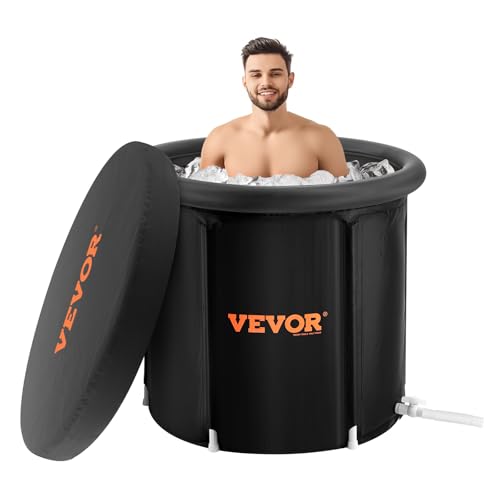
VEVOR Ice Bath XL
VEVOR comes to this category from the world of tools and outdoor equipment, and its tub reads accordingly: an XL portable outdoor plunge barrel in black, at 105 gallons. The barrel word matters. A barrel format stands taller and narrower than the wide, low tubs, which changes the sitting posture — more upright, knees drawn up, water deeper around the torso — and suits users who prefer to sit tall rather than recline, as well as patios where floor area is scarcer than headroom. On a small terrace, a barrel’s footprint can be the difference between fitting a tub and not fitting one.
At 105 gallons it matches the Bubplay’s capacity while taking a different shape to reach it, which makes the pair a useful comparison: layers and rods and foldability on one side, barrel depth and a maker’s no-nonsense outdoor brief on the other. The title is spare — it does not itemise a cover, insulation layers, or drainage hardware — so the full listing deserves a careful read on those points before purchase. What is stated is clear: portable, outdoor, XL, black, 105 gallons.
For an outdoor-only life, the barrel’s virtues compound. It can sit in a garden corner through the season, its smaller footprint leaving the lawn usable, and its upright form makes entering and leaving a matter of stepping over a rim with something to hold in mind rather than lowering into a wide pool. Buyers who picture their soaking as a brisk, upright, outdoor ritual — hose, ice, in, out, done — will recognise their tub in this description.
Strengths
- The barrel format gives depth on a smaller footprint, suiting tight terraces and upright sitting.
- At 105 gallons it matches the group’s mid-size capacity in a different, space-saving shape.
- A portable outdoor brief from an equipment maker suggests a tub built to live outside.
Trade-offs
- Cover and insulation details are not given in the title; read the full listing carefully.
- The upright barrel posture will not suit users who prefer to stretch out.
- Chiller compatibility is not stated in the listing.
Mini spec box
- Capacity: 105 gallons (XL), per the listing title
- Format: portable outdoor plunge barrel, black
- Insulation layers: no layer count in the title
- Cover inclusion: confirm on the listing page
- Drainage detail: see the full listing for the arrangement
- Chiller compatibility: no claim made in the title
Best for: a small terrace or garden corner, and users who prefer an upright, deep soak. Not suited for: anyone wanting to recline at length, or a buyer who needs inclusions itemised upfront.
Check price on Amazon for the VEVOR Ice Bath XL.
Comparison Table
| Pick | Capacity | Insulation / build | Cover | Chiller note |
|---|---|---|---|---|
| Pod Company Ice Pod Pro | 110 gal | Insulated, UV-resistant nylon | Not in listing title | Compatible; chiller separate |
| XXL Ice Bath 216 Gallon | 216 gal | Inflatable, insulated lid | Insulated lid included | Compatible; chiller separate |
| Bubplay Cold Plunge XL 105 | 105 gal | 6-layer insulation, 8 steel rods | Not in listing title | Not in listing title |
| Jecoo Ice Bath 90 Gal | 90 gal | Multiple layered | Cover included | Not in listing title |
| BINYUAN XL Ice Bath 99 Gal | 99 gal | Multiple layered, portable | Cover included | Not in listing title |
| VEVOR Ice Bath XL | 105 gal | Barrel format | Not in listing title | Not in listing title |
How to Choose a Cold Tub by Capacity, Insulation and Site
Start with your body and be literal about it. Sit on the floor with your back against a wall and your knees bent as they would be in a tub; have someone measure the space you occupy and note your height against the one stated limit in this group, the Pod Company’s 6 feet 7 inches. A tub that fits your frame at a smaller capacity will serve you better than a cavern that leaves you floating and bracing. Then count the users: a household of one soaks differently from a household of three, and the 216-gallon pick exists precisely for the second pattern.
Next, decide how the water gets cold, because that decision outlives every other. Ice management is simple, equipment-free, and scales with effort: smaller tubs need modest amounts, the largest needs a great deal, and a freezer full of frozen bottles is the thrifty middle path many owners adopt. A chiller — bought separately, and only for the two compatible models — converts the tub into an appliance with a running cost and a hum. Neither route is superior; they suit different temperaments, and choosing honestly now prevents the slow resentment of a tub that is always almost ready.
Site the tub before it ships. A filled tub weighs as much as a small car per gallon count — even 90 gallons is a serious load — so the surface must be level, strong, and close to a tap and a drain. Think about where the drained water will go, because a hundred gallons released carelessly will find the neighbour’s garden or the house’s foundations. Think about privacy, about the route from tub to warm indoors in winter, and about shade: a tub in full sun fights the sky all day, while a shaded corner keeps the cold you paid for.
Finally, plan the water itself. An uncovered, unchanged fill becomes uninviting quickly in warm weather; covers, prompt skimming of debris, and regular full changes are the unglamorous routine that keeps a tub pleasant. The makers’ guidance for your model governs the details — follow it, keep sessions short, keep children out of the tub entirely, and treat the whole practice with the respect that very cold water deserves.
Ice, Chillers and the Arithmetic of Cold
Every owner eventually does the same sum: how much ice does a fill take? The honest answer depends on the tap water’s starting temperature, the target temperature, and the tub’s insulation, but the proportions are stable — doubling the gallons roughly doubles the ice, and a big tub filled from a warm summer tap is a serious purchase at the ice shelf. This arithmetic is why capacity is a running-cost decision disguised as a size decision, and why the 90-gallon Jecoo will always be cheaper to chill than the 216-gallon XXL, however the two compare on the day they arrive.
Frozen water bottles are the experienced owner’s amendment to the sum. A chest freezer holding a rotation of large bottles gives you reusable cold that melts inside its plastic, so the tub’s water is not diluted and the bottles return to the freezer after each session. The trade is time and freezer space. Bagged ice is faster and colder at the margins. Many households blend the two: bottles for the daily maintenance of cold, bags for the deep chill before a planned session.
A chiller changes the arithmetic into a utility bill and a machine to house, and it only fits the two models whose titles say compatible. If you go that route, site the chiller where its fan can breathe, keep its hoses short and insulated where they run, and remember that the tub and chiller are separate purchases with separate listings — nothing in this guide bundles them. Owners who soak daily tend to arrive at a chiller eventually; owners who soak on summer weekends tend to find ice perfectly sufficient. Both are right, about different lives.
Common Mistakes When Buying and Siting a Cold Tub
The first mistake is buying capacity by enthusiasm. A first tub should usually be the smaller, cheaper-to-chill vessel that gets used three times a week, not the monument that gets used three times a summer; the Jecoo and BINYUAN exist for exactly that learning phase. The second mistake is siting by photograph — placing a filled tub on decking or a slope that looked fine empty. Water is heavy, patient, and honest about gravity, and it will find the low corner and stress it.
The third mistake is neglecting the cover. An uncovered tub gathers leaves, insects, and rainwater, warms in the sun, and becomes a chore to look at; the covered picks in this group, and a cover bought for the others, pay for themselves in fills that last. The fourth mistake is drainage improvisation: a hundred gallons needs a planned destination, ideally a drain or a soakaway, reached by the hoses the better-specified tubs include. The fifth is treating the tub as a toy for the whole household — these are adult products, children stay out, and the cover should be secured with that rule in mind.
Setting Up an Inflatable Tub Without Regrets
Setup day decides whether a cold tub becomes a habit or a storage problem, and it rewards the same patience as any water-bearing project. Choose the spot first and commit to it: level ground, close to a tap, within hose reach of a drain, and far enough from the house’s foundations that a hundred gallons of drainage has somewhere innocent to go. Lay the tub out flat, let the material relax in the sun for a while if the day offers one, and inflate it fully before any water arrives, because a tub filled while under-inflated will settle into wrinkles that no amount of later topping-up quite erases.
Fill with the cover decision already made. If your pick includes a lid or cover, keep it beside the tub from the first fill, because the habit of covering forms on day one or not at all. Watch the walls as the water rises; inflatable tubs announce their levelness honestly, the waterline creeping toward the low side and telling you exactly which corner wants a shim of packed earth or a board beneath. Correct it while the tub is a quarter full and still persuadable. At three quarters full, you own whatever slope you accepted.
The first entry should be a logistics rehearsal as much as anything: where the towel hangs, where the thermometer lives, what your feet cross between tub and door. In winter that route is the whole experience — ten warm steps are a pleasure, thirty cold ones across frosty paving are a negotiation. Site the tub with the return journey in mind and the practice survives the dark months, which is when a permanent, ready tub quietly outperforms a seasonal one that was folded away in October.
The Daily and Weekly Rhythm of Owning One
Ownership settles quickly into a rhythm. Daily, the cover comes off and goes back on, the surface gets a glance and, when needed, a skim with a small net or a hand, and the thermometer gets read by the people who like their cold quantified. None of this takes five minutes, and all of it is the difference between water that invites and water that merely exists. The tubs with insulated lids and covers — the XXL, the Jecoo, the BINYUAN — make this rhythm easiest, because the cover is already part of the object’s design rather than an afterthought leaning against the fence.
Weekly, the water wants a decision. Depending on use, weather, and the maker’s guidance, that decision ranges from a top-up and a tidy to a full drain, rinse, and refill. Draining is where the better-specified tubs repay their thoughtfulness: dual hoses on the Pod Company, an easy drain hose on the Bubplay, and a planned destination for the water turn the change into a background task. Time the drain for a day when the garden can use the water or the drain can take it without drama, and never release a full tub toward a slope that ends at a building.
Seasonally, the inflatable format shows its founding virtue. A tub can be dried thoroughly, folded, and stored under a bench or on a garage shelf, returning the patio to its other life. Drying is the step not to shortcut: a tub folded damp will smell of its mistake by spring. Store the hoses, rods where a model has them, and the cover together in one bag, and the next setup will take minutes instead of a search. Owners who treat the tub as seasonal equipment, maintained like a good tent, get years from it; owners who treat it as furniture get a season and a half.
Cold Water, Plainly: A Short Safety Frame
Very cold water is a physical stress, and this guide’s position on it is deliberately plain. Follow the guidance supplied with your tub, because the maker knows the product’s intended use. Keep sessions short, especially while you are learning your own responses. Get out promptly if you feel dizzy, unwell, or unusually short of breath, and warm up gradually afterwards rather than under the hottest water the shower can produce. Never soak alone in a remote spot while you are still a beginner; a household member within earshot is a simple, sufficient precaution for most home setups.
Children stay out of these tubs. That rule has no exceptions for good swimmers or brief dips, and the cover should be treated as a safety device as well as a thermal one — on, and secured, whenever the tub is unattended. Anyone with a heart condition should not use a cold tub, and anyone with a medical condition they are unsure about should settle the question with their own doctor rather than with a buying guide. Alcohol and cold water are a poor combination and belong in separate hours of the day. None of this diminishes the practice for the healthy adults it is sold to; it simply keeps the practice in the category of bracing rather than reckless.
Where Tubs Live: Patio, Garage, Garden and Gym
Each setting rewrites the ownership experience. On a patio, the tub joins the furniture and lives under the sky’s full administration — sun warming it, rain diluting it, leaves visiting it — which is why covers and UV-conscious materials earn their emphasis there. A patio tub wants to be near the house door for the winter dash and near a drain for the weekly decision, and those two pulls usually settle its exact square metre within an afternoon of living with it.
A garage offers the opposite bargain: shelter from weather and debris, water that holds its temperature with less help, and a floor that must be thought about honestly, because a hundred gallons and a garage floor drain are either best friends or a slow problem. The absorbent mat bundled with the XXL reads like an accessory designed by someone who has stepped out of a tub onto concrete in January. Gym spaces, home or shared, suit the mid-size portable picks — the BINYUAN names gyms in its title — because a tub there is equipment among equipment, filled, used, covered, and ignored until the next session without needing to charm anybody.
The garden is the romantic option and the demanding one. A tub among planting, filled on a summer evening, is the version of this hobby that sells the hobby. It is also the version with the most debris, the most insects, and the softest ground, so a proper base — a level pad of slabs or compacted gravel inside a frame — is the difference between a garden feature and a muddy negotiation. Choose the garden if you will maintain it; choose the patio if you are honest about your housekeeping, and let no photograph make that decision for you.
What a Second Season Teaches
First-season owners buy the tub; second-season owners understand it. They know which corner of their garden the afternoon sun reaches and have moved the tub out of it. They know their true ice consumption and have stopped over-chilling water for a session that the thermometer says was already cold enough. They have a draining routine that takes minutes, a drying routine that actually dries, and a storage bag where every hose, rod, and fitting lives together. The tub that survives into a third season is rarely the most expensive one; it is the one whose owner built these small systems around it.
The second season also clarifies the fork this guide keeps pointing at. Some owners discover that the ritual of ice — the freezer bottles, the planning, the thermometer — is itself the pleasure, a small ceremony of preparation. Others discover they want the water simply ready, and begin reading chiller listings for the two compatible models with new seriousness. Both discoveries are successes. The only failure mode in this category is the tub that taught its owner nothing because it was never quite convenient enough to use, and convenience, as the reviews above keep insisting, is decided by drainage, covers, insulation, and siting — the unglamorous facts in the titles.
Buying for a Household, Not a Photograph
Before the order, hold a short household summit. Who will use the tub, how often, at what hours, and who — name the person — will drain it, skim it, and dry it in November? Cold tubs fail socially before they fail mechanically: a tub maintained by nobody in particular becomes everybody’s eyesore by midsummer. The households that thrive with one assign the chores the way they assign the bins, and choose the size by the answer. A solo user with a tidy streak belongs in the 90 or 99-gallon class. A household of enthusiasts with a garage corner belongs in the conversation about the 216.
Neighbours deserve a thought where gardens are close. A tub is quiet, but its drainage is not invisible, its chiller, if one joins later, has a fan, and its users at dawn have voices. Site it with the same courtesy you would want aimed at your own fence, and the hobby stays the private, slightly eccentric pleasure it is meant to be rather than a street topic.
Final Recommendation
For most buyers, the Pod Company Ice Pod Pro is the safest pair of hands: the fullest specification, a stated height capacity, chiller compatibility for later, and drainage that respects your time. Seasonal and mobile users should take the Bubplay Cold Plunge XL 105 and its six layers and folding frame, while households with the space and the commitment will find the XXL Ice Bath 216 Gallon in a class of its own. First-timers are well served by the compact Jecoo. Choose the capacity your ice supply can feed and your floor can carry — and may your water be cold, your cover be on, and your towel be within reach.
Frequently Asked Questions
Do any of these tubs include a chiller?
No. All six picks are tubs only. Two titles — the Pod Company and the XXL — state compatibility with water chillers, which means a separate chiller unit can be connected; the chiller itself is a different purchase with its own listing.
How much ice does a fill take?
It depends on the tap temperature, the target temperature, and the tub size, but the proportions are predictable: a 90-gallon fill needs far less than a 216-gallon one. Many owners use large frozen bottles in rotation to avoid diluting the water, topping up with bagged ice before a session.
Can I leave an inflatable cold tub set up outdoors?
That is what most of them are designed for, especially under a cover or lid. UV-resistant material, as stated on the Pod Company model, helps an outdoor life. In hard winters, follow the maker’s guidance — many owners drain, dry, and store their tub until spring.
How often should the water be changed?
Follow the maker’s guidance for your model. In practice, covered tubs kept skimmed and used by one household last longer between changes than uncovered ones; visible debris, cloudiness, or any odour are the ordinary signals that a full change is overdue.
What surface can hold a filled tub?
A level, structurally sound surface — a concrete pad or solid patio is the safe default. Even 90 gallons is heavy, and 216 gallons is a very substantial load, so decking of unknown construction should be checked by someone qualified before it is trusted.
How loud is the ownership routine, honestly?
Quiet, mostly. Filling takes as long as your hose takes; draining is a hose-and-gravity affair on the models that specify one; the daily work is a cover lifted and replaced. The only machinery in the picture is a chiller, if you later add one to a compatible model, and its fan belongs in the siting conversation. The tubs themselves make no more noise than a paddling pool and considerably less fuss.
Can two people use these tubs together?
Only the largest capacities make that a realistic reading of the numbers. The 216-gallon XXL is the household-scale vessel in this group; the 90 to 110-gallon models are best understood as one-person tubs, however generous a single soak feels. Check the stated dimensions on the listing against two seated adults before assuming any mid-size model will share gracefully. Remember too that every additional user raises the waterline, warms the fill a little faster, and shortens the interval before the water wants changing, so a shared tub is not merely a bigger purchase but a busier maintenance pattern — one more reason the household conversation about who does the draining should happen before the box arrives rather than after the first algae-tinted Sunday makes the argument for you. A tub with an owner is a routine; a tub with a committee is a negotiation, and negotiations about cold water tend to be settled by the person who cares most standing in the garden with the hose while everyone else offers commentary from the warm side of the window. Choose the owner when you choose the tub, and the rest of the ownership story — the covers replaced without being asked, the water changed before it needs arguing about, the thermometer read and believed — tends to write itself in the right order, week after week, season after season. It is a small administrative decision with an outsized effect, the kind that never appears in a listing’s bullet points and yet quietly determines whether the tub in the garden is a pleasure the household defends or a project the household apologises for whenever a visitor’s eye happens to land on it. Name the owner, agree the draining day, and write both on the household calendar in ink; the tub will do the rest, asking only for cold water, a cover returned after every use, and a household that keeps its small promises to itself. That, in the end, is the entire secret of the category, and it costs nothing, weighs nothing, folds away nowhere, and cannot be ordered with the tub — which is exactly why it is worth stating here, in a guide that otherwise deals strictly in gallons, layers, lids, and hoses, and in the plain arithmetic of what a floor can carry, what a freezer can freeze, and what a household will actually do on a wet Tuesday in November when nobody is watching and the novelty has long since worn off.
Who should not use a cold tub?
Children should be kept out of these tubs, and anyone with a heart condition should not use one. Beyond that, follow the maker’s guidance, keep sessions short, and get out if you feel unwell — the tub will still be there tomorrow.
Related Guides
When you come back indoors, these guides cover the warm end of bathing and the floors around it.



[…] Best Cold Tubs […]