What's inside
- Quick Picks
- How We Chose These Picks
- Key Takeaways
- Detailed Reviews
- Comparison Table
- How to Choose a Deep Soaking Tub When Space Is Tight
- How Soaking Depth Actually Works: Overflow Height Explained
- Stone Resin Versus Acrylic in a Small Tub
- Common Mistakes in Small Bathroom Tub Projects
- Living With a Deep Tub: The First Month and Beyond
- Small Bathroom Layouts That Make a Deep Tub Work Harder
- Water, Heat and Running Costs in a Compact Deep Soak
- Converting a Shower Stall or Cloakroom Corner Into a Soaking Spot
- Deep Tubs and the People Who Share Them: Households, Guests and Growing Families
- Final Recommendation
- Frequently Asked Questions
- Related Guides
As an Amazon Associate I earn from qualifying purchases. This post may contain affiliate links at no extra cost to you.
As an Amazon Associate, cottageverdict.com earns from qualifying purchases made through links in this guide — at no extra cost to you.
Where to buy: Each tub below is sold through Amazon, with its name linking to the listing in the Quick Picks table, in its review heading and in the comparison table, so you can check price on Amazon and confirm the exact footprint before ordering. The search for the best deep soaking tubs for small bathrooms starts from a simple trade: give up length you cannot spare, and take depth instead, so the water rises over your shoulders while the tub still fits through the door of a compact room.
A small bathroom forces a choice that big bathrooms never face. A standard tub stretched to a comfortable length will not fit, yet a short shallow tub is a bath in name only. Deep soaking tubs answer by growing downward and upward instead of outward: shorter footprints, taller walls, and water that reaches the chest or shoulders of a seated bather. Several picks here follow the Japanese soaking tradition, where the bather sits upright on a built-in seat, immersed to the neck in a tub barely longer than a chair.
The six models below span three installation families. One is a 48 inch alcove tub that drops into the space a standard small tub vacates. Two are freestanding ovals at 55 and 43 inches. Three are Japanese-style soakers with seats, in stone resin and acrylic, at 47, 43 and 39 inches. Depths, where the listing states them, are striking: one square tub states 20.47 inches of depth, and the HIGEINE oval states 26.77 inches, numbers no ordinary shallow tub approaches.
Read the dimensions in this guide exactly as the listings give them, because depth claims are where soaking tubs live or die. Where a listing states a soaking depth or an overflow position, we quote it; where it stays silent, the spec box says so. Small bathrooms also punish careless measuring, so every review returns to footprint, door width and the seated posture these tubs are designed around. Depth is a gift only when the tub actually reaches the room.
Quick Picks
| Pick | Badge | Why it earns its place |
|---|---|---|
| VEVOR 48 Alcove Tub | Best Alcove Fit | A 48 by 30 inch alcove tub with left hand drain, integral flange, double-wall insulation and a stated 10.8 inch soaking depth. |
| DeerValley 55 Freestanding Tub | Best Freestanding for Small Rooms | A 55 inch freestanding acrylic soaker with centre drain and integrated overflow, the longest footprint here that still counts as compact. |
| MEDUNJESS 43 Japanese Tub | Best Stone Resin Seat Soaker | A 43 inch stone resin Japanese soaker with a seat, toe-tap chrome right drain, slotted overflow and cUPC certification, in matte white. |
| Square Japanese Soaking Tub 47 | Best Stated Depth and Capacity | The most transparent listing here: 47 inches, 20.47 inches deep, 39 gallons, with seat, pop-up drain and cUPC certification. |
| HIGEINE 43 Soaking Tub | Deepest Stated Tub | An oval Japanese-style soaker stating 26.77 inches of depth, with a built-in seat and ergonomic lumbar shaping at 43 inches. |
| MEDUNJESS 39 Japanese Tub | Smallest Footprint | At 39 inches it is the smallest tub in the guide, a stone resin seated soaker for the tightest bathrooms and ensuites. |
How We Chose These Picks
We required each pick to earn its place on depth or on a genuinely small footprint, preferably both, and we favoured listings that state their dimensions and depths numerically rather than hiding behind the word deep. The field was balanced across installation types so a reader with an alcove, a freestanding corner or a shower-sized space all find a candidate, and across materials, with acrylic, stone resin and a double-wall insulated alcove design represented. Japanese-style tubs with seats were included deliberately, because the seated posture is the honest answer to soaking in under four feet of length. Facts not stated in a listing are marked as not stated throughout.
Key Takeaways
- Depth replaces length in this category: stated depths include 20.47 inches on the square tub and 26.77 inches on the HIGEINE oval.
- Three picks are Japanese-style soakers with built-in seats, designed for upright immersion in footprints as small as 39 inches.
- Only the square 47 inch tub states a capacity, at 39 gallons; the other listings leave capacity unstated.
- One pick, the HIGEINE, states that its drain is not included, a budget detail worth knowing before you order.
- The VEVOR alcove model is the only left hand drain, alcove-format option, sized at 48 by 30 inches for existing small alcoves.
Detailed Reviews

VEVOR 48 Alcove Tub
Anyone replacing a short existing tub in a tiled alcove should start with the VEVOR, because it is the only pick designed for that exact job: 48 by 30 inches, an integral flange for the wall finish, and a left hand drain that matches the plumbing many small bathrooms already have. The listing states a soaking depth of 10.8 inches and double-wall insulation, which speaks to keeping the water warm. It is the renovation-friendly route into deeper soaking.
Door width decides more small bathroom projects than tub length does. A compact tub still has to travel through the house and turn into the room, often through the narrowest doorway in the home. Measure the bathroom door’s clear opening with the door removed from its hinges if necessary, and compare it with the tub’s smallest dimension, because a 43 inch soaker that cannot pass a 24 inch doorway is a garden ornament.
The first soak in a deep small tub teaches the filling trick: because the water rises around a seated body quickly, fill to a level lower than you think, get in, then top up. Displacement in a narrow deep tub is dramatic, and the slotted overflows on several picks exist precisely because enthusiastic first fills overshoot. Within two baths the right level becomes instinct, and the overflow returns to being a safety detail rather than a participant.
Strengths
- Alcove format with integral flange suits straightforward tub replacement
- Left hand drain position is stated clearly for plumbing planning
- Double-wall insulation and a stated soaking depth appear in the listing
Trade-offs
- At 48 inches it asks seated soaking rather than stretched-out bathing
- The stated soaking depth is shallower than the Japanese soakers here
- Right hand drain bathrooms would need plumbing changes to use it
- Footprint: 48 x 30 inches
- Soaking depth: 10.8 inches, as stated
- Drain: Left hand drain, overflow hole
- Build: Double-wall insulation, integral flange
- Capacity: not stated in the listing
Best for: small alcove renovations wanting a deeper, insulated replacement tub.
Not suited for: bathers wanting a freestanding look or a very deep upright soak.
The VEVOR 48 Alcove Tub is listed on Amazon, where you can check price and hold its dimensions up against your doorway.
DeerValley 55 Freestanding Tub
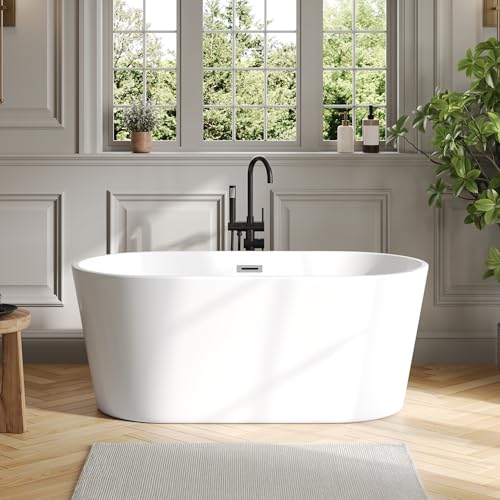
Small bathrooms that can spare a little more floor get the most conventional deep soak from the DeerValley: a 55 inch freestanding oval with an ergonomic design, a centre drain and an integrated overflow. It suits bathers who still want to recline rather than sit upright, in a room where a 60 inch tub would crowd the walls. The listing describes it as a standalone shower tub as well, hinting at flexible placement in tight remodels.
Plan the seated posture honestly. Japanese-style tubs trade sprawl for immersion: you sit on the seat, knees bent, water to your shoulders. Most converts love it within one soak, but a bather who equates bathing with floating flat should choose the 55 inch DeerValley or the alcove VEVOR instead. If two people in the household disagree, the disagreement will outlast the renovation, so settle it before ordering.
Seated soaking changes the bathing ritual in pleasant ways. Your shoulders and neck stay submerged while your head stays clear, so reading, conversation and a drink on the rim all become easier than when floating. Many owners report that the upright posture is where they finally use the bath salts and candles bought years ago, because the tub feels like a place to sit and be, not a vessel to lie in briefly.
Strengths
- 55 inch freestanding form reclines more than the seated soakers
- Centre drain and integrated overflow are both stated
- Acrylic keeps a freestanding tub light enough for upper floors
Trade-offs
- No numerical depth is stated, so deep is a description, not a figure
- Capacity does not appear in the listing either
- Freestanding placement still needs floor space on all sides for cleaning
- Length: 55 inches
- Material: Acrylic
- Drain: Centre drain, integrated overflow
- Depth figure: not given
- Model: DV-1T0582
Best for: compact rooms wanting a reclining freestanding soak at 55 inches.
Not suited for: buyers who need a stated depth figure before they commit.
DeerValley 55 Freestanding Tub — check price on Amazon, then run the tape measure over the room one last time.

MEDUNJESS 43 Japanese Tub
The upright soaking convert is the MEDUNJESS 43’s natural owner. Stone resin gives the small shell a solid, matte presence, the built-in seat sets the posture the style is famous for, and the toe-tap chrome drain on the right lets you empty the tub without reaching down through the water. The listing states cUPC certification and a slotted overflow. At 43 inches it fits corners and ensuite nooks that no reclining tub could enter.
Step-over height rises with depth, and depth is the point of these tubs. A wall over 26 inches deep asks for a confident step, so think about a grab bar on the wall beside the tub and a floor outside that stays secure under wet feet. Households with older bathers should rehearse the entry in the showroom of their imagination: sit, swing, lower. A small sturdy step outside the tub helps many bathers and costs little.
Heat behaves kindly in deep narrow tubs. The water column is compact, the surface area losing heat is small relative to the volume, and the bather’s body is mostly below the surface. The VEVOR’s double-wall insulation speaks directly to this, but the geometry alone helps every pick here. A lid or cover left across the top between filling and bathing, even a simple board, keeps a filled tub ready while you finish other things.
Strengths
- Stone resin construction with a matte white finish
- Built-in seat designed for upright, shoulder-deep soaking
- Toe-tap chrome right drain and slotted overflow are stated
Trade-offs
- Upright seated soaking is a different pleasure from reclining, and not for everyone
- No depth or capacity figure appears in the listing
- Stone resin is heavier than acrylic, so floor and carrying need thought
- Length: 43 inches
- Material: Stone resin
- Seat: Built-in seat
- Drain: Toe-tap chrome, right side
- Certification: cUPC certified, as listed
Best for: small ensuites wanting a certified stone resin soaker with a seat.
Not suited for: bathers who want to lie back, or who need stated depth figures.
On its Amazon page, the MEDUNJESS 43 Japanese Tub shows its current price; confirm the drain side there before ordering.
Square Japanese Soaking Tub 47
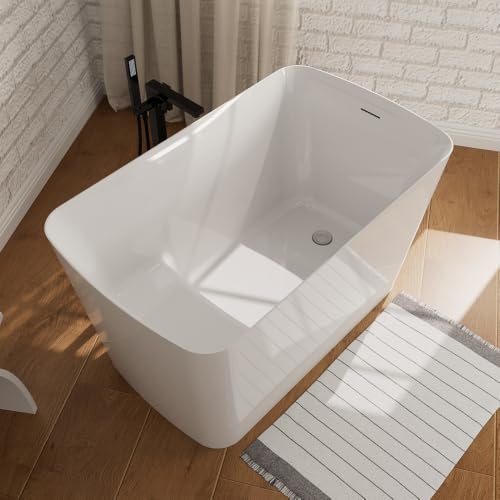
Shoppers who buy on numbers will love this square soaker, because its listing states what rivals omit: a depth of 20.47 inches and a capacity of 39 gallons, in a 47 inch square footprint with a seat. The square outline uses a corner efficiently, the acrylic keeps weight down, and the pop-up chrome right drain and slotted overflow are named. It is explicitly pitched at compact small spaces, and for once the numbers back the pitch.
Drain side is a small word with large consequences. The VEVOR drains on the left, both MEDUNJESS models and the square tub drain on the right, and the DeerValley drains in the centre. Match that to your existing waste position or accept the cost of moving it under the floor. In a small bathroom the floor is often concrete or tightly joisted, making waste moves pricier than the tub itself, so this check belongs at the top of the list.
Cleaning a deep tub means reaching down into it, so keep a soft cloth on a handle if bending is limited, and rinse the walls after each soak while they are still warm and wet. The seat ledge collects soap film in the Japanese models and deserves a wipe of its own. Matte stone resin shows water spots differently from glossy acrylic, preferring a prompt rinse to any later scrubbing campaign.
Strengths
- Depth stated at 20.47 inches and capacity at 39 gallons
- Square footprint tucks into a corner with little wasted floor
- Seat, pop-up drain, slotted overflow and cUPC certification all stated
Trade-offs
- Square styling will not suit every bathroom’s softer curves
- Seated upright posture replaces any idea of stretching out
- Glossy white is the finish named, limiting colour flexibility
- Footprint: 47 inches, square
- Depth: 20.47 inches, as stated
- Capacity: 39 gallons, as stated
- Drain: Pop-up chrome, right side
- Material: Acrylic, cUPC certified
Best for: number-driven buyers wanting verified depth in a corner-friendly square.
Not suited for: recliners, or bathrooms that cannot give up a square corner.
Visit the Square Japanese Soaking Tub 47 listing to check price on Amazon and verify the footprint fits your plan.

HIGEINE 43 Soaking Tub
Depth chasers, this is your headline act: the HIGEINE states 26.77 inches of depth, the tallest figure in this guide, wrapped in a 43 inch oval with a built-in seat and ergonomic lumbar shaping for the upright posture. Water at that depth covers the shoulders of most seated bathers completely. Read the listing’s capital letters, though: the drain is not included, so budget for one and confirm its fit before the tub arrives.
Water heating deserves a thought even though these tubs are small. Deep water over a seated bather still adds up, and the square tub’s stated 39 gallons is a useful guide to the class. A modest heater can fill that happily, but back-to-back baths in a busy household will test recovery time. The good news is that deep narrow tubs generally use less water than long shallow ones filled to the same shoulder height on a reclining body.
Children experience these tubs as wonderfully deep pools, which calls for supervision scaled to the depth rather than the room size. A 26 inch depth is over the waist of a small child standing, and seats can be slippery perches. Households with young kids should treat the deep soaker with the same respect as any deep water, keep the bathroom door latched, and empty the tub promptly after use.
Strengths
- Stated depth of 26.77 inches is the greatest in this guide
- Built-in seat with ergonomic lumbar shaping for upright soaking
- Oval freestanding form softens the look in a small room
Trade-offs
- Drain is explicitly not included, adding a purchase and a compatibility check
- Capacity is absent from the listing despite the depth figure
- A very deep tub raises the step-over height for entering and leaving
- Length: 43 inches, oval
- Depth: 26.77 inches, as stated
- Seat: Built-in seat, lumbar shaping
- Drain: Not included, per listing
- Capacity: none stated in the listing
Best for: depth-first bathers who want the deepest stated soak in 43 inches.
Not suited for: anyone wanting a drain in the box, or an easy low step into the tub.
For current pricing and the full listing detail, see the HIGEINE 43 Soaking Tub on Amazon before the installation date is set.

MEDUNJESS 39 Japanese Tub
The very smallest bathrooms, cloakroom conversions and ensuite corners are where the 39 inch MEDUNJESS makes soaking possible at all. It repeats its larger sibling’s formula in miniature: stone resin, matte white, a built-in seat, a toe-tap chrome right drain, a slotted overflow and cUPC certification as listed. Think of it as a deep soaking chair filled with water, sized for one bather who values immersion over sprawl and has almost no floor to give.
Ventilation matters more in a small room filled with deep hot water. Steam has nowhere to go, mirrors fog for hours and paint suffers over the years. Confirm the extractor fan actually clears the room, or budget for upgrading it as part of the project. A deep soak that leaves the bathroom damp until morning trades one pleasure for a maintenance problem, and small rooms forgive nothing.
Small bathrooms reward owners who keep the rim clear. A deep tub’s rim is narrow real estate, and bottles balanced there fall inward with a splash that a seated bather feels personally. A wall-mounted shelf or a caddy that suits the tub’s shape keeps products at hand without the acrobatics. The cleaner the rim, the more the little room feels like the calm soaking space the renovation promised.
Strengths
- 39 inch footprint is the smallest in this guide by a clear margin
- Stone resin build with matte finish feels substantial at small scale
- Seat, toe-tap drain, slotted overflow and certification are all stated
Trade-offs
- There is no reclining here at all; the posture is upright and seated
- Depth and capacity figures do not appear in the listing
- One bather only, and larger frames should test the fit mentally with care
- Length: 39 inches
- Material: Stone resin
- Seat: Built-in seat
- Drain: Toe-tap chrome, right side
- Depth figure: not given
Best for: the tightest bathrooms where soaking seemed impossible until now.
Not suited for: tall or broad bathers, or anyone who equates bathing with lying down.
Check the MEDUNJESS 39 Japanese Tub on Amazon for price, and let its stated depth be the number you plan around.
Comparison Table
| Pick | Type | Size | Drain / Heating | Headline fact |
|---|---|---|---|---|
| VEVOR 48 Alcove Tub | Acrylic alcove | 48 x 30 inches | Left hand drain | Soaking depth 10.8 in stated; Double-wall insulation |
| DeerValley 55 Freestanding Tub | Acrylic freestanding | 55 inches | Centre drain | Depth figure not in listing; Integrated overflow |
| MEDUNJESS 43 Japanese Tub | Stone resin freestanding | 43 inches | Right toe-tap drain | Built-in seat; Matte white, cUPC listed |
| Square Japanese Soaking Tub 47 | Acrylic freestanding square | 47 inches | Right pop-up drain | Depth 20.47 in, 39 gal stated; Seat and slotted overflow |
| HIGEINE 43 Soaking Tub | Acrylic freestanding oval | 43 inches | Drain not included | Depth 26.77 in stated; Seat with lumbar shaping |
| MEDUNJESS 39 Japanese Tub | Stone resin freestanding | 39 inches | Right toe-tap drain | Built-in seat; Smallest pick here |
How to Choose a Deep Soaking Tub When Space Is Tight
Measure the room in three dimensions, not two. Floor footprint decides whether the tub fits, door width decides whether it enters, and ceiling height matters when a tall tub must be tipped upright during installation. Write all three numbers down before browsing, and let them veto candidates ruthlessly. In small bathrooms the tape measure is the design tool; taste only gets a vote among the tubs that survive it.
Decide your posture before your material. If you want to recline, the 55 inch DeerValley and the 48 inch alcove VEVOR are your realistic candidates. If upright immersion appeals, the seated Japanese models deliver shoulder-deep water in footprints a recliner cannot match. Neither posture is superior; they are different baths. Choosing the posture first prevents the common regret of buying depth and discovering you miss lying down.
Read depth figures with a lawyer’s eye. Soaking depth, tub height and water depth to the overflow are different numbers, and listings state them inconsistently. In this guide we quote exactly what each listing states: the VEVOR’s 10.8 inch soaking depth, the square tub’s 20.47 inch depth, the HIGEINE’s 26.77 inch depth. Where a listing offers no figure, treat depth as unproven and ask the seller, because the whole purchase rests on that number.
Match the installation family to your room’s bones. An alcove tub needs an alcove; a freestanding tub needs floor space around it and a floor-level waste; a tiny Japanese soaker can stand where a shower stood. Retrofitting the wrong family into a room costs more than choosing the right family in a style you initially liked less. Plumbers consistently advise deciding this before choosing finishes, and they are right.
Do not forget the unglamorous inclusions. The HIGEINE’s listing states plainly that its drain is not included; others include toe-tap or pop-up drains. Faucets are separate decisions everywhere here, and a tall tub may need a taller filler. Total the whole working installation for each candidate, tub plus drain plus filler plus any waste move, and the honest favourite usually reveals itself.
How Soaking Depth Actually Works: Overflow Height Explained
A tub’s useful depth is set not by its outer height but by the position of its overflow, because water filled past the overflow simply leaves. When a listing states a soaking depth, it is describing roughly how much water can sit in the tub before the overflow takes the excess, and therefore how high water can rise on a seated bather. This is why two tubs of identical outer height can soak completely differently, and why this guide quotes depth figures only where listings state them.
In Japanese-style soakers the geometry compounds the effect. The bather sits on a raised seat, so the body’s mass starts higher, yet the water climbs a tall narrow column around them. Shoulders submerge in a footprint shorter than a dining chair is wide. Understanding this explains why the 39 and 43 inch models are not novelties: their depth does the work that length does in a conventional tub, and the overflow position is engineered to allow it.
When comparing any two tubs, ask for the depth to overflow if the listing omits it, and be wary of overall height presented as if it were water depth. The rim can tower several inches above the overflow. Honest sellers answer the question directly. Carry that single habit into any tub purchase and you will never again buy a deep-looking tub that soaks shallow.
Stone Resin Versus Acrylic in a Small Tub
Two materials divide this guide. Acrylic is light, warm to the touch, glossy unless specified otherwise, and forgiving to carry through a small house; the VEVOR, DeerValley, square tub and HIGEINE use it. Stone resin is a mineral composite with a matte finish and a denser, more solid feel, used by both MEDUNJESS models. In a small bathroom the practical differences are weight on the floor, the feel of the surface, and how each shows the marks of daily life.
Acrylic’s lightness is a genuine structural kindness in upstairs bathrooms, and its surface warmth makes the first contact pleasant in a cold room. It asks for gentle cleaning to protect its gloss. Stone resin feels cooler and more sculptural, hides minor water spotting in its matte texture, and carries a sense of permanence that suits the Japanese soaking aesthetic. It is heavier per inch, so the carrying route and floor deserve the same respect given to much larger tubs.
Neither material changes the water. Both hold heat adequately in these compact shapes, both clean with a soft cloth and mild cleaner, and both will serve for years if the installation beneath them is sound. Choose by the room you have: weight limits and tight staircases argue acrylic, while a ground floor ensuite built around a single beautiful object argues stone resin.
Common Mistakes in Small Bathroom Tub Projects
The first mistake is measuring the bathroom but not the journey. Staircases, hallway turns and the bathroom door itself defeat more small tubs than floor space ever does. Walk the route with a tape measure, note the tightest turn, and compare it against the tub’s dimensions in the orientation it would actually travel. Delivery crews appreciate the homework and your walls will too.
The second mistake is ignoring the step-over. Deep tubs are tall tubs, and a bather who struggles to enter will quietly stop bathing. Think through who uses this tub weekly, rehearse the entry honestly, and plan a grab bar or step as part of the project rather than as an apology afterwards. Comfort bought at the price of access is not comfort.
The third mistake is forgetting everything around the tub: the drain that is not included, the filler tall enough to clear the rim, the waste that sits on the wrong side, the extractor that cannot clear the steam. Small bathrooms concentrate every oversight into a few square feet. A one page checklist covering drain side, inclusions, filler height and ventilation prevents nearly all of them, and it takes less time to write than any single fix would take to perform.
Living With a Deep Tub: The First Month and Beyond
The first week with a deep small tub is an education in water levels. Every owner overfills once, watches the overflow earn its keep, and recalibrates. By the second week the fill line is instinct: run the water to the mark you have learned, climb in carefully, and top up the last few inches with your body already displacing its share. This tiny skill is the whole difference between a tub that feels engineered around you and one that feels like a puzzle, and it arrives faster than any new owner expects on the anxious first night.
Routines rearrange themselves around the depth. Evening baths get longer because the water stays over the shoulders instead of retreating to the waist, and the bathroom’s other users learn that the deep tub’s occupancy is measured in chapters rather than minutes. Households with one bathroom should negotiate this honestly at the start, especially where the tub shares a room with the only toilet. A lock on the door and a shared understanding about bath night scheduling prevent the small resentments that attach themselves to any beloved but monopolised fixture.
The body adapts to the seated posture in stages. The first soak can feel unfamiliar, knees high, in a way that makes some bathers miss reclining for exactly one bath. By the third or fourth, most converts report the opposite: the supported upright position, water to the chin, back against a shaped wall, feels more secure than floating ever did, and getting out is a matter of standing up from a seat rather than hauling out of a low sprawl. Bathers with creaky knees often find the seated rise genuinely easier, provided the step-over was planned with the grab bar this guide keeps recommending.
By the end of the first month the tub has usually changed the room’s status in the household. The small bathroom stops being the apology and becomes the retreat, the place guests are shown with pride rather than passed quickly. That transformation is the real product being bought in this category: not inches of depth but a small room made sufficient. Owners who measured honestly, chose their posture deliberately and planned the drain and door around the tub are the ones who report it, which is why this guide spends so many words on tape measures.
Small Bathroom Layouts That Make a Deep Tub Work Harder
The classic layout puts the deep tub where the shower used to be, often in the corner farthest from the door, with the basin and toilet along the entry wall. A Japanese soaker at the end of that sequence turns the room’s least flexible corner into its feature, and the short footprint leaves room for a basin with actual storage beneath it, the thing small bathrooms always lack. Wall-hung basins and toilets buy back visual floor, and in a room this size visual floor is what separates calm from cramped, even when the tape measure insists nothing changed.
Wet room thinking suits deep tubs surprisingly well. If the floor is tanked and drained as a whole, the freestanding soaker can stand in a space that also serves as the shower zone, with a wall-mounted shower over or beside it. Several picks here are described with shower use in mind, and the arrangement lets a tiny ensuite offer both a fast shower and a deep soak in the footprint of one. The waterproofing must be done properly and professionally, because a wet room forgives nothing, but the payoff in a small footprint is unmatched by any partitioned layout.
Mirrors and light do heavy lifting in rooms this size. A mirror that spans the basin wall bounces light into the corner where the tub stands, and lighting at two heights, ceiling and face level, stops the deep tub sitting in a gloom that makes it look smaller. Pale large-format tiles with few grout lines calm the walls, while the tub itself, especially a matte stone resin model, becomes the one sculptural object the eye rests on. Small rooms succeed by having exactly one star, and in these bathrooms the tub has already auditioned for the part.
Door swings deserve a final word because they steal more small bathroom space than any fixture. A door that opens against the tub wastes the arc it sweeps and risks a handle strike on an acrylic shell. Sliding doors, doors hung to open outward, or a swing redirected against a blank wall all return that arc to the room. When a 39 inch tub is the difference between soaking and not soaking, the door’s choreography is not a detail; it is part of the same single design problem, solved together or not at all.
Water, Heat and Running Costs in a Compact Deep Soak
Deep small tubs have a quietly excellent running cost story, and it rests on geometry. A tall narrow column of water around a seated bather holds fewer litres than a long reclining bath filled to the same shoulder line, because the reclining body needs length filled all around it while the seated body displaces the centre of a compact shape. The square tub’s stated 39 gallons is the only hard figure in this guide, but the principle holds across the class: depth bought in a small footprint is cheaper to fill than length bought in a large one.
Heating that water is only half the ledger; keeping it hot is the other half, and here the compact shape helps again. A small surface area loses less heat to the room than a broad one, the bather’s submerged body warms the water around it, and insulated construction like the VEVOR’s double-wall design slows the loss through the shell. Owners of deep small tubs commonly report that one fill stays comfortable for the whole soak without top-ups, which is precisely the experience that makes the category’s fans so loyal.
The household systems still deserve their check. A water heater that serves a family must recover between the evening’s users, and deep tubs taken back to back will test it more than their modest volume suggests, because each fresh fill starts from cold. Scheduling, a slightly larger cylinder at replacement time, or simply accepting that bath night rotates are all respectable answers. What does not work is discovering the limit mid-renovation, when the cylinder cupboard is already tiled and the budget is spoken for.
Water saving habits fit naturally around these tubs. The fill-to-a-mark discipline that seated soaking teaches is itself a saving, since nobody fills a deep narrow tub casually to the brim. A lid or cover across the top while the bather undresses keeps the heat that would otherwise steam away. And because the soak is satisfying at a modest volume, the temptation to compensate with a longer, larger bath disappears. Small deep tubs are, in the end, the rare luxury that uses less of everything except the bather’s time.
Converting a Shower Stall or Cloakroom Corner Into a Soaking Spot
The most satisfying small bathroom projects often begin with a space that was never a bathroom at all in the bather’s mind: the corner of a bedroom given to an ensuite, the end of a utility room, the shower stall in a guest bathroom that guests never use. A deep soaker at 39 or 43 inches changes the arithmetic of these conversions, because the fixture that once demanded the most floor now demands the least, and a room that could never have held a bath suddenly holds a rather wonderful one.
Plumbing decides feasibility before aesthetics get a vote. A conversion lives or dies on how close the new tub can sit to existing water supply and, far more importantly, to a waste line with a proper fall. The old shower stall is the dream donor precisely because it arrives with both, at floor level, in a waterproofed footprint. A bedroom corner near the house’s existing bathroom stack can work nearly as well. A corner at the far end of the house from every pipe is a poem that costs like an epic, and the honest builder says so at the first meeting.
Waterproofing is the conversion’s silent foundation. Whether the tub stands in a former shower tray area or on a newly prepared floor, the surfaces around a deep tub will meet water regularly, from splashes, from the bather’s exit, from the simple humidity of a small hot room. Tanking the floor and the lower walls, sealing every junction, and giving the room extraction that actually extracts are what separate a conversion that ages gracefully from one that quietly rots its own floorboards over five winters.
Building control and local rules deserve their early phone call. New bathrooms and moved waste lines sit inside regulations in most places, and a conversion that delights its owner but fails an inspection becomes a problem precisely when the house is sold. The paperwork is unglamorous and quick relative to the project, and reputable installers treat it as routine. Ask at the start, file the approvals with the house documents, and let the tub’s pleasures remain uncomplicated by doubt.
The finishing of a converted space rewards restraint. One beautiful deep tub, a simple basin, good light and a mirror are a complete room; the temptation to add the storage tower, the heated everything and the second fixture is how small conversions become cramped ones. The tub is the luxury. Everything else is support staff, chosen small and quiet. Guests shown a tiny converted soaking room consistently react as if a trick has been played on them, and in a sense one has: depth was traded for length, and the room won.
If the conversion is an ensuite, one more human detail matters: the door, and what the sleeper in the bedroom hears and sees. A deep soak is an evening ritual, and its sounds, light and steam will share the bedroom unless the door seals decently and the extractor does its work quietly. Plan the ensuite door as part of the bathing design, and the conversion serves two people, the one in the water and the one reading in bed ten feet away, with equal consideration.
Deep Tubs and the People Who Share Them: Households, Guests and Growing Families
A deep small tub is usually bought by one enthusiast and inherited by a whole household, and the inheritance negotiations are worth having early. Partners discover the seated soak at different speeds; children regard the tub as a marvel and must be taught its rules; guests ask to try it with the curiosity usually reserved for a sauna. The owner who planned the purchase as a household fixture, with the grab bar fitted and the step considered, watches all of this with pleasure. The owner who bought it as a private indulgence in a shared only bathroom has some diplomacy ahead.
For guests, the deep tub is the detail of a visit that gets described to other people. Hosts can make it effortless: towels that reach, a mat that covers the exit, and one sentence of orientation about filling lower than instinct suggests because the water rises fast around a seated bather. That single sentence saves the overflow its one dramatic moment and the guest a small embarrassment. Small bathrooms in guest rooms are exactly where the 39 and 43 inch models earn their keep, turning a room that apologised into a room that boasts.
Growing families find the tub’s role changes with the children. For toddlers it is deep water requiring the full supervision any deep water deserves, and many households simply keep it an adult fixture until children are older, which is a respectable rule plainly enforced by a bathroom door. For school age children it becomes the best bath in the house, a seated pool of remarkable depth. For teenagers it becomes contested territory at exactly the hour the owner wants it, which is a scheduling problem no guide can solve and every family recognises.
Older relatives visiting or moving in deserve the honest version of the conversation this guide has repeated: the soak is wonderful and the entry is the challenge. A household that fits the grab bar, keeps a sturdy step by the tub and shows a parent the entry in daylight, unhurried, will learn quickly whether the deep tub is a gift or a hazard for that particular person. There is no shame in the answer being the shower for daily use and the tub for supervised occasions; matching fixtures to people is the whole art of a home that works.
Through all these seasons the tub itself asks little: its seals checked, its surface rinsed, its overflow kept clear. The small deep tub’s real maintenance burden is social rather than mechanical, the gentle management of a beloved fixture in a busy house. Owners consistently report that burden as the pleasant kind, the kind attached to anything in a home that is genuinely used and genuinely loved, rather than merely owned.
There is a small moment, known to every deep tub owner, that no specification sheet can convey: the moment the water reaches the shoulders and keeps the promise the tape measure made. Everything in this guide, the door widths and drain sides, the overflow heights and stated depths, exists to protect that moment from disappointment. A bather who did the homework climbs in, sinks to the chin in a tub shorter than a sofa, and feels the particular satisfaction of a problem solved by geometry rather than by square footage. Keep that moment in mind when the measuring feels tedious and the questions to sellers feel endless. Each check is a brick in it. The households that report the moment arriving exactly as imagined are never the lucky ones; they are the ones who measured the doorway, chose their posture honestly, confirmed the drain side twice and asked what the listing left unstated. Small bathrooms forgive nothing, but they reward precision with a completeness that large rooms rarely match, because in a small room a single perfect fixture is the whole story. Buy the depth your space can hold, install it with the care its size makes possible, and the smallest room in the house will hold its head up among any in the street, one deep, quiet, shoulder-high soak at a time, for as many years as you care to live there. And when the first guest emerges from your tiny bathroom looking faintly astonished, you will know the conversion of sceptics is complete.
Final Recommendation
If only three survive your tape measure, let them be the VEVOR 48 Alcove Tub for alcove renovations, the DeerValley 55 Freestanding Tub for a reclining compromise, and the MEDUNJESS 43 Japanese Tub for certified stone resin depth.
Our first recommendation for most small bathrooms is the Square Japanese Soaking Tub 47, because its listing proves its depth and capacity in numbers and its square footprint wastes no corner. The MEDUNJESS 43 Japanese Tub is the stone resin alternative with a seat and certification stated, and the VEVOR 48 Alcove Tub is the right answer when an existing alcove dictates the project. Check price on Amazon for your shortlist, confirm drain side against your floor, and measure the doorway one final time.
A deep tub in a small bathroom is proof that square footage was never the real limit; imagination about geometry was. Trade the length you never had for depth you will use nightly, and the smallest room in the house becomes the one you retreat to. When the water closes over your shoulders in a tub that fits through your own front door, the renovation argument is settled in a single soak.
Frequently Asked Questions
How deep is the water in a Japanese soaking tub?
It depends on the model and where its overflow sits, which is why this guide quotes only stated figures: the square tub lists 20.47 inches of depth and the HIGEINE lists 26.77 inches. In practice the seated posture means water reaches the chest or shoulders even where the raw figure looks modest, because you sit low in a tall column of water. If a listing gives no depth figure, ask the seller for depth to the overflow before buying.
Will a 39 or 43 inch tub really fit an adult?
Yes, in the posture it was designed for: seated upright on the built-in seat, knees bent, immersed deeply. The MEDUNJESS models at 39 and 43 inches are single-bather soakers, and broader or taller bathers should study the interior dimensions carefully and be honest about comfort. What these tubs never offer is reclining. Buy them for immersion, not for stretching, and they deliver exactly what they promise.
What does soaking depth mean in the VEVOR listing?
The VEVOR listing states a soaking depth of 10.8 inches for its 48 by 30 inch alcove tub. Soaking depth describes the water depth the tub is designed to hold for bathing, measured to its overflow, rather than the full height of the tub wall. It is a shallower figure than the Japanese soakers here because the VEVOR is a reclining alcove design, where the bather lies back and needs less vertical water to be covered.
Are drains included with these small tubs?
Sometimes. The MEDUNJESS models state toe-tap chrome drains, the square tub states a pop-up chrome drain, and the DeerValley states a centre drain with integrated overflow. The HIGEINE states in plain capital letters that its drain is not included. Faucets and fillers are separate purchases across the board. Always read the inclusions for the exact model you choose and budget for anything missing before the installation date is set.
Can a freestanding tub work in a really small bathroom?
It can, provided the footprint is honest and you leave enough room to clean around it and step in safely. The 39 and 43 inch models here were designed for exactly that challenge, and a freestanding tub can even make a small room feel less built-in and cramped. The checks are the waste position in the floor, the door swing, and a few inches of access at the back for cleaning and seal inspection.
Do deep tubs use more water than normal tubs?
Usually less than people fear, and often less than a long shallow tub. The only capacity stated in this group is the square tub’s 39 gallons. Deep narrow tubs hold a tall column around a seated body, and the body itself displaces much of the volume. Long baths in oversized reclining tubs are typically the thirstiest option in any home, so a compact deep soaker is a comparatively modest user of water and of the heating behind it.
Related Guides
Small bathrooms connect to the rest of the home in surprising ways, and these guides pick up the neighbouring threads.
Best Customized Throw Blankets
Best Shredded Bamboo Organic Pillows


