What's inside
- Where to buy these microfiber kitchen picks
- Quick picks: towels and cloths at a glance
- How these picks were chosen
- The six microfiber sets, reviewed by size and job
- Towels versus cloths: the six sets compared
- How do you choose the right microfiber set for your kitchen?
- Why microfiber dries glass when cotton smears it
- Building the two-drawer kitchen
- Smaller microfiber judgements that pay off
- Common mistakes with microfiber kitchen towels
- Final recommendation
- Frequently asked questions about microfiber dish towels
As an Amazon Associate I earn from qualifying purchases. This post may contain affiliate links at no extra cost to you.
As an Amazon Associate, cottageverdict.com earns from qualifying purchases.
Every kitchen drawer holds a small democracy of cloths, and the vote that matters happens at the sink, several times a day, with wet hands. Shoppers looking for the best kitchen microfiber dish towels are really asking a practical question: which cloths will dry dishes without leaving lint, wipe counters without pushing water around, and survive the laundry often enough to stay pleasant? All six picks below are microfiber according to their own titles, and this guide compares them on the checkable axes — dimensions, counts, weave where stated, and the one GSM figure a title is willing to print.
Size is the first fork in this category, and it is a bigger one than newcomers expect. Most of these picks are full dish towels in the 26×18 inch neighbourhood, sized to dry a dinner service or line a draining board. Two of them are not: the HOMEXCEL set is 11×11 inch cloths, and the JOYMOOP set is 18 small cleaning cloths — tools for wiping, washing, and counters rather than for drying a roasting pan. Neither is a lesser product; they are different instruments, and the reviews keep the two families clearly separated so nobody orders cloths expecting towels.
The second fork is weave. One pick states a waffle weave and a 340 GSM weight — the POLYTE — and waffle texture is a real functional difference in microfiber, changing how the cloth grips water and glass. The rest describe themselves in the category’s usual language of softness and absorbency, claims this guide attributes to their listings rather than repeats as measurements. Read for dimensions and counts first; they are the facts that will still be true after a hundred washes.
Where to buy these microfiber kitchen picks
All six sets are sold through Amazon under the exact labels below, with the two small-cloth sets labelled as cloths so the distinction survives to checkout.
- Microfiber Dish Towels Lattice Gray 8 Pack: eight full-size dish towels at 26×18 inches in lattice-patterned gray, described as soft, super absorbent, and lint free.
- Puomue Microfiber Kitchen Towels and Dishcloths Set 12: a mixed box of twelve — full 26×18 towels plus 12×12 dishcloths — in grey, for drying and washing in one purchase.
- POLYTE Microfiber Waffle Dish Towels 12 Pack: twelve waffle-weave microfiber towels at 16×28 inches, the only pick stating a weight — 340 GSM — with lint free, quick dry claims.
- AIDEA Microfiber Kitchen Dish Towels 8 Pack: eight dish towels at 18×26 inches in grey and white, soft and absorbent multi-purpose microfiber for drying and daily kitchen work.
- HOMEXCEL Microfiber Kitchen Towels 12 Pack: twelve small microfiber cloths at 11×11 inches — hand-towel and cleaning-cloth duty, soft, absorbent, lint free, and scratch-free per the title.
- JOYMOOP Microfiber Dish Cloths 18 Piece Set: eighteen small multi-colour microfiber cloths for washing dishes and wiping countertops — the largest count and the smallest cloth in the guide.
Quick picks: towels and cloths at a glance
| Pick | Best for | Highlight from the listing title |
|---|---|---|
| Microfiber Dish Towels Lattice Gray 8 Pack | The main drying job in a busy kitchen | 8 full towels, 26×18, lattice gray |
| Puomue Microfiber Kitchen Towels and Dishcloths Set 12 | Kitchens wanting towels and dishcloths in one box | Mixed set: 26×18 towels and 12×12 cloths |
| POLYTE Microfiber Waffle Dish Towels 12 Pack | Glassware and buyers who shop by GSM | Waffle weave, 340 GSM stated, 16×28 |
| AIDEA Microfiber Kitchen Dish Towels 8 Pack | A two-tone set for drying plus general duties | 8 towels, 18×26, grey/white |
| HOMEXCEL Microfiber Kitchen Towels 12 Pack | Counters, appliances, and small wiping jobs | 12 cloths at 11×11, scratch-free per the title |
| JOYMOOP Microfiber Dish Cloths 18 Piece Set | High-turnover washing-up and counter duty | 18 small cloths, multi colour |
How these picks were chosen
Fibre came first: every pick had to state microfiber in its title, and all six do. In a category where cotton and blends crowd the same shelf, that filter keeps the comparison honest — microfiber’s split fibres are the whole reason these cloths dry glass without lint and drink spills the way they do.
The second filter was a stated size. Every title here gives dimensions, which is rarer than it should be and more useful than any absorbency adjective. The spread that resulted — full towels around 26×18, one waffle towel at 16×28, and two small-cloth families at 11×11 and an 18-piece small format — maps the real shapes this category takes, and the guide preserves that spread rather than flattening it.
Counts formed the third filter, read as compositions rather than totals. An 8-pack of full towels, two 12-piece sets with different internal splits, and an 18-piece cloth set are different kinds of abundance. The Puomue set, notably, mixes 26×18 towels with 12×12 dishcloths inside one box — a composition the review states in full, because a buyer counting twelve towels would be misreading the box.
Finally, specific claims were kept attached to their listings: lint free, quick dry, scratch-free, waffle weave, 340 GSM. Where a title states a number, the guide uses it; where a title offers an adjective, the guide attributes it. Microfiber marketing is exuberant, and the cure for exuberance is attribution.
The six microfiber sets, reviewed by size and job
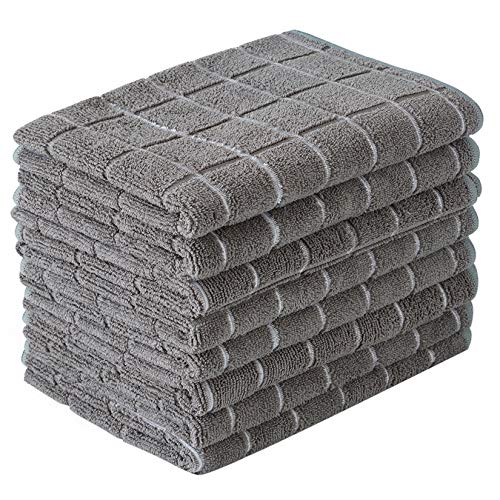
Microfiber Dish Towels Lattice Gray 8 Pack
This is the straightforward flagship of the group: eight microfiber dish towels, each 26 by 18 inches, in lattice-designed gray, with a title that promises soft, super absorbent, lint free performance. No mixed sizes, no cloth-versus-towel ambiguity — just a deep stack of the category’s standard article. For most kitchens, this is the purchase the drawer actually needs: enough full towels that a clean, dry one is always in reach and the laundry never becomes an emergency.
Listing details at a glance
- Fibre, per the listing title: microfiber
- Size stated in the title: 26 x 18 inches
- Count stated in the title: 8 pack
- Design named in the title: lattice pattern, gray colours
- Performance described in the title as super absorbent and lint free
Strengths
- Eight identical full-size towels — the deepest single-size stock here
- The 26×18 format is the versatile standard for drying and draining boards
- A lattice design in gray hides kitchen staining gracefully between washes
Trade-offs
- No GSM or weave detail is stated in the title
- One size only — small wiping jobs will use a whole towel or another product
- Gray lattice is the stated look; the title names no colour alternatives
Uniformity is this set’s strategy, and in a kitchen it is a sound one. Eight matching towels rotate evenly, wash in one predictable load, and fold into one stack — and when one eventually wears or stains past dignity, the set absorbs the loss without a visual orphan. The lattice design does quiet work too: a subtle pattern in mid-gray disguises the turmeric-and-tomato evidence of real cooking far better than white cotton ever did, which means the towels look serviceable for more of their actual lifespan.
The lint free claim, attributed to the listing, is the one that matters most at the glass cabinet. Microfiber’s reputation rests on drying glassware and polished surfaces without leaving fibre behind, and a household that hosts — or simply owns nice glasses — feels that difference weekly. As with every claim in this guide, treat it as the maker’s description to be confirmed against the product page, while the checkable facts — eight towels, 26×18, microfiber — stand on the title alone.
Best for: households wanting one deep, uniform stack of full-size microfiber drying towels. Not suited for: anyone wanting small wiping cloths or a waffle texture in the same purchase.
Check price on Amazon — eight towels at 26×18 is the whole proposition, stated plainly in the title.
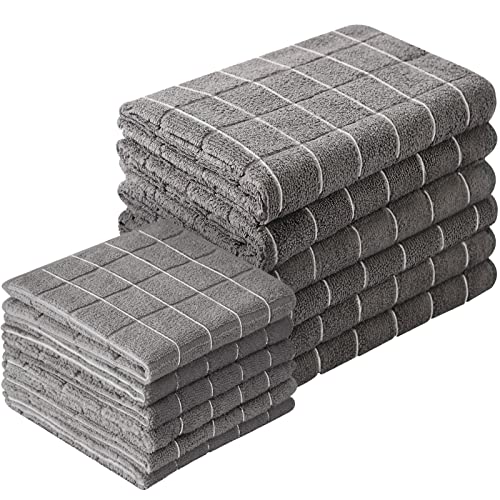
Puomue Microfiber Kitchen Towels and Dishcloths Set 12
Read this title carefully, because it is honest in a way that rewards attention: the Puomue set of 12 combines microfiber kitchen towels at 26 by 18 inches with dishcloths at 12 by 12 inches, in grey, described as lint free and made for drying dishes. Two tools, one box. The towel half handles drying and draining; the cloth half handles the washing-up itself, the counter wipes, and the small spills that a full towel is wasted on. Bought knowingly, it is one of the most sensible compositions in this guide.
Listing details at a glance
- Fibre, per the listing title: microfiber
- Sizes stated in the title: 26 x 18 in and 12 x 12 in
- Total count stated in the title: set of 12
- Colour named in the title: grey
- Use described in the title: dish towels for drying dishes, plus dishcloths
Strengths
- Two genuine kitchen tools in one purchase, each sized for its job
- The split is declared in the title rather than discovered at unboxing
- Lint free description suits the drying half of the set
Trade-offs
- The title does not state how the twelve divide between towels and cloths
- Buyers wanting twelve full towels will misread this box if they skim
- No weight or weave figure is given in the title
The unstated split is the one homework item this pick assigns: the title gives the total and both sizes but not the count of each, so the product page must confirm whether your twelve leans towel-heavy or cloth-heavy. That matters because the two halves wear out on different schedules — dishcloths live harder lives than drying towels — and a household should know which half it is stocking deeply. This is not a criticism of the set so much as a reading instruction, the same one this guide applies everywhere: totals are advertising, compositions are information.
Composition aside, the two-size system mirrors how kitchens actually run. The 12×12 cloth is the right size for a hand working inside a glass, around a tap, across a hob; the 26×18 towel is the right size for a stack of plates. Kitchens equipped with only one of the two improvise constantly, using towels as rags and cloths as mitts. A set that stocks both, in matching grey, removes a dozen small daily improvisations — an unglamorous benefit that compounds every single day.
Best for: kitchens that want the towel-and-cloth system in a single, honestly-labelled box. Not suited for: buyers who need the exact split confirmed by the title alone, or twelve full towels.
Check price on Amazon — check the product page for how the twelve divide between the two sizes.

POLYTE Microfiber Waffle Dish Towels 12 Pack
The POLYTE is the specification-lover’s pick: a 12 pack of microfiber waffle kitchen towels at 16 by 28 inches, with a stated weight of 340 GSM — the only GSM figure in this guide — and lint free, quick dry descriptions in the title. The waffle weave is the functional headline. Those recessed pockets give microfiber more surface structure, a better grip on wet glass, and channels that hold water off a polished surface, which is why waffle towels have a devoted following among people who dry a lot of glassware by hand.
Listing details at a glance
- Fibre, per the listing title: microfiber
- Weave named in the title: waffle
- Weight stated in the title: 340 GSM
- Size stated in the title: 16 x 28 inches
- Count stated in the title: 12 pack
Strengths
- The only stated GSM in the guide — a comparable, checkable number
- Waffle weave is named, a real construction difference, not an adjective
- Twelve towels is the joint-deepest stock of full towels here
Trade-offs
- At 16 inches wide these are narrower than the 26×18 picks — longer, slimmer towels
- The waffle texture is a preference; some users prefer a flat weave for counters
- Colour options are not named in the title
Hold the dimensions in mind, because 16×28 is a different shape from 26×18, not a smaller version of it. The POLYTE is a long, narrower towel — the proportions of a tea towel made for hands, shoulders, and hanging from an oven rail, and for wrapping around a hand inside a drying pass over a large pan. Households replacing wide towels one-for-one should notice the shape change before the box arrives; households who always found wide towels bunchy will recognise their preferred geometry immediately.
The 340 GSM figure deserves the same respect this guide gave the bath towel GSM earlier: it is a number a buyer can hold against the wider market, and its presence signals a maker willing to be measured. Within this guide it cannot be ranked against the other five, because no other title states a weight — and that asymmetry is itself the lesson. One stated number beats five adjectives, and shoppers who reward stated numbers with their purchases are how categories learn to print them.
Best for: glass-heavy kitchens and numbers-first buyers who want waffle weave at a stated weight. Not suited for: anyone replacing wide 26×18 towels who has not noticed the narrower shape.
Check price on Amazon — 340 GSM and waffle weave are both in the title; verify the 16×28 shape suits your drawer.

AIDEA Microfiber Kitchen Dish Towels 8 Pack
The AIDEA set is the generalist: eight microfiber dish towels at 18 by 26 inches in grey and white, described as drying towels for dishes, super soft and absorbent, and multi-purpose across kitchen and home. That last phrase is the tell — where the lattice set is aimed squarely at the drying rack, the AIDEA title applies for the wider job of household cloth workhorse, the towel that dries dishes at noon, wipes the table at two, and lines a bread basket at seven.
Listing details at a glance
- Fibre, per the listing title: microfiber
- Size stated in the title: 18 x 26 inches
- Count stated in the title: 8 pack
- Colours named in the title: grey/white
- Role described in the title as multi-purpose, for kitchen and home
Strengths
- Eight full towels in two tones, allowing a simple clean/dirty or task colour code
- Standard 18×26 dimensions match the drawers most kitchens already have
- Multi-purpose brief suits households that run one towel type for everything
Trade-offs
- No weave or weight detail appears in the title
- White towels in kitchen service show stains faster than the grey half
- Generalist positioning means no specialist feature to recommend it for glass alone
The two-tone composition is more useful than it looks. Grey for the messy work, white for the presentable work — or this week versus last week in the rotation — gives a household a sorting system with no labels and no thought required at the drawer. Systems that require no thought are the ones still running in month six. Kitchens that adopt the colour code tend to find their towels age more evenly, because the code enforces the rotation that good intentions alone rarely sustain.
Multi-purpose deserves an honest footnote. A towel that does everything will be beaten, on any single task, by the specialist: the waffle POLYTE at glass, the small cloths at counters. What the generalist wins is drawer simplicity and laundry simplicity, which in a small kitchen or a first flat is a real victory. The AIDEA’s stated facts — eight microfiber towels, 18×26, two colours — describe exactly that victory, no more and no less, and buyers who want it will not be disappointed by anything the title promised.
Best for: small kitchens and first flats wanting one two-tone towel set for every job. Not suited for: specialists who want waffle texture, stated weight, or small cloths included.
Check price on Amazon — the grey and white split is named in the title, handy if you run a colour code.

HOMEXCEL Microfiber Kitchen Towels 12 Pack
Size honesty matters most right here: the HOMEXCEL pack’s twelve pieces are 11 by 11 inch cloths, and the title itself calls them dish cleaning cloths and kitchen hand towels alongside the towel language. These are the kitchen’s wiping instruments — for counters, appliance fronts, stovetops, taps, and the hundred small wet jobs a day — in microfiber described as soft, absorbent, lint free, and scratch-free. Judged as dish towels they would seem small; judged as cloths, a dozen at this size is a properly stocked system.
Listing details at a glance
- Fibre, per the listing title: microfiber
- Size stated in the title: 11 x 11 inches
- Count stated in the title: 12 pack
- Role named in the title: dish cleaning cloths and kitchen hand towels
- Surface claim in the title: scratch-free
Strengths
- Twelve cloths means a fresh one is always available for the next spill
- The 11×11 size is right for hands, taps, and appliance detailing
- The scratch-free description suits stainless and glass surfaces, as a listing claim
Trade-offs
- These are cloths, not drying towels — a dinner service would defeat them
- No weight or weave figure is stated in the title
- Small cloths migrate and get lost more readily than full towels
The scratch-free claim, attributed to the listing, is this set’s reason to exist. Modern kitchens are full of surfaces that punish the wrong cloth — stainless steel that shows every swirl, induction glass, glossy cabinet fronts — and microfiber’s fine split fibres are the standard answer. A dedicated stock of small cloths keeps that answer at hand without sacrificing a drying towel to hob duty, which is how good towels get ruined and good surfaces get scratched in the same motion.
Pair this set mentally with any full-towel pick and the drawer completes itself: towels for drying, cloths for wiping, each used for its own work and washed on its own schedule. Households that run that two-system drawer consistently report the small mystery of kitchen laundry solved — towels stop disappearing into cleaning duty, and cloths stop being asked to dry roasting pans. The HOMEXCEL’s contribution to that system is depth: twelve is enough that the system survives a busy week and a slow laundry day simultaneously.
Best for: the wiping half of a two-system kitchen drawer, especially with stainless and glass surfaces. Not suited for: anyone shopping for dish-drying towels — read the 11×11 size twice.
Check price on Amazon — the title states 11×11 inches clearly; order it as cloths and it will delight.

JOYMOOP Microfiber Dish Cloths 18 Piece Set
The JOYMOOP set completes the size spectrum: 18 pieces of small microfiber cleaning cloth in multiple colours, titled as dish cloths for washing dishes and kitchen rags for countertops, described as highly absorbent, soft, lint free, and easy to clean. Like the HOMEXCEL, this is a cloth set, not a towel set — but where HOMEXCEL offers twelve cloths in one size class, JOYMOOP offers eighteen in colour variety, the deepest stock of the highest-turnover tool in the kitchen.
Listing details at a glance
- Fibre, per the listing title: microfiber
- Count stated in the title: 18 piece set
- Size described in the title as small; exact inches are not given in the title
- Colours described in the title as multi color
- Roles named in the title: dish cloths for washing dishes, rags for countertops
Strengths
- Eighteen cloths — the deepest stock in the guide for the fastest-wearing tool
- Multi-colour stock allows zoning by task: sink, counters, floor spills
- Small cloths wash and dry in quick, cheap loads
Trade-offs
- Exact dimensions are not stated in the title — small is the only size word
- Not drying towels; a full wash-load of dishes needs a towel partner
- Eighteen small cloths require a storage spot or they become drawer chaos
Colour is this set’s system. Multi-colour cloths let a household zone by hygiene without a single label: one colour lives at the sink, another never leaves the counter zone, a third is demoted to floor spills on sight. Cross-contamination control in home kitchens usually fails for want of a system simple enough to survive a tired Tuesday; a colour code printed into the product itself is about as simple as systems get. Eighteen pieces make the zoning generous rather than theoretical — each zone gets depth, not a token cloth.
The missing dimension is the homework: small is a description, not a measurement, and the product page should confirm the inches before ordering, since small cloths in this category range widely. What the title does establish — count, fibre, roles, colour variety — is the strategic half of the purchase. Buyers who pair this set with a full-towel pick from this guide will own the complete microfiber drawer: eighteen cloths for the wet work, eight or twelve towels for the drying, and no tool borrowed across jobs ever again. Kitchens that entertain often may extend the same stocking logic outdoors with Best Microfiber Body Towels kept for the post-pool, post-garden cleanup shelf — different room, same respect for having the right cloth in reach.
Best for: busy kitchens wanting a colour-zoned army of washing and wiping cloths. Not suited for: drying duty, or buyers who need dimensions stated in the title itself.
Check price on Amazon — eighteen pieces and multi colour are the headline facts; confirm the inches on the product page.
Towels versus cloths: the six sets compared
One table, two tool families — check the size column first, because in this category size is destiny.
| Set | Construction, per the title | Count and size |
|---|---|---|
| Microfiber Dish Towels Lattice Gray 8 Pack | Microfiber, lint free per the title | 8 towels, 26 x 18 in |
| Puomue Microfiber Kitchen Towels and Dishcloths Set 12 | Microfiber, towels plus dishcloths | 12 pieces, two sizes, grey |
| POLYTE Microfiber Waffle Dish Towels 12 Pack | Microfiber waffle weave, 340 GSM | 12 towels, 16 x 28 in |
| AIDEA Microfiber Kitchen Dish Towels 8 Pack | Microfiber, multi-purpose per the title | 8 towels, 18 x 26 in, grey/white |
| HOMEXCEL Microfiber Kitchen Towels 12 Pack | Microfiber cleaning cloths | 12 cloths, 11 x 11 in |
| JOYMOOP Microfiber Dish Cloths 18 Piece Set | Microfiber dish and counter cloths | 18 small cloths, multi colour |
How do you choose the right microfiber set for your kitchen?
Separate the drying job from the wiping job
Kitchens run two cloth systems whether they plan to or not: drying, which wants area and lint-free finish, and wiping, which wants small, cheap, replaceable cloths that can be demoted without regret. The full towels in this guide — lattice, AIDEA, POLYTE — serve the first system. The HOMEXCEL and JOYMOOP cloths serve the second. The Puomue straddles both in one box. Naming the two systems is the single most clarifying act in kitchen textile shopping.
Most drawer dissatisfaction is a systems error, not a product error: good towels destroyed by hob duty, tiny cloths asked to dry a feast’s worth of pans. Equip each system to its own standard and both suddenly seem to perform better, because each is finally doing the work its size and weave were built for.
Let dimensions overrule adjectives
Every title here states dimensions except one, and the dimensions predict your experience more reliably than any softness claim. A 26×18 towel drapes a draining board; a 16×28 wraps a hand and hangs long on a rail; an 11×11 cloth works inside a glass. Picture the cloth against the actual objects in your kitchen — the biggest pan, the wine glasses, the hob — and the right sizes select themselves.
Where dimensions are absent, as with the JOYMOOP’s small, treat the product page visit as part of the purchase, not an optional extra. Small spans a wide range in this category, and the difference between a 10-inch and a 14-inch cloth is the difference between a wiper and a near-towel.
Weave and weight: the specialist dials
Waffle weave, stated by the POLYTE alongside its 340 GSM, is the one construction upgrade this category offers in plain language: more structure, better grip on wet glass, channels that move water. If your kitchen dries serious glassware by hand, that weave is worth prioritising. If your drying is mostly pans and plates, a flat towel at the right size will serve identically and the weave becomes a preference, not a performance gap.
Weight follows the same logic as bath towels, in miniature: heavier microfiber holds more water per cloth and feels substantial; lighter cloths dry faster on the rail and cycle through laundry quicker. Only one title here states its weight, so let that asymmetry teach the general lesson — reward stated numbers where you find them, and price unstated ones as unknowns. Households building the full microfiber ecosystem can carry the same principle to the bathroom with Best Disposable Shower Slippers waiting in the guest-bath plan — different product, same stated-facts habit.
Stock for the laundry you actually do
Counts should be chosen backwards from your wash rhythm. A household that launders twice a week needs roughly double the in-use stock of a daily washer, plus a spill reserve. Eight full towels suit a small household that washes often; twelve suit a family; eighteen small cloths suit anyone, because small cloths are consumed by the day, not the week.
And plan the demotion path. Microfiber cloths that tire at the counter retire to the garage, the car, the shoe shelf. A set bought with its second life in mind can be chosen generously, since almost no piece is ever truly wasted — which quietly makes the deeper sets the economical ones over a two-year horizon.
Why microfiber dries glass when cotton smears it
Microfiber’s trick is structural: each fibre is split into fine wedges that multiply the surface area and create tiny channels that pull water in rather than pushing it around. That is why a microfiber towel can leave glass dry and unmarked where a cotton towel leaves a smear and a souvenir of lint. The titles in this guide lean on the resulting vocabulary — lint free, absorbent, quick dry — and while those remain listing descriptions, the underlying fibre behaviour they point at is the genuine, checkable reason the category exists.
The same structure explains microfiber’s two handling rules, which apply across all six picks. Fabric softener coats the fine fibres and blunts the absorbency, so it has no place in these washes; and high dryer heat can damage the split fibres over time, so moderate heat or air drying keeps the cloths performing. None of the titles states care instructions, so confirm the maker’s guidance on the product page — but a household that observes those two rules will get noticeably more life from any set in this guide.
Building the two-drawer kitchen
If this guide has a single piece of furniture advice, it is the two-drawer system: one drawer or shelf for drying towels, kept clean and reserved, and one for working cloths, kept deep and demotable. The physical separation is what enforces the functional separation — a cloth within reach at the moment of a spill will be used for the spill, whatever its intended rank, so the working cloths must be the ones within reach of the sink and hob.
Stock the drying drawer from the towel picks and the working drawer from the cloth picks, and add the Puomue’s mixed box wherever your household’s balance sits. Then stop shopping. Kitchen textiles are a solved problem at that point, and the remaining gains are all in the using — rotation, prompt washing, and the discipline of the demotion path.
Smaller microfiber judgements that pay off
Hang a towel where the cook actually stands. The best drying towel in the world loses to the mediocre one on the oven rail, because the rail is where wet hands go. Placement beats specification at the moment of use, so fit the towel’s home to the kitchen’s traffic, not to the drawer’s tidiness.
Dedicate one towel to the draining board and leave it there. A board towel that is not borrowed for hands or counters stays cleaner longer and keeps the drying system honest. It is a small act of zoning, like the colour codes in the cloth sets, and it costs exactly one towel.
Retire by feel, not by calendar. Microfiber announces its decline honestly — it starts pushing water instead of drinking it. When a towel crosses that line, demote it the same day rather than letting it linger in the good drawer, quietly downgrading every drying session it touches.
Wash new microfiber before first use, separately. Loose dye and finishing residues are common in new coloured cloths, and a first solo wash protects both the cloths’ absorbency and everything else in your laundry from an early surprise. The multi-colour sets especially reward this small ceremony.
Keep two cloths in the car and one by the back door. The kitchen system works because the right cloth is within reach; extending that reach to the muddy-paw and spilled-shopping zones prevents the good kitchen cloths from being borrowed into exile. Depth bought once, placed widely, is the whole strategy in one sentence.
A small ritual worth adopting: the Sunday reset. Once a week, gather every kitchen cloth in service, wash the lot, and restock both drawers from zero. The ritual prevents the slow drift in which the same three towels do all the work while their siblings stay folded and new — the drawer-level version of uneven rotation. Kitchens that run the reset find their sets age as sets, evenly, and replacement becomes a planned event rather than a series of small disappointments.
Think about where wet cloths wait. A microfiber cloth draped over the tap or the oven rail dries between jobs and stays pleasant; the same cloth balled in the sink turns within a day. The cloths in this guide are quick to dry by fibre, but fibre only helps where air reaches. Give each working cloth a drying spot that is not the sink itself, and the whole drawer will smell better by Friday.
Colour zoning deserves a second mention because it scales beyond the JOYMOOP set. Any household can zone with what it owns: the grey towels dry, the white ones serve, the patterned ones host. The system matters more than the palette. What zoning buys is a kitchen where a cloth’s history is visible at a glance — and history, in a room where raw chicken and salad share a counter, is not a trivial thing to know.
For households that bake seriously, a dedicated flour towel earns its place. Microfiber’s grip, wonderful on glass, can drag on doughs and delicate pastry work where a smooth, reserved towel behaves better. Keep one full towel from your drying set out of general circulation for baking days. It is a small aristocracy within the drawer, and bakers will defend it fiercely once established.
The draining board deserves its own cloth strategy. A towel laid under the rack catches the drip zone and protects counters, but it lives the wettest life in the kitchen and should rotate daily. This is where a deep set quietly pays: the board towel is the first place a shallow stock runs out, usually on the evening of the largest wash-up of the week. Count your board towels when you count your sets.
Renters and students, take heart from the cloth end of this guide. A twelve- or eighteen-piece cloth set transforms a kitchen’s daily functioning for the cost of a single restaurant meal, needs no installation, and moves house in a shoebox. Of all the purchases in this guide, the small cloths have the highest ratio of daily gratitude to money spent — the drying towels are the better products, but the cloths are the better bargains.
A word about edges and hems, the detail no title here mentions. Microfiber cloths live or die at their borders: a well-finished edge survives years of washing, a poor one curls and frays within months. Since no title states it, the product photographs and the first wash are your evidence. Inspect a new set’s edges on arrival, while the decision is still reversible, rather than discovering the answer across a season of laundry.
Hosts should keep a visible stack. When guests help in the kitchen — and guests always help in the kitchen — a visible stack of clean towels and cloths tells them where things are without a tour. Place the stack where the work happens, not where the storage is prettiest. Hospitality is mostly logistics wearing a smile, and a findable towel is logistics at its kindest.
If your household argues about one kitchen textile question, let it be this one: how many cloths is enough at the sink? The evidence of this guide points to depth — the twelve- and eighteen-piece sets exist because washing-up consumes cloths faster than intuition suggests. A household that has never run out of clean cloths mid-wash-up has either enough cloths or a very disciplined dishwasher. Buy for the household you have, not the one in the advertisement.
Finally, demote with ceremony. When a drying towel retires to cleaning duty, move it physically to the other drawer the same day. The two-drawer system fails by drift — good towels wandering into bad jobs and never returning — and drift is prevented by rituals, not intentions. Your future self, reaching for a clean towel during a dinner party, will be grateful for every small ceremony the system kept.
Breakfast is the kitchen cloth’s first exam of the day: butter knives, jam, a boiled egg’s negotiations, coffee rings. A cloth that starts the day clean and ends it in the wash is the rhythm to aim for, which is another argument for depth — the household that owns eighteen cloths can afford a fresh one at every meal, and the household that owns four cannot, whatever its intentions.
Think about the hob as a workplace with its own cloth. Grease changes a cloth’s character permanently; the cloth that wipes the hob should not later dry the glasses. Zoning by location — a cloth that lives at the hob, visibly distinct — prevents the cross-contamination of grease into the drying system. The multi-colour and two-tone sets in this guide make that zoning effortless to start and easy to keep.
A drying towel over the shoulder is the cook’s uniform across half the world’s kitchens, and the 16×28 POLYTE’s long shape is tailored for exactly that post. Shoulder towels get washed more than any other — they meet hands, spills, and hot handles’ insulation duty — so a twelve-pack in that role is not extravagance. It is the recognition that the hardest-working towel in the house deserves the deepest bench.
Picnics and garden meals extend the kitchen’s borders all summer, and the cloth system should extend with them. Two cloths and a towel in the picnic kit — the same sizes, the same zoning — prevent the good drawer from being raided and never quite restocked. The sets here are deep enough to garrison the picnic basket permanently, which is a small luxury with an outsized effect on summer evenings.
There is a quiet economics to the demotion ladder. A cloth bought for drying retires to wiping, then to the garage, then to the shoe rack, delivering value at every rung over perhaps three years. Cost per use across that ladder is vanishingly small for every set in this guide — which reframes the purchase entirely. You are not buying cloths; you are buying a three-year supply of clean surfaces, and the only way to lose money is to buy too few and improvise.
Hosts of big cooking holidays should plan the cloth surge in advance. The largest wash-up of the year arrives with the least patience for a missing towel, and a drawer stocked for ordinary Tuesdays will empty by the second course’s pans. This is the practical case for the deepest sets — not daily need, but peak need, the two or three days a year when the kitchen runs at full capacity and the cloths decide whether it feels like a celebration or a siege.
One more surface deserves its cloth: the inside of the fridge, wiped weekly, and the microwave, wiped after every explosion. A small cloth dedicated to appliances — kept with the cleaning supplies rather than the drawer — keeps food-zone cloths and chemical-zone cloths from ever trading places. The 11×11 HOMEXCEL size is built for this post, and a single cloth on permanent appliance duty simplifies the whole hygiene map of the kitchen.
If the drawer still feels chaotic after both systems are stocked, the problem is usually folding, not quantity. Microfiber folds best in thirds, stacked by size, with the working cloths in a shallow basket rather than a deep drawer — visible, grabbable, countable at a glance. Visibility is the soul of every system in this guide: what you can see, you rotate; what you rotate, lasts.
And when a set finally thins to its last good towels, replace it as a set. Topping up a worn drawer with a different product creates a permanent two-tier drawer in which the new towels do all the work and the old ones linger as guilt. A clean replacement, with the survivors demoted together to the garage box, keeps the system’s arithmetic honest — and gives the garage a very well-dressed rag shelf.
The countertop beside the sink is a small country with its own weather: permanently damp at the border, splashed at every wash. A cloth stationed there permanently — not borrowed, not rotated into drying — absorbs that weather and spares the good towels the worst post in the kitchen. Station cloths are the unsung appointments of a well-run sink, and the deep cloth sets exist to make such appointments without leaving the drawer short.
Do not forget the cook’s hands between tasks. A small cloth at the prep station, used only for hands, keeps the drying towels out of the hand business and the hand business out of the drying towels. It is the same zoning logic, applied at the scale of a chopping board, and it takes one cloth to run. Kitchens are systems all the way down; the households that enjoy them are the ones that stopped expecting single cloths to be systems by themselves.
When the drawer is finally right, protect it from the well-meaning gift. Novelty tea towels arrive every December, charming and functionally unknown, and they infiltrate the rotation like cheerful spies. Give them their own hook and their own ceremonial duties — the bread basket, the teapot cosy post — and keep the working systems unmixed. A drawer’s discipline is measured by what it refuses as much as by what it holds.
One last habit, borrowed from professional kitchens: end the day with every cloth accounted for — washed, drying, or in service — and none abandoned in the sink. Thirty seconds of accounting keeps the whole system legible, and a legible system is the kind that survives busy months without quietly collapsing back into one sad towel doing every job in the house.
Common mistakes with microfiber kitchen towels
Most disappointments in this category are reading errors or laundry errors, and both kinds are cheaper to prevent than to replace.
Ordering cloths and expecting towels
An 11×11 cloth and a 26×18 towel share a fibre and nothing else. The HOMEXCEL and JOYMOOP sets are excellent at their own job; the mistake is only in the reading. Check the inches before the count, every time.
Misreading a mixed set as a uniform set
The Puomue twelve divides across two sizes, and the title says so. Totals are the least informative number on any set listing; the composition is the information. Read for the split, then judge the value.
Using fabric softener on microfiber
Softener coats the split fibres that make microfiber absorbent, and the towels decline quietly over a few washes. Skip softener for these loads entirely, and the cloths will keep drinking instead of smearing.
Cooking the fibres in a hot dryer
High heat damages fine synthetic fibres cumulatively. Moderate heat or air drying preserves the structure you paid for. The care notes on the product page govern, and gentle heat is the safe default for the whole category.
Judging absorbency on day one
New microfiber often improves after its first washes as finishes clear. A towel condemned at first use may have been a good towel in disguise; give any set from this guide a few cycles before the verdict hardens.
Buying one set to do both systems
A single mid-size set asked to dry and to wipe will do both at half satisfaction and wear at double speed. The two-system drawer costs little more and is the actual fix for the dissatisfaction that sent you shopping.
Final recommendation
For the drying drawer, start with the lattice 8 pack if you want depth and uniformity, or the POLYTE if glassware rules your kitchen and you value its stated waffle weave and 340 GSM. The AIDEA is the two-tone generalist for smaller households, and the Puomue is the one-box compromise for kitchens that want both tools without two decisions. Each of those recommendations rests on facts printed in the titles — sizes, counts, weave, weight — rather than on adjectives.
For the working drawer, the JOYMOOP eighteen is the deepest stock and the HOMEXCEL twelve the most surface-conscious, with its scratch-free description aimed at modern finishes. Pair one from each family and the kitchen textile question closes. Readers equipping a whole home rather than one drawer may continue the stated-facts approach with Best Elderly Slippers for the household’s senior members — chosen there, as here, on construction you can verify.
Whichever combination you choose, read the size line once more at checkout. In this category, more purchases are saved by that ten-second habit than by any review — this one included.
Frequently asked questions about microfiber dish towels
What size dish towel is most useful?
The 26×18 inch format, used by the lattice set and the towel half of the Puomue set, is the versatile standard: big enough for draining boards and large pans, manageable in the hand. The 16×28 POLYTE suits hands and rails; 11×11 cloths are wipers, not dryers. Match the size to the job, not to habit.
Is waffle weave actually better?
For glass and polished surfaces, the grip of the waffle structure and channels are a genuine advantage, which is why the POLYTE leads with it. For general drying the difference narrows to preference. It is a real construction feature — one of the few in this category stated plainly enough to choose on.
Why does one set say 12 but contain two sizes?
Because set counts describe pieces, not uniformity. The Puomue set of 12 mixes 26×18 towels with 12×12 dishcloths, and its title states both sizes. Always read the composition; the total alone will mislead you in this category more often than any other number.
How should microfiber towels be washed?
The titles here do not state care instructions, so the product page governs — but the standing rules of the category are to skip fabric softener, which coats the fibres, and to favour moderate heat or air drying over high heat. Those two habits preserve absorbency across the life of the cloth.
How many kitchen cloths does a household need?
Enough to run both systems without borrowing: roughly eight or more drying towels for a family, a dozen or more working cloths, scaled by how often you launder. The sets in this guide were chosen so that one towel pick plus one cloth pick lands most households exactly in that territory.
Size for the job, split the drying from the wiping, and let the stated inches and counts — never the adjectives — close the sale.


