What's inside
- Key Takeaways
- Quick Picks for Game Day
- How Did We Choose These Stadium Seats?
- What Actually Matters on a Bleacher?
- How Do You Carry a Stadium Seat Without Hating It?
- Stadium Seats Compared
- Which Mistakes Do Stadium Seat Buyers Make?
- A Longer Look at Each Seat Across a Season
- How Should You Set Up on the Bench for Maximum Comfort?
- How Does Venue Type Change the Right Choice?
- What Should Grandparents and Older Fans Prioritise?
- How Do Stadium Seats Handle Cold and Wet Weather?
- Which Seat Suits Each Kind of Spectator?
- What Is the Etiquette of Bringing Your Own Seat?
- How Long Should a Good Stadium Seat Last?
- How Do You Pack a Car Boot for a Season of Spectating?
- What Role Does a Stadium Seat Play Beyond Sport?
- How Should You Decide Between Two Finalists?
- Final Recommendation
- Why Do Spectators Underestimate Back Support?
- What Should You Check at the Gate Before Buying?
- How Does a Good Seat Change a Family’s Season?
- What About Children in Stadium Seats?
- How Do You Choose Between Hooks and Simplicity?
- Should You Buy One Seat Now or a Pair for the Season?
- A Spectator’s Checklist for the First Outing
- What Do Seasoned Spectators Know That Beginners Learn Late?
- How Does Recline Change the Social Geometry of a Row?
- Is a Stadium Seat a Sensible Gift?
- What Is the True Cost of the Cheap Seat You Already Own?
- How Should You Store Seats Between Seasons?
- Frequently Asked Questions
- Related Guides
As an Amazon Associate I earn from qualifying purchases. This post may contain affiliate links at no extra cost to you.
cottageverdict.com is reader-supported. When you buy through links on our site, we may earn an affiliate commission.
Where to buy: every seat below is sold on Amazon, and the pick names link to their listings so you can check price on Amazon and confirm colours before game day. The best reclining stadium chairs exist because bleachers were designed by people who clearly never sat through a doubleheader. Bare metal or hard plastic, backless, and spaced by an architect’s optimism, a bleacher bench punishes spectators in exact proportion to how much they love the team.
A good stadium seat answers with three things: a cushion with real thickness, a backrest that reclines instead of merely existing, and a way of staying put on the bench instead of sliding toward the aisle by the seventh inning. The six picks here were chosen on those terms, with cushion depth stated in most listings — from 2.5 inches up to a remarkable 4.7 — plus hooks, straps, pockets, and cup holders doing the supporting work that decides whether a seat is loved or left in the car.
Portability threads through every judgement that follows. A stadium chair earns its keep in the walk from the car park as much as in the ninth inning, so backpack straps, shoulder straps, and folding designs all counted. So did width: one pick stretches to an extra-wide 24 inches, because spectators come in more than one size and bleacher comfort should too.
Key Takeaways
- Cushion thickness is the headline number in this category, ranging here from 2.5 inches to 4.7 inches of padding between you and the bench.
- Six recline positions appear on three of the six picks, letting you match your angle to extra innings, concerts, and halftime alike.
- Hooks that grip the bleacher stop the slow slide that ruins cheaper seats; two picks make their anti-slide systems a headline feature.
- Cup holders and pockets sound like garnish until you are holding a drink, a phone, a programme, and a hot dog simultaneously.
- Wide designs matter: the 24-inch extra-wide pick serves bigger spectators and anyone sharing a seat with a small child.
Quick Picks for Game Day
| Seat | Badge | The case in one breath |
|---|---|---|
| Overmont Stadium Seat, 6-Position | Best all-round stadium seat | A 2.8-inch cushion, six recline positions, dual hooks, backpack straps, cup holders, and storage pockets in one complete package. |
| BRAWNTIDE Stadium Seat, 3-Inch Foam | Best anti-slide design | Three inches of foam, an 18-inch high back, patented hooks against sliding, six recline positions, and four pockets. |
| Sportneer Stadium Seat, Extra Wide 24-Inch | Best for bigger spectators | A 24-inch extra-wide seat with a 2.5-inch cushion, six recline angles, armrests, and twin cup holders. |
| Alpcour Stadium Seat with Armrests | Best classic portable | Thick padded cushion, armrests, side pockets, and shoulder straps in a wide, carry-anywhere design. |
| Aeenoo Wide Stadium Seat, 6-Position | Thickest cushion | A 4.7-inch padded seat with armrests and six reclining positions, built for football and baseball marathons. |
| Everlasting Comfort Stadium Seat, Memory Foam | Best memory foam feel | Adjustable memory foam comfort in a portable, easy-folding seat with a storage pocket. |
How Did We Choose These Stadium Seats?
Cushion thickness came first, because it is the specification a spectator feels in minute ninety. Listings state their depths plainly, and we ranked accordingly while noting that foam type matters alongside depth: the memory foam pick competes with thinner-looking numbers by moulding to the sitter. Recline range came second, with six-position designs favoured for the freedom to sit upright for a ceremony, lean for a match, and stretch during a concert’s slow songs.
Attachment was the third filter. A seat that migrates across a bleacher forces its owner into constant small corrections, so hooks, dual hooks, and patented anti-slide systems all earned real credit. Carry method followed: backpack straps distribute weight across a long walk from parking, shoulder straps suit shorter hauls, and easy folding decides whether the seat lives in the car boot or the garage’s forgotten corner.
Finally we weighed the extras as a system. Cup holders prevent the drink-between-knees balancing act; pockets swallow phones and programmes; armrests change the posture of a whole afternoon. Spectators furnishing a porch with the same enthusiasm for supported sitting will find a kindred category in Best Inexpensive Hanging Porch Chairs, where the seats swing instead of folding.
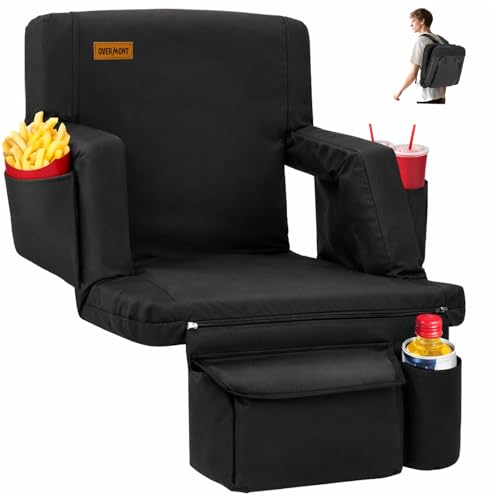
Overmont Stadium Seat, 6-Position — Best all-round stadium seat
The Overmont reads like a checklist written by someone who has suffered through every stadium inconvenience personally. A 2.8-inch cushion handles the bench, six recline positions handle the afternoon’s changing moods, dual hooks underneath grip the bleacher so the seat stays where it was placed, and backpack straps handle the walk back to the car when everyone’s legs have forgotten how walking works. Cup holders and storage pockets complete a package with no obvious omission.
Armrests elevate it above the basic folding seat. With arms supported, shoulders drop, and the whole posture of spectating relaxes; you watch the game instead of holding yourself up through it. The pockets deserve their own praise from anyone who has fished a phone out of a bleacher’s underworld of peanut shells. Everything has a place, and the place is attached to your chair.
Concerts appear in the listing’s suggested uses alongside sports events, and the seat’s versatility justifies the billing. The same recline that suits a baseball game’s long rhythms suits an outdoor gig’s encore, and the backpack carry suits festival fields where the walk from the gate is measured in songs. For a household buying one stadium seat to serve every bench the year offers, this is the safest pair of hands.
- Cushion: 2.8 inches
- Recline: 6 positions
- Attachment: dual hooks
- Carry: backpack straps; extras include cup holders and storage pockets
- Where to buy: the Overmont Stadium Seat listing on Amazon — check price on Amazon
Strengths
- Most complete feature set here, with no category left unaddressed.
- Dual hooks and backpack straps solve the slide and the carry in one design.
- Armrests transform posture across long events in a way cushions alone cannot.
Trade-offs
- Feature-rich usually means a touch heavier than the simplest folding seats.
- Cushion depth, while good, is bettered by the Aeenoo’s 4.7 inches.
- Backpack carry suits most, but drivers parking close may prefer a lighter grab-and-go seat.
Best for: households wanting one seat that handles every bleacher, bench, and concert lawn. Not suited for: minimalists who count every gram on a long hike to the stands.

BRAWNTIDE Stadium Seat, 3-Inch Foam — Best anti-slide design
The BRAWNTIDE’s listing makes a promise in plain language — no more back pain — which we read as the manufacturer’s comfort claim for its three inches of foam and 18-inch high backrest, and the design behind the promise is genuinely thoughtful. The patented hooks are the headline: they exist to prevent the seat sliding on the bleacher, attacking the specific misery of a chair that migrates an inch per inning until its owner is sitting at an angle, gripping the bench like a sailor.
Six recline positions and a tall back give taller spectators proper support, a constituency stadium seating often forgets. Four pockets and two cup holders complete the storage story, generous enough for a programme, a phone, gloves in cold months, and the snack economy of a long match. The whole design feels argued rather than assembled, each feature answering a complaint collected from real bleachers.
Parents stationed at youth sports will recognise this seat’s destiny. School and club bleachers are the hardest benches in spectating, backless and unyielding, and a tall-backed, hook-secured, thickly foamed seat converts those Saturday mornings from endurance into something approaching leisure. Buy it for the season, and it will still be reporting for duty when the youngest player graduates to the big field.
- Cushion: 3-inch foam
- Backrest: 18 inches high, 6 recline positions
- Attachment: patented hooks designed to prevent sliding
- Storage: 2 cup holders and 4 pockets
- Where to buy: the BRAWNTIDE Stadium Seat listing on Amazon — check price on Amazon
Strengths
- Anti-slide hooks address the category’s most irritating failure directly.
- Tall 18-inch backrest supports longer torsos through full matches.
- Four pockets swallow the entire pocket-dump of a spectator’s belongings.
Trade-offs
- No armrests, so shoulders carry more of the afternoon than in the Overmont.
- Taller back folds into a larger package for the car boot.
- Foam is thick but conventional; memory foam devotees should look at the Everlasting Comfort.
Best for: youth-sports parents and tall spectators on hard school bleachers. Not well suited to: buyers who consider armrests non-negotiable.
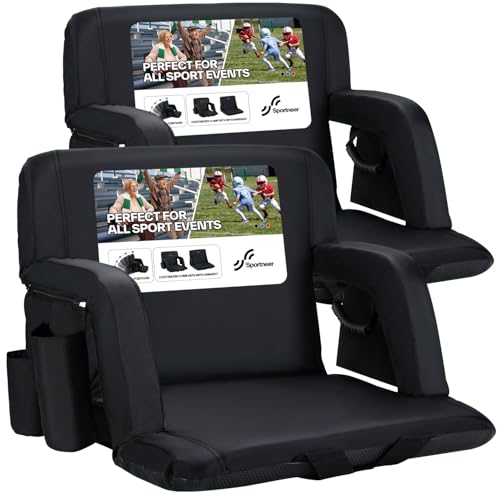
Sportneer Stadium Seat, Extra Wide 24-Inch — Best for bigger spectators
Width is dignity. The Sportneer’s extra-wide 24-inch seat acknowledges that spectators are not all built to the same template, and that a chair pinching its occupant for three hours fails at its only job. Inside that width sits a 2.5-inch cushion, six recline angles, and armrests, a combination that lets a bigger spectator settle rather than perch. Parents sharing a seat with a small child will also feel the extra inches working every single game.
The twin cup holders and two pockets keep the wide seat’s territory organised, because a broad chair at a crowded match becomes a small table for the whole row’s drinks if its owner is not careful. Armrests mark the boundary kindly. Six recline angles match the category leaders, so choosing width does not mean surrendering adjustment, a trade lesser designs impose and this one refuses.
Bleacher rows impose their own geometry, and an extra-wide seat claims its honest share of the bench. At crowded venues that can mean arriving a little early to claim the space, a small logistics tax on a large comfort dividend. For the spectators this chair serves, the exchange is not close: comfort that fits beats a narrow seat that merely technically exists.
- Width: extra wide, 24 inches
- Cushion: 2.5 inches thick
- Recline: 6 angles, with armrests
- Storage: 2 pockets and 2 cup holders
- Where to buy: the Sportneer Stadium Seat listing on Amazon — check price on Amazon
Strengths
- Genuine width serves bigger bodies and parent-and-child sharing alike.
- Six recline angles match the best here, so size costs no adjustability.
- Armrests plus twin cup holders keep a broad seat organised and bounded.
Trade-offs
- Claims more bleacher width, which packed championship rows may resent.
- Cushion is the thinnest of the six-position designs at 2.5 inches.
- Larger folded footprint needs a bigger boot corner than compact rivals.
Best for: bigger spectators and parents sharing with young children. Not the right match for: venues where every bench inch is contested territory.
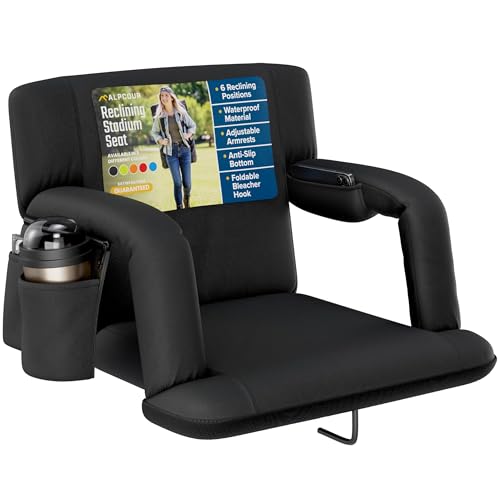
Alpcour Stadium Seat with Armrests — Best classic portable
The Alpcour represents the stadium seat in its classic form, executed with care: a wide bleacher chair with a thick padded cushion, armrests, side pockets, and shoulder straps for the carry. No single number shouts from its listing; instead the whole package whispers competence. This is the seat bought by spectators who have owned a disappointing one and now value balance over headlines.
Shoulder straps define its portability style. For the common journey — car park to gate to bench, with a stop for coffee — a shoulder carry is faster to grab and stow than backpack straps, and the seat’s wide, padded design rides comfortably enough. Side pockets keep the essentials off the bench’s sticky surface, and the armrests give the afternoon a posture that a cushion alone cannot provide.
The listing calls it the best portable seat chair for sports events, which is marketing’s way of saying it aims at the centre of the category and hits it. Families equipping two or three spectators at once will find the Alpcour’s straightforwardness appealing: no mechanism to master, no hook system to learn, just a thick, wide, armed seat that unfolds and behaves. In a category filling with specialisation, the classic done well remains a serious contender.
- Format: wide bleacher chair with thick padded cushion
- Arms: armrests included
- Carry: shoulder straps
- Storage: side pockets
- Where to buy: the Alpcour Stadium Seat listing on Amazon — check price on Amazon
Strengths
- Balanced, classic package with arms, pockets, and an easy shoulder carry.
- Wide seat welcomes a range of body sizes without a special model hunt.
- Simple design unfolds and packs away with zero learning curve.
Trade-offs
- No stated recline position count, so angle freedom is less defined than rivals.
- Shoulder carry concentrates weight that backpack straps would distribute.
- No hook system is headlined, so very smooth benches may allow some drift.
Best for: families equipping several spectators with dependable, simple seats. Poorly suited to: buyers who want a specified six-position recline and anti-slide hooks.

Aeenoo Wide Stadium Seat, 6-Position — Thickest cushion
Four point seven inches. In a category where competitors measure their cushions in the twos and threes, the Aeenoo’s stated 4.7-inch padding reads like a misprint until you consider who it serves: spectators whose hips and tailbones file formal complaints on hard benches, older fans, and anyone facing a doubleheader on aluminium. Thickness at that level changes the seat from padding into furniture, and the wide format gives the cushion a stage worthy of it.
Six reclining positions and armrests complete a specification aimed at football and baseball, the listing’s named sports, where games stretch long and pauses invite leaning back. A wide, thick, adjustable seat is effectively a small armchair that happens to fold, and spectators who have endured seasons on bare benches will understand the emotional weight of that sentence.
The trade is portability, honestly faced. More cushion means more bulk in the boot and more chair to carry from the car, so the Aeenoo suits spectators whose walk is short or whose comfort need is non-negotiable. For the fan who has started leaving games early because the bench wins by the eighth inning, this seat is not an indulgence; it is the difference between staying and going, which is to say it is the whole ballgame.
- Cushion: 4.7 inches thick, padded
- Format: wide stadium seat with armrests
- Recline: 6 positions
- Named sports: football and baseball
- Where to buy: the Aeenoo Wide Stadium Seat listing on Amazon — check price on Amazon
Strengths
- Thickest cushion in this guide by a wide margin, kind to hips and tailbones.
- Wide format plus armrests creates a genuine armchair feeling on a bench.
- Six positions cover upright ceremony and full lean-back equally.
Trade-offs
- Bulk follows thickness; the walk from a distant car park will be felt.
- Wide footprint claims generous bench space at crowded fixtures.
- Overkill for short events where a simple cushion would have sufficed.
Best for: older fans, sore hips, and doubleheaders on unforgiving aluminium. Not suited for: spectators hiking long distances to festival-style seating.

Everlasting Comfort Stadium Seat, Memory Foam — Best memory foam feel
Memory foam plays a different game from thickness. Instead of stacking inches, the Everlasting Comfort moulds to the sitter, distributing pressure across the whole contact area so no single point carries the afternoon. Spectators who find conventional foam either too firm or oddly bouncy often discover memory foam is the sensation they were describing all along. The listing pairs that material with adjustability, portability, and easy folding, a combination aimed at regular attendees rather than once-a-season guests.
The storage pocket keeps the design honest about stadium life, giving the phone and programme a home that is not a jacket pocket already hosting gloves and keys. Easy folding matters disproportionately in this category, because a seat that fights its owner during packing eventually gets left behind, and a stadium seat left behind has a comfort rating of exactly zero. This one folds like it wants to come along.
Concertgoers and festival sitters should note the portable emphasis. Where the Aeenoo optimises for the seat itself and the Overmont for the complete system, the Everlasting Comfort optimises for the relationship between sitter and material, event after event. If your back keeps a diary of every bench it meets, memory foam is the dialect it has been asking you to learn.
- Material: memory foam cushion
- Format: adjustable, portable, easy folding
- Storage: storage pocket included
- Where to buy: the Everlasting Comfort Stadium Seat listing on Amazon — check price on Amazon
Strengths
- Memory foam moulds to the individual sitter rather than offering generic padding.
- Easy folding encourages bringing it to every event, not just big ones.
- Adjustable design adapts across bleachers, benches, and concert lawns.
Trade-offs
- No armrests or cup holders are headlined, so the extras list runs shorter.
- Memory foam can feel warm during long sits in fierce summer sun.
- No stated position count, so recline freedom is less specified than six-position rivals.
Best for: regular attendees whose backs notice every bench personally. Not well suited to: buyers wanting the full armrest, cup-holder, hook-equipped system.
What Actually Matters on a Bleacher?
Ranked by the order spectators complain, the list runs: numbness from a hard bench, back fatigue from no support, sliding, cold metal in winter, and nowhere to put anything. The picks above attack those complaints in that order, which is why cushion depth and recline range headline this guide while pockets and holders play respected supporting roles. A seat solving only the fifth problem is an accessory; a seat solving the first three is equipment.
Game length should steer the choice more than team loyalty does. Ninety-minute matches forgive thinner cushions; baseball’s long afternoons and American football’s stop-start marathons do not. Households whose spectating spans both should buy for the longest event on their calendar, since a seat that survives a doubleheader will find a school match trivially easy. The same buy-for-the-hardest-case logic appears in serious kitchens, where Best 6-Burner Gas Ranges reward cooks who plan for their biggest gathering rather than their average Tuesday.
How Do You Carry a Stadium Seat Without Hating It?
Match the carry to the journey. Backpack straps, as on the Overmont, spread weight across both shoulders and leave hands free for tickets, children, and coffee, making them the right answer for long walks and festival fields. Shoulder straps, as on the Alpcour, win the short haul: faster on, faster off, and easier to stow in a crowded boot. Either beats the bare-hand carry, which guarantees the seat gets set down in a puddle at least once per season.
Keep the seat in the car if your spectating is frequent, because the forgotten-chair problem defeats more comfort plans than any specification. A seat that lives in the boot attends every game; a seat that lives in a garage cupboard attends the games you remembered to plan. Just shake out the crumbs occasionally, for the sake of the car’s dignity and the seat’s.
Stadium Seats Compared
| Seat | Cushion | Recline | Signature system |
|---|---|---|---|
| Overmont Stadium Seat | 2.8-inch | 6 positions | Dual hooks, backpack straps |
| BRAWNTIDE Stadium Seat | 3-inch foam | 6 positions | Patented anti-slide hooks, 18-inch back |
| Sportneer Stadium Seat | 2.5-inch | 6 angles | Extra-wide 24-inch seat |
| Alpcour Stadium Seat | Thick padded | Adjustable back | Shoulder straps, side pockets |
| Aeenoo Stadium Seat | 4.7-inch | 6 positions | Widest cushion, armrests |
| Everlasting Comfort Seat | Memory foam | Adjustable | Moulding foam, easy fold |
Read the cushion column against your own bench history, the recline column against your longest event, and the signature column against your most frequent annoyance. Households equipping a car boot for a season of spectating often pair one maximal seat with one simple one, a strategy as sensible as the capacity planning in Best 10 Cu. Ft. Refrigerators, where matching the appliance to the household’s real routine beats buying the biggest box on the floor.
Which Mistakes Do Stadium Seat Buyers Make?
Buying for the photograph instead of the bench is the classic error: a seat that looks plush at home may lack hooks and slide heroically on aluminium. Second, spectators underestimate the walk, choosing maximum cushion for a venue whose car park is a meadow away, then leaving the throne at home by week three. Third, they ignore row geometry, discovering that an extra-wide seat plus a neighbour’s extra-wide seat exceeds the bench’s honest capacity.
Fourth, buyers forget the weather file. Foam that drinks rain, fabric that holds a chill, and metal parts that greet winter mornings all belong in the decision for outdoor venues. Fifth, households buy one seat for a two-spectator habit, creating a comfort aristocracy that breeds resentment by halftime. Spectating is social; equip it socially, or take turns with a grace the seat itself cannot supply.
A Longer Look at Each Seat Across a Season
The Overmont by the playoffs. Its systems fade into habit: hooks clipped without thought, straps adjusted to the winter coat setting, pockets loaded in a personal order that becomes ritual. That invisibility is the mark of equipment that works, and by season’s end its owner will lend opinions about stadium seats with the confidence of a person whose back survived every round.
The BRAWNTIDE at school sports. On the hardest bleachers in the land, the tall back and anti-slide hooks convert duty into something closer to pleasure. Other parents notice, ask, and quietly upgrade their own arrangements by mid-season. The seat becomes a small ambassador for the idea that watching children play should not require physical endurance training.
The Sportneer with a child aboard. The extra width earns its keep in the unscripted moments: a tired six-year-old curling sideways, a shared blanket across two laps, a lap tray balanced during the boring innings. Spectators who bought it for themselves discover it serves the whole family’s afternoon, which is width’s hidden second job.
The Alpcour in a family fleet. Multiplied across a boot, its simplicity shines: anyone can unfold it, nobody needs the manual, and the shoulder straps keep the loading drill short. Families running three seats develop a choreography at the car that looks, to other spectators, suspiciously like competence.
The Aeenoo through a doubleheader. By game two, thinner-cushioned neighbours are standing to stretch between every inning while the Aeenoo’s owner remains seated, supplied, and serene. The 4.7 inches stop being a specification and become a reputation. Expect requests to try it during pitching changes; expect to decline with a smile that has practised.
The Everlasting Comfort on the concert lawn. Memory foam’s moulding comfort translates gracefully from bleachers to ground-level events, where its easy fold and portable manners suit blankets-and-baskets evenings. Regulars at outdoor concerts will find it becomes as much a part of the kit as the picnic itself, claimed by name when the car is loaded.
How Should You Set Up on the Bench for Maximum Comfort?
Arrive with five minutes to spare and choose the bench position like it matters, because it does. Hook or settle the seat before the row fills, centre it on your sightline rather than the bench’s markings, and set the recline one notch more relaxed than you think you need, since posture tightens as games tense. Keep the pockets loaded on the aisle side and the cup holder away from passing knees.
Layer clothing with the seat in mind. A cushion insulates against cold metal surprisingly well, but a backrest against a winter wind still rewards a proper coat, and summer sun on dark fabric argues for a light cover or a programme deployed as a sunshade during breaks. Small preparations, repeated weekly, are what separate the spectators who endure venues from those who enjoy them.
How Does Venue Type Change the Right Choice?
School and club bleachers are the harshest environment in spectating: backless aluminium, no shelter, and a season that runs from late-summer heat to late-autumn frost. Hook systems and tall backs earn their premium there, and thick foam pays for itself by October. The BRAWNTIDE and Aeenoo were practically designed in those stands, and parents should weight their virtues accordingly.
Professional stadiums increasingly offer moulded seats of their own, which changes the portable seat’s job from survival to upgrade. A thinner, elegant cushion with a reclining back can civilise a plastic shell without overwhelming the row’s geometry, and compact designs like the Everlasting Comfort suit venues where ushers and neighbours both appreciate restraint. Check your stadium’s rules on brought-in seats before the big match, because policies vary and gate staff have heard every argument.
Outdoor concerts and festivals replace the bench with grass, and the seat becomes a low throne on a blanket. Portability dominates there, recline becomes a sunset feature, and a seat that folds easily and carries kindly, like the Overmont with its backpack straps, walks from gate to field without becoming the evening’s first complaint. Ground-level events also reward seats whose fabric tolerates dew, so plan a quick wipe-down as part of the pack-up ritual.
What Should Grandparents and Older Fans Prioritise?
Cushion depth and the rise. Older spectators feel a hard bench in the hips within twenty minutes, and a deep cushion like the Aeenoo’s is not luxury but access, the difference between attending grandchildren’s games and hearing about them. Armrests matter for the same reason: they turn standing up from a negotiation into a movement, preserving independence that matters far beyond the bleachers.
Carry logistics deserve a family’s honesty. A grandparent who parks close can manage a fuller seat; one facing a long walk should be equipped by relatives who load the car, or choose the lighter end of this guide without shame. The best stadium seat for an older fan is the one that reliably arrives, unfolds without a puzzle, and lets them watch the whole game in comfort that never becomes the story.
How Do Stadium Seats Handle Cold and Wet Weather?
Cold transforms benches into refrigeration units, and a thick cushion becomes insulation as much as padding. Foam seats block the metal’s chill from below while a backrest interrupts the wind’s access, which is why autumn spectators rate their seats more passionately than summer ones. Layer a blanket over the seat for the coldest fixtures and the combination outperforms either alone.
Wet weather tests materials and tempers. Wipe-down surfaces and quick-drying habits matter; a seat left damp in a boot will announce itself at the next game. Hooks and straps should be checked after muddy events, because grit in a mechanism is tomorrow’s malfunction rehearsing. A thirty-second shake and wipe at the venue, repeated without exception, is the entire maintenance philosophy this category asks for.
Which Seat Suits Each Kind of Spectator?
The season-ticket devotee should buy the system seat, the Overmont, because frequency multiplies every small convenience into a season of ease. The parent on the youth circuit should buy hooks and height, the BRAWNTIDE, because school bleachers are where comfort goes to be tested. The occasional concertgoer should buy portability and foam that moulds, the Everlasting Comfort, because their seat must justify its storage space across a varied calendar.
The bigger spectator should never again accept a narrow perch as the price of attendance; the Sportneer’s width exists precisely to retire that compromise. The comfort absolutist, the fan whose back has filed a formal protest, should go straight to the Aeenoo’s depth and organise transport around it. And the family equipping a small crowd should build a fleet around the Alpcour’s simplicity, adding one specialist seat for whoever needs it most.
What Is the Etiquette of Bringing Your Own Seat?
Bleachers are shared territory, and a good seat respects the row. Centre your chair on your own allocation, keep straps and bags out of neighbours’ foot space, and let your cup holder hold your cup rather than annexing the bench. Extra-wide seats earn goodwill when their owners arrive early and choose row ends where geometry is forgiving. A spectator whose comfort visibly costs neighbours nothing becomes the row’s favourite, and rows remember.
Offer the spare seat when you have one. The fastest way to convert a bleacher of sceptics into fellow believers is a halftime loan to the person sitting on a folded programme. Stadium seats spread by demonstration, and more than one household in this guide’s audience will end up buying a second after exactly that experiment.
How Long Should a Good Stadium Seat Last?
Seasons, plural, if the foam keeps its resilience and the recline mechanism keeps its catch. Judge a seat at purchase by the parts that will tire first: foam that bottoms out under a thumb’s firm press in the shop will not survive a season, while dense foam that pushes back has years in it. Hooks and straps should feel overbuilt; they carry the seat’s whole relationship with gravity and benches.
Care extends the calendar cheaply. Store the seat dry, out of a boot’s summer heat when possible, and let foam rest uncompressed between events rather than folded under luggage for months. A seat treated that way can follow a child from first school match to graduation, accumulating the kind of sentimental value that makes families argue, fondly, over who inherits it.
How Do You Pack a Car Boot for a Season of Spectating?
Treat the boot as a kit room. The seats live there permanently during the season, arranged so the most-used emerges first, with a blanket folded beneath them for cold fixtures and a small towel reserved for wiping benches and seats alike. A headlamp or phone light habit helps during evening pack-ups, when straps and hooks hide in the dark with theatrical timing. Households that organise this once, in September calm, reap the benefit at every muddy February rematch.
Assign ownership inside the family. Each regular spectator’s seat, adjusted to their favourite recline and loaded with their pocket preferences, becomes personal equipment rather than communal property, ending the gate-side negotiation over who gets the thick one. Label discreetly if your household runs several identical models; future you, loading the car in the rain, will be grateful for the foresight.
What Role Does a Stadium Seat Play Beyond Sport?
Parades, graduations on lawns, fireworks nights, school assemblies in halls with folding benches, and the long waits of community events all belong to the same family of hard-seat endurance. A stadium seat bought for football quietly serves them all, which reframes its value entirely: it is not sports equipment but sitting insurance for public life. The Overmont’s concert billing and the Everlasting Comfort’s portable ease both acknowledge that wider citizenship.
Even at home the seat moonlights. Garden benches, deck steps during a barbecue, and the floor during a children’s indoor picnic all accept a stadium seat gratefully. Equipment that crosses contexts like this earns its storage space in a way single-purpose gear cannot, and households counting value per use will find few purchases in this guide’s wider family that compete.
How Should You Decide Between Two Finalists?
Run the tiebreakers in order. First, your longest regular event: the seat that survives it wins. Second, your furthest regular walk: if the winner of round one would be left behind for that walk, it loses by forfeit. Third, your bench: hooks for smooth aluminium, simplicity for wooden benches, width where rows allow. Fourth, your body: let hips, back, and shoulders vote with veto power, because they will be living with the decision weekly.
If the contest still ties, choose the seat with the extras you will use daily rather than the specification that impresses once. Pockets used every game outweigh a position count explored twice. That principle, applied honestly, resolves nearly every shortlist in this category and most others in home equipment besides.
Final Recommendation
Choose the Overmont for the complete system, the BRAWNTIDE when sliding benches and tall backs define your problem, and the Sportneer when width is the comfort you have been missing. Take the Alpcour for a dependable family fleet, the Aeenoo when cushion depth outranks every other consideration, and the Everlasting Comfort when memory foam’s moulded feel is what your back has been requesting. The bleachers are not getting softer, so bring the softness with you and stay for the whole game, encore, and trophy presentation.
Why Do Spectators Underestimate Back Support?
Because numbness shouts and back fatigue whispers. A hard bench announces itself immediately, while an unsupported back accumulates its complaint across hours, presenting the bill in the car park as stiffness that gets blamed on age, weather, or the drive home. A reclining backrest with real height interrupts that slow accumulation by letting the spine rest against something shaped for it, changing position as the event changes tempo.
The tall-back designs here, the BRAWNTIDE’s stated 18 inches chief among them, exist for spectators who discovered this accounting the hard way. Support also changes attention: a comfortable spectator watches the game, while an uncomfortable one watches the clock, and a season of clock-watching is a quiet tax on the fandom these seats exist to protect.
What Should You Check at the Gate Before Buying?
Venue rules, honestly investigated, save match-day arguments. Some stadiums restrict seat width, some ban hooks that grip their benches, and some welcome anything that keeps spectators happy. A two-minute check of your main venue’s policy, printed or online, tells you whether to favour the wide pick or the compact one, the hooked design or the simple pad. Rules vary enough that this guide refuses to guess on any stadium’s behalf.
While checking, note the bench material and row depth of your usual seats. Season-ticket holders can measure their actual territory and buy with a precision occasional visitors cannot, matching seat width to row reality and hook style to bench profile. That homework, done once, converts a hopeful purchase into a fitted one.
How Does a Good Seat Change a Family’s Season?
Attendance is the hidden statistic. Families with comfortable seats go to more games, stay longer at each, and volunteer for the early rounds and the away fixtures that thin out the less equipped. Children notice which parents look comfortable and which look martyred, and the family story of a season gets written accordingly. A pair of good seats is, in that sense, a season ticket to showing up, purchased once and redeemed weekly.
There is a quieter effect on the drive home. Spectators who sat well argue less about the referee, because comfort is generous that way, and arrive home with energy for the evening instead of a appointment with the sofa. Nobody buys a stadium seat for family harmony, yet more than a few households discover it listed, unadvertised, among the features that mattered most by spring.
What About Children in Stadium Seats?
Children experience bleachers as adventure and discomfort in alternating ten-minute cycles. A stadium seat gives a small spectator a defined territory, a back to lean into during the slow passages, and pockets that confer enormous status. Parents sharing the Sportneer’s width with a young child get the gentlest introduction, while older children graduate to their own seat with the ceremony of a jersey being handed down.
Safety habits are simple and worth teaching early: seats are for sitting, not for standing on during goals, however unfair that rule feels in the moment. Hooks and straps should be set by an adult, and the walk to the bench, seat on back or shoulder, is part of the ritual children remember as fondly as the match. Families who spectate together for years build these small liturgies without noticing, and the seats become props in the family’s happiest recurring scene.
How Do You Choose Between Hooks and Simplicity?
Hooks solve a specific problem, a seat’s slow migration on smooth benches, and they solve it completely. If your venue’s benches are powder-coated aluminium and your current cushion ends every match at an angle, the hooked designs, Overmont’s dual hooks and BRAWNTIDE’s patented set, are not upgrades but corrections. If your benches are wooden, textured, or your seat has never wandered, simplicity wins and the Alpcour’s straightforward build saves weight and fuss.
Test your current experience honestly before paying for the cure. A season of small annoyances is data; a single slippery afternoon at one unusual venue is weather. Buy for the pattern, not the anecdote, and the seat you choose will feel fitted rather than merely featured.
Should You Buy One Seat Now or a Pair for the Season?
Spectating households almost always end at two, so the honest question is whether to arrive there in one purchase or two. Buying a pair of the same model simplifies everything: identical folding, identical care, interchangeable parts of the routine, and no hierarchy at the car. The Alpcour’s classic balance makes it the natural fleet purchase here, while couples with different bodies might deliberately split, one maximal seat and one nimble one, each fitted to its owner like boots.
Budget pressure is real, and a staged purchase beats a compromised one. Buy the seat for the spectator whose comfort is most at risk now, the grandparent, the bad back, the parent facing a season of school benches, and add the second when the calendar demands it. What not to do is buy two thin, hookless compromises that leave both spectators enduring; a season is long, and benches keep their own counsel about mercy.
A Spectator’s Checklist for the First Outing
Charge the phone, because pockets are only useful if the things in them work. Pack the seat the night before, straps adjusted, so the morning’s departure is a grab rather than a project. Bring one more layer than the forecast suggests, since a comfortable seat encourages staying to the end and evenings cool quickly in open stands. Set the seat, settle the drinks, and perform the small ritual of choosing your recline for the anthem; after that, the afternoon belongs to the game, which is exactly the division of labour a good stadium seat was bought to create.
What Do Seasoned Spectators Know That Beginners Learn Late?
They know the seat is only half the system. The other half is arrival: early enough to choose a row with legroom geometry that suits a reclined back, near enough to an aisle for the inevitable trips, and settled before the crowd compresses the bench’s options. They know to set the recline before sitting, to keep one pocket permanently stocked with the small necessities, tissues, a spare battery, something for a headache, and to treat the walk back to the car as part of the event rather than its epilogue, because a seat carried kindly arrives home ready for next week. Beginners buy the chair; veterans build the ritual around it, and the ritual is where the comfort compounds.
How Does Recline Change the Social Geometry of a Row?
A reclined spectator leans into the space behind, which on a bleacher is air and the next row’s knees. Courteous reclining is a negotiation the seat’s positions make graceful: a modest angle during play, a deeper lean only when the row behind is empty or equally reclined. Six-position designs shine here because they offer the polite middle settings that a two-position seat skips. Spectators who master that diplomacy find their neighbours reclining in sympathy by the second half, the whole row quietly upgrading its afternoon together.
Is a Stadium Seat a Sensible Gift?
For the spectator in your life, it is one of the rare gifts that gets used weekly and thought of kindly each time. Choose by their venue rather than your taste: the school-sports parent receives hooks and height, the concertgoer receives portability and memory foam, the grandparent receives depth and armrests. Include the household in the secret if boot space is shared, because a surprise that reorganises a car needs allies. Wrapped awkwardly and received gratefully, a stadium seat announces that you have watched someone endure a bench and decided their afternoons deserve better, which is a thoughtful sentence in furniture form.
What Is the True Cost of the Cheap Seat You Already Own?
Households often own a thin folding pad bought in a hurry, and its real price arrives in instalments: games left early, a parent who stops volunteering for the away fixtures, a grandparent who declines the invitation twice and then stops being asked. Against that ledger, a proper seat with hooks, depth, and a back that reclines is not an upgrade to a purchase; it is the purchase, made once, replacing a subscription to discomfort nobody remembers signing. The six seats above span that correction at several levels of commitment, and any of them will be thanked by somebody’s spine before the season is out.
How Should You Store Seats Between Seasons?
Clean first, store second, in that order without exception. A seat put away with crumbs in its seams and damp in its foam returns as a biology lesson, while a seat shaken out, wiped, and aired for a day stores as equipment. Keep it somewhere dry and out of crushing company, straps loosened rather than strained, and let foam rest in its natural shape where space allows. When the new season’s first fixture appears on the calendar, the seat should emerge ready to work, smelling of nothing, with its hooks and pockets exactly as you left them, a small reward for ten minutes of care taken months earlier.
Frequently Asked Questions
Do stadium seats fit every bleacher?
Most fit standard bench bleachers, and hook systems are designed around typical bench profiles. Unusual venues, very narrow benches or theatre-style fixed seats, can defeat any portable seat, so spectators loyal to one quirky venue should test early in the season while returns remain simple.
Is a thicker cushion always better?
Up to the point where carrying it becomes the reason it stays home. Thickness wins on the bench; portability wins on the walk. The right answer is the thickest cushion you will genuinely carry to your furthest venue, which is why this guide spans 2.5 inches to 4.7 rather than crowning depth alone.
Why do recline positions matter at a sports event?
Because an afternoon has acts: upright for anthems and ceremonies, mid-recline for play, deeper lean for halftime and concerts. Fixed-back seats force one posture across all of it, and bodies protest by the final act. Six positions let the seat follow the event instead of fighting it.
Can one stadium seat be shared between two spectators?
Only sequentially and with resentment. Spectating comfort is personal and simultaneous, so households with two regular spectators should budget for two seats, mixing a maximal pick with a simpler one if cost demands a compromise.
How do you clean a stadium seat after a messy game?
Shake it out at the venue, brush crumbs from seams at home, and wipe spills promptly before they set into foam. Seats that live in car boots benefit from a monthly airing, because a closed boot in summer is a sauna with opinions about upholstery.
Related Guides
For open-air events where the seating is a lawn rather than a bench, Best Chairs for Outdoor Concerts covers the portable chairs built for festival fields and picnic concerts.


