What's inside
- Quick Picks
- How We Chose These Picks
- Key Takeaways
- Detailed Reviews
- Comparison Table
- How to Choose a Four-Hole Faucet for an Existing Deck?
- Why Do Four-Hole Sinks Deserve Faucets Built for Them?
- Common Mistakes When Replacing a Four-Hole Faucet
- How Should You Maintain a Sprayer and Dispenser Setup?
- What Is Installation Day Like with Four Fittings to Mount?
- How Does a Four-Hole Layout Change Two-Cook Evenings?
- What About Renters and Owners of Older Sinks?
- How Long Do These Traditional Layouts Serve?
- What Should You Check in the First Week?
- How Do You Choose Between the Certified Titles and the Heritage Lines?
- A Word on Water Pressure, Flow and the Sprayer
- How Do These Faucets Sit with Modern Kitchen Style?
- What Does the Sprayer Do All Week? A Small Inventory
- How Should You Budget the Whole Job, Not Just the Faucet?
- Final Recommendation
- Frequently Asked Questions
- Related Guides
As an Amazon Associate I earn from qualifying purchases. This post may contain affiliate links at no extra cost to you.
As an Amazon Associate, cottageverdict.com earns from qualifying purchases made through links in this guide — at no extra cost to you.
Where to buy: every faucet in this roundup is sold on Amazon, with its name linked in the Quick Picks table, in its review heading and in the comparison table, so you can check price on Amazon and confirm the hole count, finish and sprayer arrangement on the listing itself before you order. If you are shopping for the best 4-hole kitchen faucets, your sink has already made half the decision for you — four holes is a specific deck, and this guide respects it: six faucets built for that deck, with the fourth hole put to honest work.
What work? In this architecture the faucet’s own parts occupy the deck — handles and spout in the classic two-handle arrangement, or a single-handle body — and the fourth hole hosts the accessory: on five of these six, a side sprayer; on the sixth, a side sprayer and a soap dispenser share the honours, as its title states. That fourth hole is why four-hole sinks exist, and it is also why owners of such sinks should be suspicious of guides that would sell them a one-hole faucet and a bag of plugs. A four-hole deck with every hole working — water here, spray there, soap where the bottle used to stand — is a finished sink. A four-hole deck with three holes capped is a compromise photographed from a flattering angle.
The six divide by handle count first. Five are two-handle designs in the traditional mould, including a pair of Delta Windemere finish variants that this guide separates by finish and nothing invented. One — the Pfister Avalon, with its dispenser — is single-handle, the exception that proves how traditional this category remains. Finishes run brushed nickel three times, chrome once, stainless once in the Avalon’s wording, and one listing — the SHACO — declines to name its finish at all, which our spec box records without embarrassment. Swivels, flow rates and certifications appear exactly where titles print them. That discipline is the guide’s promise, and the reviews keep it pick by pick.
Quick Picks
| Faucet | Badge | One-line case |
|---|---|---|
| Cinwiny 2-Handle 4 Hole Brushed Nickel | Best Full Specification | Lead-free SUS304 stainless, a stated 1.8 GPM flow and a 360-degree swivelling high arc on an 8-inch centerset. |
| Delta Windemere Brushed Nickel Side Sprayer | Best Traditional Nickel | The Windemere two-handle traditional in its brushed nickel variant, with side sprayer, from Delta’s long-running line. |
| Delta Windemere Chrome Side Sprayer | Best Traditional Chrome | The same Windemere traditional design in chrome, for bright classic kitchens — the pair differ by finish. |
| VALISY 4 Hole Kitchen Faucet Brushed Nickel | Best Farmhouse Reach | NSF certified and lead-free, with a high-arc 360-degree swivel spout and side sprayer on an 8-inch centerset. |
| SHACO 4 Hole Kitchen Faucet Side Sprayer | Best Installation Story | Lead-free and NSF certified, supplied with its supply line and an easy-to-install billing in its title. |
| Pfister Avalon 4-Hole Stainless | Best Accessory Set | The single-handle exception: side sprayer and soap dispenser together, a high arc and ceramic disc valve technology. |
How We Chose These Picks
True four-hole design was the gate, and we were pedantic about it: a faucet had to be a four-hole faucet in its own title, built for the deck, not a one-or-three-hole model wearing a deck plate and calling the result four holes. A deck plate covers holes; it does not create the four-station layout — handles, spout, sprayer, and on one pick a dispenser — that defines this category, and plate-covered conversions belong to other guides. Within the gate we wanted the honest spread the market offers: two-handle traditionals and a single-handle exception, a stated-flow model and stated-swivel models, certifications where titles claim them, and the Windemere pair kept together so finish can be compared on identical architecture. The fourth hole’s job is stated per pick, from each title — sprayer on five, sprayer plus dispenser on the Avalon — because that job is the category’s whole reason for existing. Where a title omits something, most conspicuously the SHACO’s finish, the omission is printed as an omission. A buyer warned is a buyer armed.
Key Takeaways
- On five picks the fourth hole hosts a side sprayer; on the Pfister Avalon it hosts a side sprayer and a soap dispenser, per its title.
- Five picks are two-handle traditionals; the Avalon is the single-handle exception in the group.
- The Cinwiny states the fullest specification: SUS304 steel, 1.8 GPM and a 360-degree swivel.
- The two Windemere picks are finish variants of one traditional design — brushed nickel and chrome.
- Lead-free and NSF language appears on the Cinwiny, VALISY and SHACO titles.
- Every pick is a true four-hole faucet per its title, never a deck-plate conversion.
Detailed Reviews
Two handles or one, sprayer or sprayer-plus-dispenser — the six answer the four-hole question in their own accents. The Windemere pair are reviewed back to back so their single difference stays in plain sight.

Cinwiny 2-Handle 4 Hole Brushed Nickel
The Cinwiny writes the specification the rest of this guide wishes every title wrote. Two handles, four holes, a sprayer, brushed nickel — then the facts keep coming: lead-free, an 8-inch centerset layout, a high-arc spout that swivels a full 360 degrees, a stated flow of 1.8 GPM, and SUS304 stainless steel as the construction. Each of those phrases earns its keep. The centerset figure tells a four-hole deck owner the spacing story at a glance. The full-circle swivel turns the spout into a servant of the whole sink and the counter beside it. The stated flow promises brisk filling. The 304-grade steel, named rather than implied, is the grade spec-readers look for in a working faucet. And lead-free in the title is the modern baseline stated outright instead of assumed.
Two-handle control on a modern specification is a deliberate blend of eras — the traditional blending ritual, a hand for hot and a hand for cold, wrapped around contemporary materials and a contemporary swivel. Cooks who set a temperature and work at it will find the arrangement precise and repeatable; cooks who blend constantly mid-task should weigh the two-handed rhythm honestly, as every two-handle review in this batch insists. The sprayer takes the fourth hole and the rinsing independence that comes with it. For a buyer who wants one faucet whose title answers nearly every question before it is asked, the Cinwiny is this guide’s exhibit A.
- Finish: Brushed Nickel
- Handles: 2-handle
- Holes: 4 hole, with sprayer
- Material claim: lead-free
- Layout stated: 8-inch centerset
- Spout: high-arc, 360-degree swivel spout
- Flow stated: 1.8 GPM
- Steel stated: SUS304 stainless steel
- Dispenser: not stated in the listing
- Certification named: not given
Strengths
- Most complete title specification in the group
- Full-circle swivel serves sink and counter alike
- Stated flow and stated steel grade
Trade-offs
- Two-handle blending is a two-handed ritual
- No dispenser, so the fourth hole is sprayer only
- No certification named in the title
Best for: spec-first buyers with a four-hole deck who want every figure printed. Not suited for: one-handed blenders or dispenser seekers.

Delta Windemere Brushed Nickel Side Sprayer
The Windemere is Delta’s traditional four-hole answer, and this variant — model 21996LF-SS — wears the brushed nickel finish its title leads with, closing on the word Stainless, the range’s name for its stainless-look presentation. Traditional is the title’s own word for the design, two-handle is its control arrangement, and the side sprayer occupies the fourth hole. Beyond those stated facts, the title keeps its counsel: no flow figure, no swivel degree, no steel grade appears, and this review will not supply them from the brand’s wider literature, because the rule of this batch is that a faucet is its title. What the title does supply is the thing traditional buyers actually shop for — a known line, a known architecture, a known finish — from a maker whose traditional catalogue is deep enough to have habits.
Brushed nickel is the Windemere’s natural dress for the kitchens that buy it: warm-toned cabinetry, stone or stone-look worktops, a sink that works hard and shows it. The finish forgives fingerprints and the day’s splashes, and it pairs with the stainless appliance wall without demanding a match. Choose this variant over its chrome sister below when the room’s register is soft and warm; choose it over the Cinwiny when a long-running line’s familiarity matters more to you than a printed specification. Those are honest axes, and the Windemere’s buyer usually knows which side of them they live on before they finish reading the title.
- Finish: Brushed Nickel (title closes “Stainless”)
- Model in title: 21996LF-SS
- Style word in title: traditional
- Handles: two-handle
- Fourth hole: side sprayer
- Holes: 4 hole kitchen sink faucet
- Flow rate: not stated in the listing
- Swivel range: not given
- Steel grade: none stated in the listing
Strengths
- Established traditional line from a major maker
- Brushed nickel forgives a working sink’s daily marks
- Side sprayer gives the fourth hole its classic job
Trade-offs
- No flow, swivel or grade figures in the title
- Two-handle blending only
- Traditional styling will not modernise a stark deck
Best for: traditional kitchens wanting Delta’s four-hole classic in soft nickel. Not suited for: specification-first shoppers or single-handle loyalists.

Delta Windemere Chrome Side Sprayer
Same faucet, different light. The chrome Windemere, model 21996LF, carries a title that mirrors its sister’s almost word for word — traditional, four hole, two-handle, side sprayer — with the finish swapped to chrome. This guide differentiates the pair by that finish and by nothing invented, because nothing else in their titles differs, and pretending otherwise would be exactly the kind of quiet fabrication this batch exists to refuse. So the review is about what chrome does to a traditional faucet. It brightens it. It takes the Windemere’s classic curves and gives them the mirror register of the white-and-bright kitchen — the ceramic sink, the glossy tile, the room that wants its metal to sparkle and is willing to wipe for the privilege.
The practical ledger is the familiar one from elsewhere in this batch: chrome shows water spots where brushed nickel hides them, and rewards the drying wipe with a shine the softer finish cannot produce. Under hard water the chrome Windemere will ask for its descaling rhythm; under a household that wipes as it goes, it will look showroom-fresh for years. Buy the chrome if your kitchen’s story is brightness, buy the nickel if its story is warmth, and do not let anyone sell you a functional difference between these two listings, because per their titles there is none to sell. That restraint, printed plainly, is worth more than a paragraph of invented distinctions.
- Finish: Chrome
- Model in title: 21996LF
- Style word in title: traditional
- Handles: two-handle
- Fourth hole: side sprayer
- Holes: 4 hole kitchen sink faucet
- Flow rate: not stated in the listing
- Swivel range: not given
- Steel grade: none stated in the listing
Strengths
- Bright chrome lifts white, classic kitchen schemes
- Same trusted Windemere traditional architecture
- Wipes to a true mirror shine
Trade-offs
- Shows water spots more readily than its nickel sister
- No functional difference from the nickel variant to justify dithering
- Specification figures are absent from the title
Best for: bright traditional kitchens that want the classic design in chrome. Not suited for: buyers hoping the finish change buys different performance.
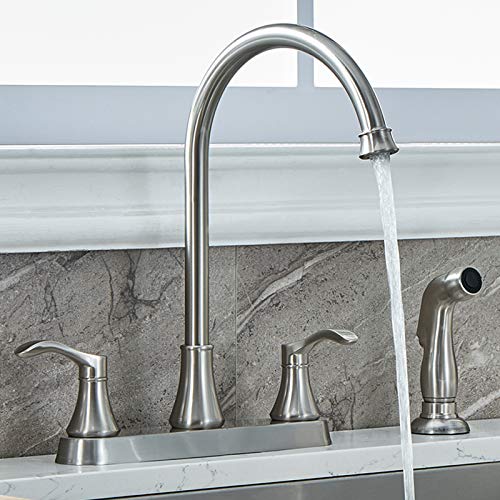
VALISY 4 Hole Kitchen Faucet Brushed Nickel
The VALISY speaks farmhouse fluently. Its title assembles the credentials in a working order: a kitchen faucet with side sprayer in brushed nickel, two handles, four holes, lead-free and NSF certified, a high-arc spout that swivels 360 degrees with the side sprayer beside it, an 8-inch centerset layout, and a stated audience of farmhouse kitchen and RV sinks. That last pairing is more sensible than it sounds — the farmhouse sink and the RV sink are both deep, hard-working, space-conscious basins that reward a full swivel and an independent sprayer, and a faucet specified for both has thought about reach. The certification language, absent from the Cinwiny’s title despite its other riches, is present here, and buyers who shop by that language will notice.
Against the Cinwiny, the VALISY trades the stated flow figure and the named steel grade for the NSF certification and the same swivel-and-centerset story; against the Windemeres, it trades line heritage for a longer printed specification. Brushed nickel keeps the farmhouse register warm and forgiving. The two-handle ritual applies as it does across this group. For the deep-sink household — farmhouse bowl or RV galley — that wants certification in writing and a spout that can turn its full circle to serve the draining board, the VALISY is the most precisely aimed pick in this guide.
- Finish: Brushed Nickel
- Handles: 2 handle
- Holes: 4 hole
- Material claims: lead-free, NSF certified
- Spout: high-arc, 360-degree swivel spout and side sprayer
- Layout stated: 8 inch centerset
- Settings named in title: farmhouse kitchen, RV sinks
- Flow rate: not stated in the listing
- Steel grade: not given
- Dispenser: none stated in the listing
Strengths
- NSF certification and lead-free claims in the title
- Full swivel plus side sprayer covers deep bowls
- Aimed squarely at farmhouse and RV sinks
Trade-offs
- No flow figure or steel grade printed
- Two-handle control only
- No dispenser for the bottle-weary
Best for: farmhouse and RV owners wanting certified language and full swivel. Not suited for: buyers who need a stated flow rate above all.

SHACO 4 Hole Kitchen Faucet Side Sprayer
The SHACO’s title is a checklist with one conspicuous blank. Present: a kitchen faucet with side sprayer, two handles, lead-free and NSF certified, a high arc, a 360-degree swivel spout, a four-hole mount, an 8-inch centerset format, a supply line included, and an easy-to-install promise. Absent: the finish. The title never names one, and this review follows the batch rule — the spec box records the finish as not stated, and any buyer for whom finish is decisive, which is most buyers, should confirm it from the listing’s photographs and specification fields before ordering. That single gap aside, the SHACO’s proposition is the installer’s friend: the supply line in the box removes the classic mid-job hardware-shop run, and the easy-installation billing, while it is the maker’s own language, at least announces the design’s intent.
Functionally the SHACO stands shoulder to shoulder with the VALISY — same certification language, same swivel, same centerset, same two-handle four-hole architecture — separated by the VALISY’s named finish and farmhouse-RV aim against the SHACO’s installation story. That is a clean choice: buy the one whose title answers your first question. If your first question is what it looks like, the VALISY answers and the SHACO makes you look further; if your first question is how the Saturday goes, the SHACO’s included supply line is a sentence written directly to you. Either way, the fourth hole gets its sprayer and the deck gets its traditional spread of handles and spout.
- Finish: not stated in the listing
- Handles: 2 handle
- Holes: 4 hole mount
- Material claims: lead-free, NSF certified
- Spout: high arc, 360-degree swivel spout
- Layout stated: 8 inch centerset
- Included per title: supply line
- Installation note in title: easy to install
- Flow rate: not given
- Dispenser: none stated in the listing
Strengths
- Supply line included, easing installation day
- Certification language matches the group’s best
- Full swivel and high arc on a centerset layout
Trade-offs
- Finish is not named in the title and must be confirmed
- No flow figure printed
- Easy-installation claim is the maker’s own wording
Best for: self-installers who value the included supply line and full specification. Not suited for: finish-first buyers unwilling to confirm the colour elsewhere.
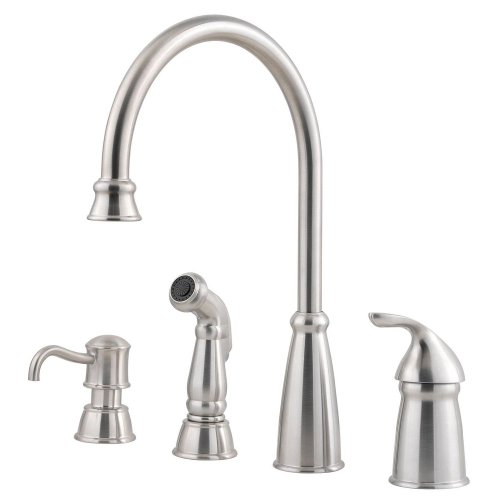
Pfister Avalon 4-Hole Stainless
The Avalon breaks the group’s pattern in the most useful way. Where the other five give the fourth hole to a sprayer alone, Pfister’s title promises a single-handle kitchen faucet with a side sprayer and a soap dispenser — both accessories, one deck, no bottles and no second station sacrificed. Single-handle control changes the daily rhythm completely: temperature blends at one lever, workable with a wrist or the back of a hand, which is the arrangement busy cooks and one-handed moments have been voting for throughout this batch’s other guides. Add a high arc for pot clearance, stainless steel construction in the title’s wording, a water-efficient note, and ceramic disc valve technology — the valve type associated with smooth, drip-resistant handle action — under the model code GT264CBS, and the Avalon is the moderniser’s four-hole faucet: old deck, new habits.
The costs are the dispenser’s eternal ones, stated in this batch before: the dispenser bottle lives under the sink and needs refilling from below a few times a year, and the arrangement assumes your four holes are disposed to host faucet, sprayer and dispenser in the layout the design intends — check the listing’s configuration against your deck’s actual hole pattern before ordering, because four holes in the wrong arrangement are their own small tragedy. For the household whose four-hole sink is a legacy fitting in an otherwise modernising kitchen, though, the Avalon is the only pick here that updates the control style and clears the soap bottle in a single purchase, and that combination earns it the closing slot.
- Finish wording: Stainless Steel
- Model in title: GT264CBS
- Handle: single handle
- Fourth-hole accessories: side sprayer and soap dispenser
- Holes: 4-hole
- Spout: high arc
- Valve technology named: ceramic disc valve technology
- Efficiency note in title: water-efficient
- Flow figure: not stated in the listing
- Swivel range: not given
Strengths
- Only pick bundling both sprayer and soap dispenser
- Single-handle control suits busy one-handed cooking
- Ceramic disc valve technology named in the title
Trade-offs
- Dispenser bottle needs under-sink refilling
- Hole arrangement must match the design’s layout
- No flow figure or swivel range printed
Best for: four-hole owners modernising to single-handle control with a clear deck. Not suited for: two-handle traditionalists or decks whose holes sit unusually.
The six are in, and the shape of the category should now be plain: a traditional deck, a working fourth hole, and a choice between heritage lines and fully documented newcomers. The table ahead compresses the reviews into one grid — handles, fourth-hole tenant, headline facts — for the readers who decide best with the whole field in front of them at once.
Comparison Table
The fourth hole’s job is the column that defines this category, so it leads the table; everything else follows the titles.
| Faucet | Handles | What the fourth hole hosts | Headline titled facts |
|---|---|---|---|
| Cinwiny 2-Handle 4 Hole Brushed Nickel | 2-handle | Sprayer | 1.8 GPM; 360-degree swivel; SUS304; lead-free |
| Delta Windemere Brushed Nickel Side Sprayer | Two-handle | Side sprayer | Traditional; brushed nickel; 21996LF-SS |
| Delta Windemere Chrome Side Sprayer | Two-handle | Side sprayer | Traditional; chrome; 21996LF |
| VALISY 4 Hole Kitchen Faucet Brushed Nickel | 2 handle | Side sprayer | NSF certified; lead-free; 360-degree swivel; centerset |
| SHACO 4 Hole Kitchen Faucet Side Sprayer | 2 handle | Side sprayer | NSF certified; lead-free; supply line included; finish not in listing |
| Pfister Avalon 4-Hole Stainless | Single handle | Side sprayer and soap dispenser | High arc; ceramic disc valve; water-efficient |
How to Choose a Four-Hole Faucet for an Existing Deck?
Begin where this category always begins: kneeling in front of your sink with a tape and a torch, because a four-hole deck is a specific inheritance and the faucet must fit the inheritance, not the other way round. Measure the centerset spacing — the 8-inch figure three of these titles state — and confirm your holes agree. Note which hole currently hosts what: on most four-hole sinks the sprayer sits in the fourth hole to the right, and the Avalon’s dispenser arrangement asks its own layout question, so sketch the deck before you shop. Check the deck’s material and thickness, and photograph the underside tangle, because four fittings — two valves, a spout, a sprayer hose, and on the Avalon a dispenser bottle — all claim under-sink territory that a disposal unit may already occupy.
Then choose by control philosophy. Two handles, offered by five of the six, give the traditional ritual: precise, repeatable blending, handles that can be worked with a wrist, and a deck that looks like the kitchens these sinks were born in. One handle, the Avalon’s offer, gives speed and one-handed grace. Neither is superior; they are different relationships with the same water, and a household should choose the one its busiest hour prefers. After control, choose by printed fact: the Cinwiny if a stated flow and steel grade settle you, the VALISY or SHACO if certification language does, the Windemeres if a known line does. Finish comes last and lightest — brushed nickel for forgiveness, chrome for brightness, the Avalon’s stainless wording for the modernising deck — because on a four-hole sink the architecture is the decision and the finish is merely its clothing.
Why Do Four-Hole Sinks Deserve Faucets Built for Them?
Because the four-hole deck is not a problem to be covered but a layout to be used, and its logic is older and better than its reputation. Each function gets its own station: hot here, cold there, the spout centred over the bowl, the sprayer in reserve at the dominant hand. That spread means two people can work one sink without negotiation, a sprayer can rinse while the spout fills, and every fitting is individually serviceable — a valve can be attended to without disturbing the spout, a sprayer swapped without touching the handles. The deck-plate alternative, in which a modern single-post faucet crouches on a plate that hides three of the four holes, throws that geography away to follow a fashion. Owners who have lived with a true four-hole arrangement rarely volunteer to lose it, and the six faucets in this guide exist because makers know it. The category is not a legacy curiosity; it is a working layout with a constituency, and this page treats it with the respect its users do.
Common Mistakes When Replacing a Four-Hole Faucet
The classic error is buying a one-or-three-hole faucet and a deck plate for a four-hole sink, then living with capped holes and a lost sprayer — a downgrade disguised as an update, which this guide’s selection rule exists to prevent. The second error is assuming the fourth hole’s tenant without reading the title: sprayer and dispenser arrangements differ per model here, and the Avalon proves the fourth hole can hold more than one surprise. Third, centerset spacing goes unmeasured, and an 8-inch faucet meets a deck drilled otherwise; the tape measure is cheaper than the return. Fourth, buyers of the Windemere pair agonise over an invented performance gap between finishes that their titles do not support — choose by light and room, as the reviews insist. Fifth, the SHACO’s lesson: a finish unnamed in a title must be confirmed, not assumed, because the box contains the finish the factory chose. Sixth, installers forget that four fittings mean four under-sink citizens, and the sprayer hose’s loop needs its clear channel just as a pull-down’s does; arrange the cabinet before the bottles migrate back and claim the territory.
How Should You Maintain a Sprayer and Dispenser Setup?
The sprayer is a small faucet in its own right and wants a small faucet’s care. Keep its nozzle face clear with the same gentle descaling rhythm as any spray head — a mild soak, a soft rub, no pins — because a sprayer that fans crooked is usually a sprayer with one crusted nozzle, not a failed unit. Exercise it weekly even in weeks you do not need it; hoses and seals that move stay supple, and a sprayer left dormant for a season is the one that weeps when finally trusted. Check its hose’s travel under the sink whenever you rearrange the cabinet, since stored bottles drift into loops with gravitational inevitability. The Avalon’s dispenser asks for two habits: refill before it runs dry, because a pump sucking air teaches the household to keep a bottle out again and defeats the arrangement, and rinse the pump’s intake when refilling, so yesterday’s soap never gums tomorrow’s. Do these small things and the fourth hole’s tenants will serve as quietly as the faucet itself, which is the entire ambition of a well-kept sink.
What Is Installation Day Like with Four Fittings to Mount?
Busier than a single-post swap, and better planned. A four-hole installation mounts a small committee — two valves or a faucet body, a spout, a sprayer, and on the Avalon a dispenser — and each member needs its hole cleaned, its seal seated and its connection tested. The wise order is dry-fit first: set every fitting in its hole without final tightening, stand back, and check the spread reads straight and centred from the room’s viewpoint, because a four-piece layout a degree out of true advertises itself along the whole deck line. Only then secure from below, working in rotation rather than finishing one fitting completely while its neighbours float, so the set settles as a set. The sprayer’s hose deserves its route planned before the valves crowd the cabinet: it should fall in a clear loop, reach its full extension without tugging its connection, and retire without snagging the bottles that will inevitably return. The dispenser’s bottle, where fitted, should be filled after mounting rather than before — a full bottle is a pendulum, and a pendulum of soap under a fresh installation is a mess with a sense of timing.
The closing ritual matters more here than in simpler swaps, because there are more joints to betray you. Flush the supplies into a bucket before the final connections, as always, then test each station in turn — hot handle, cold handle, spout at full blend, sprayer at full stretch, dispenser pump primed — with a dry tissue waiting at every joint below. Four-hole decks reward the methodical and punish the hurried in exact proportion to their fitting count, and a Saturday spent methodically is still shorter than a Sunday spent drying a cabinet. Photograph the finished underside before the cleaning bottles come home; the next person under that sink, possibly you in six years, will want the map.
How Does a Four-Hole Layout Change Two-Cook Evenings?
It gives the second cook a station, and that changes the politics of the sink entirely. In a single-post kitchen, the sink is a monarchy: one person holds it, the other waits with a dripping colander and rising opinions. On a four-hole deck the sprayer is a second water source with its own aim — the second cook rinses, fills and washes at the sprayer’s station while the first commands the spout, and the two streams cross without conflict because each has its own geography. Pasta nights, preserving days, the great post-roast recovery: all of them run measurably calmer when the sink seats two. The two-handle arrangement extends the diplomacy, since a temperature once set at the handles stays set while the sprayer comes and goes. Households that cook in pairs consistently name this — not the finish, not the brand — as the thing they would refuse to surrender, and it is the deepest reason the four-hole format retains its constituency in a pull-down century. A faucet layout that improves the household’s temper at its busiest hour is not a legacy fitting; it is a peace treaty with handles.
What About Renters and Owners of Older Sinks?
Four-hole sinks live disproportionately in older housing and rental stock, and this category serves both groups with unusual fairness. For owners of older homes, a true four-hole faucet is the renovation that respects the house: the original deck keeps its geometry, the new faucet brings modern materials and certifications to it, and nothing about the swap requires the sink or worktop to be sacrificed to a fashion. Several titles here carry the lead-free and certification language that matters most in older plumbing contexts, stated outright where it exists. For renters, the honest advice is narrower: a faucet swap usually needs the landlord’s blessing, since it is plumbing, but where that blessing exists, a like-for-like four-hole replacement is the lowest-risk upgrade in the kitchen — same holes, same layout, no drilling, no plates, and the original fitting can be kept for reinstatement. In both cases the discipline of this guide applies with extra force: read the title, measure the deck, confirm what the fourth hole will host, and let the sink you actually own choose the faucet, rather than the sink in a showroom photograph.
How Long Do These Traditional Layouts Serve?
The four-hole, two-handle layout is the longevity champion of the kitchen, and its secret is separateness. Every station is its own fitting with its own connection, so wear arrives one address at a time and is answered at that address: a handle’s cartridge, a sprayer’s hose, a dispenser’s pump can each be serviced or swapped while the rest of the set works on undisturbed. Compare the integrated modern faucet, whose single casting concentrates every function into one body — elegant, and correspondingly all-or-nothing when something deep inside it tires. The traditional set’s other longevity asset is the standardisation of its world: hole spacings, supply connections and valve dimensions in this architecture have been stable for generations, so parts conversations stay simple long after fashion has moved on. The finishes ask only the soft-cloth liturgy this batch repeats — wipe, mild soap, dry — and the sprayers ask their weekly exercise. Owners who keep the model codes filed, as every guide in this series nags, routinely measure these faucets in decades. A four-hole sink fitted with one of these six is not a compromise awaiting a real renovation; properly maintained, it is the renovation, finished.
What Should You Check in the First Week?
Four fittings mean four small audits, and the first week is when they pay. Run each station daily on purpose: both handles through their full travel, the spout through its swivel where a swivel is stated, the sprayer to its full stretch and back, the dispenser — on the Avalon — until its pump primes and delivers. Then go below with a torch and a tissue and visit every joint, because a weep at a valve or a sprayer connection declares itself in the first days or keeps its counsel for months, and the tissue test is how you choose which story you get. Check the sprayer hose’s loop hangs clear once the cabinet’s bottles have drifted home, and rearrange the drift rather than blaming the hose. Set the household’s temperature positions at the two handles — every two-handle kitchen develops its marks, the morning blend and the evening rinse — and let hands learn them. Note the model code somewhere durable. A set that ends its first week with dry joints, a clear hose loop and learned handle positions has effectively finished being installed, whatever the calendar says, and can be expected to disappear into the kitchen’s routines for years.
How Do You Choose Between the Certified Titles and the Heritage Lines?
It is the group’s most genuine fork, so it deserves a plain answer. The Cinwiny, VALISY and SHACO print their material language — lead-free across all three, NSF certification on two — because their makers compete on stated compliance and stated specification. The Windemere pair print almost nothing beyond form and finish, because Delta competes on the line’s accumulated familiarity. Neither strategy is a trick. A buyer in an older house, attentive to water quality language and wanting it in writing, is rationally drawn to the certified titles; a buyer replacing a beloved traditional faucet with its modern equivalent is rationally drawn to the Windemere’s continuity. The Avalon stands outside the fork entirely, competing on configuration — single handle, dispenser — rather than on either paperwork or heritage. Decide which currency you are actually spending: documented specification, documented lineage, or a new layout for an old deck. The titles in this guide are honest enough to tell you which currency each one accepts, and a purchase made in the right currency rarely comes back as a return.
A Word on Water Pressure, Flow and the Sprayer
Only one title in this group states a flow figure — the Cinwiny’s 1.8 GPM — and the honest treatment of that fact is to explain what such a figure can and cannot promise, rather than to grade the silent five against it. A stated flow describes the faucet’s delivery at standard test pressure; your kitchen’s delivery is the marriage of that design with your house’s supply, and an older four-hole home may have its own opinions about pressure that no faucet can overrule. What a four-hole layout does guarantee, regardless of pressure, is distribution: the sprayer and the spout draw from the same supplies, and using one while the other runs divides the flow between them, a fact two-cook households learn in their first week and plan around without resentment. The sprayer’s character is pressure made visible — a firm, narrow working stream for rinsing — and in a low-pressure house it can feel more effective than the spout’s aerated flow for shifting debris, because its water arrives concentrated. None of this is a defect to be solved; it is the physics of the format, and households that understand it stop blaming faucets for their plumbing and start enjoying the layout’s genuine gifts, which are geography and independence rather than force.
How Do These Faucets Sit with Modern Kitchen Style?
Better than the fashion pages admit. The four-hole spread has a rhythm — handle, spout, handle, sprayer — that reads as intentional in any kitchen whose design values visible function: the farmhouse room obviously, but also the industrial kitchen with its exposed everything, the traditional room with framed cabinetry, and even the transitional space that mixes a modern range with heritage bones. Brushed nickel, worn by half this group, is the finish that lets a traditional layout pass in contemporary company, because its soft grey register is the same one modern hardware speaks. Chrome does the opposite service, keeping a classic layout bright enough for a white, glossy room. The Avalon, single-handled and dispenser-bearing, is the layout’s own bridge to modern habits, proof the format can absorb new control styles without surrendering its geography. What the four-hole set will never be is invisible — it occupies its deck with presence — and kitchens committed to the monastic single-post look should shop another guide in this series with our blessing. Presence, chosen knowingly, is not a compromise; it is a style with a longer pedigree than minimalism itself.
What Does the Sprayer Do All Week? A Small Inventory
Monday: it rinses the sink itself after the weekend’s cooking, chasing the last grains and coffee grounds to the drain in a way a spout, fixed over the bowl’s centre, never quite manages. Tuesday: it fills the mop bucket standing on the floor, sparing someone’s back the lift into the bowl. Wednesday: it washes the dog, or the dog’s bowl, or the muddy boots balanced in the sink, with an aim that keeps the water on the task and off the cook. Thursday: it rinses the recycling before it goes out, the jars and tins that a spout rinses slowly and a sprayer rinses in seconds. Friday: it becomes the second cook’s station for the evening’s production, as the two-cook section described. Saturday: it hoses down the roasting tin that soaked overnight, at an angle no fixed spout can achieve. Sunday: it fills the great stockpot’s neighbour, the vase for the table flowers, standing beside the sink. None of these tasks is glamorous and together they are the argument: the fourth hole’s tenant is the hardest-working minor fitting in the house, and a household choosing among these six faucets should weigh the sprayer’s presence — universal here — as the format’s founding gift, and the Avalon’s dispenser as its one ambitious extension.
How Should You Budget the Whole Job, Not Just the Faucet?
The faucet is the visible purchase; the job around it has its own small economy, and planning it in words rather than surprises is the difference between a satisfying Saturday and a resentful one. If a plumber is hired, the labour buys the whole committee’s mounting and testing, and it is the moment to have the under-sink neighbourhood judged — shut-off valves that have not moved in a decade, supply lines of unknown age, a waste seal with a history — because the cabinet will never be emptier or the access easier. If the job is your own, the companion costs are tools and consumables: the basin wrench, a head-torch, the sealant the instructions specify, and fresh supply lines wherever age is even suspected, since a failed old line under a new faucet is the cruellest sentence in plumbing. Add the while-we-are-here list and discipline it in advance — the cabinet floor mat that will catch the next decade’s first drip and announce it, the trap that has wept quietly, the bottles’ rearrangement that gives the sprayer hose its clear loop — and refuse additions once the water is off. Set against the spending, remember what the purchase returns: a deck where every hole works, a second station at the sink, and a layout measured in decades. Few rooms in a house repay a modest, well-planned outlay as reliably as the sink you stand at three times a day.
Final Recommendation
For the fullest printed specification on a true four-hole layout, start with the Cinwiny 2-Handle 4 Hole Brushed Nickel — stated flow, stated steel, full swivel. For a known traditional line, the Delta Windemere Brushed Nickel Side Sprayer carries the category’s heritage in the forgiving finish. And for the household modernising its habits without changing its sink, the Pfister Avalon 4-Hole Stainless alone adds single-handle control and a dispenser to the sprayer’s station. Give every hole on your deck a job and the right faucet to do it, and a four-hole sink stops being an inheritance to apologise for and becomes what it always was — the best-organised workstation in the kitchen.
Frequently Asked Questions
What usually goes in the fourth hole of a kitchen sink?
A side sprayer, on five of the six picks here — or, on the Pfister Avalon, a side sprayer and a soap dispenser share the accessory honours per its title. The fourth hole exists to host an accessory station beside the faucet’s own handles and spout.
Can I fit a one-hole faucet on a four-hole sink with a deck plate?
You can cover holes with a plate, but you lose the four-station layout — separate handles and an independent sprayer — that defines this category. This guide deliberately selected only true four-hole faucets whose titles state the format, never plate conversions.
Are the two Windemere faucets different besides the finish?
Per their titles, no. Both are traditional, two-handle, four-hole faucets with side sprayers; one is brushed nickel (model 21996LF-SS) and the other chrome (model 21996LF). Choose between them by the room’s light and your appetite for wiping water spots, not by imagined performance.
What does an 8-inch centerset mean?
It describes the spacing of the faucet’s fittings across the deck — the distance the layout is built around. Three titles here state an 8-inch centerset. Measure your deck’s hole spacing before ordering so the faucet’s geography matches your sink’s.
Is two-handle control worse than single-handle?
It is different, not worse. Two handles give precise, repeatable temperature positions and a traditional ritual; a single handle gives speed and one-handed blending. Five picks here are two-handle and the Avalon is single-handle, so the category lets you choose your relationship with the water.
Does the SHACO really not state its finish?
Its title does not name one, though it states a great deal else — certification, swivel, centerset, an included supply line. Confirm the finish from the listing’s photographs and specification fields before ordering, as its review advises.
My four holes are not in a straight standard row — what then?
Measure before despairing. Four-hole decks vary, and a faucet’s stated centerset describes the layout it was built for; a deck whose spacing differs needs a model whose arrangement matches, or a conversation with a plumber about what can be adapted without drilling. The Avalon’s review raises the same caution for its sprayer-and-dispenser layout. The deck is the fixed fact in every faucet purchase, and the faucet — however handsome — is the variable that must fit it.
Is a side sprayer as useful as a pull-down spray head?
It is useful differently. A pull-down head travels with the spout’s water and offers mode menus; a side sprayer is an independent second source, available while the spout works, aimed by trigger at close range. Kitchens that rinse, fill and wash at one station after another often prefer the sprayer’s independence; kitchens that want spray modes at the main spout should look at this series’ pull-down guides instead.
Should I replace the supply lines while the faucet is being changed?
It is the cheapest insurance in the whole project, and this guide recommends it wherever the existing lines show age, stiffness or an unknown history. The cabinet is empty, the valves are being exercised and the connections are already broken; new lines fitted in that moment cost little and remove the single most common cause of under-sink water damage from the new faucet’s whole first decade. The SHACO’s title, which includes a supply line, makes the point from the manufacturer’s side: fresh lines and fresh faucets belong together.
How do I keep two-handle temperature settings consistent?
By turning the ritual into marks. Every two-handle household develops its reference positions — the morning blend, the hand-warm rinse, the full-hot soak — and hands learn them faster than eyes do, usually inside the first week. If a handle’s travel ever changes character, becoming looser or stiffer, treat it as the fitting asking for attention early, while the fix is a cartridge conversation rather than a flood conversation, and consult the model code you filed at installation.
What is the single most common regret with this category?
Buying against the deck — choosing a faucet for its photograph and discovering its layout disagrees with the holes in the sink. Every other regret in this category is survivable; that one ends in returns, plates or drilling. Measure the deck, sketch the holes, and let those two unglamorous artefacts chair the meeting at which the faucet is chosen.
Related Guides
Three companion guides follow in the series, from Vigo’s spring-spout designs to the linen and rug shelves of the wider cottage library, each one written for readers who measure first and order second. The Vigo roundup is the natural next read for anyone whose four-hole deliberations have awakened a general faucet curiosity, since it covers the most theatrical architecture in the batch; the two household guides carry the same read-the-title discipline into softer territory, where a fibre’s name matters exactly as much as a finish’s does here, and for exactly the same reason — the box will contain what the words say, and never what the shopper merely hoped they meant.
Best Lime Green Cotton Sheet Sets


