What's inside
- Key Takeaways
- Quick Picks
- How Did We Choose the Best Acrylic Bathtubs?
- What Is Acrylic, Really, and Why Did It Take Over?
- How Is an Acrylic Bathtub Actually Made?
- How Can You Tell Good Acrylic from Bad Acrylic?
- How Does Acrylic Handle Heat, Noise and Long Soaks?
- How Does Acrylic Stack Up Against the Other Materials?
- How Do Hotels and Rentals Specify Acrylic, and What Can Homes Learn?
- Which Acrylic Size Fits Which Bathroom?
- How Do the Six Acrylic Routes Compare?
- What Should You Check on the Day an Acrylic Tub Arrives?
- How Should You Install and Care for an Acrylic Tub?
- What Mistakes Do Acrylic Buyers Keep Making?
- Final Recommendation
- Frequently Asked Questions
- Related Guides
As an Amazon Associate I earn from qualifying purchases. This post may contain affiliate links at no extra cost to you.
cottageverdict.com is reader-supported. When you buy through links on our site, we may earn an affiliate commission.
Where to buy: Five of the six picks are sold on Amazon — follow a linked name to check price on Amazon, confirm the trim finish, and review the delivery arrangements. The sixth seat covers acrylic alcove tubs in prose, for reasons explained in its review.
Acrylic won the bathtub. Walk through any showroom, any remodel, any new-build bathroom in the country and the best acrylic bathtubs dominate the floor — not because acrylic is exotic, but because it solved the equation the other materials could not: light enough to install without a crew, warm enough to welcome a winter bather, shapely enough for designers, and priced, in tier terms, where ordinary households actually live. This guide reviews the acrylic field at its best, and it does so with its eyes open about the material’s one honest weakness — it is only ever as good as the reinforcement beneath its glossy skin.
That caveat organises everything below. Five linked picks, all freestanding, span the sizes real bathrooms ask for: two 67-inch ovals for generous rooms, a 59-inch all-rounder, a 55-inch compact charmer, and an air-bubble model for households who want their acrylic to fizz. The sixth seat goes prose-only to acrylic alcove tubs — not because they are lesser, but because the alcove branch of the acrylic family is best discussed as a class, and because a companion guide in this series gives alcove acrylic its own full treatment.
A word about the slug that may have brought you here: the internet’s spelling of this material wanders, but the chemistry does not. Whether the search said acrylic or something nearer to it, the tubs below are the genuine thermoformed article — sheet acrylic, reinforced, finished, and ready to hold a decade of baths.
One more framing note before the reviews: this guide treats acrylic as a family with real internal differences, not a single substance with a single verdict. A reader who has endured a thin, drumming bargain tub has not experienced what the picks below do, any more than a reader who has driven one rattling economy car has experienced what a well-built saloon does. Judge the material by its best-made examples — that is what a shortlist is for.
Key Takeaways
- The WOODBRIDGE 67-inch is the balanced champion: the size, shape, and finish most freestanding shoppers actually need.
- Vanity Art’s two entries split the difference between sprawling (67 inch) and sensible (59 inch) without changing their design language.
- The FerdY Tahiti proves acrylic’s shaping freedom at 55 inches, fitting rooms that exclude every other freestanding pick.
- The WOODBRIDGE air bubble tub adds a self-drying air system to acrylic’s easy ownership — the gentlest jetted route in the material.
- Judge acrylic by reinforcement and warranty, not gloss: the shine is free, the structure underneath is the product.
- Acrylic alcove tubs are covered prose-only here and in depth in our alcove-specific companion guide.
Quick Picks
| Pick | Badge | Why it made the list |
|---|---|---|
| WOODBRIDGE 67 Inch Acrylic Freestanding Bathtub | Best overall acrylic | A long, glossy, well-balanced oval with included matte black trim and an easy two-person install. |
| Vanity Art 67 Inch Freestanding Bathtub | Best wide acrylic | Sixty-seven by thirty-two inches of certified acrylic room for tall and broad bathers. |
| Vanity Art 59 Inch Freestanding Bathtub | Best mid-size acrylic | The same design family in a 59 by 30 footprint that suits ordinary primary bathrooms. |
| FerdY Tahiti 55 Inch Freestanding Bathtub | Best compact acrylic | A certified 55-inch oval that keeps the freestanding presence in small ensuites and guest baths. |
| WOODBRIDGE 59 Inch Air Bubble Freestanding Bathtub | Best acrylic with air | Pure air-bubble bathing in a freestanding acrylic shell, with the simplest hygiene routine in jetted tubs. |
| Acrylic Alcove Tubs as a Class | Prose-only overview | The built-in branch of the family, discussed generically here and reviewed fully in our alcove guide. |
How Did We Choose the Best Acrylic Bathtubs?
We began where acrylic itself begins: with the sheet. Quality acrylic tubs are thermoformed from continuous cast or high-grade extruded sheet, then reinforced — usually with fibreglass and resin, sometimes with additional structural layers — until the shell holds its shape under a full load of water and bather. We favoured models whose listings and documentation speak plainly about construction and certification, and we treated any tub coy about its reinforcement the way a structural engineer treats a coy bridge.
Shape came second, because shaping is acrylic’s superpower. The material can be drawn into ovals, slopes, and lumbar curves that enamelled metal cannot economically follow, so an acrylic shortlist should read like a gallery of considered geometry. Each pick below earned its seat partly on how intelligently its interior is drawn for the body it will hold — a criterion that punishes the merely photogenic.
Size coverage was the third filter, deliberately spanning 55 to 67 inches so the list maps onto real floor plans rather than one idealised suite. The fourth was ownership: included drains and overflows, recognisable certifications, brands with catalogues deep enough to imply a future supply of parts and answers. A bathtub is a twenty-year roommate; we interviewed accordingly.
We also weighed the evidence of the material’s installed base. Acrylic tubs fill more hotel rooms, rental bathrooms, and family homes than every rival combined, and that ubiquity is itself data: parts are stocked everywhere, every plumber alive has set one, and the failure modes are so well understood that they are all, by now, preventable. Novelty has its charms, but a bathtub is a strange place to seek them.
And we kept one seat deliberately linkless. Acrylic alcove tubs are a vast, worthy class that this site’s alcove-specific guide handles model by model; here they are discussed as a class, so readers whose bathrooms are alcove-shaped understand exactly where to go next rather than finding this freestanding list padded with token built-ins.
What Is Acrylic, Really, and Why Did It Take Over?
Acrylic sheet is a plastic with an unusually dignified résumé — the same family of material trusted for aircraft canopies and aquarium walls — and its bathing virtues flow from three properties. It is non-porous, so the surface seals completely against water and staining. Its colour runs through the sheet rather than sitting on it, so the white you see is the material itself, all the way down. And it is thermoformable: heated, it drapes over a mould into shapes of genuine sculptural freedom, then holds them.
The warmth deserves emphasis because it is the first thing a bather notices. Stone, enamel, and metal all greet the back with a cold handshake on a winter evening; acrylic sits near room temperature and asks nothing of the first fill. Across a season of baths, that small mercy compounds into the material’s most-loved trait, mentioned by owners more often than any specification.
The takeover followed from logistics as much as comfort. An acrylic tub weighs a fraction of its cast iron ancestor, travels in an ordinary delivery network, climbs stairs on two people’s shoulders, and installs without structural consultation in most houses. Remodelling is an industry built on such mercies. Acrylic did not win because it is the finest material in absolute terms — stone resin feels finer, enamel lasts longer — but because it is the finest material most houses can actually have, and that is the contest that mattered.
The takeover also changed what a bathroom could look like. When tubs were heavy, they were hidden — built into alcoves, boxed behind tile, treated as plumbing. A light, sculptural, freestanding acrylic tub could stand in the middle of a room like furniture, and once it could, bathroom design reorganised itself around it: the tub as centrepiece, the filler as jewellery, the window placed for the bather’s view. The gallery of picks below exists because acrylic made the bathtub a piece of design again, at prices that let ordinary rooms join in.
Its honest weaknesses are two. The surface, while hard, can be scratched by abrasives and careless metal, though scratches polish out in a way enamel chips never will. And the shell’s stiffness depends entirely on reinforcement: a thin, under-backed acrylic tub flexes and drums, while a well-built one feels nearly as planted as metal. Everything in acrylic shopping reduces, in the end, to telling those two apart.
How Is an Acrylic Bathtub Actually Made?
The process begins with a flat sheet of acrylic, heated until it drapes like heavy cloth. A vacuum draws it down over or into a mould — the master shape of the tub — and the sheet cools holding every curve of the design. This is why acrylic tubs can wear shapes that pressed steel and cast iron cannot: the mould is the only limit, and moulds are cheap compared with foundries.
Fresh from the mould, the shell is a beautiful eggshell — glossy, correctly shaped, and far too flexible to bathe in. The making of a real tub happens next: layers of fibreglass and resin are applied to the back, sometimes with additional boards or foam at the base, until the composite reaches the stiffness the designer intended. Two tubs can share a mould’s silhouette and differ entirely in this hidden half of their construction, which is why this guide keeps returning to reinforcement as the true product.
The mould leaves one more fingerprint worth knowing: because the sheet stretches as it forms, a deep, dramatically shaped tub starts life thinner at its curves than a shallow, plain one. Great makers compensate with thicker starting sheet and heavier backing exactly where the draw is deepest. When a sculptural tub also feels drum-like at its curves, the maker skipped that compensation — and the shape you fell for is precisely where the tub will age first.
Trimming, drilling for the drain and overflow, and polishing complete the object. The best makers inspect the gloss under raking light, where thermoforming’s thin spots and dust inclusions confess themselves; the worst ship what the mould gave them. When you run a hand along a fine acrylic tub and feel nothing but continuity, you are feeling the accumulated effect of those unglamorous factory minutes.
How Can You Tell Good Acrylic from Bad Acrylic?
Start with the knuckle test, in a showroom or on delivery day: rap the tub’s wall and floor. A well-reinforced shell answers with a dull, solid thud; a thin one replies with a hollow drum note that predicts years of creaks. Press the basin floor with your full weight through one heel — quality construction gives nothing away, while a shell that visibly breathes underfoot will announce every future bath with a flex and a sigh.
Read the listing for the words that cost money: reinforcement described by material and method, certification to recognised plumbing standards, and a warranty that names a number of years without embarrassment. Vague listings are not being modest; they are being economical with the truth, and in acrylic the truth lives precisely in those unglamorous lines. Weight is a useful proxy too — within a size class, the heavier acrylic tub is usually carrying more structure, and structure is what you are buying.
Inspect the finish like a jeweller. The gloss should be even across curves, the rim free of waves, the drain and overflow seats perfectly flat so their seals sit true. Thermoforming stretches sheet thinnest at the deepest draws of the mould, so the basin’s corners and floor deserve your closest look: that is where cheap acrylic confesses, in a faint thinness of colour and a flexibility the rest of the shell hides.
Finally, ask the ownership questions. Is the drain included, and in what finish? Does the maker sell replacement trim? How long has this model, not just this brand, been in the catalogue? Long-running models have survived contact with the public, which remains the most rigorous testing programme in the industry.
Price, finally, should be read as information rather than temptation. Within this material, the tiers track reinforcement, finish quality, and included hardware with unusual honesty, so a suspiciously inexpensive acrylic tub is not a bargain discovered but a specification reduced — usually in the backing, where the camera never looks.
The same scepticism should be applied to this guide’s own favourites on delivery day, using the inspection ritual described later in these pages. A shortlist earns trust by surviving scrutiny, not by requesting exemption from it, and the knuckle test does not care whose logo is on the crate.

WOODBRIDGE 67 Inch Acrylic Freestanding Bathtub — Best overall acrylic
If the acrylic category needed a single ambassador, it would look like this WOODBRIDGE: a 67-inch oval drawn with restraint, finished in a deep gloss, and specified the way careful buyers wish every listing were — drain and overflow included, in a deliberate matte black that pairs with the hardware half the country’s remodels are choosing. It represents the material’s virtues without exaggeration and its compromises without concealment.
The bathing geometry is the mainstream ideal: a continuous oval slope that lets a mid-height adult settle with shoulders near the waterline, a floor long enough to keep knees honest, and a rim wide enough to be useful furniture. WOODBRIDGE’s acrylic construction keeps the shell’s weight in the two-person-carry class, which quietly expands the list of houses this tub can serve — upstairs suites included — without a structural consultation.
Ownership is the calm modern routine the material promises. The non-porous surface rinses clean, the odd scuff polishes away, and the tub asks for nothing exotic in cleaners or rituals. Acrylic sceptics raised on enamel sometimes miss the cold solidity of metal for the first week; by the second, the warm first touch on cold mornings has usually closed the argument.
There is a designer’s reason this model keeps winning remodels, too: the oval is the chameleon of tub shapes. It sits as comfortably in a farmhouse scheme with tongue-and-groove walls as in a spa scheme with large-format tile, because its curves quote no particular decade. A tub is the hardest object in the room to change later, and choosing the shape that argues with nothing is a form of long-term insurance.
- Format: freestanding oval, 67 inches
- Material: glossy white acrylic
- Drain: included, matte black finish
- Overflow: integrated with matching trim
- Install: two-person carry class
Strengths
- Balanced size, shape, and specification
- Included trim in a current finish
- Light enough for upstairs bathrooms
Trade-offs
- Plain oval shaping, no lumbar sculpture
- Gloss shows water spots between cleans
- Matte black trim will not suit chrome schemes
Best for: the mainstream freestanding remodel. Not suited for: buyers seeking stone-like mass or elaborate shaping.

Vanity Art 67 Inch Freestanding Bathtub — Best wide acrylic
Vanity Art’s entry argues that in acrylic, width is the luxury dimension. At 67 by 32 inches it offers the broadest basin in this guide, and breadth is what tall, broad, or simply sprawl-minded bathers actually run out of in lesser tubs. Shoulders settle instead of wedging, knees can angle naturally, and the whole bath reads as roomy rather than merely long.
The specification carries the details sceptics ask about. The tub is UPC certified, its pop-up drain and overflow are included, and the acrylic shell has the thick-rimmed, deliberate feel of a maker who expects the knuckle test described above. Vanity Art’s contemporary styling — a softened rectangle rather than a pure oval — also suits the straighter lines of newer bathrooms, where a fully oval tub can look oddly antique.
The size asks its usual questions in return: a delivery route that admits it, a floor that welcomes it, and a water heater that can fill it generously. Answer those three honestly and the Vanity Art 67 is the acrylic tub in this guide most likely to be described, a year later, with the word “finally” — finally a tub that fits the bather, rather than the other way around.
Two bathers sharing this tub in sequence will notice another breadth dividend: the water stays where it should. A wide basin sloshes less when a tall bather settles, keeps the waterline steadier at the shoulders, and gives the overflow an easier job. It is the kind of physics nobody lists and everybody feels, and it is why width, once experienced, is hard to give up.
- Format: freestanding, 67 by 32 inches
- Material: white acrylic
- Drain: pop-up drain and overflow included
- Certification: UPC per the listing
- Style: contemporary softened rectangle
Strengths
- Broadest, most accommodating basin here
- Certification and included hardware
- Contemporary lines suit new-build rooms
Trade-offs
- Largest delivery and fill demands in the guide
- Needs a room with genuine spare width
- Squarer styling divides traditional tastes
Best for: tall and broad bathers in generous rooms. Not suited for: narrow ensuites or small water heaters.

Vanity Art 59 Inch Freestanding Bathtub — Best mid-size acrylic
Not every primary bathroom is a ballroom, and the 59-inch Vanity Art is the pick for the honest majority: a freestanding acrylic tub at 59 by 30 inches that brings the format’s presence into rooms where a 67-inch model would crowd the vanity and bully the door swing. It is the same design family as its bigger sibling, scaled to the dimensions most houses actually offer.
The specification remains grown-up at the smaller size — UPC certified, with a slotted overflow and pop-up drain included — which matters because compact tubs are where some makers quietly economise. The slotted overflow, hidden in the tub wall rather than plated on it, keeps the interior line unbroken and gives the basin a calm, gallery-like cleanliness that photographs well and, more importantly, wipes down well.
Bathers of average height will find the proportions friendly rather than fitted: enough length to recline, a slope that holds the back without sliding, and a water volume that fills quickly from an ordinary heater. For the guest-suite or the modest primary bath that wants one beautiful object rather than three adequate ones, this is acrylic’s most persuasive size.
The 59 also threads the needle of the delivery day better than any other pick here: light enough for two people, compact enough for the average stair turn, and small enough to wait in a hallway without becoming the hallway. Remodels are marathons of small logistics, and a tub that never creates a logistics problem earns goodwill from everyone who has to live around the project.
- Format: freestanding, 59 by 30 inches
- Material: white acrylic
- Overflow: slotted, integrated; pop-up drain included
- Certification: UPC per the listing
- Style: contemporary, clean-lined
Strengths
- Freestanding presence in an ordinary footprint
- Full specification despite the smaller size
- Quick fills from standard water heaters
Trade-offs
- Tall bathers will bend their knees
- Less visual drama than the 67-inch models
- One finish and trim scheme to match
Best for: ordinary primary bathrooms wanting the freestanding look. Not suited for: bathers well over six feet.

FerdY Tahiti 55 Inch Freestanding Bathtub — Best compact acrylic
The Tahiti is acrylic’s party trick performed at small scale: thermoforming’s freedom lets a 55-inch tub keep the continuous oval, the integrated slotted overflow, and the sculptural presence of the big models, in a footprint that fits the bathrooms freestanding tubs usually abandon. Guest ensuites, converted box rooms, city flats — the Tahiti is the pick that lets those spaces have a real bath instead of an apology.
FerdY finishes the tub in a high gloss, supplies a brushed nickel drain, and lists cUPC certification — the full paperwork at the smallest size in the guide, which again is where lesser ranges cut corners. The proportions flatter shorter bathers in particular, holding them in the recline instead of letting them slide down a long slope and brace against the far end, a small ergonomic truth that tall-focused guides rarely mention.
Its limits are the honest arithmetic of 55 inches: a tall bather folds, a shared soak is not on the menu, and the water volume makes a shallower bath than the big ovals offer. Within its brief, though, the Tahiti is complete — the acrylic tub for the room that every other pick in this guide would overwhelm.
Small tubs also fill a role big ones cannot: the deliberate second bath. In a house with a generous primary tub, the Tahiti gives the guest room its own bathing dignity instead of a shower-only compromise, and guests remember a real soak long after they forget the mattress. Hosts shopping for that effect, at a size a spare room can spare, will find nothing else in the guide that fits the brief.
- Format: freestanding oval, 55 inches
- Material: glossy white acrylic
- Drain: brushed nickel, included
- Overflow: integrated slotted design
- Certification: cUPC per the listing
Strengths
- Genuine freestanding form at 55 inches
- Proportions flatter shorter bathers
- Certified, with drain included
Trade-offs
- Short interior for tall users
- Smaller, shallower soak
- Compact scale suits fewer grand designs
Best for: small bathrooms and shorter soakers. Not suited for: tall bathers or two-person ambitions.
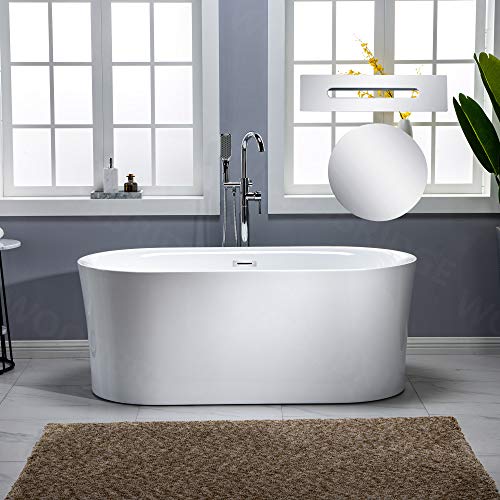
WOODBRIDGE 59 Inch Air Bubble Freestanding Bathtub — Best acrylic with air
Acrylic’s lightness makes it the natural shell for a jetted tub — less mass for the machinery to carry, easier installation around the hardware — and this WOODBRIDGE is the material’s most graceful powered expression: a 59-inch freestanding oval whose floor releases warmed air through a field of small ports, surrounding the bather in a rising fizz with no pump, no water jets, and no recirculating lines to maintain.
The air-only choice is the thoughtful core of the design. After each bath the system purges its air lines dry, so the hygiene routine that burdens whirlpool ownership simply does not exist here; the acrylic basin wipes clean, the chrome trim on this variant keeps the palette neutral, and the whole appliance returns to being a quiet oval sculpture until the next soak summons it.
What it will not do is knead a sore back the way water jets can — air massages by buoyancy and movement, a gentler persuasion that suits long, quiet soaks better than athletic recovery. Households should choose it for what it is: the easiest-living jetted acrylic tub in this guide, and the only one whose machinery never asks for a cleaning calendar.
Evening is this tub’s best hour. The bubbles catch low light, the blower’s murmur covers the house’s noises, and the acrylic’s warm touch removes the last small shock from climbing in. Owners describe it less as a bath with a feature and more as a place the day gets rinsed off them — which, at 59 inches and a mid-range tier, is a remarkable amount of ritual per square foot.
- Format: freestanding, 59 inches
- System: air bubble only, self-purging lines
- Material: white acrylic
- Trim: chrome drain and overflow on this variant
- Care: the simplest routine of any jetted tub
Strengths
- Gentle air massage with near-zero upkeep
- Acrylic keeps the appliance light to install
- Clean oval form hides its machinery entirely
Trade-offs
- No directed water-jet pressure
- Blower sound accompanies the soak
- Needs floor filler and electrical planning
Best for: quiet soakers who want bubbles without burdens. Not suited for: hydrotherapy seekers wanting firm pressure.
Acrylic Alcove Tubs as a Class — Prose-only overview
The final seat is deliberately unlinked, and the reason is structural rather than dismissive: acrylic alcove tubs are an enormous class — every major maker fields several, in every size and drain handing — and this site reviews them properly in a dedicated alcove guide rather than tokenising one model here. Discussed as a class, though, they deserve their paragraph, because for most houses the alcove is where acrylic does its life’s work.
As a class, acrylic alcove tubs offer the material’s full bargain in built-in form: light shells that a two-person crew sets in a morning, integral aprons and flanges that make the three-wall junction watertight, warm surfaces for the daily shower, and prices in the budget-to-mid tiers that keep whole remodels solvent. Their shaping is plainer than the freestanding gallery above — the alcove disciplines design — but the best of them borrow the same lumbar thinking.
Choose this class when the bathroom is alcove-shaped, the shower must live over the bath, and the budget prefers competence to theatre. Then follow the companion guide’s model-by-model reviews to pick within the class, using the same tests this article teaches: reinforcement, certification, warranty, and a knuckle that knows a drum from a thud.
One class-level warning is worth carrying across: alcove acrylic spans the widest quality range in this entire article, from superb reinforced shells to bargain tubs that flex if you look at them sternly. The alcove format hides its base behind an apron, so the knuckle test and the warranty matter even more there than in the freestanding gallery, where at least the shell is on honest display.
Best for: alcove bathrooms and shower-over-tub households. Not suited for: rooms designed around a freestanding centrepiece.
How Does Acrylic Handle Heat, Noise and Long Soaks?
Heat first, because soakers ask first. Acrylic is an insulator by nature — the same property that makes it warm to touch means the shell does not steal the bath’s heat the way a cold metal tub does in the opening minutes. A well-made double-wall or thickly reinforced acrylic tub holds a soak’s temperature respectably across the half hour most baths actually last, surrendering mainly to the room’s air at the surface, which no material can prevent. Devotees of the hour-long soak will still prefer stone resin’s thermal mass, but they are a minority with a specialised need, and this guide has a pick-shaped answer for them in other categories.
Noise is acrylic’s quieter confession. A thin shell drums under the shower and rings when a bottle falls; a well-reinforced one thuds. The difference is construction, again — and a mortar-bedded or foam-backed installation can civilise even a mid-range shell. If your bathroom sits above a bedroom, put acoustic behaviour on the checklist beside the gloss, and test the floor of any showroom candidate with a dropped shampoo bottle of your imagination.
For the long soak itself, acrylic’s warmth and shaping freedom compound: a reclined backrest that meets the spine, a rim that does not chill the neck, water that stays welcoming. The material does not win the soak on any single specification; it wins it the way it wins everything, by having no weakness the bather can find from inside the water.
There is a small ritual acrylic makes possible that deserves a sentence: the evening top-up. Because the shell itself is not drinking the bath’s heat, a short addition of hot water restores the soak completely rather than fighting a cold mass of iron or stone back to temperature. Long bathers learn to love the material for this responsiveness — the bath obeys quickly, in both directions, all evening.
How Does Acrylic Stack Up Against the Other Materials?
Against enamelled steel and iron, acrylic trades hardness for kindness. Enamel resists scratches that would mark acrylic, and its glassy ring under the shower is a pleasure acrylic cannot reproduce; acrylic answers with warmth at first touch, a fraction of the weight, and scratches that polish out instead of chipping through to a core. Households with gentle habits and cold floors choose acrylic; households with cast-iron nostalgia and strong joists choose enamel, and both are reasoning correctly from their own premises.
Against stone resin, acrylic is the democrat against the aristocrat. Solid surface feels denser, holds heat longer, and renews itself by sanding; it also costs more in tier terms, weighs far more, and demands more of floors and delivery crews. Acrylic delivers eighty percent of the bathing pleasure at a fraction of the logistical price, which is why stone resin rules the magazine covers while acrylic rules the suburbs.
Against fibreglass, its closest relative, acrylic is simply the senior material: thicker colour, harder gloss, longer grace. The honest summary of the whole comparison is that acrylic is rarely the absolute best at anything except the combination — and the combination of warmth, weight, shape, price, and forgiveness is what a bathtub, used daily for twenty years, is actually made of.
How Do Hotels and Rentals Specify Acrylic, and What Can Homes Learn?
The hospitality industry is acrylic’s toughest customer and its best reference. Hotels specify the material because a damaged tub in a working property is a revenue problem, and acrylic’s combination — polishable surface, light replacement weight, universal parts — minimises the hours a room spends out of service. When an industry that counts everything chooses a material this consistently, the choice itself is a review written in purchase orders.
Homes can steal the industry’s two best habits. The first is standardisation: hotels buy models with long production runs, so a replacement in year nine is the same object, and home buyers should favour catalogue veterans over this season’s novelty for the same reason. The second is the maintenance card: a written, gentle cleaning routine that every cleaner in the building follows. A household version — one approved cleaner under the sink, and a household agreement about scouring pads — reproduces the system that keeps hotel acrylic glossy through a thousand guests.
The industry’s inspectors add one more data point homes should envy: they measure a tub’s life in turns, not years, and acrylic’s turns run into the tens of thousands before the surface asks for renewal. A family bath used twice a day accumulates turns far more slowly than a hotel’s, which is the industry’s way of saying that a home acrylic tub, decently made, is effectively a lifetime purchase wearing a mid-range price.
Rentals teach the final lesson, which is about tenants rather than tubs: acrylic survives ordinary carelessness better than any comparably priced material, because its injuries are cosmetic and reversible. A landlord’s spreadsheet and a family’s bathroom rarely agree about anything, but about acrylic they have reached the same conclusion from opposite directions.
Which Acrylic Size Fits Which Bathroom?
Measure the room’s ambition before its dimensions. A 67-inch freestanding tub wants to be a centrepiece: it needs clearance on every side for cleaning and for the eye, a filler that can reach it, and a floor plan where the tub’s oval becomes the room’s organising idea. Bathrooms under roughly fifty square feet rarely grant all three wishes, and forcing the size produces the familiar result — a magnificent tub in a room that feels like its storage closet.
The 59-inch class is the honest centre of the market, sized for the standard primary bathroom that wants one beautiful object and a workable layout around it. The 55-inch Tahiti class serves the rooms the market forgot: the ensuite carved from a bedroom corner, the guest bath in a converted house, the apartment where the bath must share with the laundry. In each case the rule is the same — the right tub is the largest one the room can hold with clearance to spare, not the largest one that can be physically inserted.
Clearance has a number, even if listings never print it: leave enough room behind and beside a freestanding tub to pass a hand and a cloth, and enough in front for a bather to stand, turn, and dry without choreography. A tub granted that breathing space looks intentional; the same tub wedged to the walls looks like a delivery error that nobody corrected.
Do not forget the vertical dimension of fit: the water heater. Every size step upward in this guide asks more of the tank, and the bather who fills a 67-inch oval from a modest heater learns about thermal disappointment at the exact moment of maximum anticipation. Match the tub to the heater you have, or budget the upgrade into the same project, and let the tape measure and the tank agree before the order is placed.
How Do the Six Acrylic Routes Compare?
| Pick | Size | Character | Best quality | Watch out for |
|---|---|---|---|---|
| WOODBRIDGE 67 Inch Acrylic Freestanding Bathtub | 67 in freestanding | Balanced oval | All-round specification | Plain shaping |
| Vanity Art 67 Inch Freestanding Bathtub | 67 x 32 in freestanding | Wide contemporary | Basin breadth, certification | Fill and delivery demands |
| Vanity Art 59 Inch Freestanding Bathtub | 59 x 30 in freestanding | Mid-size all-rounder | Presence in ordinary rooms | Short for tall bathers |
| FerdY Tahiti 55 Inch Freestanding Bathtub | 55 in freestanding | Compact oval | Small-room fit, full paperwork | Shallow, short soak |
| WOODBRIDGE 59 Inch Air Bubble Freestanding Bathtub | 59 in freestanding | Air-bubble soaker | Bubbles with minimal upkeep | No water-jet pressure |
| Acrylic Alcove Tubs as a Class | Alcove range | Built-in workhorse | Value, warmth, easy install | Reviewed fully in alcove guide |
The table’s lesson is that acrylic is not one tub but a family of answers, and the differences that matter are size, shaping, and whether the shell carries machinery. Choose the room first, the bather second, and the badge last, and the material will not disappoint you.
If the choice narrows to the two Vanity Art models, decide by the household’s tallest regular bather and the room’s honest width: the 67 earns its premium in daily sprawl, the 59 in daily harmony with the rest of the furniture. And if it narrows to either against the WOODBRIDGE oval, decide by trim and silhouette — matte black formality against the Vanity Arts’ contemporary squareness — because in build and bathing terms they are closer than their photographs suggest.
What Should You Check on the Day an Acrylic Tub Arrives?
Delivery day is the last cheap moment to catch a mistake, so treat it as an inspection, not a signature. Open the crate in good light and read the gloss the way you would read a car’s paintwork at purchase: evenly, from an angle, looking for the thin patches, dust inclusions, and rim waves that raking light reveals. Run a palm along the basin floor and the deepest curves, where thermoforming stretches the sheet, and feel for any spot that gives under pressure like a drum skin.
Check the paperwork against the object: the model, the size, the drain finish, and the certification marks should all match the order, because acrylic lines contain many near-identical siblings and the wrong one is easiest to return while its crate is still in the driveway. Photograph everything before the crew carries it in — not from suspicion, but because a twenty-year purchase deserves a birth certificate.
Finally, rehearse the route one last time with the real tub present. Doorways that admitted the tape measure sometimes argue with the object, and discovering the argument in the hallway, with hands available and tempers fresh, is infinitely better than discovering it at the bathroom threshold with the old tub already demolished. Acrylic’s lightness forgives many things, but geometry is not among them.
While the crate is open, also confirm the small hardware is present and correct — drain body, overflow trim, any feet or levelling hardware the design uses. A missing trim piece discovered after the tub is set becomes a week of emails; discovered in the driveway, it is a phone call. Count the parts against the manual’s diagram now, while counting is free.
How Should You Install and Care for an Acrylic Tub?
Installation is where acrylic’s reputation is made or lost, because the material’s one structural demand — continuous support — is invisible once the tub is set. A freestanding acrylic tub must sit level on a sound floor with its base supported as the manufacturer directs; an unsupported shell flexes, and flexing is the parent of creaks, seal failures, and the hairline cracks that appear in year three to general bewilderment. Ten extra minutes with a level and shims on install day is the cheapest insurance in the whole purchase.
Protect the gloss during the work itself. Acrylic’s surface is at its most vulnerable before its first bath, surrounded by tools, grit, and tradespeople’s boots; a blanket in the basin and a rule that nothing metal rests in the tub will deliver it to its first fill unmarked. Plumbers who work the material daily do this by reflex, and DIY installers should borrow the reflex along with the wrenches.
Care thereafter is the gentle routine this guide has repeated because it is true: warm water, a soft cloth, a mild non-abrasive cleaner, and a rinse after bath oils. Scratches, when life eventually deals one, polish out with the kits made for the material — acrylic’s great act of forgiveness. Keep scouring powders and stiff brushes for the driveway, and the gloss you bought will still be there when the bathroom around it is due for its next reinvention.
Hard water is the one environmental opponent acrylic cannot charm. Mineral spotting dulls the gloss gradually in hard-water homes, and the countermeasure is the same boring miracle as everywhere in this guide: a wipe-down habit after baths, and a periodic pass with a cleaner made for the material. Thirty seconds of prevention, applied daily, outperforms an hour of restoration applied yearly — in acrylic care as in most of domestic life.
What Mistakes Do Acrylic Buyers Keep Making?
The cardinal mistake is buying the gloss and ignoring the shell — choosing the tub whose photographs shine brightest while its reinforcement, warranty, and certification go unread. Acrylic’s quality lives underneath, and two tubs with identical curves can be a decade apart in service life. The photographs will not tell you which is which; the warranty, the weight, the certification, and the knuckle will, and they take less time to consult than the photo gallery did. The second mistake is the unsupported install: setting a freestanding acrylic tub on an unlevel floor or skipping the manufacturer’s bedding, then blaming the material for the creaks that follow.
Cleaning errors come third: the scouring pad in the first month, the abrasive powder in the second, and a surface slowly dulled by kindness’s opposite. Fourth is size optimism — ordering a 67-inch tub for a room, a doorway, or a water heater that cannot support it, when the 59-inch version would have been loved daily instead of cursed weekly. Buy the acrylic your house can hold, support it properly, clean it gently, and it will repay all three decisions for years.
A fifth mistake belongs to the impatient: filling the tub for its first bath before the seals and bedding have cured as directed. Acrylic itself is ready the moment it is made, but the installation around it is chemistry in progress, and one evening’s restraint protects the joints that will be asked to stay watertight for twenty years. The bath will keep until tomorrow; make it a celebration rather than a leak test.
Final Recommendation
Start with the WOODBRIDGE 67 if your room and heater can take it — it is the acrylic tub against which the others here are measured. Take the wide Vanity Art for a tall household, its 59-inch sibling for an ordinary room, the Tahiti for a small one, and the air-bubble WOODBRIDGE when the soak should come with a murmur of bubbles and no maintenance calendar. Alcove households should walk over to the companion guide with this article’s tests in hand. Acrylic earned its takeover honestly — light, warm, shapely, repairable — and a buyer who respects its one demand for support will find, somewhere around the hundredth bath, that the material has quietly become the standard by which they judge every hotel tub they ever meet.
One last encouragement for the undecided: of all the decisions in a bathroom remodel, the tub material is among the most forgiving to get merely right rather than perfect, because every pick in this guide will bathe a household well for years. Spend the anxiety on measurement and installation, where mistakes are permanent, and let the acrylic itself do what it has done in a million bathrooms — disappear into the daily pleasure of a warm, glossy, uncomplaining bath.
Frequently Asked Questions
How long does an acrylic bathtub last?
A well-made, properly supported acrylic tub serves for decades of daily use. Its surface may need an occasional polish to stay glossy, but the structure does not fatigue the way thin, unsupported shells do — which is why installation quality predicts lifespan better than brand prestige.
Does acrylic crack or yellow over time?
Quality acrylic resists yellowing because its colour runs through the sheet. Cracking is rare in reinforced shells and usually traces back to an unsupported base or a serious impact; hairline surface marks, by contrast, are cosmetic and polish away with the appropriate kit.
Sunlight deserves a footnote: acrylic handles ordinary bathroom daylight well, but a tub baked for years by a large unshaded window in a hot climate may eventually show it. A blind drawn during the fierce hours is the whole prescription, and it protects the towels and joinery at the same time.
Is acrylic better than fibreglass?
For most buyers, yes. Acrylic’s colour-through surface is thicker, glossier, and far more repairable than fibreglass gelcoat, which dulls and wears sooner. Fibreglass costs less and weighs less, which keeps it in budget projects, but acrylic is the upgrade that owners feel every day.
Can you repair a scratched acrylic tub?
Usually, yes — that is one of the material’s signature virtues. Light scratches buff out with polishing compounds made for acrylic, and deeper marks can be filled and blended with repair kits. Keep the repair shallow and patient, and the surface returns to an even gloss.
Are acrylic tubs strong enough for daily family use?
Reinforced acrylic from established makers is built for exactly that duty and serves in hotels and rentals as well as homes. The daily routine it asks in return is minimal: a rinse, an occasional gentle clean, and a floor beneath it that was properly prepared on the one day that mattered. The strength question is really about construction quality: a certified, well-backed shell from a known catalogue is a safer family bet than a bargain shell of any material.
Why is there no alcove model linked in this guide?
Because alcove acrylic deserves, and receives, its own model-by-model treatment in our alcove-specific guide. This article covers the class honestly in prose rather than padding a freestanding list with a token built-in that would serve neither audience well.
Do acrylic tubs feel flimsy compared with cast iron?
Cheap ones do; well-reinforced ones do not. The difference is the hidden composite backing and the quality of the installation, not the acrylic itself. A certified shell from an established maker, set on proper support, feels planted and quiet — which is why this guide judges acrylics one model at a time instead of by material slogan.
Related Guides
Alcove readers, your full treatment waits in Best Acrylic Bathtubs for Alcove Installs; linen devotees can wrap up in Best Bath Towel Sheets; and when the renovation wanders beyond the bathroom door, the rest of the house is covered by Best 12-Volt Wet Dry Car Vacuums for the garage and Best Affordable Bagless Upright Vacuums for everywhere else.


