What's inside
- Quick Picks
- How We Chose These Picks
- Key Takeaways
- Detailed Reviews
- Comparison Table
- How to Choose Between Marine Carpet and EVA Decking?
- Common Mistakes When Flooring a Boat
- Cleaning and Storing Marine Flooring
- Measuring a Deck Without Lying to Yourself
- Trailer Bunks, Docks, and Other Hard-Working Surfaces
- What Happens in the Second Season?
- Final Recommendation
- Frequently Asked Questions
- Related Guides
As an Amazon Associate I earn from qualifying purchases. This post may contain affiliate links at no extra cost to you.
As an Amazon Associate, cottageverdict.com earns from qualifying purchases made through links in this guide — at no extra cost to you.
Where to buy: every roll and sheet reviewed below is available on Amazon, linked in the Quick Picks table, in each review heading, and again in the comparison table, so please check price on Amazon and confirm the exact dimensions and thickness before ordering the best boat rugs for your deck, trailer, or dockside space.
Begin with the fact that reorganises this entire category: there are no woven rugs in it. A shopper picturing a small, patterned, woven rug tossed onto a boat deck will not find one among these picks, because the marine market answers the rug question with two different products entirely. The first is marine carpet sold by the roll — cut-to-fit carpeting designed for boat decks, trailer bunks, porches, and patios, in the long rectangular formats that a roll makes possible. The second is EVA foam decking, sold as sheets or mats with adhesive backing, which is a foam flooring product and will never be called a rug or a carpet anywhere in this guide. Keeping those two families separate, in language as well as in shopping, is the basic honesty on which everything below rests.
Four picks belong to the carpet family. Two are Happybuy rolls in deep blue and gray, at generous lengths of 29.5 feet and 36 feet respectively, each 6 feet wide and 0.18 inches thick as titled, with waterproof and non-slide or anti-slide language in their listings. One is an OUTPRIZE heavy duty gray carpet, shorter and narrower at 16 feet by 4.5 feet but thicker at 0.3 inches, aimed explicitly at boat trailer bunks as well as decks and RV use. One is an HFYZZ self-adhesive runner, 2 feet by 7.9 feet, which brings an adhesive format to a small, defined strip of floor rather than to a whole deck.
Two picks belong to the EVA family, and they solve a different problem. The EVA foam marine decking sheet with adhesive backing addresses bass, pontoon, and jon boats as well as RV, motorboat, stair, and ATV roof uses in its title, with UV resistant, easy to cut and clean, non-slip, and waterproof language. The DURAGOODS EVA flooring offers a stated 96 by 45 inch mat at 6mm thickness, with a marine-grade description, UV resistant 3M adhesive, high density comfort wording, and an included roller for installation. Foam decking gives a cushioned, textured standing surface that carpet does not attempt, while carpet gives a fibrous, familiar underfoot character that foam does not imitate. Choose the family first. Everything else is measurement.
Quick Picks
| Product | Badge | Family and format |
|---|---|---|
| Happybuy Marine Carpet Deep Blue Roll | Best Long Blue Roll | Marine carpet roll, 6 ft by 29.5 ft, Deep Blue, 0.18 inch, waterproof with a non-slide surface as titled. |
| Happybuy Marine Carpet Gray Roll | Best Longest Coverage | Marine carpet roll, 6 ft by 36 ft, Gray, 0.18 inch thick, with anti-slide TPR waterproof back as titled. |
| OUTPRIZE Marine Carpet Gray 16FT | Best Thick Trailer Carpet | Heavy duty marine carpet, 16 ft by 4.5 ft, 0.3 inch thick, waterproof and non-slip, for bunks and decks. |
| HFYZZ Self-Adhesive Boat Carpet Runner | Best Small Runner | Self-adhesive boat carpet runner, 2 ft by 7.9 ft, waterproof marine grade, for a defined indoor outdoor strip. |
| EVA Foam Marine Decking Sheet | Best Adhesive Foam Sheet | EVA foam decking sheet with adhesive backing, UV resistant, easy to cut and clean, non-slip and waterproof as titled. |
| DURAGOODS EVA Boat Flooring with Roller | Best Foam Kit | EVA marine decking mat, 96 by 45 inches, 6mm thick, with UV resistant 3M adhesive and an included roller. |
How We Chose These Picks
The pool was accepted as the market actually presents it, rather than as the keyword imagines it. That meant admitting carpet rolls and EVA decking sheets, labelling each family in its own correct terms, and refusing to decorate either with rug language for the sake of a tidier title. Within the carpet family, picks were separated by the measurements and features their titles state: length, width, thickness, colour, backing language, adhesive format, and named uses such as trailer bunks. Within the EVA family, separation came from stated dimensions where given, thickness where given, adhesive description, and included installation help such as a roller.
Dimensions were treated as the primary facts of this category, because a flooring purchase succeeds or fails in feet and inches before it succeeds in adjectives. Where a title gives no dimensions, as with the EVA sheet pick, that absence is recorded plainly and the buyer is directed to the listing page before any cutting plan is made. Thickness received the same discipline: 0.18 inch, 0.3 inch, and 6mm are three different underfoot and durability propositions, and no review below converts or blurs them into a single vague claim of substance.
Key Takeaways
- No woven rugs appear in this class; the honest field is marine carpet rolls plus EVA foam decking sheets.
- EVA foam is a decking material, never a rug or a carpet, and this guide names it accordingly throughout.
- Carpet rolls are cut-to-fit products, so stated length and width decide a purchase before colour does.
- The gray Happybuy roll is the longest at 36 feet, while the OUTPRIZE carpet is the thickest carpet at 0.3 inch.
- Self-adhesive formats appear on the HFYZZ runner and on both EVA picks, each with its own stated brief.
- The DURAGOODS mat includes a roller, the only installation tool explicitly named in any title here.
Detailed Reviews
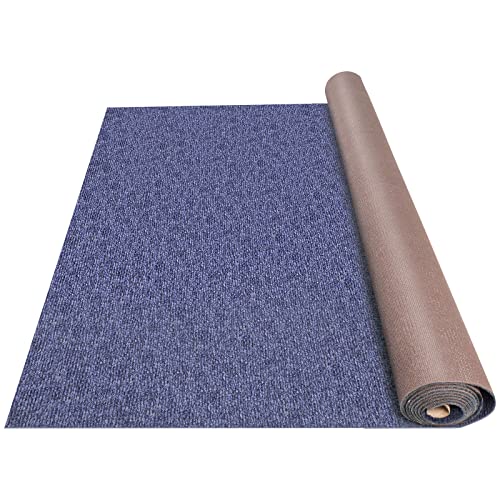
Happybuy Marine Carpet Deep Blue Roll
Deep blue is the colour most people see in their mind when they picture a boat deck dressed properly, and this Happybuy roll supplies it at a serious scale: 6 feet by 29.5 feet of marine carpet, 0.18 inches thick, described as waterproof with a non-slide surface, easy to clean, and fast to install, in a rectangular roll for boats and for home patio, porch, and deck use indoors and outdoors. A roll of nearly thirty feet is not a mat purchase. It is a resurfacing decision, enough material to cover a substantial deck in continuous runs, to wrap trailer or dock elements, or to carpet a generous porch with lengths left for the inevitable cutting mistakes that every honest installer makes on a first project.
Cut-to-fit is the working principle to understand before ordering. A roll arrives as potential rather than as a finished shape, and its value depends on the buyer’s willingness to measure twice, cut deliberately, and fit edges around the furniture, hatches, and fixtures of a real deck. The stated 6 foot width suits wide, open runs particularly well, reducing the number of seams across a broad area, while 0.18 inch thickness keeps the carpet low against thresholds and moving parts where a thicker product might interfere. Easy to clean and waterproof language, in the maker’s terms, suits a surface that will meet spray, rain, tracked sand, and the occasional spilled drink in a single weekend.
Deep blue also carries a maintenance personality worth naming. It hides a great deal of ordinary marine grime, water spotting, and pale dust inside its depth of colour, which makes it forgiving between cleans in a way a pale gray is not. The same depth can show salt residue and light sand vividly after a beach-heavy trip, so the colour rewards a rinse-and-brush rhythm rather than neglect. Buyers choosing blue for a home porch or patio should also picture it in domestic light: it is a committed, nautical colour that will set the tone of the whole space, gloriously for some households and a little theatrically for others.
Strengths
- Nearly thirty feet of 6 foot wide carpet covers large decks with fewer seams.
- Deep Blue colour hides everyday marine grime while delivering a classic boat look.
- Waterproof and non-slide surface language suits spray, rain, and busy barefoot traffic.
Trade-offs
- At 0.18 inch it is the thinner carpet profile here, prioritising fit over cushion.
- A roll this size demands measuring, cutting, and storage space for the remainder.
- Deep blue shows salt and pale sand clearly, asking for regular rinsing after trips.
Listing facts:
- Maker and model: Happybuy marine carpet roll
- Dimensions: 6 ft by 29.5 ft, as titled
- Thickness: 0.18 inch, as titled
- Colour: Deep Blue
- Surface: waterproof, non-slide, easy to clean, as titled
- Adhesive backing: not stated in the listing
Best for: a large deck, porch, or patio resurfacing in classic deep blue, planned as a cut-to-fit project. Not suited for: a small single mat need, or anyone wanting a thick, cushioned carpet profile.
Happybuy deep blue roll — check price on Amazon

Happybuy Marine Carpet Gray Roll
Gray, at 36 feet, is the maximalist of this guide: the longest roll, in the most neutral colour, from the same Happybuy family as the deep blue pick. The title describes gray marine carpet at 6 feet by 36 feet for boats and outdoor use, as indoor outdoor carpet for home, porch, patio, and deck, with an anti-slide TPR waterproof back and 0.18 inch thickness, under boat carpet rugs wording in the listing itself. That backing detail separates it from its blue sibling on paper. An anti-slide TPR waterproof back, as titled, describes a constructed underside intended to resist sliding and water, where the blue roll’s title speaks instead of a non-slide surface, so a buyer comparing the sisters should notice that one emphasises its back and the other its face.
Thirty-six feet invites projects beyond a single deck. A full boat plus trailer bunks, a boat plus a dock walkway, a large patio plus a utility area — the roll’s length turns leftovers from an embarrassment into a resource, provided storage exists for a substantial remainder. Gray supports that multi-project life better than a committed colour would, because it can move between a boat, a porch, and a garage-adjacent space without demanding that each setting share a palette. In domestic settings, gray is also the colour least likely to fight with furniture, planters, and the changing light of a long day.
The shared 0.18 inch thickness with the blue roll keeps expectations consistent: this is a low, fitting-friendly carpet profile, chosen for coverage and surface renewal rather than for plushness underfoot. Anyone whose primary wish is cushion should be looking at the thicker OUTPRIZE carpet or across the family line at EVA foam, and this guide says so plainly rather than letting a long roll’s other virtues blur the point. Measure with the same care as for blue, allowing for pattern-free but still directional cutting, and confirm on the listing page how the maker advises fixing the carpet down, since the title describes the back rather than an adhesive system.
Strengths
- Thirty-six feet is the longest coverage here, enough for combined boat and shore projects.
- Anti-slide TPR waterproof back is named, giving the clearest backing description among the rolls.
- Gray neutrality travels between marine and domestic settings without a palette argument.
Trade-offs
- Thin 0.18 inch profile prioritises coverage and fit over any cushioned feel.
- A roll of this length is heavy to handle and needs real storage for its remainder.
- Gray shows dark oil and rust marks readily around trailers and workshop-adjacent uses.
Listing facts:
- Maker and model: Happybuy marine carpet, gray
- Dimensions: 6 ft by 36 ft, as titled
- Thickness: 0.18 inch, as titled
- Backing: anti-slide TPR waterproof back, as titled
- Colour: Gray
- Adhesive system: unnamed in the title
Best for: the largest resurfacing jobs and multi-project buyers who want a neutral gray with a named backing. Not suited for: small spaces, cushion seekers, or anyone without room to store a long remainder.
Happybuy gray roll — check price on Amazon

OUTPRIZE Marine Carpet Gray 16FT
OUTPRIZE trades length for thickness, and for trailer owners that trade may be the smartest one in this guide. The title describes a 16 foot by 4.5 foot heavy duty gray marine carpet at 0.3 inch thick, waterproof and non-slip, as an indoor outdoor boat rug in the maker’s wording for boat trailer bunks, RV, deck, and home use. At 0.3 inch, this carpet carries noticeably more substance than the 0.18 inch Happybuy rolls, and substance is precisely what a trailer bunk asks for, because a bunk carpet lives between a hull and a hard support, absorbing contact, easing loading, and taking abrasion that a decorative deck surface never meets.
Heavy duty is the maker’s phrase, and the dimensions support reading the product as a working carpet rather than a dressing layer. Sixteen feet at 4.5 feet wide suits a pair of long bunks, a narrower deck, an RV step and entry zone, or a defined work area beside a boat, with the narrower width making long straight cuts simpler and waste smaller than wrestling a 6 foot roll into narrow shapes. Gray again earns its keep around trailers, where a colour must coexist with metal, grease-adjacent tasks, and outdoor storage without looking ruined by its first month of honest service.
Waterproof and non-slip language in the title addresses the two anxieties of a loading ramp environment: water, constantly, and footing, at the exact moment a person is guiding something heavy. Those are maker claims about the carpet’s intended behaviour, and they should be paired with sensible installation, because no carpet of any thickness compensates for a loose, unsecured edge on a bunk or a deck. Confirm fixing guidance on the listing page, plan cuts so edges land where they can be secured cleanly, and the thicker profile becomes an asset instead of a trip hazard of your own manufacture.
Strengths
- At 0.3 inch thick it is the most substantial carpet here, suited to bunk contact work.
- Trailer bunks are named explicitly, the clearest specialist brief among the carpet rolls.
- Narrower 4.5 foot width simplifies long cuts for bunks, steps, and defined zones.
Trade-offs
- Sixteen feet will not resurface a large deck in the continuous runs the longer rolls allow.
- Greater thickness can complicate tight thresholds and curved or intricate fitting.
- Backing construction is not given, so fixing method needs confirmation on the page.
Listing facts:
- Maker and model: OUTPRIZE marine carpet
- Dimensions: 16 ft by 4.5 ft, as titled
- Thickness: 0.3 inch, as titled
- Colour: Gray
- Named uses: boat trailer bunks, RV, deck, home, as titled
- Backing: not given
Best for: trailer bunks and smaller, harder-working zones where thickness matters more than total length. Not suited for: a full large-deck resurfacing, or intricate areas where a thick carpet is hard to fit.
OUTPRIZE gray carpet — check price on Amazon

HFYZZ Self-Adhesive Boat Carpet Runner
Not every marine flooring problem is a whole deck. Some are a single worn walkway, a step zone, a narrow boarding path, or a strip beside a berth where feet land a thousand times a season, and HFYZZ builds its answer at exactly that scale. The title describes a 2 foot by 7.9 foot self-adhesive boat carpet, as a waterproof marine grade carpet boat mat and a non-slide indoor outdoor rug runner in the maker’s phrasing, for home, patio, porch, and deck. Self-adhesive is the operative word. A runner that sticks down removes the loose-edge problem that plagues narrow strips, and it turns installation into a measure, cut, peel, and press exercise rather than a separate adhesives project.
Runner proportions change how a buyer should plan. Two feet wide is a path, not a platform, so map the exact traffic line you want to serve: the centre of a walkway, the approach to a helm, the strip where a household crosses a porch to a garden door. At just under eight feet long, one runner covers a respectable path, and two runners can be butted along a longer route with a seam that a narrow format makes relatively easy to align. Waterproof marine grade language suits the spray and damp that concentrate along those traffic lines, where shoes and bare feet carry water inward from every trip.
Adhesive formats reward surface preparation more than any other pick here. A self-adhesive runner pressed onto a dusty, damp, or flaking surface will fail at its edges first and be blamed for a preparation it never received, so clean, dry, and smooth the target strip as the maker’s guidance directs before committing the piece. Thickness is not stated in the title, which matters for thresholds at either end of a run, so check the listing page if the runner must pass under a door or meet a raised edge, and let that measurement decide between this and a roll cut to the same path.
Strengths
- Self-adhesive format solves the loose-edge problem that narrow runners usually suffer.
- Two by nearly eight feet serves a defined traffic path without a whole-deck commitment.
- Waterproof marine grade brief fits the damp, high-traffic strips where wear concentrates.
Trade-offs
- Runner width cannot serve as general deck coverage, however it is arranged.
- Thickness is not stated in the listing, complicating threshold and door-clearance planning.
- Adhesive success depends heavily on preparing a clean, dry, sound surface first.
Listing facts:
- Maker and model: HFYZZ self-adhesive boat carpet
- Dimensions: 2 ft by 7.9 ft, as titled
- Format: self-adhesive runner, as titled
- Character: waterproof, marine grade, non-slide, as titled
- Thickness: not stated in the listing
- Colour: not given
Best for: a single worn walkway, step zone, or boarding path that needs a stick-down carpet strip. Not suited for: broad coverage, or any surface that cannot be cleaned and dried before fitting.
HFYZZ adhesive runner — check price on Amazon

EVA Foam Marine Decking Sheet
Crossing the family line now, and changing vocabulary with it: this is an EVA foam decking sheet, a flooring panel, not a carpet and not a rug in any sense this guide will use. Its title describes boat flooring EVA foam marine decking with adhesive backing for boat floors, for bass, pontoon, and jon boats, RV, motorboat, stair floor, and ATV roof uses, as UV resistant, easy to cut and clean, non-slip, and waterproof. That breadth of named platforms is the sheet’s personality. EVA decking travels across vehicles and surfaces because it is a cuttable foam panel with its own adhesive, giving a cushioned, textured top layer wherever a hard, hot, or slippery surface needs domesticating.
Foam changes the underfoot proposition completely. Where carpet offers a fibrous surface over a hard deck, EVA interposes a resilient layer that softens standing, insulates against a sun-heated surface, and gives bare feet a textured purchase during long hours at a helm or on a casting deck. Easy to cut, in the maker’s words, is the enabling feature, because a sheet product earns its keep by being shaped around consoles, hatches, steps, and edges with a blade and a template, turning a standard panel into a fitted floor. Easy to clean matters in the same practical register, since a foam surface meets fish, bait, sand, and spilled drinks in a single outing.
The title gives no dimensions and no thickness, and that double absence must govern the purchase. Do not plan a deck around this sheet until the listing page supplies its size, because coverage arithmetic is impossible without it and returns for a wrongly sized panel are a self-inflicted cost. UV resistant language addresses the foam family’s known enemy, sunlight, as a maker claim about the material’s intended outdoor behaviour. Treat adhesive backing with the same preparation respect given to the HFYZZ runner: foam adhered to a contaminated surface will lift at its corners, and corners are where every passer-by’s toe goes looking for a weakness.
Strengths
- EVA foam gives cushioned, textured standing comfort that no carpet roll here attempts.
- Adhesive backing plus easy-to-cut wording supports genuinely fitted, shaped installations.
- Widest named platform range here, spanning bass, pontoon, jon, RV, stairs, and ATV roof.
Trade-offs
- Dimensions are not given in the title, so coverage cannot be planned from the title alone.
- Thickness is not given either, leaving cushion depth unconfirmed until the page is read.
- It is a foam decking sheet, so buyers wanting a carpet’s fibrous feel should stay with rolls.
Listing facts:
- Product: EVA foam marine decking sheet
- Material: EVA foam, as titled
- Backing: adhesive backing, as titled
- Claims: UV resistant, easy to cut and clean, non-slip, waterproof, as titled
- Dimensions: not given
- Thickness: none stated in the listing
Best for: boat owners who want a cushioned, cut-to-shape foam floor on a named small-boat platform. Not suited for: anyone planning coverage before confirming size, or anyone seeking a carpet surface.
EVA foam decking sheet — check price on Amazon

DURAGOODS EVA Boat Flooring with Roller
DURAGOODS answers the EVA sheet’s open questions with numbers, and adds a tool. Its title describes EVA boat flooring as a 96 by 45 inch marine decking mat with roller, in marine-grade EVA with UV resistant 3M adhesive, a secure long-lasting bond in the maker’s phrasing, 6mm thickness, high density comfort wording, and an included roller. Ninety-six by forty-five inches is eight feet by three and three-quarter feet, a substantial single mat that can serve a cockpit sole, a casting platform, or a defined deck zone in one piece, and 6mm gives the foam a stated substance that a buyer can compare honestly against the carpet thicknesses elsewhere in this guide without pretending the materials are interchangeable.
The included roller is a small inclusion with an outsized meaning. Adhesive decking succeeds or fails on contact, and a roller exists to press a sheet into even, air-free contact with its surface, chasing bubbles outward and seating edges that fingers alone leave tentative. A maker who includes the tool is signalling that installation quality is part of the product, and a buyer should accept that signal seriously by preparing the surface, planning the layout dry, and rolling methodically rather than patting hopefully. UV resistant 3M adhesive names both a property and an adhesive maker, the most specific adhesive claim in this entire guide, and high density comfort is the maker’s phrase for the foam’s intended feel underfoot.
As with its foam sibling, vocabulary discipline applies in full: this is a decking mat, a foam flooring product, and never a rug or a carpet in this guide’s language. Its comfort proposition is also its own — a resilient, high density foam surface for standing and kneeling during rigging, loading, and long days afloat — rather than the fibrous familiarity of carpet. Buyers who kneel often, on hatches, decks, and trailer-adjacent tasks, may find that foam proposition the most valuable in the guide, provided the 96 by 45 footprint matches the zone they actually need to cover.
Strengths
- Stated 96 by 45 inch size and 6mm thickness make coverage and cushion plannable.
- Included roller supports a proper, air-free adhesive installation rather than guesswork.
- UV resistant 3M adhesive is the most specifically described bonding claim here.
Trade-offs
- A single fixed mat size cannot stretch to a whole large deck without companion pieces.
- Foam surface feel will not satisfy a buyer who specifically wants carpet underfoot.
- Adhesive commitment makes repositioning a planning exercise, not a casual adjustment.
Listing facts:
- Maker and model: DURAGOODS EVA boat flooring
- Dimensions: 96 by 45 inches, as titled
- Thickness: 6mm, as titled
- Adhesive: UV resistant 3M adhesive, as titled
- Included item: roller, as titled
- Colour: not stated in the listing
Best for: a defined cockpit or platform zone of matching size, where a kitted foam installation is the goal. Not suited for: whole-deck coverage in one piece, or carpet seekers in any size.
DURAGOODS EVA flooring — check price on Amazon
Comparison Table
| Flooring pick | Correct family name | Footprint as titled | Substance as titled |
|---|---|---|---|
| Happybuy deep blue roll | Marine carpet roll | 6 ft by 29.5 ft | 0.18 inch |
| Happybuy gray roll | Marine carpet roll | 6 ft by 36 ft | 0.18 inch, TPR waterproof back |
| OUTPRIZE gray carpet | Marine carpet | 16 ft by 4.5 ft | 0.3 inch |
| HFYZZ runner | Self-adhesive carpet runner | 2 ft by 7.9 ft | Thickness not in listing |
| EVA decking sheet | EVA foam decking sheet | Dimensions not in listing | Thickness not in listing |
| DURAGOODS EVA mat | EVA foam decking mat | 96 by 45 inches | 6mm, roller included |
How to Choose Between Marine Carpet and EVA Decking?
Let your hands decide first. If you want a fibrous surface that feels like an outdoor carpet, brushes clean, and reads visually as a dressed deck or porch, the carpet family is your country. If you want a resilient, cushioned panel that softens standing, tolerates kneeling, and can be templated around awkward shapes, EVA foam is your country. Neither is a substitute for the other, and a buyer who orders foam expecting carpet, or carpet expecting foam’s cushion, will be disappointed by a perfectly honest product. The titles in this guide state each material plainly, so the family’s name on the listing is the first and most reliable sorting tool you own.
Measurement decides second, and it should be done on the boat or the porch, not at a desk. Sketch the zone, mark obstructions, decide where seams may live, and only then compare footprints: a 36 foot roll against a large continuous deck, a 16 foot thicker carpet against bunks, a runner against a single path, a 96 by 45 mat against one platform. Allow extra for cutting errors and edge finishing, because a project that ends six inches short teaches an expensive lesson about optimism. Where a title withholds dimensions, that product simply cannot enter your arithmetic until its page supplies them.
Installation decides third. Loose-laid or separately fixed carpet rolls ask for cutting skill and an edge plan. Self-adhesive runners and foam sheets ask for surface preparation and commitment, rewarding a clean, dry, sound base and punishing a contaminated one at the corners first. The included roller on the DURAGOODS mat is a reminder that pressure, evenly applied, is part of an adhesive product’s specification. Choose the installation temperament that matches your patience and your workspace, because a beautifully measured project can still fail in the final hour if its fitting method was never one you were willing to perform carefully.
Common Mistakes When Flooring a Boat
Calling foam a rug is the linguistic mistake, and ordering it with a rug’s expectations is the practical one that follows. A second mistake is measuring a deck by eye from a photograph or a memory, then discovering hatches, curves, and hardware that consume material no rectangle allowed for. A third is ignoring thickness at thresholds, lids, and moving parts, where a few tenths of an inch decide whether a hatch still opens sweetly or begins to argue with its new floor every single day.
Adhesive mistakes form their own chapter. Pressing a self-adhesive product onto dust, damp, or flaking paint guarantees edge lift, and rushing a large sheet without a dry layout invites trapped air and misaligned edges that cannot be unpeeled gracefully. Work clean, work dry, plan the order of contact, and use a roller where one is provided or available. Finally, do not leave cut edges unconsidered around water. Edges are where every flooring family meets its weather, and a project finished with attention to its perimeter will outlast a larger project whose edges were left to improvise.
Cleaning and Storing Marine Flooring
Carpet and foam ask for different kindnesses. Marine carpet rewards regular removal of sand and grit before it works into the pile, a rinse where its maker permits, and full drying before a cover or a cabin encloses it for a week, because a damp carpet stored in darkness ages by smell before it ages by wear. Foam rewards gentler surface cleaning and protection from unnecessary prolonged compression under heavy stored objects, which can leave lasting impressions in a resilient material that otherwise recovers well from daily standing.
Off-season storage decides how either family greets the spring. Rolls should rest loosely rolled rather than folded, in a dry place away from fierce heat, with the remainder labelled by its dimensions so a future project starts with knowledge instead of archaeology. Cut foam pieces should lie flat where possible. A household that labels, dries, and stores its marine flooring properly will find, year after year, that the spring refit begins with an asset instead of with a shopping list and a faint feeling of having bought the same thing twice.
Measuring a Deck Without Lying to Yourself
Most flooring waste is born in the first ten minutes, when a deck gets measured as the rectangle its owner wishes it were. Real decks interrupt themselves constantly: a console rises here, a hatch interrupts there, a seat base consumes a corner, a curve at the bow refuses every straight line offered to it. Measure in zones instead of in one grand figure, sketch each zone with its obstructions drawn rather than imagined away, and add a sensible margin to every length for trimming and for the small, inevitable discovery that a bulkhead is not quite where memory placed it. A roll forgives that honesty by yielding another cut. A fixed mat punishes its absence by simply not fitting, which is why fixed-size foam demands the strictest measuring discipline of all.
Paper templates are the humble technology that separates calm installations from expensive improvisations, particularly for EVA sheets that invite shaped cuts. Lay paper or card across a zone, mark hatches and fittings, cut the template, test it, adjust it, and only then let it guide a blade through the actual material. Carpet is more forgiving of direct measurement because an overlong edge can be trimmed in place, yet even carpet benefits from a template at a curved bow or around a pedestal, where a freehand cut announces itself forever. An hour with paper feels slow on a quiet morning and miraculously fast beside the cost of a miscut panel.
Photograph the bare deck before anything is covered, with a tape measure visible in several frames. Those photographs become the project’s memory: where fittings sat, which direction a hatch opened, how an edge was finished last season. They also become evidence at resale or during a later repair, when a future owner or a future you needs to know what lies beneath a handsome new surface. Flooring hides the very information that future work requires, and a few unglamorous photographs preserve it for free.
Trailer Bunks, Docks, and Other Hard-Working Surfaces
A trailer bunk lives a harder life than any deck, compressed between a hull and a support, soaked at every launch, baked between trips, and abraded each time a boat slides home tired at the end of a day. That is why thickness earned its own review in this guide and why a bunk buyer should think in seasons of launches rather than in afternoons of appearance. A carpet chosen for bunks should be inspected at its contact lines regularly, because wear concentrates exactly where the hull meets it, and a worn patch discovered during a calm inspection is a maintenance task while the same patch discovered during a launch is a small emergency with an audience.
Docks and walkways form the shore-side half of the same system. A runner or a carpet length that gives secure, comfortable footing between a house, a dock, and a moored boat changes how a whole property feels at dawn and after rain, when bare boards are at their least welcoming. The HFYZZ runner’s adhesive format suits a single defined path of that kind particularly well, provided the surface beneath it is sound, while a cut length from a larger roll serves a wider landing or a turning area at a dock’s end. Plan those shore pieces with the same zone discipline as the boat itself, and the property begins to read as one considered surface rather than as a series of improvisations.
RV and patio uses, named across several titles here, follow the same logic in a different accent. A step zone, an awning floor, a porch that serves bare feet all summer — each is a traffic map waiting for the right footprint and thickness, and each punishes the same two errors: measuring by hope and ignoring what happens at the edges when weather arrives. The products in this guide are honest about being rectangles and rolls. The buyer’s job is to be equally honest about the shape of the life those rectangles must fit.
What Happens in the Second Season?
First seasons flatter almost every flooring choice, because materials are new, edges are tight, and enthusiasm supplies the maintenance that habit has not yet learned. Second seasons tell the truth. Carpet reveals whether its cleaning rhythm was real, in the brightness of its traffic lines and the freshness of its smell after a damp week under a cover. Foam reveals whether its adhesive was seated properly, in corners that either lie flat as if grown there or lift in small, eloquent protests at every hatch. A buyer planning a purchase should therefore read every claim in this guide as a second-season question: not whether the surface pleases in its first photograph, but whether its material, thickness, and fitting method suit the maintenance life you will actually give it.
Record what you did. A note of the product, its dimensions, the date, and the surface preparation used turns a future repair from guesswork into continuity, and it helps a matching remainder get used instead of a near-matching replacement getting bought. Keep offcuts that are large enough to patch a wear zone, labelled and dry, because the best spare piece for a floor is a piece of the floor itself, aged in the same cupboard rather than faded on the same deck. These are unglamorous habits, closer to seamanship than to shopping, and they are the reason some boats look cared for after a decade while others look re-bought every spring.
Final Recommendation
For a large carpet resurfacing, choose the Happybuy gray roll for its 36 feet and named TPR waterproof back, or the Happybuy deep blue roll when classic blue and a slightly shorter run suit the boat better. For trailer bunks, the OUTPRIZE carpet is the specialist answer at 0.3 inch thick. For a cushioned foam zone in a stated size, the DURAGOODS mat is the complete kit. Measure your deck, name your material honestly, and may every barefoot crossing next season feel like the upgrade you planned.
Frequently Asked Questions
Are there any actual woven rugs for boats in this guide? No. The class resolves into marine carpet rolls and runners plus EVA foam decking sheets and mats, and this guide names each product by its correct family rather than calling foam or carpet roll a woven rug.
Is EVA foam a type of carpet? No. EVA foam decking is a resilient foam flooring panel, usually adhesive backed and cut to shape, with a cushioned surface character entirely different from a fibrous marine carpet.
Which carpet covers the most area? The gray Happybuy roll, at 6 feet by 36 feet as titled, ahead of the deep blue roll at 6 feet by 29.5 feet. The OUTPRIZE carpet covers less area but is thicker, at 0.3 inch.
What is marine carpet for trailer bunks? The OUTPRIZE title names boat trailer bunks explicitly, describing a heavy duty, waterproof, non-slip gray carpet at 16 feet by 4.5 feet and 0.3 inch thick, a profile suited to hull contact zones.
Do the adhesive products need a roller? The DURAGOODS mat includes a roller in its title, which supports even, air-free contact during fitting. Other adhesive products still benefit from firm, even pressure and a clean, dry surface.
Can these products be used on a porch or patio? Several titles say so directly: both Happybuy rolls and the HFYZZ runner name home, porch, patio, or deck use alongside their marine brief, in indoor outdoor terms.
How much extra material should I allow when ordering a roll? Allow for the deck you actually measured rather than the deck you remember, which in practice means adding a margin to every run for trimming, squaring ends, working around fittings, and correcting the one cut in every project that goes bravely and permanently wrong. Long rolls make that margin painless, because a remainder becomes a bunk covering, a dock path, a porch strip, or a labelled spare for a future patch, while a fixed-size mat offers no such forgiveness and should be ordered only after its stated footprint has been tested against a paper template of the zone it must cover. Buyers torn between a shorter, thicker carpet and a longer, thinner one should let the job arbitrate: coverage problems are solved by length, contact and cushion problems are solved by substance, and confusing those two currencies is how a project ends up owning plenty of the wrong material. When the arithmetic stays close after honest measuring, favour the option whose leftovers have a named second job in your household, because material with a destination rarely feels wasted even when the first project uses less of it than the plan predicted.
Can I install adhesive decking over an old surface? Only when that old surface is clean, dry, sound, and smooth enough for the adhesive to meet it everywhere, because adhesive does not negotiate with dust, damp, flaking paint, or a crumbling previous layer — it simply inherits every weakness beneath it and fails there first, usually at a corner, usually in front of guests. Titles here describe adhesive backing and, in one case, a named adhesive with a roller included, but none of that engineering rescues a poor substrate, so strip what is failing, clean what remains, let it dry beyond the point where it merely looks dry, and test a small area if the surface is unfamiliar. A loose-laid or separately fixed carpet may be the wiser family altogether over a doubtful base, since it can be lifted, corrected, and relaid without a bonding failure becoming part of the deck’s permanent record. Preparation is the least photogenic hour of any flooring project and the one that every later season quietly depends upon, which is why experienced installers speak about it with a respect that beginners sometimes mistake for exaggeration until their own first edge lifts.
Related Guides
Should a fishing boat and a family pontoon choose the same flooring? They share a material vocabulary but rarely the same answer, because their decks lead different lives and their owners value different hours of the day. A fishing platform rewards a surface that cleans quickly after bait, scales, and muddy boots, tolerates constant standing and kneeling at its edges, and can be cut precisely around hatches and pedestals, which is why a templated foam sheet or a defined foam mat often earns its place there despite the preparation its adhesive demands. A family pontoon rewards broad, forgiving coverage where children sit, grandparents cross with plates in their hands, and wet feet arrive from the water every few minutes, a brief that a long carpet roll in a forgiving colour frequently serves with less fuss and a more familiar feel underfoot. Trailer bunks, dock paths, and porch strips then get solved as their own small projects rather than as afterthoughts competing for the main material. The right question is therefore never which family wins this guide, but which hours of your own boating life deserve to be made more comfortable, cleaner, or safer — and once those hours are named honestly, the measurements in the comparison table usually point at their own answer without further persuasion from anyone.
What should I check before the first outing on a newly covered deck? Walk the whole installation slowly in the footwear, and then in the bare feet, that the season will actually bring to it, pressing deliberately along every edge, seam, hatch border, and corner where a toe or a heel could search for a weakness during a busy day. Open and close every hatch and lid the new surface approaches, because a thickness that felt trivial on a product page can change how a lid seats, how a latch travels, and how water sheds across a boundary, and those small mechanical relationships are far easier to correct in a quiet yard than at a ramp with a queue forming behind you. Check drainage paths with a bucket of water rather than with hope, watching where the water travels and where it decides to linger, since a new surface can redirect old habits into a corner nobody intended to create. Finally, note the offcuts and the product details somewhere durable, take a photograph of the finished deck for the pleasure of it as much as for the record, and only then call the project done, because a floor that has passed its inspections in private rarely embarrasses its owner in public.
Is it better to cover a whole deck at once or to improve it zone by zone? A whole-deck project offers the cleanest visual result and the fewest seams between old and new surfaces, and for a boat already stripped for other work it is often the efficient moment to act, provided the measuring, templating, and preparation all receive the time their scale demands. A zone-by-zone approach suits an owner who boats constantly, funds projects gradually, or wants to learn a material’s behaviour on a small platform before trusting it with a cockpit, because the first zone becomes a honest trial whose second-season condition teaches more than any review, including this one, can promise in advance. The risk of the gradual route is a patchwork of ages and shades, which a neutral gray carpet absorbs gracefully and a committed colour or a foam mat may not, so gradual buyers should record exact product details and keep labelled offcuts as insurance. Neither route is the mark of a better owner. The mark of a better owner is a deck whose every zone was measured, fitted, and finished deliberately, whenever in the calendar that deliberate work happened to occur.
How do I talk about these products correctly when ordering or asking for help? Use the family names this guide has used, because precise language at a counter, in a marina conversation, or in a message to a seller prevents the most expensive misunderstandings in this category before any money moves. Say marine carpet roll when you mean a fibrous roll to be cut and fitted, say self-adhesive carpet runner when you mean a narrow stick-down path, and say EVA foam decking sheet or mat when you mean a resilient foam panel with adhesive backing, giving the dimensions and thickness from the title every time you describe the job. A listener who hears a clear material, a clear footprint, and a clear installation method can advise you usefully within a sentence or two, while a listener who hears only the word rug must guess which of three different products you might mean, and guesses in flooring tend to be paid for by the person who caused them. Precision here is not pedantry for its own sake. It is the same honesty that opened this guide, carried through the purchase and into the fitting, where it quietly protects your budget, your deck, and your first weekend on the water.
Linked below are the neighbouring rug guide and two kitchen guides for readers refitting more than a deck this season.


