What's inside
- Key Takeaways
- Quick Picks
- How Did We Choose the Best Acrylic Bathtubs for Alcove Installs?
- What Makes an Alcove Install Different from Every Other Tub?
- How Do You Get the Alcove Details Right Before Ordering?
- How Do You Choose Between These Picks in Ten Minutes?
- How Do the Six Alcove Routes Compare?
- What Should You Know About Alcove Acrylic and Resale Value?
- How Does an Alcove Acrylic Tub Serve a Household Across Decades?
- Which Surround Belongs Over an Alcove Acrylic Tub?
- How Do You Keep an Alcove Acrylic Tub Watertight and Bright?
- How Do Curtains, Doors and Hardware Complete an Alcove?
- What Does a Good Alcove Installation Day Look Like?
- What Mistakes Do Alcove Buyers Keep Making?
- Final Recommendation
- Frequently Asked Questions
- Related Guides
As an Amazon Associate I earn from qualifying purchases. This post may contain affiliate links at no extra cost to you.
cottageverdict.com is reader-supported. When you buy through links on our site, we may earn an affiliate commission.
Where to buy: Five picks below are orderable on Amazon through their linked names — check price on Amazon and confirm drain handing before anything else. The sixth covers tile-in acrylic tubs in prose, as a class, for reasons its review explains.
The alcove is where bathtubs earn their living, and the best acrylic bathtubs for alcove installs are the ones that respect that job description: fit the five-foot recess exactly, seal against three walls without drama, host a shower every morning and a bath every weekend, and keep doing all of it for fifteen years without becoming a topic of household conversation. This is the companion guide to our general acrylic roundup, narrowed to the built-in branch of the family where most houses actually bathe.
Five linked picks cover the alcove’s real range. Two Kohlers bring shaped, remodel-grade basins in the standard and the slightly wider footprint. American Standard’s Studio is the clean modern default. A WOODBRIDGE alcove model hides a full whirlpool-and-air spa inside the standard outline. And one pick is not acrylic at all — an enamelled steel tub, labelled as such in every mention, included because any honest alcove shortlist must acknowledge the material many shoppers cross-shop, and because some households will be better served by it.
The sixth seat is prose-only and covers tile-in acrylic tubs as a class: the drop-in and undermount branch of alcove bathing, where the tub disappears into a tiled deck. They are discussed generically because the class is wide, locally variable, and best chosen alongside the carpentry that will surround it — but no alcove guide is complete without them.
Key Takeaways
- The Kohler Underscore is the alcove acrylic to beat: lumbar shaping and remodel-grade flange work in the standard 60 by 30.
- Kohler’s Entity adds two inches of width for bathrooms whose alcove can spare them — measure before dreaming.
- The American Standard Studio is the low-drama default; the WOODBRIDGE alcove is the spa hiding in the same footprint.
- The PROFLO Folsom is enamelled steel, not acrylic, included honestly as the hard-surfaced alcove alternative.
- Drain handing, flange design, and base support decide alcove success more than any basin curve.
- Tile-in acrylic tubs are covered prose-only as a class; they are a carpentry project as much as a plumbing one.
Quick Picks
| Pick | Badge | Why it made the list |
|---|---|---|
| Kohler Underscore 60 x 30 Alcove Bath | Best alcove acrylic overall | Lumbar-shaped soaking, integral apron and flange, and a basin that makes the standard footprint feel generous. |
| Kohler Entity 60 x 32 Alcove Bath | Best wider alcove | Two extra inches of width and Kohler fit and finish for alcoves that can accept a 32-inch tub. |
| American Standard Studio Integral Apron Bathtub | Best modern default | Clean apron-front styling and easy acrylic ownership from the most familiar name in the alcove. |
| WOODBRIDGE 60 x 30 Alcove Whirlpool and Air Tub | Best alcove spa | Whirlpool and air systems with heated soaking, concealed inside the standard 60 by 30 outline. |
| PROFLO Folsom Enameled Steel Bathtub | Alcove alternative (steel) | Porcelain enamel over steel — not acrylic — for households that want a glass-hard surface in the alcove. |
| Tile-In Acrylic Tubs as a Class | Prose-only overview | Drop-in and undermount acrylic tubs set into tiled decks, discussed generically as a class. |
How Did We Choose the Best Acrylic Bathtubs for Alcove Installs?
An alcove imposes rules a freestanding tub never meets, so our filters changed accordingly. First: the apron and the flange. An alcove tub’s front face is finished at the factory as an integral apron, and its top edges carry a flange that tucks behind the wall finish so water is directed into the basin instead of the wall cavity. Models with thoughtful apron and flange work ranked above prettier basins with weaker junctions, because an alcove succeeds or fails at its edges.
Second: dimensional honesty. The standard alcove is 60 inches, and widths run 30 to 32 inches; every pick here states its footprint plainly and fits the recess it claims. Third: the basin’s double life. An alcove tub is a shower floor five days a week, so we weighted flat, stable basin floors and sensible slip behaviour alongside soaking geometry — a tub that bathes beautifully but showers treacherously has failed its actual job.
Fourth: support and service. Acrylic alcove shells must be bedded or supported exactly as their makers direct, and their drains, trims, and parts should follow channels that will exist in a decade. The jetted pick additionally had to show a credible access and maintenance story, because machinery sealed behind tile without a plan is a debt taken against the future.
The steel pick and the prose-only class round out the honesty: alcove shoppers cross-shop materials and formats, and a guide that pretends otherwise would be a catalogue, not advice.
We also gave weight to a factor spec sheets ignore: how a tub behaves in the showroom of the mind at 7 a.m. in February. The alcove is the bathroom’s workhorse corner, and its tub is touched, stood in, and leaned on more than any object in the house except the stairs. Picks that felt warm, planted, and unremarkable in the best sense scored accordingly, because unremarkable at 7 a.m. is the highest compliment a working fixture can earn.
What Makes an Alcove Install Different from Every Other Tub?
Three walls and a ceiling of expectations. The alcove tub slides into a recess framed for it, its back and ends against studs, its apron flush with the room. That embrace is the format’s genius: plumbing hides in the wall, the shower mounts overhead, the curtain or door contains the spray, and the whole assembly fits the bathrooms that already exist in millions of houses. No other format delivers bathing and showering in five linear feet of wall.
That efficiency carries an environmental footnote worth a sentence: the alcove tub uses the room’s existing plumbing runs, its existing walls, and usually its existing floor, so a like-for-like alcove replacement is among the lowest-waste renovations in the entire house — a fact that matters to a growing number of renovators and costs the rest nothing at all.
The embrace is also the discipline. There is no adjusting the tub’s position once the walls close, no reaching its back edge, no second chance at the drain’s location. Everything the alcove forgives in daily use it demands in advance: exact measurement, correct handing, a level and supported set, and junctions sealed as if the wall’s life depended on them — because it does.
Water management is the alcove’s quiet engineering. The flange turns the wall’s runoff into the tub; the apron sheds the room’s splashes to the floor; the surround — tile, panels, or a kit — carries water down to the flange like a roof into a gutter. When an alcove fails, it fails at one of these junctions, silently, inside the wall, which is why this guide speaks about flanges with more passion than about curves.
For acrylic specifically, the alcove adds one more consideration: the shell’s edges and apron are structural participants, transferring load and sealing weather, so reinforcement quality matters here even more than in a freestanding shell that merely has to hold water and look beautiful doing it.
It is worth stating the alcove’s social virtue plainly, too: it is the democratic format. It asks nothing of a room’s architecture beyond five feet of wall, it fits the houses people already own, and its tubs span every tier from the Folsom’s working honesty to the WOODBRIDGE’s concealed spa. The freestanding gallery gets the magazines; the alcove gets the country.
How Do You Get the Alcove Details Right Before Ordering?
Start with the drain, because it cannot move cheaply. Stand facing your existing tub’s apron: the drain’s side, left or right, is the handing you must order, and every pick in this guide exists in a stated configuration that must be matched to your rough-in, not to your preference. Photograph the old installation before demolition, while the evidence is still plumbed in.
Measure the recess as a carpenter would: length at floor and at rim height, width at both ends, and a check for square, because alcoves in older houses drift from their drawings by amounts that matter to a rigid tub. Confirm the new tub’s rough-in drawing against those numbers line by line, including the drain’s distance from each wall — a half-inch of optimism here becomes a day of plumbing there.
While the tape is out, note the heights as well as the lengths: the existing supply stubs, the valve’s position, and the showerhead’s drop all interact with the new tub’s rim height, and a rim that sits an inch taller than its predecessor can leave a short bather reaching for a valve placed for the old geometry. Alcove remodels reward the renovator who measures in three dimensions and punishes, with great consistency, the one who measures in two.
Plan the support before the tub arrives. Acrylic alcove shells want a level base — a mortar bed or the maker’s specified alternative — and the time to mix mortar is not while the tub hovers. Decide the surround at the same sitting: tile over a proper waterproof backer, or a panel system, each with its own flange relationship, because the tub and its walls are one assembly and should be bought like one.
Finally, schedule the test fill. Before the surround closes, the tub should sit full of water while every joint is inspected, because the alcove’s one cruelty is that it hides its mistakes. An hour of patience at this stage is the difference between a bathroom and a recurring anecdote about a bathroom.
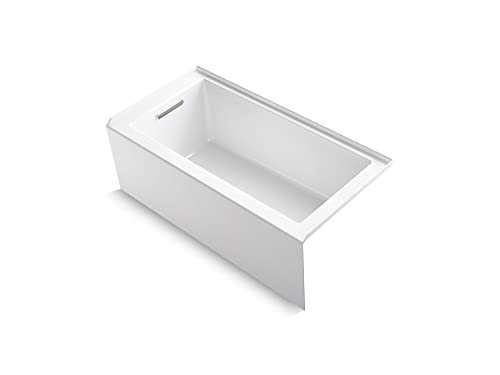
Kohler Underscore 60 x 30 Alcove Bath — Best alcove acrylic overall
The Underscore earns the alcove crown by solving the format’s oldest complaint — that a built-in tub cannot really soak — with basin geometry instead of extra inches. Its moulded lumbar support meets the bather’s back at a true reclining angle, the floor runs long and flat, and the whole basin feels considered in a way rectangular alcove tubs rarely do. In the standard 60 by 30 recess, it is the closest thing to a freestanding soak that three walls allow.
The remodel details are equally considered. The integral apron gives the front a finished, furniture-like face, and the integral flange handles the wall junction the way waterproofing engineers wish every tub did. This variant is left-hand drain; the family offers its mirror, and choosing between them is the first measurement task this guide keeps assigning. Kohler’s reinforced acrylic feels notably planted underfoot, which matters in a tub that will serve as a shower floor most mornings of its life.
Ownership is premium but sane: strong documentation, a drain ecosystem sold through ordinary channels, and a brand whose parts pipeline will outlive the remodel. If the alcove is the bathroom’s only bathing place and the household refuses to choose between shower practicality and soaking pleasure, the Underscore is where the argument ends.
Guests deliver the verdict most owners quote: they emerge from a hall bathroom looking faintly surprised, because nothing about the room’s modest footprint promised that soak. That surprise is the Underscore’s design brief fulfilled — Kohler spent the shaping budget where a bather’s spine actually rests, and the alcove’s three walls do the rest, holding the warmth and the quiet in a way an open freestanding placement cannot.
- Footprint: 60 by 30 inches, alcove with integral apron
- Drain: left-hand on this variant
- Basin: lumbar-support shaping
- Flange: integral, remodel-grade
- Material: reinforced acrylic
Strengths
- Best soaking geometry in the standard alcove
- Apron and flange work done properly
- Solid, quiet feel as a shower base
Trade-offs
- Drain commonly purchased separately
- Premium tier for the alcove class
- Thirty inches is standard, not wide
Best for: the one-bathroom household that soaks seriously. Not suited for: alcoves that can accept a wider tub and want it.

Kohler Entity 60 x 32 Alcove Bath — Best wider alcove
Two inches is not much on a tape measure and a great deal in a bathtub. The Entity takes the standard 60-inch alcove length and spends its extra width exactly where bathers feel it — at the shoulders and elbows — making it the pick for households whose recess was framed generously, or whose remodel can steal the inches from a forgiving wall. Everything else about it is Kohler’s alcove discipline: clean lines, a stable basin floor, and fit and finish that installers describe with the word “predictable”, which in their dialect is praise.
This variant is the left-drain model, and its listing notes the drain is not included — a normal arrangement at this level, but one to fold into the order rather than discover at installation. The Entity’s styling is more contemporary than the Underscore’s, with a crisper basin geometry that suits newer rooms, while its soaking manners are a touch less sculpted: width traded, fairly, for some of the lumbar theatre.
Measure before falling for it. A 32-inch tub in a true 30-inch alcove is not a tight fit but an impossibility, and the Entity’s whole appeal collapses if the recess must be rebuilt around it — at which point the Underscore, in the footprint the house already owns, becomes the smarter Kohler. Where the width is genuinely available, though, the Entity is the alcove acrylic that tall and broad bathers will thank you for.
Width also changes the shower, which is this tub’s day job. Two extra inches of standing room reads as elbow freedom under the water, a less cautious turn, and a curtain that billows against nobody. Households that chose the Entity for its baths tend to praise it, a year later, for its showers — the alcove’s oldest lesson, taught again: buy for the daily ritual and the occasional one takes care of itself.
- Format: alcove, 60 by 32 inches
- Drain: left-hand; drain not included
- Basin: wide, contemporary geometry
- Material: acrylic
- Fit note: requires a true 32-inch recess
Strengths
- Real elbow room in an alcove format
- Kohler build and documentation
- Contemporary styling suits new rooms
Trade-offs
- Will not fit a standard 30-inch recess
- Drain is a separate purchase
- Less lumbar shaping than the Underscore
Best for: wide alcoves and broad bathers. Not suited for: standard 30-inch recesses, full stop.

American Standard Studio Integral Apron Bathtub — Best modern default
The Studio is the alcove tub as reliable appliance: a 60 by 30 acrylic bath with an integral apron, a smooth contemporary face, and the fit-and-finish discipline of the most familiar name in American bathrooms. It does not attempt the Underscore’s sculpture or the Entity’s width; it attempts, and achieves, the clean correct bathroom that most remodels are actually trying to build.
Its virtues compound quietly. The acrylic is light for the crew and warm for the bather; the basin floor is broad and stable for the shower duty that dominates real schedules; the right-drain configuration of this variant matches a common rough-in; and the documentation, parts, and trim ecosystem follow channels that will still exist when the tub is old enough to vote. For rentals, resale preparation, and family bathrooms renovated under time pressure, that ecosystem is worth more than any single feature.
Choose the Studio when the project brief reads “modern, correct, finished” and the household’s bathing ambitions are honest ones — daily showers, family baths, the occasional soak without ceremony. It will not be the most talked-about object in the house, and for a great many bathrooms that is precisely the recommendation.
There is a scheduling virtue to the Studio that renovators under deadline understand in their bones: it is the pick least likely to generate a phone call. Dimensions as documented, trim as expected, parts on every shelf — the whole ownership experience is engineered to be uneventful, and in the middle of a remodel, uneventful is a luxury finish in its own right.
- Footprint: standard 60 by 30 alcove, apron front
- Drain: right-hand on this variant
- Material: acrylic, contemporary profile
- Basin: broad, stable shower-friendly floor
- Support: mainstream parts and trim channels
Strengths
- Clean design that suits most rooms
- Easy install, easy ownership, easy parts
- Dependable quality at a sensible tier
Trade-offs
- Plain basin shaping beside the Kohlers
- Acrylic care rules apply as always
- No luxury flourishes to discover
Best for: mainstream remodels, rentals, and resale prep. Not suited for: soaking connoisseurs — see the Underscore.
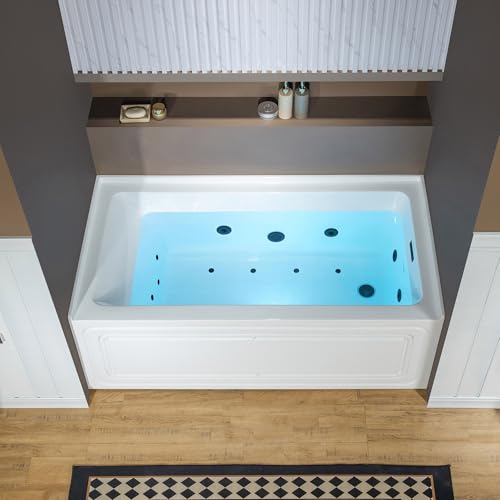
WOODBRIDGE 60 x 30 Alcove Whirlpool and Air Tub — Best alcove spa
From the room, this WOODBRIDGE is indistinguishable from the plain alcove tubs around it: same 60 by 30 footprint, same apron-front discretion. Inside the shell it carries a whirlpool system, an air bath, and heated soaking — the full spa menu, plumbed into the recess your house already has. For the household that wants one bathroom to do everything, it is the most ambitious object in this guide and, installed properly, the most rewarding.
The systems divide the labour intelligently. Whirlpool jets give directed pressure after physical days; the air system gives an all-over fizz for quiet evenings; the heater holds the water’s temperature through both. Matte black trim and the drain kit arrive included, and the right-drain layout matches the commonest rough-in — subject, as always in this guide, to verification against your own alcove before the order is placed.
The alcove format raises the stakes on this pick’s one demand: access. Pump and blower must remain reachable after the surround closes, by panel or by an adjoining opening, and the dedicated electrical circuit is not negotiable. Plan those two things with your installer at the drawing stage and the WOODBRIDGE is a marvel; skip them and it becomes a beautiful appliance entombed in tile. The guide’s enthusiasm is genuine, and so is the warning label.
Picture the finished room honestly and the case completes itself: children showered on school mornings under silent machinery, a parent soaking with the air system on a Sunday while the house sleeps, guests assuming the bathroom was always this indulgent. No other pick in the guide changes what an alcove can be; the WOODBRIDGE merely insists, fairly, that the change be planned like the appliance it is.
- Format: alcove, 60 by 30 inches
- Systems: whirlpool plus air, heated soaking
- Drain: right-hand; matte black trim and kit included
- Material: white acrylic
- Install: dedicated circuit and service access essential
Strengths
- Spa capability without changing the footprint
- Both massage philosophies in one shell
- Heated water for long evening soaks
Trade-offs
- Most demanding install in this guide
- Cleaning cycles are part of ownership
- Access planning cannot be skipped
Best for: spa-minded alcove remodels with professional install. Not suited for: simple like-for-like swaps on a deadline.

PROFLO Folsom Enameled Steel Bathtub — Alcove alternative (steel)
Label first, as promised: the Folsom is not acrylic. It is porcelain enamel fused over a steel shell, and it sits in this acrylic guide as the acknowledged alternative — the tub for the alcove shopper whose hand, testing surfaces in the showroom, keeps returning to the cool hardness of glass. Pretending that shopper does not exist would make this a purer list and a worse guide.
What steel enamel offers the alcove is a specific bundle: the lightest carry of any pick here, a genuinely hard and stain-resistant bathing surface, a trade-proven specification at a friendly tier, and dimensions — 60 by 30, three-wall alcove, left-side drain on this variant — that drop into the standard recess without negotiation. Contractors install its cousins by the thousand, and its documentation follows the professional channels they trust.
Its disciplines are enamel’s disciplines: protect the surface from hard impacts, repair any chip promptly, and accept a livelier acoustic under the shower than the acrylic picks provide. Households that accept those terms get the alcove’s hardest-wearing surface at its most accessible tier — which is why, in a guide about acrylic, this steel tub still earns its seat with its label read aloud.
One more household belongs to the Folsom: the one renovating a bathroom that will be cleaned by many hands over many years — a rental between tenancies, a family bathroom in its busiest decade, a guest suite in a house that hosts constantly. Enamel’s indifference to enthusiastic cleaning is a genuine operational virtue, and the Folsom delivers it at the tier where such bathrooms are actually budgeted.
- Install: three-wall alcove, 60 by 30 inches
- Surface: porcelain enamel over steel (not acrylic)
- Drain: left-side on this variant
- Weight: lightest pick in the guide
- Channel: professional brand and documentation
Strengths
- Glass-hard enamel surface, easy to keep bright
- Light, predictable, contractor-friendly install
- Friendly tier for a genuine enamel
Trade-offs
- Not acrylic, whatever the guide’s title says
- Chips need prompt sealing if struck
- Brighter, thinner acoustic than acrylic
Best for: enamel loyalists and value-led alcove remodels. Not suited for: shoppers who specifically want acrylic’s warmth and repairability.
Tile-In Acrylic Tubs as a Class — Prose-only overview
The final seat covers the alcove’s elegant cousins: tile-in acrylic tubs, built without an apron so they can drop into, or undermount beneath, a tiled deck that the room’s carpentry creates around them. The result is the most custom look in built-in bathing — the tub reads as part of the architecture, its rim disappearing into stone or ceramic — and it is discussed as a class, in prose, because the right model depends entirely on the deck being built to receive it.
As a class, tile-in acrylics offer the material’s full virtues — light shells, warm surfaces, broad shaping freedom — in formats from rectangular drop-ins to corner designs that turn a square bathroom’s dead space into its bathing place. Their costs are the project’s costs: the deck framing, the waterproofing where tub meets tile, and the access question, which must be answered in the carpentry because there is no apron to hide a panel behind.
Choose this class when the remodel is already a carpentry project, the design wants the integrated look, and a professional is detailing the junctions. Choose an apron-front pick from the five above when the project wants the tub to bring its own finished face and forgive a simpler build. Both are legitimate alcove philosophies; they simply belong to different budgets of time, money, and ambition.
A hybrid worth knowing exists at the class’s edge: apron-optional designs whose front can be tiled over or left as finished panel, letting one tub serve either philosophy if the design changes mid-project. They cost a little more and answer to both futures, which makes them a quiet favourite of designers whose clients reserve the right to change their minds in week three.
Best for: custom, carpentry-led bathroom builds. Not suited for: quick replacements or first-time DIY remodels.
How Do You Choose Between These Picks in Ten Minutes?
Ask four questions in order and the list sorts itself. First: how wide is the recess, honestly measured? Thirty inches removes the Entity; thirty-two admits it. Second: who bathes, and how? Serious soakers point to the Underscore’s shaping, spa dreamers to the WOODBRIDGE’s systems, shower-first households to the Studio’s calm. Third: what does your hand prefer — acrylic’s warmth or enamel’s glass? That answer alone can promote the Folsom from alternative to answer.
The fourth question is about the project, not the tub: how much build does this remodel want to be? An apron-front pick keeps the tub a product; the tile-in class makes it a construction. Households honest about their appetite for carpentry choose correctly here, and households that flatter themselves discover the truth at the tiling stage, where tuition is expensive.
Run the four questions aloud, ideally in the bathroom itself with the tape measure still in hand, and one name will be standing at the end of them. That is not indecision cured by a flowchart; it is the sound of a fixture being matched to a house instead of to a photograph.
If two names survive the four questions, let the warranty and the local parts shelf break the tie. A tub is a promise about decades, and the maker whose trims your nearest plumbing counter stocks is making that promise in a currency you can actually spend on a Saturday morning in year seven.
How Do the Six Alcove Routes Compare?
| Pick | Footprint | Material | Best quality | Watch out for |
|---|---|---|---|---|
| Kohler Underscore 60 x 30 Alcove Bath | 60 x 30 in | Acrylic | Soaking geometry, flange work | Drain often separate |
| Kohler Entity 60 x 32 Alcove Bath | 60 x 32 in | Acrylic | Width and elbow room | Needs a true 32-inch recess |
| American Standard Studio Integral Apron Bathtub | 60 x 30 in | Acrylic | Clean default, easy ownership | Plain basin shaping |
| WOODBRIDGE 60 x 30 Alcove Whirlpool and Air Tub | 60 x 30 in | Acrylic, jetted | Full spa in the standard recess | Circuit and access planning |
| PROFLO Folsom Enameled Steel Bathtub | 60 x 30 in | Enamelled steel | Hard surface, light weight | Not acrylic; chip discipline |
| Tile-In Acrylic Tubs as a Class | Deck-dependent | Acrylic | Integrated custom look | Carpentry and waterproofing load |
The table’s shape tells the alcove story: four ways to be acrylic in a recess, one honest alternative in steel, and one class that trades the apron for architecture. Every route ends in a working bathroom; they differ in how much of the room must be built around the tub to get there.
What Should You Know About Alcove Acrylic and Resale Value?
Estate agents develop instincts about bathrooms, and the alcove is where those instincts are trained. A fresh, correct alcove tub — apron gleaming, seals bright, surround sound — tells a buyer that the house’s hidden plumbing has been treated with respect, because the visible corner of it has. Of all the picks in this guide, the Studio and the two Kohlers deliver that signal most fluently, being exactly what a buyer’s eye expects a well-kept bathroom to contain.
There is a rental corollary: tenants judge a property’s care by its wet rooms, and a bright alcove with fresh seals photographs as well-kept in a listing and confirms it at the viewing. Landlords who renew the alcove’s silicone and keep the acrylic polished between tenancies are not being fussy; they are maintaining the single most persuasive surface in the property.
The WOODBRIDGE plays a different card: memorability. In a street of similar houses, the hall bathroom with a working spa tub is the detail buyers repeat to each other in the car, and memorability has a market value that appraisers cannot itemise but agents can feel. The Folsom, meanwhile, is the landlord’s resale play — enamel reads as permanence, and its tier keeps the renovation arithmetic honest for a property being prepared to sell or let.
The caution that governs all of it is condition. A neglected alcove of any material argues against the whole house, because buyers reasonably wonder what else was left to age unattended. The maintenance rhythms in this guide are therefore not merely cosmetic advice; they are the cheapest value protection available to a homeowner, applied with a cloth, once a week.
How Does an Alcove Acrylic Tub Serve a Household Across Decades?
An alcove tub’s career has acts. In the family act it is a paddling pool, a dog wash, and a shower for teenagers who treat hot water as a utility provided by nature. In the quiet act it becomes the grandparents’ careful bath and the grandchildren’s weekend entertainment. Acrylic suits the whole run because its demands never change: the same gentle cleaning, the same warm touch, the same polishable forgiveness when each generation deals it a small injury.
Planning for the later acts costs almost nothing during the remodel and a fortune afterwards. Blocking inside the wall for a future grab bar, placed where a bather’s hand actually travels during exit, is the classic example — a few offcuts of timber today, or a tile-breaking expedition in fifteen years. A handheld shower on a slide bar, chosen now, serves the toddler, the dog, the injured athlete, and the eighty-year-old with the same hardware.
None of this makes the bathroom clinical; it makes it durable in the way houses used to be built, where a room was expected to serve its people at every age they would ever be. The alcove acrylic tub, humble as it looks in a catalogue, is one of the few fixtures that can honestly promise that span — provided the household plans the wall behind it with the same long view.
It is also, not incidentally, the format guests understand instantly: no instructions, no novelty, just a bath and a shower where a bath and a shower should be. Hospitality is an underrated design brief, and the alcove has been passing it since before any of the other formats in this series existed.
The same long view applies to the smallest bathers. An alcove’s enclosed geometry is inherently the safest bathing architecture in the house — three walls, a contained floor, a parent kneeling at the apron with everything within reach — and acrylic’s warm, forgiving surface is the kindest material to learn in. Families rarely list safety among their alcove reasons, but the format has been quietly providing it for a century.
Which Surround Belongs Over an Alcove Acrylic Tub?
The tub is only the bottom half of an alcove; the walls above it decide whether the installation reads as a bathroom or a grotto. Tile over a properly waterproofed backer remains the connoisseur’s choice — repairable in sections, endless in pattern, and heavy with the labour to prove it. Its partnership with an acrylic tub is an old and happy one, provided the movement joint where tile meets tub is sealed with flexible silicone rather than rigid grout, because the two materials expand at different rates and the joint must be allowed to breathe.
Homeowners sometimes ask whether the surround should be chosen before the tub, and the honest answer is that they should be chosen in the same conversation, because each constrains the other’s details — flange heights, panel thicknesses, tile layout at the rim. A remodel that buys them in sequence, weeks apart, from different inspirations, spends its tiling day reconciling decisions that a single afternoon would have made together.
Panel and kit surrounds are the pragmatist’s answer: large waterproof sheets or interlocking panels that install in a day, wipe clean without grout lines, and forgive the schedules of real renovations. Modern kits have outgrown their plasticky ancestors, and in rental and family service their seamlessness is a genuine hygiene advantage. The discipline they demand is at their seams and edges, where the flange relationship must be followed exactly as the kit’s maker directs.
Either way, the alcove’s golden rule stands above the materials debate: water that lands on the wall must be delivered, by slope and seal, into the tub — never behind it. Grout, often blamed for alcove leaks, is rarely the culprit; the failures live at the changes of plane — tub to wall, wall to wall, fixture to surface — where movement concentrates and only flexible seals survive. Spend the sealant budget at those lines and the rest of the surround can be almost anything you love. Choose the surround your budget and your eye prefer, then spend your vigilance on that single journey, and the alcove will stay dry for the whole of the tub’s long service.
How Do You Keep an Alcove Acrylic Tub Watertight and Bright?
Watertightness is a maintenance habit, not an installation event. The silicone junctions at the apron and walls work silently for years and then begin, almost politely, to fail — a lifted edge here, a blackened bead there. Inspect them each year and renew any suspect bead before water finds the wall cavity, because the alcove’s hidden spaces forgive nothing and announce their damage late.
Keep a small maintenance kit married to the tub: the approved cleaner, a soft cloth that lives in the bathroom rather than migrating from the garage, and a tube of the right silicone for the day a bead asks to be renewed. Households that stage the kit in advance perform the maintenance; households that must shop for it first, mostly, postpone it.
Brightness is the gentler acrylic routine this site repeats because households keep needing to hear it: soft cloth, mild non-abrasive cleaner, a rinse after bath oils, and no scouring implements anywhere near the gloss. The basin floor, which works as a shower tray, deserves a weekly wipe in hard-water homes before mineral spotting can organise itself into a project.
The jetted pick adds its calendar — purge after baths, flush the whirlpool lines on schedule — and the steel pick adds its single rule about chips. None of this is burdensome; all of it is the difference between an alcove that looks installed-last-year in year ten and one that looks its age in year three.
One habit protects the alcove more than any product: ventilation. A fan that actually runs during showers, and for twenty minutes after, keeps the junctions drier, the seals younger, and the whole recess smelling like a bathroom rather than a cave. It is the cheapest maintenance in this entire guide, and the most commonly skipped.
How Do Curtains, Doors and Hardware Complete an Alcove?
An alcove tub is never quite finished at the apron; what hangs or slides in front of it decides how the room actually lives. The shower curtain is the humble champion — cheap, washable, silent, and forgiving of children — and on a curved rod it buys elbow room that makes a 30-inch alcove feel less narrow than its tape measure claims. Households that shower daily and bathe weekly lose nothing by choosing it well: a heavyweight fabric curtain with a washable liner is a genuinely finished answer, not a placeholder.
Glass doors are the alcove’s jewellery, and they ask for jewellery’s care. They contain spray better than any curtain, lend the room a hotel crispness, and demand squeegee discipline to stay worthy of either compliment; in hard-water homes without that discipline, they become frosted by chemistry within a year. Sliding doors suit tubs that are climbed into; a single swinging panel suits showers; and households bathing small children often find any door an obstacle between them and a slippery toddler, which is why so many family alcoves keep the curtain and spend the difference elsewhere.
Hardware finishes should be decided with the tub order open on the table, because the alcove concentrates every metal in the room within a few feet of each other — filler, valve trim, drain, door hinges, curtain rod. Agreement among them is what separates a designed bathroom from an assembled one, and it costs nothing except deciding once, early, and in writing.
Lighting deserves the same early decision, because an alcove lives in its own shadow. A fixture that throws light into the recess rather than merely at the room transforms the morning shower and the evening bath alike, and its wiring, like everything else in this guide, is cheap exactly once: while the walls are open.
What Does a Good Alcove Installation Day Look Like?
It starts the night before, with the recess empty, swept, and measured one final time against the tub waiting in its crate. Morning brings the dry fit: the shell offered into the alcove without commitment, the drain’s alignment confirmed, the level laid along the rim in both directions while shims and bedding are still decisions rather than archaeology. A good crew spends a suspicious amount of this hour apparently doing nothing, which is what checking looks like from the doorway.
The set itself is unhurried. Bedding placed, tub lowered and levelled, drain and overflow connected, and then the discipline this guide keeps preaching: the test fill, with the surround still open and every joint visible, held long enough for a cup of tea and a thorough inspection with a dry hand and a torch. Leaks found now are adjustments; leaks found after tiling are memoirs.
The day ends with protection — the basin blanketed against the surround work to come, the apron masked, the room’s traffic rerouted — and with the seals left in peace to cure. Bathrooms fail in their first week more often than their tenth year, and nearly always at a junction somebody hurried. A calm installation day is the cheapest luxury in the entire alcove project.
The day has one more quiet hero: the person assigned to keep everyone else out of the room. Alcove work concentrates trades in a small space, and the tub — glossy, unprotected, exactly at knee height — collects every passing toolbox and boot unless somebody owns the doorway. Assign the doorway. It is the smallest job on the project and prevents its most photographed damage.
What Mistakes Do Alcove Buyers Keep Making?
Handing, first and forever: ordering the mirror of the tub the plumbing requires, because left and right were judged from the wrong side of the apron. Width optimism follows — falling for a 32-inch tub with a 30-inch recess and discovering the difference with the old tub already in a skip. Third is the unsupported set: an acrylic alcove shell laid without its proper bedding will flex, creak, and worry its seals for years, and the fault will be blamed on the material rather than the morning it was installed.
Buyers also seal machinery away, tiling over a jetted tub’s pump without an access plan, and they rush the test fill, closing walls over untested joints because the schedule felt tight. Every one of these mistakes is cheap on paper and expensive in porcelain, tile, and weekends — which is why this guide spends as many words on the alcove’s discipline as on its tubs.
A sixth mistake is quieter and sadder: choosing the tub for the bathroom’s photograph rather than its decade. The alcove will be cleaned by tired people, used by growing people, and judged by future buyers, and the pick that serves all three is rarely the one that merely photographed best in the showroom’s kind lighting. Buy for the household’s calendar, and the photograph takes care of itself.
Final Recommendation
Buy the Underscore for the best alcove acrylic soak in the standard footprint, the Entity if your recess honestly measures wider, and the Studio when the project wants calm correctness above character. Choose the WOODBRIDGE when the alcove is ready to become a spa and the access plan is drawn before the tile, the Folsom when your hand prefers glass to acrylic and says so plainly, and the tile-in class when a carpenter, not a catalogue, is leading the build. Get the handing, the flange, and the bedding right, and an alcove acrylic will do the least glamorous and most valuable thing a bathroom fixture can do — work beautifully, in silence, while the house gets on with living around it.
A final word for the household still standing in a gutted bathroom, tape in hand, wondering whether all this discipline is really necessary for “just a tub”: the alcove you build this month is the room your family will start ten thousand mornings in. The discipline is not for the tub’s sake. It is for theirs, and it is repaid in the only currency bathrooms deal in — mornings that simply work.
Frequently Asked Questions
What does integral apron mean on an alcove tub?
It means the tub’s finished front panel is moulded as part of the shell rather than framed and tiled on site. The alternative — a tile-in tub whose front is built by the carpenter — trades that factory finish for a custom, integrated look, at the cost of the carpentry and waterproofing that the apron would otherwise have handled for free. Neither is the correct default for every house; the apron is the correct default for most, which is why it leads this guide. An integral apron gives the alcove a clean, watertight face, removes a whole trade task from the remodel, and is the standard arrangement on every apron-front pick in this guide.
How do I know if my alcove is 30 or 32 inches wide?
Measure the recess itself, stud to stud or finished wall to finished wall, at both ends — not the old tub, which may have been a compromise. Alcoves in older houses also taper, wider at the front than the back, so take the width at the apron line and at the rear wall; the smaller number is the one the new tub must obey. If the honest number is thirty, shop the 30-inch picks; a 32-inch tub cannot be persuaded into a smaller recess by enthusiasm.
Can an alcove acrylic tub support a shower?
Yes — that double duty is the format’s reason to exist. The integral flange directs wall runoff into the basin, the apron sheds splashes, and the basin floor is designed to stand on. Most alcove tubs in this guide will host far more showers than baths across their lives.
That ratio is worth designing for rather than apologising about: choose the basin floor and the surround for the thousand showers, and let the fifty baths enjoy whatever shaping remains — which, in the Underscore’s case, turns out to be a great deal. The households happiest with their alcoves are the ones that bought for the routine and were pleasantly surprised by the ritual.
Why is an enamelled steel tub in an acrylic guide?
Because alcove shoppers cross-shop it constantly, and an honest guide acknowledges the alternative with its label read aloud rather than pretending the category boundary is a wall. The Folsom’s seat is explicitly marked as steel in the picks, the table, and its review.
Do jetted alcove tubs need special access?
Yes. The pump and blower must stay reachable after installation — through an access panel, a removable section, or an adjoining space — and they need a dedicated protected electrical circuit. Both requirements should be settled at the planning stage, before the surround makes them expensive.
If the access question has no good answer in your alcove — no panel wall, no adjoining closet, no removable section — treat that as the house voting against a jetted tub, and take the Underscore or the Studio with a clear conscience. A plain alcove installed perfectly will out-serve a spa tub installed hopefully, every year of its life.
What is a tile-in tub, and why is it not linked?
A tile-in tub has no apron; it drops into or undermounts a tiled deck built around it. The class is wide and its right model depends on the specific deck carpentry, so this guide discusses it generically and recommends choosing the exact tub alongside the professional building the deck.
Related Guides
For the bubblier end of built-in bathing, continue to Best Air Whirlpool Bathtubs; for a sink that can stand beside these tubs, see Best Stone Bathroom Sinks; and when the project grows to whole-room scale, Best 72-Inch Bathroom Vanities covers the other wall — with Best 2-in-1 Cordless Vacuums waiting to clean up after all of it.


