Key takeaways
- Full-size bathtubs for school-age children: soaking depth, step-over height, slip resistance, grab bars and alcove versus freestanding family fit.
What's inside
- This guide is about full-size tubs, and only full-size tubs
- How the comparison is built
- Basin depth: how deep the water sits and how deep the child sits
- Step-over height: the climb that starts and ends every bath
- Basin floors and slip resistance: what makers actually publish
- Grab bars and handholds: planning the support a child actually uses
- Taps, fillers, and overflow: the hardware end of the tub
- Materials and coatings: surviving toys, toiletries, and time
- Width and the two-child bath
- Alcove versus freestanding in a family bathroom
- Installation details that decide whether specifications survive contact with reality
- The supervising adult is part of the specification
- One tub across childhood: planning for growth rather than a single age
- Sound, warmth, and the sensory side of bath time
- Cleaning a family tub without damaging it
- Common buying mistakes this guide exists to prevent
- A working checklist for the shortlist stage
- Bathroom doors, locks, and the room around the tub
- Check prices on Amazon
- What to verify between ordering and installation day
As an Amazon Associate I earn from qualifying purchases. This post may contain affiliate links at no extra cost to you.
When readers purchase through links here, this site may receive a commission from the retailer involved. Your checkout total stays the same either way, and commissions never decide which tubs get covered.
This guide is about full-size tubs, and only full-size tubs
The phrase bathtubs for kids points at two entirely different product families, and confusing them wastes money in both directions. One family consists of small plastic vessels designed for infants and toddlers, placed inside a larger tub or on a counter, and outgrown within a couple of years. The other family, the subject of every section below, consists of permanent full-size bathtubs installed in a family bathroom, sized for adults on paper yet chosen with school-age children firmly in mind. A child of six, eight, or eleven bathes in the household tub, not in a plastic insert, and the decisions that shape that experience are plumbing decisions: basin depth, wall height, floor texture, rim width, and where the taps sit.
Readers who actually need the small portable kind should not force this guide to serve them. best baby bathtubs for infants That companion page covers infant and toddler vessels on their own terms, with the supports and reclines appropriate to babies who cannot sit steadily. Nothing in the pages below evaluates, ranks, or recommends any product from that family, and no dimension discussed here should be applied to a baby product, because the bodies, the risks, and the bathing posture differ completely.
Why devote a full guide to ordinary tubs viewed through a child’s use? Because families remodel bathrooms rarely, and the tub installed during a renovation will serve a child from first school years through adolescence and beyond. Small specification choices that an adult barely notices, an extra inch of step-over height, a floor as smooth as glass, a rim too narrow to sit on while supervising, compound into daily friction or daily ease for a decade. Reading a standard tub catalogue through the lens of a school-age bather surfaces those choices while they can still be changed on paper.
An honesty boundary before any feature is praised
No bathtub, at any specification, replaces the supervision of an adult. That sentence is not a legal garnish on this guide; it is the load-bearing fact of the whole subject. Children drown quietly, quickly, and in water far shallower than any tub discussed here, and school-age confidence routinely outruns school-age judgement around slippery surfaces, hot water, and showing off. Features below can reduce effort, improve footing, and remove specific hazards such as scalding or awkward climbs, but every one of them operates inside a routine where a responsible adult remains present or immediately at hand. Any product language implying that a tub itself keeps a child safe should be read as marketing, not engineering.
This guide also avoids treating a bathtub as a medical device. Tubs are not therapy equipment, they carry no clinical claims, and no feature described here promises a health outcome or an absolute level of safety. Where makers publish accessibility-oriented dimensions or textured floors, those are physical specifications to compare, nothing more. Families whose children have specific mobility or medical needs should take dimensional questions to the professionals already involved in that child’s care, who can translate published measurements into personal guidance.
How the comparison is built
Everything asserted below traces back to manufacturer specification sheets, installation manuals, and recurring patterns in posted owner feedback from family households. Tub makers publish basin dimensions, wall heights, water capacities, floor finishes, and drain and overflow positions with reasonable precision, because installers depend on those figures. That published record supports genuine comparison without anyone needing to fill tubs in a studio, and this guide leans on it deliberately. Where owners consistently report that a rim feels narrow during supervised bath time or that a textured floor cleans poorly, that chorus of experience is reported as owner experience, plainly labelled.
Children at school age span a wide physical range, from a small six-year-old whose chin clears a deep tub’s rim by little, to an eleven-year-old approaching adult proportions. No single dimension suits that entire span, so this guide works with relationships rather than magic numbers: depth relative to a seated child’s torso, wall height relative to a child’s leg length and confidence, width relative to two siblings sharing a bath. Readers should hold their own child’s measurements, taken in thirty seconds with a tape, against every published figure they shortlist.
Basin depth: how deep the water sits and how deep the child sits
Manufacturers describe depth in two ways that listings often blur. The overall height of the tub, measured from floor to rim, governs the climb in and out. The soaking depth, measured from the basin floor to the overflow outlet, governs how much water the tub can actually hold around a seated bather. A tub can stand tall yet soak shallow if its overflow sits low, or present a modest exterior while offering a surprisingly deep interior. For a child, the second figure is the one that shapes bath time, while the first shapes the riskier moments at its beginning and end.
Soaking depth interacts with a child’s seated height in ways adults forget. An adult in a deep tub submerges to the shoulders and calls it luxury; a seven-year-old in the same water may sit with the surface at chin level, unable to plant feet flat against the far end, drifting slightly with every movement. That floating instability delights some children and unsettles others, and it raises the supervision effort for the adult nearby. Shallower basins, by contrast, let a child sit firmly, reach the floor with their feet, and feel oriented, at the cost of the immersive soak older children increasingly request.
Overflow position deserves attention precisely because it caps the experience. Tubs with higher overflows permit deeper fills for older children and for the adults who will also use the tub nightly, while lower overflows impose a ceiling that no tap-running can defeat legally or safely. Published water capacity figures, usually given to the overflow, translate depth and width into a practical sense of scale, and they also predict filling time and hot-water consumption, which households with small water heaters feel immediately when two baths run in one evening.
Basin floor length matters alongside depth. A child who can brace feet against the end wall sits securely and can push up to standing with control; a child adrift in an overlong basin slides toward the tap end, which is exactly where hardware hazards concentrate. Many family tubs include a gently reclined backrest at one end and a squarer profile at the other, and orienting a younger school-age child at the reclined end, away from the fittings, is a small arrangement owners mention often. As children grow, that same length becomes the asset that keeps the tub useful into the teenage years.
Reading depth figures on a specification sheet
Specification drawings reward careful reading. Some makers headline the exterior height, some the water depth, and a few list both with clear labels that listings then scramble. The honest comparison extracts four numbers for every candidate: floor-to-rim height, basin floor-to-overflow depth, interior length at the floor, and interior width at the floor. Interior dimensions at the rim flatter every tub, because most basins slope; a child sits at the bottom, so the bottom measurements describe the bath actually delivered. When a maker declines to publish interior floor dimensions, installer manuals and owner questions sometimes fill the gap, and the absence itself is information about how the product is documented.
Step-over height: the climb that starts and ends every bath
Every bath begins and ends with a child swinging a leg over the tub wall, wet on the return journey, often distracted, sometimes carrying a toy. The height of that wall relative to the child’s inside leg measurement determines whether the movement is a step or a scramble. Published floor-to-rim figures for common family tubs vary by several inches between the lowest alcove models and tall freestanding designs, and those inches matter far more to a person four feet tall than to the adults comparing brochures.
A lower wall offers obvious advantages for younger school-age children: a controlled step, hands free or lightly touching the rim, and an exit that does not require hoisting a wet body upward. Its trade-off appears at filling time, because wall height and maximum water depth travel together in many designs, so the easiest tub to enter may also be the shallowest to soak in. Families with children spanning several ages often resolve that tension in favour of entry, reasoning that a slightly shallower bath disappoints mildly while a difficult exit risks a fall every single night.
Taller tubs are not automatically wrong for families. Older children manage height easily, deep soaking models serve adults beautifully, and a tall wall beside a well-placed step platform can work for years. The step itself, however, becomes part of the safety picture: it must be stable, slip-resistant on its top surface, stored where it cannot wander, and sized so a wet foot lands fully on it rather than catching an edge. Owner feedback from families who chose deep tubs frequently mentions the step as the detail they underplanned, improvising with objects never designed to be stood on in a wet room.
Rim width influences the climb as much as height does. A broad, flat rim gives a child a place to sit momentarily, swivel, and lower both feet into the basin in a controlled sequence that adults naturally teach. A thin, rounded rim offers no such staging point, pushing the child toward a single continuous movement over the wall. Sitting rims also serve the supervising adult, who may perch there through an entire bath, so width is a comfort specification for two people at once. Makers publish rim dimensions inconsistently, yet showroom visits and owner photographs reveal them plainly.
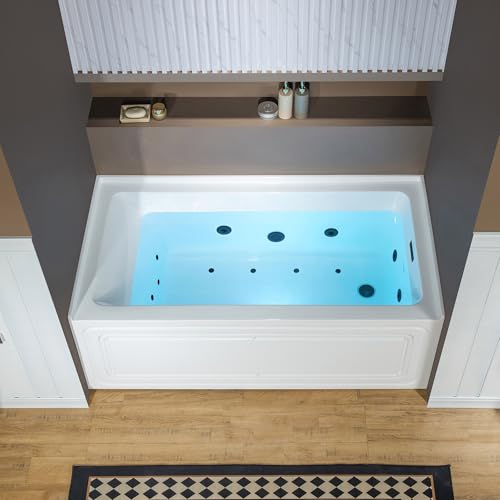
The standard five-foot alcove format remains the family default in many homes, and the linked guide compares those tubs by the same dimensional logic for readers working within a typical alcove footprint.
Basin floors and slip resistance: what makers actually publish
A wet child standing in a tub is standing on the most consequential surface in the bathroom. Tub floors range from glossy smooth finishes, through moulded textures and applied non-slip patterns, to matte finishes engineered for grip. Manufacturers describe these surfaces in their own vocabularies, sometimes citing a slip-resistance standard or test classification, sometimes offering only adjectives. The published classification, where one exists, is the comparable evidence; adjectives such as safe-grip or secure-step carry no measurable content and should be weighted accordingly.
Texture involves a genuine three-way compromise. Aggressive textures grip small wet feet most confidently, yet they collect soap film and body oils in their recesses, demanding more cleaning effort to preserve both appearance and function, because a texture clogged with residue grips little better than a smooth floor. Gentle textures clean easily and feel pleasant under a seated child, while offering modest improvement over gloss. Owners diverge predictably along this axis: households that clean the tub briefly after every use sustain textured floors happily, while households on a weekly cleaning rhythm often report textured floors gradually polishing into slipperiness they did not expect.
Seated comfort belongs in the same discussion. A child sits directly on the basin floor for most of a bath, and heavily patterned floors can feel abrasive during a long soak, particularly for lighter children with less natural padding. Some makers confine texture to the standing zone near the drain or shape it as broad, low undulations rather than sharp stippling, balancing the two postures a bather adopts. Published photographs at full resolution, and owner comments about long baths specifically, help distinguish those thoughtful layouts from texture sprayed uniformly across every inch.
Aftermarket mats and adhesive treads enter many family bathrooms as a correction to a smooth floor, and they deserve honest treatment. A quality mat with sound suction can transform footing, yet mats also trap moisture against the finish, require lifting and rinsing to prevent film build-up beneath, and lose grip as their cups age. Adhesive strips avoid the lifting problem but commit the surface and can complicate refinishing later. Choosing a tub whose factory floor already suits children is cleaner than correcting a poor floor afterward, which is why this guide treats published floor finish as a headline specification rather than a footnote.
Grab bars and handholds: planning the support a child actually uses
Children instinctively reach for support during entry and exit, and the question is whether the bathroom offers them something designed for that grip. Some tubs mould handholds directly into the rim or upper wall, giving wet hands a shaped purchase that is always exactly where it is needed. Those integral grips vary in usefulness with their position and depth; a shallow decorative scallop photographs well and assists little, while a deeper grip aligned with the natural entry point earns steady praise in owner accounts from multi-child households.
Separately installed grab bars extend support beyond what any moulding offers, and tub choice affects how feasible they are. Alcove installations present stud walls on up to three sides, allowing bars to be anchored into framing at heights planned for a growing child and for adults. Freestanding tubs, by definition, stand away from walls, so bar placement depends on whatever wall happens to be near, which may be too distant for a small arm to reach at the moment of need. That geometric fact alone steers many families with young school-age children toward alcove formats, even when their design instincts prefer a freestanding silhouette.
Planning bar positions requires thinking in sequences rather than snapshots. Support matters most at three moments: the step over the wall, the lowering into a seated position, and the push back up to standing on a wet floor. A single bar rarely serves all three, and installers who work in family and accessibility contexts typically discuss a small arrangement rather than one heroic rail. Blocking inside the wall, added during renovation before tiling, makes later bar placement almost free, while retrofitting into a finished wall without blocking limits anchor options. The cheapest moment to decide about grab support is therefore before the tub is even ordered, when walls stand open.
Nothing in this section converts a bathroom into a supervised-free zone, and bars themselves introduce a supervision point of their own: children treat horizontal rails as playground equipment with cheerful inevitability. A bar’s presence invites climbing attempts that a plain wall never provoked, which adults should anticipate rather than discover. Sound anchoring matters doubly for that reason, because a bar that will be swung on must be fixed as though swinging were in its specification, and any bar that loosens under hand pressure should be refixed before the next bath rather than merely noted.
Taps, fillers, and overflow: the hardware end of the tub
The fitting end concentrates most of a tub’s hard edges and its only source of very hot water, so its design deserves a child’s-eye audit. Deck-mounted taps on a wide rim place handles within a child’s reach, which cuts both ways: an older child can learn to run a bath under supervision, while a younger one can alter temperature mid-bath with a curious twist. Wall-mounted fillers remove handles from the rim entirely, and thermostatic controls, where fitted, limit how hot the delivered water can become regardless of handle position. Makers publish the control types compatible with each tub, and families should read those options as part of the tub decision rather than as plumber’s trivia afterward.
Scald protection is a system property, not a tub property, and honesty requires saying so. The tub contributes geometry: distance between filler and bather, depth that discourages reaching, and rim layouts that keep small bodies away from hot metal. The water system contributes the rest, through heater settings and thermostatic mixing that many plumbing codes address directly. A family relying on tub shape alone to manage temperature has misunderstood where the risk lives. Conversely, a well-arranged fitting end genuinely reduces the everyday bumps, knocks, and accidental handle contacts that fill owner accounts of minor bathroom injuries.
Spout shape matters in a way catalogues rarely discuss. A long projecting spout overhangs the basin where a child stands up, placing metal at forehead height for exactly the age group this guide concerns. Low-profile fillers, overflow fillers that deliver water through the overflow fitting, and wall spouts positioned to the side all reduce that projection. Overflow filling has the side benefit of freeing the rim from hardware entirely, leaving an uninterrupted sitting and swivelling surface, though it commits the household to compatible valve arrangements that should be confirmed before purchase.
The overflow itself is a quiet safety device with a published position worth checking. It caps fill depth, drains the surge when a child climbs in and displaces water, and its cover plate is one more piece of metal a sliding bather can meet. Covers that sit flush and smooth outperform proud, ornate designs in family service. Children also discover early that blocking an overflow is an interesting experiment, which returns the discussion, as every topic in this guide eventually does, to the adult in the room.
Materials and coatings: surviving toys, toiletries, and time
A family tub endures a distinctive abuse profile. Plastic boats abrade the floor, metal toy cars chip at rims, bath crayons and coloured foams test every finish, and gritty cleansers arrive whenever a well-meaning relative helps with housework. Material choice decides how gracefully a tub absorbs that decade. The main families, enamelled cast iron, enamelled steel, acrylic, and solid-surface or composite builds, age in visibly different ways under identical childhoods.
Enamel over cast iron brings mass, heat retention, and a hard glassy surface that resists scratching from toys better than most alternatives. Its weaknesses are equally specific: a dropped heavy object can chip the enamel, exposing iron that then rusts unless repaired, and the tub’s weight complicates installation and floor loading. Owners consistently describe iron tubs as the ones still presentable after two children have grown through them, provided chips are touched up promptly. Warmth is a secondary dividend, since the massive shell holds bath temperature longer for a child who lingers.
Acrylic offers the widest design freedom, warmer initial touch, lighter installation, and surfaces that can often be polished when fine scratches accumulate. Its surface is softer than enamel, so abrasive powders and scouring pads leave permanent dullness, a care restriction families must genuinely accept before choosing it. Quality varies with sheet thickness and reinforcement, figures makers publish with varying enthusiasm; a thin, poorly backed acrylic shell flexes underfoot, and that flexing unsettles standing children while eventually stressing the finish. A rigid, well-supported acrylic floor feels entirely different and should not be tarred by the behaviour of flimsy examples.
best acrylic bathtubs for alcove
Families leaning toward acrylic for an alcove installation can compare reinforcement styles, floor rigidity, and finish care in the dedicated acrylic alcove guide linked here.
Enamelled steel sits between those poles: lighter than iron, harder than acrylic at the surface, prone to a hollow ring when toys strike it, and vulnerable to rust at chips in the same way as its heavier cousin. Composite and solid-surface tubs, common in freestanding designs, offer matte finishes with a distinctive grip and repairability, since minor marks can often be sanded out according to maker instructions, at the cost of more particular cleaning guidance. Across all four families, the pattern is consistent: every material survives childhood well when its one or two specific enemies are respected, and poorly when a household cleans by habit rather than by label.
Bath products are a coating issue too
Toiletries marketed to children are not gentle by default. Coloured bubble preparations can tint porous or damaged finishes, oily products coat textured floors and temporarily defeat their grip, and glitter-based novelties embed in any surface irregularity and resist ordinary rinsing. None of this argues against fun at bath time; it argues for a brief rinse of the basin after such products, a habit that preserves both the finish and the floor’s published slip behaviour. Owners who rinse routinely report finishes ageing evenly, while those who let residues dry overnight describe staining patterns that map exactly onto where a child sat.
Width and the two-child bath
For a few years in many families, the bath holds two children at once, and interior width becomes the specification that decides whether that arrangement is harmony or negotiation. Published exterior width flatters; interior floor width is the honest figure, because sloping walls steal inches precisely where hips and knees need them. Two school-age children seated side by side, or one at each end in the classic sibling configuration, need enough floor width for legs to coexist without a constant shuffle that sloshes water over the rim.
Length participates in the two-child calculation as well. End-to-end bathing suits a longer basin where each child claims a backrest or a wall, while side-by-side bathing suits width. Tubs that taper strongly toward the drain end create a natural hierarchy, one generous seat and one cramped one, which siblings will identify and contest with legalistic precision. Symmetrical interiors avoid that dispute entirely. Owner feedback from twin and close-sibling households is unusually detailed on this point, because those families run the two-child configuration daily rather than occasionally.
Water volume rises with every extra inch in both directions, and the household’s heater capacity sets a practical ceiling on generosity. A very wide, deep tub filled for two children may exhaust stored hot water before the bath is drawn, leaving the second half of the evening’s routine to run lukewarm. Published capacity figures let families sanity-check a dream tub against a real cylinder or heater rating. The sweet spot most family accounts converge on is a tub wide enough for knees, deep enough for a satisfying soak, and modest enough to fill quickly on an ordinary weeknight.
Alcove versus freestanding in a family bathroom
Installation format shapes daily family life more than any finish choice. An alcove tub, enclosed on three sides, contains splashes within a defined zone, offers walls for grab bars and shelving within a child’s reach, and usually pairs with a shower over the bath that becomes the household’s workhorse as children grow. Its rim on the open side serves as the sitting and supervising edge, and its geometry is forgiving: water that escapes a child’s enthusiastic session lands in predictable places where flooring and seals were planned for it.
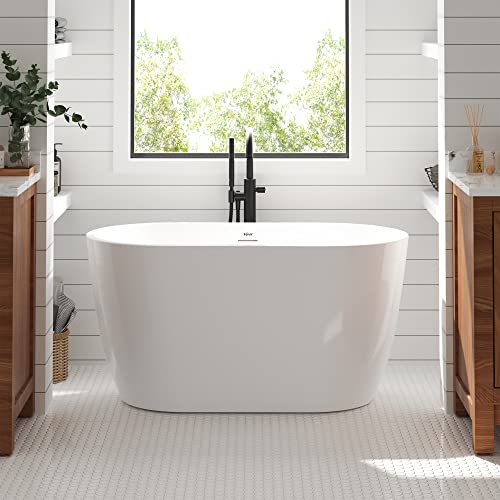
A freestanding tub offers sculptural presence, access from multiple sides, and easier cleaning behind and beneath some designs. For families, those virtues arrive with qualifications. Splashes travel in every direction, including toward flooring never intended for daily soaking. Supervision can happen from either side, which helps, yet storage for the bottles, toys, and cloths of a child’s bath has nowhere integral to live, migrating to caddies and floor baskets. Grab support, as discussed earlier, depends on incidental walls. None of this disqualifies freestanding tubs for households with school-age children, but it shifts them toward families whose children are at the older, calmer end of the range.
best 60 inch freestanding tubs
Readers committed to a freestanding silhouette can compare sixty-inch models by basin depth, rim profile, and floor finish in the linked guide, reading each candidate against the family criteria set out here.
Cleaning access separates the formats in a way that only becomes visible months later. An alcove tub’s sealed edges need recaulking on a schedule, a small recurring task, while its surfaces are otherwise simple to reach. A freestanding tub’s floor-level perimeter collects the full archaeology of family bathing, dropped toys, escaped water, hair, and dust, in a gap that may be too narrow for a mop and too wide to ignore. Owners with younger children mention that perimeter surprisingly often, usually while advising others to choose a design whose base meets the floor in a sealed plinth rather than standing on decorative feet.
The shower-over-bath question
School-age children become showering children on a schedule no parent fully controls, and a tub that accepts a shower gracefully extends its own usefulness. Alcove formats accommodate screens, curtains, and wall-mounted showers as standard practice. Freestanding tubs can host a shower only with enclosing curtains on circular rails or with acceptance of a genuinely wet room, arrangements that suit some houses and horrify others. Families choosing a tub for a seven-year-old should picture the same room serving a thirteen-year-old, because the fixture will certainly still be there, and the cost of having ignored the transition is a second renovation nobody budgeted for.
Installation details that decide whether specifications survive contact with reality
A tub delivers its published performance only when installed as its maker directs. Levelling determines whether water drains fully or pools in a corner where residue accumulates and footing changes. Support beneath the basin floor, mortar bed or manufacturer-specified feet, determines whether the floor feels solid or drum-like under a standing child. A family that has prioritised a rigid, textured floor on paper can lose both virtues to a flexible installation, so the installer’s method belongs in the purchase conversation, not after it.
Access for future maintenance deserves a family’s long view as well. Overflow and waste fittings eventually need attention, taps eventually need cartridges, and an installation that seals every approach into the wall converts small jobs into tile surgery. Alcove designs with sensible access panels, and freestanding designs with honest clearance, respect the decade-long ownership that a family tub implies. Children grow; plumbing ages on its own schedule regardless, and the household that can service its tub keeps it rather than replacing it early.
Finally, the surrounding floor should be chosen as part of the tub decision. The landing zone outside the open side receives a wet child at every bath, and its slip behaviour matters as much as the basin floor’s. Published tub dimensions define where that zone falls, including how far a swinging door or a laundry basket sits from the exit point. A clear, dry, unobstructed landing of adequate size is not an accessory to a good family tub; it is the second half of the fixture, and planning it costs nothing beyond attention at the stage when everything is still lines on paper.
The supervising adult is part of the specification
Guides usually size a tub for the bather and forget the second person in the room. A parent supervising a school-age child’s bath kneels, perches, reaches, lifts wet towels, and retrieves dropped toys for years of evenings, and the tub’s exterior geometry shapes that labour. A rim at a comfortable sitting height, wide enough to perch on without balancing, converts supervision from a crouch into a seat. An apron front with a slight recess at floor level lets a kneeling adult’s knees approach the tub instead of colliding with a vertical panel, a detail visible on specification drawings as a small inset that pays out nightly.
Reach matters in the same quiet way. Controls placed at the far end of a long tub ask a supervising adult to lean across water and a child to adjust anything, while controls on the side wall near the open rim stay within an adult’s arm and outside a seated child’s casual grasp. Storage follows reach: bottles and cloths kept on a wide rim or an alcove shelf remain available without the adult leaving the room, and every trip out of the room to fetch a forgotten item is a small supervision gap that good layout simply deletes. Families rarely list these ergonomic points when describing why a bathroom works, yet owner accounts of satisfying renovations return to them repeatedly, phrased as the room feeling easy without the writer quite naming why.
Lighting and visibility belong to supervision too, though they sit outside the tub itself. A basin colour that contrasts gently with skin and water makes it easier to see a child’s position, dropped objects, and the true water level at a glance, while a very dark interior in dim evening light obscures all three. Most family tubs are white or near-white for reasons beyond fashion, and that default serves supervision well. Where a household chooses a coloured exterior for design reasons, keeping the interior light preserves the visibility that evening bath time quietly depends on.
One tub across childhood: planning for growth rather than a single age
A tub bought for a six-year-old will be judged by a sixteen-year-old within the same decade, and the specifications that age best are the generous, neutral ones. Interior length that seems excessive for a small child becomes the reason a teenager still fits comfortably. A neutral depth, neither a shallow utility basin nor an extreme soaker, serves the widest span of bodies and moods. Highly child-specific shaping, by contrast, dates quickly; a permanent moulded seat sized for small hips becomes an intrusion in an adult bath, while removable accessories can retire to a cupboard the year they are outgrown.
That distinction between permanent geometry and removable equipment is one of the most useful lenses in this entire guide. Permanent choices, basin dimensions, wall height, floor texture, fitting positions, should be made for the household’s long future, weighted toward the adult and adolescent years that occupy most of the tub’s service life. Child-phase needs, by contrast, are best met with things that can be added and later removed: a stable step, a mat, a tap guard, a storage caddy. Families who reverse that logic, choosing permanent geometry for a brief phase and improvising the long term, describe renovations that felt perfect for eighteen months and slightly wrong for fifteen years.
Growth also changes the social use of the room. A bathroom serving one young child becomes, in time, a contested resource among siblings with school schedules, sports kits, and strong opinions about privacy and duration. A tub that fills and drains briskly, in a room whose layout allows one child to brush teeth while another bathes behind a screen or curtain, absorbs that evolution gracefully. Published drain positions and waste sizes influence draining speed more than most buyers realise, and a slow-draining deep tub in a busy morning household generates complaints that have nothing to do with bathing itself.
Sound, warmth, and the sensory side of bath time
Children experience a tub through senses that specification sheets barely touch, yet those experiences decide whether bath time is a pleasure a family protects or a negotiation repeated nightly. Sound is the first of them. Thin steel and lightly supported acrylic amplify every toy impact and water movement into a drum-like resonance that can startle a nervous bather and carry through floor structures to rooms below. Massive iron and well-bedded composite tubs deaden that noise to a muted thud. In flats and in houses where a younger sibling sleeps nearby, acoustic behaviour is a practical specification, and owners in such homes rank it far higher than visitors to a showroom would ever predict.
Warmth of touch follows material in a predictable order. Enamelled metal draws heat from skin on first contact and feels cold in a cool bathroom until water warms it, while acrylic and composite surfaces feel closer to neutral immediately. For a child who backs away from a chilly rim or hesitates to sit on a cold floor, that first-contact sensation shapes the whole routine’s opening minute. Running warm water over the surfaces before a child enters erases most of the difference, a routine so simple that families adopt it without thinking, yet knowing why it helps lets a household choose a colder-feeling material with confidence rather than discovering the hesitation unexplained.
Water temperature stability across a long bath is the third sensory factor. Deep water in a heat-retaining shell cools slowly, suiting children who play for a long stretch, while shallow water in a thin shell needs topping up, which reintroduces the tap-safety choreography each time. Families whose children take famously long baths should weight depth and shell mass accordingly, and families whose children treat bathing as a brief functional wash will never notice the difference. Neither preference is more correct; they are different childhoods asking different things of the same category of object.
Cleaning a family tub without damaging it
A tub used by children is cleaned more often and challenged by stranger substances than one used only by adults, so its care regime deserves planning rather than improvisation. The safe universal rule is that the maker’s cleaning guidance outranks every household habit and every internet remedy. Enamel tolerates more aggressive treatment than acrylic, textured floors need methods that reach into their pattern without abrading it, and matte composite finishes often specify particular products by type. A cleaning caddy assembled around the actual tub, kept in the bathroom, prevents the slow damage done by whatever bottle happened to be under a different sink.
Rhythm matters as much as chemistry. A brief rinse and wipe after a child’s bath removes soap film while it is still soluble, keeps textured floors performing as published, and prevents the ring of residue that later demands force. Weekly attention to the overflow recess, the waste surround, and the sealant lines catches the spots a daily rinse misses. Owners who describe a family tub looking new after years almost always describe that two-speed rhythm, quick and often, thorough and scheduled, rather than any heroic product, and they describe it as taking minutes because frequency does the heavy lifting.
Toys are part of the cleaning system whether anyone plans them or not. Hollow toys that take in water and cannot be fully emptied become residue factories emptied back into the next bath, and a mesh bag or open basket that lets toys drain and dry over the tub solves more hygiene grumbling than any disinfecting ritual. Storage that lives in the alcove or on a wide rim keeps that system inside the room’s routine. The tub specification contributes by offering somewhere for that storage to sit, one more unglamorous way in which rim width and alcove shelves earn their keep across a childhood.
Common buying mistakes this guide exists to prevent
The first mistake is shopping by exterior photograph alone, falling for a silhouette whose interior dimensions were never read. A sculptural tub with steeply sloping ends may deliver a surprisingly short floor length, leaving a growing child unable to sit with legs extended and an adult wondering why the bath feels cramped inside a generous footprint. The second mistake is the mirror image: choosing purely by a cavernous interior while ignoring step-over height, then spending years lifting a wet child over a wall that a tape measure predicted would be a struggle.
A third mistake is treating floor finish as a cosmetic choice, selecting the glossiest surface for its showroom shine and discovering its footing only in service. A fourth is forgetting the second child, the visiting cousin, or the family’s own future, and buying a tapered single-bather design for a household whose bath time is fundamentally social. A fifth is neglecting the water system behind the tub, pairing a high-capacity basin with a heater that cannot fill it, so the flagship feature, a deep family soak, exists only in theory on the evenings it is wanted most.
The final mistake is subtler: assuming that a product aimed at children, in name or marketing, is automatically the right answer for a child who has outgrown childhood’s first phase. School-age children bathe in the adult world of fixtures, and they are served best by adult fixtures chosen with their dimensions honestly in view, not by enlarged novelties or by baby equipment stretched past its purpose. That principle is the thread running through every section above, and it is why this guide began by separating two families that share a search phrase and almost nothing else.
A working checklist for the shortlist stage
When a family has narrowed the field to two or three candidates, a disciplined comparison on paper resolves most remaining doubt. Write down, for each tub, the interior floor length and width, the depth to the overflow, the floor-to-rim height, the rim width on the open side, the floor finish and any slip classification the maker publishes, the material and its cleaning restrictions, and the positions available for taps and future grab support. Gaps in that table are findings in themselves; a maker who publishes everything has made the comparison easy, and a maker who withholds basic dimensions is asking to be bought on faith.
Then measure the household with equal honesty. A child’s inside leg against the step-over height, a seated child’s torso against the soaking depth, two children’s hips against the interior width, the heater’s capacity against the published fill volume, and the supervising adult’s reach against the control positions. Those five pairings predict daily experience more faithfully than any showroom impression, because they compare the actual bodies and systems involved rather than an imagined average family. Where a pairing fails, believe the tape measure over the brochure photograph.
Decide, finally, which compromises the household can live with for a decade, because every candidate carries at least one. The deep tub asks for a step and closer supervision at entry; the low tub asks older bathers to accept a shallower soak; the textured floor asks for cleaning diligence; the smooth floor asks for a mat and its upkeep; the freestanding design asks for splash tolerance and creative storage. A family that names its chosen compromise out loud, rather than pretending to have avoided compromise altogether, almost always ends up satisfied, because the tub’s behaviour in service matches the bargain they consciously made.
Choose the tub whose published numbers fit the children standing in front of you and the teenagers they are quietly becoming, keep an adult’s eyes on every bath it ever hosts, and that unglamorous rectangle of enamel or acrylic will carry a family’s evenings safely from first school shoes to final exams.
Bathroom doors, locks, and the room around the tub
A family tub does not operate in isolation from its room, and a few room-level decisions amplify or undermine everything chosen at the fixture. Door swing is the simplest: a door that opens against the tub’s open side compresses the landing zone and startles a child mid-exit, while a door that opens against a wall leaves the exit path clear and visible. Where the swing cannot change, a door stop positioned with the bath routine in mind prevents the repeated small collisions that chip both door edge and enamel over years of evenings.
Privacy hardware deserves a family’s deliberate policy rather than an accidental one. School-age children increasingly want a lockable door, and households reasonably grant that privacy for dressing and toileting, yet a lock that cannot be released from outside during a bath converts an ordinary room into a sealed one at precisely the moments when adult access matters most. Many families adopt a simple convention, privacy respected, bathroom lock unused during bathing until children are well into double figures, supported by hardware that an adult can open from outside in an emergency. The tub cannot solve that policy question, but choosing a tub is a natural moment to settle it, while the room is being planned as a whole.
Ventilation completes the room picture. A family bath generates more moisture than any other event in the house, and a room that clears that moisture slowly leaves the tub’s surfaces, sealant lines, and textured floor damp for hours, shortening the life of finishes and inviting the film that defeats grip. Extraction sized for the room, actually used during and after baths, protects the investment made in the fixture itself. Owners who complain that a tub’s finish aged prematurely sometimes discover, on inspection, that the fan above it had been inadequate or disconnected for years, quietly rewriting the conditions every material in the room had been promised.
None of these room decisions carries a headline in a tub catalogue, which is exactly why they belong in a guide like this one: the families who plan the door, the lock, the air, and the landing alongside the basin are the families whose chosen tub performs in year eight the way its specification sheet said it would on the day it was unwrapped.
Check prices on Amazon
Live listings for the shortlist in this guide are pulled from Amazon below, so prices and availability are always current at the moment you look.
What to verify between ordering and installation day
The interval between paying for a tub and fixing it in place offers one last chance to catch mismatches while they are still returnable. When the tub arrives, measure the delivered article rather than trusting that it matches the drawing: interior floor length, depth to the overflow, and rim height can be confirmed in minutes with a tape and a straight edge laid across the rim. Manufacturing tolerances are small but real, and a basin that differs from its published drawing by enough to matter for a particular child should be discovered on the driveway, not after the tiling has closed around it.
Dry-fit the family’s imagination at the same moment. Sit the tub in its intended position if the room allows, or mark its footprint in tape on the floor, and walk the bath routine through in pantomime: where the supervising adult kneels, where the step stands, where towels hang within reach, and which hand finds the controls. Children invited to rehearse the climb over a taped outline, fully clothed and entirely dry, reveal awkward geometries with giggles rather than with a wet fall months later. Installers appreciate a household that has done this thinking in advance, because moving a fitting on paper costs nothing while moving it in a finished wall costs everyone involved.
Keep the paperwork that arrives with the tub, all of it, in one folder that stays with the house. The specification sheet, the cleaning guidance, the warranty terms, and the fitting manuals become the household’s reference every time a question arises about a cleanser, a chip, a cartridge, or a resale description years from now. Families who can produce that folder solve small problems in an afternoon; families who cannot are reduced to guessing at material and model from memory, and guessing is how acrylic gets scrubbed with the one powder its maker forbade, on an otherwise ordinary Saturday, by somebody who meant only to help.
That folder habit sounds too small to close a guide of this length, yet it captures the spirit of every recommendation before it: a family tub rewards households that read what makers publish, measure what brochures round away, write down what they decided and why, and then simply stay present, evening after ordinary evening, while the water runs and the stories get told across the rim.