What's inside
- Key Takeaways
- Quick Picks
- How did we choose the best baby bathtubs for infants?
- Comparison Table
- What does a safe, calm bath routine actually look like?
- How do you choose between a sling, a seat and a fold?
- What mistakes do new parents make with baby tubs?
- How do you clean and store a baby tub between baths?
- When does a baby graduate from the baby tub?
- What changes at each bathing stage of the first year?
- Where in the house should the baby actually be bathed?
- Which accessories genuinely earn their place at bath time?
- How do you bathe a baby who hates the bath?
- How do grandparents’ houses and second homes change the choice?
- What should you register for, and what should you skip?
- How do you read a baby tub listing without being misled?
- How does bath time fit the wider evening routine?
- What do experienced parents wish they had known?
- Final Recommendation
- Frequently Asked Questions
- Related Guides
As an Amazon Associate I earn from qualifying purchases. This post may contain affiliate links at no extra cost to you.
cottageverdict.com is reader-supported. When you buy through links on our site, we may earn an affiliate commission.
Where to buy: the four linked tubs below point to their Amazon listings, where you can check price on Amazon and confirm the current colourway, included accessories and the age range printed on the box. The two prose-only categories are discussed without links, because their quality varies too much between no-name listings to recommend a specific one.
Nobody shops for the best baby bathtubs for infants in a calm, research-minded mood. The purchase usually happens in the third trimester, in a hospital gift shop’s aftermath, or at midnight after a first attempt at bathing a slippery newborn in the family tub has taught the household what the product category is for. A baby tub is not really a miniature bathtub; it is a piece of confidence equipment. It holds a small, wriggling person at a safe angle, in a small, manageable volume of water, on a surface a tired parent can control with one hand while the other hand does the washing.
Judged that way, the differences between models stop being about colours and start being about support geometry. How does the tub hold a baby who cannot yet hold up their own head? What happens at the sitting-up stage, and again when a toddler wants to splash like weather? Where does the tub live between baths in a home that may not have a spare cupboard, and how fast does it dry in a steamy bathroom? The four linked tubs below answer those questions in four distinct dialects — a sling-based grow-with-me design, a contoured seat design, and two collapsible designs for homes where storage is the whole ballgame — followed by two prose-only categories that many parents meet first: foam sink inserts and inflatable travel tubs.
The safety framing throughout is deliberately practical. This guide talks about checking water temperature with a wrist or a thermometer, keeping a hand on the baby, filling shallow, and never leaving an infant unattended in water — the ordinary, unglamorous disciplines of bath time. It makes no medical claims, because a plastic tub is nursery equipment, not healthcare, and any question about a baby’s skin, health or development belongs to the family’s own clinician rather than to a product review.
Key Takeaways
- The Fisher-Price 4-in-1 leads for newborn support, with a removable sling for the earliest weeks.
- Frida Baby’s contoured seat design suits parents who prefer moulded support to fabric.
- Jool Baby and BUNWAG fold or collapse for apartments, travel and small bathrooms.
- Foam sink inserts and inflatable travel tubs, covered prose-only, are useful supplements, rarely a main tub.
- Shallow water, a temperature check and a hand on the baby matter more than any feature list.
- Choose for the stage your baby is entering, not the stage in the photograph.
Quick Picks
| Pick | Badge | Why it made the list |
|---|---|---|
| Fisher-Price 4-in-1 Sling N Seat Baby Tub | Best for newborns | A four-stage tub with a removable infant sling, seat insert and two bath toys included. |
| Frida Baby 4-in-1 Grow-with-Me Bathtub | Best moulded support | Removable seat and backrest support that reconfigures from newborn to toddler stages. |
| Jool Baby Foldable Baby Bathtub | Best for travel and storage | Folds flat, carries a built-in thermometer and grows through every stage. |
| BUNWAG Collapsible Baby Bathtub | Best cushioned collapsible | A soft cushion, thermometer and no-slip feet in a tub that packs down small. |
| Sink-insert foam cushions (category discussion) | Best first-weeks supplement | A soft foam pad that turns a clean sink into a gentle newborn bathing spot. |
| Inflatable travel tubs (category discussion) | Best suitcase option | Deflates to almost nothing for trips, with supervision and sturdiness caveats. |
How did we choose the best baby bathtubs for infants?
Support came first, because it is the entire job. Each candidate was assessed on how it positions a newborn who cannot support their own head: a sling that cradles, a contoured seat that reclines, or a cushion that pads — and on whether that support is secure enough that a parent is washing the baby rather than holding the baby up with both hands and washing by optimism. Tubs whose newborn stage depended on a parent’s forearm as the primary structure were set aside, however charming their photographs.
The second screen was the growth path. Babies pass through bathing stages the way they pass through clothing sizes — relentlessly — so a tub bought for a newborn should declare its plan for the sitting stage and the toddler stage, whether through removable inserts, convertible seating or simple generous dimensions. Drainage and drying were judged with equal seriousness: a tub that empties through a plug beats one that must be tipped one-handed, and materials that dry quickly in a humid bathroom beat materials that stay damp and thoughtful about mildew.
Storage decided the final places. In a family home with a utility cupboard, a rigid tub’s bulk is a shrug; in an apartment, it is a daily negotiation, which is why two of the four linked places went to folding designs that hang on a hook or slide behind a door. Every pick also had to be cleanable with ordinary household supplies and free of crevices that trap bathwater residue, because the person doing the cleaning is, by definition, already busy.
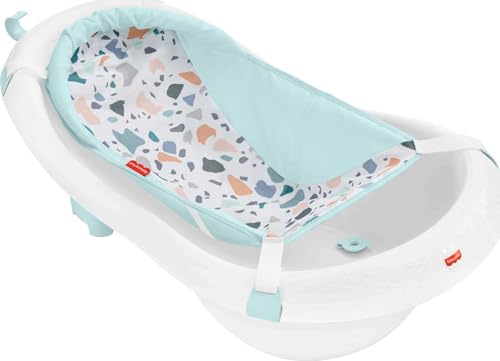
Fisher-Price 4-in-1 Sling N Seat Baby Tub — Best for newborns
The Fisher-Price 4-in-1 earns the newborn crown the straightforward way: its removable sling cradles a brand-new baby at a gentle recline, in shallow water, with the baby’s weight supported by fabric rather than by a parent’s aching wrist. For the first baths — which are less about washing and more about two nervous people learning a ritual — that sling changes the emotional weather of the whole procedure. The baby lies secure, both parental hands are freer, and the bath can proceed at the unhurried pace that keeps everyone calm.
The four-stage design then follows the standard biography of a first year. Sling out, and a sit-support insert steadies the baby who can hold their head but not yet their balance; insert out, and the shell becomes a straightforward toddler tub with room to sit and splash; and the two included bath toys acknowledge, with unusual honesty from a manufacturer, that the toddler stage is entertainment management as much as hygiene. The Pacific Pebble colourway keeps the whole thing calm to look at, which parents surrounded by primary-coloured equipment will appreciate at 7 p.m.
Caveats are the category’s usual ones. A fabric sling needs rinsing and airing after use so it dries properly between baths, and the multi-piece design means more parts to store than a one-piece rival. The tub is also a rigid footprint on the shelf — it does not fold — so the storage question should be answered before purchase. For a first baby in a home with somewhere to keep it, this remains the most reassuring starting point in the guide.
- Format: rigid four-stage tub, newborn to toddler
- Support: removable sling for infants, sit-support insert later
- Included: two bath toys in the box
- Finish: Pacific Pebble, calm neutral colourway
- Storage: full-size rigid footprint, no folding
Strengths
- Sling support makes first baths genuinely manageable
- Stages track the whole first year in one purchase
- Trusted brand with widely available replacement parts
Trade-offs
- Sling fabric needs deliberate drying between uses
- Rigid shell claims permanent storage space
- Multiple pieces mean more to rinse and keep track of
Best for: first-time parents who want the newborn stage engineered for them. Check price on Amazon.
Not suited for: tiny bathrooms with no storage, or frequent travellers.

Frida Baby 4-in-1 Grow-with-Me Bathtub — Best moulded support
Frida Baby built its reputation on products designed by people who have plainly met a baby, and the Grow-with-Me tub carries that signature: instead of a fabric sling, it uses a removable seat and backrest support in moulded plastic, reconfiguring across four stages from newborn recline to toddler independence. Parents who flinch at the laundry-and-drying routine a sling involves will feel immediately at home — every surface here wipes, rinses and dries at the speed of plastic.
The newborn configuration reclines the baby against the contoured backrest with the seat supporting from below, a geometry that holds a small body at a consistent angle without anything to adjust, tension or clip into place. As the stages progress, pieces come away and the tub opens up, ending as a roomy toddler bath. The green colourway is cheerful without shouting, the plastic feels dense rather than flexy at the rim, and the whole product has the designed coherence of a range that expects to be handed down to a second child.
The moulded approach has one honest limitation: a fixed contour fits most babies well and a few babies imperfectly, where a fabric sling conforms to everyone. Very small newborns in particular should be settled into the recline and checked for a comfortable, supported position before the water goes in — advice that applies to every tub here, but matters most with fixed geometry. The Frida is also, like the Fisher-Price, a rigid tub that will live somewhere in your home full-time. For parents who prefer wipe-clean structure to fabric, it is the strongest alternative philosophy in the guide.
- Format: rigid four-stage tub, newborn to toddler
- Support: removable moulded seat and backrest, no fabric
- Care: all-plastic surfaces rinse and dry quickly
- Finish: green colourway, sturdy rim feel
- Storage: full-size rigid footprint between baths
Strengths
- No sling to launder, air or eventually replace
- Consistent recline angle with nothing to adjust
- Feels durable enough for a second child’s tour
Trade-offs
- Fixed contours suit most babies, not literally all
- Rigid bulk needs a permanent home in the bathroom
- Plastic support feels firmer than a fabric cradle
Best for: parents who want structured, wipe-clean support from day one. Check price on Amazon.
Not suited for: homes short on storage, or babies who settle best in fabric.

Jool Baby Foldable Baby Bathtub — Best for travel and storage
The Jool Baby tub starts from the constraint the rigid models ignore: in many homes, a baby tub’s hardest job is existing between baths. This one folds flat — genuinely flat, hook-on-the-back-of-the-door flat — which converts it from a piece of furniture into a piece of luggage, equally at home in an apartment bathroom, a grandparents’ spare room or a suitcase. For families bathing a baby in a kitchen sink’s postcode of space, that single property can outrank every other specification on this page.
It is not a stripped-down travel compromise, either. A built-in thermometer addresses the most common new-parent anxiety directly, giving a read on the water without a separate floating gadget to lose, and the design is intended to grow with the baby through the stages rather than expiring at the sitting milestone. The Oat colourway is the rare baby product that looks like it belongs to adults, and the folding mechanism, the feature most likely to disappoint in this category, feels deliberate rather than flimsy when the tub is opened and set down.
Folding tubs ask for two habits in return. The hinges and creases deserve a rinse and a proper air-out after use, since folds are where moisture likes to linger, and the tub should be opened and checked for full, stable engagement before water and baby arrive — a five-second ritual that belongs in the bath routine alongside the temperature check. Used with those habits, the Jool is the pick this guide hands to apartment dwellers and travelling families without a moment’s hesitation.
- Format: foldable tub, newborn through later stages
- Extras: built-in thermometer in the tub body
- Storage: folds flat for hooks, doors and suitcases
- Finish: Oat, adult-friendly neutral colourway
- Care: folds and hinges need rinsing and airing
Strengths
- Flat fold solves the storage problem completely
- Thermometer removes a separate purchase and worry
- Travels to grandparents and holidays without drama
Trade-offs
- Fold seams need deliberate drying after each bath
- Must be checked fully open before every fill
- Less rigid underfoot than the one-piece rivals
Best for: apartments, small bathrooms and families who bathe babies in more than one house. Check price on Amazon.
Not suited for: parents who want a set-and-forget rigid tub by the family bath.

BUNWAG Collapsible Baby Bathtub — Best cushioned collapsible
BUNWAG’s entry in the collapsible contest adds the comfort layer the format usually lacks: a soft cushion that pads the baby’s back and seat, turning a folding shell into somewhere a newborn can lie without meeting hard plastic at every contact point. The cushion is the reason this tub, rather than a bare folding rival, gets recommended for the youngest babies in small homes — it borrows the sling’s kindness and packs it into a tub that still collapses for storage.
The supporting details are well chosen. A thermometer is built in for the water-temperature check, no-slip feet keep the tub planted on a wet bathroom floor or inside the family bath, and the stated range runs from newborn through the first year, which covers the period when a separate baby tub earns its shelf space most clearly. The grey colourway keeps it unisex and giftable, and as a shower gift it solves the giver’s dilemma neatly: useful from the first week, unobtrusive in any bathroom, and easy to store if the baby arrives before the nursery is finished.
The cushion, predictably, is also the maintenance item: it should be removed, rinsed and dried thoroughly after baths rather than left sitting in a damp folded tub, and households in humid climates should give the whole assembly air and light regularly. Collapsible walls also reward a stable, level surface — this is a tub for the floor or the big bath, not for a wobbling countertop. Within those ordinary disciplines, it is the gentlest small-space option in the guide.
- Format: collapsible tub for infant to toddler, 0–12 months focus
- Comfort: soft cushion included for newborn padding
- Extras: built-in thermometer, no-slip feet for stability
- Finish: grey, neutral and gift-friendly
- Storage: collapses down for cupboards and travel
Strengths
- Cushion makes a folding tub newborn-kind
- No-slip feet behave on wet floors and in big tubs
- Packs small without giving up the thermometer
Trade-offs
- Cushion needs removing and drying after baths
- Needs a level surface to feel fully stable
- First-year focus means toddlers outgrow it sooner
Best for: small homes wanting newborn comfort without a rigid tub’s footprint. Check price on Amazon.
Not suited for: families wanting one tub to serve well into the toddler years.
Sink-insert foam cushions (category discussion) — Best first-weeks supplement
The foam sink insert is where many babies actually take their first baths, and this guide discusses the category generically — it sits at a budget tier across the market — because the products are simple enough that brand matters less than condition and fit. The idea is disarming: a soft, contoured foam pad sits in a clean kitchen or bathroom sink, the tap provides warm water at a standing adult’s comfortable height, and the newborn lies supported on a surface that gives slightly under their weight. For a parent recovering from delivery, not kneeling by a tub is a genuine mercy.
Used well, the category has real virtues. The sink’s small volume warms fast and empties instantly, the foam keeps a tiny baby from sliding on porcelain, and the whole arrangement costs and stores almost nothing. The disciplines are equally clear: the sink must be cleaned thoroughly before and rinsed after, taps and hard edges sit close to the baby and need guarding attention, and the insert itself must be dried completely between uses, since foam that stays damp is foam that stops being hygienic. Most families retire the insert within the first couple of months as the baby outgrows the sink — which is fine, because it was never pretending to be the main tub.
As a supplement to a main tub, though, it earns its place in this guide honestly: it covers the earliest, most delicate weeks at standing height, travels to grandparents in a tote bag, and buys a household time to choose the bigger tub without midnight panic. Buy it for what it is, replace it if it ever stays damp or smells tired, and let it retire gracefully when the baby’s legs start negotiating with the taps.
- Format: contoured foam pad for a household sink
- Stage: newborn and earliest weeks primarily
- Positioning: budget tier across the wider market
- Care: must dry fully between every single use
- Role: supplement to a main tub, not a replacement
Strengths
- Standing-height bathing spares recovering parents’ backs
- Costs and stores almost nothing at all
- Gentle, non-slip surface for the tiniest babies
Trade-offs
- Outgrown within the first couple of months
- Sink hygiene becomes part of the bath routine
- Foam that stays damp must be replaced promptly
Best for: the first weeks at home, especially after a difficult delivery.
Not suited for: sitting-stage babies or as the household’s only bathing plan.
Inflatable travel tubs (category discussion) — Best suitcase option
Inflatable baby tubs, again discussed as a category at a budget-to-mid tier rather than as a linked product, exist for one glorious reason: they deflate. Rolled into a suitcase corner, an inflatable tub lets a family keep the bath routine intact in hotel rooms, holiday rentals and grandparents’ houses where no baby equipment waits. The routine matters more than the object — a familiar bath shape, at the familiar hour, can be the difference between a travelling baby who settles and one who files a formal complaint at midnight.
The honest limitations travel with it. An inflatable structure is only as firm as its inflation, so the tub should be blown up fully, checked for slow leaks before the trip rather than during it, and used on a stable surface with the same never-leave-the-baby discipline as any other bath — arguably with extra vigilance, since soft walls support a sitting baby less positively than rigid ones. Water depth should stay shallow, the tub should sit inside the hotel bath or on a protected floor, and drying an inflatable thoroughly before repacking is what separates a travel triumph from a mildewed souvenir.
Within those boundaries the category is genuinely useful, and many families keep one in service at home as the spare for garden paddling duty in summer once its travel career ends. It will not replace the structured support of the Fisher-Price or Frida for a newborn’s main baths, and this guide would not ask it to. As the tub that lives in the luggage, it has no serious rival.
- Format: inflatable tub, deflates for packing
- Stage: best once a baby sits with some confidence
- Positioning: budget-to-mid tier across the market
- Care: dry fully before repacking after every trip
- Role: travel and spare duty, not the main newborn tub
Strengths
- Packs to nearly nothing for holidays and visits
- Keeps the bath routine familiar away from home
- Doubles as a garden paddling pool in summer
Trade-offs
- Soft walls support sitting babies less firmly
- Needs inflation checks and puncture awareness
- Damp repacking invites mildew quickly
Best for: travelling families and grandparents’ houses without baby gear.
Not suited for: a newborn’s primary baths or unsupervised sitting practice.
Comparison Table
| Pick | Support style | Standout trait |
|---|---|---|
| Fisher-Price 4-in-1 Sling N Seat Baby Tub | Fabric sling | Four stages, toys included |
| Frida Baby 4-in-1 Grow-with-Me Bathtub | Moulded seat | Wipe-clean, no fabric |
| Jool Baby Foldable Baby Bathtub | Folding shell | Folds flat, thermometer |
| BUNWAG Collapsible Baby Bathtub | Collapsible, cushion | Soft cushion, no-slip feet |
| Sink-insert foam cushions (category discussion) | Foam pad in sink | Standing-height first weeks |
| Inflatable travel tubs (category discussion) | Inflatable shell | Packs into a suitcase |
What does a safe, calm bath routine actually look like?
Strip the equipment away and a good infant bath is a short ceremony with a fixed running order. Everything is gathered before the water runs: towel open and waiting, clothes and nappy within reach, soap and cup to hand, the room warm. The tub is filled shallow — a few inches is plenty for a small baby — and the temperature is checked before the baby is anywhere near it, with a wrist or elbow, which feel warmth more honestly than fingers, or with a thermometer of the kind two of the linked tubs build in. Comfortably warm, never hot, is the standard, and when in doubt the water should err cooler and the bath shorter.
During the bath, one hand stays on the baby — supporting the head and shoulders of a newborn, resting steady on a sitter — and the other hand does the washing, top to bottom, quickly and gently, because small babies lose heat and patience on similar schedules. The rule that outranks every other in this guide is the simplest: a baby in water is never left alone, not for the doorbell, not for a towel in the next room, not for ten seconds. If the doorbell rings mid-bath, the baby comes along wrapped in the towel, or the doorbell goes unanswered; the world can wait three minutes.
Afterwards, lift the baby straight into the waiting towel, pat dry with attention to the creases, and dress before the chill arrives. Then the equipment gets its thirty seconds: rinse the tub, empty it fully, and set it — sling, cushion, folds and all — somewhere air can reach it, because the next calm bath is built on a dry, clean tub. The whole ceremony, done a dozen times, becomes the easiest part of the evening, which is precisely what the right tub is for.
How do you choose between a sling, a seat and a fold?
The three support philosophies in this guide map onto three kinds of household. The sling, represented by the Fisher-Price, suits parents who want the newborn physically cradled and are willing to rinse and air a piece of fabric as part of the routine; it is the gentlest welcome and the most forgiving of a tiny baby’s shape. The moulded seat, the Frida approach, suits parents who want structure without laundry — a fixed, wipeable geometry that behaves identically at every bath and asks nothing but a rinse.
The folding designs suit households where space is the loudest voice in the room, and between them the choice is about padding: the BUNWAG’s cushion for the youngest babies, the Jool’s cleaner fold and stage range for families travelling or storing above all. None of the three philosophies is the correct one in the abstract, and grandparents’ houses often end up running a different philosophy from the main home without anyone suffering. Choose for your space, your tolerance for drying fabric, and the stage your baby is about to enter — the tub that matches those three facts will feel like the obvious answer within a week.
What mistakes do new parents make with baby tubs?
- Filling too deep and too hot. A few inches of comfortably warm water is the whole requirement. Deep, hot baths impress nobody in the room, least of all the baby, and the temperature check takes five seconds.
- Buying for the photograph’s stage. A tub that is perfect for a sitting six-month-old can be useless for a newborn, and vice versa. Purchase for the stage arriving next, with the growth path in writing.
- Leaving the tub damp between baths. Slings, cushions and folds that stay wet become the hygiene problem the bath was meant to solve. Drying is not an optional epilogue; it is part of the product.
- Bathing the baby where the setup wobbles. A tub belongs on a stable, level surface — the floor, inside the big bath, a solid counter for the smallest inserts — never on anything that can shift under a splash.
- Answering the door mid-bath. The baby comes with you, wrapped in the towel, or the visitor waits. No errand in the house outranks a baby in water, and every experienced parent has the same rule for a reason.
How do you clean and store a baby tub between baths?
The routine is measured in seconds, which is why it survives contact with new-parent exhaustion. Rinse the tub with clean water after every bath to remove soap film, wash it periodically with a mild household cleaner, rinse again thoroughly so no cleaner residue meets the next bath, and then — the step that does the real work — dry it or stand it where air circulates freely. Slings and cushions come out and dry separately, flat or hung, and folding tubs are stored open or loosely folded rather than sealed damp into a cupboard.
Storage location matters more than storage furniture. A tub that lives in the bathroom’s steamy corner dries slower than one hung on a hook in a ventilated spot, and a tub stored clean and dry can be trusted at a moment’s notice when a nappy event demands an emergency bath at an unplanned hour. Inspect the whole assembly weekly with fresh eyes: seams, folds, the underside, any spot where residue gathers. Anything that stays discoloured or smells stale after honest cleaning has finished its service, and replacing a baby tub is cheap compared with bathing a newborn in a questionable one.
When does a baby graduate from the baby tub?
The transition announces itself behaviourally rather than by birthday. A baby who sits steadily, pulls at the tub’s edges, treats the insert as an insult and splashes with intent is campaigning for the big bath, and most families make the move somewhere in the second half of the first year, keeping baths shallow and supervised exactly as before. The grow-with-me designs stretch their usefulness by removing supports stage by stage, which is why two of this guide’s linked picks are four-stage products: the last configuration is effectively a toddler tub that bridges to the family bath.
Graduation is also a good moment to hand equipment onward honestly. A rigid tub in clean, dry, undamaged condition is a welcome gift to the next family; a sling or cushion that has lived a damp life is not. The collapsible picks retire into the travel kit, where their second career can run for years. Equipment that served the first year well has nothing left to prove, and the household’s next bathing problem — a toddler who considers the bath a swimming venue — is a different guide’s happy problem.
What changes at each bathing stage of the first year?
The newborn stage is a support problem wearing a bath costume. The baby cannot hold their head, startles at their own splashes, and experiences the bath mostly as temperature and handling, so the winning equipment reclines them securely and lets the adult work gently and quickly. Baths are short, the water is shallow, and success is measured in calm rather than cleanliness, because a two-week-old has limited ways to get dirty beyond the obvious. This is the stage the sling and the foam insert were invented for, and it passes faster than anyone believes while inside it.
The sitting stage flips the personality of bath time entirely. A baby who can sit meets the water as a toy rather than a procedure, the support steps down to a steady base and a watchful hand, and the bath lengthens into play — cups, floating toys, the serious business of splashing. Equipment needs change with the mood: room to sit upright, a rim to grip, drainage that copes with enthusiastic water displacement. The four-stage tubs earn their price here, reconfiguring instead of expiring, and parents discover why the toddler configuration’s generous shell mattered in the original purchase.
The standing, climbing, opinionated stage that follows is managed mostly by supervision and brevity. Baths become negotiations, the big family tub takes over with shallow water, and the baby tub retires to travel or hand-me-down duty. Looking back across the three stages explains the structure of this entire guide: the best purchase is never the best newborn tub or the best toddler tub in isolation, but the one whose plan for all three stages was honest from the start.
Where in the house should the baby actually be bathed?
The location decision shapes the routine more than the tub decision does. Inside the family bath is the default for good reason — contained splashes, easy filling, a drain that asks nothing of anyone — but it costs the adult a kneeling posture that a bad back will invoice nightly. On the bathroom floor, on a mat, the same tub becomes accessible from a chair and kinder to knees, at the price of carrying water or running a longer fill from the shower hose. Kitchen counters and sinks, with the foam insert or a small tub that fits, offer standing height and the warmest room in many houses, with the discipline that food-preparation surfaces and baby baths must be separated by thorough cleaning on both sides of the event.
Twins and close siblings add a logistics chapter of their own. The workable systems bathe babies sequentially with the second baby waiting somewhere safe and supervised — never unsupervised in water while the first is dressed — or draft a second adult and run the ceremony in parallel. A second inexpensive tub, even one of the prose-only categories, often serves a twin household better than one premium tub used in relays, because the bottleneck is adult hands, not equipment. However the room is arranged, the test of the setup is whether it can be repeated, identically, by a tired adult at the end of a long day — the routine that survives exhaustion is the one that gets used.
Which accessories genuinely earn their place at bath time?
The honest accessory list is short, and most of it is already in the house. A large open towel — ideally one that lives only in the bathroom so it is always where the ceremony needs it — outperforms every hooded novelty within a month. A simple pouring cup handles hair rinsing better than shaped gadgets, a soft washcloth or two covers the washing, and a bath mat or folded towel under the adult’s knees is the accessory experienced parents mention first and manufacturers never sell. A basic thermometer earns its place for parents who like a number, though two of the linked tubs fold that function into the product itself.
Toys deserve a hygiene footnote rather than a shopping list. Anything with a squeeze-hole takes water inside and keeps it there, becoming a small dark reservoir that no amount of shaking fully empties, so the wiser toy box favours solid, sealed, easily dried pieces — cups, solid figures, the two toys Fisher-Price includes — and a weekly squeeze-and-inspect habit for anything hollow. The ceremony stays simple, the equipment stays clean, and bath time remains the calm half-hour the household designed it to be.
How do you bathe a baby who hates the bath?
Some babies vote against water with their whole bodies, and the fix is usually environmental rather than equipment-deep. A warmer room, water that is checked and genuinely comfortable, a slower entry that lets feet and legs meet the water before the torso, and a flannel laid across the tummy kept wet with warm water all lower the protest volume remarkably. Timing matters too: a bath offered to a hungry or overtired baby is a debate nobody wins, while the same bath after a feed and before the evening tiredness lands can be the calmest event of the day.
If the resistance persists, shorten the ceremony without abandoning it — a brief, warm, well-supported bath keeps the routine familiar while respecting the baby’s opinion — and mention the pattern at the next routine appointment if anything about the baby’s skin or reactions concerns you, since those questions belong to the family’s clinician. Most bath-haters convert within weeks as the sitting stage turns water into play, and the parents who kept the ritual gentle and brief are the ones whose babies arrive at that conversion soonest.
How do grandparents’ houses and second homes change the choice?
A baby who bathes at two addresses needs either two tubs or one tub that travels, and the economics argue clearly. The folding pair in this guide exist precisely for the grandparent circuit: a Jool or BUNWAG can live at the second house permanently for less money and less storage grief than any rigid duplicate, or ride in the car and serve both. Where visits are weekly and long, a dedicated second setup — tub, towel, a change of clothes that lives there — converts a logistical operation into a pleasure, and grandparents consistently report that having the right gear is what makes offering to help feel easy.
The foam insert finds its second career here too, since a clean sink exists in every house ever built, and the inflatable covers the holiday-rental scenario where even a sink’s suitability is unknown. The pattern across all three supporting options is the same: the main tub is bought for the main home’s space and stage, and the travel problem is solved separately and cheaply, rather than compromising the everyday purchase for the four weeks a year it leaves the house.
What should you register for, and what should you skip?
Baby lists accumulate tubs the way weddings accumulate toasters, so the registry advice is blunt. Register for one main tub matched to your home — sling, seat or fold, per the earlier chapters — and let the prose-only categories arrive as small gifts if they arrive at all. Skip duplicate newborn-stage products, skip anything whose support depends on a parent’s arm being the structure, and skip the elaborate bath centres with attachments nobody can name by the second month. Spend the household’s gift goodwill instead on the unglamorous consumables of the ceremony: towels that can be in two places at once, a second set of everything for the grandparents’ house, and the storage hook that gives the folding tub its home.
Above all, resist the staged nursery photograph as a buying guide. The photograph’s baby is clean, calm and six months old; yours will be slippery, opinionated and exactly as old as they are. Equipment chosen for the real ceremony — support, warmth, shallow checked water, a dry place to live afterwards — will look after the photograph’s version too, and it will still be earning its shelf space when the opinionated stage arrives.
How do you read a baby tub listing without being misled?
Listings in this category photograph beautifully and specify loosely, so a translation habit helps. The age range on the box describes the outer envelope of the stages, not a promise that a newborn and a toddler are equally well served by the same configuration — check which insert or support serves which stage, and whether every stage’s parts are actually in the box. Weight limits and dimensions deserve the same reading: measure your sink, your big bath’s floor and your storage hook against the stated footprint, because baby tubs are returned for geometry more than for quality. And treat the phrase about growing with your baby as a question — the good products in this guide answer it with removable, named parts, while the vague ones answer it with adjectives.
How does bath time fit the wider evening routine?
Experienced households treat the bath as the hinge of the evening rather than an isolated event: feed, bath, pyjamas, story, sleep, in an order so consistent that the baby begins to read the sequence itself as a lullaby. Dimming the bathroom light a fraction and lowering voices as the ceremony proceeds are small stage directions with outsized effects, borrowed from every nursery that has ever run a calm evening shift. The tub’s contribution to that machinery is reliability — it is set up in a minute, behaves identically every night, and cleans down in seconds, so the hinge never squeaks. This is the deeper reason this guide weights drying, storage and stage-planning so heavily: a tub that adds friction at 6:45 p.m. taxes the whole evening, while a tub that disappears into the routine pays its rent in sleep, which is the only currency new parents actually trade in.
What do experienced parents wish they had known?
Ask parents a year in and the answers cluster tightly. They wish they had bought for storage as seriously as for support, because the tub is out of the water twenty-three and a half hours a day. They wish they had practised the setup once before the baby came home, sling clips and all, with a doll or a rolled towel standing in. They wish someone had told them the first baths would be short, slightly chaotic and entirely sufficient — that a newborn does not need a spa procedure, only warmth, support and a parent whose hands grow steadier every evening. And almost all of them say the same closing thing: the stage that felt endless ended quickly, and the little tub they agonised over became, in retrospect, one of the easiest purchases of the year. Choose decently, set up calmly, and spend the saved worry on the baby.
Final Recommendation
For most first babies in most homes, the Fisher-Price 4-in-1 Sling N Seat is this guide’s recommendation: the sling makes the frightening first fortnight feel engineered, and the stages carry the purchase honourably through the year. Parents who prefer structure without fabric should choose the Frida Baby Grow-with-Me with equal confidence, while small homes and travelling families should go straight to the folding pair — the BUNWAG for its newborn cushion, the Jool Baby for its flat fold and thermometer. The prose-only categories earn their mentions as supporting players: a foam insert for the standing-height first weeks, an inflatable for the suitcase.
Whichever tub arrives, remember that the equipment is the smallest part of bath time — the warm room, the shallow checked water, the hand that never leaves and the towel waiting open are the actual product, and they are free. Take one photograph of the first bath, because everyone will want it in ten years, and then put the phone in another room for every bath after that; the ceremony deserves an audience of exactly the people in it. Buy the tub that supports your baby and fits your home, run the little ceremony the same way every evening, and bath time will quietly become the part of the day everyone in the house would choose to keep.
Frequently Asked Questions
How often should a newborn be bathed?
Most families settle into a few baths a week for a newborn, with daily warm-water wipes of the face, neck folds and nappy area in between, because very frequent full baths can dry delicate skin. The exact rhythm is a question for the family’s own clinician, who knows the baby; the tub’s job is simply to make the chosen rhythm easy to keep. A bath routine that parents can manage calmly at the end of a long day will be kept, and one that requires engineering will quietly lapse.
What water temperature is right for a baby’s bath?
The practical test is comfort: the water should feel comfortably warm on the inside of a wrist or elbow, never hot, and a thermometer — built into the Jool and BUNWAG picks, or a simple bath thermometer bought separately — removes the guesswork for parents who prefer a number. Fill shallow, swirl the water so no hot pocket hides at the tap end, and check again before the baby goes in if any hot water was added along the way.
Can a baby tub go inside the regular bathtub?
Yes, and for many families that is the tidiest arrangement of all: splashes are contained, filling and emptying use the bath’s own taps and drain, and the baby tub can stay there to dry. Check that the base sits flat and stable on the big tub’s floor — the BUNWAG’s no-slip feet are designed for exactly this — and remember that kneeling beside a bath is part of the posture, so a folded towel under the knees is professional-grade equipment.
When can a baby use a baby tub without the sling or insert?
When the baby can sit with steadiness and hold their head and torso confidently, the support can usually step down to the tub’s next stage — which is precisely how the four-stage designs are meant to be used, removing pieces as ability grows rather than by the calendar. Until then, the support stays in, even for babies who seem eager, because water makes every surface more slippery than it looks. When in doubt, keep the extra support for another week; nobody regrets the cautious direction.
How do I stop a folding tub going musty in a small flat?
Dry it like you mean it: rinse after the bath, shake the water out of the folds, and store it open or hung in moving air rather than folded away damp. A weekly wipe-down and an occasional airing in daylight keep the seams honest, and the same routine protects slings and cushions in the rigid tubs. Mustiness is almost never a product defect; it is a storage report card, and it improves the week the drying routine does.
What if the bathroom is shared with older children?
Then storage and scheduling become the design brief: a folding tub that hangs out of reach and out of the way, a bath hour that precedes the older children’s, and a hard household rule that the baby tub’s parts are not toys. Older siblings make excellent towel-holders and song-singers at bath time, and involving them — outside the water, with jobs that matter — turns the baby’s ceremony into a family one.
Do I need a separate baby tub at all?
Strictly, generations were bathed in sinks and washing-up bowls, and a clean sink with a foam insert remains a legitimate start, as this guide’s prose-only chapter explains. What a dedicated tub buys is repeatability and support: the same safe angle, the same shallow volume, on any surface, at any hour, without commandeering a food-preparation sink. For most households that consistency is worth a modest purchase; for a short stay with family, the sink and insert combination is an honourable substitute rather than a compromise to apologise for.
Is a second-hand baby tub a good idea?
A rigid plastic tub that can be inspected and cleaned thoroughly is one of the more sensible hand-me-downs in the nursery, provided it is undamaged, stable and can be washed properly before its first use for your baby. Fabric slings, foam inserts and cushions are the exception — porous parts with an unknown damp history are better bought new, which is inexpensive in those categories. When a gifted tub’s history is doubtful, accept the shell with thanks and replace the soft parts.
Related Guides
Once bath time is civilised, the rest of the nursery follows: our styling chapter Best Bali-Style Bathtubs is for the parents’ own bathroom ambitions, while the cleaning power in Best Robot Vacuums with Real Suction Performance handles the floors a crawling baby is about to inspect. Storage for the growing household lives in Best Bathroom Double Vanities, and the air in the nursery itself is covered by Best Air Purifiers for a Baby’s Room.


