What's inside
- Key Takeaways
- Quick Picks
- What did we look for in a banquet chair built for a decade?
- The line-up compared: silhouette, surface and frame
- Vinyl or fabric: which upholstery survives hall life better?
- How many banquet chairs does a hall actually need?
- How should a venue care for a banquet fleet?
- How should a hall lay out banquet chairs for different events?
- What happens to banquet chairs in storage, and how do you prevent it?
- How do you audit a trial pack like a venue professional?
- Why does this guide keep returning to the storeroom?
- What do venues get wrong when buying banquet chairs?
- How should hirers and venue managers talk about chairs before an event?
- What does the banquet chair market’s sameness tell a buyer?
- How do chairs and tables need to be planned together?
- What should a small venue with a tiny budget do first?
- How long does a banquet fleet realistically last, and what ends it?
- Final Recommendation
- Frequently Asked Questions
- Related Guides
As an Amazon Associate I earn from qualifying purchases. This post may contain affiliate links at no extra cost to you.
cottageverdict.com is reader-supported. When you buy through links on our site, we may earn an affiliate commission.
Where to buy: The banquet chairs below are sold through their Amazon listings, mostly in four-packs, so check price on Amazon per chair by dividing by the pack count before comparing sets that photograph alike.
The best stackable banquet chairs are the hardest-working furniture in any hall: seated on by hundreds of strangers a year, stacked by tired staff at midnight, stored in corners that are never quite the size promised. A banquet chair is not bought for one wedding. It is bought for a decade of weddings, funerals, awards dinners, examination sittings and committee AGMs, and it has to look ceremonial in the first of those years and merely decent in the tenth. That longevity test — not the showroom sit — is what separates the six picks below from the flimsier end of the market.
Three honest notes govern this guide. First, capacity: only one pick, the dome-back chair from Flash Furniture, states a weight capacity in its title — 500 LBS — and that figure is quoted for that chair alone. The other five titles stay silent, so this guide stays silent too; a venue that needs a stated capacity for its risk assessment should shortlist the dome-back and confirm the rest directly with sellers. Second, upholstery divides the field cleanly into vinyl chairs that wipe down and fabric chairs that look softer and demand extraction cleaning, and that split matters more to a hall’s weekly life than any styling difference. Third, the church-chair listings that crowd search results for this keyword are a different article class on this site and were deliberately not picked here; this guide is about the banquet format — the trapezoidal, crown and dome backs that read as event furniture. If your event is a wedding first and a hall second, the Chiavari designs in Best Chiavari Banquet Chairs are the neighbouring conversation.
Frames deserve their own sentence, because banquet chairs are read at a glance by their metalwork. Black, gold vein and silver vein finishes appear below, and the vein finishes — a dark metallic fleck that hides scuffs gracefully — exist precisely because banquet frames live a life of stacking knocks. A finish that forgives scratches is not vanity; it is maintenance policy written in paint.
Key Takeaways
- Only the dome-back pick states a capacity in its title — 500 LBS — and no figure is claimed for any other chair here.
- Vinyl picks wipe down between events; the two fabric crown-back picks look softer and need extraction cleaning.
- Five of the six picks come in four-packs; the BizChair chair is the single-chair route for topping up a fleet.
- Back silhouette is the styling decision: trapezoidal for neutrality, crown for ceremony, dome for a rounded profile.
- Vein frame finishes hide stacking scuffs better than flat black over a decade of hall life.
- Flash Furniture’s HERCULES line supplies half this guide, which simplifies fleet consistency for venues.
Quick Picks
| Chair | Badge | Why it earns its place |
|---|---|---|
| Flash Furniture HERCULES Vinyl Banquet Chair | Neutral workhorse | Trapezoidal back, black vinyl, black frame — the banquet chair that disappears into any room. |
| Flash Furniture HERCULES Crown Back Banquet Chair | Ceremonial fabric | A crown back and gold vein frame for halls that dress up, with fabric upholstery’s softer look. |
| Flash Furniture HERCULES Dome Back Banquet Chair | Stated capacity | The only pick whose title names a capacity — 500 LBS — in commercial-grade wording. |
| OEF Furnishings Banquet Chairs 4-Pack | Commercial alternative | A premium commercial seating pitch in vinyl and black from outside the HERCULES line. |
| BizChair Stacking Banquet Chair | Single-chair top-up | Black vinyl on a silver vein frame, sold singly for fleets that need three chairs, not twelve. |
| EMMA + OLIVER Crown Back Stacking Banquet Chair | Bright-frame crown | Crown back in fabric over a silver frame, the lightest-looking ceremonial option here. |
What did we look for in a banquet chair built for a decade?
The first test was class purity: a true banquet silhouette on a stacking metal frame, sold in event quantities. The second was upholstery honesty — vinyl named as vinyl, fabric named as fabric — because a hall’s cleaning contract depends on the distinction. The third was finish strategy: how the frame will look after five hundred stackings, which is where vein finishes earn their existence. Capacity claims were recorded only where titles stated them, which in this class turned out to be once, and that scarcity is itself reported rather than papered over, because a venue manager planning around stated capacities deserves to know how rare the statement is.
Pack structure mattered too. Four-packs dominate because halls buy in fours and eights around standard table counts, and a guide that ignored the arithmetic of the eight-top round table would be decorating rather than advising. The one single-sold chair was kept deliberately: fleets lose chairs to damage every year, and a top-up route that matches the fleet’s format is worth more than its price suggests. Finally, long-market presence counted for something — designs that have sold for years in this class carry a spare-parts and reordering future that a novelty listing cannot promise.

Flash Furniture HERCULES Vinyl Banquet Chair — Neutral workhorse
The trapezoidal-back HERCULES is the banquet chair as background infrastructure: black vinyl upholstery, a black frame, a back shape wider at the top that reads formal without quoting any particular period. That neutrality is the product. A hall hosting a wedding breakfast at noon and a boxing club dinner at eight needs chairs that belong to neither event, and this chair’s plain geometry is how it manages to belong to both. Vinyl completes the brief — a cloth between courses returns it to anonymous, and anonymity, in banquet furniture, is a compliment.
The HERCULES name signals the maker’s heavy-duty line, and the four-pack format suits the way halls actually expand: a room of sixty becomes a room of eighty by adding five packs, all matching, all stacking into the same profile. What the title does not claim should also be noted — no capacity figure, no cushion thickness boast — so a buyer needing either should treat this as the fleet standard rather than the specialist, and look to the dome-back below for the stated number. Judged on its own terms, this is the chair against which the rest of the guide is measured, because it is the one most halls will end up owning most of.
There is a staffing argument for the plain chair, too. Midnight resets are done by tired people, and a chair that stacks without a trick — no orientation puzzle, no fragile trim — gets stacked correctly at midnight and carelessly never. Trim-free vinyl chairs survive that reality better than decorated ones, which is why the trapezoidal workhorse so often outlasts prettier furniture bought in the same year.
Think of this chair across a single crowded Saturday to understand its design priorities. At noon it seats a wedding breakfast, wiped down from Friday’s quiz night. By three it is stacked while the room turns around, by five it seats an anniversary dinner, and by midnight it is stacked again by staff who have been on their feet since morning. Nothing in that day rewards delicacy, and everything rewards a chair that is light enough to move in strings, tough enough to shrug off the day’s knocks, and plain enough that no guest at either event felt the furniture was borrowed from the other. The trapezoidal HERCULES is engineered for that Saturday. Buyers tempted by more expressive chairs should ask whether the expression survives the double-event day, because in real halls that day, not the single showcase, is the median of a chair’s life.
- Format: stackable banquet chair, 4-pack
- Back: trapezoidal silhouette
- Upholstery: vinyl in black; frame in black
- Line: Flash Furniture HERCULES series
- Where to buy: the Flash Furniture HERCULES Vinyl Banquet Chair listing on Amazon — check price on Amazon
Strengths
- Neutral styling serves every event a hall will ever host.
- Vinyl upholstery wipes down between sittings on the same day.
- Four-pack arithmetic matches standard table planning.
Trade-offs
- No capacity figure appears in the title for risk-assessment paperwork.
- Flat black frames show stacking scuffs sooner than vein finishes.
- Vinyl can feel cold at first contact in an unheated hall.
Best for: multi-purpose halls needing one anonymous, durable fleet.
Not suited for: venues whose paperwork requires a stated capacity per chair.

Flash Furniture HERCULES Crown Back Banquet Chair — Ceremonial fabric
The crown back changes the room. Where the trapezoidal chair disappears, this chair participates: a shaped, taller back in black fabric over a gold vein frame, pitched at weddings, gala dinners and any event where the seating appears in photographs. Fabric is doing aesthetic work here — it drinks light instead of reflecting it, so a room of crown backs photographs richer than a room of vinyl — and the gold vein frame adds the metallic warmth that hotel ballrooms have traded on for decades.
The bill for that richness arrives in the cleaning rota. Fabric upholstery in a banqueting hall will meet red wine, gravy and candle wax in its first season, and it answers with extraction cleaning rather than a cloth. A venue with an events calendar heavy on dining should budget that cleaning as a standing cost of choosing fabric, not as an accident. In return, guests get a chair that feels like furniture rather than equipment, and for ticketed dinners where the ticket price whispers luxury, that feeling is part of what was sold. The four-pack format keeps the arithmetic familiar.
One more consideration belongs to mixed fleets. A hall can run vinyl trapezoids for conferences and keep crown backs for the wedding trade, but only if storage and staff discipline keep the fleets separate; two black chairs of different silhouettes will intermingle in any real storeroom. The venues that succeed with two fleets label stacks ruthlessly. Those that cannot should choose one silhouette — and if the wedding trade pays the bills, this is the silhouette that earns it.
The crown silhouette has a history worth a sentence: it descends from the formal dining chairs of hotel ballrooms, where a shaped, upholstered back signalled that the room took dinner seriously. That ancestry is why the shape still reads as celebration to guests who could not name it. A venue buying crown backs is buying that signal — and should also buy its maintenance, because a signal that arrives stained stops signalling. There is a halfway discipline some halls adopt: crown backs reserved for the top tables and the first two rows of any ceremony layout, with plainer chairs behind, concentrating both the photographs and the cleaning where they pay. The four-pack format supports that strategy neatly, since prominence seating is usually bought in smaller counts than the room’s full fleet.
- Format: stackable banquet chair, 4-pack
- Back: crown silhouette
- Upholstery: fabric in black; frame in gold vein finish
- Line: Flash Furniture HERCULES series
- Where to buy: the Flash Furniture HERCULES Crown Back Banquet Chair listing on Amazon — check price on Amazon
Strengths
- Crown back and gold vein frame photograph as ceremony, not equipment.
- Fabric upholstery feels warmer and quieter than vinyl in a dining room.
- Shares the HERCULES line’s fleet logic with the plainer picks.
Trade-offs
- Fabric demands extraction cleaning after dining events.
- Gold vein finish commits the room to a warmer palette.
- No capacity figure is stated in the title.
Best for: wedding venues and gala halls where chairs appear in photographs.
A poor fit for: high-turnover canteen or examination use.

Flash Furniture HERCULES Dome Back Banquet Chair — Stated capacity
This is the pick for the venue manager with a clipboard. The dome-back HERCULES is the one chair in this guide whose title states a weight capacity — 500 LBS — alongside commercial-grade wording, black metal frames and vinyl upholstery. That single stated figure changes what a venue can write in its own documentation, and in the world of hired halls, where insurers and hirers ask questions, a number in the manufacturer’s own title is worth more than a salesperson’s reassurance. The figure is quoted here strictly as the seller states it, for this chair alone.
The dome back itself is the gentlest silhouette in the guide: a rounded top that softens a room of rows and suits venues — places of worship with hall annexes, community centres, school halls — that want event furniture without the ballroom accent. Vinyl upholstery keeps the cleaning story identical to the trapezoidal workhorse, and the black frame keeps the fleet visually compatible with it, so a venue can run dome backs as its documented-capacity section within a mostly trapezoidal fleet without the room looking patched.
Why does only one title in six carry a number? Because capacity wording is a legal exposure sellers choose carefully, and its absence elsewhere should be read as no information rather than as a low figure. The honest buying move, if capacity matters to your venue, is to shortlist this chair first, test its sit and stack like any other, and write to other sellers for their figures in writing before treating any unstated chair as equivalent. Paperwork is unglamorous; so is every part of running a hall safely.
The dome profile has a practical virtue beyond documentation: its rounded top has no corners to catch. Chairs are carried through doorways, threaded between tables and stacked in the dark, and corners are where upholstery tears and finishes chip first. A dome back slides through that life with slightly less damage per year, which compounds across a fleet of eighty into real money. Community venues with volunteer staff — the people least likely to handle chairs gently and most likely to be handling them at all — benefit disproportionately from forgiving shapes. Pair that with the stated capacity and the commercial-grade wording, and the dome back emerges as the risk manager’s chair in this line-up: the pick whose virtues are all about the bad day rather than the good photograph.
- Format: stackable banquet chair, 4-pack
- Back: dome silhouette
- Upholstery: vinyl in black; black metal frames
- Capacity wording in title: 500 LBS, commercial grade, as stated by the seller
- Where to buy: the Flash Furniture HERCULES Dome Back Banquet Chair listing on Amazon — check price on Amazon
Strengths
- The guide’s only title-stated capacity, ready for venue documentation.
- Commercial-grade wording matches hired-hall duty cycles.
- Vinyl care matches the trapezoidal fleet’s routine.
Trade-offs
- Dome styling reads softer, less formal than crown backs at weddings.
- Black frames share the scuff-visibility of all flat finishes.
- Capacity paperwork for other chairs still needs separate confirmation.
Best for: hired halls and institutions that document seating capacity.
Not suited for: ballrooms wanting the most ceremonial silhouette.

OEF Furnishings Banquet Chairs 4-Pack — Commercial alternative
Every category benefits from a credible outsider, and OEF Furnishings fills that role here: a four-pack of vinyl banquet chairs in black on a black frame, sold under a premium commercial seating banner with a model number — OEF9110-B/4 — right in the title. The model number is a small thing that signals a big one: this is catalogue furniture, specified and reordered by code, the way institutions actually buy. A facilities manager who has ever tried to reorder “the black chairs from three years ago” will feel the appeal immediately.
On the merits available from the title, the OEF matches the HERCULES workhorse format point for point — vinyl, black, four-pack, commercial intent — which makes it the natural comparison buy: order a pack of each, run them through a season of events side by side, and let your own staff’s stacking preference and your own guests’ indifference arbitrate. That is not a evasion; in a class this standardised, the differences that matter are the ones your hall discovers. What can be said from here is that a second-source fleet is a rational strategy for venues that cannot afford a discontinued line, and OEF is the second source this guide puts forward.
The premium wording in its title should be read the way all such wording should: as a claim to be tested against the chair that arrives, its welds, its feet, its upholstery seams. Commercial seating earns the adjective in year three. The four-pack that arrives is the start of that audit, and the returns window is the time to conduct it with unusual thoroughness — sit hard, stack high, wipe aggressively — because the chair that survives your audit week will likely survive your decade.
Institutional buyers will recognise a familiar comfort in this listing: the model number turns the chair into a line item that can be specified, audited and reordered without a photograph changing hands. That matters more than it might seem. Fleets drift when reordering depends on memory and marketplace searches; a code in the title anchors the fleet to a product. The OEF also serves as negotiating ballast — a venue that can credibly buy elsewhere keeps every supplier honest — and as insurance against a line being discontinued, since a second-source fleet can absorb a range change one room at a time instead of in a single painful replacement. None of that requires the OEF to be better than the HERCULES chairs. It requires it to be equivalent and available, and equivalence is exactly what a trial pack in your own hall can establish.
- Format: banquet chairs, 4 pack, model OEF9110-B/4
- Upholstery: vinyl in black; black frame
- Positioning: premium commercial seating, per the title
- Seller: OEF Furnishings
- Where to buy: the OEF Furnishings Banquet Chairs 4-Pack listing on Amazon — check price on Amazon
Strengths
- A catalogue model number makes institutional reordering straightforward.
- Gives fleets a second source outside the dominant HERCULES line.
- Vinyl and black format matches the class standard exactly.
Trade-offs
- No capacity figure is stated in the title.
- Less long-market familiarity than the HERCULES name carries.
- Premium wording is a claim to verify, not a specification.
Best for: institutions that reorder by model number and value a second source.
Poorly suited to: buyers who want the longest-established line only.

BizChair Stacking Banquet Chair — Single-chair top-up
Fleets shrink. A chair meets a doorway at the wrong angle, a frame takes one knock too many, and a room of eighty becomes a room of seventy-nine with a gap in the back row that everyone notices. The BizChair exists for that arithmetic: a black vinyl banquet chair on a silver vein frame, sold as a single chair rather than a pack. Its value is not in furnishing a hall but in maintaining one — the top-up purchase that keeps a fleet whole without forcing a pack-sized decision for a one-chair problem.
The silver vein frame is the other half of its identity. Vein finishes scatter light across a flecked metallic surface, which is why they hide the scuffs and bright scratches that stacking writes onto flat black within a year. A venue starting fresh with silver vein buys itself a longer honeymoon of looking new, and the BizChair’s plain vinyl seat and standard banquet silhouette blend into mixed fleets more easily than a strongly styled chair would. As a trial purchase it also works: one chair, honestly priced as one chair, sat on and stacked by your own staff before any larger conversation.
Hold the single-chair format to its proper use, though. Furnishing a whole hall one chair at a time is the most expensive way to buy this class, in money and in batch consistency. The BizChair is the fleet’s spare part and audition piece — roles that sound minor until the Saturday a hirer counts chairs and finds the fleet exactly as promised because someone topped it up in March.
There is a quiet economics to the single chair that pack listings cannot offer: the audition without commitment extends beyond comfort to logistics. One BizChair can be carried through your actual storeroom door, stacked on your actual stack, wiped with your actual cleaning spray and dragged across your actual floor — four tests that no photograph performs. Venues burned by a fleet that stacked six high in the brochure and four high in the cupboard learn to run those tests before the fleet order, and a single-sold chair is the cheapest apparatus for running them. If the BizChair passes and a pack-format rival fails your cupboard test, the lesson generalises: in this category, the storeroom is a specification, and chairs should be bought to fit it as precisely as they are bought to fit guests.
- Format: stacking banquet chair, sold singly
- Upholstery: black vinyl
- Frame: silver vein finish
- Seller: BizChair
- Where to buy: the BizChair Stacking Banquet Chair listing on Amazon — check price on Amazon
Strengths
- Single-chair sales solve the fleet top-up problem exactly.
- Silver vein finish disguises stacking wear gracefully.
- Doubles as a low-cost trial chair before a fleet order.
Trade-offs
- Per-chair economics punish whole-hall purchases in singles.
- No capacity figure is stated in the title.
- Silver vein may not match an existing black-frame fleet.
Best for: topping up fleets and trialling the class cheaply.
A weak match for: furnishing a full hall in one decision.
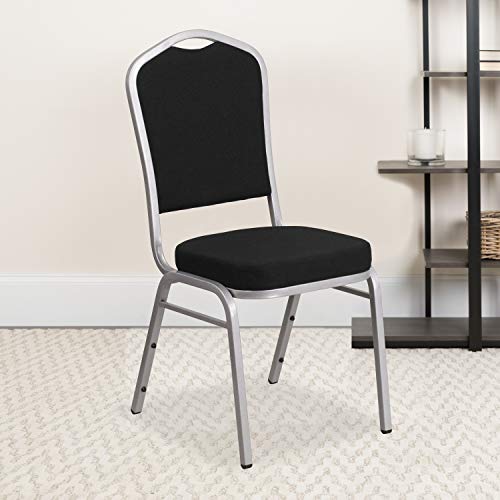
EMMA + OLIVER Crown Back Stacking Banquet Chair — Bright-frame crown
The second crown back in the guide makes the opposite frame choice from the first: fabric in black over a silver frame, where the HERCULES crown pairs its fabric with gold vein. Silver reads cooler and brighter, suiting rooms with chrome, glass and daylight — the modern wedding barn, the gallery space, the hotel that renovated recently — while gold vein belongs to the warmer, candlelit tradition. Neither is better; they are answers to different rooms, and a venue should choose by holding the frame finish against its own walls rather than against a photograph of someone else’s.
Fabric carries the same terms here as on the other crown back: a softer, quieter, more photographic sit, paid for in extraction cleaning after dining events. The four-pack format and stacking design keep it inside the fleet economy. Where the EMMA + OLIVER earns its distinct place is as the crown option for venues whose palette is cool — and palette coherence is not a frippery in the wedding market, where a chair that fights the room’s scheme appears in every photograph the couple keeps. Readers furnishing dining rooms at home rather than halls will find the domestic echo of this palette question in Best Genuine Leather Media Room Chairs, where finish choices carry the same weight at smaller scale.
One practical note for mixed-temperature rooms: fabric over a silver frame is the combination most likely to look crisp in daylight events — christenings, lunches, afternoon teas — where gold vein can read heavy. Halls whose calendar is daylight-led should weight this pick higher than its evening-focused rivals, and halls that live by candlelight should reverse the judgement with equal confidence.
Daylight deserves more respect in banquet planning than it usually gets, and this chair is the daylight pick. Morning weddings, christening lunches and afternoon award teas happen under windows, where gold finishes can look mustardy and heavy fabrics can look flat. Silver and black stay crisp in that light, and fabric’s matte surface keeps the chairs from glaring in photographs taken with flash at noon. A venue whose diary is evening-led can safely deprioritise all of this; a venue whose diary is daytime-led — garden rooms, conservatories, halls with a wall of glass — should treat the EMMA + OLIVER as a first-choice crown rather than an alternative one, because its palette was effectively designed under the light those rooms run on.
- Format: crown back stacking banquet chair, 4-pack
- Upholstery: fabric in black
- Frame: silver finish
- Brand: EMMA + OLIVER
- Where to buy: the EMMA + OLIVER Crown Back Stacking Banquet Chair listing on Amazon — check price on Amazon
Strengths
- Silver frame suits bright, modern and daylight-led venues.
- Crown back delivers the ceremonial silhouette in a cooler palette.
- Fabric upholstery photographs softly at daytime events.
Trade-offs
- Fabric cleaning costs apply in full after dining events.
- Silver finishes show dark scuffs more than vein finishes do.
- No capacity figure is stated in the title.
Best for: modern, bright venues wanting a crown-back fleet.
Not suited for: warm traditional ballrooms committed to gold tones.
The line-up compared: silhouette, surface and frame
| Chair | Back | Surface | Frame finish |
|---|---|---|---|
| Flash Furniture HERCULES Vinyl Banquet Chair | Trapezoidal | Vinyl | Black |
| Flash Furniture HERCULES Crown Back Banquet Chair | Crown | Fabric | Gold vein |
| Flash Furniture HERCULES Dome Back Banquet Chair | Dome | Vinyl | Black |
| OEF Furnishings Banquet Chairs 4-Pack | Banquet standard | Vinyl | Black |
| BizChair Stacking Banquet Chair | Banquet standard | Vinyl | Silver vein |
| EMMA + OLIVER Crown Back Stacking Banquet Chair | Crown | Fabric | Silver |
Three decisions hide in that table, in order: the silhouette your events photograph best, the surface your cleaning rota can sustain, and the frame finish your room’s palette asks for. Decide them in that order and the specific chair usually chooses itself.
Vinyl or fabric: which upholstery survives hall life better?
Survival means different things to the two materials. Vinyl survives incidents: wine, gravy, wax and mud all leave a vinyl chair within a minute of meeting it, and a decade of incidents costs vinyl only its surface sheen. Fabric survives impressions: it looks and feels richer for longer in gentle use, but each incident leaves a deposit that only extraction fully removes, so its survival depends on the cleaning budget standing behind it. A hall with weekly dining and no extraction contract should choose vinyl and never look back. A wedding venue with monthly events and a cleaning line in every quote can choose fabric and enjoy what it buys. The mistake is choosing fabric’s look on vinyl’s maintenance budget — the most common and most visible error in the whole category.
There is a middle path worth naming: vinyl for the high-incident seats, fabric for the top table and the photograph line. Hirers notice the chairs in the pictures; nobody photographs the back row. A fleet split by prominence lets a venue spend its cleaning budget where the cameras point.
How many banquet chairs does a hall actually need?
Start from tables, not from the room’s theoretical capacity. A round table seats eight to ten; a trestle seats six to eight; multiply by your table count, then add the platform party, the registrar’s table, the two chairs that will be in repair on any given month, and a small reserve for the event that grows. Most halls land fifteen to twenty percent above their seated count, and they land there after learning the hard way. Buy the fleet in four-packs to that number in one order if the budget allows, because batch consistency — same dye lot, same weld jig, same stack profile — is a real asset that dribbled purchases spend without noticing.
Then plan the stack before the chairs arrive: measure the store, decide the stack height your staff can build safely, and mark the floor. A hall that knows its stacks owns its chairs; a hall that improvises storage rents its chairs from chaos at midnight after every event. Venues furnishing club-style seating for a lounge corner of the same building will find the companion thinking in Best Club Chairs, where the arithmetic runs in singles rather than fleets.
How should a venue care for a banquet fleet?
Vinyl chairs want a wipe after every event and a deeper clean monthly, with attention to the seam where seat meets back, the graveyard of crumbs and confetti. Fabric chairs want vacuuming on the room’s rhythm and extraction on the calendar’s — after every dining-heavy month, not after the stain that finally shows. Frames want a termly inspection: feet and glides first, because a missing glide turns a stacking chair into a floor-gouging tool, then welds, then the stacking contact points where finishes wear to bright metal. Vein finishes forgive that wear visually; flat black announces it, which is a cosmetic issue until it becomes a rust issue in a damp store.
Store dry, store stacked as the maker intends, and store the fleet’s paperwork with the fleet: purchase dates, pack counts, the model number where one exists. The venue that can say exactly what it owns, and when it bought it, is the venue whose insurance conversation and reorder conversation both go well.
How should a hall lay out banquet chairs for different events?
The same fleet serves three geometries. Banquet rounds want chairs angled to the table with elbow room to dine — ten chairs around a round built for ten is a squeeze that guests feel by the main course, so seat nine and let the tenth chair live in the reserve stack. Theatre rows for ceremonies and speeches want the opposite discipline: chairs aligned in files with a centre aisle measured for two people walking abreast, and the best silhouettes — crowns, if you own them — in the front files where the photographs live. Cabaret layouts, half-rounds facing a stage, split the difference and punish any chair whose back is too low to see over comfortably in a long show.
Every layout shares one rule: the stack must have a home in the room’s plan, not in its corridor. A stack parked against a fire exit is a layout failure that no chair choice can redeem, and venues should rehearse the midnight reset — chairs stacked, tables folded, floor clear — with the same seriousness as the event itself, because the reset is where fleets age fastest and staff get hurt most often.
What happens to banquet chairs in storage, and how do you prevent it?
Storage is where banquet fleets quietly die. A damp store writes itself onto frames as rust blooming at the stacking contact points, onto vinyl as a tacky bloom, onto fabric as a smell that no extraction fully evicts. The defences are dull and total: store dry, store ventilated, and never stack chairs wet from a wipedown. Dust is the second enemy — a fleet stored uncovered for a summer returns to service grey at the shoulders — and simple covers or even old linen over the stacks pay for themselves in saved cleaning before the season opens.
Stack discipline matters as much as climate. Chairs stacked beyond their intended height lean, and a leaning stack loads the bottom chair’s frame sideways all winter, which is how a fleet develops its first wobble without a single event being held. Build stacks to the height your staff can top safely, split the fleet into more stacks rather than taller ones, and the chairs will come out of storage in the condition they went in — which is the entire, unglamorous secret of fleets that last a decade.
How do you audit a trial pack like a venue professional?
Give the trial pack the worst week you can schedule, not the easiest. Seat it at the event with the reddest wine and the longest speeches. Stack it last, in the dark, by the staff member most tired. Wipe it with the spray the cleaners actually use. Then inspect it the following morning with a notebook: upholstery seams, feet, welds, the finish at every contact point, and the sit itself, which should feel identical to the first morning. A chair that passes a hostile week has told you the truth about its decade; a chair audited gently has told you about its brochure.
Record the audit. Photographs of the contact points before and after, a line about the stack in your real cupboard, a note on the clean — that small file becomes the evidence base for the fleet order and, later, for the reorder. Venues that keep such files buy furniture the way institutions should: on evidence accumulated in their own rooms.
Why does this guide keep returning to the storeroom?
Because the storeroom is where the category’s promises are kept or broken. A banquet chair spends perhaps five percent of its life being sat on, forty percent stacked in the dark, and the rest being moved between the two — yet listings photograph only the five percent. Every durable choice in this guide, from vein finishes that forgive stacking knocks to silhouettes without corners to catch, is really a storeroom choice wearing evening dress. Buyers who internalise that ratio stop asking which chair photographs best and start asking which chair their building can keep — and that second question, asked consistently, is the whole art of furnishing a hall.
What do venues get wrong when buying banquet chairs?
The classic error is buying for the brochure event — the one perfect wedding — and furnishing a decade of ordinary Tuesdays with the consequences: fabric that cannot survive the exam season, silhouettes that fight the room’s other lives. The second error is treating capacity as a vibe. If your venue’s paperwork needs a number, buy the chair that states one, or obtain figures from sellers in writing; do not let a confident salesperson’s verbal estimate become your documentation. The third error is the storeroom surprise: fleets bought before storage is measured, stacked thereafter in corridors where they age in public view and in everybody’s way.
Smaller errors compound quietly. Mixing silhouettes without a plan makes every event look borrowed. Skipping the trial pack saves a week and costs a decade. And forgetting the top-up route — the single chair that keeps a fleet whole — turns every breakage into a visible gap that hirers photograph and mention. Banquet furniture is a system; buy the system, not the chair.
How should hirers and venue managers talk about chairs before an event?
Most chair disappointments are expectation failures agreed weeks earlier. A hirer imagining hotel ballroom seating who meets honest hall vinyl will feel let down by chairs that are, in themselves, perfectly good — and the venue will carry the blame for a mismatch it never discussed. The fix is a two-minute conversation at booking: what the fleet is, what it looks like dressed with the venue’s linen, and what the upgrade paths are if the hirer wants more ceremony — chair covers, the crown-back section, a different layout. Photographs of your own chairs in your own room, dressed for a real event, settle more arguments than any specification sheet, and they cost one afternoon to make.
Managers should also be candid about counts. A fleet number quoted from memory — “about a hundred” — becomes ninety-one on the day, with nine guests standing. Count the fleet termly, retire the wounded honestly, and quote the number you counted. In the hall business, an accurate chair count is a quiet form of hospitality.
What does the banquet chair market’s sameness tell a buyer?
Notice how alike this guide’s six picks are: black upholstery, metal frames, four-packs, three silhouettes. That sameness is not a failure of imagination; it is the market converging on what a decade of hall life actually rewards. Exotic banquet chairs exist — colours, sculptural frames, novelty materials — and they mostly serve venues with one room, one look and a short planning horizon. The standardised class endures because halls are businesses with storerooms, and standardisation is what storerooms eat. A buyer should therefore spend their discernment not on escaping the standard but on executing it well: the right silhouette for their photographs, the right surface for their cleaning reality, the right finish for their palette, and a supplier whose line will still exist at reorder time. Within those four decisions, this guide’s six chairs cover the sensible ground almost completely.
How do chairs and tables need to be planned together?
A banquet chair never works alone; it works at a table, and the pairing has rules of thumb worth stating. Chair count per table was covered earlier, but height and clearance matter as much: a banquet chair must slide under the table’s edge or apron without its back striking the rim, and guests’ knees need the space the table legs allow, which is why trestle tables with legs at the ends seat more comfortably than those with legs at the corners. When a venue replaces tables, the fleet should be test-seated at the new table before the order completes — a chair that fitted the old table’s apron may jam against the new one, and the discovery belongs in the showroom, not at the first wedding.
Colour planning runs through the pairing too. Black chairs around pale linen read as contrast and ceremony; black chairs around black cloth disappear, which some events want and others find funereal. The chair fleet is the constant in a room whose dressing changes weekly, so choose the fleet for neutrality — as the trapezoidal pick embodies — and let linen, lighting and flowers carry each event’s personality. Furniture that insists on being noticed at every event will eventually be noticed for the wrong event.
What should a small venue with a tiny budget do first?
Start smaller than pride suggests and standardise ruthlessly. A community hall with funds for forty chairs should buy forty of one chair — the trapezoidal vinyl workhorse is built for exactly this station — rather than twenty-eight of a prettier chair plus a dozen borrowed mismatches that make every event look improvised. Uniformity reads as professionalism at any budget, and a single-model fleet keeps stacking, cleaning and reordering simple for the volunteers who actually run small venues. Grow the fleet in the same model as funds allow, top up losses with singles where the format allows, and resist the donated-chairs trap: free chairs that match nothing cost more in appearance and storage chaos than they save in cash. The one upgrade worth saving for, once the base fleet is uniform, is a small crown-back section for top tables — prominence seating is where a modest venue buys the most ceremony per chair.
How long does a banquet fleet realistically last, and what ends it?
In a busy hired hall, plan on a working life measured in high single-digit years for the fleet as a whole, with individual chairs leaving service throughout — the fleet is a population, not a cohort, and it should be managed by continuous small retirements and top-ups rather than by one grand replacement. What ends a chair’s life is rarely a dramatic collapse; it is the accumulation audited earlier — a wobble that will not tighten, a seam split at the guest-contact edge, a finish worn to rust-prone metal in a damp store, a cushion gone board-flat. Venues that inspect termly catch chairs at the retirement line while they are still safe; venues that inspect never discover the line at an event, in front of the people paying for the room. Build the inspection into the calendar, keep the top-up route warm, and the fleet’s age becomes a statistic rather than a risk.
Final Recommendation
Most halls should build on the trapezoidal HERCULES vinyl four-pack: neutral, wipe-clean, arithmetically convenient, and dull in exactly the way infrastructure should be. Venues that must document capacity start with the dome-back and its stated figure. Wedding-led rooms choose between the two crowns by palette — gold vein for candlelight, silver for daylight — and budget the fabric cleaning either way. Keep the OEF pack as the credible second source, the BizChair single as the fleet’s spare part, and the whole fleet will still be earning its storage corner long after the first brochure event is forgotten.
Frequently Asked Questions
Which of these chairs has a stated weight capacity?
Only the Flash Furniture HERCULES Dome Back pick states one in its title: 500 LBS, quoted here as the seller’s wording for that chair alone, and repeated nowhere else in this guide precisely because no other seller here chose to publish a figure alongside its chair’s name. The other five titles give no figure, and this guide claims none for them; ask sellers directly, in writing, if your venue needs numbers for the rest.
Are banquet chairs and church chairs the same thing?
They overlap in the wild but not in this guide, and the distinction matters when a listing’s photograph could belong to either family at a glance. Church chairs are typically wider, book-pocketed and sold for sanctuary rows; banquet chairs carry the trapezoidal, crown or dome silhouettes above and stack for hall resets. Search results mix the two freely, so check the silhouette before assuming a listing belongs to your hall.
How many chairs come in a pack?
Five of the six picks are sold in four-packs. The exception is the BizChair chair, sold singly — useful for topping up a fleet or trialling the class, inefficient for furnishing a whole hall. When comparing pack prices, divide by four and compare per chair, because headline prices across different pack counts mislead more buyers in this category than any other single habit, and a fleet decision deserves arithmetic done on equal terms.
Is vinyl or fabric better for a wedding venue?
Fabric photographs richer and feels more ceremonial, which is why both crown-back picks use it; vinyl cleans in seconds, which is why the workhorse picks use it, and why so many experienced venue managers quietly prefer it for everything except the top table, where the cameras concentrate and the extra ceremony of fabric earns its cleaning bill. Wedding venues with cleaning budgeted per event can enjoy fabric; venues without should choose vinyl and dress it with linen and lighting.
What frame finish hides wear best?
Vein finishes — gold vein and silver vein here — disguise the bright scratches and scuffs that stacking writes onto frames, because their flecked pattern breaks up the eye’s reading of damage. Flat black looks sharpest when new and shows its biography soonest. The practical consequence is a cleaning difference too: vein frames can go longer between cosmetic touch-ups without a room looking tired, which matters in venues where staff time is the scarcest resource in the building and every saved hour is an hour spent on the events themselves.
Can these chairs be used outdoors?
They are hall furniture. A dry-weather garden event will not harm them once, but frames, upholstery seams and stacking feet are designed for indoor floors and indoor storage, and a season of outdoor life will age them years ahead of schedule. If a garden event is on the calendar, budget the chairs a thorough dry-out and inspection before they return to the stack, because damp stored in upholstery seams is how an outdoor afternoon becomes a storeroom problem.
Related Guides
For the larger communal tables these chairs so often surround at canteen-style events and long refectory layouts, the companion reference guide to Best Cafeteria Chairs and Tables covers the table-and-chair pairing from the canteen side of the same communal-seating world entirely.



[…] once for the whole room. Event and dining seating has its own scale logic, which our guide to Best Stackable Banquet Chairs covers for readers planning a gathering rather than a reading […]