What's inside
- Key Takeaways
- Quick Picks
- How Did We Sort the Spits From the Shawarma Machines?
- Two Formats, One Keyword: The Picks in One Table
- Why Does Rotation Cook Meat So Evenly?
- How Do You Truss and Load a Bird on a Horizontal Spit?
- What Should You Cook Beyond Chicken?
- How Do You Keep a Rotisserie Oven Clean Without Dreading It?
- Which Rotisserie Mistakes Spoil the Most Dinners?
- How Much Counter Does Each Format Really Claim?
- What Seasonings and Preparations Suit Rotation Cooking?
- How Do You Carve and Serve From a Spit or a Stack?
- Final Recommendation
- Is a Rotisserie Oven Worth Its Counter Space in a Small Kitchen?
- What Safety Habits Matter With a Turning, Dripping Machine?
- How Long Do These Machines Last, and What Wears Out?
- Frequently Asked Questions
- Horizontal or Vertical: A Decision in Three Questions
- What Should You Serve With Rotisserie Meat?
- What Does a Rotisserie Do to a Household’s Cooking Habits?
- What About Cooking for Guests, and the Theatre of the Turning Roast?
- How Should a First-Time Buyer Run the First Cook?
- Related Guides
As an Amazon Associate I earn from qualifying purchases. This post may contain affiliate links at no extra cost to you.
cottageverdict.com is reader-supported. When you buy through links on our site, we may earn an affiliate commission.
Where to buy: All six machines below are sold through their Amazon listings — follow the links in the Quick Picks table or in each review to check price on Amazon, and confirm the included accessories on the listing before ordering.
The best countertop rotisserie ovens divide cleanly into two tribes, and knowing which tribe you are shopping for saves every later confusion. The first tribe is the horizontal spit: a bird or roast skewered on a rod, turning slowly in front of a heating element, basting itself as it rotates — this is the Ronco design, and three generations of it anchor this guide. The second tribe is the vertical oven: food arranged upright around a central heat source, in the shawarma and kebab tradition, turning or standing in a tall glass or steel chamber — the NutriChef pair and the RareDot live here. Both tribes promise the same reward, meat that cooks evenly on every side without you standing over it, but they suit different foods, different counters, and different cooks. One capacity figure needs honest handling from the start: the 12-lb capacity quoted in this guide comes from the Ronco titles only, and it is stated only for those three machines. Skewer counts likewise appear only where a title states them — the RareDot’s kebab rack with 7 skewers. Everything else is reported as its maker states it, no more.
Key Takeaways
- Horizontal spit machines (the three Roncos) and vertical shawarma-style ovens (NutriChef, RareDot) are different formats sharing one keyword.
- The 12-lb capacity is quoted from the Ronco titles only and is not claimed for the vertical picks.
- All three Roncos state the same three functions — rotisserie, sear, and no-heat rotation — with a basket included and auto shutoff.
- The RareDot is the specification leader among the verticals: 1800W, 22QT, 500°F, a 90-minute timer, and a kebab rack with 7 skewers, all in its title.
- The NutriChef 24 Qt is the only pick whose title states dimensions: 13.4 x 12.2 x 18.9.
- Vertical ovens earn their keep on kebabs, shawarma-style stacks, and broiling as much as on whole birds.
Quick Picks
| Rotisserie oven | Badge | Why it belongs here |
|---|---|---|
| Ronco 5500 Series Rotisserie Oven (Stainless) | Stainless Horizontal | The 5500 series in stainless with the stated 12-lb capacity, three functions, basket, and auto shutoff. |
| Ronco 6000 Platinum Digital Rotisserie Oven | Digital Flagship | The 6000 Platinum digital model, carrying the same stated capacity and function set in Ronco’s digital line. |
| Ronco 5000 Platinum Digital Rotisserie Oven | Digital Alternative | The 5000 Platinum digital model — the third Ronco, for buyers comparing within the digital family. |
| NutriChef Vertical Countertop Oven With Rotisserie (1500W) | Vertical All-Rounder | A 1500W vertical oven with rotisserie, bake, broil, and kebab rack functions, two shelves, grill, skewer racks, and a bake pan. |
| NutriChef Multi-Function Rotisserie Oven (24 Qt) | Glass-Door Vertical | A 24 quart vertical glass door convection oven for rotisserie roasting and broiling, with timer and temperature control and stated dimensions. |
| RareDot Vertical Rotisserie Oven (1800W) | Shawarma Specialist | An 1800W vertical machine for shawarma, kebab, and rotisserie, 22QT, 500°F, 90-minute timer, and a kebab rack with 7 skewers. |
How Did We Sort the Spits From the Shawarma Machines?
We began, as always in this batch, with verified listings only, each pick matched to its maker’s title and image. Then we sorted by geometry before judging anything else, because a horizontal spit and a vertical chamber are answers to different questions: the spit turns a whole bird or roast past the heat, while the vertical format stacks or hangs food around a central element in the kebab tradition. Within the horizontal tribe, the honest complication is that Ronco’s three models state nearly identical core facts — 12-lb capacity, three functions, basket included, auto shutoff — so this guide differentiates them by what genuinely differs: series, finish, and digital versus standard presentation as their titles present them, without inventing feature gaps the titles do not support. Within the vertical tribe, the titles diverge more helpfully, stating wattage, capacity, a temperature ceiling, timers, dimensions, and skewer counts in different combinations, and those stated facts drive the individual reviews. A last discipline: capacities and counts are never borrowed across models, even within one brand. Readers planning serious outdoor-adjacent roasting sometimes compare this field with Best Commercial Deck Ovens for larger-format cooking, and the contrast clarifies what a countertop rotisserie is — a specialist for turning meat, not a general oven.

Ronco 5500 Series Rotisserie Oven (Stainless) — Stainless Horizontal
The Ronco 5500 is the horizontal format in its mature form: a countertop rotisserie oven in stainless, with a stated 12-lb capacity, three functions — rotisserie, sear, and no-heat rotation — a basket included, and auto shutoff. Each element of that sentence earns its place. The 12-lb capacity, stated in the title, covers the chickens, small turkeys, and roasts that make up real rotisserie cooking, with room for the bird to turn freely. The sear function addresses the format’s classic weakness — meat that cooks evenly but colours late — by letting you finish or start with direct intensity. No-heat rotation is the quiet genius: the spit keeps turning without cooking, so a finished bird rests and bastes in its own juices rather than sitting in a puddle on one side.
The included basket widens the machine beyond whole birds: vegetables, fish, and smaller cuts that cannot be skewered ride in the basket and turn with the same self-basting logic. Auto shutoff is the safety and sanity feature that lets a rotisserie be a background appliance — set the cook going, leave the kitchen, and trust the machine to stop rather than scorch. The stainless finish suits kitchens where the machine will live visibly on the counter, which, given its size, it will. For the buyer who wants the classic Ronco experience in its cleanest current form, the 5500 is the reference pick of this guide.
Think about who cooks on this machine across a year: the Sunday roaster, certainly, but also the holiday second-oven strategist, who runs a small turkey or a second bird on the counter while the main oven is occupied by everything else. Rotisseries earn disproportionate love at holidays precisely because they add a parallel cooking track that needs no supervision. The 5500’s stated capacity and shutoff make it the natural assignee of that duty in this guide — set it turning in the morning and reclaim both your oven and your attention for the rest of the feast.
- Format: horizontal countertop rotisserie oven, Stainless as listed
- Stated capacity: 12-lb per the listing title
- Functions per title: rotisserie, sear, no-heat rotation; basket included; auto shutoff
- Where to buy: the Ronco 5500 Series Rotisserie Oven (Stainless) listing on Amazon — check price on Amazon
Strengths
- Stated capacity covers real family birds and roasts.
- No-heat rotation rests and bastes a finished cook.
- Basket extends it beyond skewerable foods.
Trade-offs
- Horizontal format claims a wide counter footprint.
- Single-purpose machine — it does not pretend to be an oven range.
- Drip management is part of every rotisserie cleanup.
Best for: the classic rotisserie cook roasting whole birds weekly. Not suited for: kebab and shawarma cooking, which belongs to the vertical tribe.

Ronco 6000 Platinum Digital Rotisserie Oven — Digital Flagship
The 6000 Platinum Digital carries the same stated core as the 5500 — 12-lb capacity, the three functions of rotisserie, sear, and no-heat rotation, basket included, auto shutoff — and presents it in Ronco’s digital line, as its title announces. The honest way to read the 6000 is as the flagship presentation of a proven formula: the cooking physics are the format’s, refined over decades, and the digital interface is the differentiator for cooks who prefer programmed, repeatable settings over dial estimation. A household that roasts the same Sunday chicken to the same finish will feel that difference weekly, because repeatability is what digital control actually sells.
Because the titles of the three Roncos converge so closely, this guide resists inventing a hierarchy of cooking performance among them. What can be said is structural: the 6000 sits at the top of the numbered series in this pool, wears the Platinum name, and is the natural first look for a buyer who wants the Ronco format with its most current presentation. Confirm the control details and the exact included pieces on the listing, as with every pick here, and let your preference for digital versus standard controls — a real, daily, tactile preference — make the final call between the 6000, the 5000, and the 5500.
Digital control also changes the household politics of the roast: a programmed cook is a delegable cook. The person who perfected the Sunday chicken can hand the task to anyone in the house, because the settings, not the judgement, carry the recipe. Families with a rotating cast of cooks — teenagers learning, partners alternating — get more from that repeatability than from any marginal difference in hardware. That is the 6000’s quiet case, and for the right household it is a strong one.
- Format: horizontal countertop rotisserie oven, Platinum Digital
- Stated capacity: 12-lb per the listing title
- Functions per title: rotisserie, sear, no-heat rotation; basket included; auto shutoff
- Where to buy: the Ronco 6000 Platinum Digital Rotisserie Oven listing on Amazon — check price on Amazon
Strengths
- Digital presentation suits repeatable, programmed cooks.
- Same stated capacity and function set as the series reference.
- Top of the numbered Ronco series in this pool.
Trade-offs
- Core stated facts match its siblings, so the premium is presentational.
- Digital controls add electronics to a mechanically simple format.
- Same wide horizontal footprint as the other Roncos.
Best for: cooks who roast on a repeatable weekly programme. A poor fit for: buyers who prefer the simplest possible dial-and-go machine.
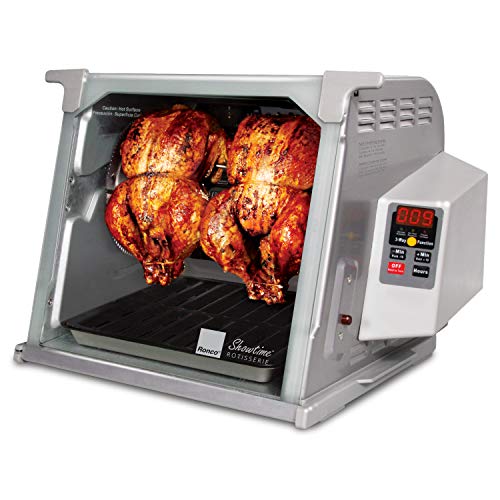
Ronco 5000 Platinum Digital Rotisserie Oven — Digital Alternative
The 5000 Platinum Digital is the third Ronco in the pool, and its title states the same trusted core: 12-lb capacity, rotisserie, sear, and no-heat rotation, basket included, auto shutoff. Its presence in this guide is not padding — it is the comparison point that lets a digital-preferring buyer choose within the family, and in a category where one brand defines the horizontal format, comparing that brand’s own tiers is the real shopping task. The 5000’s argument is positioning: the Platinum digital experience at the series’ middle rung, for the buyer who wants the interface style without automatically taking the flagship.
Practically, the decision between the 5000 and 6000 should be made on the listing pages, where the current configurations, included pieces, and terms can be compared directly, since their titles state the same cooking core. What this guide can certify is that the format underneath both is the proven one — the turning spit, the self-basting geometry, the basket for the unskewerable, the shutoff for peace of mind. A buyer who picks the 5000 for its place in the range is not buying a lesser roast; they are buying the same roast with a different badge and control presentation, and that is a perfectly rational way to shop a mature product line.
There is also a spare-parts-and-longevity angle to buying the middle of a famous line: models in a long-running family tend to remain listed, supported, and understood by a large owner community, whose collective knowledge — trussing tricks, basket hacks, cleaning routines — is a real asset that anonymous machines cannot offer. The 5000 sits inside that community as fully as the flagship does. For a buyer who values the ecosystem as much as the appliance, the middle rung is not a compromise at all.
- Format: horizontal countertop rotisserie oven, Platinum Digital
- Stated capacity: 12-lb per the listing title
- Functions per title: rotisserie, sear, no-heat rotation; basket included; auto shutoff
- Where to buy: the Ronco 5000 Platinum Digital Rotisserie Oven listing on Amazon — check price on Amazon
Strengths
- Full stated Ronco function set in the digital line.
- Lets buyers choose their tier within a proven family.
- Basket and auto shutoff included per the title.
Trade-offs
- Title facts duplicate the 6000, so comparison needs the listings.
- Not the series flagship, if top-of-range matters to you.
- Horizontal footprint, like all three Roncos.
Best for: digital-control buyers choosing deliberately within the Ronco range. Not the right match for: buyers who want the flagship model by default.

NutriChef Vertical Countertop Oven With Rotisserie (1500W) — Vertical All-Rounder
Crossing to the vertical tribe, the NutriChef 1500W machine presents itself as a small cooking station rather than a single-trick spit: a vertical countertop oven with rotisserie, bake, broil, and kebab rack functions, adjustable settings, 2 shelves, and a box that includes a grill, kebab skewer racks, and a bake pan, with Thanksgiving turkey named among its ambitions. The vertical geometry is the story — food stands or hangs in a tall chamber, fat drips away downward, and the counter footprint shrinks to a tower’s rather than a horizontal oven’s sprawl. For kebabs, that geometry is not a compromise but the authentic format, and the included skewer racks put it to work immediately.
The bake and broil functions matter because they free the vertical buyer from single-purpose guilt: this machine can run a tray bake or broil a topping on the days when nothing needs to rotate. Two shelves reinforce that generalist brief. The 1500W figure, stated in the title, is the only power number among the verticals until the RareDot, and it frames the machine as a full-strength countertop oven rather than a novelty. The turkey mention should be read as the maker’s framing of its capacity ambitions; this guide states no weight capacity for it, because its title states none — check the listing’s dimensions against your bird before a holiday depends on it.
The two-shelf arrangement deserves one more thought, because it changes the vertical machine from a meat tower into a small oven system: a main dish rotating or roasting while a tray of vegetables or flatbreads takes the second level is a complete dinner from one appliance and one footprint. Households cooking for two will feel that completeness most — the machine stops being the kebab gadget and becomes Tuesday’s oven. That breadth is why this NutriChef, rather than a purer single-function tower, anchors the middle of the vertical half.
- Format: vertical countertop oven with rotisserie, 1500W per the title
- Functions per title: rotisserie, bake, broil, kebab rack; adjustable settings; 2 shelves
- Included per title: grill, kebab skewer racks, bake pan
- Capacity: not stated in the listing title — verify on the listing
- Where to buy: the NutriChef Vertical Countertop Oven With Rotisserie (1500W) listing on Amazon — check price on Amazon
Strengths
- Vertical footprint suits narrow counters.
- Bake and broil functions broaden it beyond rotation.
- Generous included kit: grill, skewer racks, and bake pan.
Trade-offs
- No stated weight capacity in the title for large birds.
- Vertical format cooks differently from the classic spit.
- Tall chamber needs overhead clearance on the counter.
Best for: kebab lovers and narrow kitchens wanting one vertical station. Poorly suited to: traditionalists who want the horizontal spit ritual.

NutriChef Multi-Function Rotisserie Oven (24 Qt) — Glass-Door Vertical
The second NutriChef takes a different vertical route: a multi-function rotisserie countertop oven of 24 quarts, a vertical glass door convection oven for rotisserie roasting and broiling, with timer and temperature control, and — uniquely in this guide — stated dimensions of 13.4 x 12.2 x 18.9. Those dimensions are a gift to the careful buyer: you can measure your counter and your under-cabinet height against real numbers before ordering, a courtesy no other title in this pool extends. The glass door brings the visibility that rotisserie cooks love, the same watch-it-brown pleasure as the horizontal machines’ viewing windows, applied to a vertical chamber.
At 24 quarts, this is the largest stated capacity among the verticals, though quarts in a vertical convection chamber and pounds on a horizontal spit are not interchangeable measures, and this guide keeps them in their own terms. Timer and temperature control, both named, give it the set-and-monitor rhythm that rotisserie cooking rewards, since the format’s whole appeal is even cooking without attendance. Consider this the vertical pick for the measurement-minded: the buyer who plans the counter first and the menu second, and who wants convection and broiling sharing the chamber with the rotisserie rather than a pure single-purpose tower.
The convection element in its description matters for the broiling half of its life: moving air in a vertical chamber evens out the hot spots that a static vertical element would leave, so a tray of vegetables or a gratin finishes uniformly instead of in stripes. That makes this the vertical pick for cooks whose menu is only partly rotisserie — people who want the roasting and broiling of a small convection oven and the rotation when the dish calls for it, in one measured, glass-fronted box.
- Format: vertical glass door convection oven, 24 Quart
- Stated dimensions: 13.4 x 12.2 x 18.9 per the listing title
- Controls per title: timer and temperature control
- Uses per title: rotisserie roasting and broiling
- Where to buy: the NutriChef Multi-Function Rotisserie Oven (24 Qt) listing on Amazon — check price on Amazon
Strengths
- Only pick with dimensions stated in its title.
- Largest stated vertical capacity at 24 quarts.
- Glass door keeps the cook visible throughout.
Trade-offs
- No stated wattage or temperature ceiling in the title.
- Quarts do not translate directly to bird weight.
- Vertical geometry will not mimic a horizontal spit’s basting exactly.
Best for: planners who measure first and cook varied vertical roasts. A weak match for: buyers who need a stated bird-weight capacity before committing.

RareDot Vertical Rotisserie Oven (1800W) — Shawarma Specialist
The RareDot states its intentions in its name for the machine: a vertical rotisserie oven for shawarma, kebab, and rotisserie cooking, and then it backs the intention with the fullest specification among the verticals — 1800W, 22QT, 500°F, a 90-minute timer with auto shut-off, a kebab rack with 7 skewers, stainless steel construction, stain-resistant surfaces, and dishwasher-safe parts. That is a serious spec sheet for the vertical format. The 1800W makes it the most powerful stated machine in this guide; the 500°F ceiling, the only temperature maximum stated among all six, signals genuine searing intent for shawarma edges and kebab char; and the 7 skewers, the only skewer count stated anywhere here, turn kebab night from an improvisation into a system.
The dishwasher-safe parts and stain-resistant framing address the vertical format’s honest weakness — these machines collect drippings by design, and cleanup decides whether they get used weekly or monthly. Ninety minutes on the timer covers the format’s real cooks with headroom. If your rotisserie ambitions run through the kebab-and-shawarma tradition rather than the Sunday-chicken one, the RareDot is not merely an option in this guide; it is the point of the vertical half of it, and its specification discipline — every number stated, nothing implied — is how all six should have been listed.
Picture the shawarma cook this machine is built for: a seasoned stack turning slowly, the outer layer crisping toward the stated high ceiling, slices carved off in ribbons as they finish while the next layer begins its turn at the heat. That rhythm — carve, serve, repeat — is a style of eating as much as cooking, built for gatherings that graze rather than sit. No horizontal spit performs it, which is why the vertical tradition exists, and the RareDot’s stated power and temperature are exactly the numbers that style of cooking asks for.
- Format: vertical rotisserie oven — shawarma, kebab and rotisserie machine, Stainless Steel
- Stated figures: 1800W; 22QT; 500°F; 90-minute timer and auto shut-off
- Kebab rack with 7 skewers per the listing title
- Care per title: stain-resistant, dishwasher-safe parts
- Where to buy: the RareDot Vertical Rotisserie Oven (1800W) listing on Amazon — check price on Amazon
Strengths
- Fullest stated specification among the vertical picks.
- Highest stated power and the only stated temperature ceiling.
- Dishwasher-safe parts ease the format’s cleanup burden.
Trade-offs
- Shawarma-first design is specialised for the vertical tradition.
- No stated whole-bird weight capacity in the title.
- Less established name than the Ronco and NutriChef lines.
Best for: shawarma and kebab households wanting stated power and a real skewer system. Not suited for: cooks whose rotisserie world begins and ends with a horizontal chicken.
Two Formats, One Keyword: The Picks in One Table
| Machine | Format | Stated capacity | Signature stated fact |
|---|---|---|---|
| Ronco 5500 | Horizontal spit | 12-lb | Stainless; basket included |
| Ronco 6000 | Horizontal spit | 12-lb | Platinum Digital presentation |
| Ronco 5000 | Horizontal spit | 12-lb | Platinum Digital, mid-series |
| NutriChef Vertical 1500W | Vertical | Not in title | Bake, broil, kebab rack; 2 shelves |
| NutriChef 24 Qt | Vertical | 24 Quart | Dimensions stated in title |
| RareDot 1800W | Vertical | 22QT | 500°F ceiling; 7 skewers |
Why Does Rotation Cook Meat So Evenly?
A static roast has a hot side and a cool side, a top that browns and a bottom that sits in its juices; the cook compensates by turning, basting, and guessing. Rotation removes the compensation. On a horizontal spit, every surface takes its turn facing the element and its turn facing away, so heat averages out over the cook, and the juices, instead of pooling underneath, are carried around the surface as the meat turns — the self-basting that rotisserie devotees describe is simply gravity and rotation conspiring kindly. The no-heat rotation on the Roncos extends the same logic into the rest, letting a finished bird keep turning gently so its juices redistribute instead of draining to the lowest point. Vertical machines apply the principle differently — the food turns or stands around a central heat — but the promise is identical: evenness without attendance. It is an old idea, older than electricity, and the countertop machines in this guide are its domesticated form. Cooks who insulate and rest meats carefully will recognise the same patience at work in very different gear, the way outdoor cooks swear by Best Lightweight Hammock Underquilts for holding warmth where it belongs — different craft, same respect for where heat goes.
How Do You Truss and Load a Bird on a Horizontal Spit?
The ritual is simpler than its reputation. Season the bird inside and out, then truss it firmly — wings tucked, legs tied — because a flopping wing on a rotating spit will catch, tear, and cook unevenly. Slide the spit rod through the cavity’s centre of balance, not merely its centre of geometry: a bird that hangs heavy on one side will labour the motor and turn in lurches. Fix the forks tightly at both ends, then turn the loaded spit by hand once before it goes into the machine, feeling for balance and clearance. Centre the drip arrangements the machine provides, set the cook, and let rotation do what hands cannot. When the bird is done, the no-heat rotation, where your model offers it, is the resting phase — a few turning minutes that settle the juices before carving. Vertical loading is its own craft: skewers loaded evenly, stacks built level, nothing touching the element, and the same respect for balance in a different orientation.
What Should You Cook Beyond Chicken?
Chicken is the gateway, not the boundary. On the horizontal spits, pork loin and beef roasts take beautifully to rotation, leg of lamb is a classic of the format, and the included Ronco basket opens the door to vegetables, fish, and sausages that cannot be skewered. In the vertical machines, the repertoire tilts toward the kebab tradition — skewered meats and vegetables on the RareDot’s stated 7 skewers or the NutriChef’s included racks, shawarma-style stacked meats carved in ribbons, and whole vegetables broiled in the rising heat. Both tribes reward the cook who thinks in terms of surface and rotation: foods that benefit from all-over exposure, that baste themselves or char at the edges, that forgive a set-and-monitor rhythm. Delicate, sauced, or battered foods belong to other appliances, and a rotisserie earns its counter honestly by specialising in the rest.
How Do You Keep a Rotisserie Oven Clean Without Dreading It?
Rotisserie cooking is drip cooking, and the machines that get used are the ones whose drips are managed by design and by habit. Line and empty the drip arrangements the machine provides, every cook, before residue bakes into permanence. Wipe the interior while it is warm, not hot, with the machine unplugged. Treasure the RareDot’s dishwasher-safe parts if that is your machine, and treat every removable spit, fork, and basket as the soakable hardware it is. The glass door of the NutriChef 24 Qt and the viewing surfaces of the Roncos repay a quick polish, because a rotisserie you cannot see into loses half its pleasure. None of this is heavy labour; it is five minutes of routine standing between you and a machine that stays pleasant for years, rather than becoming the greasy cupboard tenant every category eventually produces.
Which Rotisserie Mistakes Spoil the Most Dinners?
- Skipping the truss. An untrussed bird flops, tears, and cooks in lurches; two minutes with string is the cheapest insurance in this guide.
- Loading off-balance. A spit loaded by geometry instead of balance strains the motor and turns unevenly — test the turn by hand first.
- Borrowing capacities across models. The 12-lb figure belongs to the Ronco titles; do not plan a vertical machine’s holiday bird around another brand’s number.
- Crowding skewers. Kebabs packed tight steam instead of charring; space is a cooking ingredient in the vertical format.
- Carving immediately. Rotation bastes the surface, but the interior still needs its rest — use the no-heat turn or a tented board.
- Letting drips bake on. Yesterday’s residue is tomorrow’s smoke and smell; the five-minute wipe is non-negotiable.
How Much Counter Does Each Format Really Claim?
Only one title in this pool states dimensions — the NutriChef 24 Qt at 13.4 x 12.2 x 18.9 — and that single act of honesty should discipline how you shop the other five: measure first, from the listings, before anything ships. The horizontal Roncos claim width: a bird turning on a spit needs a long chamber, and the machine will occupy a stretch of counter comparable to a large microwave, with clearance for its heat and for loading the spit from the front. The verticals claim height instead: towers that fit a narrower footprint but must clear the underside of your wall cabinets, with room above for steam and heat to escape when the door opens. Depth matters too, since a machine pushed flush to the splashback leaves no room for cords or ventilation. The practical exercise takes two minutes with a tape measure and saves the most common countertop-appliance regret in any category — the machine that fits the counter but not the kitchen, exiled to a cupboard where specialised appliances go to be forgotten.
What Seasonings and Preparations Suit Rotation Cooking?
Rotation rewards dry, assertive seasoning. Rubs cling and crust as the surface turns through the heat, building the bark that rotisserie meat is judged by; wet marinades, by contrast, drip away into the tray before they can work, so marinated meats should be patted dry and their marinades converted into a finishing sauce or a baste applied late. Salt early — a dry brine overnight transforms a chicken more than any gadget setting — and keep sugary glazes for the final minutes, because a turning surface under steady heat will take a sweet glaze from glossy to burnt while you are in the other room. In the vertical machines, the same logic shapes the shawarma stack: spices layered between the slices so every carved ribbon carries seasoning through, not just on its surface. Herbs belong inside cavities and under skins, where rotation’s juices will distribute them. None of this requires special equipment beyond the machines themselves, which is the format’s charm: the technique is old, the seasoning wisdom is older, and the countertop box simply makes both a weeknight possibility.
How Do You Carve and Serve From a Spit or a Stack?
Carving is the final skill, and it begins before the machine stops: rest the meat, using the Roncos’ no-heat rotation if your model offers it, or a tented board if it does not, because juices that stay in the meat are the entire point of the exercise. For a spit-roasted bird, slide it off the rod onto a board with a well to catch the juices, remove the forks, and carve in the ordinary way, saving every spoonful of the drippings for the sauce or the vegetables. For kebabs, the skewers come to the table or the board hot and are stripped with a fork in one motion. For shawarma from the RareDot, the carving is the cooking: slice the crisped outer layer in ribbons with a long knife as it finishes, return the stack to the heat, and repeat in rounds, so each serving carries both crisp edges and juicy interior. However you carve, warm plates and a rested meat are the difference between a good rotisserie dinner and the one people describe to friends the next day.
Final Recommendation
Choose your tribe first. For the classic horizontal ritual — a whole bird turning on a spit, self-basting, with a basket for the extras — the Ronco line is the format’s own history, and the choice among the 5500 in stainless, the 6000 Platinum Digital, and the 5000 Platinum Digital is a choice of finish and control style over an identical stated cooking core: 12-lb capacity, rotisserie, sear, and no-heat rotation, basket included, auto shutoff. For the vertical tradition, the RareDot is the specification-led pick for shawarma and kebab households, the NutriChef 1500W is the all-round vertical station with bake and broil aboard, and the NutriChef 24 Qt is the planner’s choice with its stated dimensions and glass door. Whichever tribe you join, truss carefully, balance honestly, and give the meat its rest — because the first time you carve a bird that turned itself to an even mahogany while you were in another room entirely, you will understand that a rotisserie is not a novelty appliance but the oldest cooking idea in the world, finally sized for a countertop.
Is a Rotisserie Oven Worth Its Counter Space in a Small Kitchen?
The sceptical case is real: a rotisserie is a specialist, and specialists must earn permanent counter in a way a general oven never has to. The earning test is frequency. A household that roasts a chicken most weeks, or runs kebabs through the summer, will use the machine more than most appliances it owns, and its unattended rhythm returns time as well as dinner. A household that roasts monthly is renting counter space to an occasional pleasure and should think harder — or choose the vertical format, whose tower footprint is the smaller imposition, or accept that the holiday-hero role alone justifies a cupboard exile between feasts. There is no universal answer, but there is an honest question: count last month’s roasts. The number, whatever it is, is the argument, and both a yes and a no arrived at that way will still look right in a year.
What Safety Habits Matter With a Turning, Dripping Machine?
Rotisseries combine three things that deserve respect: sustained heat, moving parts, and hot fat. The habits follow from the list. Keep the machine on a stable, heat-tolerant surface with its vents unblocked, and never under a low cabinet that traps its rising heat. Load and unload with mitts and with the machine’s own tools, remembering that a loaded spit is a hot, heavy, awkward object with a point at one end. Manage the drip tray before it overflows rather than after, and keep cords clear of the fat’s path. Use the auto shutoff features the titles advertise as a backstop, not a strategy — the cook’s attention is the primary safety system, and the machines’ timers are its deputy. Children should treat a working rotisserie like a working stove, because that is what it is. None of this is burdensome; it is the ordinary respect due to fire in a box, and households that build the habits find the machines relaxing rather than worrying — which is rather the point of an appliance designed to cook while you do something else.
How Long Do These Machines Last, and What Wears Out?
The format is mechanically simple — a heating element, a motor turning at a stately pace, a chamber — and simple machines age gracefully when their one enemy, baked-on fat, is kept at bay. Motors and elements are the long-lived organs; the parts that suffer are the removable ones, spits, forks, baskets, and trays, which is another argument for buying inside a known line like Ronco’s, where the ecosystem of a long-running family surrounds the machine, or for choosing the RareDot’s dishwasher-safe parts if your tolerance for hand-washing small hardware is low. Glass doors craze only under abuse; stainless chambers, like the RareDot’s and the 5500’s finish, shrug off years. The realistic lifespan conversation is therefore about care, not engineering: a wiped-down rotisserie is a decade appliance, and a neglected one is a smoky regret within two winters. Buy the machine whose cleanup you will actually perform, and the longevity takes care of itself.
Frequently Asked Questions
How big a chicken fits these machines?
For the three Roncos, the titles state a 12-lb capacity, which frames the size of bird or roast the spit is built to turn. The vertical picks state capacities in quarts or not at all, so for those, judge by the listing’s dimensions and stated figures rather than borrowing the Ronco number.
What is no-heat rotation for?
It keeps the spit turning after cooking heat stops, so a finished bird rests while rotating — juices redistribute around the meat instead of pooling at the bottom. All three Ronco titles name it among their three functions, alongside rotisserie and sear.
Can I cook kebabs in a horizontal Ronco?
The Ronco titles name a basket, which handles smaller items, but the dedicated kebab systems in this guide are vertical: the RareDot’s kebab rack with 7 skewers and the NutriChef 1500W’s kebab rack functions with included skewer racks. Match the machine to the tradition you cook.
Do vertical rotisseries cook a whole chicken well?
Vertical chambers roast whole birds in their own geometry — heat rising around an upright bird — and the NutriChef 1500W even names Thanksgiving turkey among its ambitions. What this guide will not do is state a weight capacity the titles do not state; verify the chamber dimensions on the listing against your typical bird.
Is a rotisserie oven worth it for a small household?
If the household roasts weekly, yes — the format’s evenness and unattended rhythm suit small households precisely because there is no crowd to impress, just dinner to make well. Households furnishing a first small home often pair this purchase with the room-by-room thinking in Best Air Conditioners for Small Homes, since a hot oven and a compact flat reward planning in both departments.
Horizontal or Vertical: A Decision in Three Questions
First question: what is the dish you are picturing? If it is a whole bird or a joint turning majestically, you are a horizontal buyer and the only remaining decision is which Ronco presentation suits you. If it is skewers, stacked meats, and carved ribbons, you are vertical, and the decision narrows to specification and footprint among the NutriChef pair and the RareDot. Second question: what shape is your counter? Width answers for the spits, height for the towers, and a tape measure settles arguments that preference cannot. Third question: how do you feel about cleanup systems? The RareDot’s dishwasher-safe parts, the NutriChef’s trays and racks, and the Roncos’ baskets each imply a different five minutes at the sink, and the machine whose five minutes you mind least is the machine you will still be using in three years. Answer the three in order and the six picks resolve into one, which is exactly what a shortlist is for.
What Should You Serve With Rotisserie Meat?
The classic accompaniments exist because they solve the plate’s balance: something starchy to catch the juices, something green and sharp to cut the richness, something pickled or acidic to reset the palate between bites. In spit-roasting households, potatoes cooked in the basket or beneath the bird — where the format allows — are the traditional dividend, arriving already seasoned by the roast itself. In the vertical tradition, flatbreads, chopped salads, and yoghurt-based sauces are the grammar of the meal, wrapping the carved ribbons and skewers into something greater than their parts. Sauces deserve a restraint note: a rotisserie bird’s skin and a kebab’s char are the flavour headlines, and heavy sauces bury them; serve sauces beside, not over, and let the rotation’s work remain audible at the table. The best rotisserie dinners are simple around the edges precisely because the centre needed no help.
What Does a Rotisserie Do to a Household’s Cooking Habits?
Owners of every format in this guide report the same drift: roasting stops being an event and becomes a default. When a chicken requires ten minutes of preparation and no attendance, it competes with the takeaway menu on tired evenings and frequently wins; when kebabs are a system rather than a project, they appear on ordinary Tuesdays. The machine’s real product is not roasted meat but roasted meat’s frequency, and with frequency comes skill — the trussing gets faster, the seasoning bolder, the carving cleaner — until the household has quietly acquired a specialty. That is the deepest argument for choosing the format that matches your tradition: the chicken household should buy the spit, the kebab household the tower, because the machine you use weekly is the one whose tribe you already belonged to without knowing it.
What About Cooking for Guests, and the Theatre of the Turning Roast?
Rotisserie cooking has a social physics no other format matches: the food cooks in view, turning, glistening, perfuming the room, and guests gather around it the way they gather around a fire. Hosts learn to exploit this — the machine placed where its theatre plays, the carving performed as a small ceremony, the first slices served to the people who watched them brown. That theatre is not a trivial benefit; it is the reason spit-roasting survived every century that tried to replace it with more efficient methods. When you buy one of these six, you are buying a little of that theatre for your own kitchen, scaled to a countertop and tamed by a timer, and dinner parties in households that own one tend to reorganise themselves around the turning centrepiece without anyone deciding that they should.
How Should a First-Time Buyer Run the First Cook?
Choose the most forgiving dish in your tradition — a well-seasoned chicken on the spit, a round of skewers in the tower — and treat the first cook as calibration rather than performance. Note the settings, watch the machine through its cycle, learn where its heat concentrates and how its timer behaves, and taste critically at the end. Expect the second cook to be noticeably better; rotation cooking has a short learning curve, but it has one, mostly about balance, spacing, and trusting the rotation instead of intervening. Keep the audience small and the side dishes simple. By the third cook, the ritual — truss, load, turn, rest, carve — will feel like something your kitchen always knew how to do.
Rest the bird longer than impatience suggests. A chicken that comes off the spit is still redistributing its juices under tightened skin, and carving inside the first ten minutes sends that moisture onto the board instead of keeping it in the meat. Tent loosely, keep the resting place warm rather than hot, and use the pause to finish the sides that were waiting on oven space. The second cook on any new machine deserves a notebook more than it deserves confidence: note the bird’s weight, the setting chosen, and where the skin ran dark, because that single page of handwriting calibrates the third cook better than any preset.
Related Guides
One truly final practical note: whichever machine arrives, wash every removable part before the first cook, run it empty briefly to clear the new-appliance smell, and let that first seasoning cook be something forgiving, because the machine, like the cook, deserves a gentle introduction to the household it is about to feed for years.
Choose accordingly, and may your first bird turn as evenly as the format’s long history promises it will — mahogany, rested, and carved to applause from whoever happens to be standing in your kitchen when the spit finally stops.
That February principle is worth trusting here in particular, because rotisserie machines are unusually honest appliances: they promise rotation, heat, and time, and the six listings in this guide state those promises in numbers you can check, compare, and hold the makers to.
And if the choice still feels close between two machines, let the tie be broken by the dinner you cook most, not the feast you cook once: weekly habits outvote annual occasions in every appliance category ever studied by the simple method of watching what people actually do in their kitchens in February.
Finally, respect the rest one more time, because every tribe in this guide agrees on it and every beginner skips it: the difference between a good rotisserie dinner and a great one is usually the ten quiet minutes after the machine stops, when the juices settle, the skin firms, and the cook resists the knife. Build those minutes into your timing and the machine’s even work will arrive at the table intact.
One more honest consideration belongs to the shopper comparing sticker shock across the six: the machine is the smaller cost of the hobby. String, skewers, mitts, and the birds themselves are the recurring ledger, and a rotisserie that gets used weekly repays its purchase in restaurant meals never ordered — the arithmetic every owner eventually does at a takeaway menu, smiling, while something turns at home.
And when the machine finally rests and the board is wiped, notice what the evening cost you in effort: a trussing, a loading, a carving, and a wipe — four small acts around a long, unattended, fragrant middle. Appliances that return time while returning dinner are rare in any category, and that exchange, more than any specification in any title, is why these six machines continue to find their people.
A last word on leftovers, the rotisserie’s secret dividend: a bird roasted evenly reheats evenly, and the carcass of a spit-roasted chicken makes a stock with a depth that poached birds never reach, because the roasted surfaces carry their flavour into the pot. Kebabs, too, slice cold into salads and wraps with their char intact. A machine that improves tomorrow’s lunch while making tonight’s dinner has earned its counter twice over, and households that discover this tend to roast one bird more than the week strictly requires — a small, delicious form of planning ahead.
If rotisserie cooking has you dreaming of a serious cooktop to finish sauces and sides alongside the turning bird, our guide to Best 6-Burner Gas Ranges covers the high-burner-count ranges that anchor ambitious home kitchens.


