What's inside
- Key Takeaways
- Quick Picks
- How Did We Choose These Industrial Grinders?
- What Do Throat Numbers and Motor Ratings Really Tell You?
- How Do the Six Grinders Compare?
- How Do You Plan the Menu Around a Grinding Day?
- How Should You Run a Big Grinding Session, Start to Finish?
- What Safety Habits Matter Most Around a Machine This Strong?
- How Does Grinder Ownership Change Your Meat Buying?
- What Mistakes Do New Owners of Big Grinders Make?
- What Does the First Month With a Serious Grinder Teach Most Owners?
- How Do You Handle Jams, Sinew and a Motor That Starts to Struggle?
- Should You Budget for a Dedicated Stuffer at the Same Time?
- Where Will the Machine Live, and Does the Room Matter?
- Final Recommendation
- Which Plate Sizes Cover Burger, Sausage and Chilli Grind?
- How Do You Judge Whether Your Workload Is Home, Heavy or Commercial?
- Frequently Asked Questions
- Related Guides
As an Amazon Associate I earn from qualifying purchases. This post may contain affiliate links at no extra cost to you.
cottageverdict.com is reader-supported. When you buy through links on our site, we may earn an affiliate commission.
Where to buy: each grinder below links to its Amazon listing, where you should confirm the plate sizes, included attachments and current specification sheet before ordering, because at this level of machine the details in the box decide what work it can actually do. A grinder is a long-term purchase; an hour of reading beats a decade of workaround.
There is a moment in every serious home butcher’s life when a countertop attachment or a hand crank stops being charming. It might be forty pounds of venison on the second day of the season, a whole pig bought from a neighbour, or a small farm shop taking its first paying orders. The best industrial electric meat grinders exist for that moment: machines with numbered throat sizes, honest motors and duty cycles measured in hours rather than minutes. The six below span the real boundary between heavy home use and light commercial work, and this guide will be blunt about where each one sits on that line.
One more distinction frames everything that follows: industrial in this guide means a machine built for sustained, repetitive work with replaceable wear parts, not a machine painted a serious colour. Several home grinders borrow the vocabulary; the six below were chosen because their specifications, throat classes and certifications survive being read literally. If a claim in any listing you open cannot be read literally, treat that as the review.
Bluntness matters because this category’s marketing is slippery. Horsepower figures may describe a locked motor’s peak rather than continuous grinding power, and throughput claims assume perfectly trimmed, perfectly chilled meat fed by a tireless operator. Read the picks here for what they are: capable machines whose limits we state alongside their strengths, matched to workloads we describe in pounds and hours rather than adjectives.
Key Takeaways
- Throat size, the #8, #12 and larger numbering, decides plate diameter and how fast meat can be fed.
- Judge motors by sustained behaviour under load, not by the largest wattage printed on the box.
- Throughput figures assume trimmed, well-chilled meat; real kitchens should discount them generously.
- A dedicated sausage stuffer outperforms any grinder’s stuffing mode for large batches.
- Cleaning time is part of throughput: a machine that takes twenty minutes to wash loses its speed advantage on small jobs.
- Parts availability, plates, knives and seals, decides whether a grinder is a decade-long tool or a disposable one.
Quick Picks
| Pick | Badge | Why it earns a place |
|---|---|---|
| LEM BigBite #8 Electric Meat Grinder | Best Proven All-Rounder | A 0.5 HP stainless grinder from a maker whose name is shorthand for serious home processing. |
| Weston #12 Electric Meat Grinder and Sausage Stuffer | Best #12 Throughput | A 1 HP Weston rated at four pounds a minute, with stainless plates in a die-cast body. |
| VEVOR Electric Meat Grinder 552 Lbs/H #12 | Best Rated Capacity | A #12 VEVOR claiming 552 pounds per hour, with plates, stuffing tubes and a kibbe kit included. |
| Commercial Electric Meat Grinder 1100W | Best Commercial Rating | An 1100W ETL-approved machine rated at 330 pounds per hour for restaurant and butcher use. |
| ARINOO Commercial Meat Grinder #12C | Best for Hunters and Small Farms | A 0.9HP #12C aimed squarely at venison, beef and small-farm processing days. |
| STX Turboforce HD Electric Meat Grinder | Best Accessory Bundle | A 6-in-1 STX with five grinding plates, kubbe maker and a foot pedal for hands-free control. |
How Did We Choose These Industrial Grinders?
We required a numbered throat size or an explicit commercial rating, because machines that hide their plate diameter behind vague power claims are not competing in this class honestly. Every pick here is a #8, a #12 or a stated commercial unit, with metal gearing and a specification sheet that names its motor in watts or horsepower that can be compared across brands.
Brand support weighed heavily. Grinders consume knives, plates and seals, and they occasionally need a gearbox part in year six; makers with established parts catalogues and a processing-community reputation scored ahead of anonymous machines with similar headline numbers. Included attachments were valued realistically: a second plate size is worth money, a stuffing tube is worth a little, and novelty attachments were discounted to nearly nothing.
We also read the fine print most listings hope you will skip: whether the motor figure was stated as continuous or peak, whether the throughput was given per minute or per hour and on what plate, and whether the certification mark was named or merely implied by the word commercial in a headline. Machines that survived that reading with their claims intact form this list; machines whose numbers dissolved under it did not, however glossy their photography. In a category where a purchase is measured in decades, that paperwork discipline is the buyer’s first tool, sharper than any knife in any of these boxes.
Finally, we matched machines to workloads rather than crowning one winner for everyone. A deer hunter processing two animals a year, a homesteader doing a pig each autumn, and a deli grinding daily are three different buyers, and a guide that pretends otherwise sells the first two more machine than they need while underserving the third.
What Do Throat Numbers and Motor Ratings Really Tell You?
The number in a grinder’s name is its throat and plate size class. A #8 plate is roughly three inches across, a #12 roughly three and a half, and the step up brings a wider feed tube, larger chunks per load and meaningfully faster work on big batches. It also brings a bigger, heavier head to wash, which is why the number should follow your workload rather than your ambition: a #12 that processes twenty pounds beautifully is a clumsy tool for two pounds of burger blend on a weeknight.
Motor ratings require translation. Continuous-duty power, the figure that predicts behaviour in minute forty of a grinding session, is always lower than the peak numbers advertising prefers, and some listings quote the locked-rotor maximum that the motor survives rather than delivers. Treat wattage and horsepower as class indicators, then look for the corroborating evidence: metal gears, a stated throughput in pounds per minute, a fan-cooled motor, and reviews from people processing whole animals rather than garnish quantities.
Throughput itself is a laboratory number earned with trimmed, semi-frozen meat, a coarse plate and an operator feeding without pause. In a real kitchen, with trimming, chilling breaks and plate changes, expect somewhere near half to two-thirds of the headline rate across a whole session, and plan your processing day on that honest figure. The machines below are ranked with that discount already in mind.

LEM BigBite #8 Electric Meat Grinder — Best Proven All-Rounder
LEM occupies a particular position in American home processing: the brand that hunters and homesteaders recommend to each other without being asked. The BigBite #8 pairs a 0.5 HP motor with stainless construction and the BigBite auger design, which pulls meat into the knife with less reliance on the stomper, a detail that sounds minor and feels significant across a long session, because meat that feeds itself keeps your hands free for trimming the next batch. As the smallest throat on this list, it is also the most honest fit for households whose biggest day is a deer or two plus a season of burger and sausage in family quantities.
The #8 plate size keeps the head compact enough to wash in a normal sink and store without dedicating a shelf to it, and LEM’s parts ecosystem is the deepest here: replacement knives, plates in many grinds, seals and stuffing accessories are catalogue items rather than treasure hunts. That ecosystem is what a decade of ownership actually looks like, and it is the main reason this grinder leads the list despite conceding raw size to the #12 machines.
Its limit is equally clear. A processor regularly facing fifty-pound sessions will feel the smaller throat and moderate motor as a longer afternoon, and should step up to a #12 below. Within its class, though, the BigBite #8 is the machine least likely to be regretted, because it was designed by people who process, for people who process.
- Throat class: #8
- Motor: 0.5 HP
- Construction: stainless steel
- Feed design: BigBite auger, reduced stomper work
- Roles: grinding and sausage stuffing
Strengths
- Deepest parts and accessory ecosystem in this group
- Auger design keeps meat moving with less pushing
- Compact head suits normal sinks and storage
Trade-offs
- Smallest throat here limits very large sessions
- Moderate motor is outpaced by the 1 HP units
- Premium brand pricing within its size class
Best for: hunters and homesteaders processing deer and family-scale batches. Not suited for: daily commercial grinding or fifty-pound routine sessions.
One ownership detail deserves emphasis because it decides satisfaction in year three rather than week one: LEM publishes plate sizes, knife patterns and accessory compatibility the way a toolmaker does, so an owner can add a finer plate for emulsified sausage or a coarser one for chilli grind without gambling on fit. That catalogue depth also keeps resale value unusually strong in this category, since a second-hand BigBite with available parts is a working tool, not a gamble. Hunters talk about this machine the way they talk about good knives, as equipment that becomes part of the season’s ritual, and that reputation was earned across exactly the workloads its buyers describe.

Weston #12 Electric Meat Grinder and Sausage Stuffer — Best #12 Throughput
Weston’s #12 states its case in one line: 750 watts, 1 HP, four pounds per minute. That throughput figure, earned in the #12 class with stainless grinding plates inside a die-cast aluminium body, puts it at the working heart of this list, fast enough for a whole pig session or a deer weekend without the footprint of a true shop machine. Weston, like LEM, sells into the processing community rather than the gadget market, and the design shows it: a proper-sized tray, a head that disassembles without tools, and plates that can be replaced from a real catalogue.
The die-cast body is the honest compromise to understand. It keeps weight and cost below an all-stainless build while the food-contact grinding components remain stainless, which is where corrosion and hygiene actually live. Owners who grind, wash and dry the head promptly will never meet the compromise; owners who leave a wet head assembled overnight are mistreating any grinder, this one included.
As a stuffer, it performs the way all grinders do: adequately for a few pounds of sausage, tediously for twenty, because an auger smears fat and warms the mix as it pushes. Plan on it for grinding first and stuffing second, and budget for a dedicated stuffer when sausage becomes a serious product rather than an occasional project. Judged as a grinder, this is the throughput pick of the six.
- Throat class: #12
- Motor: 750W, 1 HP
- Stated throughput: 4 lbs per minute
- Body: die-cast aluminium, model 33-1301-W
- Plates: stainless steel grinding plates included
Strengths
- Strongest stated per-minute rate in the #12 class here
- Established processing brand with real parts support
- Stainless plates where hygiene matters most
Trade-offs
- Die-cast body needs prompt drying after washing
- Stuffing mode is a compromise for big sausage batches
- Size and weight exceed weeknight convenience
Best for: whole-animal processors wanting #12 speed with brand support. Not suited for: small kitchens grinding a couple of pounds at a time.
Weston’s four-pounds-a-minute figure deserves one more piece of context: at that rate, the limiting factor in a home session stops being the machine and becomes the operator’s trimming and chilling discipline. Teams of two, one trimming and cubing while the other feeds and catches, will feel this grinder settle into a rhythm that empties a cooler of venison in a single focused morning. Solo operators should plan tray rotation around the machine’s appetite rather than discovering it, because a #12 fed intermittently still obliges you to wash a #12-sized head at the end.

VEVOR Electric Meat Grinder 552 Lbs/H #12 — Best Rated Capacity
VEVOR’s #12 makes the boldest claim in this guide, 552 pounds per hour from a 750W, 1 HP motor, and it should be read the way this guide taught you to read throughput: as a ceiling under ideal conditions, not a session average. Discounted honestly, it still describes a fast #12 machine with an ETL listing, two plates, three stuffing tubes and a kibbe kit in the box, aimed at kitchens and small restaurants that want volume without stepping to a floor-standing unit. The value proposition is capacity per purchase, and on paper nothing else here matches it.
The accessory bundle is genuinely useful rather than decorative. Two plate sizes cover the classic coarse-then-fine double grind that burger and sausage makers rely on, and three tube sizes span snack sticks to bratwurst casings for the batches where grinder-stuffing is acceptable. A buyer equipping a first processing station could run this machine for a season before wanting anything beyond a dedicated stuffer.
Where VEVOR asks for trust is longevity and parts depth compared with the heritage brands above. The sensible ownership strategy is to register the purchase, keep the documentation, and order a spare knife and plate early while the model is current, insuring the machine’s future for the price of a pizza. Buyers comfortable with that small discipline get the most rated capacity in this guide; buyers who want a twenty-year parts promise should look at the LEM or Weston.
- Throat class: #12
- Motor: 750W, 1 HP
- Stated capacity: 552 lbs per hour
- Certification: ETL listed
- Included: two plates, three stuffing tubes, kibbe kit
Strengths
- Highest rated capacity on this list
- Complete starter bundle of plates and tubes
- ETL listing supports small commercial use
Trade-offs
- Headline rate assumes ideal feeding conditions
- Parts ecosystem thinner than heritage brands
- Large head demands a roomy washing setup
Best for: small restaurants and high-volume home processors on a budget. Not suited for: buyers who rank decades-long parts support first.
Think about where a machine like this actually works in a small restaurant: the morning prep hour, when the day’s burger blend, meatballs and sausage mix must exist before the tickets start. A #12 that clears the day’s grinding in one short, cold session frees both labour and fridge space, and the kibbe kit hints at menus beyond the obvious. The discipline the restaurant must supply is the same one this guide keeps returning to: meat trimmed and chilled the night before, plates organised, and a wash routine treated as part of prep rather than an afterthought at midnight.
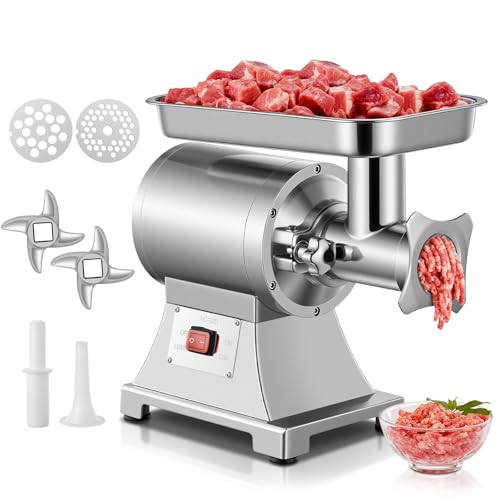
Commercial Electric Meat Grinder 1100W — Best Commercial Rating
This is the only machine here that introduces itself purely as a workplace tool: 1100 watts, ETL approved, rated at 330 pounds per hour, and described for kitchens, restaurants and butcher stores without a word of domestic garnish. That 330 figure is more conservative than VEVOR’s claim despite the stronger motor, and the conservatism itself is a commercial signal — businesses plan labour around numbers, so their suppliers’ numbers tend to live closer to the truth. Two blades and two cutting plates arrive in the box with a sausage tube, a sensible working kit with a spare blade where wear actually happens.
The stronger motor changes the character of long sessions. Where a 750W unit works hard through partially frozen trim, an 1100W machine maintains auger speed, and consistent speed is what keeps grind texture consistent across a hundred pounds. For a small butcher or a restaurant grinding its own burger blend daily, that steadiness is the difference between a product and a lottery.
Commercial framing cuts both ways for a home buyer. The machine assumes bench space, a wash routine and an operator who reads manuals; it will not flatter a small kitchen, and its support runs through commercial channels rather than a hobbyist community. If your workload is genuinely daily and measured in tens of pounds, those are the right assumptions to buy into, and this is the pick that makes them.
- Class: commercial countertop
- Motor: 1100W
- Stated capacity: 330 lbs per hour
- Certification: ETL approved
- Included: two blades, two cutting plates, sausage tube
Strengths
- Strongest motor here, steadier under sustained load
- Conservative, plannable throughput rating
- Spare blade included where wear is fastest
Trade-offs
- Workplace assumptions suit small kitchens poorly
- Support channels are commercial rather than hobbyist
- More machine than seasonal home processing needs
Best for: restaurants, delis and butcher counters grinding daily. Not suited for: occasional home use in a compact kitchen.
Businesses should also weigh the certification line with clear eyes. An ETL mark signals that the machine’s electrical safety has been examined by a recognised laboratory, which matters to insurers, landlords and health inspectors in ways a home buyer never encounters. If your grinding happens under a business licence, that mark can be the difference between equipment an inspector accepts and equipment you are asked to remove, and it costs far less to buy a listed machine first than to replace an unlisted one under instruction. That context, more than the wattage, is what makes this the commercial pick.

ARINOO Commercial Meat Grinder #12C — Best for Hunters and Small Farms
ARINOO names its audience in its own title: venison and beef, home butchering and small-farm processing. The #12C pairs a 0.9HP motor with stainless construction in the #12 class, and that combination maps precisely onto the seasonal rhythm of farm and hunting work, where a machine may sit idle for months and then face two animals in a weekend. Stainless food-contact parts matter extra in that rhythm, because a grinder returned to storage must be put away perfectly clean and dry, and surfaces that resist corrosion forgive the realities of a barn-side processing room better than plated alternatives.
Sausage making is built into the proposition, and for farm batches of ten to twenty pounds the grinder-stuffer compromise remains workable if the meat stays cold and the operator rests the motor as directed. Venison’s leanness deserves a mention: it grinds cleanly but benefits from added fat for sausage, and a #12 throat swallows the cubed fat and lean together without the baulking smaller machines show at mixed loads.
As with the other newer commercial labels here, the prudent buyer insures the future early with a spare knife, plate and seal set while the model is in production. Do that, and the ARINOO is a rational, workload-matched machine for the exact buyers it names, priced against heritage brands whose support networks it does not pretend to match.
- Throat class: #12C
- Motor: 0.9 HP
- Construction: stainless steel
- Stated game: venison and beef
- Settings: home butchering, small-farm processing
Strengths
- Workload-matched to seasonal whole-animal processing
- Stainless build suits store-and-return farm use
- #12 throat handles mixed lean and fat cubes easily
Trade-offs
- Newer label with a shallower support history
- Grinder-stuffing warms large sausage batches
- Idle months demand careful storage preparation
Best for: hunters and small farms processing seasonally at volume. Not suited for: urban kitchens grinding small weekly batches.
Farm processing has one more variable city kitchens forget: power and workspace are improvised. A grinder may run in a barn, a garage or a rented processing room, on a bench that wobbles, in November cold that actually helps the meat and punishes the operator. A straightforward machine with a honest motor, few electronic frills and parts that can be scrubbed in a utility sink fits that world better than a feature-laden one. The ARINOO’s plain specification reads, in that light, less like a lack of ambition and more like an understanding of where its named buyers do their work.

STX Turboforce HD Electric Meat Grinder — Best Accessory Bundle
STX sells versatility harder than anyone here: a 6-in-1 machine with five grinding plates, stainless blades, a sausage stuffer, a kubbe maker and a foot pedal. Strip away the arithmetic of the bundle and two features genuinely change how the machine is used. Five plates span the full working range from coarse chilli grind to fine emulsions without a second purchase, and the foot pedal is a small revelation in practice, because grinding is a two-handed job of feeding and catching, and a pedal frees the operator from reaching for a switch with meat-covered hands.
The Turboforce HD sits at the boundary of this guide’s category, and honesty requires saying so: it is a heavy-duty home machine with commercial ambitions rather than a rated commercial unit, and its throughput expectations should be set accordingly. For a household whose grinding is frequent, varied and measured in tens of pounds across a season rather than hundreds in a week, that boundary position is not a weakness. It is the correct amount of machine, wearing the best accessory kit in the group.
Kubbe making, for the uninitiated, forms hollow bulgur shells for stuffing, a specialty most grinders cannot attempt without the dedicated attachment STX includes. Whether or not your kitchen ever makes kubbe, the inclusion signals a maker thinking about grinding as a cuisine rather than a chore, and the plate range supports that reading. Buy it for range and control; step elsewhere for rated commercial duty.
- Class: heavy-duty 6-in-1, 3500 series
- Plates: five grinding plates included
- Control: foot pedal included
- Attachments: sausage stuffer, kubbe maker
- Blades: stainless steel
Strengths
- Widest plate range here, no second purchase needed
- Foot pedal suits the two-handed reality of grinding
- Kubbe attachment opens a specialty other picks skip
Trade-offs
- Heavy-duty home class rather than commercial rating
- Many attachments mean more parts to store and wash
- Peak-power marketing needs the discount this guide applies
Best for: varied home processors who grind often and stuff occasionally. Not suited for: businesses needing a certified commercial duty cycle.
The pedal deserves a final practical note: it changes safety as much as convenience. Grinding accidents happen when an operator reaches across a running machine to find a switch with slippery hands; a floor pedal puts the stop control under a foot that is already planted, and starting and stopping become reflexes rather than errands. Households teaching a teenager to help on processing day will feel that difference immediately. Combined with the plate library, it makes the STX the machine most likely to be used for small, frequent jobs, because its setup friction is the lowest here once the attachments are organised in a single box.
How Do the Six Grinders Compare?
| Pick | At a glance |
|---|---|
| LEM BigBite #8 Electric Meat Grinder | #8, 0.5 HP, stainless, deepest parts support |
| Weston #12 Electric Meat Grinder and Sausage Stuffer | #12, 1 HP, four pounds per minute, die-cast body |
| VEVOR Electric Meat Grinder 552 Lbs/H #12 | #12, 1 HP, 552 lbs per hour rating, ETL listed |
| Commercial Electric Meat Grinder 1100W | 1100W commercial, 330 lbs per hour, ETL approved |
| ARINOO Commercial Meat Grinder #12C | #12C, 0.9 HP, stainless, venison and small-farm focus |
| STX Turboforce HD Electric Meat Grinder | 6-in-1, five plates, foot pedal, kubbe maker |
How Do You Plan the Menu Around a Grinding Day?
Experienced processors think backwards from the freezer. A grinding day should end with labelled, dated, portioned packages rather than a mountain of anonymous meat, so decide the products before the first cube is cut: how many pounds of burger blend, how much breakfast sausage, how much coarse chilli grind, and what the trim balance requires to make those numbers work. That plan dictates the fat you add, the plates you stage and the casings you soak, and it prevents the classic outcome where everything becomes burger because burger is the default setting of an unplanned afternoon.
It also dictates help. Two people halve a big session and improve it, because trimming and grinding proceed in parallel and the meat spends less time waiting at room temperature. Assign one person to the board and one to the machine, swap roles hourly to keep attention fresh, and keep a third station, even if unmanned, for packaging as you go. The households and small farms that process happily for years run their grinding days like this, as small productions with a plan, a crew and an end time, rather than as heroic solo efforts that leave the kitchen looking like a battlefield and the operator swearing off sausage by February.
How Should You Run a Big Grinding Session, Start to Finish?
Chill is the whole religion. Cube the meat, spread it on trays and give it time in the coldest part of the fridge or a short stay in the freezer until it is firm and cold at the centre without being frozen solid, and chill the grinder head, plate and knife alongside it. Cold fat cuts; warm fat smears, and smearing is what turns good grind into paste, overheats motors and convinces beginners that grinding is miserable. Work in batches small enough that the meat waiting its turn stays cold, even if that means trays rotating back into the fridge mid-session.
Grind coarse before fine when texture matters, catching the meat in a chilled bowl set over ice for long sessions, and season after the first grind so distribution is even. Keep one hand for feeding and one for the tray, use the stomper as a guide rather than a ram, and let the auger set the pace; forcing the feed is how jams and motor strain begin. If the motor note changes or the head warms, stop, clear and rechill rather than pushing through, because ten minutes of patience protects both the batch and the machine.
Cleaning begins the moment grinding ends. Disassemble fully, soak the head parts in hot soapy water, scrub every plate hole clear, and dry each piece completely before reassembly or storage, since a plate put away damp is a plate corroding in the dark. A light food-safe oil film on knives and plates is the old butcher’s trick for storage, and it remains a good one.
What Safety Habits Matter Most Around a Machine This Strong?
A grinder in this class does not forgive casual hands, and its safety culture is simple enough to state plainly. The stomper exists so that fingers never approach the auger; use it for every piece, including the small ones at the end of a tray, where temptation peaks. Tie back sleeves and hair, remove rings, and keep the workspace dry, because a wet floor and a heavy machine and a distracted operator are a combination with a predictable ending. The STX’s foot pedal earns another mention here, since a stop control underfoot is reachable in the exact moment a hand is occupied.
Electrical habits matter at this power level. Run the machine on a circuit that can carry it without sharing a strip with the freezer and the radio, let the motor stop fully before reversing or disassembling, and never clear a jam with anything metal while the unit is plugged in. Teach every helper the same rules before the first tray is cubed, not after the first scare, and keep children in the audience rather than the workforce until they are old enough to treat the machine with genuine respect.
Food safety is the third leg. Grinding multiplies surface area, so the meat’s cold chain matters more after grinding than before it: grind cold, chill the result promptly, cook or freeze within the windows your local guidance gives for ground meat, and sanitise every food-contact part between species or sessions. A fast machine shortens the danger window only if the operator’s habits keep pace with it.
How Does Grinder Ownership Change Your Meat Buying?
The first change is arithmetic. Whole muscles and primal cuts cost less per pound than retail ground meat, and a household with a capable grinder starts buying chuck, shoulder and trim in bulk when prices dip, grinding fresh in the quantity the week requires. Fresh-ground meat, cooked the same day, tastes noticeably different from a package that has sat for days, and once a household registers that difference, the machine’s cost begins repaying itself in quality before the savings are even counted.
The second change is control. Blends become deliberate: a ratio of chuck to brisket for burgers, a measured fat percentage for sausage, a coarse grind for chilli that no shop counter offers. Hunters gain the most, turning trim that once went to waste into burger and sausage of known content, and small farms gain a product line. Even the freezer changes shape, organised around whole muscles that keep better and longer than pre-ground meat, ground on demand through the year.
The third change is responsibility. A household that grinds its own meat owns its food safety end to end, from sourcing to sanitation, and should buy and read a proper processing guide alongside the machine. The grinders here are tools equal to that responsibility; matching them with the knowledge is the owner’s half of the bargain.
What Mistakes Do New Owners of Big Grinders Make?
The first is buying by headline horsepower and discovering the duty cycle at minute thirty of a pig. The second is grinding warm meat and blaming the machine for paste. The third is treating the stuffing mode as a stuffer, running twenty pounds through an auger and wondering why the fat smeared and the texture suffered. Each of these is a knowledge failure rather than a machine failure, and each is avoidable with the expectations this guide has tried to set.
Maintenance mistakes follow close behind: plates and knives washed and stored wet, mismatched knife-and-plate pairs grinding against each other for years, and sinew left to wind around the auger until the motor complains. A knife and its plate wear together as a matched set, so replace them together, keep one proven pair for fine work, and never run the machine empty to test it, because dry metal-on-metal contact is pure wear with no dinner to show for it.
What Does the First Month With a Serious Grinder Teach Most Owners?
First, that preparation is the job and grinding is the reward. New owners arrive expecting the machine to dominate the session and learn within one batch that trimming, cubing and chilling consume most of the clock while the grinder itself runs for a fraction of it. That realisation reorganises the whole workflow: boards and trays multiply, the fridge gets cleared the night before, and the session becomes a calm production line instead of a wrestle. Owners who accept the lesson early produce better meat; owners who fight it keep blaming equipment for what is actually scheduling.
Second, that the wash-up is a design feature to be shopped for, not a chore to be endured. A head that strips down by hand, with few crevices and parts that fit a standard sink, gets cleaned properly every time, and proper cleaning is where food safety and machine longevity are actually decided. This is why the guide weighed head size and disassembly alongside power, and why the compact #8 earns its lead recommendation for households whose sessions are measured in tens of pounds: the machine you clean happily is the machine that stays safe.
Third, that a grinder changes a household’s relationship with meat more than any other single tool. Recipes once skipped for want of a particular grind become ordinary, trim stops being waste, and the freezer fills with possibilities instead of packages. The owners who thrive are the ones who bought for their real workload and learned their machine’s sounds the way drivers learn an engine, and by the second season the whole operation runs on habit and cold trays.
How Do You Handle Jams, Sinew and a Motor That Starts to Struggle?
Sinew is the tax wild game and cheaper trim levy on every grinder. Silverskin and connective tissue wind around the knife and auger instead of cutting, gradually throttling the feed until the motor note sours. The prevention is trimming discipline at the board: ten extra minutes with a fillet knife removing silverskin saves an hour of clearing and produces a cleaner grind besides. When winding does happen, stop the machine, unplug it, and clear the head fully rather than poking at the visible strands, because the wrap you cannot see is the one doing the damage.
A reverse function, where fitted, exists to back a jam out gently, and it should be used in short touches with the feed empty rather than as a grinding gear. Persistent jamming on ordinary meat signals a dull knife, a mismatched plate pair or meat that has warmed up, in that order of likelihood, and each cause has a fix cheaper than force. The operator’s rule is absolute: a struggling motor is information, not a challenge, and the session that pauses to diagnose finishes faster than the one that pushes a machine into thermal shutdown.
Should You Budget for a Dedicated Stuffer at the Same Time?
If sausage is an occasional ten pounds a year, no: the stuffing modes on these machines, used cold and patiently, will carry you. If sausage is a product, a season’s project or a farm product line, the dedicated stuffer is not an accessory but the second half of the system, and buying it in the same season changes what the grinder purchase should be. A stuffer’s piston presses the mix into casings without an auger’s churning, so fat stays in distinct particles, texture stays open, and the mix stays cold across a long run.
The economics are friendlier than they look. A grinder chosen purely for grinding, without paying for stuffing attachments you will abandon, plus a mid-range stuffer, often lands near the price of a bundle machine while outperforming it at both jobs. Households unsure of their sausage future can stage the decision: grind for a season, count the sausage batches honestly, and let that number, rather than a bundle’s marketing, decide the second purchase.
Where Will the Machine Live, and Does the Room Matter?
These are bench machines with real weight, and a wobbling table steals both safety and temper across a long session. Give the grinder a solid, low bench at a height that lets you feed the tray without lifting your shoulders, with the catch bowl at a comfortable level and room beside it for trays in rotation. Processing near a sink shortens the wash cycle that ends every session, and processing near the fridge shortens the cold chain that protects every batch.
Noise deserves one honest paragraph. A loaded #12 under power is loud enough to end conversation and startle dogs, and in a small house that argues for processing hours chosen with the household, or hearing protection for the operator during long runs. Plan the session the way workshops plan machining, and the noise becomes a known cost rather than a grievance. Finally, store the machine dry, assembled loosely or in a covered crate with its plates oiled and its manual on top, so the first session of next season starts with a tool, not an archaeology project.
Final Recommendation
Most serious home processors should buy the LEM BigBite #8 Electric Meat Grinder for its support ecosystem and right-sized throat, stepping up to the Weston #12 Electric Meat Grinder and Sausage Stuffer when whole-animal volume makes four pounds a minute the deciding figure. Genuinely commercial buyers belong with the Commercial Electric Meat Grinder 1100W, while variety-driven home cooks will get the most daily pleasure from the STX and its pedal. Match the machine to the pounds you truly process, and every pick here will feel overbuilt in the best way.
A grinder earns its bench space on the coldest, busiest morning of your year, so buy for that morning and no other.
Which Plate Sizes Cover Burger, Sausage and Chilli Grind?
Plate holes decide texture more than any other variable you control. A coarse plate in the region of ten millimetres gives the loose, distinct particles that chilli and rustic sausage want, where the meat should read as pieces rather than paste. A medium plate around four to six millimetres is the burger and general-purpose grind, holding together in a patty while keeping a defined bite. Fine plates near three millimetres serve emulsified sausages and smooth pâtés, usually as a second pass after a coarse grind, with the meat re-chilled between passes so the fine plate cuts instead of smearing.
The double grind deserves its reputation: coarse first to break the trim down evenly, then medium or fine for the final texture, produces a consistency a single pass rarely matches, because the first pass equalises the mixture of lean and fat that the second pass then refines. Every additional pass costs cold, though, so work with trays over ice and return the bowl to the fridge between passes on warm days. The sets with two or more plates included, the VEVOR, the commercial 1100W unit and above all the five-plate STX, spare you the follow-up orders that a one-plate machine inevitably generates.
Knives and plates must be treated as married pairs. A knife wears a pattern into its plate, and swapping in a new knife against an old plate, or the reverse, leaves gaps that tear rather than cut. Keep pairs together in labelled bags, and when one half of a pair is replaced, replace both and demote the old pair to coarse emergency duty.
How Do You Judge Whether Your Workload Is Home, Heavy or Commercial?
Count honestly across a year. A household grinding a deer or two, a pig share and a few burger sessions totals perhaps two hundred pounds annually, in bursts; that is heavy home work, and the #8 and #12 branded machines serve it for a decade. A farm or hunting camp doubling that figure, with several weekends where the machine runs for hours, sits at the top of the same class and should buy the strongest #12 it can store and wash comfortably.
Commercial begins where the calendar changes: grinding weekly or daily, in quantities other people are paying for, under food-safety obligations that include equipment certification and documented cleaning. At that point the questions shift from preference to compliance and labour cost, and the ETL-listed machines in this guide become the floor rather than the ceiling. Buyers who misjudge this boundary in either direction waste money symmetrically: the café that buys a hobby machine replaces it within a year, and the hunter who buys a shop machine washes a shop-sized head after every deer forever.
If your honest count lands between classes, buy for the sessions you repeat most, not the largest you can imagine, and let a local butcher keep the once-a-year monster job that would otherwise dictate your purchase. That single decision saves more money in this category than any amount of comparison shopping.
Frequently Asked Questions
Is a #12 grinder always better than a #8?
Only when the workload justifies it. The #12 feeds faster and handles larger cubes, but its head is heavier to wash and store, and for batches under twenty pounds the #8 finishes the whole job, including cleanup, sooner. Buy the throat that matches your typical session, not your largest imaginable one.
Why does my ground meat come out mushy?
Almost always temperature. Warm fat smears across the plate instead of cutting, and the auger then works the meat into paste. Chill the meat until firm, chill the head parts, work in smaller batches, and check that the knife edge faces the plate correctly and is sharp; those four fixes solve nearly every case.
Can I stuff sausage casings with a grinder?
Yes, for modest batches, keeping the mix very cold and working steadily. For regular sausage making in quantity, a dedicated stuffer gives a piston’s gentle, even pressure that protects fat texture, and most serious makers end up owning both machines for that reason.
Do I need a three-phase supply or a special circuit?
No machine in this guide asks for anything beyond an ordinary household or commercial single-phase socket, but the stronger units draw enough current that a shared, tired circuit will announce itself. Run the grinder on a circuit that is not simultaneously carrying a freezer, a kettle and a space heater, and in a commercial setting give it the dedicated outlet its manual almost certainly requests.
Is a bigger grinder harder to clean?
The head, tray and auger scale with the throat, so a #12 takes longer to wash and needs a bigger sink or a utility tub than a #8. The difference is minutes, not hours, but it is paid after every single session, which is why this guide keeps returning to typical batch size: a machine whose cleaning matches your routine gets cleaned properly, and proper cleaning is where both hygiene and longevity are decided.
How long can I grind continuously?
Follow the duty guidance in your machine’s manual, and treat a changing motor note, a warming head or slowing feed as instructions to pause regardless of what the manual allows. Resting and rechilling protects texture as much as machinery, so the pause is rarely wasted time.
Can these grinders handle bones for pet food?
Soft raw bones in small poultry, such as necks and frames, are within the ability of the stronger #12 machines when the manual permits it, but hard weight-bearing bones from beef or pork are beyond every machine in this guide and will damage plates and gearboxes. Pet-food grinding is a real use case with its own dedicated heavy machines; if bones are central to your plan, shop for that specification explicitly rather than testing a meat grinder’s optimism.
How do I know when a knife or plate is worn out?
The grind tells you first: meat begins to smear and extrude slowly despite being properly cold, the motor works harder, and sinew wraps more often. Inspect the knife edges for rounding and the plate face for scoring or dishing. Because the pair wears together, replace them together and keep the old pair, clearly marked, as a coarse-duty spare rather than mixing old and new components.
What spare parts should I own from day one?
A matched spare knife and plate in your most-used size, plus any seals your model uses. They are inexpensive while the model is current, and they convert a mid-season breakdown from a cancelled processing day into a ten-minute swap.
Related Guides
Grinding is one station in a well-run kitchen; our related guides cover the next ones: Best Bluetooth Digital Meat Thermometers (Waterproof Class) for cooking what you grind, Best Black Friday Deals on KitchenAid Hand Mixers for the mixing bowl’s other work, and Best BBQ Smokers for where the best cuts end up.



[…] the drawer to the worktop, our related guides continue the same evidence-first approach: Best Industrial Electric Meat Grinders for the heaviest job in the kitchen, Best Alternatives to Microwaves for reheating without one, and […]