What's inside
- Key Takeaways
- Quick Picks
- How We Chose These Picks
- The Best Cheap Pressure Cookers, Reviewed in Detail
- How Do the Six Budget Cookers Compare Side by Side?
- What Size Pressure Cooker Does a Beginner Actually Need?
- Which Features Are Worth Paying For on a Tight Budget?
- How Do You Use an Electric Pressure Cooker Safely the First Time?
- What Should a Beginner Cook First to Learn the Method?
- How Do You Keep a Budget Cooker Running for Years?
- Should a Budget Buyer Consider a Stovetop Pressure Cooker Instead?
- Which Foods Give a Budget Cooker Its Money’s Worth?
- How Much Does a Pressure Cooker Actually Save on Energy and Time?
- Which Accessories Are Worth Buying, and Which Can Wait?
- How Does a Pressure Cooker Change Weeknight Meal Planning?
- Is Buying a Secondhand Pressure Cooker a False Economy?
- Why Does Pressure-Cooked Food Sometimes Come Out Watery or Bland?
- What Are the Most Common Mistakes When Buying a Cheap Pressure Cooker?
- Final Recommendation
- Frequently Asked Questions
- Related Guides
As an Amazon Associate I earn from qualifying purchases. This post may contain affiliate links at no extra cost to you.
cottageverdict.com is reader-supported. When you buy through links on our site, we may earn an affiliate commission.
Where to buy: every cooker below is sold on Amazon, and the names in the Quick Picks table and the detailed reviews link to their listings so you can check price on Amazon before deciding. This guide to the best cheap pressure cookers is written for a specific and honourable shopper: the person who wants weeknight dinners to cook faster, has a sensible ceiling on what a countertop appliance should cost, and refuses to pay for a touchscreen they will never touch. Cheap, in this kitchen, is not a warning label. The electric pressure cooker is a mature design now, and the value end of the market is where some of the most honest engineering lives.
The best cheap pressure cookers share a pattern once you look past the badge counts. They concentrate on the handful of jobs the appliance actually performs in a real week — pressure cooking rice, beans, stews and tough cuts, plus slow cooking and sautéing — and they save money on the theatre around those jobs: smaller displays, fewer presets, simpler lids. What they must never cheapen is the safety stack and the seal, because a pressure vessel earns trust or it earns a cupboard exile. The six cookers below run from a three-quart mini built for one or two people to an eight-quart family machine, and each one is here because it spends its budget where a first-time buyer can taste the difference.
Key Takeaways
- Capacity is the first budget decision: three to four quarts suits one or two people, six quarts is the family standard, eight quarts is batch-cooking territory.
- Preset counts inflate prices faster than they improve dinners — seven to nine honest functions cover nearly everything a beginner cooks.
- Every pick here is an electric countertop model with a locking lid and automatic pressure regulation, the safest format for a first purchase.
- A stainless or good ceramic inner pot matters more than a colour touchscreen, because the pot is what you scrub for a decade.
- Buy the size for your household today, not the dinner party you host once a year — oversized cookers heat slowly and store badly.
Quick Picks
| Pick | Badge | Why it earns its place |
|---|---|---|
| Instant Pot Duo Mini 3 Qt 7-in-1 | Best for Singles and Couples | The full Duo idea shrunk honestly to three quarts, ideal for small kitchens and small appetites |
| Instant Pot Rio Mini 4 Qt 7-in-1 | Best Small Step Up | Four quarts of modernised mini cooking with a friendlier interface for first-time owners |
| Instant Pot Duo 6 Qt 7-in-1 | Best Classic Value | The original six-quart benchmark, with the deepest pool of recipes and spare parts anywhere |
| Cosori Pressure Cooker 6 Qt 9-in-1 | Best Ceramic Pot Pick | A ceramic-coated inner pot and a long safety feature list at a six-quart family size |
| Instant Pot Duo Plus 6 Qt 9-in-1 | Best Budget Stretch | The Duo formula with a clearer display and easier steam release for a little more money |
| Sweetcrispy 16-in-1 Electric Pressure Cooker 8 Qt | Best Big-Capacity Bargain | Eight quarts and a ceramic pot for large families who cook in batches on Sundays |
How We Chose These Picks
A cheap pressure cooker guide lives or dies on its definition of value, so here is ours: a cooker is good value when its price buys cooking performance, safety and durability in that order, and poor value when the money leaks into features that photograph well and cook nothing. By that standard the famous-name six-quart models remain formidable, because their pressure systems, seals and replacement-part networks have been proven across millions of kitchens. It also means a lesser-known brand earns a place only when it offers something the benchmarks do not — in this list, a genuinely large capacity with a ceramic pot at a price the big names do not attempt.
We also filtered for the beginner’s reality. A first pressure cooker should forgive: clear pressure indicators, a steam release that keeps fingers away from the jet, a lid that announces whether it is locked, and controls that a tired person can operate at six in the evening without a manual. Every pick here is electric rather than stovetop, because electric models regulate their own pressure and temperature, removing the burner-watching that makes stovetop cookers a hobbyist’s tool. And we kept capacities honest — no cooker is praised for a headline size without noting that a pressure pot should only be filled two-thirds full, so the working capacity is always smaller than the number on the box.
What we did not reward: preset counts as a proxy for quality. A cooker offering sixteen programmes is usually offering seven real functions wearing extra hats, since soup, stew and bean modes on most machines differ mainly in their factory-set times. Beginners cook better with a clear manual high-pressure mode and a kitchen timer’s honesty than with a dial of pictograms, and the reviews below judge each machine on the cooking underneath the labels.
The Best Cheap Pressure Cookers, Reviewed in Detail

Instant Pot Duo Mini 3 Qt 7-in-1 — Best for Singles and Couples
The Duo Mini answers the question nobody asks in the shop and everybody asks at home: how much pressure cooker does one person actually need? Three quarts sounds like a toy until you cook in it. That volume swallows a proper small stew, a batch of rice for two with leftovers, a half-dozen eggs, a modest portion of dried beans, or a curry that feeds a couple generously — which is to say, it covers the realistic weeknight repertoire of a small household while heating up faster than its six-quart sibling and washing up in a sink without a wrestling match.
Functionally it is a true Duo in miniature: pressure cook, slow cook, rice, steam, sauté, yogurt and warm, driven by the same control logic as the full-size original. The yogurt function deserves a mention at this size, because small households are exactly the people who make yogurt in jars, and the Mini handles a modest batch beautifully. Its sterilising role in the wider Duo line translates here into reheating and warming duties that suit a studio kitchen where the oven is small and the microwave is contested.
The limits are structural and worth naming. A whole chicken is not happening, a large batch of stock strains the two-thirds fill rule, and anyone who regularly cooks for four will outgrow it within a season. But as a first pressure cooker — the one that teaches the method at the lowest price and the smallest footprint — it is close to perfect, and many owners keep it for rice and sides long after a bigger machine joins the counter.
- Capacity: 3 quarts, sized for one to two people
- Functions: 7-in-1 — pressure, slow, rice, steam, sauté, yogurt, warm
- Inner pot: stainless steel, dishwasher friendly
- Footprint: the smallest in this guide
- Best role: first cooker, dorm-adjacent kitchens, side dishes
Strengths
- Genuine Duo cooking in a compact, quick-heating body
- Easy to store, lift, wash and find counter room for
- Lowest-commitment way to learn pressure cooking
Trade-offs
- Too small for family stews or whole poultry
- Batch cooking for the freezer is limited
- Fewer accessories made in this size
Best for: singles, couples, students and small kitchens buying their first cooker.
Not suited for: families or anyone whose stew pot currently holds six portions.

Instant Pot Rio Mini 4 Qt 7-in-1 — Best Small Step Up
The Rio Mini exists because Instant Pot noticed what owners of the three-quart model kept saying: wonderful machine, wish it were a touch bigger. Four quarts is that touch. It holds a small whole chicken where the Mini cannot, stretches a stew to three or four portions, and still parks on a modest counter without dominating it. For a couple who cooks for occasional guests, or a single cook who likes leftovers by design, this is arguably the sweetest capacity in the entire budget field.
The Rio line also represents the brand’s interface refresh, and for beginners that matters more than spec-sheet duels suggest. The controls are arranged around plain-language programmes — pressure cook, slow cook, rice, steam, sauté, yogurt and keep warm — with a cleaner display of what the machine is doing and when. First-time pressure cooks fail from confusion more often than from hardware: an owner unsure whether the pot has reached pressure, or how the release works, loses confidence fast. The Rio’s clearer feedback shortens that learning curve, which at the budget end of the market is a genuine feature rather than a luxury.
Its black finish and slightly wider stance give it a more modern counter presence than the Mini’s stainless utility look, though the wider body is worth measuring if your storage is a narrow cupboard. Between the two minis, the choice is arithmetic: count your usual portions, add one, and buy the size that covers the sum.
- Capacity: 4 quarts, sized for two to three people
- Functions: 7-in-1 core programme set
- Interface: refreshed Rio controls with clearer status display
- Finish: black, contemporary styling
- Best role: couples who entertain occasionally
Strengths
- The extra quart unlocks small whole chickens and guest portions
- Friendlier controls for genuinely new users
- Still compact enough for small counters
Trade-offs
- Wider body than the three-quart Mini
- Less recipe content written for this exact size
- Not a batch-cooking machine despite the step up
Best for: couples and small households wanting one size above the minimum.
Not suited for: weekly meal-preppers cooking for a freezer.

Instant Pot Duo 6 Qt 7-in-1 — Best Classic Value
Some products become the default answer because marketing says so; the six-quart Duo became the default because a decade of weeknight dinners says so. This is the cooker that taught a generation the method, and its budget credentials rest on a simple fact: the design is old enough to be thoroughly debugged and manufactured at enormous scale, yet the cooking underneath — pressure cook, slow cook, rice, steam, sauté, yogurt, warm — remains exactly what most kitchens need. When a recipe anywhere says pressure cook on high for twenty minutes, this is the machine the writer was picturing.
The ownership ecosystem is the Duo’s hidden discount. Replacement sealing rings, spare inner pots, glass lids, steamer baskets and a mountain of community recipes are all sized around this cooker, so the cost of keeping it running for years is lower than for any rival. Its stainless inner pot shrugs off metal utensils and dishwashers, the sauté function browns meat in the same vessel the stew then cooks in, and the whole machine has the repairable, understood quality of a tool rather than a gadget.
Age shows in the interface: the display is basic, the buttons are a membrane panel rather than a dial, and newer models release steam with more ceremony. None of that changes a single dinner. For a first family-size cooker bought on a budget, the Duo remains the answer against which bargains must argue — and most of them lose the argument on parts availability alone.
- Capacity: 6 quarts, the family standard size
- Functions: 7-in-1 with the classic Duo programme set
- Inner pot: stainless steel with a tri-ply base
- Ecosystem: the widest spares and accessories pool anywhere
- Best role: the one-cooker household workhorse
Strengths
- Proven design with unmatched recipe support
- Cheap, available spare parts for years of service
- Stainless pot handles sautéing and scrubbing alike
Trade-offs
- Older-style display and button panel
- Steam release is more manual than newer rivals
- No sous vide or air-fry tricks in this generation
Best for: families buying a first full-size cooker with confidence.
Not suited for: gadget lovers who want the newest interface available.
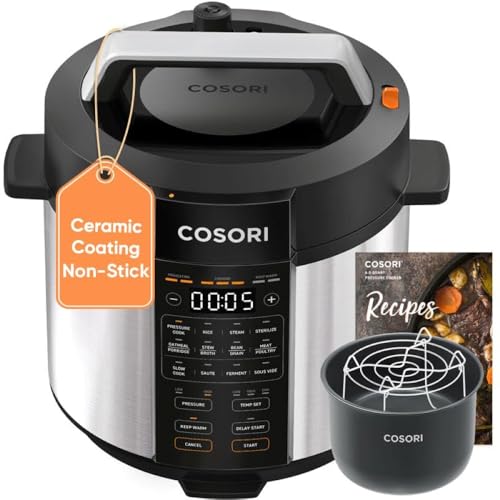
Cosori Pressure Cooker 6 Qt 9-in-1 — Best Ceramic Pot Pick
Cosori’s six-quart cooker makes its budget argument in the sink rather than on the spec sheet. Its inner pot wears a ceramic coating, and anyone who has scrubbed the seasoned remains of a bean chilli out of bare stainless will understand the appeal instantly: food releases more willingly, rice lifts cleaner, and the pot rinses like a nonstick pan because that is essentially what it is. For beginners whose enthusiasm could be killed by washing-up, that coating is a quality-of-life feature disguised as a material choice.
The rest of the machine is a modern nine-function package — pressure cooking at the centre, with slow cook, rice, sous vide, sauté and companions — driven by 1100 watts and wrapped in stainless. Cosori advertises a dozen safety features, and while the exact count is marketing arithmetic, the substance underneath is real: lid-lock detection, pressure regulation, overheat protection and a steam release designed to keep the user’s hand out of the jet’s path. A first-time buyer comparing two similar prices is entitled to choose the machine that thought harder about the frightening parts.
Ceramic coatings do ask for gentler treatment than stainless — wooden or silicone tools, no scouring pads, and an acceptance that coatings are consumables over a long enough life. Buyers who brown aggressively and scrub cheerfully may prefer the Duo’s bare metal. Buyers who cook rice three times a week and dread the pot will feel the opposite, and for them this is the six-quart pick.
- Capacity: 6 quarts for family-size cooking
- Functions: 9-in-1 including sous vide
- Inner pot: ceramic-coated for easy release
- Power: 1100W with a stainless exterior
- Safety: a dozen listed protective features
Strengths
- Ceramic pot makes cleanup genuinely easier
- Sous vide at a budget price point
- Thoughtful steam-release and lid safety design
Trade-offs
- Coating needs gentler utensils than stainless
- Smaller long-term track record than the Duo
- Spares pool is narrower than Instant Pot’s
Best for: rice-heavy households and anyone who hates scrubbing pots.
Not suited for: metal-utensil cooks who treat cookware roughly.

Instant Pot Duo Plus 6 Qt 9-in-1 — Best Budget Stretch
The Duo Plus is what happens when the classic Duo gets a modest promotion, and in a budget guide it plays the role of the sensible stretch: the cooker to buy when the entry price is tempting but you can feel, correctly, that a few quality-of-life upgrades will matter across years of dinners. The cooking platform is familiar — six quarts, stainless pot, the full Instant Pot recipe universe — but the interface steps up to a clearer blue display that shows cooking progress more legibly, and the programme set widens to nine functions with additions such as cake, egg and sterilise finding their fans.
The upgrade beginners feel most is the steam handling. The Plus generation made releasing pressure a calmer, more deliberate action, with the release control separated from the float valve’s hot neighbourhood. It sounds like a footnote until your first natural-release-versus-quick-release decision with a pot of soup at full pressure; then it is the whole review. Add a lid that rests in the cooker handles — a small mercy for wet lids and small counters — and the Plus justifies its stretch as a set of daily frictions removed rather than features added.
Judged coldly, a Duo owner gains nothing by upgrading, and a Duo shopper on a hard budget loses nothing essential by staying put. The Plus is for the buyer in between: first cooker, long horizon, and a willingness to pay a little more for the version that annoys its owner least. In budget terms that is not extravagance; it is the oldest value calculation there is.
- Capacity: 6 quarts, family standard
- Functions: 9-in-1 expanded programme set
- Display: large, clear progress readout
- Steam release: improved, cooler-touch control
- Inner pot: stainless steel, dishwasher friendly
Strengths
- Friendlier display and steam release than the classic
- Full Instant Pot spares and recipe ecosystem
- Extra programmes cover eggs, cakes and sterilising
Trade-offs
- Costs more than the Duo for similar cooking power
- Still a membrane-button interface, not a dial
- No ceramic pot option in this model
Best for: first-time family buyers planning to keep one cooker for years.
Not suited for: the strictest budgets, where the classic Duo suffices.

Sweetcrispy 16-in-1 Electric Pressure Cooker 8 Qt — Best Big-Capacity Bargain
Every budget category has one pick that changes the question, and here it is the Sweetcrispy: an eight-quart electric pressure cooker with a ceramic inner pot and a sixteen-function programme list, aimed squarely at the large family or the Sunday batch-cooker whose problem was never features but volume per pound spent. Eight quarts, respecting the two-thirds fill rule, still means a working capacity around five quarts of actual stew — a double batch by six-quart standards — plus room for the big jobs that define batch cooking: a whole large chicken, a ham hock and beans, stock from a week’s saved bones.
The sixteen presets deserve the translation offered earlier in this guide: underneath the labels sit the standard electric-cooker functions — pressure, slow, rice, steam, sauté, soup, yogurt and keep-warm among them — with factory timings tuned per programme. Used that way, as shortcuts rather than as sixteen inventions, they are harmless and sometimes handy, particularly for a newer cook who would rather press Soup than reason about minutes. The included recipe book leans into that audience and gives the first fortnight of dinners a script.
The cautions are those of any young brand at a disruptive price. The long-term spares picture — replacement rings, spare pots — is thinner than the Instant Pot ecosystem, the cooker is physically large on the counter and in the cupboard, and eight quarts is wasted money and heating time for a household of two. But for the big household counting cost per portion, this machine’s arithmetic is the most persuasive in the guide.
- Capacity: 8 quarts, the largest in this guide
- Functions: 16 preset programmes over the core set
- Inner pot: ceramic-coated for easier cleaning
- Included: recipe book for guided first weeks
- Best role: batch cooking and large families
Strengths
- Unmatched capacity for the budget-minded buyer
- Ceramic pot at a size rivals rarely offer cheaply
- Presets give beginners ready-made timings
Trade-offs
- Large footprint in storage and on the counter
- Thinner spare-parts network than big brands
- Oversized for small households’ daily meals
Best for: big families and committed weekend batch-cookers.
Not suited for: couples, small kitchens or minimalists.
How Do the Six Budget Cookers Compare Side by Side?
| Pick | Capacity | Functions | Inner pot |
|---|---|---|---|
| Duo Mini | 3 Qt | Seven functions | Stainless steel |
| Rio Mini | 4 Qt | Seven functions | Stainless steel |
| Duo Classic | 6 Qt | Seven functions | Stainless steel |
| Cosori | 6 Qt | Nine functions | Ceramic coated |
| Duo Plus | 6 Qt | Nine functions | Stainless steel |
| Sweetcrispy | 8 Qt | Sixteen presets | Ceramic coated |
The table exposes the budget field’s real structure: three sizes, two pot materials, and one famous ecosystem. Notice what does not vary — every cooker here pressure cooks, slow cooks, makes rice and sautés, because those four jobs are the appliance’s reason to exist. The money differences buy capacity, coating, display clarity and brand infrastructure, in roughly that order of usefulness. A buyer who reads the table column by column, starting with capacity, will land on the right machine far more reliably than one who starts with the function count, which is the column manufacturers most want you to read first.
What Size Pressure Cooker Does a Beginner Actually Need?
Capacity advice usually fails by ignoring the two-thirds rule: a pressure cooker must never be filled beyond two-thirds for most foods, and only halfway for foaming foods such as beans and grains, because the contents need room to boil without clogging the valves. That means a six-quart cooker is really a four-quart stew machine, a three-quart mini yields about two quarts of finished food, and the eight-quart Sweetcrispy’s working volume is what makes it a batch tool rather than a vanity size. Run your household’s arithmetic through that filter before anything else: count the portions you cook most often, in quarts of finished food, and buy the cooker whose two-thirds line covers it.
Household patterns refine the answer. Singles and couples who cook fresh most nights thrive in the three-to-four-quart class and gain speed, since smaller pots reach pressure faster with less liquid. Families of four to six live in the six-quart class, which also fits the accessories and recipes the internet writes by default. Households of seven-plus, and anyone cooking Sunday batches for a freezer, should look hard at eight quarts, accepting the storage cost as the price of doubling output per session. What almost nobody needs is the biggest size as a just-in-case purchase: an oversized cooker used daily for small meals heats slowly, uses more energy, and earns its cupboard resentment one oversized rice portion at a time.
Which Features Are Worth Paying For on a Tight Budget?
Spend first on the inner pot, because it is the part you will touch, scrub and judge every single day. Stainless steel is the durable default and browns beautifully; a good ceramic coating trades a little of that immortality for dramatically easier cleaning. Spend second on the interface you will actually read — a display that clearly shows whether the pot is pressurising, cooking or releasing prevents more beginner failures than any preset. Spend third, if anywhere, on a steam release designed to keep hands clear, because confidence around the release valve is what turns an occasional user into a weekly one.
Then stop spending. Yogurt modes are lovely and genuinely included free on most of these machines. Sous vide is a real technique and appears on the Cosori here, but it is a hobby, not a weeknight rescue. Cake and egg presets are timers with names. None of these should break a tie at the budget end, and none justifies stepping up a price class. The budget cooker’s art is subtraction: every pound not spent on theatre is a pound that bought pot, seal and safety instead — the three things standing between you and a decade of fast dinners.
How Do You Use an Electric Pressure Cooker Safely the First Time?
Begin with the water test, the ritual every manufacturer recommends and every impatient owner skips: a cup or two of water, lid locked, a few minutes at pressure, then a release. It proves the seal seats, teaches you the sounds the machine makes as it pressurises, and lets you meet the steam release in the lowest-stakes conditions imaginable. Read the lid’s anatomy while the pot is cold — float valve, release valve, sealing ring, anti-block shield — because recognising the parts is what turns the manual’s warnings into knowledge.
Then adopt the three habits that prevent nearly all beginner accidents. Always check the sealing ring is seated evenly before closing the lid, since a twisted ring is the commonest cause of mysterious steam leaks. Never force a lid that resists opening; a locked lid is a pressurised lid, and the float valve must be down before the lid should turn. And keep hands, face and wooden cupboards away from the release jet, venting toward open room rather than under a cabinet, because steam condensing on cabinet undersides damages them quietly over months. Electric cookers are engineered to be safe — interlocks prevent opening under pressure and sensors cap temperature — but they reward owners who meet the engineering halfway.
What Should a Beginner Cook First to Learn the Method?
Choose forgiving teachers. Hard-boiled eggs are the classic first cook: cheap, fast, and famous for shells that slip off cleanly, they teach timing and release with zero risk to dinner. Next, a batch of dried beans or a simple lentil soup, which demonstrates the appliance’s superpower — legumes without an overnight soak — while tolerating several minutes of timing error without complaint. Rice follows, then a stew of a forgiving cut such as chicken thighs or pork shoulder, where the pressure turns toughness into tenderness and the margin for error is measured in compliments.
Save the divas for later. Delicate fish, quick vegetables and anything whose perfection is a thirty-second window will punish a learner’s timing, and cheesecake — the pressure cooker’s party trick — deserves an audience already convinced. The deeper lesson of the first fortnight is liquid discipline: pressure cookers barely evaporate, so sauces emerge thinner than stovetop habits expect, and the fix is either less added liquid or a few minutes of sauté at the end with the lid off. Master that one adjustment and the entire recipe internet, written mostly for the six-quart class, opens up accurately.
How Do You Keep a Budget Cooker Running for Years?
The sealing ring is the consumable heart of the machine: a silicone gasket that absorbs odours, slowly hardens, and eventually leaks steam around the lid’s edge. Budget for replacing it every year or two of regular use, keep a spare if you cook both savoury stews and sweet dishes — rings carry flavour memories — and wash it after aromatic cooks. The float valve and anti-block shield need a rinse whenever starchy food has been near them, because a gummed valve is a safety feature waiting to underperform. The inner pot’s base must stay clean and dry on the outside; a wet pot bottom in a hot housing is a small, repeated insult to the heating plate.
Storage habits matter at this price point more than owners expect. Store the lid upside down or ajar so the ring airs and the pot does not develop the closed-cooker smell that greets neglected machines. Keep the cord unbent, the condensation collector emptied, and the rim channel wiped, since dried sauce in the sealing channel is the other great cause of leaks misdiagnosed as machine failure. None of this costs money. All of it is the difference between a cheap cooker that was a bargain and a cheap cooker that was merely cheap — a distinction measured in years, not in features.
Should a Budget Buyer Consider a Stovetop Pressure Cooker Instead?
It is a fair question, because stovetop pressure cookers can be inexpensive, last for decades and contain no electronics to fail. The honest answer for this guide’s audience is: probably not as a first cooker. A stovetop model asks its owner to regulate a burner by ear and eye, adjusting heat as the pressure indicator rises and falls, and to time the cooking with a separate clock. Experienced cooks find that rhythm pleasant; beginners find it one more thing to supervise in a busy kitchen, and the entire appeal of the electric format is that the supervision is built in. The electric machine watches its own pressure, holds its own temperature and switches itself to warm when the programme ends, which is why a cheap electric cooker gets used on tired Wednesdays while a cheap stovetop cooker becomes a very durable ornament.
There are two exceptions worth respecting. A household that camps or cooks on a boat may genuinely need a burner-driven pot, and a confident cook who already owns good pans may prefer a stovetop model for its searing power and indefinite lifespan. Everyone else should note the hidden costs of the stovetop bargain: the learning curve, the burner it occupies, and the absence of slow-cook, rice and keep-warm automation. Priced honestly across a year of dinners, the electric models in this guide are the cheaper way to own pressure cooking, because a tool’s real cost is measured in the meals it actually produces.
Which Foods Give a Budget Cooker Its Money’s Worth?
Dried beans are the appliance’s founding argument: a bag of chickpeas or black beans that demands an overnight soak and an hour of simmering on the stove becomes an after-work decision under pressure, with a texture many cooks judge better than tinned. Tough, inexpensive cuts are the second fortune — pork shoulder, beef shin, oxtail, lamb neck — the collagen-rich meats the butcher sells cheaply precisely because they demand time, and pressure is bottled time. A cut that needs three braising hours in an oven surrenders in well under one, and the budget cooker thereby pays its owner twice: once at purchase, and again at the butcher’s counter every week thereafter.
Stocks and broths run a close third, compressing a day of gentle extraction into an hour and producing a clarity and body that justify freezing in portions. Rice and grains reward the smaller machines in this guide daily, freeing a burner and removing the watched-pot problem entirely. Where budget cookers earn less: delicate green vegetables, which pass from crisp to khaki in the time the pot takes to pressurise, and anything prized for a crisp surface, since a pressure vessel is a steam chamber and steam does not brown. Knowing both lists is what turns the purchase from a gadget trial into a cooking strategy — play to the steam, and the machine will seem far more expensive than it was.
How Much Does a Pressure Cooker Actually Save on Energy and Time?
The savings are real but worth stating without theatre. Pressure raises water’s boiling point inside the sealed pot, so food cooks at a higher temperature and finishes dramatically faster — commonly in a third to a half of the conventional time for braises, beans and stocks. Less time at temperature means less energy consumed per dish, and an electric cooker concentrates that energy in an insulated vessel rather than heating a hob, an oven cavity and the kitchen air around them. Against a long oven braise the comparison is not close; against a quick stovetop simmer of something already fast, there is nothing to save and the cooker should stay in the cupboard.
The time saving has a second, quieter component: attention. A stew in the oven may need no more hands-on minutes than one under pressure, but it occupies the cook’s awareness for an afternoon. The electric pressure cooker compresses the whole event — pressurising, cooking, releasing — into a window short enough to fit after work, and it holds the result warm safely while the rest of dinner catches up. For the budget buyer, that is the saving that compounds: meals that would have become takeaway become home cooking, several nights a month, and the appliance’s purchase price is recovered at the restaurant door rather than the electricity meter.
Which Accessories Are Worth Buying, and Which Can Wait?
A budget cooker should stay a budget cooker, so accessories earn scrutiny. Three are worth their modest cost early. A spare sealing ring, bought while your exact model is current and findable, is insurance against the evening the original starts leaking mid-stew. A simple steamer basket or trivet with handles unlocks eggs, vegetables and pot-in-pot cooking, where a bowl of rice rides above a curry and two dishes finish together — the trick that makes small cookers feel larger than they are. And a glass lid converts the pot into a slow cooker and serving vessel you can actually see into, a small pleasure out of proportion to its price.
The rest can wait until a habit demands them. Springform pans for pressure cheesecake, egg moulds, yogurt jars, stacking inserts and silicone mitts shaped like lobsters all have their devotees, but each is a solution to a dish you may never make. The discipline that keeps this appliance cheap is to let your cooking nominate accessories one at a time, after the second occasion you wished you owned them. Bought in that order, every accessory arrives pre-justified; bought as a hopeful bundle on day one, most become drawer archaeology beside a machine that deserved better company.
How Does a Pressure Cooker Change Weeknight Meal Planning?
The deepest change is that dried and frozen stop being planning categories. A household with a pressure cooker can decide on bean chilli at six o’clock, because the beans no longer needed to be soaking since breakfast; can pull a frozen chicken portion at the door and eat it an hour later without the microwave’s rubbery compromises; can turn the cheap cut bought speculatively on Saturday into Tuesday’s dinner without clearing an afternoon for it. Planning shifts from the calendar to the pantry, and the pantry can be stocked with the inexpensive, shelf-stable ingredients — legumes, grains, tinned tomatoes, spices — that pressure cooking flatters most.
Leftovers change character too. Because the cooker excels at batch-friendly braises and soups, cooking once for two meals becomes the natural rhythm rather than a meal-prepper’s project, and the second serving often tastes better after its day of rest. The practical planning tip from experienced owners is to keep a running freezer inventory of cooked beans, stock and shredded meats — the pressure-made building blocks — so that a weeknight dinner becomes assembly rather than cooking. That is the budget promise fulfilled in full: not merely a cheaper appliance, but a cheaper way of feeding a household, built on the ingredients that cost least and the evenings that allow least.
Is Buying a Secondhand Pressure Cooker a False Economy?
Usually, yes — and the reasons are specific rather than snobbish. A used electric cooker arrives with an unknown sealing ring, an unverifiable history of drops and overheating, and a float valve whose cleanliness you cannot audit without disassembly. The parts you would want to replace immediately for peace of mind — ring, possibly inner pot — erase much of the saving, and the remaining risk concentrates in exactly the components a pressure vessel depends on. Add the absence of a warranty and the difficulty of knowing whether a discontinued model’s spares still exist, and the secondhand bargain dissolves under inspection.
The exception is a nearly-new machine from a seller you trust, bought cheaply enough that a fresh ring and a thorough clean still leave it well under the price of the budget models in this guide — several of which are inexpensive enough, new and warranted, to make the calculation difficult for the used market. A pressure cooker is a trust appliance. It should be the last thing in the kitchen bought on faith.
Why Does Pressure-Cooked Food Sometimes Come Out Watery or Bland?
New owners meet two disappointments in the first month, and both are physics rather than defects. The wateriness comes from the seal: a pressure cooker loses almost no moisture, so a stew built with stovetop quantities of liquid emerges as soup wearing a stew’s ingredients. The correction is to add roughly a third less liquid than hob habits suggest, to count the water that vegetables, onions and frozen ingredients will surrender, and to finish with the lid off on sauté for a few minutes when a sauce needs concentrating. Once that recalibration clicks, the same seal becomes a virtue — flavours that used to leave with the steam stay in the pot, and broths in particular gain a depth that open simmering rarely matches.
Blandness has a different cause: pressure cooking is fast, and fast cooking gives seasoning less time to marry. Salt added at the end tastes brighter than salt added at the start, acids such as a squeeze of lemon or a splash of vinegar wake a finished dish dramatically, and aromatics do better when they are bloomed in oil on the sauté setting before the lid closes rather than tipped in raw. Herbs split by temperament — sturdy thyme and bay ride through pressure happily, while parsley, coriander and basil should be stirred in after, fresh. None of this requires a more expensive machine. It requires the beginner to season for the method they are using, which is the last skill the water test cannot teach and the first one that makes a cheap cooker taste like a good cook owns it.
What Are the Most Common Mistakes When Buying a Cheap Pressure Cooker?
The expensive mistake in this category is buying too small to save money, then cooking in frustrated double batches until the machine is abandoned — the three-quart mini is brilliant for its audience and a false economy for a family of five. The mirror mistake is buying the largest capacity as insurance and discovering that a mostly-empty eight-quart pot is slow, bulky and faintly ridiculous for Tuesday’s rice. Third comes preset counting: choosing a sixteen-function label over a nine-function machine with a better pot, as if the extra seven programmes were seven extra appliances rather than seven extra timers.
Beginners also underrate the ecosystem question. A cooker is a ten-year relationship with a replaceable ring, a scuffable pot and questions at nine in the evening; brands differ enormously in how findable those spares and answers are, and the difference rarely appears on the box. Finally, do not judge a first cook by a recipe written for another size or a stovetop model. Pressure cooking scales by fill level and liquid behaviour, not by enthusiasm, and a disappointing first stew is usually a translation error rather than a machine error. Learn the water test, respect the fill lines, and the budget machine will repay the respect.
Final Recommendation
For most budget buyers the answer is the Instant Pot Duo 6 Qt 7-in-1: proven, repairable, and surrounded by every recipe and spare part a beginner could need. If scrubbing pots is your known weakness, take the Cosori cooker and its ceramic pot instead, and if the budget stretches a little for a calmer interface, the Duo Plus earns its premium in daily ease. Small households should not buy big out of habit — the two minis are the honest picks for one or two people — and large households should not fear the Sweetcrispy’s size, which is its entire point. Buy the capacity your Tuesdays demand, spend on pot and safety rather than presets, and a cheap pressure cooker stops being a compromise and becomes what it should have been all along: the hardest-working bargain in the kitchen.
Frequently Asked Questions
How long should a budget pressure cooker last?
With the ring replaced on schedule and the valves kept clean, the machines in this guide should give many years of weekly service; the heating elements and pressure systems in mature electric designs are not fragile, and the classic Duo’s long presence in kitchens is the evidence. The honest lifespan variables are the inner pot’s surface, the electronics’ exposure to steam and spills, and the owner’s storage habits. Treat the cooker as cookware rather than as a phone — no planned obsolescence, just maintenance — and a cheap model routinely outlasts the expensive gadget bought the same year.
Are cheap electric pressure cookers safe?
Modern electric models from established ranges are engineered with layered protections: lids that lock under pressure, sensors that regulate temperature and pressure, and releases that vent steam in a controlled direction. The accidents that made headlines in the appliance’s history overwhelmingly involved misuse — forcing lids, overfilling, blocked valves — which is why the habits in this guide matter. A budget price does not remove the safety stack on any pick here; what it removes is decoration.
Can I cook frozen meat in a pressure cooker?
Yes, and it is one of the method’s genuine weeknight rescues. Frozen chicken portions, mince and stewing cuts cook safely under pressure with added time, because the pot brings the food through the temperature danger zone quickly and holds it at a thorough cooking temperature. Use smaller, flatter frozen pieces rather than one solid brick, add a few minutes per inch of thickness, and always check the thickest part is piping hot before serving.
Why does my cooker take so long before the timer starts?
The countdown begins only once full pressure is reached, and the climb to pressure depends on how much cold food and liquid the pot must heat. A full pot of refrigerated stew can take a quarter of an hour to pressurise before a single minute of the set time elapses. This is normal physics, not a fault, and recipes quietly include it in their total times. Smaller loads, room-temperature ingredients and the sauté function used to pre-warm the pot all shorten the climb.
What is the difference between natural release and quick release?
Quick release vents the steam immediately when cooking ends, dropping pressure in a couple of minutes; it suits vegetables, eggs and anything that overcooks while it waits. Natural release lets the pot cool and depressurise on its own over ten to twenty-five minutes, which keeps meats juicier, prevents foaming foods from spraying through the valve, and effectively adds gentle cooking time that recipes for beans and roasts rely on. Many dishes use a hybrid: ten minutes natural, then vent the rest.
Do I need special recipes for a smaller cooker?
Mostly you need arithmetic rather than new recipes. Halve a six-quart recipe for a three-quart pot, keep the liquid at or above the maker’s minimum for your model, and respect the fill lines for foaming foods. Timing per dish rarely changes, because pressure cooking time depends on the food’s thickness, not the batch size. The one adjustment is seasoning boldness: smaller pots concentrate, so taste before salting at the end.
What does a burn warning mean, and how do I avoid it?
The burn message is the cooker’s temperature sensor reporting that the pot’s base is overheating, which almost always means there is not enough free liquid reaching the bottom — thick tomato sauces, starchy layers and ingredients that settled and scorched are the usual causes. Prevent it by adding thinner liquids first, layering tomato products on top without stirring them in, deglazing the pot after sautéing so no browned crust remains glued to the base, and respecting the maker’s minimum liquid for your size of cooker. If the warning appears, release pressure, open, scrape the base clean, add a splash of water and restart; the dish is nearly always salvageable, and the lesson is cheaper than it feels.
When should I replace the sealing ring?
Replace it when steam begins escaping around the lid’s edge during cooking, when the ring stays stretched or slack after washing, or when its absorbed odours survive a vinegar steam clean and start flavouring plain rice. In a hard-working kitchen that is roughly every twelve to eighteen months. It is the cheapest part on the machine and the one most responsible for its performance, which makes it the best-value maintenance in this entire guide.
Related Guides
Round out the budget kitchen with Best Electric Pressure Cookers when you are ready to see what the wider price range adds, Best Kitchen Sinks for the basin that will host a decade of pot washing, and Best Industrial Electric Meat Grinders for the weekend projects that fill a pressure cooker with stews worth batching.



[…] the coffee corner and its neighbours with Best Cheap Pressure Cookers for the weeknight dinners that follow the morning espresso, Best Kitchen and Bath Faucets, Judged […]