What's inside
- Key Takeaways
- Quick Picks
- How Did We Choose These Bagless Vacuums for Pet Hair?
- How Do the Six Picks Compare Side by Side?
- Why Does Hair Wrap Around a Brushroll, and How Do You Stop It?
- How Does Cyclonic Separation Keep Suction Alive in a Full Cup?
- Where Does Pet Hair Actually Collect in a House?
- How Should You Empty a Bagless Cup Without the Dust Cloud?
- What Filter Care Do Bagless Pet Vacuums Really Need?
- How Do You Choose Between Lift-Away, Classic Upright and Lightweight?
- What Does a Sensible Weekly Pet-Hair Routine Look Like?
- How Does Dander Differ from Hair, and Why Does It Test Filtration?
- What Should Renters and Sofa-Sleeping Dogs Change About the Choice?
- How Do You Vacuum a House with Both Carpets and Hard Floors?
- A Word on Vacuum Noise and Nervous Pets
- How Should You Read Runtime, Wattage and Suction Claims Here?
- When Does a Second, Smaller Vacuum Make Sense Alongside an Upright?
- How Do You Deep-Clean a Carpet That Has Hosted a Dog for Years?
- What Changes When the Pet Is a Cat Rather Than a Dog?
- How Should You Handle a Vacuum That Starts to Smell of Dog?
- Why Do Some Rooms Stay Hairy Despite Regular Vacuuming?
- How Do You Introduce a New Vacuum to a Household with Routines Set in Stone?
- One Last Check Before You Order a Bagless Pet Vacuum
- How Does the Seasons’ Shedding Cycle Change the Work?
- What Is the Honest Environmental Ledger of Bagless Ownership?
- How Should You Vacuum When a Household Member Has a Dust Sensitivity?
- Three Small Questions Owners Ask at the Point of Purchase
- What Mistakes Do Pet Owners Make with Bagless Vacuums?
- Final Recommendation
- Frequently Asked Questions
- Related Guides
As an Amazon Associate I earn from qualifying purchases. This post may contain affiliate links at no extra cost to you.
cottageverdict.com is reader-supported. When you buy through links on our site, we may earn an affiliate commission.
Where to buy: the five upright vacuums reviewed in detail below are sold on Amazon, and their linked names lead to the listings where you can check price on Amazon and confirm the included pet tools before ordering.
Bagless vacuums promise pet owners a seductive bargain: no bags to buy, a clear cup that shows the hair you have captured, and an emptying routine that costs nothing but a walk to the bin. The best bagless vacuums for pet hair deliver on that bargain while solving the category’s three historical weaknesses — hair wrapping around the brushroll until it stalls, suction fading as the cup fills, and a cloud of dust escaping every time the cup is emptied. This guide judges five linked uprights on exactly those points, in homes where the hair supply is guaranteed.
The pet-hair workload differs from ordinary household dirt in kind, not just quantity. Hair is long, light and electrostatic; it wraps, mats and bridges across cup inlets. Dander is fine enough to test filtration honestly. Litter, kibble and the grit dogs import add abrasive weight. A bagless machine that performs beautifully on cereal and dust may still disappoint a two-dog household, which is why every pick below was chosen for pet-specific evidence: tangle-resistant brushrolls, pet tools in the box, and cyclonic separation that holds suction as hair accumulates.
One prose-only section keeps the guide honest. Bagged pet machines remain the low-dust alternative, and for households where emptying a bagless cup triggers sneezing or worse, the bagged route may genuinely be the better purchase. We state that case fairly below, because a guide that hides the main argument against its own category is selling, not advising. Bagless wins for most pet homes on cost and convenience; it does not win for every pair of lungs.
Format unifies the linked five: all are corded uprights, because whole-house pet cleaning rewards sustained power and large cups over cordless freedom. Within that format they diverge usefully — lift-away pods for stairs and furniture, swivel steering for crowded rooms, featherweight bodies for smaller homes — so the choice becomes a matter of matching the machine to the house and the animals, which is how it should be.
Key Takeaways
- Bagless pet vacuums earn their keep through tangle management: brushrolls that resist hair wrap, or shed it, save more time than any suction figure.
- Cyclonic separation is what keeps a bagless upright pulling hard as the cup fills with light, bulky hair — judge the system, not just the motor.
- Emptying is the category’s honest cost: do it outside, into a bag, and the dust cloud problem shrinks to a minor chore.
- Lift-away pods transform stair and furniture work, which is where pet hair concentrates in most multi-level homes.
- Bagged machines, discussed in prose below, remain the right answer for dust-sensitive households despite the running cost of bags.
Quick Picks
| Pick | Badge | Why it earns its place |
|---|---|---|
| Shark Navigator Lift-Away NV360 | Best lift-away all-rounder | A swivel-steering upright whose pod lifts away for stairs and furniture, with HEPA filtration and brushroll shutoff for hard floors. |
| Bissell Pet Hair Eraser Lift-Off | Best tangle-free brushroll | A lift-off upright with a tangle-free brushroll, HEPA allergen system and swivel steering, designed end-to-end around pet hair. |
| Bissell CleanView Swivel Pet Upright 2252 | Best value swivel pet upright | A swivel-steering upright with a triple-action brushroll and a large-capacity dirt tank, aimed squarely at pet hair at a sensible tier. |
| Eureka PowerSpeed Bagless Upright NEU182B | Best lightweight full-size option | A notably light upright with a large 2.6-litre dust cup and five height adjustments, easy to carry between floors. |
| Dirt Devil Endura Reach Upright | Best budget reach for above-floor hair | A lightweight bagless upright with extended reach for above-floor cleaning, covering pet hair on floors and furniture at the budget tier. |
| Bagged Pet Vacuums as the Low-Dust Alternative | Prose-only: the honest alternative | Bagged machines that seal hair and dander inside a disposable bag — cleaner to empty, at a continuing cost per bag. |
How Did We Choose These Bagless Vacuums for Pet Hair?
The eligibility bar was pet-specific design, not pet-adjacent marketing. Each linked machine had to offer at least one engineered answer to hair: a tangle-free or easily cleared brushroll, a specialised pet tool such as a turbo brush for upholstery, or a lift-away format that takes the cleaning to the furniture where hair lives. Generic uprights with a pet word in the title were set aside, however respectable their general performance.
We then weighed the bagless ownership costs that brochures omit. Cup capacity matters because hair is bulky and a small cup in a shedding household means constant trips to the bin. Filter arrangements matter because pet dander loads them faster than household dust does. Emptying mechanisms matter because the owner performs them weekly for years. A machine slightly less powerful but pleasanter to empty will be the better companion across a dog’s lifetime, and our ordering reflects that.
Finally, we kept one eye on the stairs. Pet hair migrates upward on clothing and settles on treads and landings, and the upright that cannot address stairs conveniently leaves a third of the problem untouched. Two of the five linked picks detach into portable pods for precisely this reason, and the others compensate with hoses and tools that reach further than their footprint suggests.

Shark Navigator Lift-Away NV360 — Best lift-away all-rounder
The NV360’s lift-away pod is the feature pet owners actually use daily. Hair does not distribute itself politely across open floor; it gathers on the sofa the dog is not allowed on, the stair treads, the rug by the door. Detaching the pod converts the upright into a portable cleaner that follows the hair to those places, with the upholstery and crevice tools handling the seams where hair mats. Back in upright mode, swivel steering threads the machine around furniture legs and dog beds without the wrestling match older uprights demanded.
Shark’s supporting details suit pet homes well. Brushroll shutoff lets the machine cross hard floors — where much imported grit lands — without scattering debris or wearing the brush. The sealed system with HEPA filtration addresses the dander side of pet ownership, capturing fine particles rather than redistributing them. The cup empties from the bottom in the usual Shark fashion, and while its capacity is mid-sized rather than generous, the trade buys the NV360 its manageable overall weight and tidy footprint.
- Format: bagless upright with lift-away detachable pod
- Filtration: HEPA filter within a sealed system
- Steering: swivel head for crowded rooms
- Floor range: carpet and hard floor with brushroll shutoff
- Tools: upholstery and crevice tools for furniture and edges
- Cup: mid-sized, bottom-emptying, rinsed by hand
Strengths
- Pod format reaches stairs, sofas and car interiors without a second machine
- Sealed HEPA system suits dander-conscious households
- Swivel steering keeps whole-room cleans quick in furnished homes
Trade-offs
- Cup needs regular emptying in multi-dog shedding season
- Pod work is one-handed carrying, which some users find tiring on long stairs
- Brushroll still needs periodic hair clearing like any upright
Best for: Multi-level pet homes where stairs and furniture carry half the hair load.
Not suited for: Very large single-level homes where a bigger cup would save repeated emptying.

Bissell Pet Hair Eraser Lift-Off — Best tangle-free brushroll
The brushroll is where bagless pet vacuums go to die — hair winds around it in tightening ropes until the brush stalls, the belt strains and the owner is kneeling with scissors. Bissell’s tangle-free design attacks that failure directly, arranging the brush so hair is drawn into the cup rather than wound around the roll. In a long-haired-dog household this single feature can be the difference between a machine that is maintained and a machine that is resented, and it anchors this pick near the top of the guide.
The rest of the machine supports the headline. The lift-off pod handles stairs and furniture in the now-familiar way, the allergen system with HEPA filtration addresses dander, and swivel steering keeps the upright nimble. Bissell’s pet heritage shows in the tool selection and in small mercies like a cup that empties without the owner reaching into compacted hair. For households whose previous vacuums all died the same brushroll death, this is the corrective purchase.
- Format: bagless upright with lift-off portable pod
- Brushroll: tangle-free design to resist hair wrapping
- Filtration: HEPA within an allergen-focused sealed system
- Steering: swivel head for furnished rooms
- Tools: upholstery and crevice tools included
- Use pattern: whole-house pet cleaning with furniture focus
Strengths
- Tangle-free brushroll removes the category’s worst maintenance chore
- Lift-off pod covers stairs and the dog’s favourite furniture
- Allergen-focused filtration suits dander-sensitive homes
Trade-offs
- Feature set costs more than simpler uprights in the range
- Pod and tools reward owners who actually detach and use them
- Tangle-free does not mean maintenance-free; filters still need care
Best for: Long-haired-dog households tired of cutting hair off brushrolls.
Not suited for: Budget-first buyers whose pets shed lightly and briefly.
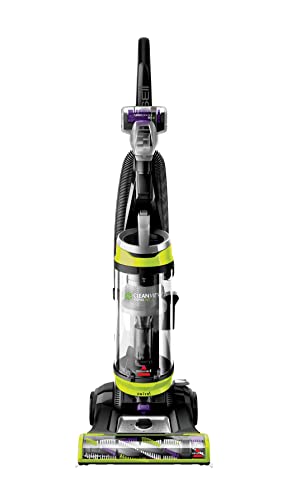
Bissell CleanView Swivel Pet Upright 2252 — Best value swivel pet upright
The CleanView Swivel Pet makes the value case for bagless pet cleaning without apologising for it. Its triple-action brushroll is designed to loosen, lift and remove embedded hair from carpet, and the large-capacity tank acknowledges the basic arithmetic of shedding: hair is bulky, and a generous cup is a genuine feature, not a luxury. Swivel steering gives it the manners of more expensive machines in furnished rooms, where most pet hair actually lives.
It is a straightforward upright rather than a transformer, and that honesty defines its ownership. Floors — carpet and hard — are its kingdom, handled confidently and quickly. Stairs and furniture are reached by hose and tools rather than by a detachable pod, which works but asks more of the owner. For a single-level home, or a household whose stairs are someone else’s problem, the CleanView’s simplicity and tank size make it the pragmatic heart of this guide.
- Format: bagless upright with swivel steering
- Brushroll: triple-action design for embedded hair and debris
- Tank: large-capacity dirt tank for fewer empties
- Floor range: carpet and hard floors across the home
- Tools: pet-focused attachments for above-floor spots
- Tier: value end of the pet upright range
Strengths
- Large tank suits heavy shedders and bigger floors
- Triple-action brushroll performs on embedded carpet hair
- Simple upright format with nothing to configure or detach
Trade-offs
- No lift-away pod for stairs and furniture
- Value build prioritises function over refinement
- Hose reach defines its above-floor ability
Best for: Single-level pet homes wanting capacity and carpet performance per pound spent.
Not suited for: Stair-heavy homes where a pod format would be used daily.
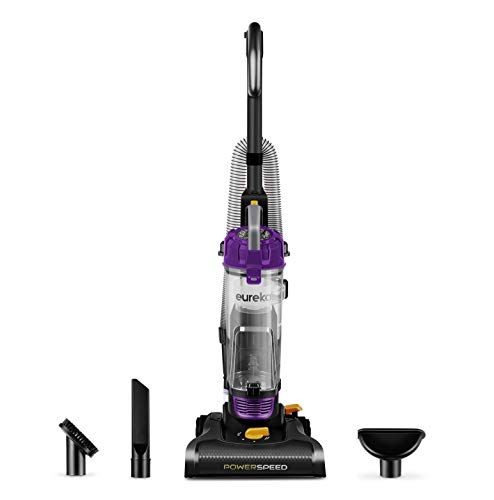
Eureka PowerSpeed Bagless Upright NEU182B — Best lightweight full-size option
Weight is the specification that decides whether a vacuum gets carried upstairs or merely intended to be. The PowerSpeed NEU182B is strikingly light for a full-size upright, yet carries a large dust cup and a proper height-adjustable brushroll with settings for the range from hard floor to deeper carpet. In a pet household spread over two floors, that combination — capacity plus carryability — solves the logistics that defeat heavier, nominally stronger machines.
Its pet credentials rest on the fundamentals rather than on specialist tools: strong suction for hair and litter, a cup big enough for a whole-floor session, and height adjustment that keeps the brush engaged properly on the short-pile rugs and runners where dogs actually spend their days. Filtration is the honest compromise of the lightweight class, adequate for hair and household dust, less specialised for dander than the HEPA picks above. Owners whose priority is hair removal across multiple floors will accept that trade gladly.
- Format: lightweight bagless upright, around ten pounds
- Cup: large 2.6-litre dust cup
- Height settings: five brushroll heights for floor types
- Floor range: carpet, rugs and hard floors
- Tools: pet turbo brush and standard attachments per listing
- Use pattern: multi-floor homes needing a carryable machine
Strengths
- Genuinely easy to carry between floors and store
- Large cup reduces emptying on whole-house cleans
- Height adjustment keeps the brush effective across rugs and carpet depths
Trade-offs
- Filtration is basic compared with sealed HEPA rivals
- Lightweight construction feels less planted on thick carpet
- Pet toolset is standard rather than specialist
Best for: Multi-floor pet homes where the vacuum must travel as easily as the dog does.
Not suited for: Dander-sensitive households needing sealed HEPA filtration above all.

Dirt Devil Endura Reach Upright — Best budget reach for above-floor hair
The Endura Reach occupies the honest bottom of this guide: the least expensive route to a full-size bagless upright that still takes pet hair seriously. Its extended reach is the headline, stretching the hose and tools to the above-floor places — sofa backs, stair edges, the tops of the dog’s favourite chair — where a purely floor-bound budget machine would surrender. For renters and first-dog households, that coverage matters more than refinement.
Endura filtration branding aside, the ownership experience is the classic budget bagless pattern: capable suction on carpet and hard floor, a cup that asks to be emptied often in shedding season, and filters that reward regular rinsing. None of that disqualifies it. Pet hair is a volume problem before it is a sophistication problem, and a light, reachable, affordable machine that gets used everywhere will outperform a premium machine that stays in one room. The Reach is the guide’s reminder that adequacy, widely applied, beats excellence narrowly applied.
- Format: lightweight bagless upright
- Reach: extended hose reach for above-floor cleaning
- Floor range: carpet and hard floor
- Filtration: Endura system with rinsable components per maker guidance
- Cup: compact, hand-emptied
- Tier: budget end of the bagless pet range
Strengths
- Above-floor reach covers furniture budget rivals ignore
- Light body suits smaller homes and storage
- Lowest-cost route into full-size bagless pet cleaning
Trade-offs
- Smaller cup fills quickly with bulky hair
- Filtration is the simplest in this guide
- Build refinement matches its tier
Best for: Renters and first-time dog owners needing whole-home coverage on a budget.
Not suited for: Large multi-dog homes that would overwhelm its cup daily.
Bagged Pet Vacuums as the Low-Dust Alternative — Prose-only: the honest alternative
Every bagless advantage has a mirror image, and the mirror is worth looking into. Emptying a bagless cup, however carefully designed, releases some fine dust at the bin — a trivial moment for most owners and a genuine problem for households managing asthma, allergies or a dust-sensitive member. A bagged machine removes that moment entirely: the bag, holding weeks of hair and dander sealed inside, lifts out and goes straight into the household waste. For those households, that is not a luxury feature; it is the whole decision.
Bagged machines also hold suction consistently as they fill, because the bag’s large surface area resists the clogging that fine dander causes, and many offer excellent filtration for the same reason. The costs are literal and ongoing — bags forever, bought in the right size, stocked before they run out — plus the environmental weight of a consumable. We discuss the class in prose only, without a linked pick, because this guide’s commission is bagless machines; but a dust-sensitive reader who chooses a good bagged pet vacuum after reading this section has been served by it, not lost to it.
- Format: prose-only — bagged upright and canister class
- Emptying: sealed disposable bag removed whole, no dust cloud
- Filtration: bag surface plus filters, often excellent for dander
- Running cost: replacement bags as a continuing consumable
- Suction behaviour: consistent as the bag fills
- Tier: spans budget to premium; bags are the constant
Strengths
- Cleanest emptying for dust-sensitive households
- Steady suction across the bag’s whole life
- Large capacity means emptying is a monthly, not weekly, event
Trade-offs
- Bags cost money forever and must be stocked
- A full bag discovered mid-clean stops the job if no spare exists
- Consumable waste that bagless owners avoid entirely
Best for: Households where dust sensitivity outweighs the appeal of bag-free running.
Not suited for: Owners whose priority is zero ongoing consumable cost.
How Do the Six Picks Compare Side by Side?
| Pick | Type | Standout trait | Watch out for |
|---|---|---|---|
| Shark Navigator Lift-Away NV360 | Bagless lift-away upright | Detachable pod turns stairs and sofas into easy territory | Cup is mid-sized, so heavy shedding weeks mean frequent empties |
| Bissell Pet Hair Eraser Lift-Off | Bagless lift-off upright | Tangle-free brushroll ends the scissor-and-kneel ritual | Premium pet features place it above basic uprights in its range |
| Bissell CleanView Swivel Pet Upright 2252 | Bagless upright | Large tank and triple-action brush at a value tier | No lift-away pod, so stairs rely on hose and tools |
| Eureka PowerSpeed Bagless Upright NEU182B | Bagless upright | Full-size cleaning at a weight small machines envy | Light build and basic filtration suit it to hair more than fine dander duty |
| Dirt Devil Endura Reach Upright | Bagless upright | Extended hose reach at the lowest tier in this guide | Budget format means smaller cup and simpler filtration |
| Bagged Pet Vacuums as the Low-Dust Alternative | Prose-only alternative class | Emptying without any dust cloud at all | Bags are a running cost and a consumable to keep stocked |
The five linked machines divide by format and filtration. The two lift-away models take the cleaning to the furniture, the CleanView and PowerSpeed maximise cup and carryability in classic upright form, and the Endura Reach stretches a budget furthest. The prose-only bagged row stands as the reminder that emptying comfort, not cleaning power, is where bagless genuinely concedes ground.
Why Does Hair Wrap Around a Brushroll, and How Do You Stop It?
A rotating brushroll collects hair the way a spindle collects thread: each strand that catches is wound tighter by the next revolution, building ropes that lift the brush off the carpet and strangle its rotation. Long hair — human and canine alike — wraps fastest, which is why households with both long-haired people and long-haired dogs suffer most. The visible symptom is a machine that sounds busy and cleans little, pushing a grey tide of hair ahead of itself.
The defences are design and habit. Tangle-free brushrolls, like the Bissell Lift-Off’s, arrange bristles and airflow so hair migrates into the cup instead of winding. Conventional rolls demand a monthly appointment with scissors or a seam ripper, performed before the wrap becomes a stall. Either way, the brushroll is a maintained component, not a fit-and-forget one, and the owner who accepts that keeps any of these machines performing at its listing’s promise.
How Does Cyclonic Separation Keep Suction Alive in a Full Cup?
A bagless upright’s central engineering problem is that its dirt container is also its air filter’s first stage. Cyclonic systems spin the incoming air so hair and grit are flung outward and downward into the cup while cleaner air proceeds to the filters. Done well, the cup can fill with bulky hair while airflow — and therefore cleaning — barely diminishes, which is precisely the behaviour a shedding household needs at minute twenty of a clean.
Done poorly, fine dander coats the shroud and filters, and the machine fades exactly when the owner is furthest from the bin. The practical test when shopping is not the cyclone’s marketing name but the maintenance it implies: washable shrouds, accessible filters and a cup that empties without compacted hair needing to be pulled out by hand. The picks in this guide were chosen with that weekly reality in view.
Where Does Pet Hair Actually Collect in a House?
Floors are the visible third of the problem. Hair concentrates where air currents die and fabrics invite it: sofa seats and their seams, the dog’s bed and the rug beneath it, stair treads and the landing turn, the hallway runner that every paw crosses, and the owner’s own bed if the dog has negotiated access. A vacuum strategy that only addresses open floor is a strategy for the minority of the hair.
This geography is why format matters as much as suction in this guide. Lift-away pods and long-reach hoses exist to take cleaning to the furniture and stairs where hair actually settles, and the household that maps its own hair geography honestly — following the dog rather than the floorplan — will choose between the five linked picks more wisely than one comparing motor figures.
How Should You Empty a Bagless Cup Without the Dust Cloud?
Technique converts the category’s notorious moment into a minor one. Empty outside when you can, or into a bag held around the cup’s mouth indoors; open the cup at the bottom of the bin rather than above it, so the fall is short; and let the contents drop rather than shaking them loose into the air. A cup emptied before it is overfull releases its hair as a coherent plug instead of an aerosol of fines.
Dust-sensitive households should adopt the stricter ritual — outdoor emptying, a mask during shedding season, hand-washing afterwards — or take the prose-only section’s advice and consider a bagged machine without any sense of defeat. The goal is a routine the household can sustain for the dog’s whole life, and sustainability includes the owner’s lungs and temper, not just the machine’s suction curve.
What Filter Care Do Bagless Pet Vacuums Really Need?
Pet dander is the fine fraction that household dust only pretends to be, and it loads filters faster than new owners expect. Rinsable filters should be washed on the maker’s schedule — and fully dried before refitting, since a damp filter in a warm machine is a smell waiting to happen. HEPA filters that are not washable should be replaced on schedule rather than shaken and hoped over, because a spent HEPA filter quietly converts a sealed system into an ordinary one.
The shroud and cyclone assembly deserve the same respect: hair bridges across them, fines cake on them, and a few minutes under a tap monthly preserves the suction the owner paid for. None of this is onerous, but all of it is real, and it is the honest running cost of the bagless bargain — attention instead of money. Owners who prefer paying money to attention have a prose-only section above written for them.
How Do You Choose Between Lift-Away, Classic Upright and Lightweight?
Choose by the house’s hair geography and your own carrying habits. A multi-level home with carpeted stairs and a sofa-sleeping dog rewards the lift-away format daily; the pod is not a gimmick there but the main tool. A single-level home with large open floors rewards the classic upright’s bigger cup and simpler path from cupboard to carpet. A home spread over floors with no storage on the upper level rewards the lightweight machine that actually gets carried.
Be honest about the operator too. A vacuum that one household member finds heavy becomes that member’s excuse, and pet hair does not respect excuses. The best format is the one the whole household will use without negotiation, which is a domestic truth no specification sheet will ever print.
What Does a Sensible Weekly Pet-Hair Routine Look Like?
Anchor the full clean to a fixed day and let the machine’s strengths set its shape: floors first with the upright, then pod or hose work on the dog’s furniture, stairs and the hallway runner, finishing with a crevice pass along skirting where hair lines accumulate. Empty the cup at the end, outside, while the machine is already in your hands — not at the start of next week’s clean, when the compacted hair has had seven days to settle in.
Between full cleans, a two-minute targeted pass over the dog’s bed area and the door rug prevents the visible build-up that makes the weekly clean feel like a rescue. Wash or replace filters on a calendar rhythm rather than when performance visibly fades, because by the time fading is visible the filters have been costing suction for weeks. That is the entire system; its power is that it is boring enough to survive busy months.
How Does Dander Differ from Hair, and Why Does It Test Filtration?
Hair is the visible problem; dander is the airborne one. The tiny skin flakes pets shed continuously are light enough to stay suspended, travel room to room on air currents, and pass through filtration that stops hair effortlessly. A household can win the hair war completely — every sofa raked, every floor gleaming — and still have a dander load that only good filtration and regular cleaning of soft furnishings will reduce.
This is why the sealed HEPA systems in this guide matter beyond their badge. A filter only performs if the air is forced through it rather than around it, and sealed-system design is the difference between filtration as engineering and filtration as decoration. Dust-sensitive readers should weight that distinction heavily, and should also wash the dog’s bedding weekly, because no vacuum compensates for a dander reservoir left undisturbed in the corner of the room.
What Should Renters and Sofa-Sleeping Dogs Change About the Choice?
Renters face two specific pressures: storage is limited, and the furniture being protected is often their own even when the floors are the landlord’s. A lift-away machine earns double value there, serving as the furniture cleaner that keeps a deposit safe and the floor cleaner the lease expects. Lightweight models suit small flats where the vacuum lives in a cupboard with everything else the household owns.
Where a dog sleeps on the sofa nightly, treat the sofa as a floor in your routine: pod or hose, upholstery tool, weekly without exception, and a washable throw as the sacrificial layer that takes the worst of the hair and dander between cleans. The throw is the cheapest filtration device in this entire guide, and households that adopt one find every vacuum in it performing beyond its tier.
How Do You Vacuum a House with Both Carpets and Hard Floors?
Mixed flooring is the modern norm and the pet owner’s mixed blessing: hard floors release hair easily but display it instantly, while carpets hide hair until it is deeply embedded. The brushroll shutoff on machines like the NV360 exists for this house — brush off on hard floors so debris is sucked rather than scattered, brush on for carpet so embedded hair is agitated free. Height adjustment, as on the PowerSpeed, refines the same partnership across rug depths.
Sequence the clean from carpet to hard floor when you can, because the carpet work shakes loose the dust that the hard-floor pass then collects, and keep a hard-floor eye on the skirting lines, where hair drifts and gathers in visible grey ropes within days of any clean. Mixed-floor homes also benefit most from the midweek two-minute pass, targeted at the hard-floor areas where new hair announces itself first.
A Word on Vacuum Noise and Nervous Pets
Many dogs tolerate a vacuum; some genuinely fear it, and a machine chosen without regard to that fear imposes a twice-weekly stress on the household. No upright in this guide is quiet in any absolute sense, but predictable routine is the real anxiolytic: same day, same order of rooms, the dog settled elsewhere with an occupation, and the machine put away promptly afterwards. Animals habituate to rituals far better than to surprises.
For very nervous pets, schedule the full clean when the dog is out on a walk, and let the midweek pass be the short, distant one. Never vacuum around a cornered animal, and never let children turn the machine into a chasing game — the association, once made, outlasts any amount of later calm. The cleanest house is not worth a dog that dreads Tuesdays.
How Should You Read Runtime, Wattage and Suction Claims Here?
All five linked picks are corded, which removes battery anxiety and replaces it with simpler questions: is the cord long enough for your largest room without a socket change, and does the machine hold its performance as the cup fills? Wattage figures describe consumption more than cleaning, and suction claims are measured under conditions no pet home reproduces. The honest comparisons are the ones this guide has used throughout — format, filtration, brushroll design, cup capacity and tools — because those are what your hands and your dog’s hair will actually test.
Cord length deserves its unfashionable moment. A cord that reaches from one socket across the main living space saves the small interruptions that fragment a clean and tempt owners to skip the far room. Check it against your rooms as you would check a robot’s pool length in our pool guides: by measurement, not by optimism.
When Does a Second, Smaller Vacuum Make Sense Alongside an Upright?
The upright owns the weekly clean, but pet hair arrives daily, and many households find a small handheld or stick machine transforms the between-days: thirty seconds on the door rug, the car footwell, the spill of litter by the tray. The second machine is not a rival but a frequency device, and its existence protects the weekly routine from becoming a daily obligation that collapses.
Choose the small machine for storage proximity — it should live where the hair lands, charged and visible — and let the upright remain the deep tool. Households that adopt the pairing consistently report the paradox this guide keeps meeting in different forms: owning more cleaning equipment leads to less time spent cleaning, because each job is done at the moment and scale it actually requires.
How Do You Deep-Clean a Carpet That Has Hosted a Dog for Years?
A carpet with years of dog history holds a deep layer that ordinary passes skim: hair and dander worked down to the backing, invisible from above and released a little with every footstep. The deep clean is a slow event — vacuum the room in one direction at half your usual pace, empty the cup, then repeat at right angles — and the second pass’s harvest routinely shocks owners who believed the room was clean. Sprinkle nothing on the carpet beforehand unless the machine’s maker approves it; powders load filters and complicate the very clean they promise to help.
Follow with the furniture and skirting of the same room before moving on, because a deep-cleaned carpet in an uncleaned room simply becomes the new settling ground. Work room by room across a weekend rather than attempting the whole house in a day, and accept that the first deep clean of a long-dogged carpet is a restoration, not a maintenance event. Afterwards, the weekly routine described earlier will hold the result with surprising ease, because maintenance on a restored carpet is a fraction of the work of maintenance on a loaded one.
What Changes When the Pet Is a Cat Rather Than a Dog?
Cat hair is finer, lighter and more electrostatic than most dog hair; it floats further, clings to vertical fabrics, and gathers in the high places cats occupy — shelf tops, wardrobe rails, the back of the television. The uprights in this guide handle the floor fraction identically, but the cat household should weight above-floor reach more heavily in its choice, because the cat’s territory is vertical in a way the dog’s never is.
Litter adds its own demand: fine, abrasive, tracked on paws along predictable routes from the tray. Those routes deserve a targeted pass more often than the room at large, and filters deserve closer attention, since litter dust is exactly the fine fraction that loads them. The litter area is also where the midweek small-machine habit pays most, because litter tracked on Monday and vacuumed on Saturday has spent five days being distributed by every foot in the house.
How Should You Handle a Vacuum That Starts to Smell of Dog?
A pet vacuum that smells has absorbed its work: the odour lives in the cup’s residue, the filters and the brushroll’s wound hair, and it re-aerosolises a little with every use. The cure is a strip-down clean — cup washed and fully dried, filters washed or replaced, brushroll cleared and wiped, the hose checked for a trapped mat of hair that has been quietly composting. Performed once, thoroughly, it usually restores the machine completely.
Prevention is rhythm rather than product: empty after every clean rather than storing hair in the machine, wash the dog’s bedding so the vacuum is not the only line of defence, and never vacuum wet accidents with a dry machine. Scented powders marketed for carpets mostly perfume the filter while loading it, and this guide’s advice is to fix the source — residue — rather than mask it.
Why Do Some Rooms Stay Hairy Despite Regular Vacuuming?
Airflow explains most stubborn rooms. Hair travels on currents from where the dog shakes, sleeps and is groomed, and it settles where currents die: behind doors, under radiators, in the lee of large furniture. A room can be vacuumed conscientiously across its open floor and retain a permanent hair population in those dead zones, which the owner’s eye eventually reads as the room simply being hairy.
The correction is to vacuum the room’s edges and obstacles deliberately — crevice tool along skirting, hose under the low furniture, a pass behind the door — rather than adding more passes to the open middle. Grooming location matters too: brushing the dog in one consistent place, ideally hard-floored and near a bin, concentrates the fallout where a two-minute pass controls it, instead of distributing it across every carpet the dog crosses afterwards.
How Do You Introduce a New Vacuum to a Household with Routines Set in Stone?
New machines fail socially in predictable ways: the cup empties differently and gets forced, the pod detaches by a latch nobody finds, the cord is shorter than the old machine’s and the far room quietly drops out of the routine. Spend the first clean learning the machine deliberately — read the emptying sequence, practise the pod release, walk the cord through your largest room — and the household’s existing routine will absorb the new tool within a fortnight.
Keep the old machine nowhere. A fallback vacuum in the garage becomes the excuse that prevents the new one’s habits forming, and the new machine is then judged forever by its worst first week. Commit, learn, and let the routine rebuild itself around the better tool; pet households are creatures of rhythm, and rhythm, once reset, defends itself.
One Last Check Before You Order a Bagless Pet Vacuum
Walk your home as your dog experiences it: where the hair mats, where the stairs turn, where the cupboard that must hold the machine actually is. Measure the cupboard, count the stairs, note whether dander sensitivity lives in your household, and then choose among the five linked picks with those facts in hand. The machine that fits your geography and your lungs will still be earning its place when the dog is grey; the machine bought on a suction figure alone will be negotiating for its cupboard space within the year.
How Does the Seasons’ Shedding Cycle Change the Work?
Most dogs shed in pulses rather than evenly, and the spring pulse in particular can triple the hair load for a month. The bagless routine should flex with it: empty the cup mid-clean without resentment, shorten the interval between furniture passes, and give the filters an extra rinse at the pulse’s peak, because dander and fine undercoat load them fastest exactly then. Owners who keep the same stately weekly rhythm through the moult conclude their machine has weakened, when in fact the dog has strengthened.
Use the pulse as the household’s annual maintenance prompt — brushroll check, filter wash, dog bedding laundered, the deep-clean pass on the main carpet — and the season that produces the most hair also produces the best-kept machine. By summer the load falls back, the routine relaxes, and the system coasts until the autumn pulse asks the same questions at half the volume.
What Is the Honest Environmental Ledger of Bagless Ownership?
Bagless ownership avoids a steady stream of disposable bags, which is its clearest environmental credit, and replaces it with water for filter washing, electricity identical to any corded machine, and a plastic appliance whose lifespan is the dominant variable. A bagless upright maintained for eight years is a genuinely low-waste device; one neglected into a two-year life is not, whatever it saved in bags.
The practical conclusion is unglamorous: the greenest choice in this guide is the machine you will maintain, in the format your household will use for longest. Longevity is the environmental feature, and it is purchased with the small calendar of care — filters, brushroll, cup — that this guide has described from several directions because it matters from all of them.
How Should You Vacuum When a Household Member Has a Dust Sensitivity?
Schedule the full clean for when the sensitive person is out, and let the house settle — windows open on a dry day — before they return. Empty the cup outdoors, shower or at least change after a heavy shedding-season clean if symptoms are significant, and weight the sealed HEPA picks in this guide above the lighter, simpler machines. Wash the dog’s bedding and throws more often than feels necessary, because soft furnishings, not floors, hold the reservoir that keeps re-loading the air.
If those measures still leave symptoms trailing every clean, take the prose-only section seriously and price a good bagged machine as a health purchase rather than a cleaning one. The households that thrive with pets and sensitivities are the ones that treat the system — machine, textiles, routine, timing — as a whole, instead of asking any single vacuum to perform a medical miracle it never promised.
Three Small Questions Owners Ask at the Point of Purchase
Should you vacuum more slowly for pet hair? Yes — pace is the cheapest performance upgrade in this category. A slow pass gives the brushroll time to agitate embedded hair free and the airflow time to carry it into the cup, while a fast pass skims the surface and leaves the woven layer untouched. On the dog’s main carpet, halve your usual speed and overlap each pass by a third; the difference is visible in the cup afterwards. Owners who adopt the slow pass routinely report that their existing machine suddenly seems stronger, which tells you where the performance was hiding all along.
What should you do with the hair the vacuum collects? Ordinary household waste is the standard route: empty the cup into a bag, tie it, and bin it, which also contains the dander for the rest of the waste journey. Gardeners sometimes compost small amounts of pet hair, but the vacuumed mixture contains household dust and grit as well as hair, so the bin is the cleaner and simpler answer for cup contents. And can the dust cup itself be rinsed? On most bagless uprights, yes — the cup is a plastic vessel that tolerates rinsing once emptied, provided it dries completely before refitting and any filter components are kept out of the water as the maker directs. A clean cup restores the fill line’s visibility and removes the residue that makes a pet vacuum smell of its work.
What Mistakes Do Pet Owners Make with Bagless Vacuums?
The first mistake is letting the cup overfill because emptying is mildly unpleasant. Hair compacts, cyclones choke, suction fades, and the owner concludes the machine is weak when it is merely full. Empty at the marked line, every time, and the machine you bought is the machine you keep.
The second mistake is ignoring the brushroll until it stalls. Hair wrap is progressive and silent; a monthly two-minute check prevents the scissor surgery and belt strain that follow neglect. Tangle-free designs postpone the problem, they do not repeal it.
The third mistake is vacuuming the floors beautifully and the furniture never. Hair’s strongholds are the sofa, the stairs and the dog’s bed, and a routine that skips them weekly wonders why the house never feels clean. Use the pod, the hose, the tools — they were the point of the purchase.
Final Recommendation
For the majority of pet households, the Shark Navigator NV360 remains the balanced recommendation: lift-away reach for the furniture and stairs, sealed HEPA filtration for dander, and swivel manners on the floor, at a sensible tier. The Bissell Pet Hair Eraser Lift-Off overtakes it where brushroll tangles have been the household’s recurring grief, the CleanView Swivel Pet serves single-level homes wanting tank capacity, the PowerSpeed serves multi-floor homes wanting lightness, and the Endura Reach serves budgets without surrendering above-floor coverage.
Buy for your house’s hair geography and your own emptying tolerance, keep the filters and brushroll on a small calendar of care, and a bagless machine will repay you in the only currency that matters here — a home that stops announcing its dog at the front door.
Frequently Asked Questions
Are bagless vacuums bad for allergies because of emptying?
Emptying is the one moment a bagless machine releases dust, and technique controls most of it: empty outside, low into a bag, before the cup is overfull. The sealed HEPA models in this guide capture dander well during cleaning itself. Households with serious dust sensitivity may still prefer the bagged route discussed in our prose-only section, and that is a legitimate choice rather than a failure of research.
How often will I empty the cup with two shedding dogs?
Expect to empty after most full-house cleans, and sometimes mid-clean at the height of the moult. Hair is bulky rather than heavy, so cup volume is the relevant figure; the larger-tank picks exist precisely for your household. Treat the marked fill line as a hard limit, not a suggestion.
Do tangle-free brushrolls really work?
They work as designed: hair is channelled into the cup rather than wound around the roll, so the scissor ritual largely disappears. They do not eliminate filter care or the occasional manual check, and very long human hair remains the sternest test. For long-haired-dog households the improvement is dramatic and immediately noticeable.
Can a bagless upright handle litter and kibble as well as hair?
Yes — the same suction and brush action that lifts hair handles the granular debris pets scatter, and hard-floor brushroll shutoff, where fitted, prevents scattering. Avoid vacuuming wet food or spills with these dry machines; let accidents dry or deal with them by hand first.
How long should a bagless pet vacuum last?
Years, with the maintenance this guide describes: filters cared for, brushroll checked, cup not abused. The consumables are filters and occasionally belts or brushes, all modest. Machines die early in pet homes mainly through neglect of exactly those items, not through the hair itself.
Is a lift-away pod worth it if my stairs are uncarpeted?
Partly. Hard stairs still collect hair along their edges and risers, and a pod with a crevice tool cleans them faster than a brush and pan. The pod also serves sofas, beds and the car, so the question is really whether above-floor cleaning matters in your home — in a pet household, it almost always does.
Related Guides
Pet hair is a whole-house system problem, and these neighbouring guides cover the backpack format, the budget end of the category and the air that hair and dander leave behind: Best Bagless Backpack Vacuums Best Affordable Vacuums for Pet Hair Best Budget Pet Vacuums Best Air Purifiers for Allergies and Pet Dander


