What's inside
- Key Takeaways
- Quick Picks
- How Did We Choose These Vacuums for High-Pile Carpet?
- How Do the Six Picks Compare Side by Side?
- How Do You Measure Your Carpet’s Pile Before Buying?
- Manual Dial, Automatic Adjustment or Suction Control: Which Suits You?
- Why Does Deep-Pile Cleaning Fill Bags and Cups So Fast?
- How Should You Vacuum High-Pile Carpet, Pass by Pass?
- What About Shag and Very Long Pile?
- How Do You Protect the Carpet Itself While Cleaning It?
- How Does Underlay Change the Machine You Need?
- What Is the Restoration Clean for a Neglected High-Pile Room?
- How Should Stairs Carpeted in High-Pile Be Handled?
- A Note on Allergies in High-Pile Homes
- How Do You Choose Between an Upright and a Canister for a Whole House of Pile?
- What Does Professional Carpet Care Know That Homes Can Borrow?
- How Should You Handle the Transition When New High-Pile Carpet Is Laid?
- Why Do Some High-Pile Rooms Still Look Flat After Cleaning?
- How Do You Store a Bagged Upright So It Is Ready for Deep Pile?
- How Does Pet Ownership Compound the High-Pile Problem?
- What Should You Ask a Carpet Retailer Before the Flooring Is Chosen?
- One Last Check Before You Order for High-Pile Carpet
- How Do Seasonal Changes Alter Deep-Pile Cleaning?
- A Final Word on Loving a Difficult Carpet
- How Should You Compare Two Machines on Your Own Carpet?
- Why the First Clean on a New Machine Deserves an Audience
- One Sentence to Carry to the Shop
- A Closing Note on Patience with Pile
- What Mistakes Do High-Pile Owners Make When Choosing a Vacuum?
- Final Recommendation
- Frequently Asked Questions
- Related Guides
As an Amazon Associate I earn from qualifying purchases. This post may contain affiliate links at no extra cost to you.
cottageverdict.com is reader-supported. When you buy through links on our site, we may earn an affiliate commission.
Where to buy: the five vacuums reviewed in detail below are sold on Amazon, and their linked names lead to the listings where you can check price on Amazon and confirm the height-adjustment arrangement against your own carpet before ordering.
High-pile carpet defeats ordinary vacuums in a specific, mechanical way: the machine’s head sinks into the pile, the brushroll buries itself, airflow seals against the fibres, and a vacuum that glides over low pile becomes a heavy, airless drag that cleans the surface while the grit stays at the base. The best bagged vacuums for high-pile carpet solve that problem with genuine height adjustment, brushrolls tuned for deep fibres, and suction that reaches the pile’s foundation — while the bag keeps the large volume of extracted carpet dust sealed and the filtration consistent across a long clean.
The bagged format suits this carpet type for reasons beyond nostalgia. Deep-pile cleaning extracts a surprising volume of dust, fibre and grit from the pile’s base, and a bag swallows that volume across weeks without the suction fade a small cup suffers mid-clean. Bagged machines also dominate the designs that high-pile demands — powerful uprights with manual height dials, canisters with powered heads — because the format’s long history is intertwined with exactly this flooring era and its descendants.
Four of the five linked picks are true bagged machines, spanning a specialist soft-carpet upright, a powered canister, and two commercial-grade uprights whose simplicity is their strength. The fifth, the Shark Rotator NV501, is included and labelled honestly as the bagless exception: its adjustable suction and lift-away versatility make it a legitimate high-pile tool for households committed to bagless running, and pretending the category has no such crossover would underserve them. One prose-only section explains the underlying science — pile height, brush behaviour and airflow — so the reader can judge any machine, listed here or not.
Judge everything that follows against your own carpet’s truth: its pile height measured at the door edge where it is uncompressed, its density, and whether a thick underlay lets a heavy machine sink further. High-pile is a spectrum from plush to shag, and the right setting on the right machine matters more than any headline suction figure ever printed.
Key Takeaways
- Height adjustment is the non-negotiable feature: the head must ride high enough that the brush agitates pile tips without the housing sealing against the fibres.
- Bagged machines hold suction across the large dust volume deep-pile cleaning extracts, and they dominate the designs built for this carpet type.
- The Soniclean is the specialist for soft, dense luxury carpet; the Kenmore 600 canister brings a powered head and HEPA bagged filtration to the same problem.
- Commercial uprights from Oreck and Sanitaire succeed through light weight and simple, robust height behaviour rather than features.
- The Shark NV501 is this guide’s labelled bagless exception, included for adjustable suction — everything else linked here is genuinely bagged.
Quick Picks
| Pick | Badge | Why it earns its place |
|---|---|---|
| Soniclean Soft Carpet Upright Vacuum | Best for soft, dense luxury carpet | An upright designed specifically for soft carpet, using sonic vibration and a soft-touch brush to clean deep, dense pile without bogging down. |
| Kenmore 600 Series Bagged Canister Vacuum | Best bagged canister for high-pile | A bagged canister with a powered Pet PowerMate head, hair-eliminator brushroll, two-motor design and HEPA filtration for carpet and hard floors alike. |
| Oreck Commercial XL Upright Vacuum | Best lightweight bagged upright | A famously light bagged upright with automatic height adjustment and a high-speed brushroll, long used commercially on carpet of every depth. |
| Sanitaire Tradition SC684G Upright | Best durable commercial workhorse | A traditional bagged commercial upright with a metal-and-substance build, manual height settings and a design made to be repaired, not replaced. |
| Shark Rotator Lift-Away NV501 | Bagless exception — included for adjustable suction, labelled honestly | A bagless lift-away upright with HEPA filtration and swivel steering; included, clearly labelled as not bagged, because its suction control helps on high-pile. |
| Height Adjustment and Soft-Carpet Brush Science | Prose-only: why high-pile defeats ordinary vacuums | Pile height, brush behaviour and the airflow seal — the three-part mechanics that decide whether any machine can clean deep carpet. |
How Did We Choose These Vacuums for High-Pile Carpet?
Eligibility began with height behaviour. Each linked machine had to offer a credible mechanism for riding correctly on deep pile — a manual height dial with genuinely high settings, automatic height adjustment that responds to pile, a specialist soft-carpet design, or, in the Shark’s case, suction adjustment that prevents the head sealing down. Machines whose only answer to high pile was more power were excluded, because power without clearance is precisely the failure this guide exists to prevent.
We weighted brushroll design next. Deep pile needs a brush that reaches into the fibre column and flicks grit upward into the airstream without chewing the pile itself — a balance that soft, dense modern carpets make genuinely difficult, since their fibres mat and resist. The Soniclean’s whole existence is that balance, and the commercial machines achieve a version of it through light heads that float rather than plough.
Finally, we kept the bagged brief with one declared exception. Four picks are bagged because the title promises bagged and the format’s virtues here are real. The Shark NV501 is labelled a bagless exception in its heading, its table rows and its text, included because some readers will not buy bagged at any recommendation — and they deserve one honest crossover option rather than a guide that ignores them.
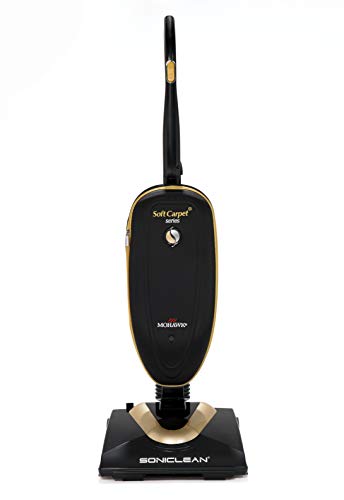
Soniclean Soft Carpet Upright Vacuum — Best for soft, dense luxury carpet
Modern soft carpet — the dense, silky, high-pile flooring sold under a dozen luxury names — broke a generation of vacuums. Their heads sank, sealed and stalled on it, and owners concluded the carpet was uncleanable. The Soniclean Soft Carpet upright exists as the direct answer: a machine engineered around that flooring, pairing a soft-touch brushroll that works the pile without tearing at it with sonic vibration that loosens grit at the pile’s base so the airflow can lift it away. On the carpet it was designed for, the difference is not subtle.
The bagged format completes the specialist brief. Deep soft pile surrenders a large volume of fine dust and fibre, and the bag contains it across weeks of cleans while filtration stays consistent. The machine’s manners on its home surface — it moves, where rivals drag — make the weekly clean sustainable, which matters because soft carpet shows traffic patterns quickly and rewards frequent, gentle attention over occasional heroics. If your home’s defining surface is soft high-pile, this is the guide’s most confident single recommendation.
- Format: bagged upright designed for soft carpet
- Cleaning action: sonic vibration plus soft-touch brushroll
- Pile fit: soft, dense, high-pile carpet specifically
- Filtration: bagged system with sealed disposal
- Use pattern: carpet-focused homes with luxury soft pile
- Tier: specialist premium within the bagged upright class
Strengths
- Cleans the soft-carpet generation that defeats conventional uprights
- Sonic action reaches grit at the pile base without harsh brushing
- Moves across deep pile instead of sealing and dragging
Trade-offs
- Specialisation means hard floors are not its home territory
- Bags are a continuing consumable, as with all bagged picks
- Less versatile for mixed-floor homes than the canister below
Best for: Homes whose main rooms wear soft, dense, high-pile carpet.
Not suited for: Hard-floor-dominant homes needing one machine for everything.

Kenmore 600 Series Bagged Canister Vacuum — Best bagged canister for high-pile
The Kenmore 600 Series answers high-pile with the canister’s classic advantage: a powered floor head driven by its own motor, fed by a body that never has to balance on the pile itself. The head can be set and worked across deep carpet with the two-motor design holding brush and suction in their proper partnership, while the bagged body — using the Type Q HEPA bags examined elsewhere in our guides — keeps filtration at the level a deep-pile dust load demands. The hair-eliminator brushroll addresses the wrapping problem that pet-owning, high-pile households suffer doubly.
Versatility is the canister’s second argument. The same machine that works the bedroom’s plush carpet takes its bare-floor tool to the kitchen, its attachments up the stairs and its Pet PowerMate to the upholstery, with a retractable cord and a stair-friendly grip smoothing the transitions. For a mixed-floor home whose carpet happens to be high-pile, the 600 Series avoids the specialist’s compromise: nothing in the house is a second-class surface. It asks only that the owner accept the canister’s trailing body, a habit most converts stop noticing within a month.
- Format: bagged canister vacuum with powered floor head
- Motors: two-motor design separating brush and suction duties
- Brushroll: hair-eliminator design to resist wrapping
- Filtration: HEPA system with Type Q bagged primary stage
- Tools: Pet PowerMate and attachments for above-floor work
- Cord: retractable, with stair-grip body design
Strengths
- Powered head holds its settings and aggression on deep pile
- One machine serves carpet, hard floors, stairs and upholstery properly
- HEPA bagged filtration suits the dust volume high-pile releases
Trade-offs
- Trailing canister body is a habit some upright loyalists resist
- Heavier total system to store than a single upright
- Bags and filters both appear on the consumables calendar
Best for: Mixed-floor homes with serious high-pile carpet in the main rooms.
Not suited for: Owners who know they dislike canister handling from past experience.

Oreck Commercial XL Upright Vacuum — Best lightweight bagged upright
The Oreck Commercial XL solves high-pile by subtraction. It is light enough that it does not sink into deep pile the way heavy uprights do, its automatic height adjustment lets the head float at the surface the carpet presents, and its high-speed brushroll agitates the pile tips and upper column where most household dirt lives. Hotels and offices have run these machines across acres of carpet for decades precisely because the formula — light, simple, bagged, effective — survives both the flooring and the staff turnover.
In a home, the same virtues read as kindness: a machine an older owner can carry upstairs, a bag that swallows weeks of carpet dust, and a near absence of settings to get wrong. The compromises are the commercial ones — a toolkit and refinement level aimed at floors rather than at the full domestic repertoire, and a design language that prioritises serviceability over beauty. For a high-pile home whose priority is a light machine that simply cleans carpet well, those compromises are easily borne.
- Format: bagged commercial upright, notably lightweight
- Height: automatic adjustment across carpet depths
- Brushroll: high-speed design for carpet agitation
- Floor range: carpets and hard floors per the listing
- Use pattern: commercial carpet care adopted by homes
- Tier: mid-range with commercial durability expectations
Strengths
- Light weight prevents the sinking that stalls heavy uprights on pile
- Automatic height behaviour removes the settings guesswork
- Simple, serviceable design with a long commercial track record
Trade-offs
- Above-floor toolkit is minimal beside domestic rivals
- Commercial styling and noise character
- Bagged consumables continue as with all bagged picks
Best for: High-pile homes wanting the lightest effective bagged upright, including older owners.
Not suited for: Homes needing rich above-floor and upholstery capability from one machine.
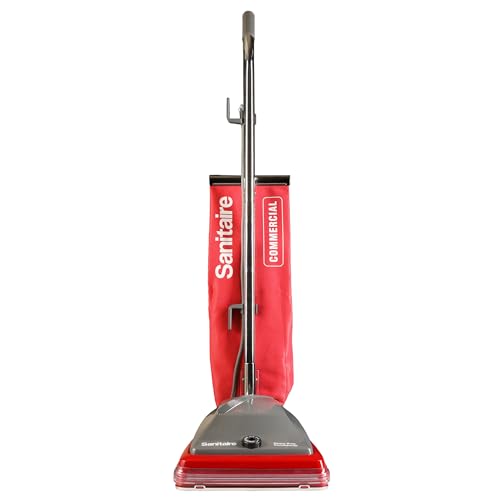
Sanitaire Tradition SC684G Upright — Best durable commercial workhorse
The Sanitaire Tradition is the upright as the commercial world made it for generations: a bagged machine of substance, with manual height adjustment that gives the operator explicit control over how the head rides a given carpet, a brushroll built for sustained agitation, and construction intended to be opened, serviced and returned to work rather than discarded at the first failure. On high-pile carpet, that manual dial is the point — the operator sets the head high enough to ride the pile and low enough to work it, and the setting stays where it was put.
Homes that adopt the Tradition usually do so after lighter machines have disappointed them on deep carpet or died young on its resistance. The Sanitaire’s weight, which counts against it on stairs, counts for it on the flat: planted, steady, and indifferent to the drag that makes lesser uprights wander. It is not a feature-rich domestic appliance and does not pretend to be; it is a carpet-cleaning instrument with a bag, and for high-pile rooms in a house that values longevity over versatility, that focus is the recommendation.
- Format: bagged commercial upright, traditional construction
- Height: manual adjustment dial with positive settings
- Build: serviceable design with widely available parts
- Use pattern: sustained carpet cleaning in commercial and domestic settings
- Filtration: bagged primary filtration
- Tier: commercial mid-range, bought for lifespan
Strengths
- Manual height control suits deliberate high-pile setup
- Repairable construction supports a very long service life
- Planted, steady handling on deep carpet
Trade-offs
- Heavy to carry between floors
- Commercial noise and minimal above-floor equipment
- Aesthetics and refinements trail domestic designs
Best for: High-pile homes prioritising durability and explicit height control.
Not suited for: Multi-level homes where the machine must travel stairs weekly.
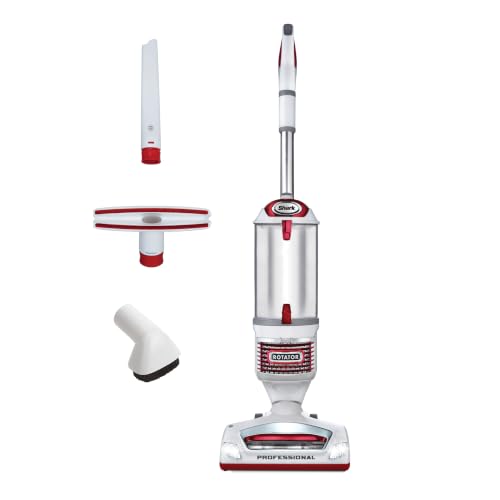
Shark Rotator Lift-Away NV501 — Bagless exception — included for adjustable suction, labelled honestly
The label comes first, in the heading and here again: the NV501 is a bagless machine, and it appears in a bagged guide as a declared exception, not a quiet substitution. Its claim on a high-pile reader’s attention is suction adjustability. On deep pile, the failure mode is often the head sealing itself to the carpet under full suction; a machine that lets the operator bleed that suction back to the point where the head rides and the brush works gives the user a control that functions, in practice, like a second height adjustment.
The rest of the Rotator package is the familiar, capable Shark formula: lift-away pod for stairs and furniture, swivel steering, HEPA filtration within a sealed system, LED headlights that reveal the grit line at the skirting. For a household that will not return to bags — and such households have their reasons, rehearsed in our bagless guides — the NV501 is the honest crossover we would point to for high-pile rooms, with its dust-cup discipline accepted as the price. Bagged loyalists should pass it by for the four machines above, which is exactly the choice this guide’s labelling exists to make cleanly.
- Format: bagless lift-away upright — not a bagged machine
- Suction: adjustable, to prevent sealing on deep pile
- Filtration: HEPA filter within a sealed system
- Steering: swivel head with LED headlights
- Tools: wide upholstery tool, dusting brush and crevice tool
- Cup: hand-emptied; filters on a wash-and-replace rhythm
Strengths
- Suction control directly addresses high-pile’s sealing failure
- Lift-away versatility covers stairs and furniture
- No bags to buy, for households committed to bagless running
Trade-offs
- Bagless — cup emptying releases the dust bags would seal
- Smaller dirt capacity than the bagged picks on deep-pile loads
- Filters require the washing discipline bagged owners skip
Best for: Bagless-committed households with high-pile carpet in main rooms.
Not suited for: Readers who came to this guide specifically for bagged ownership.
Height Adjustment and Soft-Carpet Brush Science — Prose-only: why high-pile defeats ordinary vacuums
High-pile failure is a three-part mechanism. First, weight: a heavy head compresses the pile beneath it, shortening the very fibres it must clean. Second, seal: with the housing sunk into the pile, the carpet itself gaskets the head, airflow collapses, and suction — which is only useful when air moves — becomes a static grip that makes the machine harder to push while cleaning less. Third, brush burial: a brushroll set for low pile ploughs through deep fibres, wrapping itself in carpet wool and straining its drive, while the grit at the pile’s base sits undisturbed below the brush’s effective reach.
Correct height adjustment reverses all three. The head rides on the pile’s surface, the brush tips agitate the fibre column’s upper and middle reaches, and air flows through the pile — carrying loosened grit from depth into the machine. Soft-carpet science adds a fourth consideration: dense modern fibres mat under aggressive brushing, so the ideal action agitates without tearing, which is the Soniclean’s founding insight and the reason gentle, frequent cleans beat rare, violent ones on luxury pile. Judge every machine you ever consider for this carpet by those mechanics, and marketing language becomes easy to translate.
- Format: prose-only — the mechanics of high-pile cleaning
- Failure one: head weight compresses the pile
- Failure two: the carpet seals the head and kills airflow
- Failure three: the brushroll buries and wraps in deep fibre
- Correction: ride height, brush-tip agitation, moving air
- Soft-carpet addition: agitate without tearing the fibre
Strengths
- Explains every success and failure in this category
- Gives buyers a test to apply to any future machine
- Justifies the settings discipline the picks require
Trade-offs
- No product to buy — knowledge only
- Applying it may demand a new machine after all
- Settings still need per-carpet experimentation
Best for: Every high-pile owner, before and after choosing a machine.
Not suited for: Low-pile households, for whom ordinary rules apply.
How Do the Six Picks Compare Side by Side?
| Pick | Type | Standout trait | Watch out for |
|---|---|---|---|
| Soniclean Soft Carpet Upright Vacuum | Bagged upright — soft-carpet specialist | Purpose-built for the soft-carpet generation other vacuums struggle on | Specialist design is tuned to carpet; hard-floor households need a second answer |
| Kenmore 600 Series Bagged Canister Vacuum | Bagged canister with powered head | Powered head performance with canister versatility across every floor | Canister trailing takes practice on stairs and in tight rooms |
| Oreck Commercial XL Upright Vacuum | Bagged upright — commercial lightweight | Featherweight body that floats over pile instead of sinking into it | Commercial simplicity means fewer tools and refinements for home use |
| Sanitaire Tradition SC684G Upright | Bagged upright — traditional commercial | Repairable, old-school construction for decades of carpet work | Heavier and louder than domestic machines; tools are an afterthought |
| Shark Rotator Lift-Away NV501 | Bagless lift-away upright (exception to the bagged brief) | Suction adjustment prevents the head sealing down on deep pile | It is bagless — cup emptying and filter care replace bag changes |
| Height Adjustment and Soft-Carpet Brush Science | Prose-only explainer | The physics behind every pick in this guide | Understanding it may make you dissatisfied with machines you already own |
The comparison separates the specialists from the generalists. The Soniclean owns soft luxury pile, the Kenmore owns the mixed-floor house, the Oreck and Sanitaire bring commercial lightness and durability respectively, and the Shark stands apart — capable, versatile and bagless by design, included under its honest label.
How Do You Measure Your Carpet’s Pile Before Buying?
Measure where the carpet is honest: at a doorway or beneath furniture, where traffic has not compressed it. Press a ruler into the pile to the backing and read the fibre height, then judge density by how readily your fingers reach that backing. A tall, open pile and a tall, dense pile are different countries — the first asks mainly for ride height, the second for the soft-carpet treatment — and conflating them is how owners buy the right feature for the wrong carpet.
Note the underlay too. A thick, soft underlay deepens the sink of any machine and can push a borderline carpet into specialist territory. Retailers’ descriptions of your carpet, if you still have them, give the manufacturer’s own pile terms; combine them with your ruler’s evidence and the settings guidance in this guide becomes directly usable rather than theoretical.
Manual Dial, Automatic Adjustment or Suction Control: Which Suits You?
Manual height dials, like the Sanitaire’s, give explicit, repeatable settings — the operator learns that this carpet wants the second-highest notch and sets it forever. The cost is a moment’s attention at each change of surface. Automatic adjustment, like the Oreck’s, removes the attention and usually finds a good ride height unaided, at the price of occasional indecision on borderline piles where the head hunts between heights.
Suction control, the Shark’s route, attacks the seal rather than the height, and in practised hands it is remarkably effective on the softest carpets. The three mechanisms can coexist in a household’s fleet without contradiction: they are different answers to the same physics, and the best choice is the one whose daily operation you will actually perform correctly — a dial you will set beats an automatic system you fight, and both beat a specification you admire and never use.
Why Does Deep-Pile Cleaning Fill Bags and Cups So Fast?
A high-pile carpet is a reservoir. Its fibre column traps grit at the base, sheds its own fibres continuously, and holds the household’s dust in a depth no hard floor can match. The first cleans with a correctly set machine mine that reservoir, and the volume extracted routinely alarms owners into suspecting the machine is eating the carpet. Some fibre loss is normal — new carpet sheds its manufacture for months — but the bulk of the early harvest is the accumulated load the old, wrongly-set machine never reached.
Expect the rhythm to settle: after the restoration cleans, a bag’s life stretches toward the household’s normal interval, and the cup-owning Shark driver sees the same curve in miniature. Judge any machine in this guide by its fourth clean on your carpet, not its first, because the first is archaeology and the fourth is housekeeping.
How Should You Vacuum High-Pile Carpet, Pass by Pass?
Slowly, and in two directions. A deliberate pace gives the brush time to work the fibre column and the airflow time to lift what the brush frees; the second pass at right angles reaches the grit that the pile’s lean sheltered on the first. On soft carpet, let the machine’s weight and settings do the work rather than bearing down on the handle, because pressing the head into the pile recreates the seal you paid to avoid.
Empty or check the bag’s fullness before the big rooms, keep the brushroll free of wrapped fibre — deep pile sheds enough to wind any brush over a season — and finish with the edges, where pile meets skirting and grit concentrates in the shelter of the wall. That routine, weekly, is what keeps luxury carpet looking like the showroom rather than like a traffic map of the household’s habits.
What About Shag and Very Long Pile?
True shag, with fibres long enough to swallow small objects, is the extreme of the spectrum and the honest limit of several machines in this guide. The brushroll itself becomes the risk: long fibres wrap it, strain it and can be torn by it. For shag, the correct technique on any rotary machine is the highest setting, suction moderated, and patience — or, on the shaggiest rugs, suction-only cleaning with the brush disengaged where the machine allows it.
Owners of extensive shag should treat the Soniclean and the canister’s powered head with watched first passes, testing a corner before committing a room, and should accept that a small shag rug is sometimes best cleaned by taking it outside and beating it, as households did before any of these machines existed. Knowing where powered cleaning ends is part of owning the carpet, not an admission of defeat.
How Do You Protect the Carpet Itself While Cleaning It?
High-pile’s enemies include its own maintenance done badly. A brushroll with damaged bristles or a worn, sharp-edged soleplate can snag and tear fibres; wheels with embedded grit score the backing as the machine turns; and aggressive daily cleaning of one traffic lane wears the pile unevenly against the room’s edges. Inspect the machine’s underside monthly — it takes a minute — and rotate the cleaning pattern so no single route is ground into the carpet’s memory.
Furniture dents deserve their own gentleness: ice cubes left to melt in a compression, then fibres teased upward with a coin’s edge, restore most dents without machinery. And keep the machine’s settings honest when guests’ children or movers bring different flooring into the house — the dial set for the bedroom’s plush will mistreat a thin rental rug, and versatility includes remembering to change back.
How Does Underlay Change the Machine You Need?
Underlay is the invisible half of the flooring system. A thick, soft pad lets the whole carpet — machine, pile and all — depress under weight, deepening the seal problem and making a borderline head behave like a sunken one. Homes with luxurious underlay should bias their choice toward the floaters and specialists: the Oreck’s lightness, the Soniclean’s design brief, the canister head whose weight is modest because its motor and bag live elsewhere.
A firm, thin underlay does the opposite, lending the pile a resilience that forgives heavier machines and wider setting errors. When you replace carpet or underlay, keep the vacuum in the conversation — flooring retailers rarely ask, but the pairing of pile, pad and machine is a system, and changing one element can quietly retire another’s competence.
What Is the Restoration Clean for a Neglected High-Pile Room?
A room whose carpet has been surface-cleaned for years by a wrongly-set machine holds a deep load, and its restoration is a project: furniture moved, the machine set by experiment, slow passes in two directions with the bag or cup checked between each, edges creviced, and the whole repeated a week later when the pile has recovered its loft and released another layer. Two such sessions usually reach the carpet’s true base, after which weekly maintenance holds it.
Manage expectations about appearance as well as dirt. Traffic lanes compressed and soiled for years may remain visibly different even when genuinely clean, because pile crush is physical, not hygienic. Professional steam cleaning has its place after the vacuum restoration — on a carpet first emptied of its dry load, which is the order that protects both the carpet and the professional’s machine.
How Should Stairs Carpeted in High-Pile Be Handled?
Stairs concentrate the worst of every factor: deep pile, heavy traffic, awkward geometry. The canister’s powered head and the lift-away Shark earn their versatility here, worked tread by tread with the machine’s body stationed safely below or above, never balanced on the stairs themselves. Uprights, however good on the flat, should not be wrestled up a carpeted staircase; the Oreck’s lightness tempts it and the Sanitaire’s weight forbids it, and both instincts should be resisted in favour of the detachable formats.
Between deep cleans, a crevice pass along the tread edges — where pile meets riser and grit lines form — keeps stairs presentable, and a stiff brush flicked through the pile before vacuuming lifts the compressed fibres that make stair carpet look tired before its time. Stairs are the room’s handshake with every visitor; they repay the attention disproportionately.
A Note on Allergies in High-Pile Homes
Deep pile is a reservoir for dust and dander as well as grit, and households with sensitivities should treat the carpet as part of their air management: bagged machines with HEPA stages, like the Kenmore system, changed on rhythm; the Shark’s sealed system maintained with equal discipline if the bagless route is chosen; and vacuuming done, where possible, when the sensitive person is out, with the room aired before they return.
The carpet itself is not the enemy — it traps particles that hard floors return to the air with every footstep — but it only plays that beneficial role when the vacuum emptying it is thorough and its filtration honest. That is the final argument for the settings discipline this guide has repeated throughout: on high-pile, technique is not a refinement of the clean, it is the clean.
How Do You Choose Between an Upright and a Canister for a Whole House of Pile?
The upright concentrates everything in one footprint: park it in a cupboard, wheel it out, and the floors of a single level surrender in one pass. Its compromises arrive with stairs and furniture, where the format’s wholeness becomes its weight. The canister divides the machine into a body that follows and a head that works, and the division pays rent on every staircase, under every bed and across every mixed floor the house contains — at the price of a trailing presence some owners never stop noticing.
Decide by walking your own cleaning route mentally with each format in hand. Count the staircases, the under-bed reaches, the transitions between carpet and hard floor. The route votes, and it rarely votes ambiguously: houses that are one deep-carpeted level choose uprights and thrive; houses that mix levels and surfaces choose canisters and wonder why they waited. Either machine in this guide will clean the pile itself superbly once its format fits the route.
What Does Professional Carpet Care Know That Homes Can Borrow?
Hotels and offices run high-pile’s commercial cousins under a discipline homes can copy free of charge: machines are set per carpet and the setting recorded, brushrolls are inspected on a rota rather than on failure, bags are changed on schedule with the date noted, and the same rooms are cleaned in the same pattern so results can be compared week to week. Nothing in that list requires a facilities department — a pencil note inside the cupboard door delivers most of it.
The professional secret is not equipment, since the Oreck and Sanitaire in this guide are quite literally the professionals’ equipment. It is the refusal to let maintenance become improvisation. A home that borrows the rota — settings noted, brushroll monthly, bags dated — will extract from any of these machines the performance their commercial users take for granted.
How Should You Handle the Transition When New High-Pile Carpet Is Laid?
New carpet sheds. For its first months the pile releases loose fibre at a rate that fills bags startlingly fast and convinces some owners their machine is consuming the purchase. It is not; it is harvesting the manufacture’s surplus, and the correct response is frequent, gentle cleaning at the correct height, with the brushroll checked often because the shed fibre winds it fastest in exactly this period.
Resist aggressive settings on new pile. The fibres have not yet settled into their working mat, and harsh brushing now can distort the finish the carpet will wear for a decade. Let the Soniclean principle govern whatever machine you own: agitate kindly, vacuum often, and let the carpet and the machine grow accustomed to each other across the first season.
Why Do Some High-Pile Rooms Still Look Flat After Cleaning?
Because cleanliness and loft are different properties. A vacuum can extract every particle and leave the pile lying in its traffic direction, especially where furniture and feet have pressed the same paths for years. Loft returns with moisture and mechanical encouragement: a light steam from a kettle held at a safe distance — never applied recklessly to fibres that dislike heat — or the humidity of a professional clean, followed by brushing the pile upright against its lean while it dries.
Set expectations room by room. A hallway’s pile may never stand like the corners’ again, and that is wear, not dirt. The vacuum’s promise is the clean; the carpet’s appearance is a partnership between cleaning, rotation of furniture and rugs, and time. Owners who separate those ledgers stop blaming machines for geometry.
How Do You Store a Bagged Upright So It Is Ready for Deep Pile?
Store it with a fresh or sound bag fitted, the dial returned to your main carpet’s setting, and the brushroll cleared — three small acts that make the next clean begin at full competence. A machine stored with a bursting bag and a wound brush starts every session with two apologies, and sessions that start badly get postponed. The cupboard should also hold the spare bags and the pencil that dates them, because a servicing station and a storage space are the same square footage used with intent.
Cord care matters on the heavy machines particularly: loop it loosely rather than winding it tight against the hooks, and the insulation survives the years the machine’s motor will. These are the closing disciplines of every section in this guide, and they are deliberately unglamorous — longevity in cleaning equipment is a pile of small habits, much like the carpet’s own loft is a pile of small fibres standing together.
How Does Pet Ownership Compound the High-Pile Problem?
A pet in a high-pile home delivers hair into a fibre column that hides it completely. Surface passes that satisfy the eye leave the base loaded, and the household concludes the carpet is clean while the reservoir builds. The correct response is the deep routine this guide describes — slow passes, two directions, edges included — performed at the pet household’s shorter interval, with the hair-eliminator and tangle-aware designs in this guide earning their place on exactly this duty.
Bags fill faster and brushrolls wind sooner; both calendars compress. Accept the compression as the honest cost of the combination, and choose capacity where you can — the canister’s bagged volume, the uprights’ generous bags — because the pet-and-pile household is precisely the one that mid-clean servicing interruptions will defeat. The goal is a session that finishes, every time, at the pace the carpet demands.
What Should You Ask a Carpet Retailer Before the Flooring Is Chosen?
Ask how the pile behaves under a vacuum — a question retailers hear less often than they should, given that the carpet will meet a vacuum thousands of times and a salesperson once. Ask for the manufacturer’s own cleaning guidance, the pile’s height and density in plain terms, and whether soft-carpet construction is involved, because that single fact can retire your current machine on the day the flooring arrives.
Bring the answer home to this guide’s framework before the carpet is ordered, not after. If the chosen flooring demands a specialist you do not own, price the Soniclean-class purchase into the flooring project, where it belongs, rather than discovering it as an emergency afterwards. Flooring and machine are one system purchased in two shops; the households that treat them so are the ones whose carpets still look chosen, rather than endured, five years on.
One Last Check Before You Order for High-Pile Carpet
Measure the pile at the door edge, decide upright or canister by walking your route, and confirm on the listing that the machine’s height mechanism — dial, automatic or suction control — is described in plain words. Then order, and spend the first clean experimenting with settings on one room until the machine’s behaviour matches the description in our science section. That hour of calibration, performed once, is what separates the owners who praise these machines for a decade from those who review them after a weekend.
How Do Seasonal Changes Alter Deep-Pile Cleaning?
Winter loads high-pile with grit carried further into the house on wet shoes, and the pile’s base receives a mineral harvest that only correct-height cleaning reaches. Shorten the interval on entrance-adjacent rooms and give the brushroll an extra check, because wet grit is abrasive to everything it touches, including the machine. Summer lightens the load but adds the open-window dust that settles into pile across the whole house rather than at its edges.
Use the seasons as the settings audit. Pile compresses and recovers with humidity and heating, and a notch that was perfect in January can ride slightly wrong in July. Thirty seconds of experiment at each season’s turn — the same calibration this guide prescribed at purchase — keeps the machine married to the carpet as both of them change through the year.
A Final Word on Loving a Difficult Carpet
High-pile is chosen for how it feels at the end of the day — the step out of bed, the child’s floor games, the room that sounds softer than the rest of the house. Its cleaning demands are the rent on that feeling, and they are honestly not high: the right machine, the right setting, a slow pass in two directions, a brushroll kept clear. Households that pay that rent without resentment keep carpets that guests sink into and ask about.
That is the standard this guide has aimed at throughout — not a carpet that survives its vacuum, but a pairing of floor and machine so well matched that neither is ever the household’s problem. Choose by the science, set by experiment, and the deepest carpet in the house becomes the easiest to be proud of.
How Should You Compare Two Machines on Your Own Carpet?
If the decision narrows to two finalists and both can be tried — a retailer’s demonstration area with a comparable carpet, a borrowed machine from a neighbour with the same flooring — run the same test on each: a measured square of carpet, the same number of slow passes, then a hand pressed deep into the pile and a look at what the bag or cup collected. The machine that leaves the pile’s base cleaner at the setting you found by experiment is the machine, whatever the brochures said.
Weight the handling across a whole room, not a square. A head that delights for ten passes and exhausts by the fiftieth will lose the household’s weekly vote, and the weekly vote is the only one that keeps carpet clean across years. The trial that matters is boring, long and representative — which is precisely why so few buyers perform it and so many machines are returned.
Why the First Clean on a New Machine Deserves an Audience
Watch the first full clean the way you would watch a new cleaner’s first shift in a hotel: not from suspicion, but because calibration is a collaboration. Note where the head hesitates, which setting the stairs’ landing carpet prefers, how the bag’s fill compares with the old machine’s on the same rooms. Those observations, written down while they are fresh, become the household’s settings card — the small document that turns a good purchase into a decade of correct use.
Owners who skip the audience tend to run the machine on its delivery settings forever, which for high-pile is a little like driving a car in the gear it arrived in. The machines in this guide reward the hour of attention extravagantly, because every subsequent clean inherits it.
One Sentence to Carry to the Shop
Bring your pile’s measurement, your route’s shape and your household’s honest tolerance for bags, and let those three facts — not a suction figure, not a colour, not a promotion — choose among the five machines above, because they are the same three facts your carpet will judge the purchase by every week of its life.
A Closing Note on Patience with Pile
Deep carpet rewards the unhurried in everything — in the pass, in the setting, in the season given for a new machine and an old floor to understand each other — and the households that grant it that patience are repaid in the currency the carpet was bought for: rooms that feel like a decision, not a default.
What Mistakes Do High-Pile Owners Make When Choosing a Vacuum?
The first mistake is buying suction and ignoring clearance. A powerful machine whose head seals against deep pile cleans worse than a modest machine that rides correctly, and it exhausts its owner in the bargain. Height behaviour is the specification; everything else is commentary.
The second mistake is setting the height once, by guess, and never revisiting it. Carpets differ by room and compress by traffic, and the correct notch is found by experiment — start high, lower until the brush audibly works the pile without the machine dragging — then remembered for that room.
The third mistake is neglecting the brushroll on the carpet that sheds most. Deep pile feeds fibre to the brush continuously, and a wound brush quietly converts a good machine into a surface skimmer. Check it monthly, clear it gently, and the machine you bought remains the machine you own.
Final Recommendation
For soft, dense, luxury pile, the Soniclean Soft Carpet upright is the recommendation this guide exists to make — it is the specialist the flooring itself calls for. Mixed-floor homes should take the Kenmore 600 Series canister and its powered head, weight-sensitive owners the Oreck’s floating lightness, and longevity seekers the Sanitaire’s repairable substance. The Shark NV501 serves, under its honest bagless label, the households that will not buy bags — and the prose-only science section arms every reader to judge the next machine the market offers them.
Set the height by experiment, vacuum slowly in two directions, and your high-pile carpet will give back the thing it promised on the day it was laid — depth you can feel underfoot and see across the room, clean all the way to its roots.
Frequently Asked Questions
Can a robot vacuum handle high-pile carpet?
Most robots are built for low and medium pile; deep pile defeats their clearance, brush design and navigation alike, and soft carpet can stall them outright. A few models tolerate the shallower end of high-pile, but for genuine deep or soft carpet, the uprights and canister in this guide remain the reliable tools, with the robot — if owned — relegated to the home’s harder floors.
Why does my current vacuum leave lines and drag marks on my carpet?
Those are the signatures of a head riding at the wrong height: set too low, the housing ploughs the pile into ridges; set unevenly by a worn wheel or a wound brushroll, it tracks. Work through the settings deliberately on one room, checking the brush’s condition first, and the marks usually resolve into the even finish the carpet should show.
How high should the head be set for high-pile?
High enough that the machine pushes with steady, moderate effort and the brush audibly engages the pile without the motor straining — found by starting at the highest setting and stepping down one notch at a time. The right setting is a behaviour, not a number, because pile height and density vary between rooms and across a single carpet’s life.
Are bagged vacuums really better for carpet dust volume?
For the deep-pile workload, the bag’s large capacity and consistent filtration across weeks of extracted dust are genuine advantages, and the sealed change suits the fine fraction carpet releases. Bagless machines clean high-pile well too — the NV501 proves it — but their cups fill faster on this debris and their filters carry more of the burden.
Will these machines damage delicate or antique rugs?
Any powered brush deserves caution on fragile textiles. Test an inconspicuous corner, use the highest setting and moderated suction, and consider suction-only cleaning or professional care for genuinely antique pieces. The machines here are built for modern high-pile carpet; heirlooms play by older rules.
What is the single most important setting on these machines?
The height setting, by a distance. Everything else — suction, brush speed, filtration — performs only once the head rides the pile correctly, and the five minutes spent finding that setting by experiment on your own carpet will do more for your results than any upgrade within this guide’s price landscape.
Related Guides
High-pile carpet sits within a wider landscape of floor care, and these guides cover the cordless, robotic and stick formats readers most often compare against a dedicated bagged machine: Best Affordable Cordless Vacuums Best Alexa-Connected Robot Vacuums Best Cordless Vacuums for Animal Hair Best Stick Vacuums


