What's inside
- Key Takeaways
- Quick Picks
- How Did We Choose These 12,000 BTU Portable Air Conditioners?
- What Is the Difference Between ASHRAE and SACC Ratings?
- How Much Room Can a 12,000 BTU Portable Really Cool?
- How Do the Six 12,000 BTU Portables Compare?
- How Should You Install a Portable Air Conditioner for Best Results?
- What Does It Cost to Run a Portable Air Conditioner?
- How Do You Keep a Portable Air Conditioner Efficient All Summer?
- When Is a Portable the Wrong Answer?
- What Separates a Good Portable From a Loud Box?
- What Mistakes Do Portable Air Conditioner Buyers Make?
- Final Recommendation
- Frequently Asked Questions
- Related Guides
As an Amazon Associate I earn from qualifying purchases. This post may contain affiliate links at no extra cost to you.
cottageverdict.com is reader-supported. When you buy through links on our site, we may earn an affiliate commission.
Where to buy: every machine in this guide to the best 12,000 BTU portable air conditioners is sold on Amazon, and each pick name below links straight to its listing so you can check the current window kit, hose length and SACC figure before ordering. Start by measuring the room you actually sleep or work in, because in this class the honest capacity number is smaller than the big one printed on the box.
A portable air conditioner is the appliance people buy when the building says no: no window unit allowed, no holes in the wall, no permanent installation before the lease ends. The 12,000 BTU shelf is where that compromise gets serious, because it is the first size that can genuinely hold a large bedroom or a small living room through a hot afternoon instead of merely taking the edge off a desk corner. Six machines sit in this guide, and they divide along one fault line that matters more than any badge: how much of that headline capacity survives the journey from a laboratory rating to a real room with sun on the glass.
That fault line has names. ASHRAE capacity, the older test, measures a portable unit in conditions that flatter it, while SACC, the seasonally adjusted figure the Department of Energy now requires, accounts for the heat the machine itself dumps back into the room and the warm air its exhaust hose pulls in through every crack. A unit advertised at 12,000 BTU ASHRAE may deliver 8,000 BTU SACC, and that smaller number is the one your room will feel. Two picks below publish their SACC plainly, one hides an inverter behind a bigger ASHRAE figure, and three ask you to trust the headline alone, so this guide reads each listing the way a careful buyer should.
Portables also ask something of the room itself. A single exhaust hose turns the unit into a slow vacuum, drawing replacement air from under doors and around window frames, which is why sealing the window kit with care changes performance more than any control on the panel. Drainage is the other quiet chore: most of these machines evaporate much of their condensate through the exhaust, yet humid weeks can still fill an internal tank or demand a hose to a floor drain. Buyers who plan for the hose, the seal and the water on day one tend to love these machines; buyers who improvise tend to review them harshly.
Noise completes the picture, and it is the trait brochures describe most vaguely. A portable compressor sits inside the room with you, so its sound is closer and more mechanical than a window unit muffled by glass and wall. Inverter models soften that sound by running steadily at low speed instead of clunking on and off, while basic models trade refinement for simplicity and a shorter feature list. The six below were chosen to span those trade-offs honestly: smart and plain, inverter and conventional, famous badge and challenger brand, each with a room and a sleeper it suits.
Our Top Picks
Key Takeaways
- Judge every 12,000 BTU portable by its SACC figure when the listing gives one; ASHRAE alone overstates what the room receives.
- Inverter drive, on the Midea Duo here, is the strongest tool this class has against both noise and wasted energy.
- A carefully sealed window kit is worth more cooling than the gap between most of these models.
- Drainage-free designs still need a plan for the most humid weeks of the year.
- Smart controls matter most when the unit cools a room you are not sitting in yet.
- Single-hose machines fight the room’s air pressure, so closing doors and shading glass pays back immediately.
Quick Picks
| Pick | Badge | Why it earns its place |
|---|---|---|
| BLACK+DECKER Smart Portable AC 12000 BTU BPACT12WT | Best Documented Capacity | Its listing states both 12,000 BTU ASHRAE and 8,000 BTU SACC, so you size your room from an honest number. |
| DREO Portable Air Conditioner 515S 12000 BTU | Best for Bedrooms | Drainage-free cooling and a quiet brief make it the pick most clearly designed around sleep. |
| Midea Duo Portable AC 14000 BTU Inverter | Strongest Delivered Cooling | Its 12,000 BTU SACC is the highest delivered figure in this guide, and it adds heat for winter. |
| GrowthWing 12000 BTU Smart Portable AC | Best Smart Value | WiFi, voice and remote control with auto-evaporation, aimed squarely at app-first households. |
| Global Commander Portable AC 12000 BTU | Most Transparent Challenger | A little-known brand that nonetheless publishes an 8.15K SACC figure beside its headline rating. |
| Humhold 12000 BTU Portable AC | Simplest Remote-Control Pick | A floor-standing 12,000 BTU unit with remote control and no connected features to configure. |
How Did We Choose These 12,000 BTU Portable Air Conditioners?
Every pick had to be a genuine floor-standing portable in the 12,000 BTU ASHRAE neighbourhood, verified against the site’s own product pool, with a window kit and exhaust hose included rather than sold as an afterthought. Beyond that threshold, selection favoured listings that disclose something checkable: a published SACC rating, a named coverage area, a drainage approach described in plain words, or smart controls specific enough to be tested on arrival. Models whose listings offered nothing but a wattage and a promise were passed over, however glossy their photography.
The six were then arranged as a decision, not a ranking ladder. One pick anchors the class with a published SACC and a household name, one brings inverter engineering and a heat mode, one chases quiet for bedrooms, and the remaining three compete on straightforward value, smart features and compact manners. Where two machines share a headline number, the analysis below separates them by the things listings reveal and rooms expose: hose design, condensate handling, control depth and the honesty of the capacity claim itself.
What Is the Difference Between ASHRAE and SACC Ratings?
ASHRAE 128 is the older laboratory standard, and it rates a portable air conditioner roughly the way a sprinter is timed on a still day: the machine’s raw output, measured without fully charging it for the heat leaking back through its own exhaust arrangement. SACC, the seasonally adjusted cooling capacity introduced by the Department of Energy, corrects that optimism. It weights performance across a range of outdoor temperatures and applies an adjustment for the infiltration a single-hose design invites, so the resulting figure describes delivered comfort rather than bench output.
The practical consequence is a discount of roughly a third on single-hose machines. The BLACK+DECKER in this guide states the arithmetic openly: 12,000 BTU ASHRAE becomes 8,000 BTU SACC. The DREO makes the same confession in different notation, 12,000 ASHRAE and 8,000 DOE. The Global Commander publishes 8.15K SACC beside its headline, which quietly makes it one of the most transparent listings here. When a listing gives no second number at all, a prudent buyer mentally applies the same discount before deciding the machine fits the room.
None of this makes ASHRAE figures fraudulent; they remain useful for comparing machines tested the same way, and every maker plays by the same labelling rules. The error is personal, not corporate: sizing a 500-square-foot great room from the ASHRAE number alone, then blaming the machine for a shortfall the SACC figure predicted. Read both numbers when both exist, size from the smaller one, and let any surplus capacity become faster pull-down on the worst afternoons rather than a disappointment discovered in July.
How Much Room Can a 12,000 BTU Portable Really Cool?
Sizing guidance for portables starts from the SACC figure and a rough allowance of twenty BTU per square foot for an average room, adjusted for ceiling height, sun exposure and the heat people and screens add. On that arithmetic an 8,000 SACC machine serves a shaded bedroom of around 300 square feet comfortably, works harder in a 400-square-foot living space, and merely assists in anything larger. Listings in this guide claim coverage up to 550 square feet, figures best read as the ceiling of possibility in a mild, shaded, well-sealed room rather than a promise for a west-facing loft.
Ceiling height quietly rewrites those claims, because air conditioners cool volume, not floor area. A 250-square-foot room with eleven-foot ceilings holds as much air as a 340-square-foot room under eight-foot lids, and it will behave like the larger space on a hot evening. Kitchens, home gyms and rooms over uninsulated garages all run hotter than their measurements suggest, while basement rooms and north-facing studies run cooler. The honest method is to measure, then grade your room’s heat load frankly before trusting any coverage line.
Oversizing a portable is a lesser sin than oversizing a window unit, because the machine’s inefficiency forgives some excess, yet a grossly oversized unit still short-cycles, cools the air near its own sensor and leaves the far corners clammy. The picks below cluster tightly in delivered capacity, which is deliberate: at this size the contest is about noise, drainage and controls, not about finding a secretly stronger machine. Choose the capacity once, with SACC, then spend your comparison energy on how each unit behaves across a whole night.

BLACK+DECKER Smart Portable AC 12000 BTU BPACT12WT — Best Documented Capacity
BLACK+DECKER’s BPACT12WT is the reference point of this class precisely because its listing does the arithmetic in public: 12,000 BTU on the traditional scale, 8,000 BTU SACC beneath it, coverage claimed up to 550 square feet. That transparency lets a buyer plan properly, treating the machine as a strong bedroom and modest living-room cooler rather than a whole-flat solution. Around that honest core sits a 3-in-1 design covering cooling, fan and dehumidification, with smart control for households that like to start the cool-down from the train home.
In daily service the virtues are steadiness and familiarity. The controls follow the grammar most people already know from window units, the remote logic is conventional, and the smart layer adds scheduling without forcing an app between you and a cold room on the first night. Dehumidifier mode earns its place in shoulder seasons, when a room can feel swampy at temperatures that do not quite justify full cooling, and the fan mode circulates air on mild evenings without running the compressor at all.
The limitations are the class’s limitations, plainly worn. It is a single-hose machine, so the negative-pressure effect described earlier applies in full, and its compressor cycling is audible in the way fixed-speed portables always are when the room goes quiet at 2 a.m. Buyers whose sleep is fragile should read the DREO and Midea analyses below before deciding. Buyers who want the documented, mainstream, sensibly featured option, from a brand with service reach, will find this the easiest machine in the six to justify.
Ownership of the BPACT12WT tends to settle into a routine quickly, which is a compliment. The filter slides out for rinsing without tools, the casters roll willingly across hard floors and reluctantly across deep carpet, and the remote’s buttons are large enough to find by touch in a dark room. Households that move a portable between a daytime office and a night bedroom will feel the weight on stairs, as with every machine here, yet for a unit that mostly lives in one room and visits another occasionally, the BLACK+DECKER’s balance of documented capacity and ordinary manners is hard to fault.
- Capacity (listing): 12,000 BTU ASHRAE
- Delivered capacity: 8,000 BTU SACC
- Coverage claim: rooms up to 550 sq ft
- Modes: cool, fan, dehumidify (3-in-1)
- Controls: smart enabled with remote
Strengths
- SACC published in the listing itself
- Smart scheduling plus conventional controls
- Dehumidifier mode suits muggy shoulder seasons
Trade-offs
- Single hose invites infiltration losses
- Fixed-speed compressor cycles audibly
- Coverage claim assumes a kind, shaded room
Best for: buyers who size from SACC and want mainstream smart features. Not suited for: very light sleepers in small, quiet bedrooms.
Confirm the window kit dimensions against your sash before ordering. Check price on Amazon.

DREO Portable Air Conditioner 515S 12000 BTU — Best for Bedrooms
DREO built the 515S around the room portables struggle in most: the bedroom, where the machine sits a few feet from the pillow and every litre of condensate becomes a 3 a.m. errand. Its listing leads with drainage-free cooling, meaning the unit is designed to evaporate and expel its moisture through the exhaust under normal conditions instead of filling a tank that stops the show overnight. For renters in humid climates that single design decision removes the most common reason portable owners give up on their machines.
The capacity disclosure is equally grown-up, printed as 12,000 BTU ASHRAE with 8,000 BTU DOE alongside, so expectations can be set in SACC terms from the start. Control arrives three ways, app, voice and a physical remote, which suits the bedroom pattern of adjusting temperature without getting up or lighting a phone screen at full brightness. Fan and dehumidifier modes round out a 3-in-1 spec aimed at year-round usefulness rather than a single August.
Quiet is claimed in the listing’s own language and the design intent is credible, though this guide assigns no decibel figure the listing does not state. What can be said is that drainage-free operation removes one whole category of night noise, the tank-full shutdown and the sloshing empty, and that a machine marketed for bedrooms lives or dies by its low-speed manners. Pair it with a well-sealed window kit and a door left closed, and the 515S is the pick here most likely to be forgotten by morning, which is the highest praise a bedroom portable can earn.
The 515S also suits the growing class of people who work where they sleep, in studio flats and spare-room offices where one machine must serve a desk by day and a bed by night. Its drainage-free design matters doubly there, because a tank alarm during a video call is as unwelcome as one at midnight. Set the unit near the window it will use permanently, dress the hose neatly once, and the DREO becomes part of the room’s furniture rather than a guest appliance, quietly holding whatever temperature the hour demands.
- Capacity (listing): 12,000 BTU ASHRAE
- Delivered capacity: 8,000 BTU DOE/SACC
- Condensate: drainage-free design
- Modes: cool, fan, dehumidify (3-in-1)
- Controls: app, voice and remote
Strengths
- Drainage-free cooling suits overnight runs
- Honest dual capacity disclosure
- Three control paths including voice
Trade-offs
- Extreme humidity can still overwhelm evaporation
- App setup is one more account to manage
- Bedroom focus means modest living-room reach
Best for: sleepers who hate emptying tanks at night. Not suited for: buyers cooling a large open-plan living space.
Check the listing’s drainage-free conditions against your climate’s humidity. Check price on Amazon.

Midea Duo Portable AC 14000 BTU Inverter — Strongest Delivered Cooling
The Midea Duo crashes this 12,000 BTU party with a bigger headline and the engineering to back a different conversation: 14,000 BTU ASHRAE, an inverter compressor, and a published 12,000 BTU SACC that exceeds the delivered capacity of every other machine here. Its Duo name refers to a hose-in-hose exhaust arrangement, which draws intake air from outside instead of stealing it from the room, attacking the single-hose infiltration problem at its root. Buyers comparing purely on delivered cooling per the listings’ own numbers will land here, and the reasoning is sound.
Inverter drive changes the machine’s temperament as much as its efficiency. Rather than slamming between full power and silence, the compressor modulates, holding temperature with a steadier, quieter hand and avoiding the repeated start-up surge of fixed-speed rivals. The listing also includes a heat mode rated for the same generous footprint, turning a summer purchase into a shoulder-season heater for a room that runs cold, and smart control through app, remote and voice assistants completes a specification with no obvious hole.
Why is it not simply the default answer for everyone? Because surplus capacity costs money and floor space, and a 300-square-foot bedroom does not need 12,000 SACC delivered by a flagship. The Duo earns its premium in larger rooms, in homes where it will also heat, and for buyers who have already been disappointed by an ordinary portable’s shortfall. If your room defeated a lesser machine last summer, this is the upgrade path that addresses the physics rather than the marketing.
Living with the Duo through a heatwave clarifies who it is for. Where lesser portables fall behind by mid-afternoon and never quite recover, the Duo’s delivered capacity keeps a large room on schedule, and the inverter’s low murmur at holding speed is the sound of a machine with headroom. Owners stepping up from a disappointing first portable consistently describe the same relief: the room simply stays where they set it. That composure, bought with money and floor space, is the flagship experience this class can offer.
- Capacity (listing): 14,000 BTU ASHRAE
- Delivered capacity: 12,000 BTU SACC
- Drive: inverter compressor
- Exhaust: Duo hose-in-hose design
- Extras: heat mode, smart and voice control
Strengths
- Highest SACC in this guide
- Hose-in-hose design fights infiltration
- Heat mode extends its season
Trade-offs
- Oversized for small bedrooms
- Flagship pricing within this class
- Heavier brief than a basic room cooler
Best for: large rooms and buyers burned by weak portables before. Not suited for: small bedrooms needing simple, modest cooling.
Verify your window can take the Duo hose arrangement before ordering. Check price on Amazon.

GrowthWing 12000 BTU Smart Portable AC — Best Smart Value
GrowthWing’s entry competes by bundling the connected features that big brands ration: WiFi control, voice operation and a remote, wrapped around a 12,000 BTU machine claiming rooms up to 550 square feet. The household this suits is easy to picture, one that already runs lights and plugs by voice and wants the spare-room cooler to join the same routines, starting before guests arrive and stopping when the house empties. Auto-evaporation handles condensate in the background, reducing the tank-watching that defines older portables.
The listing describes quiet operation without publishing figures this guide can verify, so the claim is best treated as an intention to check against your own tolerance during the return window. Its 3-in-1 modes cover the standard cool, fan and dehumidify trio, and nothing in the specification reaches for the inverter refinement of the Midea or the documented SACC candour of the BLACK+DECKER. What you get instead is breadth: a modern control surface on a conventional, comprehensible machine.
Challenger brands live or die on the unglamorous details, so inspect the window kit’s foam and panels on arrival, test the app pairing while returns are still easy, and run the unit through a full hot afternoon in the first week. GrowthWing’s proposition is that none of those checks will embarrass it, and that the smart features you will use daily outweigh a famous badge you will not. For the connected household on a budget of attention as much as money, that is a coherent bet.
A word about living with the GrowthWing’s app, because connected appliances succeed or fail there. Pair it on your home network’s main band, name the unit for the room it cools, and build one simple schedule rather than a cathedral of automations. Voice control proves genuinely useful when hands are full of laundry or a sleeping child. If the app ever sulks, the remote and panel still run everything essential, a fallback discipline that connected-appliance buyers should demand from any brand, famous or not.
- Capacity (listing): 12,000 BTU
- Coverage claim: up to 550 sq ft
- Condensate: auto-evaporation
- Modes: cool, fan, dehumidify (3-in-1)
- Controls: WiFi, voice and remote
Strengths
- Full smart control set included
- Auto-evaporation reduces drainage chores
- Voice operation fits connected homes
Trade-offs
- No SACC figure in the listing
- Quiet claim is unquantified
- Challenger brand support is less proven
Best for: app-first households wanting voice control included. Not suited for: buyers who size strictly by published SACC.
Test app pairing and the window kit fit during the first week. Check price on Amazon.
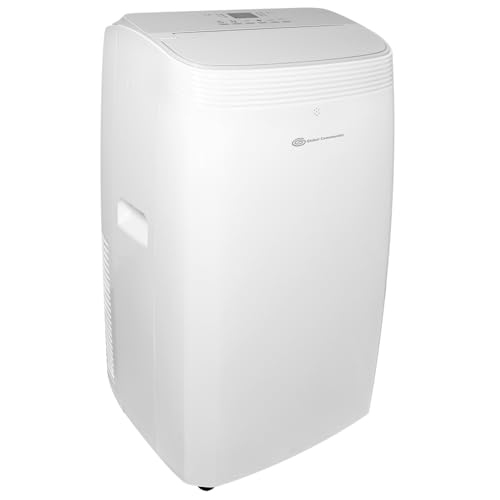
Global Commander Portable AC 12000 BTU — Most Transparent Challenger
Global Commander’s listing does something many famous brands avoid: it prints 8.15K SACC directly beside the 12,000 BTU headline, giving buyers the delivered-capacity number that actually predicts a cool room. That single act of candour reframes the whole proposition. Instead of wondering what the machine really does, you can size it against the BLACK+DECKER’s 8,000 SACC and see two honest figures within a whisker of each other, then decide on price, kit and controls with clear eyes.
Beyond the numbers, the specification is deliberately plain: a white floor-standing unit, model PAG-Y11KCO730C, without a thicket of connected features competing for your attention. For a workshop office, a rental property, a guest room used six weekends a year, that plainness is a feature. There is less to pair, less to update and less to break, and the machine’s job description fits on one line: cool the room it is pointed at, through a hose, from a window.
The risks are the usual challenger-brand risks, and they should be managed rather than ignored. Documentation may be thinner, replacement hoses and window panels harder to source in three years, and resale value negligible. Mitigate by keeping the box and paperwork, photographing the kit as installed, and confirming every mode works in week one. Buyers comfortable with that small administrative burden get something genuinely rare at this end of the market: a portable whose listing respects them enough to publish the unflattering number.
The Global Commander rewards a particular kind of owner: the one who reads the manual, keeps the screws, and labels the window panel with the room it was cut for. In a rental portfolio or a family home with several occasional rooms, that orderliness turns a plain machine into a dependable asset that can be deployed each June in minutes. Its published SACC figure means the person deploying it also knows exactly which rooms it can hold, knowledge that prevents the annual ritual of discovering a mismatch during the first heatwave.
- Capacity (listing): 12,000 BTU
- Delivered capacity: 8.15K SACC
- Model: PAG-Y11KCO730C
- Format: floor-standing, white
- Controls: unit and remote basics
Strengths
- SACC printed beside the headline
- Delivered capacity matches famous rivals
- Plain specification, little to go wrong
Trade-offs
- Thin smart feature set
- Parts sourcing may age poorly
- Documentation likely minimal
Best for: guest rooms, rentals and buyers who read SACC first. Not suited for: households wanting app and voice ecosystems.
Keep the window kit parts and paperwork somewhere safe after fitting. Check price on Amazon.

Humhold 12000 BTU Portable AC — Simplest Remote-Control Pick
Humhold’s 12,000 BTU portable is the Luddite option in a guide full of apps, and that is its charm. The listing promises a floor-standing cooling unit with a remote control, full stop: no account creation, no firmware, no voice assistant mediating between you and a colder room. For a grandparent’s spare room, a site office, a holiday let where the WiFi password changes monthly, the absence of connectivity is not a missing feature but a design philosophy with real operational value.
Set expectations by the class arithmetic this guide has repeated: with no SACC published, assume delivered capacity in the familiar 8,000 BTU neighbourhood and size for bedrooms and modest living spaces rather than open-plan sprawl. The remote covers the essential choreography of portable ownership, temperature, mode, fan and timer from the sofa, and a floor-standing format on casters lets the machine follow the household from a day office to a night bedroom if the window kits cooperate.
What you give up is scheduling finesse and any claim to category-leading quiet, and what you accept is the standard single-hose bargain. Judge the Humhold instead on the humble virtues: does it start reliably, cool steadily, drain manageably and survive being rolled across thresholds? Those are week-one questions, answerable inside a return window, and a simple machine gives you fewer places for disappointment to hide. In a market addicted to features, a portable that only promises to cool is almost a radical act.
For the Humhold, judge the first week by a short checklist rather than a general impression. Does the room reach the set temperature by bedtime? Does the remote wake the unit reliably from across the room? Does condensate behave through a humid night, and does the hose connection stay seated when the machine is nudged? A simple unit that passes those four tests has delivered everything its listing promised, and simplicity that performs is worth more than sophistication that sulks.
- Capacity (listing): 12,000 BTU
- Format: floor standing with casters
- Controls: remote control
- Modes: cooling with fan settings
- Connectivity: none listed
Strengths
- No accounts or pairing required
- Remote covers the essential controls
- Portable between rooms on casters
Trade-offs
- No SACC figure published
- No smart scheduling
- Single-hose efficiency limits apply
Best for: guest rooms, lets and anyone avoiding apps. Not suited for: buyers wanting schedules and voice control.
Run it through one full hot afternoon inside the return window. Check price on Amazon.
How Do the Six 12,000 BTU Portables Compare?
| Pick | Listing headline | Room fit | Defining trait |
|---|---|---|---|
| BLACK+DECKER Smart Portable AC 12000 BTU BPACT12WT | 12,000 ASHRAE / 8,000 SACC | Large bedroom, modest living room | Published SACC transparency |
| DREO Portable Air Conditioner 515S 12000 BTU | 12,000 ASHRAE / 8,000 DOE | Bedrooms first | Drainage-free condensate handling |
| Midea Duo Portable AC 14000 BTU Inverter | 14,000 ASHRAE / 12,000 SACC | Up to 550 sq ft with heat | Inverter plus Duo hose |
| GrowthWing 12000 BTU Smart Portable AC | 12,000 BTU headline | Up to 550 sq ft claimed | WiFi and voice bundle |
| Global Commander Portable AC 12000 BTU | 12,000 BTU / 8.15K SACC | Guest rooms and rentals | Published SACC from a challenger |
| Humhold 12000 BTU Portable AC | 12,000 BTU headline | Bedrooms and spare rooms | Remote-only simplicity |
Read the delivered-capacity column before the headline column and the table rearranges itself: the Midea Duo stands alone on SACC, the BLACK+DECKER, DREO and Global Commander cluster honestly around 8,000, and the GrowthWing and Humhold ask to be judged on features and simplicity instead of published delivered figures. That spread, not the shared 12,000 on the boxes, is the real shape of this class.
How Should You Install a Portable Air Conditioner for Best Results?
Begin at the window, because installation quality is portable performance. Fit the window panel snugly, then seal its perimeter with the supplied foam and, if gaps remain, additional weatherstrip; every visible daylight line around that panel is cooled air leaving and hot air arriving. Keep the exhaust hose as short and straight as the room allows, since each bend and each extra foot of hot hose radiates heat back into the space you are paying to cool, and never let the hose sag into a low loop where condensate can pool.
Position the unit on a level floor with clear space around its intake grilles, away from curtains that can be drawn against the vents, and give it a dedicated stretch of wall socket rather than a tired extension lead. Portable compressors draw serious current at start-up, and a shared, overloaded circuit announces itself at the worst moment of the hottest day. If the machine must share a room with a door that opens constantly, accept that the room’s temperature will swing and set the thermostat with that traffic in mind.
Finish with water. Even auto-evaporating and drainage-free designs have limits, so learn where your unit’s drain port sits, keep the supplied cap and a shallow tray in a known drawer, and check the condensate behaviour during the first humid spell rather than the first flood. A ten-minute inspection in June is the difference between a machine you trust through August and a puddle you discover in September, and it costs nothing but attention.
What Does It Cost to Run a Portable Air Conditioner?
Running cost follows a simple chain: delivered cooling divided by efficiency equals electricity, multiplied by hours and your local tariff. Portables sit at the thirsty end of the air-conditioning family because the single-hose design wastes some of its own work, which is why the inverter Duo and the honest SACC figures matter to your bill as much as to your comfort. A machine that reaches the target temperature and idles down will almost always out-economise a stronger unit that blasts and rests in cycles.
Habits move the number more than hardware at the margins. Pre-cooling a bedroom for an hour before sleep costs less than fighting a heat-soaked room at midnight, closing blinds on sun-struck glass removes load no compressor should be asked to carry, and raising the set point by a single degree trims consumption in a way most sleepers never feel. Dehumidifier mode on muggy but mild days deserves special mention, since dry air at a moderate temperature often feels cooler than damp air dragged lower at full compressor effort.
Finally, count the costs that never reach the meter. A portable frees you from installation fees, landlord negotiations and permanent alterations, and it leaves with you when you move. For renters and short postings, that portability is an economic feature no efficiency table captures. The right question is not whether a portable is the cheapest way to cool a room forever, but whether it is the cheapest way to cool this room, this summer, under your constraints, and for the households in this guide’s audience the answer is frequently yes.
How Do You Keep a Portable Air Conditioner Efficient All Summer?
Efficiency in a portable is a habit, not a specification. The filter is the first habit: rinse or vacuum it every couple of weeks during heavy use, because a clogged filter forces longer compressor runs for the same cooling and gradually lends the output air a stale smell. The second habit is shade. Closing blinds on the sun side of the room before the heat arrives removes load at zero running cost, and a machine that starts its day in a shaded room may never need its highest, loudest speed at all.
The third habit concerns doors and expectations. A portable cools a defined volume best, so keep the door of the cooled room mostly closed, resist cooling empty rooms out of optimism, and let the thermostat sit at the warmest temperature that still feels genuinely comfortable. Many households discover that dry, moving air at a moderate setting beats still, colder air for sleep, which is why the fan and dehumidifier modes on these machines earn their keep across a whole season rather than a single hot week.
End-of-season care decides whether next summer starts with cooling or with troubleshooting. Drain the unit fully, run fan-only mode to dry the internals, clean the filter, coil the hose without crushing it and store everything upright in a dry place. Ten unhurried minutes in September protects the seals, discourages mould and means the first hot night of the following year is met with a machine that simply starts, which is the entire point of owning one.
When Is a Portable the Wrong Answer?
Honesty about this category requires naming its limits. A portable is the wrong answer for a whole house, for a room with windows that cannot accept a kit or open at all, and for anyone whose sleep demands near-silence, because a compressor in the room will always be present in a way a compressor outside the wall is not. It is also the wrong answer where a window unit is permitted and practical, since a comparable window machine delivers more cooling per unit of electricity with its hot side properly outdoors.
It is the right answer in a longer list of real situations than its critics admit: rentals with installation bans, heritage windows, rooms used a few weeks a year, home offices that overheat while the rest of the house stays pleasant, and households bridging the gap until a permanent system is installed. The six picks in this guide exist because those situations are common, and because a well-chosen portable, honestly sized and carefully installed, solves them without apology.
If you stand between the two, let the SACC arithmetic decide. Measure the room, grade its sun and ceiling honestly, and compare the result with the delivered figures published above. Where a pick’s SACC covers your room with a little to spare, buy with confidence; where every figure falls short, believe the numbers rather than the headlines, and look at a different format before the heatwave makes the decision for you.
What Separates a Good Portable From a Loud Box?
Vibration tells the story first. A portable’s compressor shares your floor, so its mounting, the cabinet’s rigidity and the surface beneath it decide how much of its work arrives as hum through the joists. A machine that sounds acceptable on a showroom’s concrete can drone on a suspended timber floor, which is why a rug or an anti-vibration mat under the unit is a legitimate cooling accessory rather than a superstition.
Airflow design is the second separator. Units that move a generous volume of air at low fan speed feel calmer and sound softer than units that achieve the same cooling with a frantic blast, and their breeze reaches further across a room instead of pooling at the machine’s feet. When you test a new portable, stand where the bed or desk actually is, not beside the unit, and judge the temperature and the noise from the seat you bought it for.
Thermostat placement creates the third difference, invisible in listings. A sensor tucked near the machine’s own cold outlet convinces the unit the room is finished long before the far wall agrees, producing the classic portable complaint of a freezing puddle of air around the unit and a warm bed. Models with follow-me style sensing in the remote, or simply a sensor placed thoughtfully, hold a room more evenly, and cycling behaviour in the first evening will tell you which kind you bought.
The window kit deserves a paragraph of suspicion in any portable review, because it is the component most often cheapened. Thin panels warp, foam compresses into ribbons, and hose cuffs crack at the thread. A kit that seals badly can erase the difference between an 8,000 SACC machine and a stronger one, which is why several analyses above keep returning to installation: in this category the accessory is not an accessory, it is half the appliance.
Longevity in portables is mostly a story of filters and coils kept clean. A washable filter clogged with a summer of dust strangles airflow, lengthens run times and invites the musty smell owners blame on the machine’s character. Rinse the filter on a calendar rhythm, vacuum the intake grilles when you do, and store the unit upright and dry through winter, and a mid-priced portable will repay you with seasons rather than a single heroic summer.
Storage between seasons is where portable hoses go to die, crushed under boxes in a garage until their cuffs crack. Coil the hose loosely, keep the window panels flat rather than leaning, and bag the small screws and foam with the remote. Owners who treat the kit as part of the appliance, rather than packaging, start each summer ten minutes from cold air while everyone else is ordering replacement parts.
A portable also changes how a household uses its rooms across a day. The machine’s mobility, limited by window kits but real, lets cooling follow occupancy: office in the morning, living room in the evening, bedroom at night in homes with kits fitted in more than one window. Buying a second window kit, where the maker offers one, can be the cheapest capacity upgrade in this entire category.
Humidity deserves a final word, because temperature is only half of comfort. Air conditioners dehumidify as a by-product of cooling, and on days when the air is heavy but not hot, that drying can matter more than the degrees. Rooms that smell of damp in August, instruments, books and leather that suffer in sticky air, all benefit from the dehumidifier modes these machines carry, a quiet second job that rarely appears in headline comparisons.
Renters should photograph the window installation before the first removal, because refitting a kit from memory in the following June wastes the first hot evening. Note which panel sat where, which foam went on which edge, and how the hose cuff locked. That small archive, kept on a phone, turns a yearly chore into a ten-minute routine and protects the deposit-friendly promise that made a portable attractive in the first place.
Children and pets interact with portables in ways listings never mention. The exhaust hose grows warm, the intake can attract curious fingers and fur, and a machine on casters can be nudged by an enthusiastic dog. Place the unit so its hose run is out of the main traffic path, keep the filter schedule tighter in a shedding household, and teach small hands that the grille is not a toy, and the appliance will coexist peacefully with family life.
There is also a resale and hand-me-down economy in this category worth remembering. A portable that no longer suits a growing household often suits a student flat, a workshop or a relative’s spare room perfectly, because its requirements are only a window and a socket. Keeping the kit complete and the manual with the machine preserves that second life, one more reason the unglamorous accessories deserve the same care as the compressor itself.
Finally, trust your own room over any review, including this one. Every guide works from listings and physics, but your room has its own sun path, its own door habits and its own sleeper. Use the first week deliberately: test the machine on the hottest afternoon available, at the hours you actually occupy the room, and let that evidence confirm or overturn the paper comparison while changing your mind is still free.
A portable’s relationship with curtains deserves one practical note: heavy drapes drawn behind the unit can be pulled against its intake by the very airflow the machine creates, quietly throttling it. Tie drapes back, or position the unit forward of the curtain line, and check after the first evening that nothing soft has migrated against the grilles while the room was dark and the machine was working.
Guests form opinions about a household from its spare room, and a portable that cools that room properly is hospitality in appliance form. Run the unit before visitors arrive rather than after they complain, air the room, set a moderate temperature and leave the remote on the pillow. Small courtesies like these are the difference between a machine that merely works and a home that feels considered.
When the heat finally breaks, resist switching the machine off and forgetting it the same hour. A fan-only run dries the coils, an emptied and cleaned unit stores without smells, and a kit left fitted for a few extra days covers the false autumn that so often precedes one last hot weekend in September.
What Mistakes Do Portable Air Conditioner Buyers Make?
The failures in this category are remarkably consistent, and nearly all of them happen before the machine is even switched on.
- Sizing from the ASHRAE headline alone, then discovering that an 8,000 SACC delivery cannot hold a 550-square-foot sunlit room.
- Stretching the exhaust hose across the room for a tidier look, radiating heat along its whole length and strangling airflow with bends.
- Leaving gaps around the window panel unsealed, so the machine’s own negative pressure pulls hot outdoor air straight back inside.
- Ignoring condensate until the tank warning or the puddle arrives, instead of learning the drain arrangement during the first humid week.
- Placing the unit in a corner behind curtains, where its intake chokes and its thermostat reads the cold puddle instead of the room.
Final Recommendation
Start with the number that matters. If your room is large, sunlit or has already defeated a portable, the Midea Duo Portable AC 14000 BTU Inverter is the honest upgrade, with delivered capacity the others cannot match and a heat mode for the cold months. For the mainstream bedroom or living room, the BLACK+DECKER Smart Portable AC 12000 BTU BPACT12WT sets the standard with published SACC figures and smart manners, while the DREO Portable Air Conditioner 515S 12000 BTU is the one to choose when sleep and drainage-free nights are the priority.
Let the room cast the deciding vote, and let this closing thought stand for the whole class: a portable air conditioner rewards buyers who respect its physics, so size it by SACC, seal it like you mean it, and the machine you bring home will feel twice the cooler the box promised.
Frequently Asked Questions
Is 12,000 BTU enough for a living room?
For a modest, shaded living room of roughly 300 to 400 square feet, yes, provided you judge by the SACC figure and seal the window kit well. Open-plan spaces, rooms joined to kitchens and glass-heavy rooms ask more than this class delivers, and those are the cases where the Midea Duo’s higher SACC or a different cooling format altogether deserves consideration.
Why does my portable make the hallway feel warmer?
A single-hose unit exhausts indoor air outside, and the replacement air has to come from somewhere, usually under the door from the rest of the home. That is the infiltration SACC accounts for. Sealing the window installation, keeping the cooled room’s door mostly closed and cooling only the rooms you occupy all reduce the effect noticeably.
Do drainage-free portables ever need emptying?
In sustained high humidity they can. Drainage-free designs evaporate condensate into the exhaust stream, which handles ordinary conditions well, but a tropical week can produce water faster than the machine sheds it. Learn the manual drain procedure before you need it, and treat an occasional drain as maintenance rather than malfunction.
Can I run a portable air conditioner all night?
Yes, and bedrooms are their natural habitat, provided the circuit is sound and the condensate arrangement is understood. Inverter and bedroom-focused models modulate or run more gently once the room reaches temperature. A timer or sleep mode that relaxes the set point slightly in the small hours saves energy without waking you in a warm room.
Does a portable need a dedicated electrical circuit?
It deserves an honest check. These machines draw substantial current, particularly at compressor start, so a socket shared with a kettle, microwave or space heater on the same circuit invites trips. Plug directly into a wall outlet, avoid extension leads, and if the breaker complains, move other loads rather than blaming the air conditioner.
How long should a portable air conditioner last?
With its filter rinsed regularly, coils kept clear and dry winter storage, a portable from this class should serve several summers of regular use. The window kit and hose usually age faster than the refrigeration system, so keeping those parts safe between seasons protects the machine’s performance as much as any servicing.
Related Guides
Cooling decisions rarely stop at one room, so continue with our companion guides: Best 14,000 BTU Portable Air Conditioners, Best Air Conditioners for Apartments and Best Affordable Dishwashers.


