What's inside
- Key Takeaways
- Quick Picks
- How Did We Choose These 5,000 BTU Compact Window Air Conditioners?
- What Size Room Does 5,000 BTU Actually Suit?
- Mechanical Dials or Electronic Controls: Which Age Better?
- How Do the Six Compact 5,000 BTU Units Compare?
- How Do You Install a Compact Window Unit Safely?
- How Much Does a 5,000 BTU Unit Cost to Run?
- What Maintenance Does a Small Window Unit Need?
- When Should You Step Up to 6,000 BTU Instead?
- What Is Life Like With the Smallest Real Air Conditioner?
- What Mistakes Do Compact Window Unit Buyers Make?
- Final Recommendation
- Frequently Asked Questions
- Related Guides
As an Amazon Associate I earn from qualifying purchases. This post may contain affiliate links at no extra cost to you.
cottageverdict.com is reader-supported. When you buy through links on our site, we may earn an affiliate commission.
Where to buy: the best 5,000 BTU compact window air conditioners gathered here are all sold on Amazon, and each pick’s name links to its listing so you can confirm the window width range, the control type and the weight before ordering. This is the smallest true air-conditioning class, built for one small room at a time, and its charms are lightness, simplicity and a gentle appetite for electricity.
Five thousand BTU is where air conditioning begins: a compact box, light enough for one person to lift into a window, drawing little enough current to share a household circuit without drama, and strong enough to turn a small bedroom, a nursery, a dorm room or a home office nook from a place you endure into a place you sleep. Every listing in this guide claims the same territory, rooms up to 150 square feet, and that uniformity is liberating, because it means the decision rests on controls, noise manners and fit rather than on capacity brinkmanship.
The class divides neatly by how you talk to it. Three of these machines use mechanical dials, the oldest interface in cooling, which cannot crash, need no batteries and survive a decade of dusty summers without complaint. The others add electronic control, remote operation, eco modes and extra fan speeds, comforts that matter most in bedrooms where the person adjusting the machine is horizontal and unwilling to stand up. Neither philosophy is wrong; they are answers for different sleepers.
Window air conditioners enjoy one enormous physical advantage over the portables elsewhere in this series: the hot half of the machine lives outside the glass, so the rated capacity is delivered honestly, without the infiltration tax that shrinks portable ratings into SACC confessions. A 5,000 BTU window unit genuinely delivers its 5,000, which is why this modest class cools its small rooms with an authority that surprises people arriving from portable experience.
Fit is the gate everything else passes through. Compact units are designed for standard double-hung windows within a stated width range, and they ask for a sill that can bear their weight with the included support and side panels doing their share. Measure the window’s clear opening, check the listing’s minimum and maximum widths, and confirm the sash still closes onto the unit’s top rail. Ten minutes with a tape measure is the entire difference between an easy Saturday installation and a return label.
Our Top Picks
Key Takeaways
- Every pick here serves rooms up to about 150 square feet; choose on controls and manners, not capacity.
- Window units deliver their rated BTU honestly, with no portable-style SACC discount to apply.
- Mechanical dials are the reliability champions; remotes and eco modes are the comfort champions.
- Measure the window opening against the listing’s width range before anything else is decided.
- Light weight is this class’s superpower: most owners can install one unaided in under an hour.
- Quiet-operation claims recur across the listings, but bedroom placement still rewards the gentlest fan settings.
Quick Picks
| Pick | Badge | Why it earns its place |
|---|---|---|
| GE Window Air Conditioner 5000 BTU | Best Straightforward Small-Room Pick | Manual controls, two cooling modes and an easy install kit for spaces up to 150 square feet. |
| Frigidaire 5000 BTU Window-Mounted AC | Best Quiet Mechanical Pick | Quiet operation, effortless temperature control, two fan speeds and auto restart in a dial-era cabinet. |
| Midea 5000 BTU EasyCool Window AC | Best Mechanical All-Rounder | EasyCool mechanical controls and a reusable filter, pitched at bedrooms, living rooms and offices. |
| Amazon Basics 5000 BTU Window AC | Best Budget Pragmatist | Quiet operation, cool and fan functions, washable filter and adjustable window kit at house-brand value. |
| TCL 5000 BTU Window Air Conditioner | Best Compact Design | A compact-design cabinet with reusable filter and easy controls from an electronics giant. |
| Frigidaire 5000 BTU Window AC with Remote | Best Bedroom Comfort Pick | Remote control, eco mode, three fan speeds and auto restart: the fullest control set in this class. |
How Did We Choose These 5,000 BTU Compact Window Air Conditioners?
Each pick had to be a genuine 5,000 BTU window unit verified in the site’s product pool, with an install kit included and a listing that states its room claim plainly. Beyond that, selection balanced the class’s two tribes, mechanical and electronic, and favoured machines that add one well-chosen idea: a remote with eco mode, an easy-install kit that respects beginners, a reusable filter, or a compact cabinet that leaves more of the window’s light intact. Identical-on-paper units were separated by the clarity of their listings and the coherence of their intended user.
The result is a shortlist that reads as six small answers to six small situations: the dial loyalist, the light sleeper, the renter in a hurry, the budget pragmatist, the compact purist and the comfort seeker who wants the remote on the nightstand. Where brands repeat, as Frigidaire does twice, the two models were kept because they genuinely differ in controls, and the analyses below treat them as the different machines they are.
What Size Room Does 5,000 BTU Actually Suit?
The listings agree on 150 square feet, and for once the industry number deserves trust, because window units are rated on delivered capacity. A bedroom of ten by twelve feet, a dorm single, a nursery, a box-room office: these are the class’s home turf, and in them a 5,000 BTU machine does not strain. It pulls the room down in a reasonable span, then cycles gently to hold it, which is the rhythm of efficient cooling rather than a compressor roaring at its limit until dawn.
The edges of the envelope are defined by heat, not floor area alone. A 150-square-foot room under a hot roof, or one whose window takes the afternoon sun full in the face, behaves like a larger room and may leave this class wishing for the 6,000 BTU shelf in the companion guide. Conversely, a shaded basement room of 180 square feet may be served perfectly well. Square footage is the entry ticket; sun, ceiling and occupancy decide the seat.
Kitchens and exercise rooms break the sizing rules entirely, because their internal heat loads dwarf their dimensions. A small kitchen with an oven running is no place for a 5,000 BTU unit to prove itself, and a home gym generates a exercising adult’s worth of heat in the corner. Match this class to sleeping, sitting and working rooms, the quiet occupations, and it will never embarrass you.
Mechanical Dials or Electronic Controls: Which Age Better?
The mechanical control is a rotary thermostat and a mode knob, technology older than most of the people buying it, and its virtues are the virtues of simplicity: it works after a decade in a dusty window, it can be operated by touch in the dark once its positions are learned, and when the power blinks it simply resumes. Its vice is imprecision; a dial holds a neighbourhood of temperature rather than an address, and the room’s comfort drifts a few degrees around the setting across a night.
Electronic controls trade that ruggedness for exactness and reach. A digital set point, a remote that adjusts from the bed, an eco mode that lets the fan rest between compressor runs, a sleep curve that relaxes the temperature as the night deepens: these are real comforts, particularly in the bedrooms this class serves. Their costs are batteries, boards and the small but nonzero chance that the clever part fails before the cooling part does.
The honest answer is that both age fine when bought from makers who build either properly, and the choice is temperamental. Households that keep appliances for fifteen years and distrust features lean mechanical and are happy. Households that value a precisely held nursery temperature or a remote within arm’s reach lean electronic and are equally happy. The picks below honour both temperaments, and the analyses say plainly which is which.

GE Window Air Conditioner 5000 BTU — Best Straightforward Small-Room Pick
GE’s 5,000 BTU unit is the class reduced to its essentials and executed by a company that has built window air conditioners for generations: manual controls, two cooling modes with fan settings, an easy install kit, and a white cabinet that disappears into a window frame. The listing’s promise, small spaces up to 150 square feet, is exactly the class’s promise, delivered without decoration. For a first air conditioner, a dorm room or a rental bedroom, that plainness is a kind of respect for the buyer.
Manual controls shape the ownership experience in ways owners come to appreciate. The dial’s positions become muscle memory within a week, adjustments happen by touch at midnight, and there is no remote to lose down the side of the bed. Two cooling modes are genuinely sufficient at this size, because a small room offers a small machine only two honest jobs: pull down after a hot day, then hold through the night, and the GE’s settings map onto those jobs without surplus.
What you forgo is precision and reach: no digital set point, no eco choreography, no adjusting from under the covers. Households who run a room cool for a baby, or who wake warm at 3 a.m. and want relief without standing, should look at the remote-equipped Frigidaire below. Households who want the machine to be a dial, a hum and a cool room will find this GE the most honest object in the guide.
Installation is the other half of its brief, and the easy install kit earns its adjective. The unit’s compact class weight makes it a one-person lift for most adults, the side panels trim to the window’s width, and the whole exercise, measured window to first cold air, fits inside an hour for a beginner who reads the instructions once before starting. That accessibility is not a footnote; for the renters and students this machine serves, it is the product.
A season in, the GE’s owners tend to speak of it the way people speak of a good kettle: it is simply there, doing the thing. That uneventful quality is engineered, not accidental, and in a category where drama means a hot night or a flooded sill, uneventful is the highest available praise.
- Capacity (listing): 5,000 BTU
- Coverage claim: small spaces up to 150 sq ft
- Controls: manual
- Modes: 2 cooling modes with fan
- Install: easy install kit included
Strengths
- Dead-simple manual controls
- Easy install kit suits beginners
- Trusted maker for parts and support
Trade-offs
- No remote or digital set point
- No eco mode refinements
- Dial holds a range, not a degree
Best for: dorms, rentals and first-time window unit owners. Not suited for: sleepers who adjust temperature from bed.
Measure your window’s width range against the listing before ordering. Check price on Amazon.

Frigidaire 5000 BTU Window-Mounted AC — Best Quiet Mechanical Pick
Frigidaire’s window-mounted 5,000 BTU model occupies the thoughtful middle of this class: it keeps the mechanical era’s simplicity while polishing the details that simplicity usually skips. The listing emphasises quiet operation and effortless temperature control, a pairing aimed squarely at bedrooms, and adds two fan speeds and auto restart, the feature that returns the machine to duty after a power blink without asking anyone to notice, decide or climb out of bed.
Auto restart deserves more fame than it gets in small units. Summer storms trip power precisely on the nights when rooms are hottest, and a machine that resumes cooling on its own protects sleep, pets in a closed room, and the general peace of a household that would otherwise wake at dawn in a warm box wondering what happened. It is a small line in a listing and a large one in a life.
Two fan speeds sound modest beside rivals’ three, yet in a 150-square-foot room the practical difference between a second and third fan step is small, while the difference between a quiet low speed and a crude one is the whole night. Frigidaire’s long history in this exact product, the small white window box, shows in such judgements: the specification spends its effort where small rooms feel it, on sound and steadiness, rather than on a spec-sheet arms race.
Choose this Frigidaire over its remote-controlled sibling below when the room’s occupant prefers a control that cannot be lost and a machine that behaves identically every night of the decade. Choose it over the GE when auto restart and the quiet brief matter more than the last degree of dial simplicity. It is the connoisseur’s mechanical pick, which is a title this class rarely awards and this machine earns.
The quiet Frigidaire rewards one experiment in its first week: run each fan speed at bedtime distance and learn which one your sleep accepts, then make that speed the night’s default rather than chasing temperature with the thermostat. Small machines reward households that operate them deliberately, and this one’s two speeds are enough when they are used with intent.
- Capacity (listing): 5,000 BTU
- Coverage claim: 150 sq ft rooms
- Character: quiet operation emphasis
- Fan: 2 speeds
- Recovery: auto restart after outages
Strengths
- Quiet brief suits bedrooms
- Auto restart protects sleep
- Simple controls, polished details
Trade-offs
- No remote control
- Two fan speeds only
- Mechanical thermostat imprecision
Best for: light sleepers who still prefer simple controls. Not suited for: buyers wanting bedside remote adjustment.
Confirm the quiet-operation fit by testing low fan on the first night. Check price on Amazon.
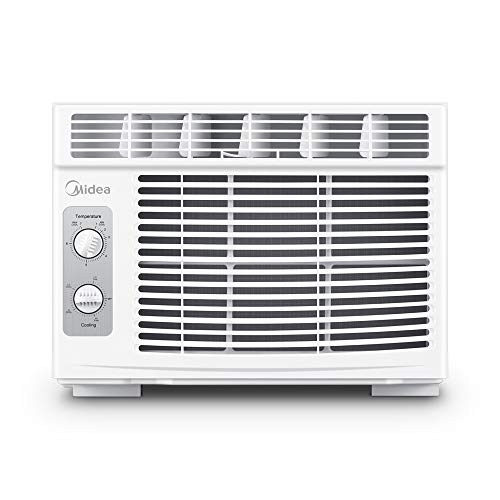
Midea 5000 BTU EasyCool Window AC — Best Mechanical All-Rounder
Midea’s EasyCool is the friendliest face of the mechanical tribe: controls described as easy to use because they are, a reusable filter that rinses clean instead of being replaced, and a listing that names the small bedroom, living room and home office as its habitats. Midea builds an enormous share of the world’s room air conditioners, including machines sold under other badges, and the EasyCool carries that manufacturing confidence in its fit, finish and unremarkable reliability.
The reusable filter is a small feature with a long shadow. Small units live or die by airflow, and a filter that costs nothing to maintain actually gets maintained, rinsed under a tap on a Sunday rhythm and back in service before lunch. Over five summers that habit preserves the machine’s cooling and its air quality, while a neglected disposable filter quietly strangles both. EasyCool’s name, whatever its marketing origins, turns out to describe the ownership as much as the installation.
Mechanically controlled and proud of it, the EasyCool asks its owner to accept the dial’s gentle imprecision in exchange for an interface a child, a guest or a grandparent can operate without instruction. In shared and transient spaces, spare rooms, rentals, the office that colleagues borrow, that universality is worth more than a degree of precision nobody else can reproduce.
Set against the GE, the Midea counters with its filter and its maker’s sheer scale; set against its own brand’s smarter siblings in other guides, it is the reminder that Midea’s range begins with honest simplicity. Buyers who want the world’s biggest small-appliance maker, a washable filter and a dial will find the EasyCool the easiest machine in this guide to live with and the hardest to argue against.
EasyCool ownership has a social footnote: because anyone can work its controls, it becomes the unit guests and relatives are actually allowed to touch. In the spare room, that translates to visitors who sleep comfortably instead of politely enduring, which is a small hospitality triumph purchased with a dial.
- Capacity (listing): 5,000 BTU
- Coverage claim: rooms of 150 sq ft
- Controls: mechanical, easy-to-use
- Filter: reusable, washable
- Rooms named: bedroom, living room, office
Strengths
- Reusable filter lowers upkeep cost
- Universally understood controls
- Huge maker’s manufacturing depth
Trade-offs
- No remote or timer
- Dial temperature is approximate
- No eco mode
Best for: spare rooms, rentals and low-maintenance households. Not suited for: precision seekers and remote devotees.
Add the filter rinse to a monthly calendar from day one. Check price on Amazon.

Amazon Basics 5000 BTU Window AC — Best Budget Pragmatist
Amazon Basics applies the house-brand formula to the smallest window class: the essential specification, cool and fan functions, a washable filter, an adjustable window kit and intuitive mechanical controls, at the value end of the shelf, with quiet operation claimed in the listing. For a room that needs cooling rather than a relationship, a student flat, a site office, a spare room used on summer weekends, that formula is not a compromise but a correct reading of the brief.
The adjustable window kit matters more at this price than any electronic flourish would, because value evaporates if installation fights back. A kit that trims to fit and panels that seal adequately preserve the class’s core promise, an hour from box to cold air, and the washable filter likewise protects the running-cost side of the value equation across seasons rather than weeks.
Expectations should be set with the same clarity the listing mostly shows. The controls are mechanical, the feature list is the class minimum executed competently, and the brand behind it is a retailer rather than an appliance maker, which shapes the support experience toward replacement rather than repair. For the rooms this machine targets, that trade is usually acceptable, and often wise.
The Basics unit also makes a sensible second machine: the one bought for the guest room after the main bedroom’s unit proved the concept, or for the teenager’s room where a lost remote is a certainty and a dial is destiny. Judge it in week one on the class’s eternal tests, pull-down time, night noise on low fan, a sealed installation, and let it be what it is: competent cooling at the shelf’s most accessible point.
The Basics machine’s second life is worth planning for. When the main rooms graduate to larger units, this one migrates to the workshop, the attic room, the college flat, carrying its kit with it. Value machines earn their keep across addresses, and keeping the panels and screws together is the whole secret of that longevity.
- Capacity (listing): 5,000 BTU
- Coverage claim: up to 150 sq ft
- Functions: cool and fan
- Filter: washable
- Kit: adjustable window kit, mechanical controls
Strengths
- Value pricing for the full brief
- Washable filter included
- Adjustable kit eases fitting
Trade-offs
- Retailer brand, replacement-style support
- Minimum feature set
- Mechanical controls only
Best for: guest rooms, student flats and second-machine duty. Not suited for: buyers wanting a maker’s service network.
Verify the window kit trims to your opening’s exact width. Check price on Amazon.
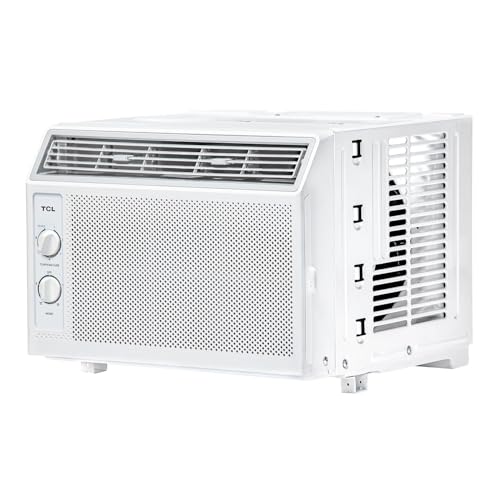
TCL 5000 BTU Window Air Conditioner — Best Compact Design
TCL’s H5W33M sells the class’s most underrated virtue in its listing’s own words: compact design. In a small room, the air conditioner shares the window with light, view and curtains, and a cabinet that intrudes less, in depth and in visual bulk, leaves the room feeling like a room rather than a machine housing. Students, small-apartment dwellers and anyone cooling a pretty room will understand immediately why that earns a pick of its own.
The rest of the specification follows the class’s sensible script: 5,000 BTU for rooms to 150 square feet, easy-to-use controls and a reusable filter. TCL’s scale as one of the world’s largest electronics makers underwrites the basics, panel fit, control feel, packaging that survives shipping, with a competence that smaller badges sometimes miss. Nothing here reaches for novelty, and the machine is better for it.
Compactness has one more practical dividend: weight and handling. The smallest cabinets in this class are the easiest to lift, level and, crucially, to remove and store in autumn, which matters in rentals and seasonal homes where the unit winters in a cupboard. A machine that one person can install in spring and shelve in autumn without help or dread is a machine that gets used for a decade.
Choose the TCL when the room is small in every sense, tight window, tight floor plan, tight tolerance for visual clutter, and when the controls’ simplicity matches the household’s taste. It concedes the remote and eco refinements to the Frigidaire below and the dial purists’ heritage to the GE and Midea, and in exchange it simply takes up less of your life and your window. For many small rooms, that is the correct trade.
TCL’s compact cabinet has one more subtle benefit in shared housing: it leaves the window more usable. Curtains hang better, the sash’s remaining light is greater, and the room’s proportions survive. In the small rooms this class serves, those centimetres of normalcy are felt daily, long after the novelty of cooling itself has faded.
- Capacity (listing): 5,000 BTU
- Coverage claim: 150 sq ft
- Design: compact cabinet, model H5W33M
- Controls: easy-to-use
- Filter: reusable
Strengths
- Compact cabinet preserves the window
- Easy handling for seasonal storage
- Big-maker build competence
Trade-offs
- No remote control
- Basic feature set
- Compact class limits room size strictly
Best for: small flats, pretty rooms and seasonal use. Not suited for: rooms at the class’s size ceiling with heavy sun.
Compare the cabinet depth with your sill and curtain arrangement. Check price on Amazon.

Frigidaire 5000 BTU Window AC with Remote — Best Bedroom Comfort Pick
Frigidaire’s second appearance in this guide is a different machine wearing the same capacity: electronic control with a remote, eco mode, three fan speeds, auto restart and the brand’s quiet-operation brief, aimed at the buyer who wants the small room held precisely and adjusted from the pillow. If the mechanical Frigidaire above is the class’s traditionalist, this is its modernist, and the fact that both exist at 5,000 BTU proves how completely controls, not cooling, define this shelf.
Eco mode is the feature with real physics behind it. By letting the fan rest when the compressor rests, instead of stirring the room continuously, it trims electricity and, just as noticeably in a bedroom, trims the soundscape, giving the night genuine quiet intervals. Three fan speeds complete the bedroom brief: a brisk pull-down after a hot day, a middle working gear, and a low murmur for holding temperature while someone sleeps a metre away.
Auto restart, shared with its sibling, guards the whole arrangement against summer storms, and the remote’s presence on the nightstand converts the 3 a.m. adjustment from an expedition into a button press. These are not luxuries in the abstract; in the specific theatre of a small bedroom on a hot night, they are the difference between a machine that cools a room and a machine that cares for a sleeper.
The cautions are the electronic tribe’s usual ones: keep the remote findable, keep spare batteries in the drawer, and accept that a control board is a more complex thing to fail than a dial. For the nursery that must hold its temperature, the light sleeper who wakes warm, the home worker who wants the office exact, those are easy prices. This is the pick for buyers who read the mechanical-versus-electronic section above and knew their tribe instantly.
The remote Frigidaire’s eco mode deserves a fortnight’s trial before judgement, because its rhythm, fan resting, compressor waking, room holding, feels unusual for two nights and then becomes the household standard. Many owners report that the quiet intervals, as much as the cooling, are what they would refuse to give back.
- Capacity (listing): 5,000 BTU
- Coverage claim: 150 sq ft maximum
- Controls: electronic with remote
- Modes: eco mode, 3 fan speeds
- Recovery: auto restart
Strengths
- Fullest bedroom control set
- Eco mode quiets and saves
- Three fan speeds for pull-down and sleep
Trade-offs
- Remote can be lost or flattened
- Electronics add a failure mode
- Premium within a simple class
Best for: nurseries, light sleepers and precise bedrooms. Not suited for: dial loyalists and feature minimalists.
Put spare remote batteries in the nightstand on day one. Check price on Amazon.
How Do the Six Compact 5,000 BTU Units Compare?
| Pick | Listing headline | Room fit | Defining trait |
|---|---|---|---|
| GE Window Air Conditioner 5000 BTU | 5,000 BTU, manual | Up to 150 sq ft | Easy-install simplicity |
| Frigidaire 5000 BTU Window-Mounted AC | 5,000 BTU, quiet focus | 150 sq ft rooms | Auto restart included |
| Midea 5000 BTU EasyCool Window AC | 5,000 BTU, mechanical | Rooms to 150 sq ft | Reusable filter |
| Amazon Basics 5000 BTU Window AC | 5,000 BTU, value line | Up to 150 sq ft | Washable filter, adjustable kit |
| TCL 5000 BTU Window Air Conditioner | 5,000 BTU, compact | 150 sq ft | Space-saving cabinet |
| Frigidaire 5000 BTU Window AC with Remote | 5,000 BTU, electronic | Up to 150 sq ft | Remote plus eco mode |
Capacity cannot separate these six, so the table’s honest columns are controls and character: two dial-driven Frigidaire and GE and Midea machines built for permanence, a value play from Amazon Basics, a compact cabinet from TCL, and one fully electronic Frigidaire for the comfort maximalists. In a class this uniform, temperament is specification.
How Do You Install a Compact Window Unit Safely?
Compact does not mean weightless, so begin by respecting the lift: clear the path, open the window fully, and have the sill clean and dry before the machine leaves its box. Set the unit into the opening so its cabinet tilts very slightly toward the outdoors, the slope that lets condensate drain outside rather than into the wall, then lower the sash onto the top rail and extend the side panels to close the gaps the cabinet cannot.
Secure what the kit provides: screws where the instructions call for them, foam where air leaks threaten, and the sash lock or bracket that keeps the window from being raised from outside, a security detail renters and ground-floor rooms should never skip. A compact unit is light enough to tempt improvisation, yet the difference between a sealed, level, secured installation and a casual one is audible all summer in rattles and visible in the electricity it wastes.
Finish by testing like an inspector. Run the machine on its coldest setting, walk outside and confirm condensate drips where it should and not down the wall, come back in and listen for panel buzz at each fan speed, pressing each trim piece to find the one that sings. Five minutes of this on installation day prevents the season’s most common annoyances, and leaves you with nothing to do but enjoy the room.
How Much Does a 5,000 BTU Unit Cost to Run?
This is the cheapest cooling money can buy without a fan and a prayer. Small window units draw modest current, run on ordinary circuits alongside lamps and laptops, and, because their rooms are small, reach temperature and cycle down quickly. In a bedroom used eight hours a night, the seasonal electricity cost is typically the smallest line in the household’s summer budget, which is precisely why this class is the rational answer to a single hot room in an otherwise comfortable home.
Habits still compound. A unit cooling an empty room all afternoon because nobody set a routine is wasting its cheapness, and a filter left to felt over with dust makes the compressor work for its living. The mechanical picks ask for a human routine, switch on before bed, off in the morning, while the electronic Frigidaire’s eco mode automates part of that discipline. Either way, the machine rewards households that treat cooling as a service delivered to occupied rooms.
Compare the alternative honestly: cooling a whole house to rescue one hot bedroom costs many times more than this small box in the window, and running a portable in the same room delivers less comfort per unit of electricity. The 5,000 BTU window class is not a compromise forced by poverty; for the single-room problem it is the engineering optimum, and its running costs are the proof.
What Maintenance Does a Small Window Unit Need?
The filter is the whole liturgy at this size: rinse or vacuum it monthly through the season, more often in dusty streets or pet households, and the machine will repay the attention with undiminished cooling and cleaner air. The washable and reusable filters on several picks here exist to make that habit free, removing the last excuse for neglect. A clogged small unit does not fail dramatically; it fades, cooling a little less each week until the room feels stuffy and the machine is blamed for a maintenance debt.
At the season’s turn, remove the unit or winterise it in place according to the manual: clean the filter, let the cabinet dry, check the side panels and foam for next year, and store the machine upright somewhere dry. In-place winterising with a proper cover suits households whose windows and storage argue against removal, while a stored unit frees the window’s light for the dark months, a benefit small rooms feel keenly.
Give the exterior a moment too. Leaves and debris against the outside grille, a bent fin section, a drain hole furred with grime: each is a small tax on performance that a soft brush and five minutes retire. Small machines survive decades on this diet of minor kindnesses, which is why so many 5,000 BTU units are inherited, handed down and still cooling long after fancier appliances have been replaced.
When Should You Step Up to 6,000 BTU Instead?
The boundary cases deserve a rule rather than a shrug. Step up when the room exceeds the class’s 150 square feet in earnest, when its ceiling is high, when its window faces the afternoon sun unshaded, or when the room hosts heat sources, a gaming PC, a second sleeper, a south-facing nursery roof. Any one of these can be absorbed; two together will leave a 5,000 BTU machine running flat out and losing, which is the least efficient and least comfortable way to cool anything.
Stay with 5,000 when the room is small, shaded and occupied by sleepers rather than appliances. An oversized unit in a tiny room short-cycles, clicking on and off, cooling the air in bursts and leaving humidity under-managed, so bigger is not automatically better even when the price gap is small. The 6,000 BTU guide in this series exists for the boundary rooms; this class exists for the rooms it fits exactly, and exactness is a virtue.
If the tape measure leaves you genuinely torn, consider the household’s trajectory: the box room becoming a nursery, the office gaining a second desk, the teenager’s gaming rig arriving at Christmas. Capacity bought for the room’s future is rarely wasted at this end of the market, while capacity bought for its present alone can be outgrown in a single season of change.
What Is Life Like With the Smallest Real Air Conditioner?
It restores rooms. Every house has one: the small bedroom under the roof, the study that becomes a sauna by three, the nursery whose window catches the evening sun. A compact unit returns those rooms to the household for the whole summer, and the restoration is out of proportion to the machine’s size and cost. Families routinely describe this class not as an appliance purchase but as getting a room back.
It teaches restraint in cooling. A household with one small unit cools one room well and lets the rest of the home be summer, and many discover they prefer that honesty to the arctic uniformity of whole-house systems. The cooled room becomes the evening’s gathering place, the reading room, the good-sleep room, and the machine’s limitation turns into a rhythm the household organises itself around contentedly.
It is the appliance most often bought twice. The first unit proves the concept in the worst room; the second follows for the next room the following summer, because the installation holds no more terror and the running cost holds no surprises. Makers know this, which is why the class is so crowded with competent, similar machines competing on manners rather than miracles.
Its sound becomes part of the summer’s texture. A small window unit’s hum, steady and low on its night setting, is for many people the sound of sleeping well in July, a white noise that masks street sounds and signals cool. Light sleepers should still test the first nights honestly, yet the class’s reputation for bedroom service is built on exactly this: a gentle, predictable voice rather than silence.
It asks almost nothing socially. Guests need no instruction, landlords rarely object to a standard window fitting that leaves no trace, and the machine can be removed in autumn restoring the window completely. In housing where permanence is negotiated, that reversibility is a political feature as much as a practical one.
It also disciplines the window itself. A room with a unit fitted gets its curtains arranged, its sash maintained, its gaps noticed. Owners find themselves sealing draughts they ignored for years, because the machine makes air visible as a resource. The winter dividend, a tighter window in January, is an unlisted feature no manufacturer claims and many owners quietly enjoy.
Longevity stories cluster around this class for a reason. Simple machines with washable filters, modest loads and seasonal rest can serve for a very long time, and the second-hand market in compact units is brisk every spring. Buying a well-made one is therefore less a consumption decision than a small act of household infrastructure, closer to a good ladder than to a gadget.
Finally, it reframes what cooling is for. Not a house held at laboratory uniformity, but a child sleeping through a heatwave, a night-shift worker resting at noon, an elderly parent comfortable in the room they love. The smallest class keeps the purpose in view because it can do nothing else, and that clarity is worth more than the specifications that fill the rest of this guide.
A compact unit also changes a room’s acoustics in a way nobody lists: it gives the space a floor of sound that makes the rest of the house seem further away. Night-shift workers sleeping at noon, parents settling a baby during a loud afternoon, students revising through a street’s summer noise, all lean on that masking effect as much as on the temperature drop itself.
There is an etiquette to the cooled small room in a shared house, and households evolve it quickly: the door stays shut, the unit is not borrowed without asking, the person who pays the bill has thermostat rights. These micro-treaties sound comic until the first heatwave, when they become the constitution of the cool room and keep the peace better than any house meeting.
Autumn removal day has its own quiet satisfaction. The window returns, the light returns, the machine goes to its cupboard cleaned and coiled, and the room resumes its winter shape. Owners who keep that ritual speak of their units with an affection rarely granted to appliances, because the relationship is seasonal, cyclical and entirely free of resentment.
And if the machine eventually retires after long service, it usually does so gradually, cooling a little less, humming a little more, giving its household a season’s warning rather than a sudden failure. Even its ending is considerate. Few purchases at any price can say as much, and none in this guide’s other classes say it more reliably.
Dormitories and student houses deserve a mention of their own, because this class is their unofficial standard. A compact unit transforms a rented room’s summer from something survived into something studied and slept through, and its removability respects the lease in a way no other real cooling can. The student who buys one in the first year commonly sells it on, still working, in the last.
Grandparents’ spare rooms are another quiet stronghold. The machine that cools the room grandchildren sleep in during August visits earns a gratitude out of all proportion to its cost, and its simple controls, on the mechanical picks especially, mean the hosts themselves can run it without a tutorial from the younger generation. Cooling, here, is a form of welcome.
The class also serves the night economy: bakers, nurses, drivers and carers who sleep against the sun’s schedule and need a room that is dark, quiet and cool at noon. For them the small unit is not a comfort accessory but occupational equipment, and the reliability of the mechanical tribe and the auto restart of the Frigidaire pair are professional virtues.
Renters in older buildings add one more appreciation: these machines ask nothing of the wiring. Where a larger unit might demand an electrician’s visit and a landlord’s permission, the compact class simply plugs in, which keeps the whole transaction inside the tenant’s own authority. Independence, at this size, is a specification.
There is also the matter of the window’s other seasons. A household that fits a unit each spring becomes fluent in its window’s health: the sash cords, the seal, the sill’s paint. That fluency, acquired for cooling, pays out in winter draughts noticed and fixed, an accidental home-maintenance education delivered by the smallest appliance in this entire series.
If a single sentence could hold the class’s appeal, it would be this: it is the largest amount of real cooling that asks the smallest amount of permission, from landlords, from circuits, from the household budget and from the person who must lift it. Everything else in this guide is commentary on that sentence.
One caution belongs in this reflective section rather than the mistakes list, because it concerns hope rather than technique: a compact unit will not reconcile a household to a room that is fundamentally misused, the west-facing glass box chosen as a nursery for its view. It will help, genuinely and nightly, but the room’s architecture remains the senior partner in the arrangement, and blinds or a room swap may still be the honest cure.
The second-hand ritual each spring is worth joining deliberately. Units appear in quantity as households upgrade, and a buyer who knows the class, who can check a filter, listen to a compressor and inspect a kit, can cool a room for very little. This guide’s analyses double as a used-buyer’s checklist, which is one more service a clear-eyed category can perform.
And the last word belongs to proportion. Not every problem wants the biggest machine, the smartest machine or the permanent machine. Some problems want a small white box, a dial or a remote, and a room returned to its people by bedtime. That is the whole of this class’s wisdom, and it is enough.
What Mistakes Do Compact Window Unit Buyers Make?
Small machines forgive much, but not these five errors, which between them account for nearly every disappointed owner in this class.
- Skipping the tape measure and discovering the window’s opening is narrower than the cabinet, or too wide for the side panels to seal.
- Installing the unit dead level or tilted inward, so condensate drains into the room or the wall instead of outside.
- Buying this class for a sun-baked 220-square-foot room, then blaming the machine for a sizing decision the listings warned against.
- Neglecting the filter until airflow fades, when a monthly rinse would have kept the little unit at full strength.
- Leaving the window unsecured around the unit, forgetting that a fitted air conditioner must never become an entry point.
Final Recommendation
Let temperament decide among equals. The dial loyalist’s machine is the Midea 5000 BTU EasyCool Window AC, all simplicity and a washable filter; the light sleeper’s is the Frigidaire 5000 BTU Window AC with Remote, with its remote, eco mode and three fan speeds; and the beginner’s easiest first installation is the GE Window Air Conditioner 5000 BTU, backed by an easy install kit and a famous name. The value and compact specialists complete a shelf with no weak member.
Take this as the small class’s closing truth: measure the window, respect the 150-square-foot promise, and a 5,000 BTU box will give a small room back to its people for summer after summer, asking almost nothing in return.
Frequently Asked Questions
Can one person install a 5,000 BTU window unit alone?
In most cases yes, and that is a defining virtue of this class. The units are comparatively light, the kits are designed for it, and the whole job typically takes well under an hour. Respect your own limits, though: a second pair of hands for the lift into the window is always welcome, and no installation deadline is worth a strained back.
Will a 5,000 BTU unit cool a room of 200 square feet?
It will cool it partially and run almost constantly doing so, which is the least comfortable and least efficient outcome. In a shaded, low-ceilinged 200-square-foot room it may hold a pleasant temperature on ordinary days and lose on the hottest ones. The honest answer is to step up to the 6,000 BTU class, where the same money buys a machine working within itself.
Are mechanical controls less accurate than electronic ones?
Yes, in the specific sense that a dial holds a band of temperature rather than a set degree, and the room drifts gently within that band. Many sleepers never notice; some, particularly parents holding a nursery at a chosen temperature, notice immediately. Accuracy is the electronic picks’ clearest advantage, and the mechanical picks answer with decades of trouble-free service.
How loud is a compact window air conditioner?
The listings here trade in quiet-operation language rather than figures this guide can verify, so judge by placement and fan speed instead. On low fan at night, a healthy unit in this class produces a steady hum most sleepers accept as background. Panel rattle, the true enemy, is an installation fault: find the buzzing trim piece on day one and seat it properly.
Can I leave the unit in the window all winter?
You can, with a proper exterior cover and the interior side sealed, and many households do. Removal and indoor storage is kinder to the machine and returns the window’s light, and at this class’s weight it is an easy autumn ritual. Either path is legitimate; the illegitimate one is leaving the unit uncovered and forgotten with its gaps open to the weather.
Does a small window unit need a special circuit?
No. This class draws modest current and coexists happily with the ordinary loads of a bedroom or office. Plug it directly into a wall socket rather than a power strip, keep the cord unpinched by the sash, and the electrical side of ownership is finished. It is one more reason these machines suit rentals and older homes whose wiring predates modern appetites.
Related Guides
For the rooms just above this class and the small-space appliances that keep them company, continue with: Best 6,000 BTU Window Air Conditioners, Best 18-Inch Dishwashers and Best Apartment Dishwashers.



[…] big-room decision leads to smaller rooms or quieter appliances, these guides continue the thread: Best 5,000 BTU Compact Window Air Conditioners, Best Air Conditioners, Judged by Lab-Test Standards and Best Quiet […]