What's inside
- Where to buy these newborn bath tubs
- Quick picks at a glance
- How these picks were chosen
- The six tubs, reviewed one by one
- Comparing the six: format, support and stated span
- How do you choose a newborn bath tub that fits your life?
- The first bath, and the hundred after it
- Setting up the bath station
- Second babies, hand-me-downs and the twin question
- Common mistakes when buying a newborn bath tub
- Final recommendation
- Questions parents ask about newborn bath tubs
As an Amazon Associate I earn from qualifying purchases. This post may contain affiliate links at no extra cost to you.
As an Amazon Associate, cottageverdict.com earns from qualifying purchases.
Before any product is discussed, the rule that governs every newborn bath tub in this guide needs stating plainly, because no feature on any listing outranks it: a baby in water is held, supported and watched by an adult at all times, with a hand on the baby or an arm within immediate reach, and a baby is never — not for the doorbell, not for a towel on the other side of the room — left alone in a tub. Bath supports, slings, cushions and seats are aids to a caregiver’s hands, never replacements for them. Gather everything first — towel, cloth, clothes, nappy — keep the water shallow, keep the room warm, and treat every bath as a two-hands job that happens to be done mostly with one hand free.
With that frame fixed, newborn bath tubs become a genuinely interesting shopping problem, because the first months change so fast. The tub that cradles a two-week-old who cannot hold up a head must, a few months later, seat a splashing sitter, and the six picks here answer that moving target in two distinct ways. Five of them fold or collapse for storage and travel; one, the Frida Baby, is a rigid plastic tub that instead grows by reconfiguring its seat and backrest. Around that divide cluster the details that separate the picks: thermometers on some titles and not others, cushions and nets and slings, drain holes, no-slip feet, and age ranges that run from 0-12 months to a stated 0-24 months.
Everything in the reviews is read off the listing titles, and where a title is silent — on dimensions, for instance, which most of these titles are — the review works with what is printed rather than inventing measurements. Age ranges are quoted as the titles state them, and they are treated as the makers’ framing, not as permission to relax the supervision rule above: a tub rated by its listing for a toddler still demands the same hands-on attention as one bought for a newborn.
It is also honest to say what this guide cannot settle. Titles do not report basin dimensions, materials beyond the Frida’s stated plastic, or how any cushion behaves after fifty washes, and no amount of careful reading manufactures those facts. What careful reading can do — and what the reviews below attempt — is rank the picks by the evidence that exists: the support each title names, the span each title claims, the storage each title promises, and the small operational details, a drain here, no-slip feet there, that separate a considered design from a basin with ambitions.
There is a temptation, standing in the glow of a new nursery, to buy the tub for the baby in the photographs — serene, smiling, apparently waterproof by temperament. Resist it gently. Real newborns are slippery, loud and unimpressed, and real baths happen at the end of long days in ordinary bathrooms. The reviews below therefore keep returning to unglamorous questions: where does the water go, where does the tub go, what holds the baby while a hand is busy with a cloth. A tub that answers those three questions well will be forgiven almost any aesthetic shortcoming by month two.
Where to buy these newborn bath tubs
All six tubs are sold on Amazon, and each review ends with a link to its own listing so colours and current configurations can be confirmed there. In the order they were shortlisted:
BUNWAG Collapsible Baby Bathtub — A grey folding tub for the 0-12 month span, sold with a soft cushion and a thermometer, on no-slip feet.
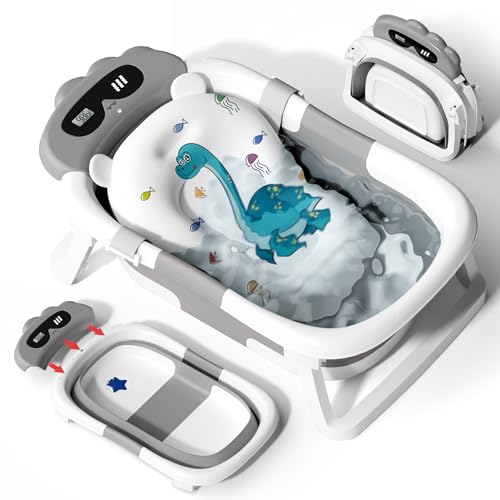
AVIDOR Collapsible Baby Bathtub — A grey collapsible tub with a soft bath net and a dinosaur shape, framed for newborn to toddler use.
MoreFeel Collapsible Baby Bathtub — The accessory-rich folder: thermometer, a hooded towel and a soft floating cushion in the box, plus a drain hole.
Jool Baby Foldable Bathtub — An oat-coloured folding tub with a thermometer, built to fold flat for apartments and families on the go.
Frida Baby 4-in-1 Bathtub — The rigid exception: a green plastic tub whose removable seat and backrest reconfigure it from newborn to toddler stages.
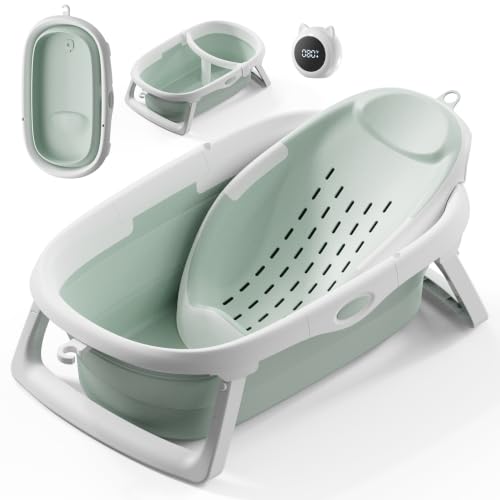
CheerTry 4-in-1 Baby Bathtub — A green collapsible 4-in-1 rated by its title for 0-24 months, with an adjustable sling, T-shaped support and a water thermometer.
Notice how much of the competition happens in the accessories. The tubs themselves share a basic geometry — a basin, a support for a small body, feet that grip — and the titles compete on what surrounds that geometry: how the baby is held, how the water temperature is checked, how the tub stores away. That is the right way to read this guide. The basin is the commodity; the support system and the storage answer are the product, and they are what the next several thousand words will keep returning to, tub by tub.
Quick picks at a glance
| Pick | Best for | Standout detail from the listing title |
|---|---|---|
| BUNWAG Collapsible Baby Bathtub | First-year bathing with temperature feedback | Collapsible, soft cushion and thermometer, no-slip feet, 0-12 months, grey |
| AVIDOR Collapsible Baby Bathtub | Playful design with a support net | Collapsible, soft bath net, no-slip feet, dinosaur shaped, grey |
| MoreFeel Collapsible Baby Bathtub | The most complete starter kit | Thermometer, hooded towel and floating cushion included, drain hole |
| Jool Baby Foldable Bathtub | Small homes and travel | Folds flat for compact storage, thermometer, oat colour |
| Frida Baby 4-in-1 Bathtub | One rigid tub across all stages | 4-in-1 grow-with-me, removable seat and backrest support, green |
| CheerTry 4-in-1 Baby Bathtub | The longest stated age span in a folder | Collapsible 4-in-1, 0-24M, adjustable sling, T-shaped support, thermometer |
Three of the six carry a thermometer in the title and three do not; four name a specific support — cushion, net, sling, seat — and the differences among those supports are the differences that will matter at the sink at 7 p.m. with a slippery, unimpressed newborn. Read for the support first and the storage second.
A note on the two 4-in-1 claims, since the phrase appears twice with different meanings. On the Frida it describes a rigid tub whose seat and backrest reconfigure; on the CheerTry it describes a folding tub whose sling and support adjust. Same label, different machinery — and a standing lesson of this category, which is that stage language should always be chased back to the mechanism the title actually names before it is allowed to influence a decision.
How these picks were chosen
The first filter was the support system, because supporting a baby who cannot yet support a head is the entire job of a newborn tub. Titles were read for what holds the baby: a soft cushion on the BUNWAG, a bath net on the AVIDOR, a floating cushion on the MoreFeel, an adjustable sling with a T-shaped support on the CheerTry, and a removable seat with backrest on the Frida. A tub whose title offered nothing on this point had to earn its place another way, through storage or stage range, and each review states plainly which currency its pick trades in.
The second filter was honesty about span. Age ranges in these titles run from a tight 0-12 months to 0-24 months, with several picks described more loosely as newborn to toddler, and the guide reports those figures exactly as printed rather than harmonising them. A stated 0-12 month tub is not a worse tub; it is a tub whose maker frames it as a first-year product, and for many families that framing matches reality — by the first birthday, plenty of babies graduate to a big tub with a caregiver in or beside it, a milestone the grown-up soaking guides, including Best Soaking Tubs For 2, approach from the far end of life.
Third came the practicalities a title can verify: no-slip feet, named on two picks; a drain hole, named on one; folding or collapsing, named on five; a thermometer, named on three. Where a title does not mention a feature, the review does not assume it — a collapsible tub without a stated drain hole is emptied by tipping, and that is written as a fact of the listing rather than a flaw discovered later. Dimensions, notably, appear in none of these six titles, so no review pretends to compare basin sizes; buyers for whom the fit inside a specific sink is decisive should take measurements from the listing pages themselves.
One further note on method: colours are reported exactly as the titles give them — grey three times over, green twice, oat once — because colour is one of the few attributes a buyer can verify at a glance on arrival, and a guide that is careless with the checkable facts forfeits trust on the uncheckable ones. The same discipline applies to counts: a thermometer is credited only where a title names one, a drain only where a title names one, and no pick is praised for a feature borrowed from a sibling product’s listing.
The six tubs, reviewed one by one

BUNWAG Collapsible Baby Bathtub
The BUNWAG opens the guide with the most legible newborn proposition of the six: a collapsible tub in grey, framed by its title for 0-12 months, that arrives with a soft cushion and a thermometer, standing on no-slip feet, and positioned as a portable travel tub and a baby shower gift. Each element of that sentence answers a first-time parent’s actual anxiety — how the baby is cradled, how the water temperature is judged, whether the tub skids on a wet surface, and where the tub lives between baths.
What the listing title states
- Format: collapsible baby bathtub, portable for travel
- Support: soft cushion included
- Temperature: thermometer included
- Stability: no-slip feet
- Age framing per title: 0-12 months, infant to toddler wording also used
- Colour: grey
Strengths
- The cushion-plus-thermometer pairing covers the two judgements a new caregiver finds hardest: support and water temperature.
- No-slip feet are named outright, which not every pick in this guide does.
- The 0-12 month framing is honest about being a first-year product rather than promising years of service.
Trade-offs
- No drain hole is mentioned in the title, so emptying means lifting and tipping the tub.
- The stated span ends at 12 months, the shortest explicit range here.
- Basin dimensions do not appear in the title, so sink fit must be checked on the listing.
The cushion is the heart of this pick. A newborn on a bare plastic slope is a newborn sliding gently and continuously, and the caregiver’s supporting hand ends up doing two jobs — holding position and holding the baby — while the washing hand does a third. A soft cushion that keeps a small body where it was placed returns the supporting hand to its one real job. That is the correct way to value the accessory: not as comfort decoration, but as workload engineering for the adult, whose attention is the actual safety system in the room.
The thermometer earns its place in the same unsentimental way. Experienced grandparents test bath water with an elbow and trust decades of calibration; a first-time parent at 3 a.m. has no calibration to trust, and a number replaces the guess. Between the cushion and the thermometer, the BUNWAG reads as the guide’s most deliberately beginner-oriented tub, and its shower-gift positioning in the title suggests the maker knows it — this is the tub bought by people for people who have never bathed a baby.
The grey colourway plays a quiet part in that gift logic. Grey survives the hand-me-down chain without declaring a nursery’s theme, photographs neutrally on a registry, and does not show the waterline marks that pale plastics collect. More practically, grey is the colour of a household object rather than a toy, which suits a product that will sit in an adult bathroom for a year. Nothing about the colour changes how the tub works, but purchasing decisions are made by humans in rooms, and a tub that looks at home in the room it will occupy is a tub that gets used as intended — out on the counter, aired and ready, rather than hidden and damp.
Best for: first-time parents in the first year, and gift buyers who want the support and temperature questions answered in one box.
Not suited for: families wanting a tub whose stated span runs well past the first birthday, or anyone whose sink fit depends on published dimensions.
Confirm the grey colourway and the cushion and thermometer contents on the listing Check price on Amazon.
AVIDOR Collapsible Baby Bathtub
AVIDOR takes the same collapsible chassis and makes two different choices: support comes from a soft bath net rather than a cushion, and the tub is dinosaur shaped — a design decision aimed squarely at the toddler the newborn will become. The title frames it for newborn to toddler, calls it a durable essential infant bath tub, notes portable travel use and no-slip feet, and lists the colour as grey, which makes the dinosaur a matter of silhouette rather than bright colour, at least as the title describes it.
Details given in the title
- Format: collapsible baby bathtub, portable travel tub
- Support: soft bath net included
- Stability: no-slip feet
- Design: dinosaur shaped
- Age framing per title: newborn to toddler
- Colour: grey
Strengths
- A bath net suspends a newborn in the water rather than resting the baby on a surface, a support style many caregivers find reassuring in the earliest weeks.
- No-slip feet are stated, matching the BUNWAG on the stability point.
- The playful shape gives the tub a second life as a toddler’s own bath, extending its welcome past the newborn stage.
Trade-offs
- No thermometer is named in the title, so water temperature is judged by hand and elbow.
- No drain hole is mentioned; emptying is by tipping.
- The title gives no cushion, so the net is the whole support story — buyers who prefer a padded base should look at the picks either side of this one.
The net-versus-cushion question is the first genuine fork in this guide, and it is worth understanding rather than glossing. A cushion supports from below with padding; a net cradles by suspension, letting water surround the baby while the mesh holds position. Neither is a substitute for the caregiver’s hand — the rule from the opening of this guide applies to both without exception — but they distribute the adult’s work differently, and caregivers tend to have a real preference once they have tried one. A household that has already bathed a baby with a net will know immediately whether this pick speaks to them.
The dinosaur shape deserves a more serious defence than it might seem to need. Bath resistance is a developmental stage, not a character flaw, and a tub that a two-year-old regards as theirs — a creature they climb into — converts a nightly negotiation into a routine. AVIDOR’s bet is that the tub’s hardest working months may not be the newborn weeks at all, but the opinionated toddler season after them, and the title’s newborn-to-toddler framing backs that reading.
The word durable in the title is worth a moment too, because folding tubs live or die at their hinges and seams. A collapsible basin is folded and unfolded hundreds of times across a childhood, often one-handed, often wet, and the title’s durability claim — reported here as the maker’s own description — is the listing’s answer to the obvious question. Buyers cannot test a hinge from a product page, but they can note which titles volunteer the claim and which stay silent, and weigh a shower-gift purchase accordingly: a gift tub that fails at month three is a story told at family gatherings for years.
Best for: caregivers who prefer net support for the newborn weeks and want a tub a toddler will claim as their own.
Not suited for: buyers who want a thermometer in the box, or a padded cushion base rather than a suspended net.
Look over the grey dinosaur silhouette and net arrangement on its product page Check price on Amazon.

MoreFeel Collapsible Baby Bathtub
MoreFeel competes on completeness. The title lists a thermometer, one hooded towel and one soft floating cushion alongside the collapsible tub itself, adds a drain hole — the only pick in the guide whose title names one — and frames the whole package as a durable foldable tub for infants to toddler, built for portable travel use. Read as a shopping list, it is the pick for the household that wants to open one box and be equipped, towel included.
From the listing title
- Format: collapsible, foldable, portable travel bathtub
- Support: soft floating cushion included
- Temperature: thermometer included
- Extras per title: 1 hooded towel included
- Emptying: drain hole stated
- Age framing per title: infants to toddler
Strengths
- The drain hole is a genuine operational advantage — water leaves without lifting a full tub with a baby recently in it.
- Thermometer and cushion together cover support and temperature, matching the strongest beginner package here.
- The included hooded towel closes the loop from bath to wrapped baby in one purchase.
Trade-offs
- No-slip feet are not mentioned in the title, unlike the two picks above.
- More components mean more pieces to dry, store and keep track of between baths.
- No explicit month range is printed — the framing is infants to toddler without numbers.
Pause on the drain hole, because its value is easy to underestimate from a product page. A tub of water is heavy, awkward and — once the baby is out and wrapped — an object every caregiver wants gone from the sink or floor quickly. Draining in place, then lifting an empty, light, foldable tub, is a calmer sequence than manoeuvring a full basin, and calm sequences are safety features in a room where the adult’s other hand is holding a wet newborn. Of all the accessory differences in this guide, this is the one most likely to be appreciated daily rather than occasionally.
The floating cushion is the second idea to understand on its own terms. Where the BUNWAG’s cushion is a base and the AVIDOR’s net a hammock, a floating cushion works with the water’s own support, letting a small baby rest partly buoyed while the caregiver’s hand does the guiding. Support styles are not ranked in this guide — they cannot be, from titles alone — but they are distinguished, because a caregiver replacing a tub they already own usually knows exactly which style failed them and which they are shopping for.
The hooded towel, easily dismissed as a gift-box sweetener, has a practical core: the moments immediately after the bath are when a wet newborn loses heat fastest and protests loudest, and a towel with a hood covers the head — the largest source of that heat loss on a small body — in the same motion that wraps the rest. Having that towel arrive in the tub’s own box means the first bath’s choreography can be rehearsed complete, towel included, rather than improvised around whatever the linen cupboard holds. Small completeness, nightly dividends.
Best for: households wanting the fullest starter kit — support, thermometer, towel and a drain — in a single folding package.
Not suited for: minimalists who would rather own three pieces than six, or buyers who want no-slip feet stated in the title.
Check the bundle contents and drain arrangement where they are listed Check price on Amazon.

Jool Baby Foldable Bathtub
Jool Baby’s title is written for a specific address: the small home. The tub is foldable and portable for travel, it folds flat for compact storage, it is pitched at apartments and families on the go, it includes a thermometer in an oat colourway, and it claims to grow with the baby through every stage. What the title does not name is equally distinctive — no cushion, net or sling is mentioned — so this review reads it as the storage-first pick whose support arrangements must be examined on the listing itself.
Title facts, as printed
- Format: foldable baby bathtub, portable for travel
- Storage: folds flat for compact storage
- Temperature: thermometer included
- Colour: oat
- Age framing per title: grows with baby through every stage
- Support accessory: none named in the listing title
Strengths
- Folding flat is the strongest storage claim in the guide — a tub that can live behind a door or in a cupboard gap.
- The thermometer is included, covering the temperature judgement for new caregivers.
- The through-every-stage framing promises the longest useful life of the folding picks, as the title words it.
Trade-offs
- With no support accessory named, buyers must check the listing to see how a newborn is cradled.
- No drain hole and no no-slip feet are mentioned in the title.
- Oat is the single colour the title offers; nurseries wanting grey or green are served by other picks.
Storage is not a trivial virtue in a newborn product, because the newborn industry is an occupying army. A tub that folds flat can be exiled to a wardrobe top or a hallway cupboard between baths, returning the bathroom to the adults who also live in the flat, and that daily reclaiming of space is worth real money in a one-bathroom home. Jool’s title understands its buyer precisely: the apartment dweller for whom every stored object must justify its cubic footage, and for whom a rigid tub would be a permanent piece of furniture they never chose.
The grow-through-every-stage claim should be read as the title’s framing rather than a mechanism, since the title does not describe stages, inserts or configurations the way the Frida title does with its removable seat. That does not make the claim empty — a generously sized basin serves a sitter long after the newborn weeks — but it does mean the diligent buyer should look at the listing’s own stage description before counting on a multi-year run. What is verifiable here is the fold, the thermometer and the colour, and on those three the pick is strong.
Travel is the other half of the flat-fold argument, and it is more than a holiday nicety. Babies bathe at grandparents’ houses, in holiday rentals with unfamiliar baths, in the homes of friends during long visits — and a tub that folds flat travels in a suitcase or car boot without negotiating for space against the rest of the infant entourage. Arriving with the baby’s own familiar tub also preserves the routine in a strange room, which any parent who has defended a bedtime sequence will recognise as worth packing space. The oat colour, calm and adult, suits that guest-bathroom life: it borrows nobody’s décor and offends nobody’s.
Best for: apartment households and travelling families for whom flat storage is the deciding feature.
Not suited for: buyers who want the newborn support method spelled out in the title, or a stated drain and no-slip feet.
See the oat colourway and the flat-fold design on the product page Check price on Amazon.

Frida Baby 4-in-1 Bathtub
Frida Baby is the structural dissenter in this guide, and its title says so in every line: a 4-in-1 grow-with-me bathtub for newborns to toddler, made of plastic, with a removable seat and a backrest support, in green, sold as a single pack. Nothing folds. Instead of collapsing for storage, this tub persists — a rigid basin whose interior reconfigures as the baby grows, the seat and backrest adjusting the support from the newborn stage toward toddler independence.
What the title gives
- Format: rigid plastic bathtub — not collapsible
- System: 4-in-1 grow-with-me
- Support: removable seat and backrest support
- Age framing per title: newborns to toddler
- Colour: green
- Pack: 1 pack
Strengths
- The stage system is described mechanically — a seat and backrest that reconfigure — rather than as a bare longevity slogan.
- A rigid basin has no fold seams or collapse mechanisms, which some caregivers prefer for stability and cleaning.
- Removable support pieces let the same tub serve a held newborn and, later, a seated toddler.
Trade-offs
- It does not fold, so storage demands a permanent home for a full-size tub.
- No thermometer is named in the title.
- No drain hole or no-slip feet are mentioned in the title either — the listing page is where those checks belong.
The rigid-versus-folding question is the guide’s deepest divide, deeper than any accessory comparison, because it is really a question about the house. A family with a utility space, a big bathroom or a permanent bath station gains nothing from folding and may gain plenty from rigidity: a tub that is simply always there, always in its place, with no unfolding ritual between the decision to bathe and the bath. Grandparents’ houses, in particular, run on this logic — the tub lives there, the stages advance there, and nothing needs to be packed.
The removable seat and backrest also change who does the supporting across the months. In the newborn configuration, the seat is the junior partner to the caregiver’s ever-present hand; as the baby gains trunk control, the backrest takes over more of the posture work and the adult’s hand becomes supervision rather than scaffolding. That progression — support that retires gradually as the baby’s own body takes over — is the most developmentally literate idea in any of these six titles, and it is achieved without a single fold.
Cleaning follows the same rigid logic. A one-material plastic basin with removable inserts can be emptied, rinsed and wiped as separate simple pieces, with nowhere for water to hide inside a mechanism — a mundane virtue that compounds across two years of daily use. The green colour is the one flourish, and it is a sensible one: distinctive enough that a toddler recognises their tub, deep enough to hide the scuffs of long service. In a guide full of tubs that disappear into cupboards, the Frida is unapologetically furniture, and for the right house that is the highest compliment available.
Best for: households with room to keep a tub out, who want one rigid basin to reconfigure from newborn to toddler.
Not suited for: small flats, frequent travellers, or anyone whose storage plan depends on the tub folding away.
Review the green finish and the seat and backrest arrangement at the listing Check price on Amazon.
CheerTry 4-in-1 Baby Bathtub
CheerTry closes the guide by refusing the guide’s own divide: it is a collapsible tub that also claims a 4-in-1 stage system, rated in its title for newborn and toddler across 0-24 months — the longest explicit span here — with an adjustable bath sling, a T-shaped support and a water thermometer, in green, and baby shower positioning. If the Frida is the rigid stage tub and the Jool the flat-folding traveller, the CheerTry is the attempt to be both kinds of product in one green basin.
Stated in the title
- Format: collapsible baby bathtub
- System: 4-in-1
- Support: adjustable bath sling and T-shaped support
- Temperature: water thermometer included
- Age framing per title: 0-24 months
- Colour: green
Strengths
- The 0-24 month span is the longest stated range in the guide, doubling the BUNWAG’s explicit first year.
- An adjustable sling adapts the support as the baby grows, rather than fixing one newborn geometry.
- Thermometer included, and the collapsible format keeps storage and travel options open.
Trade-offs
- No drain hole is named in the title, and no no-slip feet either.
- A sling-and-support system has more parts to rinse, dry and store than a plain basin.
- Buyers should verify on the listing how the four stages are configured, since the title names the system without detailing each stage.
The adjustable sling is the detail to dwell on. A fixed net or cushion is fitted to the newborn the baby is today; an adjustable sling is a bet on the baby of three months from now, whose weight, length and wriggle will all have changed. Adjustability is how a folding tub answers the Frida’s stage argument without a rigid frame — the support migrates instead of the furniture changing. Combined with the T-shaped support named in the title, the CheerTry’s interior is the most engineered of the folding five, at the accepted cost of more components in the cupboard.
The 0-24 month framing also reframes the purchase economically. A first-year tub is a short-tenure object, often bought under shower-gift logic; a two-year tub is nursery infrastructure, and at that tenure the collapsible format stops being a travel feature and becomes a household one — the tub that folds away each night for two years of evenings. Whether any individual baby still wants a tub at twenty months is a family question, but the title’s span at least makes the option the buyer’s to decline rather than the product’s to deny.
The baby shower mention in the title deserves the same realistic reading given to the BUNWAG’s gift framing. A 4-in-1 collapsible with a thermometer reads on a registry as the considered choice — the tub that has thought about month eighteen as well as week one — and its green colourway keeps it neutral for any nursery. Gift buyers should simply note the corollary: a system with a sling and a T-shaped support has an unboxing with moving parts, and the recipient household that prefers utter simplicity may be better served by the plainer picks earlier in this guide.
Best for: families wanting one folding tub with an adjustable support and the longest stated age span in the guide.
Not suited for: buyers who want a drain or stated no-slip feet, or who prefer the fewest possible components.
Confirm the green colourway and the sling and support details on the listing Check price on Amazon.
Comparing the six: format, support and stated span
| Tub | Format | Support named in title | Thermometer | Age framing in title |
|---|---|---|---|---|
| BUNWAG Collapsible Baby Bathtub | Collapsible | Soft cushion | Yes | 0-12 months |
| AVIDOR Collapsible Baby Bathtub | Collapsible | Soft bath net | No | Newborn to toddler |
| MoreFeel Collapsible Baby Bathtub | Collapsible, drain hole | Floating cushion | Yes | Infants to toddler |
| Jool Baby Foldable Bathtub | Folds flat | None named | Yes | Every stage, per title |
| Frida Baby 4-in-1 Bathtub | Rigid plastic | Removable seat and backrest | No | Newborns to toddler |
| CheerTry 4-in-1 Baby Bathtub | Collapsible | Adjustable sling, T-shaped support | Yes | 0-24 months |
Laid out this way, the market’s shape becomes clear: folding is the default, support is the battleground, and the thermometer is a common but not universal courtesy. The two tubs without a thermometer — AVIDOR and Frida — are also two of the most confident designs here, which suggests their makers expect caregivers who already trust their own temperature judgement. Everyone else is, in effect, selling reassurance by the degree.
The colour column, usually decoration in a comparison table, carries one practical signal here: grey appears three times because it is the default dialect of the category — neutral for gifts, forgiving of water marks, invisible in an adult bathroom. The two green tubs and the single oat one are the picks for households that want the nursery palette to reach into the bathroom, or a toddler who identifies objects by colour. None of this changes a single bath; all of it changes whether the tub looks like it belongs in the room where the baths happen, which, across two hundred baths, is not nothing.
How do you choose a newborn bath tub that fits your life?
Where will the tub live between baths?
Answer honestly and half the guide falls away. A cupboard gap, a wardrobe shelf or the space behind a door demands a folder — Jool flat, or any of the collapsibles — while a permanent station by the bath argues for the Frida’s rigidity. Measure the storage spot before ordering, and remember the tub must also dry somewhere; a folding tub stored damp in a closed cupboard is a mildew farm with a baby brand on it. The tub that lives in the open, dry and ready, beats the cleverer tub stored badly.
Which support style suits a baby who cannot sit?
For the pre-sitting months, the support named in the title is the product: cushion for padding from below, net for suspension, floating cushion for buoyancy-assisted rest, sling for adjustability, seat-and-backrest for staged posture. None of them replaces the caregiver’s hand — that rule does not bend for any design — but they differ in how much positioning work they take off that hand. Caregivers who have bathed a baby before usually know their preference; first-timers should weight the BUNWAG and MoreFeel packages, whose titles assemble the most support and feedback in one box.
Do you need the thermometer in the box?
Need is too strong a word for anyone, and useless is too strong for first-timers. A thermometer converts an anxious guess into a reading, and three of these titles include one. Experienced caregivers who test water by elbow as a reflex can safely choose the AVIDOR or Frida without it. Households where several adults and grandparents will rotate bath duty should value the thermometer more highly than they expect — it standardises the judgement across people whose elbows are calibrated by different decades.
How long should one tub serve?
Decide whether you are buying a first-year tool or a two-year fixture. The BUNWAG’s stated 0-12 months is a complete, respectable answer for families who expect to graduate to the main bath around the first birthday. The CheerTry’s stated 0-24 months and the stage systems on the Frida serve families who prefer one purchase to stretch. Neither philosophy is thriftier in the abstract — it depends entirely on when your household’s babies actually leave the baby tub, which is a question about your family’s habits, not about the products.
Who else will be giving the baths?
A tub is often operated by a small cast — two parents, a grandparent, perhaps a night nanny in the early weeks — and the best choice is the one the least experienced cast member can run confidently. Thermometers standardise temperature judgement across the cast; a single obvious support system standardises positioning; a tub with many configurations asks each operator to learn them all. Households with rotating caregivers should lean toward the simpler, feedback-rich picks — BUNWAG and MoreFeel wear that brief openly — while a single confident bather can happily choose on storage or span alone.
The first bath, and the hundred after it
The first bath at home is a ceremony; the hundred after it are logistics, and a tub should be chosen for the logistics. What repeats nightly is a sequence: fill, check, carry or place, bathe with one hand supporting, lift the baby out to a waiting towel, empty, rinse, store. Every pick in this guide can be mapped onto that sequence, and the differences that matter are the ones that recur — a drain hole that spares a heavy lift every single night, a fold that returns the bathroom every single night, a support that settles the baby every single night. Accessories used once a month are decoration; the sequence is the product.
The sequence also explains why small frustrations loom so large in parents’ verdicts on tubs. A hinge that pinches, a cushion that takes two days to dry, a basin that must be carried full across a room — each is trivial once and corrosive nightly. When reading the reviews above, translate every stated feature into its nightly frequency: thermometers are read nightly, supports are felt nightly, storage is performed nightly. The right tub is the one whose nightly frictions are the ones your household minds least, and that is a question only your household can answer — the titles simply tell you which frictions each pick has chosen to have.
Drying the baby deserves its half of the ritual, and it is where the textiles from the rest of the bathroom take over — a soft, quick-drying towel of the kind compared in the guide to Best Peshtemal Towels is the classic bath-exit wrap, while the cotton quality discussion in Best Supima Cotton Towels suits households choosing the towel wardrobe that will receive a clean baby two hundred times a year. Tub and towel are one system bought in two shops.
Setting up the bath station
Where the tub is used matters as much as which tub it is. A counter or sink-height setup saves the caregiver’s back through the newborn months, when baths are frequent and the baby is light; a floor or in-bath setup suits heavier toddlers. Whichever height you choose, the station should hold everything within arm’s reach before the water runs — towel, cloth, clean clothes — because the supervision rule means the adult does not leave to fetch anything, ever, once the baby is in the water. A tub with no-slip feet, where the title states them, earns its keep on smooth counters and wet bath floors alike.
Water depth follows the same conservative logic as everything else in this guide: shallow, covering the baby’s body without approaching the face, and warm rather than hot, checked by thermometer where one is included or by the inside of the wrist or elbow where one is not. The tub is a tool for keeping a small amount of water organised around a small person while an adult does all the real work — buy it in that spirit and every pick here will serve.
Timing is the last setup variable, and it is free. A bath slotted into the calm part of the evening routine — fed baby, warm room, unhurried adult — goes better than the same bath attempted against a hungry cry, and a tub that is quick to fill and simple to empty supports the calm slot rather than consuming it. This is the hidden argument for the unglamorous features throughout this guide: the drain, the fold, the ready thermometer. Each one removes a minute of friction from the exact part of the day when the household has the fewest minutes to spare.
Second babies, hand-me-downs and the twin question
A tub bought for a first baby often serves a second, and that horizon changes what good value looks like. Folding tubs should be checked at their hinges and seams before a second tour of duty, rigid tubs at their insert fittings, and any soft component — cushion, net, sling — should be inspected and cleaned with extra care before it cradles a newborn again. The titles here frame their spans in months of one baby’s life, but a well-kept tub’s real service may be measured in children, which quietly rewards the simpler constructions: fewer parts, fewer places for wear to hide.
Registry logic runs the other way, and it is worth naming for gift buyers: the tub on a registry was chosen by the parents, and the most helpful gift is the listed one rather than a well-meant upgrade from another row of this guide. Where no registry exists, the accessory-complete picks — MoreFeel above all — are the safest gifts, because they spare new parents the second shopping trip for the thermometer and towel they did not know they needed until the first bath was already running.
Twins rewrite the arithmetic entirely. Two newborns are bathed in sequence, never simultaneously by one adult, so one good tub serves both — the second baby waits, supervised by another adult or safe in a cot, while the first is bathed. What twins actually double is not the tub but the towels, the laundry and the value of a drain hole at the end of a double shift. Households expecting multiples should spend on the support style that suits the bathing adult best, since that adult will perform the routine twice as often, and on rotation textiles rather than on a second basin.
Common mistakes when buying a newborn bath tub
Treating any support as a substitute for a hand. Slings, nets, cushions and seats assist the caregiver; they do not supervise. The baby who is held and watched is safe in any of these tubs, and the baby left alone is at risk in all of them.
Buying the longest age span by default. A stated 0-24 months is only value if your family will use a baby tub that long. Many households graduate babies earlier, and a first-year tub chosen well beats a two-year tub chosen by spreadsheet.
Ignoring where the tub will dry. A folding tub put away damp, or a rigid tub left holding rinse water, undoes the hygiene the bath just achieved. Storage and drying are one decision, not two.
Assuming features the title never mentions. Drain holes, no-slip feet and thermometers appear in some of these titles and not others. Ordering on an assumed feature is how the wrong tub arrives; the listing page settles every one of these questions.
Choosing for the photograph instead of the sequence. The cutest tub loses to the practical one by the third week, when the nightly routine — fill, support, lift, empty, store — has repeated twenty times and every friction in it has been felt twenty times.
Final recommendation
For most first-time households, the MoreFeel is the most complete answer in one box: cushion support, a thermometer, a towel and the guide’s only stated drain hole, in a tub that folds away afterwards. The BUNWAG runs it close for the first year specifically, with no-slip feet the MoreFeel title does not claim. Choose the AVIDOR if a net is your known preference and a toddler-pleasing shape matters, the Jool if flat storage in a small home outranks everything, the Frida if a rigid stage system in a permanent spot fits your house, and the CheerTry if you want folding plus the longest stated span with an adjustable sling. In every case, the tub is the junior partner at bath time; the adult’s hands and eyes are the senior ones.
If a second adult will share bath duty, buy for the pair of you rather than for the more confident one: the thermometer-equipped, plainly supported picks forgive inexperience, and inexperience is not a failing to be embarrassed about but a stage every caregiver passes through in the first fortnight. The tub that makes a nervous grandparent feel competent is worth more than the tub that impresses a product photographer, because competence at the sink is the whole safety system wearing an apron.
Questions parents ask about newborn bath tubs
Can a bath support let me take my hands off the baby? No. Every support in this guide — cushion, net, sling, seat — is an aid to the caregiver, and the rule stands for all of them: a hand on or immediately at the baby, eyes on the baby, for the whole bath, every bath.
Which is better, a folding tub or a rigid one? Neither in the abstract. Folding tubs win on storage and travel, which is why five of the six picks fold; the rigid Frida wins on permanence and a seat-and-backrest stage system. Your home’s storage decides, not a ranking. One refinement: if the tub will travel weekly — to a grandparent’s house, say — folding stops being a storage feature and becomes the product itself, and the flat-folding Jool or any collapsible here outranks a rigid tub that would have to live in two houses at once.
Why do some titles say 0-12 months and others 0-24? Those are the makers’ own framings, reported here as printed. A 0-12 month tub is designed as a first-year product; a 0-24 month tub claims a longer run. Both still require the same supervision at every age.
Is a thermometer necessary? Not strictly — caregivers have judged water by wrist and elbow for generations — but three of these titles include one, and for first-time parents or multi-caregiver households it replaces an anxious guess with a shared number.
Does a drain hole matter? More than it appears to. Only the MoreFeel title names one, and draining in place means never lifting a full, heavy tub one-handed beside a wet baby — a small mercy repeated every single night, in the part of the routine when the adult’s arms are tired, the baby is wrapped and cooling, and the bathroom floor is at its wettest and least forgiving.
Buy the tub for the hundred ordinary baths, keep a hand on the baby through every one of them, and the ceremony of the first bath — the photographs, the grandparents, the tiny towel — will look after itself beautifully.


