What's inside
- Key Takeaways
- Quick Picks
- How Did We Choose the Four Linked Machines?
- Four Machines and Two Routes, Compared
- What Should You Check Before Cleaning Any Upholstery?
- How Do You Clean Upholstery Without Watermarks, Soaking, or Regret?
- Which Upholstery-Cleaning Mistakes Happen Most?
- Upholstery Fabrics, One by One: What Each Asks of a Machine
- The Geography of Furniture Soil: Where Upholstery Actually Gets Dirty
- Drying: The Half of Upholstery Cleaning Nobody Titles
- Keeping a Dual-Purpose Machine Ready: The Ownership Routine
- When Should Upholstery Go to the Professionals Instead?
- How Do the Four Linked Picks Divide the Work Between Them?
- Final Recommendation
- Frequently Asked Questions
- Related Guides
As an Amazon Associate I earn from qualifying purchases. This post may contain affiliate links at no extra cost to you.
cottageverdict.com is reader-supported. When you buy through links on our site, we may earn an affiliate commission.
The linked machines below are sold on Amazon, and each one links to its own listing there, so when you have settled on a format you can check price on Amazon for the exact model. Where to buy is the easy part. Understanding why upholstery changes the carpet-cleaning question is the part worth your time.
The best upholstery and carpet cleaner machines are the dual-purpose extractors: machines that wash carpet in the ordinary way and also put a hose, a tool, and extraction suction onto fabric that stands vertically, curves, and cannot be walked on. Upholstery is not small carpet. It is thinner, backed by foam instead of a pad, often more delicately dyed, and shaped into seams, tufts, and arms that no floor head can follow. A machine earns the upholstery half of this title only when its design acknowledges those differences — with hand tools shaped for fabric, extraction controlled enough not to drown foam, and a brief that names furniture, vehicles, and stairs alongside floors.
This guide is built differently from its companions in this batch, and it says so plainly: it contains four linked machines, not six. The dual-purpose portable class is a genuinely small class, and its strongest models were claimed by the portable and small-machine guides in this batch; rather than pad this guide with repeats or with machines whose titles never mention upholstery, we present the four machines whose titles honestly carry the dual brief, and then discuss — in prose, without links — the two other routes into upholstery cleaning that a buyer should know exist: steam cleaners as a class, and full-size uprights with hose attachments as a class. Four verified machines and two honestly described alternatives will serve a reader better than six links assembled by force.
A note on what “dual-purpose” should not mean: it should not mean a floor machine with an upholstery afterthought, nor a spot cleaner stretched across a whole room by an optimistic owner. The machines and routes in this guide earn the term by design — tools shaped for fabric, extraction scaled to cushions, briefs that name furniture in print. Anything less is a single-purpose machine with ambitions, and ambitions are not a specification.
One expectation deserves setting before the picks: upholstery cleaning is slower craft than floor cleaning, measured in cushions rather than rooms, and its results are judged at arm’s length rather than from the doorway. A machine that excels here will not produce the satisfying before-and-after of a whole washed room; it will produce a chair that no longer smells of dog, a sofa arm restored to its original shade, a car seat that stops embarrassing you in daylight. Those are the victories this class exists for, and they are worth more, per hour of work, than almost anything else in home cleaning.
Key Takeaways
- Upholstery cleaning is extraction on vertical, foam-backed, often delicate fabric — a different discipline from floor washing, demanding hand tools and restraint with water.
- This guide links four machines whose titles carry the dual brief, and discusses steam cleaners and hose-equipped uprights in prose rather than padding the list.
- The BISSELL Little Green HydroSteam 3618 is the heat option: HydroSteam technology combining hot water and steam, titled for upholstery and car detailing.
- The Uwant portable brings a stated 18Kpa suction and three brush heads to upholstery work — the most hardware-forward title of the four.
- The Shark StainStriker PX201 is the tool-and-formula pick: three tools and two named formulas for carpet, upholstery, and rugs.
- The BISSELL Little Green Pet Deluxe 3353 is the pet-and-vehicle specialist, titled for pet messes on upholstery and for car and auto detailing.
Quick Picks
| Option | Our tag | Reason for its place |
|---|---|---|
| BISSELL Little Green Pet Deluxe Portable Carpet Cleaner 3353 | Pet and Vehicle Specialist | Titled for pet messes on upholstery and vehicles, with car and auto detailing in its brief. |
| BISSELL Little Green HydroSteam Portable Carpet Cleaner 3618 | The Heat Option | HydroSteam technology combining hot water and steam for multi-purpose upholstery work. |
| Uwant 18Kpa Portable Carpet Cleaner with 3 Brush Heads | Brush-Head All-Rounder | Stated 18Kpa suction, three brush heads, and a pet cleaner with tools for spot, rugs, and couch. |
| Shark StainStriker Portable Carpet/Upholstery Cleaner PX201 | Tools and Two Formulas | Three tools plus Deep Clean Pro and OXY formulas across carpet, upholstery, and area rugs. |
| Steam cleaners (class discussion, no single model linked) | The Chemical-Light Route | Heat and steam for refreshing and light soil on suitable fabrics, discussed in prose below. |
| Full-size uprights with hose attachments (class discussion, no single model linked) | The Whole-House Route | Floor machines whose hose systems reach stairs and furniture, discussed in prose below. |
How Did We Choose the Four Linked Machines?
The admission test was a titled dual brief: each linked machine’s listing title had to name upholstery work directly, not merely tolerate it. That test is stricter than it sounds. Many carpet cleaners can be waved at a sofa; few are designed, tooled, and titled for the job, and the difference shows in tool shape, in extraction control, and in whether the manufacturer is willing to print the word “upholstery” where lawyers can read it. The four survivors each print it, and each adds a distinct second argument — pet specialization, steam, brush-head variety with stated suction, or a tool-and-formula system.
The two prose routes were chosen by the same logic in reverse: they are the routes a buyer will inevitably encounter while shopping this keyword, and a guide that ignored them would leave its reader to meet them unprepared. Steam in particular attracts upholstery shoppers, because the word sounds gentle and chemical-free; the prose section below gives it a fair hearing and its honest limits. The hose-equipped upright is the opposite temptation — one big machine for everything — and it, too, deserves a clear-eyed account. Neither route is linked, neither is assigned specifications it did not earn, and both are presented as what they are: alternatives with real virtues and real costs.
We also weighed, for each of the four, the question of what its owner must supply: solution in every case, patience with undocumented figures in three, heat judgment in one, and a small inventory discipline wherever heads and tools multiply. A machine’s true specification includes its demands, and the detailed sections state them alongside the capabilities so the comparison a reader makes is between whole ownership experiences, not between highlight reels.
A last note on method, because this guide’s shape invites the question: the four linked machines are the complete honest answer from this batch’s verified pool for the dual-purpose portable class. Readers who want more dual-purpose options should widen the search to the hose-equipped uprights discussed below — several of which appear, fully linked and fully reviewed, in this batch’s companion guides to standard and heavy-duty carpet machines — rather than asking this page to repeat them.

BISSELL Little Green Pet Deluxe Portable Carpet Cleaner 3353 — Pet and Vehicle Specialist
The Pet Deluxe 3353 is titled with unusual directness: a portable carpet cleaner in a gray and blue colorway that tackles pet messes on upholstery and vehicles, with car and auto detailing capability stated outright. That is a narrow brief, precisely drawn, and it happens to describe one of the commonest real workloads in this entire category. Pet messes do not distribute themselves evenly across a home’s floors; they concentrate on the dog’s chair, the car’s back seat, the rug by the door — vertical, curved, foam-backed surfaces that a floor machine cannot touch and a cloth cannot clean.
There is a behavioral detail in the pet brief worth extracting: pet messes on upholstery are discovered by nose as often as by eye, and they are discovered late — after the liquid has passed through fabric into foam. A machine kept ready, with its tool rinsed and its solution in date, answers that discovery in the hour it matters; a machine that must be assembled, filled, and remembered answers it next weekend, when the odor has become a resident. The Pet Deluxe’s value is therefore partly logistical, and owners should honor it logistically: a fixed home, a rinsed tool, a place beside the furniture it serves.
The Little Green lineage behind this model matters in the way it mattered throughout this batch: the format — carried machine, hose, hand tool, extraction — is the proven shape of portable upholstery work, and the Pet Deluxe configuration points that shape at animals and automobiles. What the title does not print is equally familiar by now: no suction figure, no tank size, no enumerated tool list. Buyers who need those numbers know where this guide sends them. What the title does establish — pet messes, upholstery, vehicles, detailing — is a coherent promise, and for the household whose upholstery problem wears a collar or rides in the back seat, it is the most relevant promise among the four.
- Format: portable carpet cleaner, model 3353, gray/blue colorway
- Work named in the title: pet messes on upholstery and vehicles
- Capability named in the title: car and auto detailing
- Suction figure: the listing title states none — consult the manufacturer documentation
- Tank capacity and tool list: neither is printed in the listing title, so verify the pair in the documentation
- Where to buy: the BISSELL Little Green Pet Deluxe Portable Carpet Cleaner 3353 listing on Amazon — check price on Amazon
Strengths
- The most precisely aimed title of the four: pets, upholstery, and vehicles in one brief.
- Detailing capability extends the machine’s value to the car’s seats and footwells.
- A proven portable format sized for the furniture-and-vehicle geography of pet life.
Trade-offs
- Pet-free, car-free households are buying a specialization they will not exercise.
- No figures or tool enumeration in the title for buyers who compare on paper.
- As a portable, it answers incidents and furniture — whole rooms remain upright work.
Best for: pet owners whose messes live on upholstery and in vehicles. Not suited for: households wanting whole-room washing or stated performance figures.

BISSELL Little Green HydroSteam Portable Carpet Cleaner 3618 — The Heat Option
The HydroSteam 3618 adds the one ingredient the other three linked picks do not offer: heat, in two forms. Its title states that HydroSteam technology combines hot water and steam, in a portable cleaner described as multi-purpose, with upholstery and car and auto detailing in its brief. Heat changes extraction work in ways upholstery owners can feel: hot solution loosens the greasy, body-oil films that dull sofa arms and headrests — the characteristic soil of furniture, quite different from carpet’s grit — and steam offers a pass that refreshes fabric with minimal chemistry, useful on the pieces a household is cautious about.
It helps to place the HydroSteam correctly among its three companions: it is the only linked pick whose argument is a process rather than a tool set. The Uwant argues hardware, the Shark argues implements and chemistry, the Pet Deluxe argues specialization — the HydroSteam argues temperature. That makes it the pick whose results vary most with its operator, in both directions, and the pick whose buyer should be most honest about which kind of operator they are. Households that clean by the label and the test patch will find it the strongest upholstery instrument here; households that clean by enthusiasm should choose any of the other three and be happier.
The cautions deserve equal billing, and this guide gives them without flinching. Heat sets protein-based stains; steam stresses some dyes and delicate weaves; foam-backed upholstery punishes excess moisture from any source. The HydroSteam is therefore the pick for the owner who will read fabric labels and test hidden patches — the owner who wants heat as an instrument, not as a default. In those hands it is the most capable upholstery tool among the four, because furniture soil is so often the greasy, ground-in kind that cold extraction merely persuades. In careless hands it is the pick most capable of an expensive mistake, and the spec box’s silences — no figures are printed — should send every buyer to the documentation regardless.
- Format: portable carpet cleaner, model 3618, HydroSteam configuration
- Technology named in the title: HydroSteam, combining hot water and steam
- Work named in the title: multi-purpose upholstery cleaning; car and auto detailing
- Suction figure: unstated in the listing title; the documentation is where it lives
- Tank capacity: absent from the listing title; confirm it in the documentation
- Heat cautions: protein stains and delicate or unstable-dyed fabrics require testing — see the documentation for fabric guidance
- Where to buy: the BISSELL Little Green HydroSteam Portable Carpet Cleaner 3618 listing on Amazon — check price on Amazon
Strengths
- Hot water and steam attack the greasy films that define upholstery soil.
- A steam option allows chemical-light refreshing of suitable fabrics.
- Upholstery and detailing are both titled briefs, not afterthoughts.
Trade-offs
- Heat demands judgment: it can set protein stains and stress delicate fabrics.
- No performance figures in the title, so capability comparisons need documentation.
- Owners of antique or delicate upholstery should look to professional care instead.
Best for: owners of hard-worn modern upholstery who want heat as a cleaning instrument. Not suited for: delicate, antique, or dye-unstable fabrics, or heat-averse beginners.
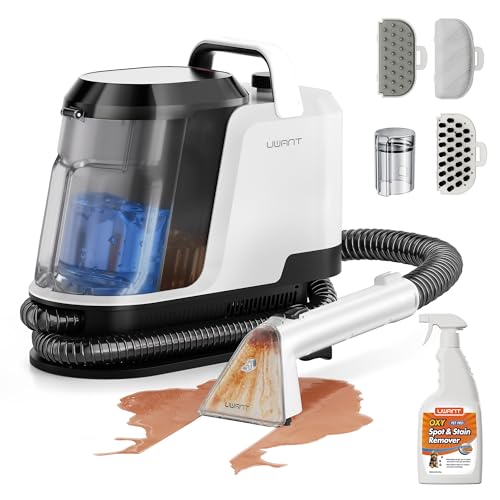
Uwant 18Kpa Portable Carpet Cleaner with 3 Brush Heads — Brush-Head All-Rounder
The Uwant’s title is the most hardware-forward of the four: a stated 18Kpa of suction, three brush heads, a pet pro cleaner with tools for pets, and a 2-in-1 carpet cleaner brief covering spot, rugs, and couch. For upholstery work, the brush heads are the headline. Furniture fabric varies more across a single sofa — flatweave seat cushions, textured back panels, tight seams — than carpet varies across a whole house, and interchangeable brush heads let the operator match agitation to each surface instead of asking one brush to be simultaneously gentle and determined.
Brush-head variety also future-proofs the purchase in a way single-tool machines cannot match. Households change their furniture more often than their cleaners; the sofa that arrives next year may wear a tighter weave or a deeper texture than the one the machine was bought for, and a head for each texture travels across that change. The same logic applies to the household’s other rooms — dining chairs in one fabric, a nursery chair in another, car seats in a third — each asking a slightly different agitation, each answerable from the same small box of heads.
The stated suction supports the same work from the other side: upholstery extraction succeeds when the tool seals and lifts, pulling solution back out of fabric that sits on foam, and a manufacturer willing to print 18Kpa is addressing that lift directly — subject to this batch’s standing caution that no test method is stated and figures should be read as indicative. The pet pro positioning and the couch-and-rug scope complete a machine aimed squarely at the lived-in family room: animals, furniture, floor coverings, one carried unit. Of the four linked picks, this is the one a hardware-led buyer will shortlist first, and the one whose documentation check can be shortest, because its title has already done more of the work.
- Format: portable carpet and upholstery cleaner machine, 2-in-1 design
- Suction stated in the title: 18Kpa
- Brush hardware named in the title: 3 brush heads
- Included, per the listing title: pet pro cleaner and tools for pets
- Surfaces named in the title: spot work, rugs, and couch
- Tank capacity: the listing title does not print one — check the manufacturer documentation
- Where to buy: the Uwant 18Kpa Portable Carpet Cleaner with 3 Brush Heads listing on Amazon — check price on Amazon
Strengths
- Three brush heads match agitation to upholstery’s varied surfaces and seams.
- A stated 18Kpa suction gives buyers a concrete capability figure.
- Pet tools plus couch, rug, and spot scope cover the family room end to end.
Trade-offs
- The suction figure arrives without a stated test method, as throughout this batch.
- Brush heads multiply the parts to rinse, dry, and keep together.
- Tank capacity is undocumented in the title, which matters for whole-sofa sessions.
Best for: family-room owners who want brush variety and stated suction for couch, rugs, and pets. Not suited for: minimalists who want one tool and no wardrobe of heads.

Shark StainStriker Portable Carpet/Upholstery Cleaner PX201 — Tools and Two Formulas
The PX201 completes the four with the StainStriker proposition in its three-tool form: a 3.5-inch stain tool, a crevice tool, and a pet mess tool, with Deep Clean Pro and OXY formulas, for carpet, upholstery, and area rugs, against stains and odors. Where its siblings in this batch’s other guides scale the same system up or down, the PX201 sits at the configuration most upholstery owners actually need: a precision tool for the mark, a crevice tool for the seams and junctions where upholstery spills collect, and a pet mess tool for the household’s likeliest emergency — with two chemistries to choose between per incident.
The PX201 also illustrates a quiet principle of this class: formulas are tools. A deep-cleaning formula and an oxygenated formula are not two bottles of the same idea; they are two different attacks, on greasy soil and on colored organic marks respectively, and upholstery — which collects both kinds on the same cushion, often in the same evening — is where the choice between them stops being theoretical. Owners who learn to read a stain before reaching for a bottle get professional-looking results from household machines; the PX201 is the pick that most explicitly equips that literacy.
Upholstery rewards that precision disproportionately. A sofa stain is rarely a neat circle on a flat field; it is a splash across a seam, a drip down a vertical face, a pool in the angle where seat meets arm. Tools shaped for those geometries, worked slowly with the right formula, are the difference between a cleaned sofa and a sofa with a tidemark. The odor half of the title’s promise matters here as well: upholstery holds smells in its foam long after its surface looks clean, and extraction with an oxy formula is the household process that actually reaches that layer. No suction figure is printed, and the spec box records the fact without apology.
- Format: portable carpet and upholstery cleaner, model PX201
- Tools named in the title: 3 tools, including 3.5-inch stain, crevice, and pet mess tools
- Formulas in the title: Deep Clean Pro, plus the OXY bottle
- Titled territory: carpet, upholstery, and area rugs
- Suction figure: none in the listing title — the documentation holds it
- Tank capacity: not printed in the listing title, so confirm it in the documentation before ordering
- Where to buy: the Shark StainStriker Portable Carpet/Upholstery Cleaner PX201 listing on Amazon — check price on Amazon
Strengths
- Three shaped tools cover upholstery’s seams, junctions, and pet emergencies precisely.
- Two formulas let chemistry follow stain type, including odor work in foam-backed fabric.
- Carpet, upholstery, and rug scope makes it a genuine dual-purpose household machine.
Trade-offs
- No stated suction for buyers who rank by figures.
- No wide tool, so large upholstery panels take patient, overlapping passes.
- Whole-room carpet work remains, as with all four picks, an upright’s territory.
Best for: stain-and-odor households wanting shaped tools and two chemistries for furniture and rugs. Not suited for: numbers-led shoppers or anyone needing to wash whole rooms.
Steam Cleaners as a Route into Upholstery Care — Discussed, Not Linked
Steam cleaners occupy the upholstery shopper’s imagination because they promise cleaning with heat and water alone — no solution bottles, no chemistry, just vapor and a cloth or brush attachment. The promise is partly real. Steam loosens surface soil and greasy films, refreshes fabric, and leaves very little moisture behind, which makes it attractive for light, frequent upholstery maintenance on fabrics that tolerate heat: a weekly pass over the sofa’s arms, a refresh of dining chairs before guests, a chemical-free routine in homes with crawling infants or sensitive noses. As maintenance, on suitable fabric, the class is genuinely useful.
One more consideration belongs to the steam discussion: water quality and residue. Steam leaves no solution residue, which is its genuine advantage for frequently refreshed fabrics, but it can leave mineral deposits from hard water on both the machine and, faintly, the fabric — a slow dulling that owners in hard-water districts should weigh. Extraction with solution, thoroughly recovered, leaves less behind than its reputation suggests; steam, carelessly maintained, can leave more. Neither class is the purity it advertises, and the choice between them should be made on soil type and fabric, not on slogans.
Its limits are equally real, and they are the reason this guide discusses the class rather than recommending a model within its linked picks. Steam does not extract. It loosens soil and leaves the loosened soil, and the moisture that carried it, in the fabric unless the operator wipes and blots with discipline — there is no recovery tank pulling the dirty water out, which is the defining act of the machines above. Deep stains, pet accidents, and anything that has soaked into foam are extraction problems, and steam alone answers them cosmetically at best. Heat also narrows the fabric list: delicate weaves, some dyes, and heat-sensitive synthetics are excluded, and protein stains can be set by it. The honest summary is that steam is a maintenance instrument and the extractors above are cleaning instruments; households that confuse the two end up with refreshed-looking upholstery that still smells like its history. Buy steam, if you buy it, for the weekly refresh — and keep extraction for the truth.
Full-Size Uprights with Hose Attachments — Discussed, Not Linked
The second route is the opposite philosophy: one large machine for the whole house, whose hose and tool set extends its reach from floors to furniture. The virtues are substantial. An upright’s tanks and motor dwarf a portable’s, so a hose session on a three-seat sofa does not stop for refills; the same purchase covers the seasonal whole-room clean and the weekly upholstery incident; and the storage footprint is one machine, not two. Several uprights reviewed elsewhere in this batch — in the standard and heavy-duty guides — carry exactly this configuration, with hoses, upholstery tools, and pet-specific attachments named in their titles, and readers set on this route will find them fully linked there.
There is also a session-shape difference that rarely gets stated. Upright hose work suits the planned, whole-suite clean — the Saturday when every cushion comes off and the machine works through the room methodically, tanks refilled at leisure. Portable work suits the unplanned shape of real furniture life, which is incident-shaped. Households should audit their own history before choosing a route: count last year’s upholstery events, and note how many were planned. The ratio is the answer, and it is rarely the ratio the shopper expected.
The costs are ergonomic and practical. Hose work with a full-size upright means the machine stands beside the sofa while you work its tool — fine on the ground floor, a expedition on the stairs, and genuinely awkward inside a car, where the portable class rules unchallenged. The upright’s power also demands more respect on delicate fabric: extraction force sized for carpet pile must be moderated by technique on thin upholstery over foam. And the incident problem remains: the upright lives where it lives, often a floor away from the spill, while the portable lives in the cupboard beside the sofa. Households whose upholstery work is planned and session-based thrive on this route; households whose upholstery work is emergencies should keep a portable within reach whatever else they own. The two routes are complements wearing the disguise of rivals.
Four Machines and Two Routes, Compared
| Option | Type | Titled evidence | Furniture strength | Watch out for |
|---|---|---|---|---|
| BISSELL Little Green Pet Deluxe 3353 | Linked portable | Pet messes on upholstery and vehicles; detailing | Pets and car interiors | No figures in title |
| BISSELL Little Green HydroSteam 3618 | Linked portable | HydroSteam hot water and steam; upholstery; detailing | Greasy films on modern fabric | Heat judgment required |
| Uwant 18Kpa with 3 Brush Heads | Linked portable | 18Kpa stated; 3 brush heads; pet tools | Varied surfaces and seams | Capacity unstated |
| Shark StainStriker PX201 | Linked portable | 3 tools; Deep Clean Pro and OXY formulas | Stains and odors in foam-backed fabric | No wide tool |
| Steam cleaners | Prose route | Class discussion only | Light, frequent refreshing | No extraction; heat limits fabrics |
| Uprights with hose attachments | Prose route | Class discussion only | Session-scale furniture work | Distance from incidents; car work awkward |
One row of the table deserves a second look from every reader: the watch-out column is longer, in spirit, for the two prose routes than for any linked machine — not because the routes are worse, but because they are unbounded. A linked machine’s limits can be checked against a title and a documentation page; a class’s limits must be understood in principle, because no single model’s paperwork will state them for you. That is the quiet service the prose sections perform, and it is why they belong in a guide that could have filled its space with two more product links and said less.
The table’s shape is this guide’s argument: four verified machines for the incident-driven, furniture-first household, and two legitimate routes for households whose upholstery life runs on different rails. What the table cannot show is fabric — yours — and the buying sections below return to it, because in upholstery work the fabric always has the deciding vote.
What Should You Check Before Cleaning Any Upholstery?
The care label, first and without exception. Furniture carries cleaning codes for a reason: some fabrics accept water-based cleaning, some demand solvent-only care, some accept vacuuming and nothing wetter, and the code — not the machine’s enthusiasm — governs. Find it under a cushion or on the frame’s underside, and obey it even when it disappoints you; a water-safe machine on a solvent-only fabric is a ruin with good suction. Then test: solution, heat if your machine offers it, and extraction, all in a hidden patch, dried fully and inspected before the visible work begins.
Bring a budget of time to the same checklist. A dual-purpose machine’s first upholstery session always takes twice the estimate — the label hunt, the test patch’s drying, the discovery that the seams need their own pass — and owners who schedule it tightly either skip the test patch or skip the drying, the two skips this guide exists to prevent. Give the first session a free afternoon; the fourth will take an hour, because the knowledge, unlike the machine, compounds.
Next, read your furniture’s construction the way the picks above read their titles. Foam-backed fabric punishes soaking, because foam drinks what fabric merely holds and returns it slowly as odor; down-blend cushions ask for minimal moisture and fast drying; tight seams and tufting trap solution and need the crevice tool’s attention and extra dry passes. Dark fabrics hide your test patch’s sins and show your residue’s; light fabrics do the reverse. And keep the household’s wider fabric logic in view: the reader who would never buy a machine for the home’s sewing work without checking its stated capabilities — the portability questions in Best Portable Sewing Machines are the same questions in another fabric dialect — should bring exactly that discipline to the sofa.
How Do You Clean Upholstery Without Watermarks, Soaking, or Regret?
Begin dry, as always: vacuum the piece thoroughly with an upholstery nozzle, lift pet hair with the dedicated tool where your machine provides one, and inspect the seams, where soil concentrates invisibly. Pre-treat marks individually, with the formula matched to the mark, and give chemistry its minutes. Then extract in small sections, keeping the tool sealed and moving at the pace the foam dictates — which is slower than carpet pace, because every pass’s water must come back out of a cushion, not a floor.
Work the piece in a deliberate order: hidden test patch, worst stain while your technique is fresh, oil zones with their dwell time, seams, then the broad panels last, because the panels are where an improving operator’s early unevenness would show most. Keep a dry cloth in the spare hand for the drips that escape the tool on vertical faces — upholstery work always produces them, and a drip caught in two seconds is a watermark prevented. Rinse the tool the moment the session ends, while the evidence is still liquid.
Feather your edges. Watermarks form where a cleaned patch dries against an uncleaned one, so work whole panels — a full cushion face, a full arm — rather than spot-shaped islands, and blend the boundary with progressively drier passes. Extract until the recovery runs clear, then make dry passes beyond that point, because upholstery’s foam will otherwise hold the session’s moisture against the fabric for days. Stand loose cushions on edge, aim a fan at the piece, and keep everyone — especially the dog, whose opinion of a damp sofa is that it is a better sofa — off the furniture until the foam is dry at its core, not merely at its face. The same respect for material limits governs fabric work throughout the house; it is why the heavy cloth in Best Sewing Machines for Denim rewards the operator who matches force to fabric, and upholstery is simply that lesson with water added.
Which Upholstery-Cleaning Mistakes Happen Most?
Ignoring the care code is the expensive one, and it is usually committed in a hurry, at a party, with a well-meaning machine. The second is soaking: treating a cushion like a carpet section, flooding foam that then holds moisture and odor for a week. The third is heat without homework — steam or hot extraction on an untested fabric, setting the stain or shifting the dye in a single confident pass. The fourth is the tidemark error, cleaning a neat circle in the middle of a cushion and framing the stain in a ring of its own making.
A fifth mistake is neglecting the machine’s tools afterwards, which in upholstery work means nozzles carrying pet residue into the next job’s clean fabric. And a sixth, subtler one: forgetting that upholstery ages. A fifteen-year-old sofa’s fabric has a fraction of its original tolerance for agitation and moisture, and the gentle, panel-by-panel, well-dried clean that seems excessive for new furniture is simply correct for old. Match the violence of the method to the age of the piece, and both will last longer — a principle the embroidery-minded, who would never hoop a fragile textile at full tension as the machines in Best Embroidery Machines for Home Use make possible, already understand in their hands.
Upholstery Fabrics, One by One: What Each Asks of a Machine
Modern synthetic upholstery — the polyester and microfiber family that covers most family sofas — is the extraction-friendly case: water-tolerant, colorfast in the ordinary run of things, and forgiving of the brush work the Uwant’s heads and the StainStriker’s tools supply. Its characteristic soil is the greasy film, and it is where the HydroSteam’s hot water earns its keep most safely. Cotton and linen covers sit one step up in caution: they accept water but show watermarks readily, which makes the panel-by-panel, feathered-edge technique in this guide’s how-to section a requirement rather than a refinement, and they dry more slowly than their weight suggests.
Leather and faux leather leave this guide’s territory almost entirely — they are wiped and conditioned, not extracted — and any machine’s title claiming them should be read with suspicion. Velvet and pile fabrics ask for minimal agitation and a test of whether extraction flattens their nap. Wool blends ask for cool water and gentle chemistry. Outdoor furniture fabrics, built to shrug off weather, tolerate extraction happily but hold their soil in textured weaves that reward brush variety. The practical method is always the same sequence — label, fiber, test patch, technique — but the answers differ by fabric, which is why this guide refuses to crown a single machine for all sofas: the four linked picks divide the fabric map between them, heat for the synthetics, brushes for the textures, tools and formulas for the stains, and pet specialization for the household where fabric type is the least of the variables.
The Geography of Furniture Soil: Where Upholstery Actually Gets Dirty
Upholstery does not soil evenly, and a guide that pretended otherwise would misdirect every cleaning session. Arms and headrests carry the oil load — skin and hair contact, hour after hour, in exactly the places a casual clean skips. Seat cushions carry the incident load: crumbs worked into seams, drinks at the cushion’s edge, the slow grind of denim against fabric. Backs carry almost nothing except dust and the occasional pet’s lookout post. A competent upholstery session therefore spends its time in a deliberate order — incidents first, while the solution is fresh; arms and headrests second, with dwell time doing the work; seams throughout, with the crevice tool; backs last and briefly.
Vehicles redraw the same map in miniature: driver’s seat as arm-and-headrest and cushion combined, back seats as the incident zone, footwell carpet as the grit frontier. Dining chairs concentrate everything onto a single small cushion that can be cleaned completely in minutes — the highest satisfaction-per-effort ratio in the entire upholstery world, and a good first job for a new owner learning a machine’s manners. Stairs, the carpeted kind, belong to this geography too: vertical faces, heavy soil, no floor machine welcome. The four linked picks were chosen against this map — every one of them can work a seam, a vertical face, and a cushion — because a machine that only understands floors understands less than half of where a home’s fabric actually suffers.
Drying: The Half of Upholstery Cleaning Nobody Titles
No title in this guide’s four claims a drying technology, and the omission is worth a section, because drying decides upholstery outcomes more than any other phase. A cushion is a sponge wearing a dress: the fabric can feel dry while the foam beneath holds the session’s water, and that hidden water is tomorrow’s odor and next month’s mildew line. The defenses are all in the operator’s hands — extraction continued past the point of visible return, dry passes until the tool comes away nearly clean, cushions stood on edge to expose their largest faces, moving air for hours, and the discipline to keep the piece out of service until a pressed hand at the cushion’s center finds the foam dry, not merely the surface.
Season and room conspire in this phase. A winter clean in a heated, closed house dries differently from a summer clean with the windows open, and thick cushions in a basement family room are the slowest drying combination in domestic life. Plan upholstery sessions the way the heavy-duty guide in this batch plans whole floors: morning work, airflow staged in advance, and no guests — canine or human — on the furniture until the foam has given up its water. Owners who master drying discover that their machine was never the limiting factor; owners who skip it conclude, wrongly and expensively, that extraction itself does not work on sofas.
Keeping a Dual-Purpose Machine Ready: The Ownership Routine
A dual-purpose machine lives two lives — floor incidents and furniture sessions — and its ownership routine must serve both. The incident life demands readiness: solution in date, tool rinsed from the last job, a home within a few steps of the sofa. The session life demands completeness: every brush head accounted for, formulas stocked in both kinds where the machine uses two, and a drying plan for the furniture before the first cushion is wet. Owners who run both lives well develop a small ritual — after every use, rinse and dry the tool, empty and rinse the tank, coil the hose loosely, and return the machine to its place assembled. Five minutes, every time, without negotiation.
The failure mode to avoid is the slow divergence: heads migrating to drawers, formulas expiring at the back of a cupboard, the machine exiled to a garage by a household member who needed the cupboard. A dual-purpose cleaner that has diverged is two half-machines, and it will be found wanting on exactly the day a pet, a party, and a pale sofa converge. Treat the kit as a kit — one home, one inventory, one ritual — and the four linked picks will still be answering incidents, completely, years after their purchase.
When Should Upholstery Go to the Professionals Instead?
Honesty requires a boundary, and upholstery’s boundary is clearer than carpet’s. Send out the antiques, the heirlooms, the silk and the unstable dyes, the pieces whose fabric code forbids water, and the pieces whose value is mostly sentimental and therefore irreplaceable. Send out, too, the disasters beyond household scale: the flood-soaked suite, the smoke-damaged room, the stain that has defeated two careful household attempts — professionals bring extraction power, drying chambers, and insurance that no portable in this guide pretends to match.
Everything else — the family sofa, the dining chairs, the car, the nursery rocker, the stairs — is household territory, and it is a large, valuable territory. The economics argue for owning the means: a single professional upholstery visit prices against a substantial share of a portable machine, and the machine then answers a decade of incidents. The boundary rule is simple enough to print on the cupboard door: if the piece cannot be replaced, it cannot be practiced on; if it can be replaced, it can be cleaned — carefully, by label, with the right one of these four machines.
How Do the Four Linked Picks Divide the Work Between Them?
Read as a set, the four machines form a small, complete system for the dual-purpose household, and their divisions are clean. The Pet Deluxe owns the animal-and-automobile territory, where incidents are frequent, odors matter, and the surfaces are curved. The HydroSteam owns the grease territory — arms, headrests, the shiny paths that hands and heads polish into family-room furniture — wherever fabric tolerates heat. The Uwant owns the texture territory, swapping brush heads across the household’s variety of weaves, with stated suction as its passport. The PX201 owns the stain territory, matching shaped tools and twin chemistries to marks that have already happened and smells that have already settled.
A household buying one machine should locate its own center of gravity on that map; a household buying two will find the pairs assemble themselves — pet plus heat for the dog-owning family room, brushes plus formulas for the texture-rich, stain-prone one. What none of the four owns is the whole room’s carpet, and the guide’s honesty on that point is deliberate: dual-purpose means floors in patches and furniture in full, and the reader whose floors need lanes should start with the upright guides in this batch and add one of these four as the furniture partner.
Final Recommendation
Choose by the furniture you actually own and the messes it actually collects. Pet households should take the Little Green Pet Deluxe 3353 and its vehicle-ready brief; owners of greasy, hard-worn modern upholstery should take the HydroSteam 3618 and use its heat with respect; hardware-led buyers should take the Uwant and its three brush heads and stated suction; and stain-and-odor fighters should take the PX201 and its shaped tools and twin formulas. Keep the two prose routes in their honest places — steam for the refresh, the hose-equipped upright for the planned session — and read every care label before any machine touches any fabric. Do that, and the sofa that has been quietly absorbing your household’s whole history will give it back, one clear recovery tank at a time, until what remains is only the furniture you meant to keep.
Frequently Asked Questions
Can I clean any sofa with these machines?
No — the furniture’s care code decides, not the machine. Water-based extraction suits fabrics coded for water cleaning; solvent-only and vacuum-only fabrics exclude these machines regardless of their quality, and antique or delicate pieces belong to professional care. Always find the label, test a hidden patch, and let the fabric’s instructions overrule this guide, the machine’s title, and your own optimism.
Is steam or extraction better for upholstery?
They do different jobs. Extraction removes soil, stains, and odor from the fabric and its foam, recovering the dirty water; steam refreshes and loosens light surface soil but leaves what it loosens behind unless carefully wiped. For incidents, pet messes, and deep soil, extraction is the answer; for light, frequent refreshing of heat-tolerant fabric, steam has its place — which is why this guide links extractors and discusses steam in prose.
Why does this guide link four machines instead of six?
Because four is the honest count. The dual-purpose portable class is small, its strongest models appear in this batch’s companion guides, and padding this page with repeats or with machines whose titles never claim upholstery work would serve the list rather than the reader. The two remaining routes into upholstery cleaning — steam cleaners and hose-equipped uprights — are covered in prose, without links or invented specifications.
How do I stop a cleaned cushion from smelling damp afterwards?
The smell is moisture held in foam, and the cure is extraction thoroughness plus drying discipline: dry passes until the tool pulls almost nothing, cushions stood on edge, a fan aimed at the piece, and no sitting until the core is dry. If a piece already smells, a second light extraction with thorough drying usually clears it; the error to avoid is re-soaking it in a frustrated attempt to wash the smell out at once.
How often should upholstery be extraction-cleaned?
By soil rather than by calendar: arms and headrests in a busy household benefit from attention a few times a year, seat cushions whenever incidents accumulate, and whole pieces annually at most for the average home. Pet households run hotter on every figure. Over-cleaning is a real if lesser risk — each session is moisture and agitation that fabric must survive — so the rhythm to aim for is prompt incidents, seasonal attention to the oil zones, and patience in between.
What is the difference between a carpet cleaner with a hose and these portables?
Scale and address. A hose-equipped upright brings larger tanks and a floor machine’s power to furniture work, but it works from wherever the machine can stand, and it lives wherever a large machine lives. The portables in this guide carry the whole system to the fabric — into cars, up stairs, beside the sofa — and live within reach of incidents. The prose section above weighs the two routes in full; most furniture-heavy households end up preferring the portable’s address and many own both shapes eventually.
Can these portables handle a car interior properly?
Two of the four linked picks are titled for exactly that — the Pet Deluxe 3353 and the HydroSteam 3618 both name car and auto detailing — and the portable format is the natural shape for footwells, seats, and seams. Work in sections, extract thoroughly because automotive foam dries slowly, and leave the vehicle open to air afterwards until the interior is dry throughout.
Related Guides
Upholstery that survives its cleaning deserves a floor covering that can survive its household too, and the pet-stain-resistant end of the rug market is surveyed in Best Area Rugs with Pet Stain Protection — a fitting next read for the pet households this guide mostly serves.


