What's inside
- Key Takeaways
- Quick Picks
- What Did a Machine Have to Prove to Stand on This Café Bar?
- Best Coffee Machines for Cafes: What Each One Actually Does All Day
- How Much Espresso Capacity Does a Café Counter Honestly Need?
- Where Do Water, Power, and Counter Depth Decide the Purchase?
- How Do Dayparts Change Which Machine Earns Its Keep?
- How Should a Café Think About Beans When the Machines Differ This Much?
- What Belongs in the Budget Beyond the Machine’s Price Tag?
- What Does a Sensible Cleaning and Descaling Rota Look Like?
- Which Errors Do First-Time Café Owners Make With Machines?
- Should a New Café Buy Commercial Equipment Second-Hand Instead?
- Final Recommendation
- Frequently Asked Questions
- Related Guides
As an Amazon Associate I earn from qualifying purchases. This post may contain affiliate links at no extra cost to you.
cottageverdict.com is reader-supported. When you buy through links on our site, we may earn an affiliate commission.
A café counter is an unforgiving place to learn that a machine was built for a kitchen. The best coffee machines for cafes have to survive the morning rush in both directions at once: a queue of milk drinks that all want steam at the same moment, and a drip drinker who expects a fresh cup without joining the espresso line at all. That is why this guide is organised around the bar, not around brand names. One genuine two-group commercial espresso machine anchors the list, two guided home-bar style machines cover the small café that sells espresso drinks in dozens rather than hundreds, a plumbed pod system absorbs the decaf-and-tea traffic, and an airpot brewer keeps brewed coffee moving without tying up a group head.
Where these machines are sold matters to a working café, so a note on channels before the picks: all six listings below are sold through Amazon, and each pick links straight to its own product page, where the current configuration and delivery terms live. For a business purchase that is genuinely convenient — no dealer appointment, no showroom trip — but it also means the buyer does the installer’s homework personally. Read the electrical and plumbing lines in every spec box twice. A café machine that arrives before its circuit does is an expensive ornament during the exact week you can least afford one.
Read the six picks as a system rather than a ranking. The order below follows the bar from its engine outward — espresso first, then the stations that protect it — because that is how a café actually experiences its machines during service. A café that buys only the first pick owns an engine with no support; a café that buys only the supporting picks owns a drinks program with no heart. The guide’s real recommendation is the combination, sized to the room.
One honesty note that shapes everything after this paragraph. The figures quoted in this guide come from the listing titles themselves: cup-per-day ratings, wattage, boiler sizes, capacities. Where a title is silent about something a café owner would reasonably ask — pump type, portafilter size, warranty terms — the spec box says so instead of filling the gap with a plausible guess. Commercial espresso is a field where invented numbers cause real purchasing mistakes, and this guide would rather leave a blank marked as a blank.
Key Takeaways
- Only one pick is a true two-group commercial machine: the touchscreen two-group unit rated by its title at 150–250 cups a day, with dual 1-litre brew boilers and an 8-litre steam boiler behind them.
- The two Ninja Luxe models and the De’Longhi La Specialista Arte Evo suit cafés whose espresso trade is real but modest — guided tamping and frothing forgive a junior barista in a way a full commercial group never will.
- The Keurig K-4500 is the list’s pressure valve: a plumbed single-serve café system that takes decaf, tea, and one-off orders off the espresso bar entirely.
- Drip coffee still earns its counter space. The NUPANT airpot brewer auto-fills and holds coffee in a 2.2-litre thermal carafe, so brewed coffee never waits on the espresso queue.
- Electrical planning is the hidden purchase: the two-group machine’s title states 4,600 watts on a 110-volt listing, a combination worth a conversation with an electrician before checkout, not after delivery.
Quick Picks
| Machine on the bar | Bar role | Why it holds a place here |
|---|---|---|
| Two-Group Commercial Espresso Machine | The rush-hour engine | The only genuine two-group machine in the lineup, PID-controlled and rated in its title for 150–250 cups a day. |
| De’Longhi La Specialista Arte Evo | Small-café all-rounder | Built-in grinder, four preset recipes, and a barista toolkit in the box for cafés training staff as they go. |
| Ninja Luxe Cafe Pro | Four-format counter unit | Espresso, drip, and cold brew from one footprint, with an integrated tamper that keeps puck prep consistent. |
| Keurig K-4500 Cafe System | Plumbed pod workhorse | A large-business single-serve system that absorbs decaf and specialty one-offs without touching the bar. |
| NUPANT Airpot Brewer | Brewed coffee, held properly | Auto-filling brewer with a 2.2-litre thermal airpot, so filter coffee is poured, not brewed to order. |
| Ninja Luxe Cafe Premier | Guided second station | Barista Assist guidance and a dual froth system for hot or cold foam at a satellite or training station. |
What Did a Machine Have to Prove to Stand on This Café Bar?
The first test was role clarity. A café does not buy “a coffee machine”; it buys coverage for specific dayparts and drink categories, and every pick below was admitted because it fills one named slot — main espresso bar, second station, pod overflow, or the drip corner — better than a generalist would. Machines whose titles could not say what job they do were set aside, however polished their photographs looked.
The second test was throughput language. Commercial buyers deserve numbers, so titles that state a cups-per-day rating, a wattage, a boiler volume, or a carafe size earned trust that vague “commercial grade” phrasing never does. That is also why the restaurant conversation belongs in this guide’s orbit: a café whose food program grows will eventually shop the drip-and-urn world covered by Best Coffee Machines for Restaurants, and the honest-throughput habit transfers directly to that category.
The third test was staffing reality. Most small cafés do not employ a career barista on every shift; they employ good people who were trained last month. Guided machines — preset recipes, integrated tampers, frothing systems that texture milk hands-free — were therefore judged as training tools as much as appliances. A machine that makes the fourth-best latte in town identically on every shift will outsell a temperamental machine that makes the best latte only when its favourite operator is working.

Two-Group Commercial Espresso Machine — The only true café engine in the lineup
Start with the numbers its title is willing to print: two groups, PID control, a touchscreen display, a stated working range of 150 to 250 cups a day, 4,600 watts, dual 1-litre brew boilers, and an 8-litre steam boiler, on a 110-volt listing aimed at cafés, restaurants, and coffee shops. That is a specification written for a buyer who measures a morning in tickets. Two groups mean two portafilters pulling at once; separate brew boilers mean each group holds its own temperature instead of borrowing stability from a shared tank; and an 8-litre steam boiler is the difference between steaming milk continuously through a rush and rationing steam between drinks.
PID control is the detail a café owner should linger on. Espresso extraction is brutally sensitive to temperature drift, and a PID loop holds the brew boilers at a set point rather than letting them swing around one. Across a 200-cup day, that stability is what keeps the 9 a.m. flat white tasting like the 7 a.m. one — the quiet consistency that regulars actually pay for, even if they never learn the vocabulary for it.
The caution is electrical, and it is printed in the same title: 4,600 watts at 110 volts is an unusual pairing that implies a very serious circuit. Treat the listing as the start of a conversation with your electrician and, if the premises are leased, your landlord. Counter depth, drainage for the drip tray, and a water supply worthy of the boilers all belong on the same checklist. None of that diminishes the machine; it simply marks it as the one pick here that behaves like installed equipment rather than an appliance, because that is what it is.
Ownership rhythm matters with a machine of this class. A touchscreen interface shortens the path to programs and cleaning cycles, but the daily disciplines remain manual: purging groups, wiping wands the moment milk leaves them, backflushing on schedule, and watching the steam boiler’s behaviour the way a chef watches a stock pot — continuously, and before small changes become service failures. Cafés that assign those rituals to named people on a posted rota get years of dull reliability from commercial equipment. Cafés that leave them to whoever is passing get the same machine and a very different ownership story, usually told to a repair technician at the worst possible hour.
- Format: two-group commercial espresso machine with touchscreen display
- Temperature control: PID, as stated in the listing title
- Stated output: 150–250 cups per day
- Boilers: dual 1L brew boilers and an 8L steam boiler
- Power: 4,600W, 110V per the title — confirm the circuit requirement with an electrician
- Portafilter size and pump type: the listing title does not give either — confirm both on the product page
- Where to buy: the Two-Group Commercial Espresso Machine — check the current listing on Amazon before ordering.
Strengths
- Two groups and a large steam boiler answer the actual bottleneck of a café rush: simultaneous shots and continuous milk.
- PID control plus separate brew boilers protect shot-to-shot consistency across a long service.
- The title states its daily cup rating openly, which lets an owner match machine to menu with real arithmetic.
Trade-offs
- The 4,600W/110V combination demands electrical verification before purchase, not improvisation after.
- It is installed equipment in spirit: drainage, water, and counter planning come with the territory.
- A café selling forty espresso drinks a day is buying capacity it will never invoice against.
Best for: cafés with a genuine milk-drink rush and the counter, circuit, and ticket volume to justify a two-group bar. Not suited for: kiosks, offices, or any site where espresso is an amenity rather than the product being sold.

De’Longhi La Specialista Arte Evo — The trainer-friendly small-café machine
Not every café needs two groups; some need one honest station that a new hire can run respectably by Friday. The La Specialista Arte Evo is built for exactly that business. Its title promises a built-in grinder, four preset recipes, a powerful milk frother, and a barista toolkit included in the box — a combination that reads like a training program disguised as an appliance. The grinder being internal matters more than it sounds: it removes one separate purchase, one separate calibration habit, and one square foot of counter from a small café’s list of problems.
Preset recipes deserve a defence, because purists sneer at them. In a café, a preset is a standard. When the owner is not on shift, the preset is what keeps the house cappuccino the house cappuccino. Four recipes will not cover an experimental menu, but they cover the drinks that pay the rent in most neighbourhood cafés — espresso, and the milk drinks built on it — with a repeatability that freehand preparation by rotating staff rarely matches.
The limit is ceiling, not quality. This is a single-station machine from a maker whose title leans on its worldwide espresso reputation rather than on commercial duty ratings, and it states no cups-per-day figure. A café whose Saturday queue reaches the door should read it as a second station or a starter machine with a planned promotion path, not as the final answer. Bought with that understanding, it is one of the most sensible small-café purchases on this page.
There is also a menu-design consequence worth naming. Four preset recipes quietly discipline a café’s drinks list toward the drinks that can be executed perfectly by everyone, which is where small cafés make their money anyway. The owner who wants a fifth, experimental drink can still build it by hand on this machine; the presets simply guarantee that the core menu never depends on who is standing at the bar. In a business where the Saturday team is rarely the Tuesday team, that guarantee is a feature with a cash value, even though no listing will ever print it.
- Format: espresso machine with built-in coffee grinder
- Recipes: 4 preset recipes per the listing title
- Milk: frother described in the title as powerful
- In the box: a barista toolkit is included, per the title
- Daily cup rating: not given in the listing title — judge it as a single-station machine
- Where to buy: the De’Longhi La Specialista Arte Evo — its Amazon page carries the current configuration.
Strengths
- Built-in grinding and included tools collapse three purchases and three setup chores into one.
- Preset recipes give rotating staff a shared standard to pour against.
- A recognised espresso specialist brand, which eases the owner’s learning curve and parts anxiety.
Trade-offs
- No stated commercial throughput rating; busy cafés will outgrow it as a main bar.
- Four presets suit a focused menu, not an experimental one.
- One station means espresso and milk work queue behind each other at peak.
Best for: small cafés, bakeries, and bookshops where espresso is a serious sideline and staff rotate. Not suited for: high-volume espresso bars whose morning rush is measured in dozens of simultaneous tickets.

Ninja Luxe Cafe Pro — Four drink families on one footprint
The Luxe Cafe Pro makes an argument no traditional espresso machine can: that a small café’s counter is better served by breadth than by depth. Its title lists a 4-in-1 machine covering espresso, drip coffee, and cold brew, with a built-in grinder, a hot water outlet, a hands-free milk frother, and an integrated tamper, finished in stainless steel. Read that as a menu strategy. Espresso drinks, a drip option for the customer who wants “just coffee,” cold brew for the afternoon trade, and hot water for tea — four revenue lines that would otherwise need three separate appliances and the counter to hold them.
The integrated tamper and hands-free frother are the two features a café owner should weigh most heavily, because both attack inconsistency at its source. Tamping is the least standardised act in a small café; building it into the machine narrows the gap between the owner’s puck and the Saturday casual’s puck. Hands-free frothing similarly turns milk texturing from a wrist skill into a repeatable setting, and it frees the person on bar to pull the next shot while the milk finishes.
What this machine is not is a commercial espresso engine, and its title does not pretend otherwise — no cup rating, no boiler figures, no group language. Its drip and cold brew are café-convenient rather than café-scale. Place it in a café whose drinks trade is measured in scores per day, or as the versatility station beside a main bar, and it earns its footprint handsomely. Ask it to carry a rush alone and the queue will deliver the review.
Consider where this machine quietly earns money outside the morning peak. Cold brew through the afternoon, hot water for the tea drinker who arrived with coffee drinkers, a drip cup for the laptop guest who will order twice more before leaving — these are the low-drama, high-margin orders that fill a café’s quiet hours. A traditional espresso bar serves them reluctantly, with equipment designed for something else. The Pro serves them as first-class citizens of the same station, which is why café-corners inside bookshops, garden centres, and bakeries should read this pick first rather than last.
- Format: 4-in-1 espresso machine with drip coffee and cold brew modes
- Grinder: built in, per the listing title
- Milk: hands-free frother; hot water outlet also stated
- Puck prep: integrated tamper named in the title
- Finish: stainless steel
- Commercial duty rating: none appears in the listing title — position it by role, not by volume claims
- Where to buy: the Ninja Luxe Cafe Pro — sold via its Amazon listing, where today’s terms are posted.
Strengths
- Espresso, drip, cold brew, and hot water from one machine simplifies a small café’s entire drinks program.
- Integrated tamping and hands-free frothing compress the training curve for new staff.
- Built-in grinding keeps the station self-contained on a short counter.
Trade-offs
- Versatility is bought with depth: none of its four modes matches a dedicated machine at volume.
- No commercial throughput figure is stated, so capacity planning rests on role, not ratings.
- Cold brew and drip output suit a sideline trade rather than a brew-led menu.
Best for: compact cafés and café-corners inside other businesses that want a full drinks menu from one station. Not suited for: espresso-led bars where shot volume, not menu breadth, is the business.

Keurig K-4500 Cafe System — The plumbed pod system that protects the bar
Every café menu has a shadow menu: the decaf for the customer who cannot have caffeine, the tea-adjacent specialty drink, the flavoured coffee a regular insists on. Served from the espresso bar, those orders steal group time and grinder changes from the drinks the café is actually known for. The K-4500 exists to take that traffic elsewhere. Its title describes a large-business single-serve coffee and specialty beverage café system, plumbed, in silver and black — and the word “plumbed” is the whole pitch. A plumbed pod system never stops for a reservoir refill mid-rush, never asks a barista to choose between a tank and a ticket.
Pod coffee in a café needs an honest defence, because the café trade can be snobbish about it. The defence is segmentation. Nobody orders a pod drink expecting the café’s signature shot; they order it because it is the drink they want, made identically every time, by any member of staff, in under a minute. For offices-with-café-corners, hotel cafés, and bakery counters, that reliability is the product. The K-4500’s café-system framing — specialty beverages alongside coffee — suits exactly the counter where variety is demanded and barista depth is thin.
The trade-off is the familiar one: pods cost more per cup than beans and tie the café to a pod supply chain, and the drink ceiling is the pod’s ceiling. A café whose identity is craft should keep pods out of sight or off the menu entirely. A café whose identity is welcome — everyone gets their drink, quickly — will find this the hardest-working quiet machine on the counter.
One operational detail separates a good pod installation from an annoying one: pod logistics. A plumbed machine removes water from the worry list, but pods arrive in cases, empty into bins, and run out on the one flavour a regular loves if nobody owns the reordering. Assign the pod shelf to a person, keep the decaf stocked as religiously as the house blend, and the K-4500 disappears into the café’s background — which is the highest compliment a support machine can earn. Its silver-and-black finish helps there too; it reads as commercial equipment, not as a domestic brewer that wandered into a business.
- Format: single-serve pod system for large business use
- Water supply: plumbed, per the listing title — no reservoir refills
- Drinks: coffee and specialty beverages, per the title’s café-system description
- Finish: silver and black
- Reservoir size: irrelevant by design here, and no figure is stated in the title
- Where to buy: the Keurig K-4500 Cafe System — find it on Amazon, where the listing confirms plumbing requirements.
Strengths
- Plumbed water removes the refill pause that quietly throttles counter service.
- Any staff member can serve any pod drink identically, which flattens training to nearly nothing.
- Decaf and specialty orders stop competing with the espresso bar for time and equipment.
Trade-offs
- Per-cup pod cost runs above bean cost, and the café marries a pod supply chain.
- Drink quality is capped by the pod, not by the skill of the person serving.
- Craft-led cafés may find a pod system off-brand for their room.
Best for: bakery cafés, hotel counters, and café-corners where variety and speed outrank ceremony. Not suited for: purist espresso bars whose brand promise is hand-made everything.
NUPANT Airpot Brewer — Brewed coffee that never blocks a group head
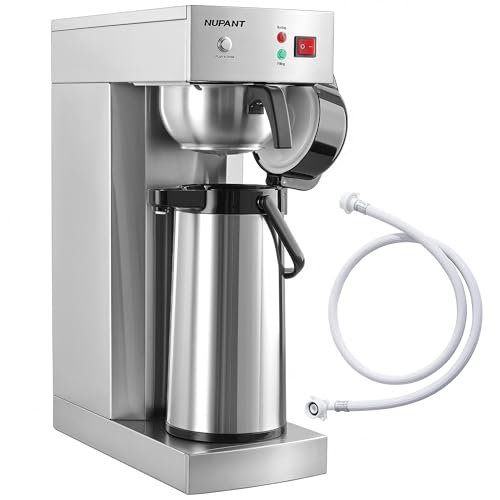
A café that makes its drip drinkers wait behind six lattes is teaching them to buy drip somewhere else. The NUPANT’s answer is separation: an auto-filling commercial airpot brewer that keeps a 2.2-litre (74-ounce) thermal carafe filled and holding, so the drip order is a pour, not a project. Its title adds the details that matter in service — a thermal carafe described as holding heat for 24 hours, stainless steel construction, and a 120V/1450W electrical footprint that any café circuit already understands. That last figure is quietly important: unlike the two-group machine, this brewer asks nothing exotic of the building.
Auto-filling deserves emphasis. A brewer plumbed or arranged to refill itself removes the most common drip failure in cafés, which is not bad coffee but absent coffee — the airpot discovered empty at the exact moment a tour group arrives. Paired with a thermal carafe rather than a hot plate, the coffee also escapes the stewed flavour that burners give a pot held through a slow afternoon. Fresh batches stay worth drinking, which is what makes a drip program a profit line instead of an apology.
Read the title’s “pour over dispenser” phrasing with care: this is a drip brewer feeding an airpot, not an espresso device of any kind, and it will not rescue a café whose espresso station fails. Its job is narrower and, in many cafés, just as valuable. Buy it as the drip department’s entire staff, and judge it on whether the airpot is ever empty when it should not be.
The airpot format carries one more café advantage that rarely gets mentioned: it travels. The same carafe that serves the counter can walk to a tasting event, a meeting room booking, or the café’s own outdoor seating without an extension lead or a second machine. Cafés that cater small functions from their own kitchen will find the brewer paying for counter space it does not even occupy on those days. Just date each batch as it brews — a thermal carafe preserves coffee generously, and that generosity becomes a quality risk only when nobody remembers which hour the pot belongs to.
- Format: auto-filling commercial airpot drip brewer
- Carafe: 2.2L / 74oz thermal airpot, with 24-hour heat retention claimed in the title
- Construction: stainless steel
- Power: 120V / 1450W per the listing title
- Espresso capability: none — this is a brewed-coffee machine only
- Where to buy: the NUPANT Airpot Brewer — its Amazon listing is where to confirm the current package.
Strengths
- Auto-fill plus a thermal airpot keeps drip coffee available without staff attention or burner stewing.
- Standard 120V/1450W power slots into ordinary café circuits with no electrical project.
- Separating drip from the espresso bar shortens both queues at once.
Trade-offs
- One carafe size fits cafés whose drip trade is steady, not banquet-scale.
- It contributes nothing to espresso or milk drinks; the bar still needs its own machine.
- Thermal holding rewards batch discipline — yesterday’s coffee in a thermal carafe is still yesterday’s coffee.
Best for: cafés with a loyal drip trade that deserves better than a burner and a wait. Not suited for: venues expecting it to substitute for an espresso station during a breakdown.
Ninja Luxe Cafe Premier — The guided station for a second counter
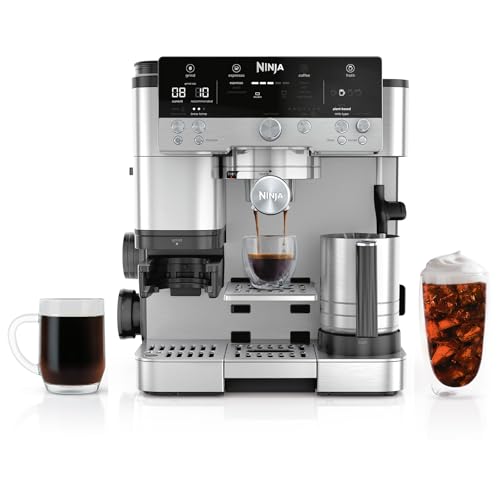
The Premier is the Pro’s sibling with a different brief. Its title describes a 3-in-1 espresso machine, model ES601, in stainless steel, built around guided Barista Assist technology and a dual froth system producing hot or cold microfoam. Where the Pro sells breadth — drip and cold brew join the menu — the Premier sells guidance. In café terms that makes it the natural second station: the machine placed at the pastry counter, the training bench, or the weekend satellite bar, where the operator may be the café’s least experienced person and the drinks still have to match the house standard.
Barista Assist is worth taking seriously as a staffing tool. Guided workflows walk the operator through dose and extraction decisions that a commercial machine assumes as prior knowledge. The result is not a replacement for a trained barista; it is a floor under the drinks made by everyone else. Cafés live and die on that floor, because customers remember the worst cup, not the average one.
Cold microfoam is the feature with menu consequences. Iced drinks are no longer a summer exception in café trade, and a dual froth system that textures cold foam opens the iced-latte-and-cold-foam segment that a steam-only station handles awkwardly. The Premier’s honest boundary is the same as the Pro’s: no commercial rating appears in its title, and it should be scheduled like the guided appliance it is — high value per drink, modest drinks per hour.
There is a training dividend here that owners undervalue. A new hire who learns extraction on a guided machine learns what a correct shot looks and tastes like before being asked to produce one unaided, because the guidance externalises the standard. Move that hire to the main bar later and the palate transfers even though the workflow changes. Cafés with chronic staff turnover — which is to say, most cafés — should count that onboarding effect as part of the purchase, the way a kitchen counts a combi oven’s training modes. The machine teaches while it serves, and it serves drinks a trainee working alone on a manual machine simply could not be trusted with yet.
- Format: 3-in-1 espresso machine, model ES601
- Guidance: Barista Assist technology for consistent results, per the title
- Milk: dual froth system for hot or cold microfoam
- Finish: stainless steel
- Grinder and drip/cold-brew modes: the title for this model does not claim them — check the listing rather than assuming parity with the Pro
- Where to buy: the Ninja Luxe Cafe Premier — available through Amazon; verify the ES601 designation on the page.
Strengths
- Guided preparation raises the floor under drinks made by junior staff.
- Cold microfoam capability serves the iced-drinks segment from the same station.
- Compact guided format suits a satellite counter that a full machine would overwhelm.
Trade-offs
- No stated commercial throughput; it supports a bar rather than carrying one.
- Guidance systems reward the house standard, not experimentation beyond it.
- Buyers wanting drip and cold brew in the same unit should compare the Pro above.
Best for: cafés adding a second drinks point or a training station without a second full bar. Not suited for: solo duty as the only machine in an espresso-led café.
Best Coffee Machines for Cafes: What Each One Actually Does All Day
| Machine | Day job | Stated headline figure | Staffing assumption |
|---|---|---|---|
| Two-Group Commercial Espresso Machine | Main espresso bar | 150–250 cups/day, 4,600W | A trained barista on every shift |
| De’Longhi La Specialista Arte Evo | Solo station, small café | 4 preset recipes, built-in grinder | New hires productive within days |
| Ninja Luxe Cafe Pro | Menu breadth station | 4-in-1: espresso, drip, cold brew | One operator covering all drinks |
| Keurig K-4500 Cafe System | Pod overflow and variety | Plumbed single-serve café system | Any staff member, no bar skills |
| NUPANT Airpot Brewer | Drip program | 2.2L airpot, 120V/1450W | Batch discipline once a cycle |
| Ninja Luxe Cafe Premier | Guided second station | Dual froth, hot and cold foam | Junior staff, guided workflow |
How Much Espresso Capacity Does a Café Counter Honestly Need?
Work backwards from the worst twenty minutes of your week, not from the daily average. A café selling 180 drinks a day sounds gentle until 70 of them arrive between 8:00 and 8:40, at which point the question is not cups per day but drinks per minute with milk. Two groups, a large steam boiler, and a second pair of hands answer that question. A single guided station, however good, answers a different one — steady trade spread across opening hours — and owners who confuse the two buy twice.
Menu mix sharpens the arithmetic. A café whose tickets are mostly drip and pod drinks can run a modest espresso station happily for years, because the espresso queue is short even at peak. A café whose identity is milk drinks lives or dies by steam capacity, which is precisely the figure the two-group machine’s 8-litre steam boiler addresses and the figure domestic-style machines do not state at all. When a title is silent about steam, believe the silence.
Finally, plan the failure day. Machines stop, usually mid-rush, and a café with a pod system and an airpot brewer still sells coffee while the espresso bar is down. Redundancy across formats — the exact shape of this guide’s six picks — is not indecision; it is the cheapest business-interruption insurance a small café can buy.
There is a subtler capacity question hiding inside the first one: capacity for whom? A café near a station serves strangers who will forgive a good cup slowly made exactly once, because they will not return to test the second. A neighbourhood café serves regulars who forgive nothing twice but reward consistency for years. The stranger-café should optimise for peak throughput; the regulars-café should optimise for the floor under its worst cup, which is why guided consistency features so heavily in this guide’s middle picks. Knowing which café you are running is worth more than any single specification on this page, and it costs nothing but honesty to find out before the machines arrive.
Where Do Water, Power, and Counter Depth Decide the Purchase?
Three of these six machines touch the building. The two-group espresso machine wants serious power and a water supply; the K-4500 wants a plumbed line; the NUPANT’s auto-fill works best with a supply arranged rather than improvised. Café owners should walk the counter with a tape measure and the listing open, checking depth against the machine, clearance above for cup storage and steam wands, and a drainage answer for drip trays that will otherwise be emptied by hand forty times a day.
Water quality is the unglamorous variable that decides boiler life. Hard water scales boilers and group heads, and cafés in hard-water districts should budget filtration alongside any plumbed machine, espresso especially. The cost is modest next to a descale service call during a holiday weekend. Ask the same practical question about every plumbed appliance in the building, incidentally: a café washing its own glassware faces the identical install-first logic, which is why the Best White Dishwashers guide insists on matching the machine to the load and the room before falling for a finish.
Power deserves the last word because it is the mistake with the longest lead time. The two-group machine’s stated 4,600 watts will not negotiate with an old building’s panel. Get the electrician’s verdict in writing before the order, and if the premises cannot support the machine, step down to a guided station with a clear conscience rather than discovering it with a crate on the pavement.
How Do Dayparts Change Which Machine Earns Its Keep?
A café’s day is not one shift but four small businesses wearing the same apron. The commuter hour wants speed and milk; the mid-morning lull wants a pleasant drip and a place to sit; the lunch crowd wants drinks that accompany food rather than star in it; the afternoon wants cold drinks and a reason to linger. Each pick in this guide has a daypart where it is the hero and another where it is merely present, and owners who map machines to dayparts stop asking which machine is “best” and start asking which hour is currently unserved.
The commuter hour belongs to the two-group machine or, in a smaller room, to whichever guided station has the shortest path from order to cup. Mid-morning belongs to the airpot: drip drinkers refill, read, and stay for a second pastry precisely because nobody made them queue behind a portafilter ritual. Lunch spreads demand across everything, which is when the pod system quietly justifies itself by taking the awkward orders — the decaf, the flavoured drink, the tea-adjacent request — out of every other queue.
Afternoon is where the Ninja pair earn their counter rent. Cold brew and cold-foam drinks are afternoon drinks, ordered by people who are not in a hurry and who photograph well-poured glasses. A café that cannot serve them watches that trade walk to the chain on the corner. None of this requires six machines; it requires the owner to notice that the machine bought for the morning rush may be the wrong tool for the afternoon margin, and to let each station work the hours it was built for.
Staffing follows the same curve. The expensive labour hour is the rush, and every format that removes a drink from the barista’s hands during that hour — pods pre-empting odd orders, the airpot pre-empting drip — is effectively a labour purchase disguised as equipment. Owners comparing machine prices without comparing the labour each machine saves are reading only half the invoice, and usually the smaller half.
How Should a Café Think About Beans When the Machines Differ This Much?
A mixed fleet quietly complicates the bean program. The espresso bar wants a blend dialled for milk; the guided stations perform best with forgiving, medium-roasted beans that tolerate small dose errors; the airpot brewer flatters a different roast again, one that stays pleasant as it holds. New owners often buy a single bag for everything and then blame machines for cups that were actually bean mismatches. The cheaper experiment runs the other way: hold the machines constant, change one bean at a time, and let each station declare what it likes.
Grinding policy follows the same logic. Two picks in this guide grind internally, which fixes their freshness at the point of brewing but ties the café to each machine’s grinder manners. The two-group bar, by contrast, lives or dies by its separate grinder, and that grinder deserves the same research budget as the machine it feeds. Espresso folklore is full of expensive group heads rescued — or ruined — by a grinder decision made as an afterthought at the bottom of an order form.
Freshness discipline is the part no machine can sell you. Beans rested properly after roasting, stored away from the steam wand’s humidity, and dosed by weight rather than by scoop will lift every pick on this page by more than the gap between the picks themselves. Cafés chasing quality should spend their second thousand on scales, storage, and a relationship with a roaster who delivers on the café’s rhythm — before they spend it upgrading hardware that was never the bottleneck.
What Belongs in the Budget Beyond the Machine’s Price Tag?
The machine is the loudest line in a café’s opening budget and rarely the largest honest one. Around it gather the grinder the two-group machine assumes, the filtration the plumbed picks deserve, the electrician the 4,600-watt listing demands, the plumber the K-4500’s water line invites, and the unglamorous fleet of milk jugs, scales, thermometers, knock boxes, and spare portafilter baskets without which the finest machine pours like a hobby. Owners who price only the headline appliance discover these costs sequentially, in the order they become emergencies.
Consumables deserve a line of their own. Pods for the K-4500, beans for three different stations, milk in quantities that surprise every first-time owner, cleaning chemicals matched to each format — these are weekly numbers, and they decide whether the drinks program is a profit centre or a decorative expense. The correct comparison between a pod drink and a bar drink is not pod price against bean price; it is pod price against bean price plus the barista minutes the pod saved during the hour when barista minutes are scarcest.
Then there is the reserve nobody budgets: the breakdown fund. Commercial machines earn money every day they work and stop earning the day they stop, so a café should hold a repair reserve from its first month rather than financing its first failure on a credit card in its sixth. The mixed fleet in this guide softens that risk structurally — a café with pods and an airpot still trades while the espresso bar is dark — but softening is not eliminating, and the reserve is what converts a breakdown from a crisis into an errand.
Finally, price the training. Every guided feature in the Ninja and De’Longhi picks is, in accounting terms, prepaid training: money spent once on the machine instead of repeatedly on supervision, remade drinks, and the quiet cost of a regular who never returns after a bad cup. Owners who see guided machines as lesser equipment are comparing them against an ideal barista; owners who see them as insurance are comparing them against their actual rota. The second comparison is the honest one, and it is why this guide refuses to apologise for including guided machines in a commercial list.
What Does a Sensible Cleaning and Descaling Rota Look Like?
Daily, the list is short and non-negotiable: purge and wipe steam wands after every milk drink, brush group heads, empty and rinse drip trays, and wash the airpot before the first batch rather than after the last customer notices. The NUPANT’s thermal carafe and the pod system’s drip tray fail in the same way when neglected — slowly, invisibly, and then all at once in the flavour of everything they serve.
Weekly, backflush the espresso groups, scrub pod-system needles and trays, and descale according to your water rather than the calendar. Hard-water cafés live on a shorter cycle, and the plumbed machines in this guide reward owners who fit filtration early and treat cartridges as consumables with a replacement date written on them in marker. None of this is skilled work. All of it is scheduled work, and the cafés whose coffee tastes clean in month nine are simply the ones where the schedule survived the rota’s author going on holiday.
Which Errors Do First-Time Café Owners Make With Machines?
The classic error is buying for the café in the business plan instead of the one that opened. A two-group machine purchased for a projected rush that never arrives ties up capital and counter that a smaller station plus a pod system would have used better. The mirror error is just as common: a domestic-style machine worked at commercial pace until it fails in month four, at which point the owner buys the commercial machine anyway, having paid for both.
Skipping the grinder conversation ranks next. Two picks here build grinding in, which settles the question; a café choosing the two-group machine must budget a commercial grinder as a separate, non-optional purchase, because a great group head fed by a poor grinder produces expensive mediocrity. The same discipline applies to a café kitchen rolling its own pasta, where the hand-cranked machines in Best Manual Pasta Machines reward the same buy-for-the-real-load honesty and never once ask for a circuit. Owners also neglect the cleaning calendar: group heads backflushed late, steam wands baked with milk, airpots never scrubbed. Every machine in this guide rewards a posted cleaning rota and punishes its absence within weeks, in the cup.
Should a New Café Buy Commercial Equipment Second-Hand Instead?
The temptation is understandable: used two-group machines change hands constantly as cafés close, and the discount against new equipment can look like found money. Sometimes it is. A well-kept machine from a café that closed for rent reasons rather than equipment reasons can serve a new owner for years. But the used market prices in ignorance — the buyer cannot see the scale inside the boilers, the group seals approaching failure, or the service history that was never written down — and a machine that needs a boiler descale, two group rebuilds, and a pump in its first quarter has quietly spent its discount.
The guided and pod picks in this guide change the calculation for small cafés. When a new, warrantied, guided station costs what it costs, the used commercial machine must be dramatically cheaper to justify its unknowns, and it must still pass the electrical and plumbing tests that apply to the new two-group pick. First-time owners without a technician they trust should treat the second-hand route as a second café’s strategy, not a first one’s. The first café’s scarcest resource is not money; it is the owner’s attention during opening months, and a machine with a past spends that attention freely.
If you do buy used, buy the inspection before the machine: a technician’s hour, a look inside the boiler through the group, a steam test at full tilt, and a written note of what will need doing within a year. Sellers who welcome that process are selling equipment; sellers who resist it are selling a story. The same scepticism, applied to new listings, is what this guide’s title-first rule is for — believe what the specification states, and let silence about a figure count as information too.
Final Recommendation
Build the bar in layers. If your café’s identity is espresso and your rush is real, the two-group PID machine is the only pick here designed for that life, and the electrical homework is simply part of its price. If your café is smaller, food-led, or staffed by a rotating cast, choose the De’Longhi or the Ninja Pro as the main station, let the K-4500 absorb variety traffic, and give drip its own airpot brewer so no queue waits on another queue. Add the Premier when a second counter or a training bench appears. Whichever combination you choose, spend the savings from not over-buying on the things this guide kept returning to: filtration, a grinder worthy of the bar, a posted cleaning rota, and a repair reserve. Those four quiet purchases are what separate cafés whose machines are still earning in year three from cafés shopping for replacements in year one. A café rarely regrets buying coverage for the drinks it actually sells — it regrets the monument it bought for the café it imagined.
Frequently Asked Questions
Can a small café start with a guided machine and upgrade later?
Yes, and it is often the wisest sequence. A guided station like the La Specialista Arte Evo or the Luxe Cafe Pro lets a new café learn its real menu mix — how many drinks are espresso, how many are drip, how many are pods in disguise — before committing to installed commercial equipment. The guided machine then retires gracefully to second-station or training duty rather than being discarded.
Why does this guide include a pod system in a café list?
Because cafés sell more than espresso. The K-4500 takes decaf, tea-style, and flavoured orders off the bar, serves them identically through any staff member, and — being plumbed — never pauses for a refill. It protects the espresso program’s time rather than competing with its quality.
What does PID control actually change in the cup?
PID holds brew temperature at a set point instead of letting it swing around one. Across a long service that stability removes the slow drift that makes late-morning shots taste different from early ones. For a café, that consistency is the difference between a house flavour and a lottery.
Is the two-group machine’s power requirement a real obstacle?
It can be. The title states 4,600 watts on a 110-volt listing, which implies a heavy dedicated circuit. Older buildings and leased units may need panel work. Confirm with an electrician before ordering; if the building cannot support it, the guided stations in this guide are the honest fallback.
How should a café split drinks between an espresso machine and an airpot brewer?
By queue logic: anything that can be batched without quality loss belongs in the airpot, and anything defined by freshness and milk belongs on the bar. Drip drinkers get a faster pour, espresso drinkers get the barista’s full attention, and neither line waits behind the other.
Do cafés need a separate grinder for the two-group machine?
Yes. The two-group pick’s title describes the espresso machine only, and espresso quality is set more by grind consistency than by almost anything the group head does. Budget a commercial grinder as part of the same purchase, and treat any quote that omits it as an incomplete quote.
Which of these machines suits a café inside another business?
The guided Ninja stations and the K-4500 were practically designed for cafés inside bookshops, bakeries, and garden centres, where the person serving coffee also serves everything else. They forgive divided attention, need no plumbed espresso infrastructure, and cover a respectable menu from one footprint.
Related Guides
Cafés weighing a pod-led program against a pod-assisted one will find the fuller pod picture in Best Keurig Coffee Machines, where the home and office end of the Keurig range is compared in the same title-first spirit as this guide.


