What's inside
- Key Takeaways
- Quick Picks
- By What Standard Were These Machines Judged for Break-Room Duty?
- Best Coffee Machines for an Office, Judged by the Break Room’s Real Questions
- Pods, Beans, or a Pot: Which Strategy Fits Your Office’s Personality?
- Who Owns the Machine? The Question That Decides Everything After Delivery
- Why Is Milk the Supply Chain Nobody Planned?
- When Should an Office Replace or Graduate Its Machine?
- Where Should the Machine Live, and What Does the Room Owe It?
- How Does Hybrid Working Change the Office Coffee Calculation?
- What Does Good Office Coffee Quietly Do for Recruitment and Clients?
- Which Office Coffee Mistakes Generate the Most Folklore?
- How Should an Office Run the First Month With a New Machine?
- What About the Colleagues Who Do Not Drink Coffee?
- Final Recommendation
- Frequently Asked Questions
- Related Guides
As an Amazon Associate I earn from qualifying purchases. This post may contain affiliate links at no extra cost to you.
cottageverdict.com is reader-supported. When you buy through links on our site, we may earn an affiliate commission.
Office coffee is a morale system that happens to dispense caffeine. The best coffee machines for an office are judged by a constituency that never reads reviews: the colleague who arrives at eight to an empty pot, the new starter who cannot work the machine and quietly stops trying, the facilities manager who inherits every complaint. This guide therefore ranks the break room’s three honest strategies against each other. Pod systems — the Keurig K155 — sell variety and zero skill. Bean-to-cup automatics — the Bosch Series 6, the Ninja AutoBarista Pro, the Cafe Bueno — sell real espresso drinks at the press of a button. And grind-and-brew drip machines — the Cuisinart and the Gevi — sell a fresh pot, ground seconds before brewing, for offices whose culture gathers around a carafe rather than a queue.
How an office buys matters almost as much as what it buys, so the channel note up front: all six machines are sold through Amazon, each pick linked to its own listing, which suits office purchasing — no lease negotiation, no service contract ambush, and a machine that can be expensed, delivered, and pouring before the quarterly planning meeting ends. The office manager’s homework is consumables and cleaning rather than installation: pods, beans, milk, and the descaling calendar are the real contract, and the spec boxes below flag which machines carry which obligations.
Figures in this guide come from listing titles and nowhere else. Drink counts, touchscreen sizes, carafe capacities, and timer features are quoted as titled; where a title is silent — reservoir size on several picks, for instance — the spec box marks the gap rather than estimating it, because an office that orders for forty people around an invented capacity will meet the truth at 8:05 on a Monday, in front of everyone.
Key Takeaways
- The Keurig K155 Office Pro is the variety answer: a commercial single-cup pod machine where every drinker chooses their own drink and nobody brews for anybody else.
- The Bosch Series 6 is the bean-to-cup flagship — 25 drinks per its title, a 3.7-inch touchscreen, a cup warmer, and combined cleaning and descaling in one program.
- The Ninja AutoBarista Pro offers 13 drink options, hot and iced, with a built-in grinder and an easy self-clean cycle aimed at offices without a coffee enthusiast in residence.
- The Cuisinart DGB-400 and Gevi 10-Cup grind whole beans immediately before brewing drip — the Gevi with a burr grinder and a 4-hour warm plate, the Cuisinart with a blade grinder and a 12-cup carafe.
- The Cafe Bueno is the wildcard super automatic: grinder and milk frother, auto wake and sleep, and a title that promises it works with all milk types, which makes it the small office’s quiet answer to the alternative-milk question.
Quick Picks
| Break-room machine | Office it flatters | Core argument in one line |
|---|---|---|
| Keurig K155 Office Pro | Mixed tastes, zero training | Commercial pod brewing where every cup is a personal choice. |
| Bosch Series 6 Fully Automatic | Espresso-drinking office | 25 drinks from bean to cup, with cleaning and descaling combined. |
| Ninja AutoBarista Pro | Hot-and-iced variety seekers | 13 one-touch drinks, hot or iced, with self-cleaning built in. |
| Cuisinart Grind & Brew DGB-400 | Pot culture, fresh-ground | 12 cups of drip brewed from beans ground in the machine. |
| Gevi Grind & Brew 10-Cup | Small team, burr-grinder standards | Burr-ground drip with a touchscreen and a 4-hour warm plate. |
| Cafe Bueno Super Automatic | Home-office and small studio | Super automatic espresso with auto wake and sleep, for all milk types. |
By What Standard Were These Machines Judged for Break-Room Duty?
The first standard was the stranger test: can a person who joined the company on Monday make a good drink on Tuesday without asking anyone anything? Offices are not cafés; there is no barista, and the machine’s interface is its training program. Touchscreens, one-touch drinks, and pod systems pass the stranger test by design. Machines that fail it — however excellent their coffee in expert hands — generate the quiet resentment that ends with half the office buying coffee outside and the machine gathering dust beside the microwave.
The second standard was the Monday-morning test: what happens when thirty people want coffee inside the same twenty minutes? Pod and bean-to-cup machines answer with a queue that moves one drink at a time, predictably. Drip machines answer with a pot — if someone started it. That “if” is the drip strategy’s whole risk in an office, and the programmable timers on both grind-and-brew picks exist precisely to retire it: the pot can be brewed before the first arrival, by a machine that was told to do so the night before.
The third standard was the facilities test: who cleans it, with what, and how often will they actually do it? Bean-to-cup machines concentrate their mess inside, where cleaning programs — the Bosch’s combined cycle, the Ninja’s self-clean — do the work that office volunteers reliably postpone. Readers who want the deeper end of that engineering conversation will find it in Best Professional Coffee Machines, where the same trade-off between automation and control is argued at prosumer level. Pod machines spread their mess across a bin of spent pods. Drip machines keep theirs in a carafe that somebody’s manager will eventually wash. Choose the mess your office will genuinely manage.

Keurig K155 Office Pro — Variety without a rota
The K155’s title is short and entirely commercial: a single-cup commercial K-Cup pod coffee maker, the Office Pro, in silver. That brevity is the pitch. A pod machine in an office is not really a coffee maker; it is a vending arrangement in which every drinker is their own barista, every drink is a fresh decision, and the office never again holds a meeting about whose turn it is to brew, whose coffee is too strong, or why the pot from nine is still sitting there at three. The political peace a pod system buys is worth as much as the coffee.
Commercial designation matters in this category more than brand loyalty. An office-rated Keurig is built for a duty cycle of dozens of cups a day, every day, by people who will never read its manual — a different life from a domestic machine pressed into office service and failing by spring. The K155’s silver finish and office-pro framing suit it to the visible break room, where equipment is part of the room’s impression on clients and candidates alike.
The honest costs are the pod system’s eternal pair: per-cup cost above any bean-based rival, and a waste stream of spent pods that somebody must own. Offices with sustainability commitments should count that stream before ordering, not after the first bin fills. Offices should also curate the pod shelf deliberately — a dozen varieties sounds generous and usually means four favourites, three tolerables, and five that age into office folklore. Buy the favourites deep and the novelties shallow.
Who should choose it? The office of mixed and changing tastes — hot-desking spaces, client-facing suites, teams where coffee preference is a personality trait — and any office whose honest self-assessment is that nobody will maintain anything more complex. A pod machine maintained by nobody still works. That is its whole, considerable argument.
- Format: commercial single-cup pod machine, K-Cup system
- Designation: Office Pro, per the listing title
- Finish: silver
- Reservoir size: not stated in the listing title — check the product page against your headcount
- Drink range: determined by the pods stocked, not by the machine
- Purchase route: the Keurig K155 Office Pro — Amazon lists it with current office-supply terms.
Strengths
- Every drinker chooses their own drink; the office pot politics simply end.
- Commercial build matches a duty cycle domestic pod machines are not designed for.
- Zero training, zero brewing skill, zero rota — the stranger test passed absolutely.
Trade-offs
- Per-cup pod cost is the highest running cost on this page.
- Spent pods create a waste stream the office must own visibly.
- Drink quality is the pod’s quality; enthusiasts will still walk to the café.
Best for: mixed-taste offices, client suites, and any workplace allergic to maintenance. Not suited for: offices whose coffee culture is a point of pride rather than a utility.

Bosch Series 6 Fully Automatic — The bean-to-cup flagship
The Bosch Series 6 carries the richest title in this guide, and it reads like a facilities manager’s wish list answered point by point: a fully automatic coffee and espresso machine in stainless steel with 25 drinks, XL to-go options, instant-start, a 3.7-inch touchscreen, a cup warmer, a built-in grinder, and combined cleaning and descaling. Begin with the last item, because it is the one that decides whether a bean-to-cup machine survives office life. Cleaning and descaling are the two chores office machines die of neglect by; a program that combines them into one routine is a program that might actually be run, by a person who did not volunteer to be a barista.
Twenty-five drinks is the menu argument. A bean-to-cup machine lives on the breadth of its one-touch repertoire — espressos, long coffees, milk drinks — because its whole promise is café variety without café skill. The XL to-go options acknowledge how office coffee is actually consumed: in large cups, carried to desks and meeting rooms, not sipped ceremonially at the machine. Instant-start attacks the other office reality, the 8 a.m. cluster, by removing warm-up from the queue’s arithmetic.
The touchscreen and cup warmer are the experience layer. A 3.7-inch screen is how the stranger test gets passed at this level — drinks chosen by picture and name rather than by manual — and a cup warmer is a small luxury that signals the office takes coffee seriously, which in a break room is a message to staff as much as a feature. Stainless construction completes the impression of equipment rather than appliance, appropriate for the most expensive machine on this page.
The commitments are beans, milk, and the cleaning program’s consumables, plus a counter position with room to work around the machine. Offices should also think about whose job the bean hopper is; an empty hopper at the morning peak is the bean-to-cup equivalent of the empty pot, and it generates the same folklore. Assign it, stock for it, and the Bosch will repay the organisation with the best drinks in this guide.
- Format: fully automatic bean-to-cup coffee and espresso machine
- Drinks: 25, per the listing title, including XL to-go options
- Interface: 3.7-inch touchscreen; instant-start
- Grinder: built in; cup warmer fitted
- Maintenance: combined cleaning and descaling program, per the title
- Purchase route: the Bosch Series 6 Fully Automatic — its Amazon page sets out the current offer.
Strengths
- The broadest one-touch menu here, with to-go sizes that match real office habits.
- Combined cleaning and descaling is the maintenance feature most likely to be used.
- Touchscreen operation passes the stranger test at flagship level.
Trade-offs
- The richest feature set carries the richest obligations: beans, milk, and program consumables.
- Flagship positioning means flagship expectations of budget and counter space.
- Milk drinks require a milk supply chain the pod and drip picks never ask for.
Best for: offices that want café drinks as a genuine staff benefit, with someone owning the supplies. Not suited for: workplaces where the machine will be nobody’s job and everybody’s excuse.

Ninja AutoBarista Pro — Thirteen drinks, hot or iced, self-cleaning
The Ninja AutoBarista Pro, model AE1051 by its title, pitches a slightly different office dream: a fully automatic espresso machine with 13 drink options, one-touch hot and iced preparation, a built-in coffee grinder, a milk frother, easy self-clean, and a named repertoire of lattes, cappuccinos, and cold brew. Thirteen drinks is fewer than the Bosch’s twenty-five, and the honest reading is that thirteen well-chosen drinks cover an office’s actual repertoire with room to spare — the long tail of any menu is ordered twice a year and photographed more often than drunk.
Iced is the differentiator with demographic force. Cold coffee is no longer a seasonal preference; in many offices it is the default order of everyone under thirty-five, all year. A bean-to-cup machine that treats iced drinks as first-class one-touch citizens — rather than as espresso poured over ice in a spirit of improvisation — matches the modern break room’s real demand curve. Cold brew among the named options widens that cold offer beyond the espresso family entirely.
Easy self-clean is the facilities headline, stated in the title with the same prominence as the drinks. Ninja has built its office case on the chores: a machine that cleans itself easily is a machine whose coffee still tastes like coffee in month six, which is when most office machines begin their slow decline into folklore about how good the coffee used to be. The built-in grinder keeps the bean story simple — one hopper, one supply line, no separate equipment to site or clean.
Choose between this and the Bosch by menu philosophy and office character. The Bosch is the broader, more flagship statement; the Ninja is the focused, cold-friendly, maintenance-forward alternative. Either gives an office real espresso drinks without a resident enthusiast; neither forgives an empty bean hopper or an unstocked fridge, and both should be bought with a named supplies owner as part of the order.
- Format: fully automatic espresso machine, model AE1051
- Drinks: 13 options, one-touch hot and iced, per the listing title
- Named drinks: latte, cappuccino, cold brew
- Grinder and frother: both built in
- Maintenance: easy self-clean, per the title
- Purchase route: the Ninja AutoBarista Pro — Amazon’s listing for the AE1051 shows the bundle.
Strengths
- Hot and iced one-touch range matches how offices actually drink now.
- Self-cleaning is treated as a headline feature, not a manual footnote.
- A focused menu of thirteen drinks covers real demand without novelty bloat.
Trade-offs
- Fewer stated drinks than the Bosch flagship, for menus that genuinely roam wider.
- Bean and milk logistics still apply in full — automation is not abolition.
- Cold-drink fans will drain the ice supply; somebody must own that too.
Best for: offices with a young, iced-coffee-drinking centre of gravity. Not suited for: workplaces wanting the widest possible hot-drinks repertoire above all.

Cuisinart Grind & Brew DGB-400 — The fresh-ground pot, on a timer
The DGB-400 represents the oldest office coffee culture, upgraded at its weakest point. Its title: a grind and brew 12-cup automatic drip coffee maker, model DGB-400NAS, with a built-in blade grinder, a 24-hour programmable timer, a glass carafe, in stainless steel and black, with 12-cup capacity. The culture is the pot — coffee as a shared resource that a team gathers around, pours from, and judges collectively. The upgrade is the grinder: beans ground inside the machine immediately before brewing, so the pot tastes like fresh coffee rather than like the office’s memory of fresh coffee.
The programmable timer is the feature that makes pot culture survivable in an office. The eternal failure of office drip is the unmade pot — the first arrival who does not make it, the meeting that drinks the last cup at ten and leaves the machine cold. A 24-hour timer lets the office arrange for the first pot to exist before the first arrival, which quietly removes the most resented moment in break-room life. Set it on Friday for Monday, keep the bean hopper honest, and the machine does the rota’s hardest shift.
Blade grinding is the honest compromise in the title, and this guide will name it as one. A blade grinder is simpler and cheaper than a burr grinder and produces a less even grind; for drip coffee — a forgiving extraction — the difference is real but modest, and many offices will never taste it across a working morning. Offices that can taste it should look at the Gevi below, which is precisely why both machines are here: the category contains a genuine choice, and pretending otherwise would serve nobody.
Glass carafe and a warming plate complete the classic arrangement, with the classic caveat: coffee held on heat declines, and a pot brewed at eight is a different drink by eleven. Pot-culture offices handle this by rhythm — brew, drink, brew again — and the 12-cup size suits a team of eight to fifteen who actually will drink a pot inside its good hours. Bigger offices should not stretch it; they should graduate to the automatics or run two pots’ worth of discipline.
- Format: grind-and-brew drip, 12-cup glass carafe
- Grinder: built-in blade grinder, per the listing title
- Timer: 24-hour programmable
- Model: DGB-400NAS
- Finish: stainless steel and black
- Purchase route: the Cuisinart Grind & Brew DGB-400 — available through Amazon’s office range.
Strengths
- Beans ground at brew time lift the humble office pot into fresh-coffee territory.
- The programmable timer abolishes the unmade-first-pot problem.
- Twelve-cup capacity matches a real team’s morning in one brew.
Trade-offs
- Blade grinding is the evenness compromise of the category.
- One pot, one coffee: no per-drinker variety, no decaf diplomacy.
- Held coffee declines on the plate; slow offices will taste the afternoon pot.
Best for: teams with genuine pot culture and a shared taste in coffee. Not suited for: offices of individualists who each want a different drink.

Gevi Grind & Brew 10-Cup — Burr-ground drip with a touchscreen
The Gevi is the Cuisinart’s argument answered by a smaller, fussier machine: a 10-cup grind and brew drip coffee maker with a built-in burr grinder, a 24-hour programmable timer, touchscreen control, a 4-hour warm plate, and a permanent filter with the original glass carafe. The burr grinder is the headline for anyone who followed the blade-versus-burr thread above. Burrs crush beans between surfaces at a set gap, producing the even particle size that drip extraction rewards; in the cup, that evenness reads as sweetness and clarity rather than as the slight muddle a blade can leave.
The 4-hour warm plate is the second considered feature, and it cuts both ways in a way offices should think about honestly. Four hours of holding serves the office whose coffee drinking is spread across the whole morning — the studio where people arrive at nine, ten, and eleven and each deserve a warm cup. It also tempts the office to let a pot ride all four hours, by which point the coffee has been gently cooking for most of them. The feature is a tool; the discipline — brew a second pot at eleven rather than defending the first — remains the office’s.
Touchscreen control and a permanent filter modernise the chores. The screen passes the stranger test more gracefully than dials and buttons with cryptic icons, and the permanent filter deletes the paper-filter supply line entirely — one less consumable for the office to run out of, at the cost of a rinsing habit the machine’s owner must keep. Ten cups sizes the machine for the smaller team, the department kitchen, or the second station in a larger office whose main room runs an automatic.
Between the two grind-and-brew picks, the decision is grinder philosophy against capacity. The Gevi grinds better and brews less; the Cuisinart brews more and grinds simpler. Offices should count their morning drinkers, multiply honestly, and let the arithmetic choose — while remembering that a second fresh pot beats a first stale one at either size.
- Format: grind-and-brew drip, 10-cup glass carafe
- Grinder: built-in burr grinder, per the listing title
- Timer and controls: 24-hour programmable, touchscreen
- Holding: 4-hour warm plate, per the title
- Filter: permanent filter included
- Purchase route: the Gevi Grind & Brew 10-Cup — Amazon carries it with the current specification.
Strengths
- Burr grinding is the quality choice for drip, and it is built in.
- Touchscreen controls pass the stranger test without a manual hunt.
- Permanent filter removes a consumable from the office’s shopping list.
Trade-offs
- Ten cups is a small team’s pot; large offices will out-brew it by nine.
- The 4-hour plate rewards discipline and punishes its absence in the cup.
- Permanent filters need rinsing habits paper never demanded.
Best for: small teams and departments that care how the pot tastes. Not suited for: whole-floor break rooms with a thirty-person morning surge.
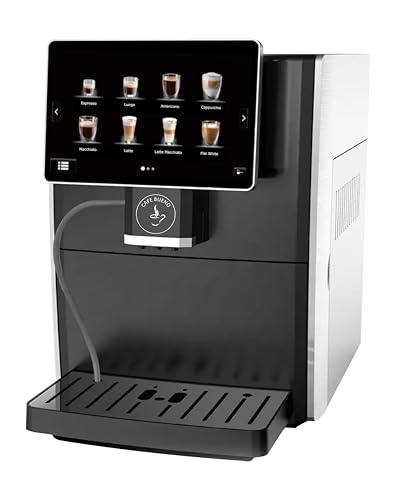
Cafe Bueno Super Automatic — The home-office wildcard
The Cafe Bueno’s title makes its positioning plain by accident: a super automatic espresso machine “for home,” with a grinder and milk frother for lattes, cappuccinos, and macchiatos, auto wake and sleep, and compatibility with all milk types. It earns its place in an office guide at the small end of office — the home office that hosts clients, the two-person studio, the satellite workspace — where a full bean-to-cup flagship would be theatre and a pod machine would undersell the room. Super automatic means the whole espresso process, grinding through extraction, happens inside at a button’s request, and for a small office that is the entire requirement stated in one phrase.
Auto wake and sleep are the features a small office will feel daily. A machine that wakes before the workday and sleeps after it removes the warm-up wait from the morning’s first drink and the standby waste from the evening — small mercies that compound across a year of working days. The all-milk-types promise matters in the same practical register: small offices stock whatever milk the team actually drinks, including the alternatives, and a frother that copes with all of them ends a whole category of break-room negotiation.
The honest boundary is scale and statement. The title claims no drink count, no touchscreen, no commercial designation, and this guide will not lend it any. Against the Bosch and Ninja it is the lighter instrument; against the pod machine it is the more serious cup. Small offices should also note that a super automatic concentrates its maintenance inside, and its cleaning rhythm, whatever the manual specifies, belongs to the same named-owner discipline as the flagships’.
Bought knowingly — as the small office’s espresso machine rather than the large office’s bargain — the Cafe Bueno is a sensible, likeable conclusion to the list: real bean-to-cup drinks, waking and sleeping on schedule, in rooms where coffee is a pleasure of working life rather than a facility to be managed.
- Format: super automatic espresso machine with grinder and milk frother
- Named drinks: latte, cappuccino, macchiato
- Scheduling: auto wake and sleep, per the listing title
- Milk: stated to work with all milk types
- Drink count and interface: neither is given in the listing title — verify on the product page if they matter to you
- Purchase route: the Cafe Bueno Super Automatic — sold on Amazon, where its full details live.
Strengths
- Full bean-to-cup automation sized and priced for small offices.
- Auto wake and sleep fit the machine to the working day without attention.
- All-milk frothing ends the alternative-milk negotiation at the machine.
Trade-offs
- No commercial designation or drink count is claimed; large offices should look up-list.
- Internal maintenance still needs a named owner, as with all automatics.
- A home-framed title means office buyers must verify duty expectations themselves.
Best for: home offices, studios, and small teams wanting real espresso drinks. Not suited for: whole-floor break rooms or any office needing stated commercial capacity.
Best Coffee Machines for an Office, Judged by the Break Room’s Real Questions
| Machine | Who makes the drink? | Stated menu size | Chore it creates |
|---|---|---|---|
| Keurig K155 Office Pro | Each drinker, via pod | Set by pods stocked | Pod shelf and pod bin |
| Bosch Series 6 Fully Automatic | The machine, from beans | 25 drinks | Beans, milk, cleaning program |
| Ninja AutoBarista Pro | The machine, hot or iced | 13 drink options | Beans, milk, ice, self-clean |
| Cuisinart Grind & Brew DGB-400 | Whoever sets the timer | One pot, 12 cups | Hopper, carafe washing |
| Gevi Grind & Brew 10-Cup | Whoever sets the timer | One pot, 10 cups | Hopper, filter rinsing |
| Cafe Bueno Super Automatic | The machine, small scale | Not stated in title | Beans, milk, internal cleaning |
Pods, Beans, or a Pot: Which Strategy Fits Your Office’s Personality?
Offices have coffee personalities, and the machine should be cast like a colleague. The pod office values fairness and autonomy: nobody’s taste governs anybody else’s, nobody performs labour for the group, and the cost of that peace is paid per cup without resentment. The bean-to-cup office values the perk: coffee as a visible investment in staff, worth beans, milk, and a cleaning program because the drinks are genuinely good and people notice. The pot office values the gathering: the carafe as a small daily commons, with all the warmth and all the politics that commons have always carried.
Headcount bends the choice without deciding it. Below eight drinkers, almost anything works and the Cafe Bueno or a grind-and-brew will be loved. Between eight and thirty, the automatics and the pod system fight it out on maintenance honesty. Above thirty, the question becomes stations rather than machines — a pod bank for variety, an automatic for the enthusiasts, a pot for the meeting rooms — and the office should stop asking one appliance to be a culture. The same scaling logic governs every shared appliance in a growing workplace, from the coffee machine to the built-in cooking wall examined in Best GE Profile Double Wall Ovens: capacity problems are solved by matching the equipment fleet to the population, never by asking one unit to be heroic.
Budget honestly across a year, not at the checkout. The pod machine is cheap to buy and dear to run; the automatics invert that; the drip machines are modest at both ends and pay for it in labour and politics. A spreadsheet with three columns — machine, consumables, and the value of staff minutes — will choose more wisely than any review, including this one.
Who Owns the Machine? The Question That Decides Everything After Delivery
Every office machine in this guide will be cleaned, stocked, and descaled by somebody, or it will be cleaned, stocked, and descaled by nobody, and the coffee will announce which. The single most predictive decision an office makes is naming that somebody before the machine arrives — a facilities person, an office manager, a rotating volunteer with actual authority to order supplies. Bean hoppers, pod shelves, milk, filters, and descaler all flow from that one appointment.
The machines differ in how gracefully they survive a vague answer. The pod system survives it best, which is a legitimate reason to choose it. The automatics survive it worst in flavour terms, because their mess is internal and cumulative — though the Bosch’s combined program and the Ninja’s self-clean are both designed to shrink the owner’s job to something a busy person will actually do. The drip machines sit between: a carafe left unwashed is visible, which is its own kind of management system.
Put the owner’s name on the machine, literally, with the supplies list and the descaling dates. Offices laugh at this suggestion and then discover, six months later, that the offices with good coffee all did it. It is the cheapest feature in this entire guide, and it is not sold with any machine.
The owner’s job description, written out, is shorter than feared: check the hopper and the milk on a fixed round, order against a par level rather than against an empty shelf, run the cleaning program when the machine asks rather than when it insists, and keep one shelf of the store cupboard as the machine’s own. Fifteen minutes a week, honestly rostered, is the entire difference between the offices in this guide’s success stories and the offices in its cautionary ones. Everything else — the touchscreen, the burr grinder, the twenty-five drinks — is commentary on that single appointment.
Why Is Milk the Supply Chain Nobody Planned?
Every bean-to-cup decision is secretly a milk decision. The Bosch, the Ninja, and the Cafe Bueno all make milk drinks a headline feature, which means the office has volunteered for a fresh-milk supply chain: quantities matched to a spiky week’s demand, fridge space that is actually respected, a rule for the carton opened on Friday, and an answer for the colleagues whose milk is not the milk in the shared fridge. Offices that skip this planning discover that their espresso machine makes excellent black coffee and a daily small argument.
The alternatives each carry their own logic. Pod systems sidestep fresh milk for the drinks that come complete in the pod, at the cost of the pod premium. Drip culture treats milk as a jug on the side, the simplest arrangement ever devised and still, in many offices, the happiest. Powdered and long-life options exist on a spectrum of acceptability that each office must locate for itself, honestly, by tasting rather than by assumption.
The practical advice is to cost the milk before the machine. Count the milk drinks in a honest week, price the fridge run, and assign the carton to the same named owner as the beans. An automatic whose milk supply fails twice a week will be judged a bad machine by people who never learn the true story, and in office folklore the judgement is the reality.
When Should an Office Replace or Graduate Its Machine?
Machines announce their retirement in stages: the queue that used to clear now lingers, the cleaning program runs more often for the same result, the folklore shifts from praise to apology. The wise office reads those signals as a capacity story before it reads them as a breakdown story. Often the machine has not declined at all — the office has grown around it, hybrid patterns have spiked its peaks, and the correct purchase is a second station rather than a replacement, leaving the original doing honourable work at the load it was bought for.
Graduation has a natural order in this guide’s terms. The pot office adds an automatic when the enthusiasts secede; the pod office adds a bean-to-cup when the perk budget grows; the automatic office adds a pod bank when variety complaints outnumber quality complaints. Each addition is cheaper than a rip-and-replace, and the fleet that results — like the fleet in a well-run kitchen — covers more of the working day than any single flagship could.
Replacement proper is justified when maintenance stops holding the line: when descaling no longer restores the drinks, when parts and patience both run short, when the machine’s downtime has become a standing joke with a cost attached. At that point the office should buy its next machine with the data the old one generated — real drink counts, real favourites, real peak times — because an office that has run one machine for years knows exactly what it needs, if it bothers to ask its own experience.
Where Should the Machine Live, and What Does the Room Owe It?
Placement is an office decision disguised as a furniture decision. The break room is the default, but the right answer is wherever the queue will do least damage: away from the meeting-room doors it would block at nine, near enough to water and a sink that the cleaning chores stay easy, and on a counter with room for the machine’s entourage — cups, pods or beans, milk, sugar, the bin for spent pods and grounds. Machines squeezed into a corner without their entourage generate a daily litter of improvisation that the room, not the machine, gets blamed for.
Water deserves a sentence of its own. None of the six picks here is presented as a plumbed machine, which is precisely their office convenience: they fill from a tap and forgive buildings where plumbing a coffee point would need a landlord, a contractor, and a committee. The corollary is that somebody carries the water, in reservoirs and jugs, forever — another entry in the named owner’s job description, and a reason to site the machine within a sensible walk of the sink rather than at the picturesque far end of the floor.
Power and heat are the quiet constraints. Bean-to-cup machines and drip brewers alike want a circuit that is not already hosting the kettle, the microwave, and the toaster in a daily negotiation, and they want ventilation space the manual will specify. A five-minute conversation with whoever manages the building’s electrics, held before the order rather than after the first tripped breaker, is the cheapest facilities management an office will ever buy.
How Does Hybrid Working Change the Office Coffee Calculation?
The hybrid office has a spikier coffee problem than the office it replaced. Tuesdays and Wednesdays run at full strength; Mondays and Fridays run at a third of it, and any machine sized by weekly average will be wrong in both directions — queued at midweek, idle and stale at the week’s edges. Pod and bean-to-cup machines absorb spikiness gracefully because they make drinks one at a time against demand. The pot is the hybrid era’s casualty: a full carafe brewed for a floor that turns out to be working from home is waste with a warming plate.
Hybrid patterns also change what the coffee is for. When attendance is voluntary, the office competes with the kitchen at home and the café on the corner, and its coffee becomes part of the argument for coming in. That argues for quality at the point of service — the automatics’ genuine espresso drinks, the grind-and-brew’s fresh pot on the days the team is in — over sheer provision. Several offices now run a smaller, better setup for exactly this reason: fewer drinks, better ones, on the days that matter.
Supplies ordering must follow the same rhythm. Beans and milk bought for a five-day office spoil in a three-day one; pods, shelf-stable and portioned, quietly gain an advantage in hybrid buildings that has nothing to do with taste. The wise office manager audits actual consumption for a month before committing to a strategy, because the hybrid office’s coffee truth is in its bin and its bean hopper, not in its headcount.
What Does Good Office Coffee Quietly Do for Recruitment and Clients?
Candidates interview the office while the office interviews them, and the coffee is part of the evidence. A break room with a real machine, stocked and clean, tells a story about how the organisation treats ordinary days; a neglected machine with an apologetic note taped to it tells the opposite story at the same volume. Neither story is fair in isolation, and both are believed instantly, which is why facilities-minded companies treat the coffee point as part of the tour rather than a cupboard to be hurried past.
Clients read the same signals in the meeting room. Coffee carried in from a functioning, generous setup supports the meeting’s purpose; coffee that arrives late, lukewarm, or apologised for taxes it. This is an argument for the meeting-room station — often the pod machine, for its variety and silence — as a deliberate purchase rather than an afterthought, and for keeping its supplies at a standard the break room’s larger traffic would forgive but a client’s palate will not.
None of this requires extravagance. It requires the alignment this guide has argued for throughout: a machine matched to the office’s real character, a named owner, stocked shelves, and cleaning that happens on schedule. Offices that achieve that alignment discover the coffee stops being discussed at all — it becomes part of the background competence of the place, which is the highest state office coffee can reach.
Which Office Coffee Mistakes Generate the Most Folklore?
Buying a domestic machine for a commercial duty cycle is the classic — it works beautifully until the month it does not, and the saving evaporates into a replacement bought in a hurry. The second is stocking by enthusiasm: forty pod varieties, five bean brands, three milks, and no depth in any of them, so the favourite is always the one that ran out. The third is the meeting-room blind spot — equipping the break room and forgetting the room where clients actually drink the coffee, which is how an office ends up carrying cups down a corridor on a tray, past the Best Commercial Coffee and Tea Machines guide’s entire reason for existing: service-scale equipment belongs where service actually happens.
The fourth mistake is subtler: treating coffee as beneath planning because it is inexpensive per cup. Coffee is the most frequent experience an office provides its staff — more frequent than the chairs, the lighting, or the annual party — and its quality is read, fairly or not, as a measure of how the organisation treats people. A modest machine, owned properly and stocked generously, beats a flagship neglected, every single morning of the year.
How Should an Office Run the First Month With a New Machine?
The first month decides the folklore, so it should be stage-managed shamelessly. Launch with full shelves — beans or pods in depth, milk stocked, cups that fit the machines’ dispense heights — and with the named owner visibly attentive, because habits form around whatever the first weeks normalise. A machine that runs dry twice in its first fortnight will be described as unreliable for years by people who cannot remember why they think so.
Gather the data the machine offers freely. Which drinks does the office actually choose from a 25-drink menu? When does the queue form? How fast do beans and milk move against the forecast? A month of honest numbers converts the second purchase — the supplies standing order, the possible second station — from guesswork into arithmetic, and it arms the office manager for the budget conversation with evidence instead of enthusiasm.
Finally, retire the old arrangement completely. Offices that keep the sad kettle-and-instant corner alive “just in case” split their own culture and guarantee that neither setup is stocked properly. Commit, clear the counter, and let the new machine be the office’s coffee story without a understudy undermining it — the one exception being the deliberate second station, added later, for a diagnosed reason.
What About the Colleagues Who Do Not Drink Coffee?
Every office contains them: the tea drinkers, the decaf loyalists, the colleague who wants hot water and lemon and the simple dignity of not being an afterthought. A coffee purchase that ignores them builds a small, daily inequity into the room, and the machines here differ in how gracefully they include the minority. Pod systems include them by catalogue — tea and decaf are just more pods on the shelf. The automatics include them partially, through hot water and decaf beans if the office stocks a second hopper’s worth of discipline, which most do not. The pot excludes them almost entirely unless a kettle is deliberately stationed beside it.
The cheapest inclusion strategy is deliberate rather than expensive: a kettle with its own place in the setup, a tea shelf stocked with the same generosity as the pod shelf, and decaf treated as a first-class supply rather than a dusty exception. Offices are judged by their minorities on exactly these small provisions, because majority needs take care of themselves in any system. The office that plans for its non-coffee drinkers has usually planned everything else in this guide as well — the habits are the same habit, wearing different aprons.
Final Recommendation
Choose by honesty about your office’s character. Mixed tastes and zero maintenance appetite: the K155, and spend the savings on a deep, well-curated pod shelf. A genuine perk culture with a named supplies owner: the Bosch for breadth, the Ninja for the iced-drinking generation. A team that gathers: the Cuisinart for capacity or the Gevi for the better grind, with the timer set and the pot’s rhythm respected. A small studio that wants the ritual without the facility: the Cafe Bueno, waking with you and sleeping when you do. The right office machine is the one whose chores your office will actually perform — because in the break room, a loved machine of modest spec will out-pour a neglected flagship every working day of the year, and the office that understands that sentence before it shops will never have to learn it afterwards from its own disappointed Monday mornings.
Frequently Asked Questions
How many drinks a day can an office automatic handle?
No title in this guide states a daily rating, so plan by role rather than by number: the Bosch and Ninja are built as fully automatic office-class machines, while the Cafe Bueno is framed for home and small-office scale. Offices above thirty heavy drinkers should think in stations, not single machines.
Is a pod machine cheaper than bean-to-cup over a year?
Almost never on consumables: pods cost more per cup than beans by a wide margin. The pod machine’s economy is labour and peace — no rota, no training, no pot politics. Offices should price both columns before deciding which economy is theirs.
Blade or burr grinder for office drip?
Burr, if the office tastes the difference — the Gevi’s even grind is the quality choice. Blade, if the pot is a utility and capacity matters more — the Cuisinart brews twelve cups to the Gevi’s ten. Drip is forgiving enough that both answers are defensible, which is why both machines are listed.
Who should descale the office machine, and when?
The named owner, on the schedule the water demands — hard-water offices more often. The Bosch combines cleaning and descaling into one program and the Ninja advertises easy self-clean; both features exist because descaling postponed is the commonest cause of office-machine decline.
Can one machine serve a whole floor?
One machine can serve a whole floor’s coffee the way one lift serves a whole floor’s people: technically, with queues. Past roughly thirty regular drinkers, split the load — pods for variety, an automatic for quality, a pot for meetings — and let each do what it is best at. The hybrid week’s spikes make the case earlier than raw headcount suggests: size for the busiest morning the floor actually has, not for its average day.
What is the single most common reason office coffee disappoints?
Not the machine — the ownership vacuum around it. Empty hoppers, unstocked milk, descaling deferred past the point of flavour: every common office coffee failure is a supplies or cleaning failure wearing a machine’s face. Name an owner before delivery and most disappointments never occur.
Related Guides
Small offices and home workspaces working out their wider appliance footprint will find the compact end of the range gathered in Best Small Coffee Machines, a useful companion when counter space, rather than headcount, is the binding constraint — and when the office in question is really a desk, a studio corner, or a home workspace whose coffee ambitions have outgrown the kettle without yet justifying a flagship bean-to-cup installation of the kind this guide’s upper half describes.


