What's inside
- Key Takeaways for Roasting-First Buyers
- Quick Picks: Six Roasting Ovens for Home Counters
- How did we judge roasting ability from listings alone?
- Roasting Ovens Compared on What the Titles Prove
- Why is this guide separate from the commercial baking ovens?
- What size of bird fits in a countertop roasting oven, honestly?
- How do you get crisp skin without drying the meat?
- What should sit beside the oven in a roasting household?
- How do you adapt a favourite wall-oven recipe to a countertop cavity?
- What is the real difference between roasting, baking, and air frying in these ovens?
- How should a roasting oven be cleaned, given what roasting does to it?
- What accessories are worth buying, and which are clutter?
- How do two-dish dinners work in a single countertop cavity?
- When does a household outgrow a countertop roaster, and what comes next?
- How do you roast vegetables properly in the same oven as the meat?
- What role does resting play, and how long is long enough?
- How do you keep a countertop oven from smoking out the kitchen?
- What should a first-time roaster cook in the first month?
- How do you choose between the large picks when two would both fit?
- What is the one habit that improves every roast in any of these ovens?
- Roasting Mistakes Countertop Owners Keep Making
- Final Recommendation
- Frequently Asked Questions
- Related Guides
As an Amazon Associate I earn from qualifying purchases. This post may contain affiliate links at no extra cost to you.
**cottageverdict.com is reader-supported. When you buy through links on our site, we may earn an affiliate commission.**
Where to buy a roasting-capable countertop oven without a showroom trip: each model below is linked from its name in the opening table and again at its detailed heading, so you can check price on Amazon, confirm the stated size against your counter and cabinets, and picture the machine in your kitchen before it arrives.
A countertop oven earns the word roasting only if a whole chicken — or a small turkey breast, a pork shoulder, a serious tray of vegetables — fits inside it with air still able to move. The best countertop ovens for roasting are therefore chosen on usable cavity and clearance from the heating elements, not on the longest feature list. A machine can air fry, dehydrate, proof, and toast beautifully and still fail this page’s only real test: dinner, roasted properly, for the household that bought it. The six picks below are all domestic countertop ovens — no commercial models have been borrowed from the bakery category — and each was judged by how honestly its stated size translates into a bird, a pan, and room to breathe.
The field spans three shapes. Two large French-door machines, from Emeril Lagasse and Oster, open wide and swallow family pans. The Breville Smart Oven Air Fryer Pro brings the most function depth, with thirteen functions named in its title. The Nuwave Bravo XL Pro counters with a stated 30QT capacity, a 50–500F range, and a temperature probe in its title. The Cuisinart TOA-55 is the compact convection option whose title gives a 0.6 cubic foot interior and a 450°F maximum, and the Toshiba 10-in-1 adds a rotisserie function — the one feature in this guide that changes roasting mechanics rather than merely assisting them.
One measurement warning before the picks: manufacturers describe these cavities in quarts, cubic feet, slice counts, and pizza diameters, sometimes in the same title. None of those units is a chicken. Where a title states a concrete fit — a 15 x 12 inch pan, a 12-inch pizza — this guide uses it; where it does not, the honest advice is to measure your roasting pan and your bird against the maker’s internal dimensions, because an oven that fits the pan but not the pan plus clearance will roast the top of dinner faster than the middle.
Key Takeaways for Roasting-First Buyers
- Every pick here is a domestic countertop oven; the commercial bakery machines live in a different guide and a different kitchen.
- Usable cavity and element clearance decide roasting success — headline quarts are only the starting point.
- French-door models (Emeril Lagasse, Oster) give the widest, least awkward access for heavy roasting pans.
- The Toshiba is the rotisserie pick: its title names rotisserie among its functions, and rotation changes how a bird bastes.
- The Nuwave states the widest temperature range in its title, 50-500F, and includes a probe in its description.
- The Cuisinart TOA-55 is the compact choice, with a stated 0.6 cu. ft. interior and 450°F maximum — size your bird accordingly.
Quick Picks: Six Roasting Ovens for Home Counters
| Oven | Shape and stated size | Roasting case in one line |
|---|---|---|
| Breville Smart Oven Air Fryer Pro | Function-depth flagship | Breville’s BOV900 with thirteen functions in its title and a convection setting the maker says cuts cook time by up to 30%. |
| Emeril Lagasse 26QT French Door | French-door family roaster | A stated 26QT extra-large interior behind French doors, with 24 one-touch presets and six accessories in its title. |
| Oster Extra-Large French Door | Pan-fit transparency pick | A French-door oven whose title states the fit that matters — 15 x 12 inch pans — across six cooking presets. |
| Cuisinart TOA-55 | Compact convection roaster | A 0.6 cu. ft., 1800W, 7-in-1 oven with a stated 450°F maximum and room for a 12-inch pizza, per its title. |
| Nuwave Bravo XL Pro | Probe-and-range technologist | A 30QT oven with a stated 50-500F range, 142 presets, and a smarter probe in its title — the data-driven roaster. |
| Toshiba 10-in-1 Convection | Rotisserie rotation pick | A 10-in-1, 1500W convection oven whose title names rotisserie among its functions, with six accessories included. |
How did we judge roasting ability from listings alone?
The judging rule was to trust dimensions and named functions, and to distrust adjectives. A stated pan fit, a stated cavity volume, a rotisserie named among functions, a probe included in the box — those are facts a buyer can plan a Sunday around. Words like spacious and extra-large were treated as invitations to look for the number behind them, and where the number exists in a title, it appears in the spec boxes below; where it does not, the box says what to verify instead. That discipline matters more in this category than most, because countertop ovens are marketed at snack and breakfast duties even when households buy them for dinner.
Roasting also imposes two tests that snack duties never meet. The first is thermal headroom: a bird lowers cavity temperature when it goes in and keeps absorbing heat for an hour, so convection and honest wattage matter. The second is geometry: the distance between a tall bird and the upper elements decides whether skin crisps or scorches while the centre catches up. Every pick below is discussed against those two tests, in the language its own title supports, so that a buyer with a tape measure and a favourite roasting pan can finish the judgement at home.
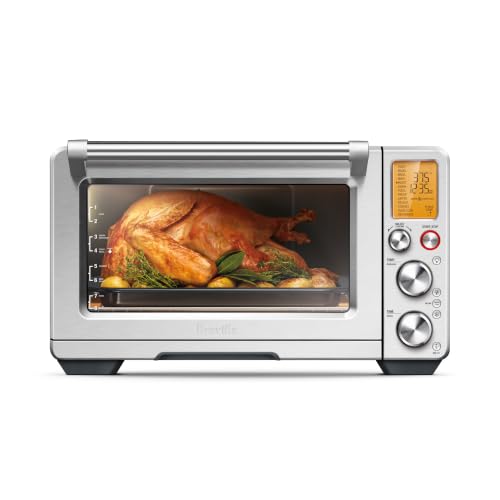
Breville Smart Oven Air Fryer Pro — Function-depth flagship
The Breville is the oven for households that roast often and cook everything else in between. Its listing title describes the BOV900 Smart Oven Air Fryer Pro in brushed stainless steel, with thirteen functions spanning roast, bake, dehydrate and more, and a convection setting the maker credits with reducing cook time by up to 30%. Treat that percentage as the manufacturer’s framing rather than a promise about your chicken — but do treat the convection itself seriously, because moving air is what evens out a roast in a compact cavity and crisps skin that still air merely steams.
Thirteen functions can be a gimmick or a discipline, and in Breville’s case the discipline argument wins: a dedicated roast function exists so that the oven’s behaviour — element pattern, fan, temperature curve — is tuned for a joint of meat rather than borrowed from a toast setting. Households that roast twice a week and dehydrate, bake, and reheat in between will use the depth; households that roast twice a year will pay for a library they never open. The honest self-knowledge question comes before the purchase, not after.
The title does not state a cavity volume or a pan fit, so the roasting buyer has one job before ordering: take the maker’s internal dimensions and your largest roasting pan — handles included — and confirm the pairing with clearance above the bird. Breville’s flagship class is built for family cooking, but this guide claims only what the listing states, and a tape measure is a better authority than a category reputation when a turkey breast is at stake.
- Model named in the listing title: BOV900 (BOV900BSS), brushed stainless steel
- Functions stated in the title: 13, including roast, bake, and dehydrate
- Convection claim in the title: reduces cook time by up to 30% (maker’s figure)
- Cavity volume and pan fit: not stated in the listing title — verify internal dimensions with the manufacturer documentation against your roasting pan
- Breville Smart Oven Air Fryer Pro — check price on Amazon.
Strengths
- Dedicated roast function among thirteen named modes
- Convection supports even browning in a compact cavity
- Flagship build suits households that cook in it daily
Trade-offs
- Function depth is wasted on occasional roasters
- No cavity figure in the title, so measuring is mandatory
- Premium positioning among countertop ovens
Best for: keen home cooks who roast weekly and will use the wider function library.
Not suited for: households wanting the largest stated cavity for the fewest decisions.
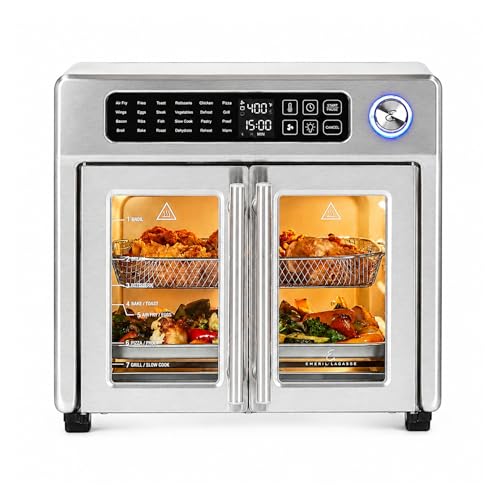
Emeril Lagasse 26QT French Door — French-door family roaster
French doors change roasting ergonomics more than any preset can. The Emeril Lagasse model’s listing title describes a 26QT French door multi-function air fryer toaster oven, a countertop convection cooker with 24 one-touch preset options, an extra-large interior, and six cooking accessories included. Doors that open sideways and out of the way let you approach a heavy, hot roasting pan with both hands and a straight back, instead of reaching over a drop-down door that is itself hot and exactly where your forearms want to be. Anyone who has lifted a chicken in its pan out of a conventional countertop oven will recognise that as a safety feature disguised as a luxury.
The stated 26QT interior is the capacity headline, and it places this oven in the family-roasting class: whole chickens, generous vegetable trays, and the kind of pan that feeds six without negotiation. Twenty-four presets will divide opinion — roasters who trust a probe and their own judgement may use three of them — but presets earn their keep with the household’s second cook, the teenager reheating, and the weeknight roast chicken that nobody wants to think hard about. Six included accessories similarly lower the friction of the first month, when a missing rack can stall a new routine.
Counter space is the true cost. A 26QT French-door oven is a permanent resident, not an appliance that returns to a cupboard, and the doors need swing clearance in front of a counter that also hosts chopping boards and resting trays. Measure the whole working zone, not just the footprint. Households that can give it that territory gain the most accessible large roaster in this guide; households that cannot should look at the Cuisinart’s smaller claim on the same counter.
- Stated capacity in the title: 26QT, described as extra-large interior
- Presets stated in the title: 24 one-touch preset options
- Included per the title: six cooking accessories; French-door format
- Maximum temperature and wattage: not stated in the listing title — confirm both in the manufacturer documentation
- For the Emeril Lagasse 26QT French Door, check price on Amazon.
Strengths
- French doors make heavy pan handling safer and easier
- 26QT stated capacity covers family-size roasts
- Accessories included for an immediate start
Trade-offs
- Permanent counter resident with door-swing clearance needs
- Preset abundance exceeds what confident roasters will use
- Top temperature not stated in the title
Best for: families roasting whole chickens and large trays every week.
Not suited for: small kitchens where the counter cannot surrender a permanent zone.

Oster Extra-Large French Door — Pan-fit transparency pick
The Oster earns trust by answering the roaster’s actual question. Its listing title describes an extra-large French door air fryer countertop oven with six cooking presets, elegant French doors, a stated fit for 15 x 12 inch pans, a claim of using 99.5% less oil in its air-fry context, and an auto-shutoff timer. That pan dimension is worth more than a quart figure: a 15 x 12 inch pan is a real roasting and sheet-pan size, the size that holds a spatchcocked chicken or a family tray of vegetables in one layer, and a buyer can verify the fit against the pan already in their cupboard in ten seconds.
Six presets, against the Emeril’s twenty-four, reads as restraint, and for roasting households restraint is often right: roast, bake, air fry, and a few companions cover the week without a menu-diving habit. The auto-shutoff timer deserves a specific mention for roasting, because the classic countertop disaster is not undercooking — it is the forgotten oven holding dinner at temperature into the evening. A timer that ends the session protects both the food and the household’s peace of mind.
French doors carry the same ergonomic argument as the other French-door pick: two-handed, straight-on access to heavy pans. Choosing between the Oster and the Emeril comes down to stated capacity versus stated pan fit and how much preset depth your household will genuinely use. This guide will not crown one; it will note that the Oster’s title answers the fit question in numbers, and numbers are what roasting decisions should be made from.
- Pan fit stated in the listing title: fits 15 x 12 inch pans
- Presets stated in the title: six cooking presets; auto-shutoff timer named
- Format: French doors; described as extra-large
- Oil-use claim in the title (99.5% less) refers to air frying, not roasting; cavity volume in quarts is not stated there — check the manufacturer documentation if you need it
- Oster Extra-Large French Door — check price on Amazon.
Strengths
- Stated pan dimensions make fit verification instant
- Auto-shutoff timer guards long roasts and forgetful evenings
- French-door access suits heavy roasting pans
Trade-offs
- Fewer presets than the French-door rival
- No quart capacity stated in the title
- Extra-large class still claims permanent counter space
Best for: households whose favourite roasting pan measures near 15 x 12 inches.
Not suited for: preset collectors, or counters that cannot host an extra-large machine.

Cuisinart TOA-55 — Compact convection roaster
Not every roasting household needs the biggest box. The Cuisinart TOA-55’s listing title describes an air fryer toaster oven combo, 7-in-1, 1800W, stainless steel, with a 0.6 cubic foot interior, convection capability, a maximum temperature of 450°F, a removable crumb tray, and a stated fit for a 12-inch pizza. Read those numbers as a coherent small-kitchen proposition: enough cavity for a modest chicken or a tray of thighs and vegetables, full countertop wattage for proper browning, and a footprint that leaves the counter usable for the rest of cooking.
The 450°F ceiling is the honest limit to plan around. It covers the great majority of roasting — chickens, pork, root vegetables, traybakes — at the temperatures recipes actually specify, and the stated figure lets a buyer decide in advance rather than discover a cap mid-recipe. The removable crumb tray, meanwhile, is a roasting feature in disguise: roasting sheds fat and crumbs that toast never does, and a tray that slides out for washing is the difference between an oven that stays pleasant and one that slowly seasons itself with old drippings.
Size the bird to the box and this Cuisinart will satisfy. A 0.6 cubic foot cavity asks for chickens at the modest end, spatchcocked birds that sit flatter, or joints rather than whole large birds — techniques many roasters prefer anyway for even cooking. Households whose Sunday centrepiece is regularly a very large bird should step up to the French-door class; households whose roasting is weeknight-scale will find the TOA-55 the most proportionate machine in the guide.
- Interior stated in the listing title: 0.6 cu. ft.; fits a 12-inch pizza
- Power and heat stated in the title: 1800W; maximum temperature 450°F
- Functions stated in the title: 7-in-1 with convection capability
- Removable crumb tray is named in the title — a genuine roasting-maintenance plus
- Cuisinart TOA-55 — see current pricing on Amazon.
Strengths
- Complete spec picture stated in the title: volume, watts, ceiling
- Compact footprint preserves counter for prep
- Removable crumb tray suits fatty roasting work
Trade-offs
- 0.6 cu. ft. asks for modest or flattened birds
- 450°F ceiling excludes a few very-high-heat techniques
- Seven functions is depth enough, but not the widest here
Best for: smaller kitchens roasting chickens and trays at weeknight scale.
Not suited for: households whose centrepiece is routinely a very large whole bird.

Nuwave Bravo XL Pro — Probe-and-range technologist
The Nuwave speaks to the roaster who wants instruments. Its listing title describes the Bravo XL Pro air fryer toaster oven with grill combo, a newer system with ultra-fast convection, claims of 35% crispier and twice-more-even results in the maker’s framing, 142 presets, a 50-500F temperature range, a smarter probe, a PFAS-free note, 30QT capacity, and stainless steel construction. Discount the comparative percentages as marketing grammar, and the remaining facts are substantial: the widest stated temperature range in this guide, the joint-largest stated capacity, and a temperature probe — the single tool that turns roasting from timing folklore into knowledge.
A probe deserves its paragraph. Roasting doneness is an internal temperature, not a number of minutes, and birds vary enough that minute-based recipes are approximations wearing confidence. An oven built around a probe — insert, set target, let the machine mind the approach — produces the cook who stops carving into joints to check and stops serving the outer slices dry while the centre catches up. For households that roast expensive meat, that consistency is the entire argument, and it is a strong one.
The 50-500F range brackets the guide at both ends: low enough for gentle, slow work and dehydrating-adjacent tasks, high enough — 500F is the highest ceiling stated in any title here — for aggressive finishing and crisping that the 450°F machines cannot attempt. At 30QT it is also a large permanent counter resident. Buyers should therefore want both halves of its personality, the probe discipline and the range, before giving it the territory; wanting only one points to a cheaper pick elsewhere in this line-up.
- Capacity given in the listing title: 30QT
- Temperature range stated in the title: 50-500F — the widest in this guide
- Included per the title: smarter probe; 142 presets; grill combo format
- Maker’s comparative claims (crispier, more even) appear in the title as marketing framing; wattage is not stated there — confirm it in the manufacturer documentation
- Nuwave Bravo XL Pro — check price on Amazon.
Strengths
- Built-in probe turns doneness into a measured fact
- 500F ceiling enables high-heat finishing others here cannot
- 30QT stated capacity matches the largest picks
Trade-offs
- 142 presets is far beyond most households’ real repertoire
- Large footprint demands permanent counter territory
- Comparative performance claims are the maker’s, not measurements
Best for: precision-minded roasters cooking valuable meat and whole birds regularly.
Not suited for: minimalists who want six honest buttons and a quiet life.

Toshiba 10-in-1 Convection — Rotisserie rotation pick
Rotisserie is the only feature in this guide that changes the physics of roasting rather than assisting it. The Toshiba’s listing title describes a 10-in-1 convection toaster oven, six-slice class, 1500W, with bake, broil, rotisserie, and pizza functions named, LCD knob controls, and six accessories included. A bird on a spit bastes itself as it turns, juices travelling over the surface instead of pooling beneath it, and the skin browns with an evenness that static roasting — however good the convection — approaches only with manual turning. Households that grew up around rotisserie chicken will need no persuading; the flavour memory is the sales pitch.
The practical questions are about size and setup. Rotisserie capacity is governed by the spit’s clearance in every direction, a stricter geometry than a pan on a rack, and the listing title does not state a bird weight — so the buyer must take the maker’s stated rotisserie limits from the full listing or documentation and respect them, choosing birds that fit rather than birds that almost fit. The six included accessories suggest the spit hardware travels with the oven, but confirming the exact rotisserie kit contents on the listing is a thirty-second job worth doing before the first Sunday depends on it.
At 1500W the Toshiba is the gentlest draw in this line-up, which suits older kitchen circuits, and its six-slice framing places it in the mid-size class rather than the French-door territory. Judge it as the specialist it is: if rotisserie chicken is a household ritual, this is the only pick that performs it; if it would be used twice and forgotten, the same money buys more plain cavity elsewhere in the guide. Specialisation is a virtue exactly when the speciality is loved.
- Functions named in the listing title: 10-in-1 including bake, broil, rotisserie, and pizza
- Power stated in the title: 1500W; six-slice countertop class
- Included per the title: six accessories; LCD knob controls
- Rotisserie bird-weight limit and cavity volume: not stated in the listing title — verify the maker’s stated limit before planning a bird
- Toshiba 10-in-1 Convection — check price on Amazon.
Strengths
- True rotisserie function for self-basting whole birds
- 1500W is gentle on older kitchen circuits
- Six accessories included per the title
Trade-offs
- Rotisserie geometry limits bird size more strictly than a pan does
- Bird-weight limit not stated in the title
- Mid-size cavity will not match the French-door pair for trays
Best for: households where rotisserie chicken is a standing ritual.
Not suited for: buyers who would use the spit twice and resent its storage forever.
Roasting Ovens Compared on What the Titles Prove
| Oven | Stated size evidence | Heat evidence in title | Signature roasting trait |
|---|---|---|---|
| Breville Smart Oven Air Fryer Pro | Not stated in title | Convection, up to 30% faster per maker | 13 functions including roast |
| Emeril Lagasse 26QT French Door | 26QT stated | Not stated in title | French doors, 24 presets |
| Oster Extra-Large French Door | Fits 15 x 12 in. pans | Not stated in title | Stated pan fit, auto-shutoff |
| Cuisinart TOA-55 | 0.6 cu. ft., 12-in. pizza | 1800W, max 450°F | Compact convection, crumb tray |
| Nuwave Bravo XL Pro | 30QT stated | 50-500F range stated | Probe-led roasting, 142 presets |
| Toshiba 10-in-1 Convection | 6-slice class | 1500W stated | Rotisserie function named |
Why is this guide separate from the commercial baking ovens?
Because the kitchens are different countries. A commercial convection oven is specified in sheet pans and circuits and bought to repeat one bake forty times; a domestic roasting oven is specified in birds and pans and bought to make dinner. The two categories share the word oven and almost nothing else — which is why no model appears in both this guide and our guide to Best Roaster Ovens for Turkey‘s commercial counterpart coverage, and why a reader equipping a bakery should not be shopping here, nor a home roaster there. Each guide keeps its own standard so that both can keep their promises.
That separation also protects the buying logic. Domestic buyers should ask domestic questions: does it fit under my cabinets, does my pan fit inside it, can I lift dinner out of it safely, and will it clean without a feud? The moment a home buyer starts comparing themselves against commercial duty cycles, they overspend on capacity and underspend on the ergonomics they will actually live with every evening.
What size of bird fits in a countertop roasting oven, honestly?
Honestly, it depends on geometry more than on the bird’s weight, and the only trustworthy method is measurement: your bird’s height and width, the pan it sits in, and the cavity’s internal dimensions with clearance above for air and browning. Spatchcocking — removing the backbone and flattening the bird — is the great reconciler, turning a bird that would not fit whole into one that roasts faster and more evenly in almost any of these ovens. Turkey, as a category, mostly outgrows countertop ovens entirely, which is why dedicated roasters exist as their own appliance class, examined in our guide to Best Wood-Fired Pizza Ovens‘s neighbouring outdoor-and-specialist coverage and, more directly, in the roaster guide linked from this page’s recommendations.
As a working pattern: the compact Cuisinart suits modest chickens and joints; the mid-size Toshiba and Breville suit family chickens with technique; and the 26–30QT French-door and Nuwave class suits the largest birds a countertop can credibly claim. Any seller’s photograph of an enormous turkey inside a small oven should be read as theatre, not as a specification.
How do you get crisp skin without drying the meat?
Three levers, in order of importance. First, dry the surface: pat the bird dry, salt it ahead when time allows, and let it stand uncovered in the refrigerator so the skin gives up its moisture before the heat arrives. Second, use convection and do not crowd the cavity — air must move around the bird, which is another reason the clearance this guide keeps mentioning is a cooking requirement, not a fitting nicety. Third, rest the roast properly before carving, tented and timed, so juices redistribute instead of flooding the board. A probe, where the oven provides one, governs the whole process by telling you the truth about the centre while the skin takes care of itself.
Fat management runs underneath all three. Roasting renders fat that a countertop cavity collects in its tray, and a tray allowed to fill becomes smoke, smell, and eventually a cleaning grudge. Empty or manage the drippings partway through long roasts of fatty birds, use the drippings as the treasure they are — roast potatoes, gravy, tomorrow’s soup — and the oven stays the household’s favourite appliance instead of its smokiest.
What should sit beside the oven in a roasting household?
A roasting household is a small system too: a pan that fits the oven and the bird, a rack that lifts the bird off its juices, a thermometer you trust, tongs long enough to keep wrists clear of the cavity, and a resting board with a channel for the juices. None of it is expensive, and all of it decides results more than a preset count does. The same whole-system thinking governs the serious outdoor cooks who graduate from countertop roasting to fire — readers heading that way will find our guide to Best Commercial Ovens for Baking useful for the commercial end of the spectrum and the pizza-oven coverage for the flame end.
Buy the system in the right order: oven first, measured against the counter; pan second, measured against the oven; thermometer third, trusted against everything. Households that reverse that order — accessories first, oven by impulse — spend a year discovering mismatches one Sunday at a time.
How do you adapt a favourite wall-oven recipe to a countertop cavity?
Start a little lower and a little shorter, then let one test roast teach you the machine. Convection in a compact cavity moves heat faster than the big oven’s still air, so the working translation is a modest temperature reduction and an earlier first check — after which the probe or the thermometer, not the recipe’s clock, decides doneness. Keep notes on the recipe card itself: ‘countertop, 25 degrees lower, done at 55 minutes’ is the kind of annotation that turns a new appliance into a household instrument within a month.
Pan choice changes with the cavity too. Dark pans brown faster under close elements; glass and ceramic hold heat into the resting period; a low-sided roasting pan lets the fan’s air reach the bird’s skin, while a deep casserole shelters it. None of these is a rule so much as a lever, and roasting households that learn which lever does what stop blaming the oven for results that were chosen, unknowingly, at the pan cupboard.
What is the real difference between roasting, baking, and air frying in these ovens?
Mostly intent, airflow, and temperature — the functions are the oven’s attempt to pre-set those variables for you. Roasting aims at larger items, sustained heat, and browning with moisture retained inside; baking aims at even, gentler heat for goods that rise; air frying is high-heat convection in a small space with a perforated surface, built for crisping small items fast. A household can roast on a bake setting and air fry on a roast setting, and many do, but the named modes exist to save the adjustment work — element patterns and fan behaviour chosen by people who tested the food you are about to cook.
The practical lesson is to learn your own oven’s two or three honest modes rather than its full menu. For the roasting household, that is the roast mode, the convection behaviour at your usual temperatures, and the one reheating mode that revives leftovers without cremating them. The other functions are not wasted — they are the household’s second cook, the dehydrating experiment, the holiday overflow — but mastery of the core modes is what the weekly roast actually depends on.
How should a roasting oven be cleaned, given what roasting does to it?
Roasting is the dirtiest work a countertop oven does: fat aerosolises, lands everywhere, and bakes itself onto surfaces a toast cycle would never soil. The routine that keeps the machine pleasant is therefore immediate and small — wipe the interior while it is warm and the fat is still cooperative, wash the pan and rack with the dinner dishes rather than after them, and empty the crumb or drip tray before the next roast rather than before some eventual one. Ten unglamorous minutes after dinner replaces the quarterly deep-clean that everybody dreads and nobody schedules.
Once a month, look at the elements and the fan guard with the oven cold and unplugged, and remove what a cloth can reach. Fat build-up near elements is a smoke source first and a fire consideration second, and it is entirely preventable at the monthly scale. Households that keep this rhythm find their oven smells of the current dinner rather than the accumulated archive of previous ones — a detail guests notice even when they cannot name it.
What accessories are worth buying, and which are clutter?
Worth it: a second roasting rack if your household roasts weekly, because racks live in dishwashers at exactly the wrong moment; a probe thermometer you trust, even if the oven has one, because a second opinion settles arguments; and a pan one size down from the maximum, because the smaller pan’s clearance roasts better on the days the bird is modest. Each of these earns its cupboard space in the first month of real use, which is the correct test for any accessory.
Clutter: the single-purpose gadgets — the vertical roaster used twice, the novelty tray in a shape no recipe requests, the third set of tongs. Countertop-oven households are usually short of storage precisely because the oven itself took a cupboard’s worth of territory, so every accessory should be interrogated like a tenant: what do you do, how often, and where exactly will you live? The ones with good answers make roasting easier; the rest make it archaeological.
How do two-dish dinners work in a single countertop cavity?
By sequencing rather than simultaneity. The roast goes in first and establishes the timeline; the side that tolerates resting — roasted vegetables, a gratin — either precedes it and holds, or follows it into the residual programme while the meat rests, which is the elegant solution: resting time, which the meat requires anyway, becomes cooking time for the accompaniment. Households that plan the rest as a working interval rather than dead time find a single cavity feeds a table without apology.
Temperature compromise is the other skill. Most roasts and most vegetable sides share a workable band, and where they do not, the dish with the narrower tolerance dictates and the other adapts — vegetables forgive ten degrees in either direction far more readily than a bird forgives being rushed. A written run-sheet for the big dinners, timed backwards from the table, turns this from improvisation into routine within two or three performances.
When does a household outgrow a countertop roaster, and what comes next?
The honest signals are repetition and resentment: the bird that no longer fits even spatchcocked, the weekly need for two trays at once, the holiday that has become a negotiation with the cavity. At that point the household’s options are the ones this site’s other guides exist for — a dedicated roaster for the turkey class of problem, a full-size oven for the general one — and the countertop machine usually does not leave; it retires to the honourable second career of reheating, baking small batches, and handling the overflow it was always secretly best at.
Resist outgrowing it in imagination first. Many households replace a countertop oven for capacity they need twice a year, then live with the larger machine’s counter claim for the other fifty weeks. The spatchcock technique, the two-dish sequence, and the borrowed roaster for the single biggest day are cheaper answers, and they keep the kitchen proportioned to the life actually lived in it — which is, in the end, what every pick in this guide was chosen to serve.
How do you roast vegetables properly in the same oven as the meat?
Vegetables roast on the opposite virtues from meat: they want space, high heat, and to be left alone. A single layer with gaps between pieces is the whole secret — crowded vegetables steam in their own moisture and emerge boiled in everything but name. In a countertop cavity, that means roasting vegetables in the batch the tray honestly holds rather than the batch the shopping produced, and running two honest batches while the meat rests if the gathering is large. The meat’s resting interval and the vegetables’ second batch are made for each other, and households that pair them stop experiencing the single cavity as a limitation.
Cut size is the second lever: pieces of a similar thickness finish together, and the cook who cuts the carrots to the potatoes’ measure rather than to habit gets a tray that can be served whole instead of picked through. A little fat, applied before the oven rather than after, and salt at the end for the dense vegetables — these are small disciplines, but roasting is a technique made entirely of small disciplines, which is why it rewards the attentive and forgives almost nobody else.
What role does resting play, and how long is long enough?
Resting is the roast’s second cooking phase, in which heat equalises through the meat and juices that were driven to the centre return to the outer slices. Cut too soon and those juices take the shortest route out — onto the board — leaving the meat drier than its cooking deserved. The working pattern is simple to state: small joints need minutes in the low double figures, whole birds need longer, and the rest should happen somewhere warm and undisturbed, tented loosely, while the cook uses exactly that interval for gravy, vegetables, and the table.
Countertop roasting has a hidden resting advantage: the cavity itself, switched off, is a warm, enclosed resting chamber for the pan while the accompaniments finish elsewhere — or the bird rests on the counter under its tent while the vegetables take the cavity. Either choreography works; what matters is that the rest is planned into the timeline rather than discovered as dead time. Households that plan it find their roasts improve without a single new purchase, which makes resting the highest-value technique in this entire guide.
How do you keep a countertop oven from smoking out the kitchen?
Smoke is usually fat management announcing itself. A tray allowed to fill with rendered fat will eventually put that fat in contact with heat it should never meet; the remedies are to choose a pan deep enough for the bird’s rendering, to draw off excess drippings partway through a long roast of a fatty bird, and to keep the cavity’s surfaces clean enough that yesterday’s film is not today’s smoke. A bird trussed or positioned so it does not slump into its own drippings also roasts cleaner and browns better, which is the same advice wearing two hats.
Ventilation is the partner discipline: a window, an extractor, a door ajar — countertop cavities vent into the room by design, and a household that plans the air path enjoys the smell of roasting while the household that does not enjoys rather too much of it. None of this is a reason to fear the fatty roasts; a duck or a pork shoulder in a well-managed countertop oven is one of the great weeknight achievements. It is a reason to treat fat as an ingredient with a schedule, not as a surprise.
What should a first-time roaster cook in the first month?
A chicken, four ways, before anything ambitious. First, a simple salted chicken to learn the oven’s timing and the cavity’s hot spots. Second, the same chicken spatchcocked, to learn what the flattened geometry does to speed and skin. Third, a tray of vegetables alone, to learn the single-layer discipline without a bird complicating the lesson. Fourth, the full performance — bird, vegetables in sequence, gravy from the drippings — now that every element has been rehearsed separately. A month of that curriculum produces a roaster; a single heroic turkey as a debut produces a story.
Write the timings down as you go, on the recipe or in a notebook that lives with the oven’s accessories. Every cavity has a personality — a few degrees of enthusiasm, a corner that colours faster — and the notebook is how a household learns its own machine’s character rather than a reviewer telling it about a different one. That is, in the end, the honest limit of any guide, this one included: it can choose the right six machines and state their facts exactly, but the last ten percent of roasting is always local knowledge, earned one chicken at a time.
How do you choose between the large picks when two would both fit?
By the second cook and the second year. The second cook test asks who else uses this oven and what they need from it: the household whose partner reheats, toasts, and bakes casually may value the Breville’s guided depth or the Emeril’s presets, while the household of confident cooks may prefer the Nuwave’s instruments or the Oster’s restraint. An oven is shared territory, and the pick that only its purchaser understands becomes a small daily friction in a shared kitchen.
The second year test asks what the household will be cooking then: the same weekly chicken, in which case the ergonomic pick wins, or a widening repertoire, in which case the flexible pick does. French doors age well for backs that will not get younger; probes age well for cooks who will not get less ambitious. There is no universal winner between two ovens that both fit — there is only the household’s honest forecast of itself, which is a better shopping tool than any comparison table, including the one in this guide.
What is the one habit that improves every roast in any of these ovens?
Bringing the meat out of the refrigerator ahead of the heat, so the cavity’s energy goes into cooking rather than into warming a chilled centre — and seasoning it in that same interval, so the surface is dry, salted, and ready when the oven is. It costs nothing, requires no accessory, and narrows the gap between a good roast and a great one more reliably than any feature named in any title in this guide. The cooks who do it are not following a rule so much as respecting a sequence: prepare, season, rest the meat, heat the oven, and only then begin.
Pair it with its mirror habit at the end — rest before carving, every time, without negotiating with hunger — and a household has adopted the two disciplines that separate roasting as a technique from roasting as an event. The ovens in this guide were chosen to reward those disciplines with the cavity, convection, and instruments they require. The rest, as every honest roasting guide must finally admit, is practice — delicious, repeatable, weekly practice.
Roasting Mistakes Countertop Owners Keep Making
- Trusting a quart figure instead of measuring the bird, the pan, and the clearance together.
- Crowding a second tray beside the roast and wondering why nothing browns.
- Roasting on a toast or bake setting when the oven offers a dedicated roast mode.
- Letting rendered fat fill the tray until the kitchen fills with smoke.
- Skipping the rest so the juices run onto the board instead of staying in the meat.
- Buying the largest oven for a twice-a-year bird and resenting its counter territory all year.
Underneath these mistakes is a single misunderstanding: a countertop oven is not a small version of a wall oven but a different instrument, with tighter geometry, faster air, and less forgiveness for crowding. Played as its own instrument — measured, uncrowded, rested, and cleaned — it roasts superbly, which is why so many households quietly stop using the big oven altogether. Played as a miniature, it disappoints in ways that get blamed on the machine rather than the method.
Final Recommendation
Choose by the roast you actually cook. Precision roasters should start with the Nuwave Bravo XL Pro and its probe; rotisserie households with the Toshiba, the only spit in the line-up; families lifting heavy pans weekly with one of the French-door pair — the Emeril for stated capacity and presets, the Oster for its plainly stated pan fit. Keen all-round cooks will live happily inside the Breville’s function depth, and smaller kitchens should take the Cuisinart TOA-55 and size their birds with the spatchcock technique it quietly encourages.
A countertop roaster is bought for a hundred ordinary dinners, not one heroic bird — pick the oven that fits your pan, your counter, and your Tuesdays, and the Sundays will take care of themselves.
Frequently Asked Questions
Can a countertop oven really roast a whole chicken as well as a full-size oven?
Yes, and often more evenly, because the smaller cavity circulates hot air around a single bird with less wasted volume — provided the bird fits with clearance and is not crowded by extra trays. The limits are size, not quality: very large birds and multi-tray roasts still belong to a full-size oven or a dedicated roaster. For the standard family chicken, any of the larger picks in this guide will produce results a household can be proud of.
Is a rotisserie function worth choosing an oven for?
Only if rotisserie cooking is a genuine household habit. A spit produces self-basted, evenly browned birds that static roasting imitates imperfectly, so for families who eat rotisserie chicken regularly the Toshiba’s specialisation is decisive. For everyone else it is hardware that occupies cavity geometry and cupboard space while contributing nothing — in which case a larger plain cavity, like the French-door picks, serves dinner better.
What does a temperature probe actually change?
It replaces guessing with knowing. Recipes quote minutes per pound because they cannot see inside your bird; a probe can. Roasting to a target internal temperature produces consistent results across birds of different sizes, ends the ritual of cutting into the joint to check, and makes expensive roasts far less stressful. If you roast valuable meat often, the probe-equipped pick in this guide justifies itself on that feature alone.
How much clearance does a countertop oven need around it?
Follow the manufacturer’s stated clearances for your exact model — they vary, and this guide will not invent a universal figure. In practice, plan for space above and behind the oven for heat to escape, keep the zone clear of paper, cloth, and plastic storage, and never push the machine flush into a corner to win back an inch. French-door models additionally need their swing zone kept clear in front, which should be part of the counter plan from the start.
Should I choose French doors or a conventional drop-down door?
Choose French doors if heavy roasting pans are your routine: the straight-on, two-handed lift is safer and kinder to backs, and nothing hot hangs where your forearms pass. Choose a conventional door if counter depth is tight or the household includes small children whose reach you are managing, since a drop-down door forms a barrier and a shelf. Both formats roast identically well; the difference is entirely in the thirty seconds when dinner is moving.
Related Guides
If the roast in question outgrows every countertop cavity — a full holiday turkey, most obviously — step up to the dedicated machines in our guide to Best Countertop Rotisserie Ovens, where rotation and capacity are the whole design brief.


