What's inside
- Where to buy these six retro rugs
- Quick Picks
- How these picks were chosen
- The six rugs, reviewed one by one
- Side-by-side: the six patterns at a glance
- How to choose a midcentury rug that fits your room?
- Styling retro geometry without turning the room into a film set
- Common mistakes when buying a retro rug
- Final recommendation
- Questions people ask about these rugs
As an Amazon Associate I earn from qualifying purchases. This post may contain affiliate links at no extra cost to you.
As an Amazon Associate, cottageverdict.com earns from qualifying purchases.
A room styled around mid-century furniture has a particular problem: the floor is the largest single surface in it, and a rug that ignores the period can quietly undo everything the sideboard, the tapered legs and the starburst clock are trying to say. Shoppers hunting for the best midcentury rugs usually want two things at once — geometry, colour blocking or atomic patterning that belongs to that era, and a modern washable, low-pile construction that survives real life with pets, children and spilled coffee. Those two wishes pull in opposite directions, because authentic vintage pieces are rarely washable and rarely sized for open-plan living rooms. The six rugs gathered here resolve that tension in different ways. Two are generous 8×10 anchors for a full seating arrangement, two sit in the middle 5×7 and 5×8 band where most apartments actually live, one is a 6×9 in green, and one is a compact 4×6 for a reading corner or a small bedroom. Every one of them is described by its listing as washable and low pile, which matters more than it first sounds: low pile is what lets a retro pattern read crisply instead of blurring into shag, and it is also what lets a dining chair slide without fighting the floor. Read the pattern notes closely, because scalloped edges, atomic motifs, colour blocks, seventies abstracts and botanical geometry create very different rooms even at identical sizes.
Shoppers arriving here from a search for vintage rugs sometimes need one expectation reset before anything else: these are contemporary washable rugs wearing period patterns, not mid-century originals, and that is a feature. An original in usable condition demands professional cleaning, careful placement away from traffic and a tolerance for the fragility of age. A washable interpretation asks for none of that patience. It can go under the dining table, survive the dog and still show up in photographs looking like the confident design gesture it was bought to be.
Where to buy these six retro rugs
The scalloped teal 8×10 opens the list for anyone whose living room needs a large, soft-edged statement in blue-green tones rather than another rectangle of beige. BEIMO’s green 6×9 follows, aimed at bedrooms and dining spaces where an abstract geometric pattern should stay quiet enough to sleep beside. Third comes the atomic 5×7, the most literally period of the set, built around the starburst-and-boomerang visual language of the fifties. Tzvjxln’s colour-block 5×8 is the bold graphic option, a statement piece that behaves almost like abstract art laid flat. Phtbz shrinks the idea down to 4×6 with a colourful seventies palette, handy for renters and small rooms. Closing the six, the terracotta botanical 8×10 warms up big rooms that feel cold, pairing geometric structure with plant-like shapes in earthy red-brown.
Quick Picks
| Pick | Best for | Standout from the listing |
|---|---|---|
| Retro Mid-Century Modern Area Rug 8×10 Teal Blue Scalloped | Large living rooms wanting soft edges | Scalloped outline in teal and blue, washable, sold as a soft vintage throw carpet |
| BEIMO Mid Century Modern Rug 6×9 Green Abstract Geometric | Bedrooms and dining rooms in green tones | Abstract geometric pattern, low pile, non-slip backing, green beige and pink colourway |
| Mid Century Modern Atomic Retro Area Rug 5×7 | Fifties purists in mid-size rooms | Atomic retro motif, machine washable, non-slip, sized 5 by 7 feet |
| Tzvjxln Mid Century Geometric Area Rug 5×8 Color Block | Bold graphic statements | Colour block abstract design, low pile, non-slip, washable indoor rug |
| Phtbz Mid Century Modern Retro Area Rug 4×6 Colorful 70s | Small rooms and renters | Geometric abstract pattern in a colourful seventies palette at 4×6 |
| Mid Century Modern Boho Botanical Geometric Rug 8×10 Terracotta | Warming up spacious rooms | Botanical geometric pattern in terracotta, machine washable, low pile, non-slip |
How these picks were chosen
Selection started with pattern honesty. A rug earned its place only if its listing described a recognisably mid-century visual idea — scalloping, atomic shapes, colour blocking, seventies geometry or botanical motifs — rather than a generic pattern with the word retro pasted on. Size spread came second: a list containing six identical footprints would help almost nobody, so the six span 4×6 through 8×10 with two mid sizes in between. Practical construction formed the third filter, and here the listings speak consistently: washable surfaces and low pile appear again and again, with non-slip backing named on most. That combination suits the way these rugs will actually be used, under coffee tables, dining sets and beds where a thick pile would trap crumbs and fight chair legs. Colour range was the final consideration. Teal, green, terracotta and multicolour options sit alongside one another so that a reader with walnut furniture and a reader with pale oak both find a plausible direction. Nothing in this list was chosen for fibre snobbery; where a listing stays silent about material, the review below says so plainly instead of guessing.
One more filter deserves explaining: versatility across rooms. Each listing names several spaces — bedroom, living room, dining room, office — and that breadth was treated as a mild positive rather than a promise, because a washable low-pile rug genuinely can migrate between rooms as a household changes. Readers comparing softer bathroom-scale crochet pieces for a very different job can look at Best Crochet Rugs, which covers small cotton mats rather than room-size flooring.
A note on what the listings do and do not tell us, because honest shopping depends on it. These six listings are generous with pattern names, sizes and care instructions, and noticeably quieter about fibre composition. That silence is common among washable printed rugs, and it is why the reviews below dwell on the verifiable things — footprint, pattern language, pile, backing and care — rather than inventing material stories. A buyer who needs a specific fibre for allergy or ethical reasons should treat the absence as a question to resolve on the product page, not as a detail to assume in either direction. What can be judged from the listings is substantial: whether the geometry is scalloped or blocked, whether the palette runs teal, green, terracotta or full seventies colour, and whether the rug is built to be washed, which for most households decides whether a bold pattern is a pleasure or a liability within the first year of ownership.
It is also worth saying plainly that none of these is an heirloom object, and none pretends to be. They are practical, washable interpretations of a beloved design era, priced and built for rooms that are lived in rather than preserved. Judged on those terms — pattern fidelity, usable sizes, honest care demands — the six separate themselves clearly, and the reviews that follow are written to expose exactly those separations rather than to praise everything equally.
The six rugs, reviewed one by one

Retro Mid-Century Modern Area Rug 8×10 Teal Blue Scalloped
Scalloping changes everything about how a big rug behaves in a room. Straight edges announce a rectangle; a scalloped outline softens the geometry, letting an 8×10 footprint feel decorative rather than territorial. This teal and blue design leans into that softness, and its listing describes it as a soft vintage throw carpet, language that suggests a relaxed, pliable hand rather than a stiff formal rug. In a living room arranged around a low sofa and a pair of lounge chairs, the wavy border does quiet visual work, echoing the curved arms and rounded cushions that mid-century furniture does so well. Teal also happens to be one of the era’s signature colours, sitting comfortably beside walnut, teak and brass without demanding that everything else in the room match it.
- Size from the title: 8×10 feet
- Pattern: scalloped, in teal and blue
- Care: washable, per the listing
- Material composition: not given in the listing title
- Intended rooms named: bedroom and living room
Strengths
- The scalloped edge gives a large rug a finished, deliberate look that plain hems rarely achieve.
- An 8×10 footprint is big enough to hold a full seating group with front legs on the rug.
- Washability at this size is genuinely useful in homes with dogs or small children.
Trade-offs
- Teal commits the room’s palette; it will not quietly blend with warm reds or oranges.
- A shaped border is harder to layer under a second rug or tuck beneath heavy furniture.
- The listing gives no fibre details, so buyers who care about composition must check further.
Think about placement before ordering. Scalloped rugs look best with breathing room around the border, which means this design suits a defined seating zone more than a wall-to-wall squeeze between bookcases. In a bedroom, let the scallops show along the sides of the bed rather than hiding the entire rug beneath the frame. The vintage softness the listing mentions also hints that this is a comfort-first piece: pleasant under bare feet in the morning, less formal than a structured flatweave. For households that rotate décor seasonally, a washable 8×10 in a distinctive colour is a commitment but a reversible one — roll it away and the room resets. Check price on Amazon if the teal scalloped outline matches the room you are picturing.
Consider how the scallops interact with other curves in the room. A kidney-shaped coffee table, a round mirror or an arched floor lamp will rhyme with the border and make the whole arrangement feel composed by one hand. Straight-edged, boxy furniture can still work, but the contrast should be deliberate: one curved hero piece, the rug, against an otherwise rectilinear room reads as a design decision, while a dozen competing curves dissolve into whimsy. The teal family also shifts character with the light it receives. In morning sun it leans fresh and aquatic; under warm evening lamps it deepens toward the petrol tones that mid-century designers loved against brass. If your living room faces north and spends its days in cool grey light, teal holds its own where warmer colours might turn muddy. Underfoot, a rug sold as soft and vintage in character invites bare feet and floor-sitting, so it suits households whose living rooms double as play space, reading sprawl and film-night territory. Just remember that a shaped outline cannot be trimmed or easily rotated to hide wear in one traffic lane, so place the busiest walking line across the rug’s middle rather than along one scalloped flank, and the pattern will age evenly across its whole surface.
Best for: living rooms that need a large, soft-edged anchor in blue-green tones. Not suited for: narrow rooms where the shaped border would be swallowed by furniture on every side.

BEIMO Mid Century Modern Rug 6×9 Green Abstract Geometric
BEIMO’s 6×9 occupies the size slot that awkward rooms always seem to need: bigger than a 5×7, less demanding than an 8×10. The pattern is abstract geometry in green with beige and pink in the colourway, a combination that reads mid-century without shouting about it. Its listing emphasises a soft, low-pile, non-slip surface and easy care, and names the living room, dining room, bedroom and office as its territory. Green is a forgiving colour for a rug that must live with daily traffic, because it hides the visual noise of everyday dust better than pale neutrals while still feeling calm. In a dining room, the low pile is the headline feature — chairs need to glide, and a non-slip backing helps the rug stay put while they do.
- Size from the title: 6×9 feet
- Pattern: abstract geometric, green with beige and pink
- Pile: low, described as soft
- Backing: non-slip, per the listing
- Care: washable, easy care
Strengths
- The in-between 6×9 size solves rooms that a 5×7 leaves bare and an 8×10 overwhelms.
- Low pile plus non-slip backing is the right pairing for dining chairs in constant motion.
- Muted green geometry coordinates with plants, wood and linen without a palette fight.
Trade-offs
- Abstract geometry is subtler than atomic or colour-block designs, so period purists may find it tame.
- Pink in the colourway will not suit every scheme, even used sparingly.
- Fibre content is none stated in the listing title, so texture expectations should stay flexible.
Bedrooms are where this rug’s temperament makes most sense. A 6×9 slides under a queen bed with a comfortable margin on three sides, and the soft low pile gives a gentle landing without the tripping lip of a thick rug. The abstract pattern also forgives the visual clutter of real bedrooms — laundry baskets, bedside stacks of books — because its geometry is busy enough to absorb small messes visually. Offices benefit too: a desk chair on castors rolls far more happily over low pile than over anything plush. If your room already carries strong pattern in curtains or artwork, this quieter geometry is the one on the list least likely to start an argument with them. Check price on Amazon for the green abstract in the 6×9 footprint.
Green deserves a longer defence, because it is the colour buyers most often admire and then reject in favour of something safer. A green rug behaves like a piece of landscape brought indoors: it grounds a room the way grass grounds a garden, and almost every wood tone, from pale ash to dark walnut, sits happily on top of it. The beige woven through this colourway keeps the green from going cold, while the pink notes, used as accents within the geometry, give cushion-hunters an easy third colour to echo. In a home office the effect is practical as well as pretty, since green surroundings are restful during long screen hours and the abstract pattern disguises the scuffs a rolling chair inevitably leaves behind. Dining rooms gain another quiet advantage: food spills, the great enemy of pale rugs, disappear visually into a mid-tone green field far more readily than into cream or grey. Households that eat at the table daily rather than ceremonially should weigh that camouflage heavily, because a rug that forgives Tuesday night’s dropped peas will be loved longer than a pristine one that records every meal.
Best for: bedrooms, dining rooms and offices needing a calm green mid-size rug. Not suited for: anyone chasing a loud, unmistakably fifties statement piece.

Mid Century Modern Atomic Retro Area Rug 5×7
Atomic patterning is the purest visual shorthand the mid-century period produced: starbursts, orbs and boomerang shapes scattered like a diagram of the space age. This 5×7 wears that language openly, and its listing pairs the motif with machine washability and a non-slip build for living rooms, bedrooms, dining rooms and offices. At 5 by 7 feet it is the classic apartment size, large enough to define a sofa-and-coffee-table zone in a compact flat, small enough to move when the lease ends. Where the scalloped and colour-block picks interpret the era loosely, this one quotes it directly, which makes it the natural centrepiece for a room that already owns a sunburst clock, a record player or tapered-leg furniture.
- Size from the title: 5 by 7 feet
- Pattern: atomic retro
- Care: machine washable carpet, per the listing
- Fibre details: not stated in the listing title
- Backing: non-slip
Strengths
- The atomic motif is the most authentically period pattern among the six picks.
- A 5×7 is easy to place, easy to move and easy to store between homes.
- Machine washability suits a patterned rug that will show spills against its design.
Trade-offs
- Strong motifs date a room deliberately; this is a style commitment, not a neutral base.
- Five by seven feet can look lost under a large sectional in an open-plan space.
- The busy pattern competes with patterned upholstery, so plain sofas pair best.
Styling an atomic rug is mostly an exercise in restraint elsewhere. Let the floor carry the pattern and keep cushions, throws and curtains in solid colours pulled from the rug itself. The non-slip build matters in the dining setting the listing mentions, because a 5×7 under a small table for four will be tugged daily by chair legs. In a teenager’s bedroom or a games room, the space-age scatter feels playful rather than precious, and washability stops being a bonus and becomes the whole point. Renters in particular should note how much personality a single washable 5×7 can inject into a room they are not allowed to paint. Check price on Amazon when a direct fifties quotation is what the floor needs.
The atomic pattern carries a small risk worth naming: it is so strongly coded to one decade that visitors will read the room as a deliberate homage, and you should be pleased by that reading rather than surprised. Lean into it with a restrained hand. A single record player, a tapered sideboard or a pair of starburst-adjacent cushions is enough corroboration; the rug supplies the rest of the accent. Because the motif scatters across the surface rather than centring on one medallion, this design tolerates furniture placement gracefully — a coffee table can sit anywhere on it without decapitating the pattern’s focal point, which is a genuine practical edge over centred designs. It also hides the evidence of life well. Crumbs, pet hair and the grey dust of a city flat all vanish into a busy scatter, extending the dignified interval between washes. For a child’s bedroom the space-age shapes double as a play landscape of planets and comets, and the machine-washable build means that double life is sustainable rather than reckless.
Best for: period-faithful styling in apartments and mid-size rooms. Not suited for: large open-plan floors or rooms already heavy with competing patterns.
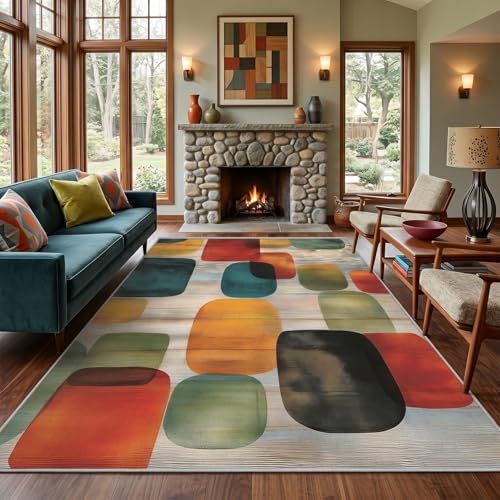
Tzvjxln Mid Century Geometric Area Rug 5×8 Color Block
Colour blocking is the boldest dialect of mid-century design: big fields of contrasting colour meeting at hard edges, like a Mondrian that wandered off the wall. Tzvjxln’s 5×8 abstract statement rug works in that dialect, and its listing describes a low-pile, non-slip, washable indoor rug for living rooms and bedrooms. The extra foot of length over a standard 5×7 is more useful than it sounds, stretching the rug past the ends of a three-seat sofa so the composition does not look clipped. Because the pattern is large-scale, this rug behaves like artwork; furniture placed over it should be simple, and the blocks themselves become the room’s colour plan, dictating cushion and curtain choices.
- Size from the title: 5×8 feet
- Pattern: retro colour block, abstract statement design
- Pile: low
- Backing: non-slip, per the listing
- Care: washable
Strengths
- Large-scale blocks give a room instant structure and a ready-made colour palette.
- The 5×8 proportion flatters sofas better than a square-ish footprint.
- Low pile keeps the hard-edged design looking sharp rather than fuzzy.
Trade-offs
- Bold blocks dominate; artwork and upholstery must defer to the floor.
- Precise placement matters, because a block boundary under one chair leg looks accidental.
- Colour commitment is total — this is not a rug that fades into the background.
Rooms with plain white walls benefit most from this kind of floor-level confidence. In a rental where painting is forbidden, a colour-block rug smuggles in the strong hues the lease will not allow on walls. Under a dining table, align the blocks deliberately with the table’s edges so the composition looks composed rather than random. The washable, low-pile build keeps the boldness practical: a spilled glass of red wine on a statement rug is a crisis only if the rug cannot be cleaned, and this one is sold as washable. Bedrooms with plain bedding can also carry it, though the energy of the pattern suits morning people better than minimalists seeking calm. Check price on Amazon for the colour-block statement in 5×8.
Colour-block rugs ask one thing of their owners: confidence about placement. Spend the extra ten minutes with masking tape on the floor before the rug goes down, marking where its boldest block will fall relative to the sofa, because once furniture is arranged the composition is set for years. The reward for that care is a room that photographs like a magazine spread, where the floor plan reads as clearly as a diagram. Colour blocks also age interestingly. Because each block is a flat field, fading — if it comes — arrives as a softening of the whole composition rather than the destruction of a detailed motif, and the design remains legible long after a fine pattern would have blurred. In open-plan spaces this rug can do zoning work that furniture alone struggles with, declaring the living area’s boundary in colour while the dining zone beyond stays plain. Pair it with a low, leggy sofa that leaves the blocks visible around its base, and avoid a glass coffee table unless you enjoy seeing the pattern all day, which, admittedly, many owners of this rug genuinely do.
Best for: plain rooms needing one decisive graphic gesture. Not suited for: spaces already saturated with colour or pattern elsewhere.

Phtbz Mid Century Modern Retro Area Rug 4×6 Colorful 70s
By the seventies, mid-century geometry had loosened up: curves replaced some of the angles, and the palette warmed into the harvest tones and playful brights this 4×6 celebrates. Phtbz describes a geometric abstract rug in a colourful retro seventies style, washable, for living rooms and bedrooms, and even frames it as a giftable piece of mid-century décor. At 4 by 6 feet it is the smallest rug here, which is precisely its usefulness. Small rugs define small zones — a reading chair and lamp, a desk nook, the foot of a single bed — without pretending to carpet a whole room. Its scale also makes it the easiest washable on the list to handle on laundry day.
- Size from the title: 4×6 feet
- Pattern: geometric abstract, colourful seventies retro
- Care: washable area rug, per the listing
- Placement named: living room and bedroom
- Pile height: not given in the listing title
Strengths
- Compact footprint suits studios, nurseries, dorms and reading corners.
- The seventies palette warms rooms that fifties teal would leave cold.
- Small and washable means low-effort care and easy storage between uses.
Trade-offs
- Four by six feet will underwhelm as the sole rug in a full-size living room.
- Multicolour patterns can clash with existing bright furnishings.
- Zone rugs shift more on hard floors, so placement away from main walkways helps.
Treat this size as an accent with a job. Under a desk it softens the work corner and catches chair castors’ noise; beside a bed it gives the morning a warmer first step; in an entryway-adjacent living space it announces the home’s style early. The listing’s gift framing is not silly either — a 4×6 washable rug is one of the few décor gifts that does not demand the recipient redecorate around it, because it can always retreat to a smaller zone. Layering is another option: centred over a larger plain flatweave, the colourful geometry reads as intentional rather than undersized. Check price on Amazon if a small seventies accent is the missing piece.
Small rugs are routinely underestimated, so here is the case for the 4×6 as a strategic purchase rather than a compromise. It is the size you can carry to the washing machine without a wrestling match, the size that fits in a linen cupboard when the season changes, and the size that can trial a bold palette in one corner before you commit a whole room to it. The seventies colourway is exactly the sort of experiment a small rug exists for: joyful, warm and unmistakably retro, yet confined to a footprint that a future change of heart can redeploy to a hallway, a nursery or a guest room in minutes. Children claim these rugs instinctively, turning them into islands, stages and reading territories, and a washable build means those claims cost the household nothing. In a studio flat, one 4×6 under the armchair and lamp creates a psychological room division that renters cannot achieve with walls, and that division — a place that is for reading, not working or sleeping — is worth more than its square footage suggests.
Best for: compact zones, renters and anyone testing the retro look at low commitment. Not suited for: anchoring a full seating arrangement on its own.

Mid Century Modern Boho Botanical Geometric Rug 8×10 Terracotta
The second 8×10 on the list takes the era’s geometry outdoors in spirit, folding botanical shapes into the pattern and washing the whole thing in terracotta. Its listing describes a machine-washable, low-pile, non-slip rug for warm mid-century spaces, and that word warm is the key to its appeal. Terracotta flatters rooms that teal would chill: north-facing living rooms, spaces with grey sofas, floors in pale wood that need grounding. The boho-botanical influence also softens the geometry, so the rug suits households that find atomic patterns too sharp and colour blocks too loud. Plants, inevitably, look wonderful near it, the leaf shapes in the pattern rhyming with real foliage on the shelves above.
- Size from the title: 8×10 feet
- Pattern: boho botanical geometric, terracotta
- Care: machine washable
- Pile: low, with non-slip backing
- Fibre content: none stated in the listing title
Strengths
- Terracotta warmth rescues cold, grey or north-facing rooms at floor level.
- Botanical softening makes the geometry liveable for pattern-shy households.
- Full 8×10 coverage anchors large seating groups and dining sets alike.
Trade-offs
- Earthy red-brown fights cool blue-grey schemes rather than complementing them.
- Boho styling drifts from strict mid-century, which purists may resist.
- A washable 8×10 is a heavy laundry load; check your machine’s capacity first.
Dining rooms deserve a special mention for this pick. A low-pile 8×10 under a six-seat table leaves room for chairs to pull out without dropping off the rug’s edge, and the busy botanical geometry is merciful toward crumbs and splashes between washes. In living rooms, pair the terracotta with cream upholstery and black accents for a scheme that feels curated rather than themed. Because the pattern mixes structure with organic shapes, it also bridges styles — a room halfway between Scandinavian and mid-century will find this rug diplomatically fluent in both. Households with dogs will appreciate that the earthy palette camouflages paw-borne dust on the days between cleans; speaking of dogs, the fleece choices in Best Dog Blankets cover the washable throws that protect sofas in pet households like these. Check price on Amazon for the terracotta botanical in the full 8×10 size.
Terracotta has a social quality that cooler colours lack: it makes rooms feel inhabited. Guests settle faster in a warm-floored room, and long evenings stretch more comfortably over earthy reds than over greys. The botanical side of this design deepens that effect, because leaf and stem shapes suggest the garden even in a fourth-floor flat, and they give the eye a gentle, wandering path across the floor instead of a grid to march along. Practical households should also note how the colour treats sunlight. In a bright south-facing room, terracotta absorbs glare visually and stays rich, where pale rugs wash out to nothing by noon. The 8×10 scale means the pattern repeats generously rather than cramping, so the botanical shapes breathe. If the room holds a fireplace, this is the pick that belongs in front of it; if it holds a wall of bookshelves, the warm field below them turns the whole wall into a library corner. Few rugs on any list manage to be both the warmest and one of the most washable options at once.
Best for: large rooms needing warmth, plants and forgiving pattern. Not suited for: cool-toned schemes built on blues and greys.
One pattern in this set will usually announce itself as yours within a single reading of the reviews, and it is worth trusting that reaction. Rugs are looked at every day for years; a design that merely seems sensible tends to become invisible, while a design that genuinely pleases its owner keeps paying small daily dividends. The practical filters — size, washability, pile — exist to protect that pleasure from logistics, not to overrule it. So shortlist by heart, then veto by tape measure and washing machine, and what survives both tests is the rug to order.
Side-by-side: the six patterns at a glance
| Rug | Footprint | Pattern language | Care note from the listing |
|---|---|---|---|
| Retro Mid-Century Modern Area Rug 8×10 Teal Blue Scalloped | 8×10 | Scalloped, teal and blue | Washable |
| BEIMO Mid Century Modern Rug 6×9 Green Abstract Geometric | 6×9 | Abstract geometric, green beige pink | Washable, easy care, non-slip |
| Mid Century Modern Atomic Retro Area Rug 5×7 | 5×7 | Atomic retro | Machine washable, non-slip |
| Tzvjxln Mid Century Geometric Area Rug 5×8 Color Block | 5×8 | Colour block abstract | Washable, low pile, non-slip |
| Phtbz Mid Century Modern Retro Area Rug 4×6 Colorful 70s | 4×6 | Seventies geometric abstract | Washable |
| Mid Century Modern Boho Botanical Geometric Rug 8×10 Terracotta | 8×10 | Botanical geometric, terracotta | Machine washable, low pile, non-slip |
Read down the pattern column and the list divides neatly into three temperaments. The scalloped teal and the terracotta botanical are the softeners, using curves and plant shapes to make geometry gentle. The BEIMO green and the atomic 5×7 are the middle path, recognisably patterned but composed of smaller, repeatable motifs. The colour-block Tzvjxln and the seventies Phtbz are the extroverts, one by scale of pattern and the other by exuberance of palette. Size, meanwhile, should be decided by furniture, not by bravery: measure the seating group, then choose the footprint that lets at least the front legs of every seat rest on the rug.
Choosing well comes down to sequencing. Pattern first, because it is the decision you will see; size second, because it is the decision you will feel; care third, because it is the decision you will repeat. The sections below take those in an order that mixes all three, since real rooms refuse to separate them neatly.
How to choose a midcentury rug that fits your room?
Start with the furniture footprint, not the room’s walls
Rugs fail most often by being one size too small. Pace out your seating arrangement and mark where the front legs of the sofa and chairs land; the rug should reach under all of them. In practice that pushes most living rooms toward 8×10, most apartments toward 5×7 or 5×8, and dining rooms toward a size that leaves roughly two feet of rug beyond the table on every side so chairs stay on the surface when pulled out. Bedrooms follow a different rule: the rug should extend beyond the bed’s sides and foot far enough that bare feet meet rug, not floorboards, at every exit point. When a room falls between sizes, the 6×9 BEIMO exists precisely for that gap.
Pick a pattern dialect and commit to it
Atomic, colour-block, scalloped, botanical and seventies patterns are cousins, not twins, and mixing two dialects in one room usually reads as indecision. Decide which story the room tells. A collection of fifties furniture deserves the atomic quotation; a plain contemporary sofa can carry the colour-block’s graphic weight; a plant-filled, texture-rich room will absorb the botanical terracotta without blinking. Once the floor’s dialect is set, echo it in at most two small accessories — a cushion, a lampshade — and let everything else stay quiet.
Weigh washability against how the room is really used
Every pick here is sold as washable, but washability matters unevenly. A rug under a dining table or in a dog-owning household will be washed; a rug in a formal sitting room may only ever be vacuumed. Match the care burden to the reality: large washable rugs need a machine with the capacity to take them, so confirm your laundry setup before choosing an 8×10. Low pile, shared across most of the list, is the quiet hero — it vacuums cleanly, releases crumbs, and keeps retro patterns looking printed-sharp rather than blurred.
Let the existing wood and light cast their votes
Before falling for a colourway on a screen, audit what the rug must live with. Walnut and teak lean warm and welcome terracotta, seventies brights and beige-flecked greens; pale oak and ash sit cooler and flatter teal, atomic palettes and crisp colour blocks. Then watch the room’s light for a day. South-facing rooms bleach delicate colours and reward saturated ones, while north-facing rooms grey everything down and need warmth or contrast to compensate. A rug is the largest colour decision in most rooms, larger than the sofa, so it deserves the same deliberation you would give paint — with the advantage that, unlike paint, a washable rug can be rolled up and reconsidered whenever the household’s taste moves on.
Plan the rug’s second life before its first
Washable, standard-size rugs are among the most redeployable objects in a home. The 5×7 that anchors a first flat’s living room becomes the bedroom rug in the second flat and the nursery rug in the family house. Choosing a pattern you genuinely like, rather than one that merely matches this year’s cushions, is what makes that second life possible. Mid-century patterns have already survived seventy years of fashion cycles, which is the strongest available evidence that they will survive your next sofa as well.
Styling retro geometry without turning the room into a film set
The line between a mid-century room and a mid-century theme park is repetition. One starburst clock is a nod; starbursts on the rug, the curtains, the cushions and the wallpaper is a costume. Let the rug be the era’s loudest voice and dress the rest of the room in the period’s quieter virtues: clean lines, warm wood, uncluttered surfaces. Modern pieces are welcome — a contemporary sofa under a seventies rug looks intentional, whereas a full suite of reproduction furniture can feel like a museum diorama. Lighting helps too, since low-pile printed patterns read best in even, warm light rather than under a single harsh ceiling bulb. Finally, leave some floor visible. A border of bare wood or plain flooring around a patterned rug is what makes the pattern look chosen; wall-to-wall pattern leaves the eye nowhere to rest.
Texture is the styling lever most retro rooms forget. A low-pile printed rug is visually smooth, so the room above it should supply the tactile variety: a nubby throw, a leather cushion, a woven basket, the grain of real wood. Without those contrasts, even a beautiful colour-block floor can leave a room feeling flat, as if it were a photograph of a room rather than a room itself. Books, ceramics and plants are not clutter in this context; they are the layer that convinces the body the space is real. Add them slowly, one object at a time, and stop the moment the floor stops being the first thing a visitor notices — that balance point is where a styled room lives.
Scale deserves a second word as well, because mid-century furniture is famously low and leggy, and a rug must negotiate with those legs. spindly chair legs on a busy atomic scatter can look restless, whereas the same chairs on the calmer BEIMO geometry settle down. Conversely, a heavy contemporary sofa with a skirted base hides most of any rug beneath it, which argues for the boldest patterns — colour blocks or scallops — whose edges still speak from under the furniture. Walk around your arrangement and look at what actually remains visible of the floor; that visible crescent is the rug you are truly buying, and it should be chosen with as much care as the full rectangle in the product photograph.
Finally, give a new rug a fortnight before judging it. Printed colours look louder in the first days simply because they are new, and the eye edits them down as the room’s other objects reassert themselves. Many returned rugs were not wrong; they were merely new. Live with the pattern through different lights and one full weekend of ordinary mess, then decide — the washable builds on this list make that trial period a low-stakes experiment rather than a gamble.
Common mistakes when buying a retro rug
Measuring the room instead of the furniture. A rug bought to fit the walls will almost always strand the sofa on bare floor, breaking the seating group into visual islands. Measure the arrangement, then buy for it.
Letting two bold patterns share one sightline. An atomic rug beneath a floral sofa forces the eye to referee a fight nobody wins. If the rug shouts, the upholstery should murmur, and vice versa.
Ignoring the laundry question until the rug is home. Washable is only a benefit if your machine, or a laundrette nearby, can actually handle the rug’s size and weight when wet. Settle that detail before the 8×10 arrives, not after the first spill.
Placing a shaped or colour-block rug carelessly. Scalloped edges hidden under furniture waste the design, and colour blocks that end mid-chair look like mistakes. Position these rugs so their geometry reads as a deliberate composition.
Forgetting what sits on top. Coffee tables with busy bases, patterned throws and crowded shelving all compete with a graphic floor. Simplify the layers above a bold rug or choose the quieter BEIMO-style geometry instead.
Buying the pattern before checking the palette in daylight. Screen colours flatter everything. A teal that glows on a monitor can turn grey-green in a dim hallway, and terracotta can flare orange in strong sun. Wherever possible, judge a colourway against your room’s actual light, and favour the designs whose neighbouring shades — beige in the BEIMO, blue in the scalloped teal — give the main colour somewhere forgiving to land.
Treating washable as invincible. A washable rug still deserves prompt attention to spills, regular vacuuming to lift grit out of the pile, and a full dry before it goes back under furniture. Households that build those small habits keep printed patterns crisp for years; households that rely on the washing machine as a rescue service find even the toughest rug ageing early along its busiest paths.
There is a historical comfort in this category that newer styles cannot offer. Mid-century geometry has been continuously loved since it was invented, through decades when it was fashionable and decades when it was not, which means a rug in this language is unlikely to embarrass its owner when tastes rotate again. The washable construction is the modern contribution, and it is the one that matters most day to day: the era’s designers worked in wool and patience, but today’s households need pattern that survives a toddler’s birthday party and a dog’s wet November. These six rugs are where those two timelines meet, and the meeting is a happy one — the patterns have lost none of their nerve, while the care demands have shrunk to a wash cycle. Buy the one whose colours you would still choose in five years, in the largest size your furniture honestly supports, and the floor will repay the decision every single day it is walked on.
Final recommendation
For most living rooms, the terracotta botanical 8×10 is the safest large bet: warm, forgiving, washable and gentle enough in pattern to live with for years. If your allegiance is to the fifties themselves, the atomic 5×7 is the honest choice, sized for apartments and styled without apology. Small spaces and first-time retro buyers should start with the Phtbz 4×6, which delivers the palette without the commitment, while dining rooms belong to the low-pile, non-slip BEIMO 6×9. The scalloped teal is the romantic of the group and the colour-block Tzvjxln the extrovert; both reward rooms brave enough to centre them. Whichever direction you lean, let size follow furniture and pattern follow temperament, and the rug will look collected rather than purchased. Hosts setting up a spare room around a new rug may also want the towel guidance in Best Guest Bath Towels, which deals with stocking a guest bathroom properly.
The short version of everything above: measure the furniture group, choose one pattern dialect, respect the laundry logistics, and let the rug’s colour argue with nothing else in the room. Readers who follow those four rules rarely return a rug, whatever its pattern.
Beyond the headline questions below, the wisest pre-purchase habit is embarrassingly simple: tape the rug’s outline on your floor for a full day. Live with the taped rectangle through meals, work and evening light. Size mistakes become obvious within hours, and they are the cheapest mistakes in all of decorating when caught in tape rather than in a delivered parcel.
Questions people ask about these rugs
Are washable low-pile rugs a good match for dining rooms?
Yes, and the combination is close to ideal for that job. Low pile lets chairs slide instead of catching, non-slip backing keeps the rug from migrating under the table, and washability answers the spills that dining guarantees. The BEIMO 6×9 and the terracotta 8×10 both fit that brief on this list.
Which of these patterns is closest to authentic fifties style?
The atomic 5×7, without much contest. Starburst and boomerang motifs were the era’s signature graphics. The scalloped and colour-block designs are also period-rooted, while the botanical and seventies picks interpret later or softer branches of the family tree.
Can a bold colour-block rug work in a small flat?
It can, provided the rest of the room stays restrained. In a compact space a single graphic rug often replaces several smaller decorations, giving the flat a designed feel with fewer objects. Keep walls and upholstery plain and let the floor do the talking.
How do I stop a non-slip rug from creeping on hard floors?
Start by unrolling it fully and letting it relax flat for a day before placing furniture. Keep the floor beneath it clean and dry, since dust undermines grip, and arrange heavy furniture on the rug’s edges where the design allows. If creep persists in a walkway, repositioning the rug out of the main traffic line usually solves more than any accessory.
Do these rugs suit homes with dogs?
The washable, low-pile builds across this list are among the more dog-tolerant options available: hair vacuums off low pile easily, and accidents can be washed rather than spot-treated forever. Earthy, patterned designs like the terracotta botanical also hide the evidence of muddy paws between cleans.
Should a midcentury rug match my curtains or my sofa?
Neither, exactly. The healthiest relationship is coordination without copying: pull one colour from the rug into a cushion or a throw, leave the sofa in a solid that appears nowhere in the pattern, and keep curtains quieter than both. Exact matching across floor, windows and seating is what tips a room from styled into themed, and themed rooms tire their owners fastest.
What is the easiest size to live with as a first retro rug?
A 5×7 or 5×8, because both cover a real seating zone yet remain light enough to wash, move and store without help. First-time buyers who start at 8×10 sometimes discover the pattern is right but the logistics are not, whereas a mid-size success teaches the household its taste at a manageable scale — and the mid-size rug almost always finds a second room to live in later.
How long should a washable rug like these last?
Longevity depends less on the calendar than on traffic and care rhythm. A low-pile washable rug in a bedroom can look fresh for many years, while the same build in a hallway works far harder. Rotate the rug if the design allows it, vacuum grit out before it grinds into the base, and wash on need rather than on a punishing schedule, and any of these six should serve through several rearrangements of the room above it.
Choose the pattern your room has been quietly asking for, lay it under the furniture that matters, and let the floor finally join the conversation the rest of your mid-century pieces started years ago.


