What's inside
- Key Takeaways
- Quick Picks
- How We Chose These Picks
- How Do the Six Compare at a Glance?
- How High Should a 36-Inch Chimney Hood Hang?
- What Do You Do When the Chimney Does Not Reach the Ceiling?
- Why Does Canopy Depth Matter More on a 36-Inch Range?
- How Do You Install a Chimney Hood Without Regretting It?
- Ducted or Ductless: What Should a Chimney Buyer Decide?
- How Do You Clean a Chimney Hood and Keep It Handsome?
- Which Kitchens Suit a Chimney Hood Best?
- How Does a Chimney Hood Change a Kitchen’s Design?
- What Should You Know About Chimney Hoods and Resale?
- How Do Chimney Hoods Behave Over a Big Family Gathering?
- What Is the Honest Difference Between 380 and 900 CFM Over a Wide Range?
- How Should You Light a Kitchen Around a Chimney Hood?
- What Happens When a Chimney Hood Meets an Old House?
- How Do You Live With a Chimney Hood’s Sound?
- What Should You Check in the First Month of Ownership?
- Why Do Restaurants Trust Chimneys, and What Can Homes Borrow?
- How Should a Chimney Hood Be Chosen for a Rental or a Flip?
- What Does the Chimney Itself Actually Do?
- Which Chimney Mistakes Do Buyers Regret Most?
- Final Recommendation
- Frequently Asked Questions
- Related Guides
As an Amazon Associate I earn from qualifying purchases. This post may contain affiliate links at no extra cost to you.
cottageverdict.com is reader-supported. When you buy through links on our site, we may earn an affiliate commission.
Where to buy: the six chimney hoods below each link to their Amazon listing, where chimney extension options, duct sizes, and mounting hardware can be verified against your ceiling height before ordering. The best 36-inch chimney range hoods do two jobs at once, and this guide refuses to judge either in isolation. They are extraction machines sized for a 36-inch range, and they are also the tallest piece of furniture in most kitchens — a stainless chimney rising from the hob to the ceiling that every guest will see and every cook will live under.
That double life explains the spread of this shortlist. Airflow here runs from the Broan and Cosmo designs at 380 CFM, through the SNDOAS at 450 and the VIKIO HOME at 580, to the Tieasy at 700 and the IKTCH at a full 900 — yet the right choice is rarely the strongest, because a chimney hood’s capture depends on its canopy reaching over a wide range’s front burners and its flue being planned around the ceiling it must meet. A beautiful chimney installed two inches too high is a sculpture that ventilates poorly.
So read the reviews for the machines, then read the sections after them for the architecture: ceiling heights, chimney extensions, soffits, stud-finding, and the choreography of lifting a tall steel flue into place without denting it. Chimney hoods reward households that plan in three dimensions, and punish — gently, permanently, and in plain sight — those that shop from a photograph alone.
Key Takeaways
- A 36-inch chimney hood is furniture as well as extraction — judge the silhouette and the motor with equal seriousness.
- Canopy reach over the front burners decides capture on a wide range more than the headline airflow does.
- Measure ceiling height before ordering; the chimney section must meet the ceiling or an extension or soffit must close the gap.
- Ratings here span 380 to 900 CFM — match the motor to your range’s output and your duct, not to ambition.
- Most of these convert between ducted and ductless, but a chimney over a serious range deserves its duct.
- Two-person installation, wall studs, and a protected floor turn a dramatic appliance into a calm Saturday.
Quick Picks
| Model | Badge | Why it earns a place |
|---|---|---|
| IKTCH 36in 900CFM | Flagship Chimney | 900 CFM, gesture sensing and touch control, adjustable lights, and a full stainless chimney presence. |
| Broan BW5036SSL | Trusted Chimney Name | A 380 max blower CFM chimney hood with three speeds and LED lighting from the ventilation specialist. |
| Cosmo Vista 380CFM | Baffle-Filter Chimney | Cosmo’s Vista chimney with 380 CFM, push buttons, permanent dishwasher-safe baffles, and a backdraft damper. |
| SNDOAS 36in 450CFM | Mid-Power Chimney Value | 450 CFM in a chimney-style wall mount with three speeds, push buttons, LED light, and convertible venting. |
| Tieasy 36in 700CFM | Strong Touch-Control Chimney | 700 CFM with touch control, permanent filters, three speeds, and a stainless wall-mount chimney body. |
| VIKIO HOME 36in 580CFM | Low-Noise Middleweight | 580 CFM with a low-noise billing, touch control, three speeds, LED lights, and convertible stainless chimney form. |
How We Chose These Picks
Chimney hoods were judged as architecture first and appliances second, because a model that cannot meet a kitchen’s ceiling gracefully has failed before its motor is considered. Every pick had to present a complete wall-mount chimney in the 36-inch width, with a canopy deep enough to matter over a wide range’s front burners. Convertible venting was welcomed but ducted competence was required — a chimney is a commitment, and these six all honour it.
Within that frame we spread the power ladder deliberately, from the honest 380 CFM pair through the middleweights to the 900 CFM flagship, because 36-inch ranges vary from gentle electric slabs to gas ranges with genuine theatre in them. Filter type, control reach over a wide hob, lighting, and the realism of each noise story completed the assessment. What we excluded matters too: no slim panels pretending to be chimneys, and no island models, which belong to a different guide and a different ceiling.
Three chimneys frame the category. The IKTCH 36in 900CFM is the flagship for ranges that run hot and wide; the Broan BW5036SSL brings a trusted name and honest airflow to family cooking; and the Cosmo Vista 380CFM adds dishwasher-safe baffles for kitchens where frying is a habit rather than an event.

IKTCH 36in Wall Mount Range Hood 900CFM — Flagship Chimney
The IKTCH is the chimney as statement: a broad 36-inch canopy, a tall stainless flue, and extraction rated at 900 CFM for ranges that actually need it. Gesture sensing joins a touch panel, so a wave clears the air when both hands are committed to a roasting tin, and the two adjustable lights can be aimed where a wide hob actually needs them rather than where a designer assumed it might.
Power at this level changes what a wide range can do at home. Five burners running together — a stockpot, two saucepans, a griddle, a frying pan — produce a combined plume that defeats lesser canopies at the edges; the IKTCH’s pull holds the whole width, provided the duct behind the chimney is sized to let it. That proviso is the review in miniature: this is superb equipment for a properly planned installation.
The convertible ducting deserves a sceptical note. Yes, the machine can recirculate, and in a temporary installation that may serve; but a 900 CFM chimney recirculating over a serious range is a fountain recycling its own water. Plan the duct, use the conversion only as a bridge, and the hood becomes what its silhouette promises.
Daily life with it is calmer than the specification suggests. Lower speeds handle ordinary suppers at a murmur, the touch panel wipes clean, and the chimney’s sheer verticality makes a plain kitchen look deliberately designed — the effect guests comment on, usually while standing exactly where the extraction is working hardest.
Fit it with respect for its weight and height. The flue sections want careful handling to avoid the fingerprints and micro-dents that stainless shows forever, and the mounting wants studs, not optimism. Households that give it those courtesies get the flagship experience the price of admission implies.
A year into ownership, IKTCH households tend to divide their cooking into two eras. Before it, the big range was used apologetically — burners rationed, the griddle a special occasion, frying done with a window open in February. After it, the range is simply used, all of it, on an ordinary Tuesday, because the chimney overhead has made the full repertoire socially acceptable indoors. That behavioural change is the truest measure of a flagship extractor, and it is why owners defend the purchase with a warmth that specification sheets never quite explain. The machine did not merely clear air; it returned a stove to its owners.
- Airflow: 900 CFM listing figure
- Mounting: wall-mount chimney, 36-inch canopy
- Controls: gesture sensing plus touch panel
- Lighting: two adjustable lamps
- Vent path: ducted or ductless convertible
- Finish: stainless steel throughout
Strengths
- Holds capture across a full wide range
- Gesture control suits busy two-handed cooking
- Chimney silhouette anchors a kitchen design
Trade-offs
- Needs a duct sized for its appetite
- Recirculating mode wastes its potential
- Tall flue demands careful two-person fitting
Best for: 36-inch ranges cooking on several burners at once.
Not suited for: low ceilings or kitchens avoiding a visual centrepiece.

Broan-NuTone BW5036SSL Chimney Range Hood — Trusted Chimney Name
Broan-NuTone builds ventilation the way boiler makers build boilers — as a trade, not a fashion — and the BW5036SSL carries that temperament into the chimney category. Its 380 max blower CFM is the most modest figure in this guide, stated without inflation, and aimed at the many 36-inch ranges whose cooking is family-scale rather than theatrical: roasts, pasta nights, weekend breakfasts, the occasional stir-fry.
Three speeds map onto that cooking honestly. The low setting ventilates a simmering sauce in near-silence; the middle handles the Sunday roast; the top is there for the frying pan’s loud five minutes. LED lighting is integrated into the canopy, and the convertible design lets the hood exhaust outside where a duct exists or recirculate where one is still a plan.
The chimney format gives even this modest extraction a capture advantage over slim under-cabinet panels: the canopy’s depth and the flue’s presence gather the plume from a wide range more completely, and mounting height can be set for capture rather than dictated by a cabinet’s underside. On a 36-inch electric range especially, this combination — deep canopy, honest motor — performs beyond what the CFM figure alone predicts.
Broan’s long game is parts and precedent. Filters, lamps, and switches for a mainstream Broan chimney remain findable in a way that exotic imports rarely match, and installers have fitted this pattern often enough to have opinions about it — mostly favourable ones, which in the building trades is a review of considerable weight.
Choose it where the range is wide but the cooking is sane, the budget prefers sense to spectacle, and the household would rather own the hood the local merchant can service blindfolded. It is the chimney for people who read manuals, and there are more of those kitchens than the showroom suggests.
The Broan’s long-service character shows in small places. Its controls are the sort a gloved hand can work at a carving station, its canopy edges are finished rather than merely folded, and nothing in its operation requires a household to learn a new ritual — the fan is summoned, the air clears, the light does its plain duty. In guest houses, holiday lets, and the kitchens of people who cook well but think about appliances rarely, that absence of personality is a genuine luxury. The chimney looks correct, works correctly, and leaves its owners free to think about lunch.
- Airflow: 380 max blower CFM as listed
- Speeds: three fan settings
- Mounting: wall-mounted chimney design
- Lighting: LED lamps in the canopy
- Vent path: convertible installation
- Brand: Broan-NuTone specialist range
Strengths
- Honest airflow matched to family cooking
- Deep chimney canopy aids capture
- Strong parts and installer familiarity
Trade-offs
- Least headroom here for smoky cooking
- Styling is conservative beside rivals
- Top speed reserved for short bursts
Best for: wide electric ranges and measured family cooking.
Not suited for: pro-style gas ranges run at full theatre.

Cosmo Vista 36in Wall Mount Hood 380CFM — Baffle-Filter Chimney
The Cosmo Vista pairs the same honest 380 CFM class as the Broan with a filter decision that suits greasier cooking: permanent baffle filters that go through the dishwasher. Where mesh would load up and fade between washes, the Vista’s baffles shed grease into their channels and emerge from a hot cycle ready to work, which makes this the 380-class choice for households whose wide range sees regular frying rather than occasional boiling.
Push-button controls keep the interface legible through steam, and a backdraft damper is included in the specification — a small mercy that stops the chimney becoming a cold-air inlet on January nights. Three fan speeds cover the working range, and the ducted wall-mount format means steam from a 36-inch range’s pasta water leaves the building entirely rather than touring it.
The Vista styling is the other half of its appeal. Cosmo’s chimney lines are clean and slightly architectural, tall without being fussy, and the stainless finish sits comfortably in both modern and transitional kitchens. In a category where the appliance is unavoidably a visual event, that restraint ages well — nothing about the silhouette will date the room in five years.
Judge it as the thinking household’s middle path: real baffles, real ducting, honest airflow, and a chimney that flatters the kitchen daily. Ranges run at constant full output will want more motor, and this guide contains it further down the page; ranges used the way most families actually use them will find the Vista sufficient in the way a well-made coat is sufficient — completely, and for years.
Vista owners who fry often develop a particular affection for the dishwasher cycle that restores their baffles. There is a small ceremony to it — baffles out on a Sunday, a hot wash, steel back in place by supper — and the reward is measurable in the kitchen’s smell by Monday. Cosmo’s damper, meanwhile, earns its gratitude exactly once a year, on the first still, freezing night, when the household realises the chimney is not breathing cold air onto the cook’s neck. Small engineering, noticed annually, is still engineering worth having.
- Airflow: 380 CFM ducted rating
- Filters: permanent baffles, dishwasher-safe
- Controls: push-button panel
- Damper: backdraft damper included
- Speeds: three fan settings
- Design: Vista collection wall-mount chimney
Strengths
- Baffles suit regular frying at this size
- Damper guards against winter backdraughts
- Timeless chimney styling in steel
Trade-offs
- Same modest ceiling as its class
- Buttons offer no remote convenience
- Needs its duct to show its best
Best for: frying-friendly family kitchens wanting baffles.
Not suited for: six-burner cooking at constant full output.
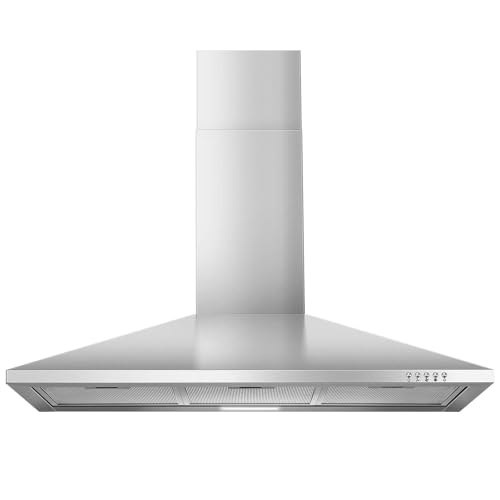
SNDOAS 36 Inch Range Hood 450CFM — Mid-Power Chimney Value
The SNDOAS occupies the chimney category’s sensible centre: 450 CFM, three speeds, push-button controls, and a wall-mounted flue that gives a 36-inch range the full chimney look without the flagship’s appetite or ceremony. For the large group of kitchens whose wide range arrived with a house purchase rather than a chef’s ambition, that centre is exactly where the value lives.
Three speeds over 450 CFM divide the work gracefully — a whisper for keeping a finished dish warm under the lights, a middle for the ordinary evening, and a top setting that deals respectably with a frying pan’s ambitions. Push buttons answer reliably with the back of a knuckle, and the LED light covers the wide hob evenly enough to judge a pan sauce by colour.
Convertible venting keeps the SNDOAS eligible for kitchens whose duct is theoretical, though — as with every chimney here — the machine’s character completes itself on a real duct. Recirculating buys time; ducting buys transformation. The chimney format helps either way, since the canopy’s gather is deeper than a slim panel’s and the plume has somewhere to collect before the filters meet it.
As an object it is unpretentious stainless, neither jewel nor apology, and in most kitchens that is the correct register for an appliance that must share a wall with cabinets, art, and the occasional splatter of tomato sauce reaching improbable heights. Buy it for proportion: enough power, enough presence, no surplus of either.
The SNDOAS earns its keep in the kitchens that dominate real life: a wide range inherited with a house, a family that cooks nightly without heroics, and a renovation budget being spent in a strict order. It hangs there doing the chimney’s double duty — presence on the wall, competence over the pans — while the household’s money goes to the roof, the boiler, the windows. When visitors assume it cost more than it did, that is the design working. When the cook forgets it entirely for a month, that is the engineering working, and of the two compliments the second is worth more.
- Airflow: 450 CFM listing figure
- Format: chimney-style wall mount
- Speeds: three-speed exhaust fan
- Controls: push-button operation
- Lighting: LED over the wide hob
- Vent path: ducted or ductless convertible
Strengths
- Balanced power for typical wide ranges
- Chimney presence without flagship bulk
- Buttons stay simple and repairable
Trade-offs
- Mid-pack extraction for smoky work
- No gesture or remote options
- Convertible hardware tempts ductless drift
Best for: standard 36-inch ranges and everyday family cooking.
Not suited for: constant multi-burner high-heat sessions.

Tieasy Range Hood 36 inch 700CFM — Strong Touch-Control Chimney
The Tieasy steps the chimney category’s power up to 700 CFM while keeping its manners modern: touch control on a clean panel, permanent filters, and three speeds that let the motor loiter as happily as it lunges. For a 36-inch gas range whose burners add real output to the cooking’s plume, that combination — genuine headroom, washable filtration, an uncluttered face — is a persuasive one.
Permanent filters matter more as airflow rises, because a strong fan dragging against choked mesh wastes exactly the performance the household paid for. The Tieasy’s filters wash and return, keeping the system’s resistance where the designers left it. Touch control, meanwhile, suits the chimney format: the panel sits on the canopy’s face, reachable without stretching over a wide hob’s front burners.
Styling is contemporary stainless, all straight lines and quiet reflections, and the chimney proportions flatter ceilings of ordinary height without needing the extensions taller rooms demand of narrower flues. Ducted, it exports a wide range’s steam completely; the convertible path exists, as ever, as a bridge rather than a destination.
Consider it the guide’s momentum pick — the point where spending stops buying features and starts buying extraction. Households graduating from an underpowered hood over a big range will feel the difference in the first week, most sharply on the evenings when three burners and an oven all report for duty at once and the kitchen air, somehow, stays its own.
Tieasy households often arrive from a specific frustration: a handsome range throttled for years by a hood that could not keep up, its top burners treated as decorative. The first full-house cooking session under the Tieasy — oven on, three burners lit, a pan searing — tends to be reported to friends with the enthusiasm of a plumbing breakthrough. Touch control divides opinion in the abstract, but owners cooking over a wide, hot hob praise being able to summon the fan without reaching through the plume, and the permanent filters keep the system’s promise from fading between washes.
- Airflow: 700 CFM listing figure
- Controls: touch panel on canopy face
- Filters: permanent, washable design
- Speeds: three-speed exhaust fan
- Vent path: ducted or ductless convertible
- Body: stainless wall-mount chimney
Strengths
- Serious airflow for gas ranges
- Permanent filters protect performance
- Touch panel reachable over wide hobs
Trade-offs
- Touch face needs regular degreasing
- Power wasted on restrictive ducts
- Presence too modern for some period kitchens
Best for: 36-inch gas ranges outgrowing a weaker hood.
Not suited for: tiny kitchens with minimal cooking output.

VIKIO HOME 36 Inch Wall Mount Hood 580CFM — Low-Noise Middleweight
The VIKIO HOME’s pitch is balance with a bias toward calm: 580 CFM — squarely between the 450-class and the heavyweights — in a wall-mount chimney whose listing emphasises low noise alongside its touch control and three speeds. For open-plan homes where the kitchen shares air and conversation with the living room, that bias is not a soft feature; it is the feature, because a hood too loud to run during dinner is a hood that will not be run during dinner.
At 580 CFM the extraction itself is no compromise for most 36-inch cooking. A roast with all the trimmings, a curry night, a full breakfast — the canopy’s chimney gather plus this airflow clears them with room to spare, and the top speed remains a burst tool rather than a lifestyle. LED lights and a touch panel keep the daily interface clean, and the stainless body carries the standard chimney silhouette without exaggeration.
Convertible venting broadens its eligibility, and ductless households will find it a capable recirculator — but the low-noise engineering only fully makes sense ducted, where the fan is not fighting its own filtered exhaust. Give it a decent run and its calm becomes structural: the system clears the room before noise ever needs to enter the discussion.
In the middle of this guide’s power ladder, the VIKIO is the pick for households that host where they cook. Its number is not the largest on the page and its silhouette is not the boldest, yet for the commonest real-world brief — a wide range, an open room, a family that talks while dinner happens — it may be the most precisely aimed machine here.
The VIKIO HOME’s signature moment is a dinner party. The range is working at full sociable stretch, the room is full, and at some point a guest asks — genuinely puzzled — whether the hood is actually on. It is, at a working speed, clearing the air over a four-pan dinner while conversation proceeds at drawing-room volume a few feet away. That is the low-noise engineering made visible, or rather audible by its absence. Households that entertain where they cook describe this as the difference between a kitchen that hosts and a kitchen that merely feeds, and they do not give it back.
- Airflow: 580 CFM listing figure
- Character: low-noise design emphasis
- Controls: touch control panel
- Speeds: three-speed fan
- Lighting: LED lights in canopy
- Vent path: ducted or ductless convertible
Strengths
- Strong yet conversation-friendly extraction
- Chimney capture over the full range width
- Touch interface keeps the face uncluttered
Trade-offs
- Not the ceiling for extreme cooking
- Noise advantage depends on duct quality
- Convertible mode dulls its best trait
Best for: open-plan kitchens with a 36-inch range.
Not suited for: sealed commercial-style cooking at home.
How Do the Six Compare at a Glance?
All six share a silhouette family and a width; everything else — power, filters, controls, temperament — is negotiation. The snapshot below pairs each chimney with the household it was plainly designed for.
| Model | Snapshot |
|---|---|
| IKTCH 36in 900CFM | 900 CFM chimney, gesture and touch, adjustable lights. |
| Broan BW5036SSL | 380 CFM max, three speeds, LED, convertible chimney. |
| Cosmo Vista 380CFM | 380 CFM, permanent baffles, damper, push buttons. |
| SNDOAS 36in 450CFM | 450 CFM chimney, three speeds, push buttons, LED. |
| Tieasy 36in 700CFM | 700 CFM, touch control, permanent filters, three speeds. |
| VIKIO HOME 36in 580CFM | 580 CFM, low-noise billing, touch control, chimney form. |
How High Should a 36-Inch Chimney Hood Hang?
Mounting height is where chimney hoods are won and lost. Too high, and the plume from a wide range’s front burners expands, cools, and drifts past the canopy’s edges before capture; too low, and tall pans foul the filters while the cook’s head negotiates with steel. Manufacturers publish a range for each model, and the productive end of that range — balanced against the tallest stockpot the household owns — is where the tape measure should land.
Gas ranges generally ask for more clearance than electric ones, and the range maker’s word on that subject outranks any guide’s. What surprises many buyers is how much difference a single inch makes: lowering a chimney within its permitted band can transform a mediocre installation into a convincing one, because capture improves with proximity far faster than airflow figures improve with money.
What Do You Do When the Chimney Does Not Reach the Ceiling?
Ceilings vary more than chimneys do. A standard flue covers the common range of ceiling heights; a taller room needs an extension section, ordered with the hood rather than improvised after it, while a lower or awkward ceiling may call for the flue to be trimmed by someone who cuts stainless for a living. The unforgivable outcome is the visible gap — a chimney that stops short of the ceiling reads as an error from every seat in the room.
Soffits and bulkheads offer a second answer in older houses: build the ceiling down to meet the chimney over the cooking zone, and the dropped section can quietly carry the duct’s horizontal run as well. Whichever route a kitchen takes, decide it before the hood is hung, because adjusting a flue after installation means doing the heaviest part of the job twice.
Why Does Canopy Depth Matter More on a 36-Inch Range?
A wide range puts its front burners further from the wall, and a plume rises vertically from wherever the pan sits. A shallow canopy leaves those front burners effectively outdoors — their plume clears the canopy’s front lip and disperses into the room no matter how heroic the motor behind the filters becomes. Chimney canopies earn their keep precisely here, gathering over the full depth of the hob in a way slim under-cabinet panels cannot imitate.
This is also why the modest-CFM chimneys in this guide acquit themselves better than their numbers suggest. Capture is a meeting between a rising column and a waiting canopy; deepen the canopy and the meeting happens on the hood’s terms. Shoppers comparing a 380 CFM chimney against a higher-rated slim panel for a wide range should weight that geometry at least as heavily as the airflow line.
How Do You Install a Chimney Hood Without Regretting It?
The work divides into structure, duct, and theatre. Structure: find the studs, because a chimney’s mounting bracket wants timber, not plasterboard and hope, and mark the canopy height from the finished floor with the range already in place. Duct: run it before the flue sections go up, sealing joints while they are still reachable. Theatre: protect the floor and the hob, unwrap the steel at the last moment, and lift with two people who have agreed beforehand who calls the movements.
Stainless flues record every mishandling permanently, so gloves stay on and protective film stays put until the chimney is fixed and level. Connect power last, test with a steaming pan before the film comes off, and only then stand back. A chimney installed this way looks deliberate; one wrestled into place alone looks, forever, slightly apologetic.
Ducted or Ductless: What Should a Chimney Buyer Decide?
Every chimney in this guide can recirculate, and almost none of them should for long. The format’s whole geometry — a deep canopy gathering a wide plume — exists to hand that air to a duct. Recirculating through a chimney is survivable for a season or a rental, but steam and heat remain in the room, and a wide gas range’s output will defeat carbon filtration’s dignity within months.
The duct route from a wall-mount chimney is usually the kindest in the business: straight up, a bend, and out through the roof or the wall, with the flue concealing the vertical entirely. Buyers who can see any route at all should take it, and treat the convertible hardware as insurance rather than as the plan.
How Do You Clean a Chimney Hood and Keep It Handsome?
The canopy and filters follow the usual rhythm — baffles or mesh washed as cooking demands, steel wiped along its grain with a soft cloth so the finish keeps its direction. The flue adds one new duty: its tall faces collect the room’s dust and the kitchen’s finest aerosol at a stately pace, and a monthly pass with a dry microfibre cloth keeps the chimney from developing a visible tide line at hand height.
Fingerprints are the chimney’s daily tax, paid mostly around the controls. A cloth kept in the nearest drawer, used for ten seconds after cooking, prevents the slow collage that otherwise builds up by the weekend. None of this is onerous; it is simply the standing arrangement between a household and a large, beautiful, vertical piece of stainless steel that everyone can see.
Which Kitchens Suit a Chimney Hood Best?
The natural home is a range against a wall with no cabinet above it — a layout that leaves the wall bare and asking for exactly this object. Open-plan spaces benefit doubly, since the chimney gives the cooking zone a visual anchor and its capture keeps the living end of the room out of the cooking’s weather. Kitchens with very low ceilings, ranges under existing cabinetry, and island hobs are the honest exceptions, served better by other formats.
Style matters less than sellers pretend. A stainless chimney sits happily in farmhouse, industrial, and contemporary rooms alike, because its shape is functional rather than decorative — it looks like what it does. Buyers torn between this and a hidden insert should ask which the room wants: a chimney declares the stove the kitchen’s hearth, and most 36-inch ranges were bought by people who agree.
How Does a Chimney Hood Change a Kitchen’s Design?
A chimney gives a kitchen a vertical, and rooms are organised by their verticals. Once a tall flue stands over the range, the eye reads the cooking zone as the room’s hearth — the place the architecture is about — and other decisions arrange themselves around it: where the table sits, which wall takes the shelves, how the lighting divides between work and welcome. Designers exploit this shamelessly, aligning the chimney with a window or a doorway to give the whole room an axis.
The practical consequence is that a chimney should be chosen with the room, not merely for the range. Its finish will converse with every other metal in the space for a decade; its width will set the visual weight of the cooking wall; its height will either meet the ceiling with intent or haunt the room with a gap. Households that treat the purchase as furnishing, with the tape measure of a furnishing decision, are the ones whose kitchens look photographed rather than assembled.
What Should You Know About Chimney Hoods and Resale?
Estate agents have a phrase for a kitchen with a proper chimney over a wide range: it photographs as a cook’s kitchen, and that photograph does measurable work in a listing. The hood signals that the range beneath it is real, that the ventilation was thought about, and that the room was finished rather than accumulated. Few appliances return their cost at resale, but a well-chosen chimney is among the minority that plausibly returns a visible fraction of it in the kitchen’s overall impression.
The reverse also holds. A chimney hung crooked, stopped short of the ceiling, or wearing a film of neglected grease in the viewing photographs tells buyers a story about the whole house’s maintenance. Sellers preparing a kitchen for market gain more from degreasing and aligning an existing chimney than from almost any other hour of work in the room — the appliance is simply too tall, too central, and too reflective to hide.
How Do Chimney Hoods Behave Over a Big Family Gathering?
The examination day for any 36-inch installation is the festival meal: oven occupied since morning, every burner spoken for, a cook and two self-appointed assistants orbiting the range. The plume in that kitchen is not one column but a weather system, and the chimney’s canopy depth earns its cost by gathering from the whole hob while its motor — even a modest one — works steadily rather than heroically. This is where owners discover whether their mounting height was honest.
It is also where the social dividend appears. A kitchen that clears its own air can hold its crowd; helpers stay at the counter instead of retreating to the garden with the gravy. By the time the meal reaches the table, the room smells of dinner in the pleasant, bounded way a dining room should, rather than carrying the full archive of the afternoon’s frying. Chimneys are bought for weekdays, but they are bragged about on holidays.
What Is the Honest Difference Between 380 and 900 CFM Over a Wide Range?
On paper the flagship moves well over twice the air of the modest pair, and in a kitchen that difference is real but narrower than the arithmetic suggests. Capture happens at the canopy, and a deep chimney canopy at the correct height intercepts most of an ordinary plume before the motor’s size becomes the question. The 380 CFM machines clear family cooking completely; what they cannot do is recover a situation — a pan already smoking freely, four burners at full output — as fast as the big motors can.
Think of the gap as recovery speed and headroom rather than as competence. The strong hoods forgive: a moment’s inattention, a hotter pan than intended, a second frying pan joining the first. The modest hoods reward attention instead, asking the cook to light the fan early and keep the smokiest work toward the back. Neither philosophy is wrong, but they suit different cooks, and choosing between them honestly is worth more than any single specification in this guide.
How Should You Light a Kitchen Around a Chimney Hood?
A wide range under a chimney is a workplace that deserves its own lighting plan, and the hood’s integrated lamps are only the first layer. They light the pans — the essential task — but the counters flanking a 36-inch range need their own sources, or the cook works between a bright hob and dim preparation zones with a tall steel flue shadowing the middle distance. Under-cabinet strips or well-aimed ceiling spots on either side complete what the canopy begins.
Colour matters at the pan more than elsewhere in the house. A sauce’s shade, meat’s sear, the exact moment garlic turns — all are colour judgements, and lamps that render colour faithfully make a cook measurably more accurate. When a chimney’s lights prove too cool or too dim for a household’s taste, adjusting the room’s other lighting to compensate is easier than regretting the hood, whose lamps are part of its architecture.
What Happens When a Chimney Hood Meets an Old House?
Old houses bring crooked walls, ceilings that slope with a century’s confidence, and chimney breasts that may or may not be where the drawings claim. A wall-mount flue against an uneven wall shows every millimetre of the wall’s wandering, so the fitting begins with packing and scribing rather than with the drill. None of this is fatal — installers who work in period houses treat it as Tuesday — but it should be priced into the plan rather than discovered mid-lift.
The reward for the trouble is considerable, because a stainless chimney in an old kitchen creates the productive tension those rooms do best: honest modern equipment standing inside honest old bones, neither pretending to be the other. Many of the most admired kitchens in this size class are exactly that pairing, and the hood — tall, functional, unapologetic — is usually the object that makes the pairing legible.
How Do You Live With a Chimney Hood’s Sound?
A chimney’s soundtrack is set less by its motor than by the speed the cooking demands and the duct the air escapes through. At the low settings where most family cooking lives, every model in this guide can sit beneath a conversation; the flagship’s top speed is an event noise, tolerated because it is brief and because the alternative is a room full of smoke. Households sensitive to sound should test a hood the way they will use it — fan on early, at the lowest effective speed — rather than auditioning its maximum in a showroom and flinching.
There is also a placement truth worth stating: a chimney over a range in a kitchen separated from the living space by a door can be as loud as it likes, while the same machine in an open-plan room must earn its welcome nightly. That is why this guide keeps returning open-plan households to the middleweights — their balance of capture and calm is not a compromise but a correct answer to a specific room.
What Should You Check in the First Month of Ownership?
Four small checks, made while the installation is young, prevent nearly every long-term chimney grievance. Confirm the flue sections have not shifted and the canopy remains level after the household’s first weeks of door-slamming and pan-clattering. Run a hand around the canopy’s edge during a steamy cook to feel for escaping air that would betray a duct joint loosened in the fitting. Wash the filters once, early, purely to learn the mechanism while the manual is still findable.
Finally, cook the meal the hood was bought for — the full-range, all-burners production — and judge the result from the next room rather than from the stove. If the air there stays clean, the installation is right and the next decade is a maintenance rhythm. If it does not, the first month is when adjustments are cheap, installers are reachable, and a mounting height can still be revisited without resentment.
Why Do Restaurants Trust Chimneys, and What Can Homes Borrow?
Professional kitchens settled on the canopy-and-flue shape generations ago, not from tradition but from physics: a deep hood over the cooking line, a straight road up, and filters built to be washed nightly. Homes borrow the shape at a smaller scale, and the borrowing works best when the household also borrows the habits — fan on before the pan heats, filters washed before they shine with grease, and the understanding that capture is a system rather than a switch.
What homes should not borrow is the assumption of unlimited makeup air and industrial duct sizes. The domestic chimney succeeds by proportion: enough canopy, enough motor, a decent duct, and a cook who lights the fan early. Within that proportion, the six machines in this guide are all legitimate heirs of the professional pattern, scaled for rooms where dinner is also a social occasion.
How Should a Chimney Hood Be Chosen for a Rental or a Flip?
Investment kitchens have their own logic, and it points firmly at the calm end of this guide. A chimney in a rental must survive tenants who will never read its manual, so buttons beat touch panels, washable filters beat exotic media, and a mainstream maker’s parts network beats a dazzling import’s specification. The Broan pattern exists in this guide precisely for that brief, with the Cosmo Vista beside it where frying tenants are expected.
For a resale renovation the calculus shifts toward the photograph: the chimney is the kitchen’s tallest argument, and a clean-lined model at a sensible height over a gleaming range sells the room’s intentions before a word is spoken. Even there, honesty governs — a chimney that vents properly will survive a buyer’s surveyor and a home inspector’s steam test, while a beautiful recirculating sculpture over a gas range invites exactly the questions a seller least wants asked.
What Does the Chimney Itself Actually Do?
New buyers sometimes assume the flue is packaging — a decorative sleeve hiding an ordinary duct — and it is partly that, but the chimney section also works for its living. Its height gives the captured air a straight, warm runway in which grease-heavy vapour keeps moving toward the exit instead of cooling and settling, and its volume buffers the pulses of a busy hob, smoothing the draw at the canopy below. A chimney is, in effect, the visible portion of the ventilation system’s good behaviour.
That is why the flue’s interior should be treated as duct, not as cupboard: sealed where it meets the canopy, unobstructed along its run, and never used as storage for the duct’s spare parts or the installer’s offcuts. Households that understand the chimney as machinery in a handsome coat tend to install it better, maintain it better, and — not coincidentally — enjoy looking at it more.
Keep one more proportion in mind while choosing: the chimney’s width should answer the range, not the wall. A 36-inch hood centred over a 36-inch range reads as inevitable; the same hood drifted a few inches off-centre by a careless bracket will draw the eye for a decade. Centre it, level it, and let the flue meet the ceiling squarely, and the appliance stops looking installed and starts looking intended — the highest compliment a kitchen fitting can earn.
Which Chimney Mistakes Do Buyers Regret Most?
Chimney errors are unusually permanent, because the appliance is both heavy and highly visible. The patterns below account for most of them.
- Ordering before measuring the ceiling, then discovering the flue stops short or crowds the canopy.
- Hanging the canopy at a flattering height for the room rather than a functional height for the plume.
- Bolting a wide, powerful chimney onto a narrow leftover duct and judging the hood for the mismatch.
- Mounting into plasterboard without finding studs, and listening to the result for years.
- Removing the protective film and gloves too early, engraving fingerprints and scratches into the flue.
- Running a serious gas range under a recirculating chimney and expecting the steam to leave.
Every regret on that list is a planning failure, not a product failure — which is good news, because planning is free and chimneys are not.
Final Recommendation
For most 36-inch kitchens the decision resolves into temperament. The Broan and the Cosmo Vista cover family cooking with honesty — one with a trusted name, the other with baffles for frying households — while the SNDOAS and VIKIO HOME serve the broad middle, the latter with a welcome bias toward quiet. The Tieasy suits gas ranges that have outgrown weaker extraction, and the IKTCH crowns the category for ranges run wide, hot, and often, provided its duct is built to match.
Measure the ceiling, respect the studs, hang the canopy where the plume can reach it, and any of these six will repay the planning daily — a chimney chosen well becomes the kitchen’s hearth and its clearest air at once, which is a rare double for any appliance to achieve.
Frequently Asked Questions
Can a chimney hood work in a kitchen with a low ceiling?
Usually, yes, with planning. The flue can often be trimmed or the canopy mounted at the lower end of its range, but the arithmetic of ceiling height, canopy height, and range clearance must be done before ordering. Very low ceilings may suit a different format altogether.
Do chimney hoods need an outside wall?
No. The range must sit against a wall for a wall-mount model, but the duct can rise through the ceiling and exit through the roof or turn and leave through a different wall. Interior-wall ranges are routine chimney installations.
Why does my chimney show every fingerprint?
Tall stainless faces are mirrors with a job, and skin oil prints on them faithfully. A soft cloth used along the grain after cooking prevents build-up; the ten-second habit is far easier than the monthly restoration it replaces.
Is 380 CFM enough for a 36-inch range?
For electric ranges and family-scale cooking, paired with the chimney’s deep canopy, it is a workable and honest figure. For a high-output gas range used at full stretch, the stronger models in this guide exist precisely because 380 would be asked to do too much.
Can I fit a chimney hood where cabinets currently hang?
The cabinets above the range must go — a chimney occupies that whole vertical. Many households redistribute the lost storage elsewhere in the remodel, and the visual and extraction gains are the compensation.
How loud is a chimney hood compared with an under-cabinet model?
Comparable at working speeds, and often calmer, because the chimney’s capture lets the fan run lower for the same result. The duct run’s quality — diameter, smoothness, elbows — influences the soundtrack more than the hood’s format does.
Related Guides
Once the chimney is planned, the adjoining projects deserve the same care. Readers often continue with Best 42-Inch Range Hoods, Best Affordable Gas Dryers, Best Blow Dryers for Damaged Hair.



[…] planned, the rest of the home list may be calling. Readers continuing the project often turn to Best 36-Inch Chimney Range Hoods, Best Affordable Apartment Dryers for Ventless Spaces, Best BaByliss Hair […]