What's inside
- Where to buy these grooming stations
- Quick Picks
- How these picks were chosen
- A working routine inside a stainless grooming station
- Coat types change what the station must cope with
- Keeping the installation sound through years of washes
- Safety, water temperature and the people around the tub
- What a station costs you besides the purchase itself
- Side-by-side: the six stations on the facts that divide them
- How to choose a grooming tub that fits your space and your dog?
- Setting up a home grooming station without salon ambitions
- Common mistakes when buying a dog washing station
- Final recommendation
- Frequently asked questions
As an Amazon Associate I earn from qualifying purchases. This post may contain affiliate links at no extra cost to you.
As an Amazon Associate, cottageverdict.com earns from qualifying purchases.
Anyone who has tried to wash a large, unhappy dog in a household bath already knows why dog grooming tubs exist. The problem is rarely the shampoo. It is the lifting, the kneeling, the escape attempts over a slippery rim, and the lake that spreads across a floor never designed for it. The six stations in this guide are professional-style stainless grooming installations — with ramps or stairs, faucets, drains and, in two cases, powered help — and they ask for dedicated space plus proper water supply and drainage in return for turning bath day into a standing, controlled job.
That bargain needs stating plainly before any product names appear. None of these is a fold-away tub you store behind a door. Each one is a piece of equipment that will live where you install it, plumbed in, taking a measured rectangle of your garage, utility room or grooming space. In exchange, the dog walks up instead of being hoisted, you work at waist height instead of on your knees, and grey water leaves through a drain instead of being bailed. Whether that exchange makes sense depends on how many dogs you wash, how heavy they are, and how honest you are about your back.
Where to buy these grooming stations
All six picks are sold through Amazon, and the buying links in each review below lead to the exact listing whose title supplied the facts in this guide. The SGOLAN suits readers working with the tightest measured bay. OLIPIC puts its effort into a ramp, door and drain combination for large dogs at home. The first VEVOR gathers the washing fittings and a hair-filtering board into a fifty inch frame. Albott answers with grippy steps and a garage-friendly pitch. The electric-lift VEVOR removes manual hoisting from the job altogether. POLIMO, finally, builds the dryer into a sixty-one inch body for people who wash and dry in volume.
Quick Picks
| Pick | Best for | Standout from the title |
|---|---|---|
| SGOLAN Dog Washing Station 46in Grooming Tub Left Stair | Compact professional stations | 46 inch stainless tub, left stair, faucet included |
| OLIPIC Stainless Steel Dog Washing Station Grooming Tub | Large dogs at home | Stairs, drain and door named together in the title |
| VEVOR Dog Washing Station 50in Stainless Grooming Tub Right Door | Accessory-ready 50 inch stations | PE filter board, faucet, showerhead and soap holder listed |
| Albott 50in Stainless Steel Dog Washing Station Left Door | Garage and grooming-space setups | Anti-slip steps, sprayer, faucet and soap box in the title |
| VEVOR Electric Lift Dog Washing Station 50in Grooming Tub | Lifting help for heavy pets | Electric lift, 330 lb figure and right door in the title |
| POLIMO Dog Washing Station with Dryer 304 Stainless 61in | Wash-and-dry in one footprint | Built-in dryer, LED display, storage drawer, 61 inch body |
How these picks were chosen
Selection started from a simple boundary: every station here is a stainless steel grooming installation, not a portable plastic bath, because the keyword promises equipment for people who wash dogs regularly and want a permanent setup. Within that boundary, the six were spread deliberately across the real decision axes. Size runs from forty-six inches to sixty-one, so both a compact utility corner and a dedicated grooming bay find a candidate. Entry runs from stairs to ramps to a powered lift, because the right answer for a sprightly spaniel differs completely from the right answer for an elderly mastiff.
Fittings were read straight from the listing titles and nothing was assumed. Where a title names a faucet, a showerhead, a filter board or a dryer, that feature is discussed; where a title stays silent, the review says the detail is not there rather than filling the gap with hope. Door side was treated as a first-class criterion, since left and right configurations cannot be swapped after plumbing. Finally, any station whose title leaned on powered functions was flagged for the extra installation thinking that electricity near water demands. No prices, star ratings or review counts appear anywhere in this guide, because those figures move and a printed number would mislead within weeks.

SGOLAN Dog Washing Station 46in Grooming Tub Left Stair
The smallest footprint in this set belongs to the SGOLAN, and that single fact shapes almost everything sensible you can say about it. At forty-six inches it still presents itself as a proper washing station rather than a raised household bath, with a stair on the left, a faucet in the package, and a stainless body aimed at large, medium and small pets alike. Households converting a corner of a utility room will feel the difference those saved inches make when a door swings or a laundry basket needs passing room.
Listing details at a glance
- Length: 46 inches, as printed in the listing title
- Material: Stainless steel
- Access: Left stair
- Fittings: Faucet included
- Drainage detail: Not given in the listing title
- Door side: None stated in the listing
Strengths
- Shortest tub in the group, easing tight utility-room layouts
- Left stair lets most dogs walk up instead of being lifted
- Faucet arrives with the station, trimming the parts list
Trade-offs
- Left-side access fixes your room layout before you start
- No dryer, lift or storage extras appear in its title
- Smaller basin gives giant breeds less turning room
Think about how a dog actually enters this tub. The stair sits on the left, so the station wants a clear approach from that side, and placing it hard against a left-hand wall would defeat the very feature you paid for. Once the dog is up and inside, the faucet being part of the listing removes one separate purchase from the setup list, though you will still need to plan the hose run, the water feed and the waste outlet as a single plumbing job rather than three afterthoughts. Stainless steel matters here less for shine than for behaviour under daily abuse: claws scrabble, shampoo sits in puddles, wet coats shake grit across every surface, and a metal basin tolerates that routine without the staining anxiety that follows lighter plastic shells. The listing speaks to home use explicitly, which fits the likely buyer — someone bathing a big dog often enough that lifting into a household bath has become a back problem, yet not running a salon with back-to-back appointments. Floor loading deserves a thought too, because a filled station plus a large wet dog concentrates weight in a small rectangle, and older timber floors in outbuildings can flex in ways a concrete garage slab never will.
Washing technique changes once a dog stands at working height. You can keep one hand on the animal while the other works the faucet, you can see the belly and the inside of the back legs without crouching, and rinsing runs downhill toward the drain instead of pooling around your knees on a bathroom floor. None of that requires salon ambitions. It simply removes the wrestling match from bath day, and for an elderly dog who dislikes being lifted, a walked-up stair entry can be the difference between a calm wash and a cancelled one.
Best for: owners with a measured, limited bay who still want a walk-up stainless station for regular home bathing. / Not suited for: a grooming room planned around right-side entry, or anyone expecting powered lifting help from the tub itself.
Check price on Amazon — worth a look if the layout described above matches your room.
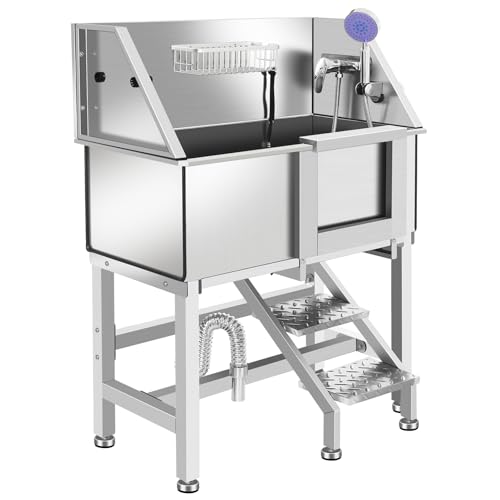
OLIPIC Stainless Steel Dog Washing Station Grooming Tub
OLIPIC pitches its station squarely at large dogs kept at home, and the title spends its words on the practical trio of stairs, drain and door rather than on electronics or extras. That emphasis reads honestly: the daily friction in dog washing is getting a heavy animal in, keeping it contained while water runs, and getting grey water away without flooding the floor. A door that closes the gap left by the stair opening addresses the escape route that open-entry tubs leave wide.
Key facts from its title
- Material: Stainless steel
- Access: Stairs, described as 34 inch R-RAMP in the title
- Door: Included, per the listing title
- Drain: Included, per the listing title
- Overall tub length: Not stated in the listing title
- Intended setting: Home, per the listing title
Strengths
- Door, stairs and drain are all named in one listing
- Ramp-style access can feel steadier for big, cautious dogs
- Professional-style build framed for domestic installation
Trade-offs
- Ramp footprint extends well beyond the tub itself
- Tub length itself is not given in the title
- No faucet detail is spelled out in the title wording
The thirty-four inch ramp figure in the title deserves careful reading. It describes the access arrangement, and a longer, gentler climb generally suits arthritic or nervous dogs better than a couple of tall steps, because the animal can keep three feet grounded while moving. You will need floor space in front of that climb, so measure the room with the ramp deployed in your mind, not just the tub rectangle taped on the floor. The professional language in the listing sits alongside a clear home framing, and the sensible interpretation is construction borrowed from salon equipment rather than a promise of salon throughput. At home, throughput rarely matters; durability of hinges, door seals and drain fittings matters far more, because a station that drips onto a garage floor every Sunday will quietly rot whatever it stands on. Put a tray or matting under the work zone, keep a towel station within arm’s reach, and treat the first few washes as training sessions with treats at the top of the ramp, so the dog learns the route before water and noise enter the picture.
Containment changes shampoo work. With a door shut, you can let a medicated shampoo sit for its full contact time without holding a slippery collar throughout, and you can step back half a pace to reach a bottle without the dog treating your movement as an invitation to leap. Rinsing a double coat still takes patience, since water must reach skin through dense fur, but standing at a comfortable height while you part the coat with your fingers beats kneeling on a bath mat. Afterward the drain does the unglamorous work, and a station that empties fully, without a stubborn puddle in one corner, dries faster and smells better between washes.
Best for: households bathing a large dog who needs a gradual walk-in route and a closable door during soaking. / Not suited for: a narrow room where a thirty-four inch access run would block the doorway or the main walking path.
Check price on Amazon — see the listing for the configuration in this size.

VEVOR Dog Washing Station 50in Stainless Grooming Tub Right Door
At fifty inches, this VEVOR station steps into the size band where a big dog can turn without scraping the sides, and its title reads like a checklist of the small fittings groomers actually touch: a PE filter board, a faucet, a showerhead and somewhere sensible to put the soap. The door is on the right, the stairs handle entry, and the whole pitch is completeness rather than any single headline mechanism.
Spec points, as listed
- Length: 50 inches
- Material: Stainless steel
- Door: Right door
- Filter: PE filter board
- Washing fittings: Faucet and showerhead
- Extras: Soap holder; stairs for access
Strengths
- Filter board tackles hair before it reaches plumbing
- Both faucet and showerhead are named in the title
- Soap holder keeps bottles out of the basin water
Trade-offs
- Right-door layout will not suit every room corner
- No powered lift or dryer appears in the listing
- Fifty inch length still demands a generous bay
Filter boards rarely get discussed, yet they decide how annoying cleanup becomes. Hair is the constant by-product of washing a dog, and a board that catches coat before it reaches the drain turns a plumbing problem into a lift-out-and-rinse chore. If you groom a shedding breed through a coat change, that difference shows up weekly. The separate showerhead matters for a different reason: a fixed faucet fills and rinses broad areas, while a hand-held head lets you chase shampoo out of armpits, groins and the dense ruff around a neck without spinning the dog around. Soap storage sounds trivial until a bottle falls into soapy water for the third time. Layout, though, is the deciding question. A right door wants approach space on the right, and the stairs need their own run, so sketch the station, the entry path and your standing position together. Groomers work from the long side, moving along the dog, so leave yourself a clear strip rather than wedging the tub between shelving units.
The title says the station supports bathing pets of all sizes, and the honest reading is that a fifty inch basin physically accommodates a wide span, from a cat-sized small dog who will use one corner to a tall breed standing diagonally. Small animals bring their own issue: they can feel exposed in a big steel box, and a non-slip mat plus a calm, quick routine helps more than any feature list. Temperature control also deserves respect at both ends of the size range, because small dogs chill quickly once wet and large thick-coated dogs overheat if the room is steamy. Work steadily, rinse thoroughly, and let the station’s height save your spine rather than rushing the wash to escape discomfort.
Best for: multi-pet homes wanting a fifty inch station whose hair filtering and washing fittings are spelled out up front. / Not suited for: buyers whose only available wall forces left-side entry, or anyone hoping for a dryer bundled into the same unit.
Check price on Amazon — compare the fittings list against your own plumbing plan.

Albott 50in Stainless Steel Dog Washing Station Left Door
Albott’s fifty inch station mirrors the size of the VEVOR above while flipping the door to the left and swapping the vocabulary toward footing: anti-slip steps headline the access story, joined by a sprayer, a faucet and a soap box. The listing also names garages and grooming spaces alongside the home, which hints at the outbuilding installations many large-dog owners end up choosing.
What the title gives us
- Length: 50 inches
- Material: Stainless steel
- Door: Left door
- Steps: Anti-slip steps
- Washing fittings: Sprayer and faucet
- Extras: Soap box; settings named include home, garage and grooming spaces
Strengths
- Anti-slip steps address the riskiest moment of entry
- Sprayer and faucet both included for rinsing control
- Listing explicitly contemplates garage installation
Trade-offs
- Left door constrains which wall the station can hug
- No filter board is mentioned in its title
- Garage use may need heating thought in cold months
Wet paws on smooth steps are where wash-day accidents begin, so a tread treatment on the climb is more than decoration. A dog who slips once on the way up may refuse the station for weeks, and rebuilding that confidence costs far more time than choosing grippy steps in the first place. Garage placement brings practical gifts — a concrete floor that forgives splashes, room to shake off outdoors afterward, space for a fan — and one recurring problem: temperature. An unheated garage in winter makes a miserable wash for a wet dog and numb hands for you, so think about water temperature at the tap and how quickly you can dry the animal once the sprayer stops. The sprayer and faucet pairing covers the two water jobs, soaking and directed rinsing, while the soap box keeps products corralled at the end of the tub rather than balanced on a wet rim. Fifty inches of stainless steel also needs a delivery plan; measure door widths and the turn into the garage before the crate arrives, because a station this size does not squeeze through gaps on optimism.
There is a social side to a fixed washing spot that portable tubs never develop. The dog learns that this corner means bath, the routine settles, and behaviour improves because nothing about the setup changes between washes. Keep leads, towels and brushes stored at the station, run the same entry sequence each time, and the process becomes boring in the best possible way. Boring is the goal. Excitement during a wash usually means somebody is slipping, escaping or shaking shampoo across the ceiling. A left-door station placed thoughtfully, with its steps giving confident footing, pushes every wash toward that calm routine.
Best for: owners planning a garage or utility installation where sure-footed steps and a left-side door match the room. / Not suited for: right-entry layouts, or a bathroom-sized indoor corner where a fifty inch steel station would dominate the floor.
Check price on Amazon — worth a look if the layout described above matches your room.

VEVOR Electric Lift Dog Washing Station 50in Grooming Tub
The second VEVOR in this line-up keeps the fifty inch stainless format and adds the one mechanism that changes who can use it: an electric lift, with a three hundred and thirty pound figure printed in the title and a right door for entry. Lifting is the task that ends home grooming for many people, not the washing itself, and a powered platform speaks directly to groomers with bad backs and owners of giant, placid dogs.
Stated details
- Length: 50 inches
- Material: Stainless steel structure
- Lift: Electric lift
- Capacity figure: 330 lbs, as printed in the listing title
- Filter: PE water filter board
- Washing fittings: Faucet and showerhead; right door
Strengths
- Electric lift removes the heaviest manual handling
- Printed capacity figure aids honest load planning
- Filter board, faucet and showerhead all included
Trade-offs
- Power near water demands careful, protected installation
- Most complex mechanism here, so most upkeep questions
- Right-door-only entry still dictates room layout
Read the capacity figure carefully and modestly. It is a number from the listing title, useful for comparing against the combined reality of tub load and animal weight, not a licence to treat the platform casually. The genuine benefit of a lift is positioning: the tub can meet the dog at a lower height for entry and then rise to the working height that suits the person washing, which varies between household members. That adjustability also helps with older dogs who manage a small step but not a full stair climb. Power brings obligations a static station never asks for. The lift needs an electrical supply near a wet area, installed with appropriate protection, plus a plan for keeping cables and controls dry, and a manual answer for what happens if power fails mid-wash with a wet dog in the basin. None of that is a reason to avoid the design; it is simply the checklist that separates a delighted owner from a frustrated one. The PE water filter board returns here, catching coat before the drain, and the faucet and showerhead pairing again covers filling and detail rinsing.
Multiple pets are named in this listing, and a lift station in a multi-dog household earns its keep through repetition. Instead of recruiting a second person for every large-dog lift, one person can run the whole wash, which means baths happen on schedule rather than when help is available. Scheduling matters for skin health in breeds prone to irritation, where regular rinsing with an appropriate shampoo forms part of ordinary care. Between animals, the filter board and basin want a rinse and wipe so the next dog does not stand in the previous dog’s grit. Build that two-minute reset into the routine and the station stays pleasant to approach, for the dogs as much as for you.
Best for: groomers or owners whose limiting factor is lifting, and who can give a powered station a properly protected supply. / Not suited for: an outdoor or outbuilding spot with no safe electrical provision, or buyers wanting the simplest possible static tub.
Check price on Amazon — see the listing for the configuration in this size.
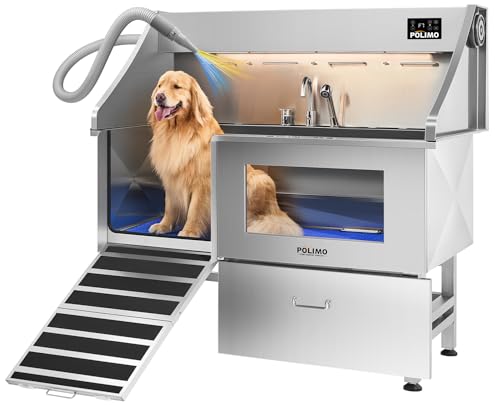
POLIMO Dog Washing Station with Dryer 304 Stainless 61in
Everything about the POLIMO runs larger: sixty-one inches of 304 stainless steel, a left ramp, a faucet, and then a set of features none of the other five stations claim — a built-in pet dryer, an LED display and a storage drawer. It is less a tub with accessories than a complete wash-and-dry appliance, aimed at large, medium and small pets and clearly expecting a permanent, generous home.
The listing in brief
- Length: 61 inches
- Material: 304 stainless steel
- Dryer: Built-in pet dryer
- Display: LED display
- Storage: Storage drawer
- Access: Left ramp; faucet included
Strengths
- Dryer built in, completing the wash in one place
- Longest basin here, with room for large dogs to stand
- Drawer storage keeps grooming kit at the station
Trade-offs
- Sixty-one inch body needs a dedicated, spacious bay
- Dryer noise may unsettle sound-sensitive animals
- Most appliance-like unit here, with display and powered parts
Drying is where thick-coated dogs defeat casual setups. A bath towel barely touches a dense undercoat, and a damp dog left to air-dry in a cool room can stay clammy for hours, which is why groomers treat forced-air drying as half the job. Folding that function into the station removes a separate dryer stand, a loose hose and one more appliance competing for floor space. The drawer sounds like a minor luxury until you picture the alternative: brushes, combs, shampoo and ear cleaner scattered across a wet worktop or living in a bucket. Contained storage at the point of use keeps the routine tidy and keeps products away from a curious dog’s mouth. The LED display presumably serves the dryer functions, though the title does not detail its readings, so resist inventing specifics; what can be said is that controls live on the unit rather than on a separate handset. Size discipline matters most of all here. Sixty-one inches plus a ramp run plus working space around three sides adds up to a small room’s worth of floor, and this station belongs in a dedicated grooming area, a large garage bay or a salon corner — not squeezed into a domestic bathroom.
Consider noise as part of the package. Dryers move air loudly, and a dog who tolerates washing may object to sustained blowing near the ears, so introductions should pair short dryer bursts with rewards before a full groom depends on it. The ramp entry on the left again fixes orientation, and the station’s scale means that decision is hard to reverse once plumbing is connected. Owners washing several large dogs, or running a small grooming service from home, will extract the most from this design, because its advantages compound with repetition: no separate dryer setup, no hunting for tools, and a basin long enough for the biggest client to stand square without curling. For a single small dog bathed monthly, the same features would be splendid overkill, and honesty about your actual workload should steer the choice.
Best for: high-volume home groomers or small salons wanting washing and drying combined in one permanent stainless station. / Not suited for: compact homes, occasional bathers, or any room where a left ramp and sixty-one inch body cannot both fit comfortably.
Check price on Amazon — compare the fittings list against your own plumbing plan.
A working routine inside a stainless grooming station
The wash itself follows a rhythm that a fixed station makes possible, and spelling that rhythm out helps explain why professionals organise their space the way they do. The dog enters dry, stands while you brush out loose coat before any water touches it, and that single habit — brushing first — keeps a surprising share of hair out of the filter and off the drain. Loose undercoat that gets wet before it gets brushed turns into felted mats against the skin, so the dry brush-out is coat care, not tidiness. Only once the worst of the shedding is in the bin does the water start, wetting from the neck backward so the head stays dry and calm longest, which most dogs appreciate.
Shampoo work goes better in sections. Lather one side fully, let your fingers reach the skin through the coat rather than scrubbing the surface hair, then move along. A station at standing height lets you use your body weight gently through your palms instead of crouching and pushing upward, and your shoulders will notice the difference by the second dog. Rinsing deserves more time than washing; residue left in a dense coat is the commonest cause of post-bath itching that owners then blame on the shampoo itself. Run the showerhead or sprayer against the lay of the coat, part the fur with your free hand, and keep going until the water over your fingers feels completely free of slipperiness. In a plumbed station that rinsing water leaves immediately, instead of the dog standing in its own grey bathwater as happens in a household tub, and that alone improves the result on white or pale coats.
Ears, eyes and drying finish the session. Keep water out of ear canals, wipe faces with a damp cloth rather than the sprayer, and check between toes where grit hides. Then the drying decision arrives: towel for short coats, forced air for anything dense, and patience either way, because a dog released damp into a cool house will roll on the nearest soft surface to finish the job itself. The station contains the mess of that final shake far better than an open bathroom, and the dog can shake freely the moment the sprayer stops, which most of them have been waiting to do since the first wetting.
Coat types change what the station must cope with
A smooth-coated dog like a typical short-haired terrier mix is the easy case: quick to wet, quick to rinse, quick to dry, and the station’s main gift is height. Double-coated breeds rewrite the workload. Their undercoat holds water like a sponge, sheds in drifts during the wash, and punishes any weakness in hair filtration, which is why the filter-board models in this guide will appeal disproportionately to owners of such dogs. Curly and corded coats bring a different demand — water must be worked in deliberately or dry pockets survive under a wet surface — and the hand-held rinsing options earn their place there. Long drop coats need the wash kept methodical so hair does not tangle while soapy, and a basin long enough for the dog to stand square, rather than turned, keeps the coat hanging straight.
Skin sensitivity cuts across all coat types. Dogs with reactive skin benefit from the thorough rinsing a plumbed station encourages, from lukewarm rather than hot water, and from a basin that is cleaned of the previous product before they step in. If two dogs in one household use different shampoos — a common arrangement where one animal has a vet-directed wash — the station should be rinsed between them as a matter of routine. None of this requires salon training. It requires the one thing a permanent station provides and a bathroom improvisation rarely does: a consistent setup where good habits are easy to repeat.
Keeping the installation sound through years of washes
Maintenance divides into the two-minute jobs and the twice-a-year jobs, and confusing them is how stations deteriorate. After every wash: lift and rinse the filter arrangement where one exists, wipe the basin, check the drain runs freely, and leave the door or entry open so the interior dries. Weekly, in a busy household: look at seals and hinges, feel for any looseness in steps or ramp fixings, and run a hand along pipework for the first beading of a slow leak. Twice a year: inspect the supply connections properly, test any electrical protection fitted for powered models, and check the floor beneath for the dark staining that betrays a long, quiet drip.
Stainless steel forgives a great deal, but it records neglect as tea-coloured marks around standing water and as rough patches where harsh scouring has broken the surface. Gentle cleaning preserves it. Abrasive pads and bleach-heavy routines do the slow damage, and they are unnecessary, because shampoo residue and dog grease yield to ordinary washing-up methods and warm water. Steps and ramps deserve the same attention as the basin; a tread surface clogged with dried shampoo and grit loses the grip that justified it. Treat the station like the plumbing fixture it is, rather than like furniture, and it will outlast several dogs.
One last planning thought belongs to households expecting change. Puppies become heavy adults, adult dogs become stiff seniors, and families acquire second dogs. A station chosen with a little headroom — in length, in entry gentleness, in the load figures printed in its title — absorbs those changes without a second purchase. That is the quiet argument for buying the entry route and the size you might need, rather than the smallest unit today’s dog can squeeze into, and it applies whichever of the six listings above ends up plumbed into your corner.
Safety, water temperature and the people around the tub
Water temperature deserves more respect than it usually gets in product discussions. Dogs cannot tell you the water has crept too warm, and their thinner-skinned areas — belly, groin, ears — register heat sooner than a human hand testing a stream does. Run the water over the inside of your wrist, keep it in the comfortable lukewarm band, and recheck during the wash, because a supply shared with a household can surge when someone elsewhere opens a cold tap. A station with both faucet and hand-held rinsing gives you a quick way to move water away from the dog while you correct the mix, rather than leaving the animal standing under a stream that has turned unpleasant.
Restraint inside the tub is a judgement call, not a default. Many stations in salon use include tether points, though the titles in this guide do not dwell on them, so plan as if you will manage the dog with presence, positioning and a hand kept near the collar. A dog who panics against a fixed tether can injure itself faster than a dog who simply steps around in a basin, so any restraint you add yourself should break away or release instantly. Children should watch from outside the wet zone, both because floors around a working station are slippery and because a large wet dog shaking or scrambling is a lot of animal in motion. The station makes washing calmer, not risk-free, and treating it with the same respect you would give any plumbed, powered workshop equipment keeps the routine safe for everyone in the room.
Noise and novelty form the last safety layer, and they are really about stress. Pumps, dryers and running water in an echoing steel basin sound bigger to a dog than to you. Introduce sounds separately from washing where you can, keep the first sessions short, and watch for the quiet signs — lip licking, yawning, a paw lifted and held — that say the dog has had enough learning for one day. A station installed at home has one huge advantage over a salon here: there is no appointment clock. You can stop mid-introduction, play in the garden, and try again tomorrow, and that patience compounds into a dog who walks up the ramp voluntarily for years.
What a station costs you besides the purchase itself
The honest budget for any pick in this guide includes more than the listing. There is plumbing work, possibly an electrical visit for the powered models, floor protection, a hair trap where the chosen design lacks filtration, and the small army of towels, brushes and bottles that a real routine consumes. There is also space, priced in a different currency: the garage bay that no longer holds a bicycle, the utility corner given over permanently. None of that argues against buying. It argues for buying once, with the full picture counted, because the households who regret a grooming station almost never regret the washing — they regret discovering the installation’s true footprint, in money or in room, after the crate was already open. Measure everything, price the plumbing, and then choose with clear eyes.
Breed size maps onto these six stations in a way worth making concrete. A forty-six inch basin handles most medium dogs with room to spare and will physically contain many large ones, but a tall, long-bodied breed standing in it may not be able to turn, which matters when you need the other side rinsed and the dog dislikes being backed up. The fifty inch models buy that turning room, and it is why they cluster in the middle of this guide: for the majority of large family dogs, fifty inches is the size where washing stops feeling like packing. Sixty-one inches enters genuinely different territory, suiting the giant breeds and professional throughput, where two smaller dogs may even be managed in sequence without the basin feeling crowded between them.
Height of the dog matters alongside length, in a way tape measures miss. A deep basin wall that contains a splashing medium dog may sit below the chest of a very tall breed, changing how much water escapes and how secure the animal feels. Conversely, a small dog in a large, deep station can feel as if it has been lowered into a well, and a raised insert or simply a calm, quick routine becomes important. None of the titles here publish basin depth figures, so that judgement has to be made from photographs on the listing and from your knowledge of your own dog’s proportions — one more reason the reviews above refuse to invent measurements the titles do not provide.
Delivery day itself deserves a sentence or two of planning, because these stations arrive as serious freight. Have the route cleared, the final bay empty, and a second pair of hands available before the crate is opened, and inspect the basin, steps and fittings while the packaging is still around you rather than a week later. Keep the documentation with your household plumbing papers, note which side the door and entry sit on for anyone helping you install, and photograph the connections before walls or panels close around them. That small archive turns any future drip, replacement part or house move from an archaeological dig into a five-minute conversation with a plumber who can see exactly what was fitted and where.
Finally, give the finished installation one honest trial before you judge it: wash the most cooperative dog you own first, note where you reached awkwardly, where water pooled, and where the dog hesitated, then adjust towel positions, bottle storage and your own stance for the second wash. Stations reward that kind of small iteration, and by the fourth or fifth bath the setup usually feels as if it had always been there.
That settling-in period is also when most owners stop noticing the station as equipment and start treating it simply as the place baths happen, which is precisely the outcome a permanent installation is bought for.
Keep a small notebook by the station for the first month and jot down anything that annoyed you, because those notes become the shopping and adjustment list that perfects the corner.
Side-by-side: the six stations on the facts that divide them
| Station | Length | Entry route | Notable extra |
|---|---|---|---|
| SGOLAN | 46 inches | Left stair | Faucet included |
| OLIPIC | Not stated in the listing title | Stairs / 34 inch R-RAMP | Door and drain named |
| VEVOR 50in Right Door | 50 inches | Stairs | PE filter board, soap holder |
| Albott | 50 inches | Anti-slip steps | Sprayer and soap box |
| VEVOR Electric Lift | 50 inches | Right door, electric lift | 330 lb figure in title, filter board |
| POLIMO | 61 inches | Left ramp | Built-in dryer, LED display, drawer |
Reading across the rows, the pattern is clear: length alone does not rank these stations. The forty-six inch SGOLAN may serve a single medium dog better than a sixty-one inch POLIMO serves a cramped room, because a station you cannot walk around is a station you will curse weekly. Entry route is the second dividing line, and it interacts with the individual dog in front of you. Steps are compact and familiar; a ramp spreads the climb; a lift removes the climb from the dog’s duties almost entirely while adding machinery to yours. The extras column, finally, is where money quietly concentrates, and each extra should have to justify itself against your actual routine — a dryer earns its place only if you truly dry, a drawer only if your kit currently lives in chaos.
How to choose a grooming tub that fits your space and your dog?
Measure the room as a working system, not a rectangle
Start with a tape measure and a piece of chalk rather than a shopping list. Mark the tub footprint, then mark the ramp or stair run, then stand where you will stand and mime washing a dog: reaching the far shoulder, bending for legs, stepping back with a towel. Rooms fail this test in predictable places — a door arc crossing the ramp, a water heater stealing the standing strip, a window sill exactly where your elbow wants to be. Check the delivery route with the same honesty, including the tightest turn between the street and the final bay, because a crated fifty inch station does not negotiate corners the way a flat-pack shelf does. Ceiling height rarely matters, but floor construction does: a filled tub, a large dog and an adult human add up to a serious point load, and a suspended timber floor in an old outbuilding deserves a sceptical look before installation day.
Match the entry route to the dog you have now
Dogs age faster than equipment wears out, so choose entry for the dog of three years from now as well as today’s. A confident young dog handles steps without thinking. A dog with stiff hips, a healing injury or simple anxiety about heights will prefer the gradual geometry of a ramp, and a genuinely heavy or immobile animal points toward the lift. Watch how your dog currently handles the car, the vet’s table and any stairs at home; reluctance in those settings predicts reluctance at the tub. Also consider your own future: if lifting a wet, wriggling forty kilos already leaves you sore, a station that removes lifting protects the whole routine’s longevity. The cheapest station is the one you can still use in five years, not the one with the shortest invoice today.
Plan water in, water out, and hair in between
Every station here assumes a supply and a drain, and the quality of that plumbing decides whether the installation feels professional or improvised. Hot and cold feed with a comfortable mixing range matters because dogs feel temperature acutely and a sudden cold blast ruins trust. Drainage needs fall, capacity and a route that will not back up when a full tub empties at once. Hair management sits between those two systems: a filter board or trap you can lift and clean in seconds will actually get cleaned, while an awkward arrangement will be postponed until the drain slows. If your chosen station’s title does not mention filtration, budget for an inline hair trap from the start. Grey water rules vary by area, and a garage installation draining anywhere other than the household system deserves a check against local requirements before pipes are cut.
Setting up a home grooming station without salon ambitions
A home station succeeds when the whole corner works, not just the tub. Put lighting above the work area that does not throw your own shadow across the dog. Keep a non-slip surface under your feet, because you will stand in splashed water even with the best technique. Store towels within one step, hang the sprayer or showerhead where it cannot fall and startle the dog, and give shampoo bottles a home that is not the tub rim. Ventilation matters more than people expect: a steamy, detergent-scented small room makes both parties keen to finish, and rushed washes leave shampoo residue that itches later. An extractor fan or an openable window quietly improves every session. Finally, run two or three practice visits with no water at all — walk up, stand, treats, walk down — so the first real bath is the fourth visit, not a debut performance.
Common mistakes when buying a dog washing station
Buying length and forgetting the approach. Owners measure the tub, celebrate that it fits, and discover the ramp needs another metre they do not have. The station and its entry are one object; measure them together, in the room, with doors opening.
Choosing a door side from a photograph. Left and right configurations look interchangeable on a screen and are anything but once plumbed against a wall. Decide from your room’s fixed features — supply position, drain position, your standing side — and only then look at pictures.
Treating plumbing as a finishing touch. A station installed before its water and waste runs are solved becomes an expensive storage shelf. Plumbers should see the space before the crate arrives, not after it is unpacked.
Skipping the training washes. Dogs introduced to a new station with immediate water, noise and restraint often decide the place is bad news permanently. Short, dry, rewarded visits first are the cheapest behaviour insurance available.
Ignoring hair until the drain slows. Coat volume surprises every first-time station owner. Establish the filter-cleaning habit from the very first wash, when it takes seconds, rather than after a blockage forces the lesson.
Final recommendation
For most home buyers, the decision resolves into three honest questions. How much room do you truly have, entry run included? How does your dog need to get in, given its size, age and temperament? And which extras will you use weekly rather than admire monthly? Answer those and the shortlist usually picks itself: the SGOLAN for compact bays, OLIPIC for ramp-and-door containment, the two fifty inch static stations for fitting-led buyers split by door side, the lift VEVOR where hoisting is the barrier, and the POLIMO where washing and drying happen often enough to justify an appliance-scale footprint. Readers planning the plumbing for a permanent bay may also want the bathing counterpart in our guide to Best Deep Hot Tubs, since the water-supply thinking overlaps more than the product names suggest.
Frequently asked questions
Can one of these stations live in a normal bathroom?
Realistically, rarely. Even the forty-six inch SGOLAN needs its stair approach, plumbing access and working room around it, and most domestic bathrooms surrender all their floor to that combination. Garages, utility rooms and dedicated grooming corners are the natural homes for equipment of this class.
Do I need a professional plumber for installation?
Unless you are genuinely confident with supply and waste work, yes. The station itself is only furniture until water arrives at the right temperature and leaves without leaking, and a plumber’s single visit costs less than repairing one hidden drip discovered months later.
How do I persuade a nervous dog to use the ramp or steps?
Slowly, and before any water appears. Let the dog explore the station dry, reward standing in the empty tub, keep sessions short, and add water only after entry looks boring. A dog who trusts the route will tolerate the wash; a dog rushed up a ramp under pressure remembers the fright. Readers furnishing the rest of a pet-friendly home sometimes browse Best Machine Made Rugs for washable floor coverings near muddy entrances, which pairs sensibly with a new bathing routine.
Is stainless steel difficult to keep clean?
It is among the easiest surfaces in a grooming space: rinse after use, wipe shampoo residue before it dries, clean the filter arrangement, and dry the basin if the room is damp. The discipline is frequency, not effort — two minutes after every wash beats an hour of scrubbing monthly.
What separates the lift model from the static stations in daily use?
Positioning. A static tub fixes the working height forever, while the electric lift lets the basin meet a dog low for entry and rise to suit whoever is washing. That flexibility helps multi-person households and anyone whose back limits lifting, at the cost of powered parts that need a protected supply. For the floor underneath a busy grooming corner, the washable options in Best Reversible Cotton Rugs are worth a look once the station itself is settled.
Choose the station your room, your plumbing and your dog can all live with, and bath day stops being an event the whole household dreads.


