Our Top Picks


What's inside
- Why gutters defeat ordinary wands, and what a curved attachment changes
- The case for staying on the ground
- Anatomy of the bend: U shapes, J shapes, and twin jets
- Telescopic reach and the physics of reaction force
- Quarter-inch quick couplers and the language of fittings
- Pressure compatibility: matching the wand to the washer
- A methodical cleaning sequence, from dry inspection to final flush
- Downspouts, elbows, and the blockages below the gutter line
- Protecting the house while dirty water does its travelling
- Safety in detail: lines, footing, weather, and fatigue
- Maintenance of gutters, and of the wand itself
- Choosing among models without a showroom
- How this guidance was assembled
- Seasonal timing and the debris calendar
- Working around roof edges, tiles, and fragile details
- Troubleshooting weak jets, leaks, and wandering heads
- Other jobs the same pole can do, and jobs it should never do
- Environmental judgement around the drip line
- Storage, transport, and keeping a long tool ready
- A final walk-through before the first cleaning day
- Comparing quotes, kits, and complete systems
- Check prices on Amazon
- Disclosure
As an Amazon Associate I earn from qualifying purchases. This post may contain affiliate links at no extra cost to you.
Why gutters defeat ordinary wands, and what a curved attachment changes
A gutter sits in one of the most awkward positions on a house: high enough to demand elevation, shallow enough to hide its contents, and open at the top so that everything it collects stays invisible from below. Leaves, seed cases, roof grit, and the fine sediment washed off shingles settle into a dense mat that holds moisture against the metal and feeds overflow during heavy rain. A standard straight lance pointed upward from a ladder can move some of that material, but the jet strikes at a shallow, glancing angle, pushing debris along the channel as often as it lifts debris out. The operator ends up relocating the mess rather than removing it.
A gutter wand solves the geometry problem with shape rather than force. The working end curves through a U or J bend, so the nozzle section hangs over the gutter’s outer lip and points downward into the channel while the operator remains below. That downward direction is the entire point. Water entering the trough from above can get beneath the matted layer, break its grip, and drive loosened material toward the downspout opening or over the side in a controlled flush. Instead of blasting blindly upward and hoping, the operator works with a jet whose direction matches the shape of the thing being cleaned.
Many designs split the output into two jets angled slightly apart, and manufacturer documentation describes this twin arrangement as a way to cover the width of a standard trough in one pass. One jet scours the bottom of the channel while the other worries at the side wall where slime and seed husks cling. The spread also reduces the need to twist the wand constantly, a small mercy that matters during a long run along a full elevation. Shoppers should understand, though, that these attachments do not create pressure. They redirect whatever the washer supplies, which is why compatibility with the machine’s pressure and flow ratings governs everything that follows.
The case for staying on the ground
Falls from ladders injure large numbers of homeowners every year, and gutter work has traditionally required exactly the posture that makes ladders dangerous: leaning, reaching sideways, and shifting position every few feet. A telescopic gutter wand changes the risk calculation by keeping both feet on the ground for most single-storey and many two-storey homes. The operator walks slowly along the wall, guiding the curved head through the trough, while gravity and the downward jets do the clearing. Removing the ladder from the routine removes the fall, the awkward carrying, and the temptation to overreach just a little farther rather than climb down and move the ladder again.
Ground-based work is not automatically safe work, and honest guidance should say so plainly. Debris flushed from a gutter falls, by definition, toward the person standing beneath it, so eye protection is essential and a brimmed hat earns its place. Wet leaves and grit landing on paths create slippery footing precisely where the operator is walking and looking upward, a combination that deserves slow movement and frequent glances down. Electrical service lines entering near roof height demand awareness before any long pole rises toward them. The wand removes the ladder hazard; it does not remove the need for attention.
There are also houses where ground-based cleaning reaches its limits. Deep overhangs, gutters tucked behind fascia boards, and rooflines broken by dormers can block a curved head or force angles that drain the jet of usefulness. Third-storey gutters stretch even long telescopic poles and magnify every handling problem described later in this guide. Recognising those limits in advance, and reserving genuinely awkward sections for professional attention, is part of using the tool well. Readers planning broader exterior work may find that a mid-range machine covers most of it, and our comparison of best 3000 psi pressure washers explains where that class is sufficient for siding, paths, and patios.
Anatomy of the bend: U shapes, J shapes, and twin jets
The U-bend is the classic form, curving a full half-circle so the outlet faces straight down. It suits gutters whose outer edge stands clear of the fascia, giving the hook room to drop into the channel without the pole pressing against the wall. The J-bend turns through a shallower arc, presenting the jets at a slight angle rather than vertically. That angle can help where roof tiles or shingles overhang the trough, because the head slides in diagonally instead of needing clearance directly above. Neither shape is universally superior; the right choice follows the architecture of the house, which is why measuring the gap between roof edge and gutter before buying beats guessing from a product photograph.
Jet configuration deserves the same scrutiny. Fixed twin nozzles are simple and durable, with nothing to adjust and nothing to clog except the orifices themselves. Some designs use a single rotating or oscillating outlet, adding mechanical complexity in exchange for a sweeping action inside the trough. Rotating elements in dirty water eventually meet grit, and grit wins arguments with small moving parts unless the design allows easy flushing and disassembly. Specifications and documentation should state orifice size and the pressure range the head is built for, because a jet sized for a modest electric machine will behave very differently on a powerful gas unit.
Material at the curved head matters more than material elsewhere on the wand. Brass fittings resist corrosion through seasons of wet storage and tolerate repeated connection cycles. Aluminium keeps weight down, which the operator’s shoulders will appreciate, but threads in softer metals wear faster when grit contaminates them. Plastic heads are light and inexpensive yet can crack when a cold morning meets an accidental knock against brickwork. Since the head is the part that disappears into the gutter and strikes hidden obstacles, durability there should outrank small savings.
Fixed curved wands versus telescopic poles with curved ends
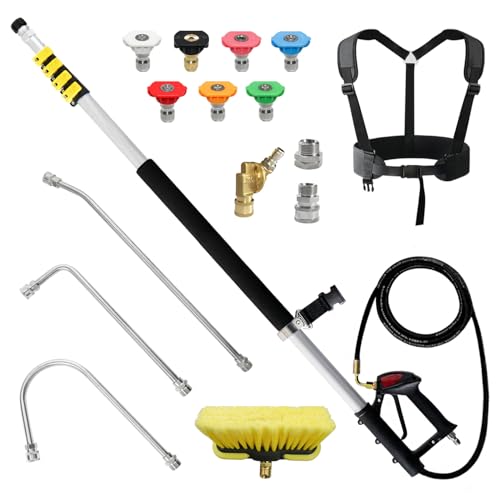
Two broad families serve this job. A fixed curved wand is a relatively short attachment that connects to a standard lance, useful when the operator does stand on a stable platform or works on low outbuildings, garages, and single-storey extensions. A telescopic pole with a curved gutter end is a complete long-reach system, extending many feet and carrying water through its own sections to the hook at the top. The first family is lighter, cheaper to store, and quicker to deploy for low work. The second family delivers the ground-based promise fully, at the cost of weight, flex, and the reaction forces explored in the next section.
Telescopic reach and the physics of reaction force
Every jet produces an equal push in the opposite direction, and a gutter wand concentrates that truth at the end of a very long lever. When twin jets fire downward into a trough, the pole pushes back and upward against the operator’s hands, and the longer the extension, the more that force translates into sway, bounce, and fatigue. At full stretch on a two-storey elevation, the head can wander inches with each pulse of the pump, making precise placement along a narrow channel genuinely difficult. This is not a defect in any particular product; it is physics, and it shapes how the tool should be selected and used.
Several strategies tame the reaction. Reducing pressure at the machine, where the washer allows adjustment, or fitting jets with larger orifices to drop working pressure, trades some scouring force for a great deal of control, and gutter debris rarely needs maximum pressure anyway. Bracing the pole against the wall or resting a section on the gutter’s edge, where the construction allows it, steadies the head. Working in shorter extended lengths, cleaning lower or nearer sections with the pole partially collapsed, keeps leverage manageable. Most importantly, short trigger bursts with pauses to reposition produce cleaner gutters than one continuous blast delivered while wrestling a flexing pole.
Pole construction determines how much flex the operator fights. Fibreglass sections are light and electrically cautious but can bow noticeably at full extension. Aluminium sections feel stiffer yet conduct electricity, a serious consideration anywhere near overhead lines, and they add weight with every added metre. Clamp design between sections matters because a collar that slips under load shortens the pole suddenly and throws the head sideways. Documentation should state the maximum extended length, the length collapsed for storage, and the pressure ceiling for the pole itself, since internal seals in telescopic sections live under the same pressure as any hose.
Quarter-inch quick couplers and the language of fittings
Most gutter attachments connect through the quarter-inch quick-connect system that dominates consumer pressure washing. A plug on the attachment snaps into a socket on the lance or pole, held by a spring-loaded collar and sealed by a small O-ring. The system’s virtue is universality: nozzles, foam applicators, surface cleaners, and gutter heads from different makers generally share the same interface, so one machine can serve many jobs. Verifying that an attachment uses this standard fitting, rather than a proprietary thread or a bayonet unique to one brand, protects the buyer from owning a capable tool that fits nothing they have.
Threads appear at the other end of many poles, where the high-pressure hose attaches, and here the vocabulary becomes less forgiving. Common threaded fittings in this market have specific diameters and thread forms that look similar in photographs while refusing to mate in person, sometimes cross-threading just convincingly enough to leak under pressure. Specifications should name the fitting standard explicitly at both ends of any wand. Adapters exist for most mismatches, yet each adapter adds a joint, a potential leak, and a small pressure loss, so a pole that connects natively to your hose and lance is worth more than a marginally longer one that needs two brass intermediaries.
Coupler hygiene decides whether the standard system stays convenient. Grit in a socket scores the plug, flattens O-rings, and eventually produces the fine misting leak that soaks an operator’s sleeve during gutter work. Rinsing fittings before connecting, storing poles with couplers capped or joined, and replacing O-rings at the first sign of flattening keeps connections crisp for years. A coupler that will not seat fully must never be forced or used partially engaged, because a fitting separating under pressure at the top of an extended pole is dangerous and, at minimum, ends the day’s work in a shower of dirty water.
Pressure compatibility: matching the wand to the washer
Every gutter attachment carries a pressure window in its specifications, a minimum below which the jets dribble uselessly and a maximum the seals and head are built to withstand. Exceeding the maximum risks splitting a plastic head, blowing a section seal, or turning a jet insert into a projectile inside the gutter. Falling below the minimum produces the opposite frustration: water that rinses but cannot lift the compacted layer where leaves have decayed into soil. Checking that window against your machine’s output should happen before purchase, not at the top of the first cleaning session.
Electric machines at the modest end of the market pair naturally with gutter wands, because the debris in a trough yields to water direction and persistence more than to extreme force. Indeed, excessive pressure aimed into a gutter can damage the gutter itself, denting thin aluminium, forcing water behind fascia boards, and scattering sealant from joints. Readers whose homes need only this gentler class of equipment can explore our guide to best 2000psi electric power washers, where the machines discussed match the pressure windows of most gutter attachments comfortably. Owners of powerful gas washers, by contrast, should plan to moderate output through jet sizing or machine adjustment before pointing it into a metal channel mounted with small brackets.
Flow deserves a mention alongside pressure. Twin jets divide the machine’s flow between two orifices, and a low-flow washer may feed both so weakly that neither stream cleans with authority. Conversely, a high-flow machine can produce a torrent that overwhelms the gutter’s capacity to carry water to the downspout, sending sheets of dirty water over both edges. The specifications for better attachments state a recommended flow range for exactly this reason. Matching all three numbers, pressure window, flow range, and fitting standard, is the unglamorous homework that separates a satisfying purchase from a return parcel.
Gutter construction sets its own limits
The gutter itself imposes limits no attachment can repeal. Half-round and box profiles present different interior shapes to a twin jet, and narrow troughs on older homes may not admit wider heads at all. Spike-and-ferrule hangers crossing the channel interrupt the wand’s travel, while hidden hanger systems leave the interior clear. Guards and mesh covers must be removed or opened before any wand work begins, and some guard designs effectively prevent wand access altogether, which their owners should discover during a dry inspection rather than mid-clean. Seam sealant, end caps, and mitred corners all resent direct close-range jets, so technique near joints should soften: greater distance, briefer bursts, and a visual check afterward for displaced sealant.
A methodical cleaning sequence, from dry inspection to final flush
Begin on a dry day with a simple look at what can be seen: downspout outlets at ground level, staining on fascia boards, and any sagging sections visible from below. Sagging matters because a wand full of water pressure will not correct a gutter that slopes the wrong way; standing water will remain standing after cleaning until the slope is repaired. Note where downspouts discharge and clear those areas so flushed water has somewhere to go. If a downspout is already blocked solid, flushing the gutter above it merely fills a pipe, so confirming that downspouts run free, with a garden hose at low pressure, is a sensible preliminary.
Scoop before you spray wherever access allows. The heaviest, wettest layer of gutter contents comes out fastest by hand or with a small scoop on low sections and outbuildings, and removing that bulk first means the wand’s water is spent on residue and flushing rather than on relocating sludge. On higher runs where scooping from the ground is impossible, expect the wand work to take longer and plan the direction of travel so debris migrates toward the downspout rather than accumulating against a corner. Working away from a downspout pushes material into an ever-growing dam; working toward it gives every loosened handful an exit.
With the pole extended only as far as the first section requires, seat the curved head in the trough and use brief trigger pulls, watching what comes over the edge and what moves along the channel. The sound changes as the head passes from a clogged stretch to a clear one, and the water running from the downspout tells the real story: dark and gritty at first, then progressively clearer. Advance slowly, overlapping each placement, and resist the urge to hurry on featureless mid-sections where hidden hangers wait to snag the head. When the head does snag, lower pressure, ease backward, and reposition rather than forcing the bend past an obstruction it cannot see.
Downspouts, elbows, and the blockages below the gutter line
A clean gutter feeding a blocked downspout is a job half finished. Elbows at the top and bottom of downspouts collect the very material the wand mobilises, and a partial obstruction there reveals itself as water spilling from joints during the flush. Gentle pressure directed into the downspout opening from the gutter can clear loose accumulations, but a solid plug of compacted leaves resists water stubbornly and may need dismantling of the lowest elbow, a straightforward task on most installations since elbows are usually screwed or slip-fitted. Ground-level cleanout points, where fitted, make this maintenance far easier and are worth adding during any downspout repair.
Underground drainage extensions complicate the picture. Where downspouts connect to buried pipes, flushing large volumes of debris-laden water into them risks creating an invisible blockage in a far less accessible place. Disconnecting the extension or fitting a leaf filter at the transition during cleaning protects the buried run. Afterward, running clear water through the whole system and watching each discharge point confirms that the path from roof to ground is genuinely open, which is, after all, the entire purpose of the exercise.
While water is flowing, inspect the gutter system as a system. Joints that drip during the flush need resealing once dry. End caps that weep, corners that overflow at modest flow, and sections that hold puddles an hour later each point to specific small repairs. A cleaning session doubles as the best inspection opportunity of the year, because the system’s behaviour under controlled water reveals faults that a dry visual check misses. Noting those faults immediately, even in a phone note, converts cleaning into genuine maintenance rather than cosmetic effort.
Protecting the house while dirty water does its travelling
Gutter flushing is a messy trade, and preparation decides where the mess lands. Move vehicles, cushions, and stored items away from the wall below the work. Cover delicate plantings near the drip line with breathable fabric, since a sudden dump of gritty water can flatten seedlings and coat foliage in sediment. Windows beneath the gutter will collect splatter regardless, so plan a rinse of glass and sills as the finishing step rather than treating it as an annoyance. Light-coloured render and painted brick show dirty streaks prominently; wetting the wall below the gutter before starting lets flushed water sheet over a wet surface instead of soaking grime into a dry, absorbent one.
Neighbours deserve a thought where houses stand close. Overspray and flushed debris do not respect boundaries, and a brief word beforehand, plus care with jet direction near the boundary section, preserves relations that outlast any cleaning day. Timing matters too: pressure washers are loud, and early weekend mornings are rarely appreciated. None of this requires elaborate planning, just the ordinary courtesy of imagining the work from the other side of the fence.
Personal cleanup closes the loop. Clothing worn under a gutter line will be wet and gritty, and footwear will carry sediment onto paths and into the house unless rinsed at the door. The pole and head need rinsing as well, inside and out, because the same grit that filled the gutter now coats every fitting. Shaking out sections, flushing the head with clean water, and letting components dry before collapsing the pole for storage prevents the internal corrosion and seized clamps that otherwise greet the operator next season.
Safety in detail: lines, footing, weather, and fatigue
Overhead electrical lines are the gravest hazard in long-pole work. Service drops often approach a house near roof height, exactly where a gutter pole operates, and contact or even close approach with a conductive pole can be lethal. Fibreglass reduces but does not abolish the risk, and wet conditions compromise every material. The rule in safety documentation is unqualified: never raise a pole where it could reach a line, and if a gutter section sits unavoidably close to the service entrance, that section belongs to professionals with appropriate equipment and training. No clean gutter justifies gambling against that rule.
Weather windows matter for more ordinary reasons. Wind pushes an extended pole around, fights the operator’s aim, and blows dirty spray back into faces and onto finished sections. Wet ground softens footing on lawns and turns sediment-slicked paving treacherous. Cold snaps make plastic components brittle and hands clumsy. A calm, dry, mild morning is not a luxury preference but a genuine control measure, and postponing in poor conditions is a decision experienced operators make without embarrassment.
Fatigue arrives differently in pole work than in ordinary washing. Shoulders and forearms carry a leveraged load continuously, and the head-heavy balance of a water-filled telescopic pole worsens as extension grows. Alternating grip positions, lowering the pole to rest between sections, and splitting a large house into two sessions all protect both the operator and the quality of the work, which deteriorates noticeably when tired arms begin skipping the far half of each trough. Harnesses and support belts offered for long poles genuinely help some users by transferring load to the hips, provided they are fitted as their documentation directs and not treated as permission to work indefinitely.
Maintenance of gutters, and of the wand itself
A cleaned gutter still needs its hardware honoured. Check that brackets and hangers hold the channel firmly, since a trough flexing under water weight opens joints and spills at seams. Confirm the slope toward each downspout by watching where residual water gathers after the flush; even a modest fall along the run keeps the channel self-draining, while a belly in the middle guarantees a permanent puddle that breeds insects and accelerates corrosion. Touch up scratched paint on metal gutters before rust establishes, and renew failed sealant at corners while surfaces are dry, following the sealant maker’s stated curing conditions.
Repetition is the cheapest gutter protection available. Two lighter cleanings a year, timed after leaf fall and after spring seed drop, prevent the deep compaction that makes the job miserable and the overflow that stains walls and undermines foundations. Houses under mature trees may need an additional pass, while homes in open settings can stretch intervals. The calendar should follow the trees, not habit. Keeping the wand accessible rather than buried behind storage clutter makes those frequent, shorter sessions realistic, which is why storage design for the tool matters more than it first appears.
The wand’s own upkeep is brief but specific. Flush clean water through the pole after every use until the jets run clear, then drain sections fully before collapsing them, since trapped water corrodes internal fittings and freezes destructively in cold storage. Inspect jet orifices against the light; a partial blockage distorts one stream of a twin pair and unbalances the head’s behaviour in the trough. A soft brush or a jet-cleaning wire of the type supplied with many washers clears debris without enlarging the orifice, whereas drilling or reaming ruins the carefully sized opening. Lubricate section clamps sparingly as documentation advises, and store the pole supported along its length rather than leaning its weight onto the curved head.
When guards, screens, and covers enter the decision
Many homeowners consider guards after one miserable cleaning too many, and a wand purchase should be weighed against that alternative honestly. Mesh and surface-tension covers reduce the volume of material entering a trough, though none eliminate maintenance entirely: fine sediment still accumulates, and covers themselves need cleaning or the water sheets over them during downpours. Guards also change access, since most designs must be lifted for a wand head to enter. For houses under heavy leaf fall, guards plus an annual wand flush can be a sensible partnership. For houses with modest debris, the wand alone, used twice a year, is simpler and leaves the gutter fully inspectable, an advantage that should not be surrendered lightly.
Choosing among models without a showroom
Since few shoppers can handle these tools before buying, specifications must carry the evaluation. Start with extended length, and measure your own gutter height rather than trusting storey counts, because ceiling heights and ground slopes vary enough to embarrass assumptions. A pole should reach the trough with a section or two in reserve, since a pole at its absolute maximum is at its flexiest and weakest. Next, confirm the pressure ceiling and recommended flow range against your washer’s published output. Then examine the head: bend shape, jet arrangement, and material, matched against your gutter profile and the clearance beneath your roof edge.
Weight at full extension deserves more respect than weight in the box. Listings may state the pole’s dry weight, but a water-filled pole carries noticeably more, held at the worst possible leverage. Collapsed length decides whether the tool stores along a garage wall or becomes a permanent trip hazard across it. Clamp style, whether lever, twist, or button-lock, affects how reliably sections hold under reaction force and how easily cold or gloved hands can adjust them. Warranty coverage on seals and section joints signals how the maker expects the tool to age.
Budget discipline in this niche follows a familiar pattern: spend on the head, the couplers, and section stiffness, and save on bundled extras of doubtful use. Our survey of best affordable pressure washers applies the same principle to the machines themselves, distinguishing savings that cost nothing in service from savings that cost years of reliability. A gutter wand is a simple tool asked to work in a hostile position, full of gritty water, at the end of a long lever. Simplicity executed in durable materials beats elaborate features executed thinly, every season of its life.
Finally, consider who else will use the tool. A pole manageable for a tall adult may be unwieldy for a shorter partner, and a household tool that only one person can operate safely is a fragile arrangement. Adjustable working length helps, as does a head light enough to control when the pole is shortened for low outbuildings. Trying the assembled pole in the garden, without water, before the return window closes is a humble but effective evaluation that specifications cannot replace.
How this guidance was assembled
Our research drew on manufacturer documentation for gutter attachments and telescopic poles, published specifications for pressure and flow compatibility, fitting standards for quarter-inch quick-connect systems, and safety guidance concerning ladder alternatives, overhead lines, and pole reaction forces. Gutter maintenance recommendations reflect established building-care practice regarding slope, sealant, hangers, and downspout drainage. Where sources differ on technique, this guide favours the approach that keeps the operator on the ground and the water pressure moderate, because the gutters themselves, thin metal held by small brackets, reward restraint. No maker influenced the criteria, and the same standards would apply to any attachment a retailer chose to stock.
Readers can verify most of what matters with a tape measure and their washer’s manual: gutter height, trough width, roof-edge clearance, machine output, and fitting type. Those five facts narrow the field more decisively than any advertising claim. A wand that fits the house, matches the machine, and connects without adapters will be used often, and a tool used often keeps a drainage system healthy almost as a side effect of its own convenience.
Seasonal timing and the debris calendar
Gutters fill on a schedule written by the surrounding landscape. Autumn delivers the obvious load of leaves, but the species around the house refine the timing: some trees drop early and cleanly, others hold foliage until the first storms strip it in a single weekend. Spring contributes seed cases, blossom, and the stringy catkins that mat together with surprising tenacity. Summer storms wash roof grit downward continuously, so a gutter that looked clear in May can carry a gritty sediment line by August, heavy enough to matter even though it never blocks the channel outright. Winter adds freeze-thaw stress to any water trapped by that sediment.
Cleaning just after the major local drop, rather than on a fixed calendar date, keeps each session shorter and prevents the deep, composted layer that forms when leaves sit wet for months. That bottom layer is the true enemy: it holds moisture against seams, feeds plant seedlings that root in the trough, and resists flushing more stubbornly than fresh material. A wand used promptly moves loose debris almost effortlessly, which is a strong argument for owning the tool rather than hiring equipment occasionally. Ready access changes behaviour, and behaviour, more than any specification, determines whether gutters stay clear.
Roof material writes part of the calendar too. Ageing asphalt shingles shed granules steadily, and those granules accumulate as a dense, heavy sediment that behaves more like wet sand than leaves. Metal roofs shed debris quickly but deliver it in sudden slides after rain. Tile roofs contribute moss fragments and the grit that collects in their valleys. Knowing what your own roof contributes helps set realistic expectations for how much material the wand must move and how often the downspout strainers need attention.
Working around roof edges, tiles, and fragile details
The junction between roof and gutter concentrates fragile elements. Drip edges, tile noses, slate corners, and the first course of shingles all sit within reach of a carelessly handled curved head, and a metal hook knocked repeatedly against brittle tile can chip edges that are expensive to replace. Moving the head along the trough rather than lifting and dropping it at each step reduces those impacts. Where the roof overhang is tight, approaching sections from a slight angle, pole offset to one side, often seats the head more gently than forcing a vertical drop from directly below.
Fascia boards and soffits behind the gutter deserve protection from the jets themselves. A twin jet aimed carelessly outward can drive water up behind the fascia or into soffit vents, introducing moisture into spaces designed to stay dry. Keeping the head fully inside the channel, jets oriented along and down rather than outward, prevents most of that misdirection. Brief bursts help again here, because the operator can observe where the first water goes before committing to a longer pull. On houses with painted timber fascia, a jet striking at close range can also lift paint that was quietly failing, revealing rather than causing the problem, but the distinction is small comfort on the day.
Satellite dishes, aerials, chimney flashings, and the cables that accompany them cluster near rooflines and complicate pole movement. Planning the walking route along each elevation before raising the pole, noting where cables cross and where a step backward might meet a garden wall, prevents the mid-job improvisations that lead to snags. A pole under pressure that snags suddenly and then releases can swing its head sharply, so a clear route is a safety feature rather than a convenience.
Troubleshooting weak jets, leaks, and wandering heads
When a gutter wand disappoints, the cause usually sits in one of four places. Weak jets point first to supply: a partially blocked orifice, a kinked hose, a clogged inlet filter on the washer, or a machine whose flow simply cannot feed two jets at the expected pressure. Clearing an orifice with a proper cleaning wire and checking each connection in sequence solves most cases. Uneven jets, one strong and one feeble, almost always mean debris in the weaker orifice, since the pair share a common feed and pressure cannot favour one side on its own.
Leaks at section joints indicate seals that have dried, flattened, or picked up grit, and they worsen under the flexing of a long pole. Draining and drying the pole, cleaning the seal seats, and renewing O-rings restores most joints. A leak at the hose connection may be nothing more dramatic than a coupler that never fully seated because sediment occupied the socket. The discipline of rinsing fittings before assembly, tedious as it sounds, prevents the majority of these interruptions.
A head that will not stay oriented in the trough usually reflects torque from the hose or pole rather than a fault in the bend. A stiff hose tries to rotate the pole toward its natural coil, and the operator ends up fighting that twist for the entire run. Laying the hose out in long, relaxed curves before starting, and rotating the pole sections so their clamps align neutrally, reduces the fight considerably. Some heads allow the bend to be indexed at different angles relative to the pole, and setting that index so the jets sit squarely in the channel while the operator’s grip feels natural is worth the minute it takes at ground level.
Knowing when the problem is not the wand
Overflow during cleaning sometimes indicts the gutter rather than the tool. A trough that spills at modest flow may be undersized for its roof area, pitched incorrectly, or served by a downspout positioned where water cannot reach it before rising. A wand can reveal these faults with admirable clarity but cannot correct them. Similarly, persistent plant growth signals that seeds and soil are arriving faster than any reasonable cleaning interval, pointing toward tree management or guards as the real remedy. Treating the wand as a diagnostic instrument as well as a cleaning tool leads to better decisions about where money should go next.
Other jobs the same pole can do, and jobs it should never do
A telescopic pole bought for gutters often earns secondary employment. With a straight nozzle or a soft brush attachment rated for pressure use, the same reach rinses high siding, clears cobwebs and wasp activity from eaves before nests establish, and washes the tops of conservatory roofs where algae films thrive. Solar panels present a more delicate case: panel makers publish their own cleaning guidance, often favouring plain water, soft tools, and no pressure at all, so their documentation governs and the pole may serve only as a hose guide rather than a pressure lance. Respecting those distinctions keeps a versatile tool from becoming an expensive mistake.
Some tasks should be refused outright. A gutter wand is not a drain rod, and forcing its bend into a downspout risks lodging the head in an elbow. It is not a roof-cleaning lance either; directing pressure upward under shingles or tiles from gutter height can drive water into the roof structure. Nor should the curved head be used at ground level for vehicles or patios, where its jets point in directions the operator does not expect. Readers setting up equipment for vehicle care are better served by the dedicated guidance in best car pressure washers for home use, where lance length, pressure, and detergent are matched to paintwork rather than to a metal trough overhead. Each attachment in a kit has a geometry it was born for, and honouring those boundaries is basic craft.
Children should not operate or assist with a pressurised pole, and the wand should be depressurised before being handed between adults. The trigger discipline that applies to any lance applies doubly to one whose business end is far from the operator’s eyes. When the job ends, releasing pressure, draining the pole, and collapsing it promptly returns a potentially hazardous lever to a harmless stored object.
Environmental judgement around the drip line
What leaves a gutter is mostly organic: leaves, seeds, grit, and the occasional abandoned nest material. Spread on a lawn or gathered into garden waste, it is harmless enough, and many gardeners regard the sediment as respectable compost material once separated from roof grit. The exceptions deserve attention. Houses with older roofing or painted surfaces may shed particles that do not belong in vegetable beds, so directing flushed material onto paths for collection is the cautious default. Standing water flushed from a long-neglected gutter can also carry mosquito larvae, a small but satisfying reason to complete the job thoroughly before breeding season.
Detergents are rarely necessary for gutter flushing, and skipping them is both simpler and kinder to planting below. Where algae staining on the gutter’s exterior is the target, products formulated for exterior surfaces, applied at low pressure and rinsed as their documentation directs, achieve more than raw pressure aimed at thin metal. Keeping chemicals out of the trough itself also protects the sealants and coatings inside it. Water, direction, and persistence accomplish the core task; chemistry is an occasional guest, not the host.
Water use stays modest when the operator works methodically, because brief, placed bursts replace the continuous running that an open hose would demand for the same result. Shutting the trigger while repositioning, already recommended for control, doubles as conservation. On properties harvesting rainwater, disconnecting the downspout diverter during cleaning prevents a slug of sediment from entering the storage tank, a detail easily forgotten and mildly annoying to remedy afterward.
Storage, transport, and keeping a long tool ready
Telescopic poles fail in storage more often than in use. Sections collapsed while wet seize as corrosion and grit cement the joints, and poles stored leaning in a corner develop a permanent set or a bent lowest section. The better routine is consistent: flush, drain, dry, collapse, and lay the pole horizontally on supports or hang it from broad hooks that cradle rather than pinch. The curved head, removed where the design allows, stores in a bucket or on a shelf where its jets cannot be knocked against masonry. Couplers capped against dust complete a routine that takes minutes and preserves the tool for years.
Transport to other properties, for those who help relatives or maintain a second home, argues for a pole whose collapsed length fits the vehicle without threading it through windows. A simple fabric sleeve or a length of drainpipe with end caps protects both the pole and the car interior from gritty residue. Labelling the pole’s pressure ceiling on a small tag near the handle is a thoughtful touch when others may connect it to unfamiliar machines, preventing the one careless pairing that splits a seal.
Keeping a few consumables with the pole, spare O-rings, a cleaning wire, a replacement jet insert where the design uses them, and a small tube of the lubricant the maker specifies, turns most field failures into two-minute repairs. The gutter job then proceeds on the day planned, in the weather window chosen, rather than being postponed by a fitting that cost almost nothing. Reliability in small tools is mostly this: preparation measured in pennies and minutes, applied consistently.
A final walk-through before the first cleaning day
Assemble the whole system at ground level first. Connect hose, pole, and head; extend each section and lock it; then run plain water at the machine’s gentlest effective setting while the head points at a driveway or a bucket. Watch every joint for misting, feel how the pole reacts when the trigger opens, and practise raising the head to gutter height against the house on a clear section before any debris is involved. That rehearsal reveals hose torque, clamp behaviour, and the pole’s balance while the stakes are nothing more than a wet driveway.
Choose the first real elevation deliberately: the side of the house with the fewest obstacles, the most forgiving planting, and a downspout you have already confirmed runs free. Complete that side fully, including the final flush and a look at the discharge, before moving on. Success on one elevation teaches the pace for the rest of the building and exposes any mismatch between pole length and gutter height while repositioning is still easy. If the head cannot seat properly on that easiest side, it will not seat anywhere, and the return window matters more than pride.
End the day by recording what you learned: which sections needed which extension, where hangers interrupted travel, which joints dripped, and how long the whole house took. Those notes, kept with the spare O-rings, turn the second cleaning into a routine rather than a fresh expedition. Within a year the task shrinks from a dreaded project to a seasonal habit of an hour or two, which is precisely the transformation a well-chosen gutter wand is supposed to deliver.
Comparing quotes, kits, and complete systems
Gutter wands are sold in three configurations that listings often blur together. The curved head alone suits owners who already possess a compatible telescopic pole or who work only on low structures with a standard lance. A complete pole-and-head system costs more but guarantees that sections, seals, and head were designed for one another, which matters when reaction forces test every joint simultaneously. Kits bundle the head with brushes, spare jets, or extra couplers; those bundles reward scrutiny, because a kit padded with attachments for jobs you will never do is not a saving, while a kit whose spares match the head’s actual wear points can be genuinely shrewd.
Reading the fine print of a listing repays the effort. Some extended lengths are quoted with the operator’s own reach silently included, inflating the figure by the height of a person. Others state the pole’s length honestly but omit the pressure ceiling, or give a ceiling that applies only when the pole is partially collapsed. Photographs can mislead about head size relative to a real gutter, so dimensions in the specifications, bend radius, head width, and jet spacing, deserve priority over imagery. A maker who publishes complete dimensions, fitting standards, and replacement part numbers is behaving like a maker who expects the tool to be kept, and that behaviour correlates with the tool actually being worth keeping.
Returns policy is part of the specification in practice, because fit against an individual house cannot be fully judged from measurements alone. A seller who allows a reasonable trial period understands the product’s nature. Testing the assembled pole dry, then with water at ground level, before committing it to the roofline respects both the seller’s terms and your own safety, and it surfaces incompatibilities while remedies are still simple.
One further comparison belongs in the decision: the wand against doing nothing differently at all. Overflow left for another season stains fascia, rots timber behind the gutter, pools against foundations, and turns paths icy where downspouts discharge across them in winter. Measured against those slow, compounding repairs, a modest pole and two afternoons a year are trivial. The tool does not need to be impressive; it needs to be present, compatible, and used. That is why this guide has weighted fit and durability above every novelty, and why the cheapest adequate wand, used faithfully, outperforms the finest system that stays in its box because assembly feels like a project in itself.
Keep that perspective in view when a listing tempts you toward the longest pole or the most elaborate head on the page. Reach you cannot control cleans nothing, pressure the gutter cannot tolerate repairs nothing, and features you will never deploy maintain nothing. The right purchase is the plain, well-made tool that matches the house standing in front of you, and it earns its cost quietly, season after season, in dry walls and clear downspouts.
Check prices on Amazon
Live listings for the shortlist in this guide are pulled from Amazon below, so prices and availability are always current at the moment you look.


Disclosure
A brief word on funding, since it shapes how this page was written. This site may receive a commission from a retailer when a reader purchases through a link published alongside guides like this one, and that commission is paid from the retailer’s side of the sale, so the reader pays nothing extra for having arrived through our pages. No manufacturer pays to be mentioned here, no brand can buy a kinder description of its fittings or its pole sections, and the criteria in this guide, bend geometry, pressure compatibility, coupler standards, and honest reach, were drawn from specifications and documentation without regard to any commercial arrangement. The commissions simply support a publication that remains free for readers to use.
Pick the wand that fits your gutters, matches your machine, and keeps your feet planted on the lawn, and the twice-yearly flush becomes the easiest maintenance habit your house ever asked of you.