What's inside
- Where to buy these picks
- Quick Picks
- How these picks were chosen
- The six picks in detail
- Side-by-side: doors, metals and stated sizes
- How do you choose a hibachi grill for home use?
- Skewer craft: getting the most from a small fire
- Where a hibachi lives when it is not lit
- Fuel buying for a firebox this small
- Teaching a beginner on a hibachi
- Wind, rain and the small-fire problem
- What to cook first when the fire is young
- Cleaning day: what each surface asks of you
- A note on smoke and neighbours
- Common mistakes
- Final recommendation
- Frequently asked questions
As an Amazon Associate I earn from qualifying purchases. This post may contain affiliate links at no extra cost to you.
As an Amazon Associate, cottageverdict.com earns from qualifying purchases.
A hibachi grill earns its place at home by doing one small job beautifully: a handful of skewers, two chicken thighs, a row of mushrooms, cooked close over real charcoal while everyone is still standing around the table talking. Shoppers hunting for the best hibachi grills for home use quickly discover that the category splits into heavy cast iron boxes built like miniature stoves and featherweight aluminum alloy trays meant to travel. This guide works through that split using only what each listing title actually states, because hibachi listings are notorious for photographs that promise accessories, dimensions and heat claims the words never confirm. Six models made the shortlist, and they differ in shape, metal, airflow hardware and how many mouths they can realistically feed on a weeknight.
Where to buy these picks
First up is a squat cast iron yakitori box with separate coal and draft doors, sized by its maker for two people and small enough to ride along on a camping trip.
MegaChef’s oval entry follows, a black cast iron portable whose listing keeps its description short and leans on shape and material rather than hardware.
The Marsh Allen 30052 brings the only stated cooking footprint in this group, a 10 by 18-inch cast iron charcoal grill aimed squarely at campers.
GIANTEX answers with hardware: a double-sided grate, an air regulating door, a fire gate and a grate lifter all named in one title.
Hortsun goes the other direction entirely, an aluminum alloy rectangular stove with wire mesh and a wooden base included for tabletop yakitori.
Closing the set, Fockety offers another aluminum alloy rectangle, this one talking about quick heating and a calligraphy-styled wire grill base.
Quick Picks
| Pick | Best for | Highlight from the listing title |
|---|---|---|
| Cast Iron Hibachi Yakitori Tabletop | Two-person skewer sessions on a patio table | Separate coal door and draft door on a 100% cast iron body |
| MegaChef Oval Cast Iron Hibachi | Campers who like an oval firebox shape | Oval cast iron construction finished in black |
| Marsh Allen 30052 Cast Iron | Anyone who plans around a known grate size | Stated 10 by 18-inch cooking footprint |
| GIANTEX Portable Hibachi Grill | Cooks who adjust heat mid-service often | Double-sided grate plus air regulating door and fire gate |
| Hortsun Japanese Hibachi Charcoal Grill | Tabletop yakitori indoors or out | Wire mesh cooking surface with a wooden base included |
| Fockety Japanese BBQ Hibachi Grill | Fast light-up for small charcoal batches | Aluminum alloy body with quick heating wire grill |
How these picks were chosen
Selection started with fuel honesty. Every model here burns charcoal according to its title, so nobody shopping this list ends up with a gas or electric unit wearing hibachi styling. From there the titles were read for three practical signals: what the firebox is made of, how air reaches the coals, and whether any dimension or serving guidance appears at all. Cast iron and aluminum alloy behave very differently once lit, so both metals are represented deliberately rather than ranked as good and bad.
Airflow hardware earned extra weight because hibachi cooking is mostly coal management. Doors, draft openings and regulating panels named in a title suggest the maker expects the cook to steer heat during service, not just light a pile and hope. Models whose titles stay silent on airflow were not excluded, but they are described below as simpler light-and-cook designs, and that silence is flagged in their spec boxes instead of being papered over with guesses borrowed from photographs.
Portability claims were also checked against material. A cast iron grill described as portable means something different for a car boot than for a backpack, and the reviews below keep that distinction plain. Finally, any title element that reads as marketplace clutter rather than product information was ignored; the Marsh Allen listing carries a string of suffix characters that say nothing about the grill, so the analysis sticks to its model number, metal, fuel and stated size.
One last filter was applied across all six: nothing in the analysis below depends on a photograph. Where a title states a door, a base, a dimension or a metal, the review uses it; where a title is silent, the review says so and treats the gap as a question for the full listing. That discipline makes this guide less breathless than most hibachi roundups, but it means every claim you read here can be traced to words the maker actually published.
The six picks in detail

Cast Iron Hibachi Yakitori Tabletop
This opening pick is the most stove-like of the six: a small charcoal unit built entirely from cast iron, shaped as a tabletop skillet grill and fitted with two separate doors, one for coal and one for draft. The maker positions it for two people, which frames everything else about it — this is a grill for a couple cooking skewers in rounds, not a family feeding station.
- Material: 100% cast iron, as stated
- Fuel: charcoal
- Doors: coal door and draft door both named
- Serving guidance: ideal for 2 people
- Cooking surface dimensions: the title gives no measurements
Strengths
- Two distinct doors let the cook add fuel and adjust draft as separate actions
- Full cast iron body suits the high, direct heat yakitori cooking demands
- Tabletop skillet format keeps the fire close to small skewered pieces
Trade-offs
- Two-person sizing caps how much cooks at once
- Cast iron makes this a lift-with-care portable, not a light one
- No grate dimensions appear in the title, so skewer length planning is guesswork
The door pairing is what separates this grill from plain open trays. A coal door means fresh charcoal can be fed in without lifting the cooking surface and scattering ash across food already grilling, while a draft door gives the cook a crude but effective throttle: open it to push heat up before a fatty cut goes on, close it down when delicate vegetables need the fire to calm. On a two-person table that rhythm matters, because skewers arrive in small waves and each wave wants a slightly different fire. The skillet framing in the title also hints at how the maker imagines it used — shallow, close, and tended constantly rather than loaded and left alone.
At home this suits a balcony or small patio where a full-size grill would dominate the space and take longer to light than the meal takes to eat. Camping is named in the title too, and cast iron travels well in a vehicle where weight is less punishing. What the listing never provides is a cooking area figure, so anyone whose yakitori skewers run long should measure their skewers against product answers elsewhere on the listing page before ordering, since the title alone cannot confirm the fit.
Think about ash behaviour with this little stove, because twin doors change the cleaning routine as much as the cooking one. Ash can be coaxed toward the coal door rather than scooped past the cooking grate, and the draft door gives a second inspection point for the grey build-up that slowly strangles a small fire. Over a long evening of two-person rounds, that matters: hibachi fires rarely die from cold, they die from their own ash. A cook who clears the bed between rounds keeps the heat honest, and this design makes clearing a door-level task instead of a full dismantling. It is an unglamorous advantage, but unglamorous advantages are the ones still working in month six.
Best for: a couple who cook yakitori in small rounds and want separate control over fuel and draft
Not suited for: a household feeding five people at once, because the maker sizes this grill for two
Check price on Amazon — the twin-door cast iron layout is the detail to weigh first.
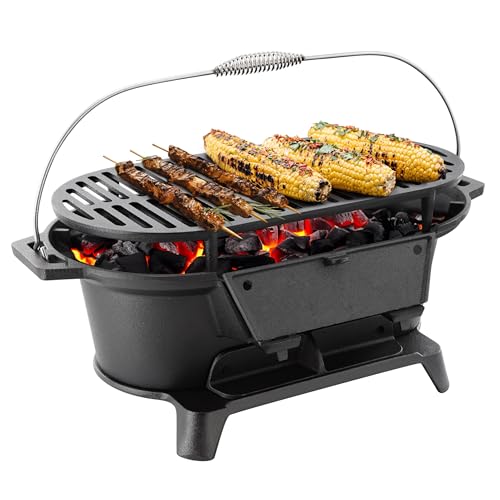
MegaChef Oval Cast Iron Hibachi
MegaChef’s entry is the quiet one of the group. The title offers an oval cast iron body in black, portability, and outdoor and camping use, then stops. There are no doors, grates, dimensions or serving counts to analyse, so this review treats the MegaChef as a shape-and-material proposition: an oval firebox in heavy metal for cooks who already know how they manage charcoal.
- Material: cast iron
- Shape: oval
- Colour: black
- Doors or draft hardware: not given in the listing
- Dimensions: none stated in the listing
Strengths
- Oval firebox gives an elongated cooking zone in a compact footprint
- Cast iron construction matches the rest of the traditional end of this list
- Black finish and simple form keep the design uncluttered
Trade-offs
- Title names no airflow hardware, so heat control reads as manual coal work
- No dimensions are published in the title for table planning
- No serving guidance appears, leaving capacity to the buyer’s judgement
An oval firebox changes how food arranges itself over the coals. Long items — skewers, asparagus spears, strips of pepper — can lie along the length of the oval while smaller pieces cluster at the narrower ends where heat usually softens. That geometry is the real argument for this MegaChef, and it is a legitimate one for yakitori-style cooking where most pieces are elongated anyway. The cast iron body should hold a coal bed steadily once it is hot, rewarding cooks who light early and cook in sequence rather than chasing flare-ups.
The trade is information. Rival listings on this page name their doors, lifters and included bases; this one does not, which may mean a simpler product or simply a terser title. Either way, a buyer comparing on stated facts alone should treat the MegaChef as the minimalist option and check the full listing for grate style and measurements before committing. For a camper who wants cast iron without accessory clutter, that minimalism could be exactly the appeal — fewer parts to lose in a dark campsite.
Campsite manners are where an oval iron box quietly earns friends. It throws no sparks of its own beyond what the charcoal gives, it sits low and stable on uneven ground, and its simple silhouette reads as cookware rather than machinery, which suits sites where people cook close together. The unknown dimensions cut both ways here: the grill is plainly compact in intent, yet a buyer packing a specific storage box cannot verify the fit from the title. Treat that as a pre-purchase errand, not a flaw in the firebox itself, and measure the intended shelf or crate against the full listing before the first trip depends on it.
Best for: campers who want an oval cast iron firebox and prefer managing coals by hand
Not suited for: shoppers who need confirmed dimensions or named airflow doors before buying, since this title provides neither
Check price on Amazon — start with the oval shape and decide if that geometry fits your skewers.

Marsh Allen 30052 Cast Iron
Marsh Allen’s 30052 is the only grill in this six whose title commits to a number: a cooking footprint of 10 by 18 inches. That single measurement does a lot of work. It tells a buyer exactly how the grill sits on a picnic table, how many skewers lie side by side, and whether it fits the storage shelf back home. The body is cast iron, the fuel is charcoal, and the stated destination is camping.
- Model: 30052
- Material: cast iron
- Fuel: charcoal
- Stated size: 10 by 18 inches
- Airflow doors: the title names none
Strengths
- Published 10 by 18-inch size removes the guesswork rivals leave behind
- Cast iron body in a classic hibachi format
- Model number makes cross-checking parts and listings straightforward
Trade-offs
- No draft or coal door is named, unlike the two-door opener on this list
- The title carries marketplace suffix clutter that adds no product information
- Rectangular footprint is larger than the mini tabletop options here
Eighteen inches of length is a genuinely useful skewer dimension. Standard yakitori skewers can rest across the ten-inch width with their handles clear of the coals, and the length allows a working arrangement: fresh skewers over the hottest stretch, resting skewers toward an end. Ten inches of width keeps the whole fire shallow, which suits charcoal economy — a thin, even bed rather than a deep pile. For camping, where charcoal is carried in and ash is carried out, that shallow-bed efficiency is a practical virtue the dimensions quietly reveal.
Nothing in the title describes how air reaches that fire, so the honest reading is a conventional open hibachi arrangement where the cook manages heat by moving food and redistributing coals. Experienced hibachi cooks do exactly that without complaint, but a beginner choosing between this and the door-equipped models should understand the difference: the Marsh Allen trades adjustment hardware for a known size and a long-established model identity. Its title also ends in a jumble of characters that belong to marketplace bookkeeping, not the product, and they are disregarded throughout this guide.
There is a budgeting angle to a published footprint that rarely gets mentioned. Knowing the fire is 10 by 18 inches tells you how much charcoal a session consumes — a shallow bed across that area is a modest handful, not half a bag — and how many skewers a round holds, which in turn tells you how much food to buy. Hibachi economics reward that precision, because the format’s charm is cooking small amounts beautifully rather than grilling a week’s protein in one sitting. The 30052’s stated size lets a household plan a whole evening, fuel and food both, before a single match is struck.
Best for: campers and patio cooks who plan around an exact 10 by 18-inch footprint
Not suited for: beginners who want a named draft door to steer heat, because this title names none
Check price on Amazon — the published footprint is its strongest card; measure your table against it.

GIANTEX Portable Hibachi Grill
GIANTEX loads its title with working parts: a double-sided grate, an air regulating door, a fire gate and a grate lifter, all on a small cast iron charcoal body pitched at picnics, camping and backyard barbecue cooking. Where the MegaChef asks you to trust shape and metal, this one asks you to trust its toolbox. The question it raises is whether that hardware matches how you actually cook.
- Material: cast iron
- Fuel: charcoal
- Grate: double-sided
- Hardware: air regulating door, fire gate and grate lifter
- Dimensions: none stated in the listing
Strengths
- Grate lifter lets the cook raise the cooking surface without improvised tools
- Air regulating door gives a stated means of steering the fire
- Double-sided grate offers two cooking faces in one component
Trade-offs
- More hardware means more parts to clean and keep track of outdoors
- No dimensions appear in the title despite the detailed feature list
- Serving capacity is never quantified by the maker
The grate lifter deserves first attention because it solves the most awkward moment in hibachi cooking: the coals need attention halfway through a round of food. Lifting a hot, loaded grate with tongs or a fork is how skewers end up in the dirt. A dedicated lifter, named right in the title, turns that moment into a planned move. Pair it with the air regulating door and the cooking style becomes deliberate — lift, adjust the fire or the draft, settle the grate, keep cooking. The fire gate adds a second route into the coal bed, so refuelling does not always require the full lift either.
A double-sided grate usually means one face suits smaller pieces and the other handles larger items, though this title does not specify what distinguishes the two sides, so that reading stays a question for the full listing rather than a claim here. Backyard cooks will likely use this grill differently from campers: at home the hardware encourages experimentation, while on a picnic the lifter and gate simply make a small fire easier to run politely around other people’s food. Either way, the absence of dimensions is the gap to close before ordering.
Extra hardware changes the social shape of a hibachi evening in a way worth picturing. With a lifter and gates, one person becomes the fire-keeper, adjusting and refuelling while everyone else keeps eating — a small division of labour that keeps rounds flowing. Without them, adjustments pause the table. Neither arrangement is better in the abstract, but hosts who entertain while they cook should notice that this GIANTEX is designed around a dedicated operator. Solo cooks and couples will feel the benefit differently: for them the lifter is mostly about safety and clean hands at the exact moment the grate is hottest and heaviest with food.
Best for: hands-on cooks who refuel and adjust mid-cook and want the lifter and doors to do it cleanly
Not suited for: minimalists who dislike loose accessories, since the lifter and multi-part grate need storing and washing
Check price on Amazon — count the hardware against your patience for washing up afterwards.
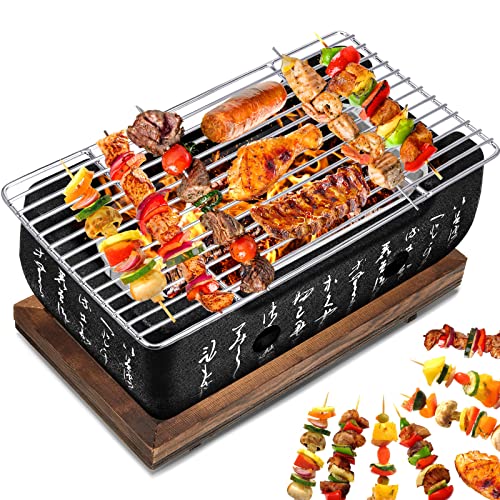
Hortsun Japanese Hibachi Charcoal Grill
Hortsun breaks the cast iron pattern. Its rectangular stove body is aluminum alloy, the cooking surface is wire mesh, and a wooden base is included in the box, with the title explicitly blessing both indoor and outdoor tabletop use. That combination describes a different social object: a light grill that sits in the middle of a dining table on its wooden stand while people cook their own skewers as they eat.
- Material: aluminum alloy
- Style: rectangular
- Cooking surface: wire mesh
- Included: wooden base
- Grill dimensions: not given in the listing
Strengths
- Wooden base is included, protecting the table the grill sits on
- Aluminum alloy keeps the stove light enough to bring to the table easily
- Wire mesh suits small yakitori pieces that might slip through wide bars
Trade-offs
- Mesh surfaces demand more scrubbing than bar grates after sugary marinades
- Aluminum alloy will not hold heat like the cast iron models here
- Indoor use still means live charcoal, so ventilation remains the cook’s responsibility
The wooden base is the most thoughtful inclusion in this whole group, because tabletop hibachi has an obvious problem: a metal box full of charcoal gets hot underneath. A purpose-made base answers that directly and signals the maker designed this grill for the table-first style of Japanese barbecue, where the cooking happens within everyone’s reach. Wire mesh supports that style too. Small pieces — chicken skin, mushroom slices, quail eggs on skewers — sit on mesh without the balancing act that wide-spaced bars demand, and the mesh pattern marks food with a fine crosshatch rather than heavy sear lines.
Choosing aluminum alloy is choosing responsiveness over reserves. A lighter metal body heats quickly and cools sooner after the last skewer, which suits a weeknight table where nobody wants to guard a hot cast iron box for an hour afterwards. The title’s indoor mention should be read carefully: it describes where the maker positions the stove, not a promise about smoke, and any household using charcoal inside needs serious ventilation. For outdoor tables the same lightness makes this the easiest of the six to carry from kitchen to garden.
Marinade management deserves a paragraph of its own on a mesh surface. Fine wire mesh and sticky glazes negotiate badly unless the cook oils the mesh while it heats and keeps sugary sauces for the final minute. The reward for that discipline is texture: mesh supports delicate pieces — a row of shishito peppers, slivers of squid, enoki bundles — that would sag or slip on widely spaced bars. Households whose yakitori tastes run delicate will get more from this Hortsun than from any bar-grated rival here, provided they accept the slower, soak-and-scrub wash that mesh demands after the meal.
Best for: households that cook yakitori at the table and want the protective wooden base included
Not suited for: cooks who rely on heavy heat retention for thick cuts, since an aluminum alloy body sheds heat faster than cast iron
Check price on Amazon — picture it on your own table, base and all, before choosing.

Fockety Japanese BBQ Hibachi Grill
Fockety closes the list with a second aluminum alloy rectangle, this one emphasising quick heating and a calligraphy-styled wire grill, again burning charcoal and framed for yakitori. Its title runs long and ends mid-phrase, which limits how much can be verified from it, but the core proposition is clear enough: a light, fast-lighting portable stove in the Japanese barbecue format.
- Material: aluminum alloy
- Fuel: charcoal
- Shape: rectangle
- Claimed trait: quick heating wire grill
- Included accessories: none stated in the listing title
Strengths
- Quick heating is the maker’s headline claim, suiting spontaneous small meals
- Aluminum alloy body keeps the stove portable between home and park
- Rectangular wire grill format matches skewer-based cooking
Trade-offs
- Title names no wooden base or stand, unlike the other tabletop option here
- The listing title trails off unfinished, leaving some details unverifiable from it
- No size appears anywhere in the title
Quick heating, as the listing claims it, is really a claim about the whole system: a light alloy body and a wire grill over a modest charcoal load will be cooking-ready sooner than a thick cast iron box that must soak up heat first. For the way hibachi actually gets used at home — a sudden decision, a small pile of skewers, dinner in half an hour — that speed has genuine value. The calligraphy element appears to describe the styling of the wire grill or base, a decorative touch that does not change the cooking but does change whether the stove looks at home on a set table.
The honest caveats are about absence. There is no stated base, so a buyer planning tabletop use should confirm from the full listing what the stove stands on, and no dimensions are given, so skewer fit cannot be checked from the title. Against the Hortsun, which bundles its base and says so, the Fockety asks a few more questions of its buyer. Against the cast iron trio it offers the opposite temperament entirely: light, quick and simple, for cooks who treat hibachi as an impulse rather than a ritual.
Decorative styling on a grill is easy to dismiss until the grill lives on a dining table, where it is looked at for an hour at close range. The calligraphy element on this Fockety, whatever its exact placement, signals a maker thinking about the object as tableware, not just hardware. That has a practical shadow: styled wire and light alloy reward gentle cleaning tools, not the wire brush violence that cast iron shrugs off. Buyers who enjoy objects that look considered on the table will forgive that care; buyers who clean everything with maximum aggression should look at the iron end of this list instead.
Best for: spontaneous cooks who value a fast light-up and a light alloy body for small skewer meals
Not suited for: tabletop hosts who need an included protective base confirmed in writing, because this title never mentions one
Check price on Amazon — its speed claim is the headline; check the stand arrangement on the listing.
Side-by-side: doors, metals and stated sizes
| Model | Body and fuel | Airflow and access | What the title leaves open |
|---|---|---|---|
| Cast Iron Hibachi Yakitori Tabletop | Cast iron, charcoal | Coal door plus separate draft door | Cooking area dimensions |
| MegaChef Oval Cast Iron Hibachi | Cast iron, charcoal | No door named | Dimensions and serving count |
| Marsh Allen 30052 Cast Iron | Cast iron, charcoal | No door named | Airflow hardware of any kind |
| GIANTEX Portable Hibachi Grill | Cast iron, charcoal | Regulating door, fire gate, lifter | Dimensions and serving count |
| Hortsun Japanese Hibachi Charcoal Grill | Aluminum alloy, charcoal | Mesh top, wooden base included | Overall dimensions |
| Fockety Japanese BBQ Hibachi Grill | Aluminum alloy, charcoal | Wire grill, quick heating claim | Base arrangement and size |
Read across the rows and the pattern of this category shows itself: metal and doors are stated proudly, dimensions mostly are not. Shoppers weighing a very different tabletop format can compare notes in the guide to full-size kettle cooking, although the closest sibling read here covers tabletop grilling in the Korean style, where pans and charcoal boxes share the same table. Best Korean BBQ Grills for Home
How do you choose a hibachi grill for home use?
Which metal suits the way you cook?
Cast iron rewards patience. It takes longer to come up to temperature, then holds a steady bed that forgives a distracted cook chatting through a round of skewers. Three of the six picks here use it, and all three are described as portable in the vehicle sense — you carry them gladly from car boot to picnic table, less gladly in a rucksack. If your hibachi life happens on one patio, that weight is a fair trade for stability, and the metal shrugs off the thermal shock of a breezy evening better than thin alternatives.
Aluminum alloy rewards spontaneity. The two alloy picks light fast, cook responsively and cool down sooner, which changes the social contract of the meal: the grill can join the table late and leave it early. The compromise is heat reserve. A thick piece of meat dropped onto a light grill drags the surface temperature down further, so alloy models favour the thin, small, quick pieces that yakitori is built on anyway. Match metal to menu and the choice mostly makes itself.
How much airflow control do you actually want?
Look at the doors. The opener on this list separates coal access from draft control, the GIANTEX adds a regulating door and fire gate, and the other four titles name no doors at all. Doors do not make a grill better in the abstract; they make heat adjustable without touching the food. If you cook mixed rounds — fatty chicken skin followed by delicate prawns — that adjustability prevents the second round suffering for the first round’s fire.
Cooks who work in a single style often prefer the doorless designs, because an open hibachi bed can be managed by raking coals to one side and sliding food across the gradient. It is a skill worth learning either way. What matters is choosing honestly: a beginner who buys a doorless grill expecting push-button heat control will blame the grill for a mismatch the titles actually disclosed.
What size fire can your table and household support?
Only one title here publishes dimensions, the 10 by 18-inch Marsh Allen, and only one publishes a headcount, the two-person cast iron opener. Everyone else leaves capacity unstated, which makes your own arithmetic important. Count skewers per round, not people per meal: a hibachi feeds a crowd happily across six rounds, but it feeds four hungry people badly if everyone expects a full plate simultaneously. Table size matters just as much — the grill, its base or stand, plates of raw food and drinks all compete for the same surface.
Households with small children or wobbly patio tables should weight stability over capacity. A low, heavy cast iron box resists knocks; a light alloy stove on a wooden base needs a level, unhurried table. Neither is wrong, but the room decides. Measure the table, count the regulars at it, and let those two numbers narrow this list faster than any feature comparison will.
Once the hibachi itself is chosen, many households start eyeing a larger companion for weekend cooking, and the two-burner format is the usual step up from tabletop charcoal. Best Two Burner Grills
Skewer craft: getting the most from a small fire
Yakitori technique adapts beautifully to home hibachi because the format was always small-batch. Cut pieces uniformly — thigh meat in similar-sized chunks, negi in matching lengths — so a skewer finishes evenly over a shallow bed. Salt-led seasoning suits the format; sugary tare glazes belong on at the very end, brushed over nearly finished skewers, because sugar scorches fast over charcoal that sits inches away. Keep one stretch of the grill emptier than the rest as a resting zone, and rotate skewers a quarter turn at a time rather than flipping them repeatedly.
Charcoal arrangement is the other half of the craft. A single even layer, fully ashed over before food appears, beats a heaped pile that is still flaming at the edges. Binchotan-style charcoal burns hotter and cleaner but lights slowly; ordinary lump charcoal lights faster and suits weeknight timing. Whichever fuel a household keeps, the hibachi rewards the cook who lights early, waits for the grey ash, and only then starts threading the evening’s first round onto skewers.
Where a hibachi lives when it is not lit
Storage quietly decides how often a small grill gets used. Cast iron models want to be stored dry and lightly oiled, because a damp garage will freckle them with rust between weekends; the alloy stoves forgive a more casual shelf but their wire mesh grills need a proper scrub before storage or old marinade flavours the next meal. Ash disposal deserves a routine too — fully cold ash, a metal container, and never a same-night trip to a plastic bin.
A hibachi kept near the table it serves gets used three times as often as one buried behind bicycles. If space allows, give the grill a single home: a low shelf with its charcoal, tongs and skewers together, so lighting up is a five-minute decision rather than an expedition. That convenience, more than any door or grate, is what turns a purchase into a habit.
Fuel buying for a firebox this small
Charcoal choice alters a hibachi more than any accessory. Lump charcoal varies by bag — mixed sizes, some dust — and a small firebox feels that variance keenly, so many home cooks sift the bag and reserve the even, fist-sized pieces for the grill while the crumbs go to a chimney starter or a fire pit. Uniform pieces make a uniform bed, and a uniform bed is what lets a cook judge doneness by position rather than by luck.
Quantity discipline helps too. A hibachi session rarely needs more than a modest chimney of charcoal, and lighting a second small batch midway beats starting with a mountain that must burn down before delicate food can approach it. Keep the bag somewhere dry and near the grill’s home; charcoal that has absorbed a damp week lights reluctantly and burns sulkily, and the cook ends up blaming a perfectly good grill for its fuel’s bad week.
Teaching a beginner on a hibachi
A hibachi is one of the kindest grills to learn on because everything is visible and close. There is no lid hiding mistakes and no dial pretending to be knowledge; the beginner watches colour change, hears fat hit coals, and learns the geography of a fire by sliding a skewer two inches sideways. Start a learner with forgiving pieces — chicken thigh, mushrooms, peppers — and let them run one round while you watch, rather than hovering with corrections.
The format also teaches restraint. Small fires punish overloading instantly and reward patience obviously, lessons that transfer to every larger grill afterwards. Households bringing a teenager or a nervous partner into outdoor cooking could do worse than start them here, on whichever of these six fits the table, with a bowl of salt, a pair of tongs and a round of skewers that cannot really go wrong.
Wind, rain and the small-fire problem
A hibachi’s fire is small enough for weather to bully. A gusty patio strips heat from the bed, pushes flames sideways and burns one end of the coals faster than the other, so placement matters more than equipment: a corner sheltered by a wall, the grill’s long side angled away from the prevailing breeze, and a cook who rotates skewers more often on windy nights. Several designs here, with their doors and gates, at least give the cook a way to shield or feed a struggling fire without lifting everything apart.
Light rain ends most hibachi evenings, and it should — water, hot iron and bare feet are poor company — but a passing shower need not end the meal if the grill lives under a porch edge and the food moves indoors in rounds. What weather should never do is rush the cook. The most common hibachi failure on a breezy evening is not equipment at all; it is a host who, feeling the night cooling, overloads the bed and smokes out the table. Keep rounds small and the fire will outlast the weather.
What to cook first when the fire is young
Sequencing is the hibachi cook’s quiet skill. The youngest, fiercest fire suits foods that want a hard, fast sear and forgive intensity: salted chicken skin, prawns in their shells, thick mushroom caps. As the bed settles into its steady middle age, the main rounds land — thigh skewers, pork belly, peppers, onions — in the order the table wants to eat them. Delicate items, anything glazed, anything that cooks in a minute, belongs to the fire’s calm later phase.
Dessert over the embers is the tradition nobody regrets adopting: skewered fruit, a few marshmallows for the unashamed, or simply bread crisped at the edge of the coals while the grill cools. Planning a sequence like this also solves the pacing problem hosts worry about, because the meal acquires courses naturally. Write the order on the back of the shopping list, light the fire early, and let the coals conduct the evening.
Cleaning day: what each surface asks of you
Post-meal care splits this list by material more sharply than cooking does. Cast iron grates and bodies want heat, a stiff brush and dryness; soak them and they repay you in rust. The iron picks here will tolerate a vigorous scrape while still warm, then a wipe and a dry shelf. Their doors and gates add hinges and edges where ash packs in, so a small brush or an old chopstick for the corners is worth keeping with the grill’s kit.
Wire mesh and alloy ask for the opposite temperament. Mesh rewards a soak in hot soapy water while the table is being cleared, then a patient pass with a soft brush; left overnight, glaze sets like varnish. Alloy bodies should cool before washing, and abrasive pads will scar the finish that makes the lighter grills pleasant to look at. None of this is difficult, but it is different, and a household that hates soaking anything should weigh that honestly against the mesh models’ undoubted charm with delicate food.
A note on smoke and neighbours
Charcoal smoke is part of the pleasure at your own table and occasionally a negotiation at the fence line. Small fires help: a hibachi bed produces a fraction of the smoke of a large grill, most of it in the first minutes after lighting and whenever fat hits fresh coals. Lighting early, before guests or neighbours settle outside, and keeping the bed settled rather than flaming keeps the plume modest. Fatty rounds are the smoky ones, so sequencing them mid-meal, once the fire is calm, is both better cooking and better diplomacy.
Apartment balconies raise the stakes, and rules vary by building in ways no product title can answer. Check the building’s position on charcoal before choosing from this list at all; where charcoal is out, none of these six is the right purchase, whatever its charms. Where it is allowed, the compact end of this group, lit considerately and cooked on in small rounds, is about as neighbourly as live-fire cooking gets.
Common mistakes
Buying by photograph instead of by title
Listing photographs routinely show flames, food and accessories arranged for appetite, not accuracy. One title in this very group trails off mid-sentence and another carries bookkeeping clutter, which shows how little editorial care these pages get. The defence is to shop from the stated facts — metal, fuel, doors, dimensions — and treat anything visible only in a picture as unconfirmed until the listing text backs it up.
Expecting a hibachi to feed a party in one round
A tabletop fire cooks in waves. Hosts who load every skewer at once crowd the bed, drop the temperature and end up steaming food over dying coals. Plan the meal as rounds, season each round as it lands, and let guests eat the way the grill cooks. The two-person sizing on the opening pick is not a limitation to apologise for; it is the honest arithmetic of the format.
Ignoring what the grill stands on
A hibachi concentrates serious heat in a small box, and tabletops — wooden, glass-topped, resin — scar accordingly. One pick here includes a wooden base for exactly this reason; the others leave the question open. Improvising with a ceramic tile or a dedicated stand is not optional decoration, it is part of the purchase, and it should be settled before the first lighting, not after the first scorch mark.
Letting sugary marinades meet fresh coals
Sugar-heavy marinades drip, flare and coat a wire mesh in cement-like residue. The fix is sequencing: cook marinated pieces over a settled, ashed bed, add glazes late, and keep a small bowl of water nearby for the occasional flare. Mesh-topped models especially reward this discipline, because their fine surface clogs faster than bars and punishes neglect at washing-up time.
Storing cast iron damp after a camping trip
The drive home is where cast iron hibachis quietly rust. Ash holds moisture against the metal, and a sealed car boot finishes the job. Empty the ash once it is cold, wipe the interior dry, and give the iron a whisper of oil before the lid or cover goes on. Ten minutes of care after each trip is the difference between a grill that seasons beautifully and one that flakes.
Treating the first lighting as the real test
New cast iron smokes, new coatings smell, and a first fire in any of these grills is partly a burn-in whether the title mentions one or not. Judging a hibachi by its maiden session is like judging a pan by its first egg. Run one hot, empty or nearly empty fire, let the metal and your own handling settle in, and only then invite an audience. Several disappointed reviews of perfectly decent small grills trace back to a first-night verdict that a second session would have reversed.
Hosts who graduate from tabletop fires to dedicated patio appliances often ask about radiant-heat models next, and the infrared category is where that curiosity usually lands. Best Infrared Patio Grills
Final recommendation
For most households the decision narrows to temperament. Choose the two-door cast iron opener if you cook for two and enjoy steering a fire; choose the GIANTEX if you refuel mid-meal and want a lifter and gates to make that tidy. The Marsh Allen is the planner’s pick, the only one whose footprint you can measure your table against today, while the MegaChef suits campers who trust an oval iron box and their own coal craft.
At the lighter end, the Hortsun is the most complete tabletop proposition because its wooden base is actually included and named, and the Fockety is the impulse option — light, quick to heat by its maker’s claim, and simple. None of the six is a mistake in the abstract. The only real error is buying a grill whose stated facts describe a different evening than the one you plan to have.
And if the choice still feels finely balanced, remember how these evenings actually unfold: nobody at the table will ask which door configuration you bought. They will remember whether the fire was ready when the first skewers were, whether the grill sat steady on the table, and whether the cook looked relaxed. Choose the model whose stated facts protect those three things in your household, and the rest of the specification sheet fades into the background where it belongs.
One practical tiebreaker if two models still stand: pick the grill whose unknowns bother you least. Every title here leaves something unstated, and ownership is mostly living with the gap you chose — an unmeasured footprint, an unnamed door, an unlisted base. The cooks who love their hibachis are rarely the ones who bought the most features; they are the ones whose grill’s stated facts matched their table, their household and their patience from the very first evening.
Frequently asked questions
Can a hibachi grill replace a full-size barbecue?
For skewers, small cuts, vegetables and seafood, yes — that is precisely its home ground. For large joints, whole chickens or feeding eight people at once, no; the firebox is simply too small. Most owners keep the hibachi for weeknight and tabletop cooking and something larger for events, and find the small grill gets used more often.
Is cast iron or aluminum alloy better for a first hibachi?
Cast iron is more forgiving once lit because its heat stays steady, but it is heavier and needs dry, oiled storage. Aluminum alloy lights and cools faster and suits spontaneous meals, though its temperature dips more when food lands. A first-time buyer who cooks planned meals usually settles happier with iron; an improviser usually prefers alloy.
What charcoal works best in these grills?
Lump charcoal is the practical default: it lights reasonably fast, burns hot and leaves little ash in a small firebox. Premium binchotan-style charcoal burns longer and cleaner for long yakitori sessions but needs patience to light. Briquettes can work in the larger iron models, though their ash output is heavy for a small box. Avoid self-lighting charcoal near food you care about; its lighting fluid flavours the first round.
Can the tabletop models really be used indoors?
One listing here explicitly positions its stove for indoor and outdoor tabletop use, but burning charcoal indoors always demands strong ventilation, because charcoal produces carbon monoxide regardless of the grill around it. Many households use these grills on a balcony, by an open door or under a powerful extractor. The maker’s positioning is a starting point, not a substitute for ventilation judgement.
How do I know what size to buy when titles omit dimensions?
Only one pick in this group publishes its footprint, so for the others, check the full listing’s specification section and, failing that, judge by serving guidance and format: two-person and mini tabletop models serve couples in rounds, while larger iron boxes handle family skewer nights. When in doubt, favour the grill whose stated facts answer your question over a rival whose facts must be guessed.
How long does a hibachi take to be ready to cook on?
Most small charcoal loads are ready once the coals have ashed over, which for lump charcoal in a compact firebox is typically a matter of patience rather than equipment — light early, then thread skewers while you wait. Light alloy models feel ready sooner because their bodies hold less heat; heavy iron takes a little longer to settle but then holds its temperature through several rounds without fresh fuel.
Do I need special skewers for a hibachi?
Flat metal skewers are the workhorse choice: they stop pieces spinning when you turn them, survive the heat indefinitely and wash clean. Bamboo skewers work too and suit big gatherings, but they want a soak before use and they char at the exposed ends over a fierce bed. Whichever you keep, length matters more than material — the handle end must clear the firebox edge, which is another reason the one published footprint in this group is so useful when planning.
However the coals settle on your table, may the first skewer off your new hibachi be the one that turns a Tuesday into an occasion.


