What's inside
- Where to buy these six electric grills
- Quick picks at a glance
- How these picks were chosen
- The six grills, reviewed one by one
- Side-by-side: the six electric grills compared
- How do you choose the right outdoor electric grill?
- Outlets, cords and the electrical reality of outdoor cooking
- Cleaning and storage once the season turns
- A season with an electric grill, from first cookout to last
- Which of the six suits which household?
- Weather, shelter and where an electric grill should stand
- What wattage can and cannot tell you
- Accessories and habits that change the result
- Planning a full menu on each design
- Common mistakes when buying an electric grill
- A note on noise, neighbours and shared spaces
- Final recommendation
- Frequently asked questions
As an Amazon Associate I earn from qualifying purchases. This post may contain affiliate links at no extra cost to you.
As an Amazon Associate, cottageverdict.com earns from qualifying purchases.
Balcony rules, lease clauses and a landlord who can smell charcoal from two floors away are the usual reasons a household starts hunting for the best outdoor electric grills. The appeal is straightforward: plug into a wall outlet, cook outside, and skip fuel tanks, charcoal ash and open flame altogether. The hard part is that electric models differ sharply in cooking area, wattage, whether a stand is included or removable, and whether the design suits a tabletop, a small patio corner or a full cookout gathering. A compact single-zone grill that delights a couple grilling peppers for two can feel cramped the first time eight burgers need to land at once, while a wide dual-zone machine may dominate a narrow balcony rail-to-door walkway.
This guide works through six listings whose titles state their wattage, surface size or serving count plainly enough to compare. Some lean portable, with stands that come off so the grill head can sit on a table. Others stay planted, offering shelves, lids and larger stated surfaces for backyard cooking. Reading the six side by side, the pattern to watch is how each maker spends its electrical budget: one concentrates 1560 watts under porcelain-enameled cast-iron grates, another spreads 1800 watts across a much wider dual-zone surface, and two 1600W designs add a double layer and a removable stand. None of that tells you which one belongs beside your door until you match surface, stand and heat control against the meals you actually cook outdoors.
Where to buy these six electric grills
The Weber Q 1400 Electric suits a household that wants cast-iron grates and precise heat control in a portable gray body. Shoppers drawn to a stand that converts to tabletop duty should look closely at the Cuisinart CEG-115 Outdoor Electric. Anyone cooking two foods at two heats will want to read the Royal Gourmet DL2001 Dual-Zone Electric review first. The George Foreman Indoor/Outdoor Stand Grill is the serving-count pick, rated in its title for fifteen servings on a removable stand. Techwood’s 15-Serving Indoor/Outdoor Electric matches that serving claim and adds a double layer design at 1600W. Finally, the CUSIMAX Electric Grill Outdoor brings a lid, an oil collector and adjustable heat to small-space cookouts.
Quick picks at a glance
| Pick | Best for | Standout from the title |
|---|---|---|
| Weber Q 1400 Electric | Small households wanting cast-iron searing | 1560-watt element, porcelain-enameled cast-iron grates, precise heat control |
| Cuisinart CEG-115 Outdoor Electric | Stand or tabletop flexibility | 240 sq. in. non-stick surface, grilling up to 550°F from a wall outlet |
| Royal Gourmet DL2001 Dual-Zone Electric | Two foods at different heats | 1800W, 416 sq. in., dual-zone layout, digital thermometer |
| George Foreman Indoor/Outdoor Stand Grill | Big batches on a slope design | 15-serving rating, removable stand, 5 heat settings, fat-removing slope |
| Techwood 15-Serving Indoor/Outdoor Electric | Double-layer cooking with a stand | 1600W, 15-serving rating, portable removable stand |
| CUSIMAX Electric Grill Outdoor | Small spaces and cookout gatherings | Lid, oil collector, adjustable heat, 1600W, removable stand |
How these picks were chosen
Every grill in this roundup earned its place from facts printed in its own listing title, because electric grilling lives or dies on numbers a shopper can verify before ordering. Wattage came first: the six titles state outputs from 1560 watts up to 1800 watts, and that spread matters because a household outlet delivers a fixed ceiling, so makers trade raw element power against surface size. Cooking area came second, using the square inches or serving counts each title declares rather than guessing from photographs. Two titles give square inches directly, two give fifteen-serving ratings, and the Weber title stays silent on area, which is itself useful information about how that model is positioned.
Stand design formed the third filter. Four of these grills mention a stand, and three of those describe it as removable, which changes storage completely: a removable stand lets the grill head ride in a car boot or slide onto a shelf, while a fixed arrangement suits a patio corner that never gets rearranged. Heat control formed the fourth filter, ranging from a simple adjustable dial to five named heat settings, precise control language, a digital thermometer and a genuine dual-zone layout. Finally, surface material was weighed where stated: porcelain-enameled cast iron appears twice, a non-stick surface once, and the remaining titles leave grate material unnamed, so those picks had to justify themselves through size, power or stand versatility instead.
One deliberate omission shaped the list as well. No gas, charcoal or pellet model appears here, because the entire point of this category is cooking where flame-based fuel is impractical or unwelcome. Within that electric-only frame, the six spread across the realistic shapes of the market: a compact portable, a convertible stand model, a wide dual-zone backyard machine, two fifteen-serving family grills and a lidded small-space design with an oil collector.
The six grills, reviewed one by one

Weber Q 1400 Electric
The Weber Q 1400 Electric is the purist’s entry in this group: a portable gray grill whose title leads with porcelain-enameled cast-iron grates and precise heat control rather than serving counts or shelf space. Its 1560-watt element runs on 120 volts, ordinary household current, so it asks nothing special from the outlet on a porch or balcony. Weber calls it a portable grill outright, and the absence of any stand in the title tells you the design expects a table, a cart or another stable surface you already own. For a cottage household that grills for two or three people and cares more about grate quality than footprint bragging rights, that focus reads as confidence rather than omission.
Spec snapshot from the listing title:
- Power: 1560 watts, 120 volt
- Grates: porcelain-enameled cast iron
- Heat control: described as precise
- Colour: gray
- Cooking area in square inches: not given in the title
- Stand: none mentioned
Strengths
- Cast-iron grates hold and distribute heat in a way thin coated surfaces rarely match, which suits searing.
- The 1560-watt draw sits comfortably within a standard circuit shared with porch lighting.
- A portable body without a stand stores on a shelf instead of claiming floor space all winter.
Trade-offs
- No stated cooking area means batch size must be judged cautiously rather than from a number.
- There is no stand in the title, so a suitable table has to come from your own furniture.
- Only one cooking zone is implied, limiting mixed menus that need two temperatures at once.
Picture a narrow rental balcony on a Friday evening: two chicken breasts, a halved zucchini and a pair of corn cobs, cooked by someone whose lease bans every flame appliance by name. The Q 1400 fits that scene because its whole pitch is grate quality in a small electrical footprint. Cast iron rewards patience, since the grates keep their heat when cold food lands, and the precise control language in the title suggests a dial meant for adjustment rather than a simple on-off switch. What the title does not promise is crowd capacity, and honest shopping means accepting that boundary instead of projecting a family reunion onto a portable grill.
The porcelain enamel over the iron deserves a moment of attention too. Enamel gives cast iron a smoother, more forgiving surface than bare seasoned metal, which matters outdoors where a grill may sit under a cover between weekends. Combined with the gray finish, the package reads as equipment meant to live outside a cottage kitchen door rather than as a novelty appliance dragged out twice a summer. Its rivals in this list chase size or serving counts; this one chases the cooking surface itself, and for households that grill small quantities of good ingredients, that trade can be the right one.
Best for: couples and small households that prize cast-iron grates and already own a sturdy outdoor table. Not suited for: anyone planning to feed a crowd from one load, because the title states no serving count or surface area to support that plan. Check price on Amazon for the Weber Q 1400 Electric if grate material tops your list.

Cuisinart CEG-115 Outdoor Electric
Cuisinart’s CEG-115 builds its case on flexibility: the title calls it a 2-in-1 portable grill that works with a stand or as a tabletop unit, pulling 550°F grilling temperatures from a plain wall outlet. Its cooking surface is stated at 240 square inches with a non-stick finish, a size that maps neatly onto dinner for three or four people. Where the Weber asks you to bring your own table, this Cuisinart brings both options in the box, which changes who should consider it: renters who move often, cottage owners who grill on a deck one weekend and a dock the next, and anyone whose outdoor space doubles as something else during the week.
Listing facts for the CEG-115:
- Peak temperature claimed: 550°F
- Cooking surface: 240 sq. in., non-stick
- Formats: stand or tabletop
- Power source: wall outlet
- Wattage: not stated in the title
- Model: CEG-115
Strengths
- Two configurations in one purchase cover both a permanent patio spot and portable tabletop cooking.
- A stated 550°F ceiling is the highest temperature claim anywhere in this roundup.
- Non-stick surfacing simplifies the after-dinner scrape-down on a shared cottage deck.
Trade-offs
- Wattage goes unstated, so circuit planning leans on the outlet claim alone.
- At 240 square inches, a six-person burger run needs cooking in relays.
- Non-stick coatings reward gentle tools, ruling out the stiff metal brushes some grillers prefer.
Think of a lakeside cottage where the grill migrates: Saturday lunch happens on the stand at the deck’s edge, while Sunday breakfast sandwiches cook on a picnic table closer to the water. A 2-in-1 design earns its keep in exactly that rhythm, because the stand stops being furniture you tolerate and becomes an accessory you deploy when wanted. The 550°F figure in the title is a manufacturer’s claim, and it signals intent: this grill wants to sear, not merely warm. Shoppers who treat electric grills as apologetic substitutes should note that Cuisinart is promising steakhouse-style surface heat from an ordinary socket.
The non-stick surface cuts both ways and deserves honest framing. It will release fish fillets and marinated vegetables with less tearing than bare metal, and cleanup after a sticky glaze takes minutes rather than a soaking session. In exchange, the cook gives up the aggressive scraping and high-heat burn-off routines that cast iron tolerates. Households that grill delicate food often will call that a bargain; households whose style is char and scrape may prefer the Weber’s grates. Either way, the CEG-115’s identity is clear: the convertible middle option, hot enough to sear and flexible enough to live in two places.
Best for: households that split grilling between a fixed patio spot and a table elsewhere. Not suited for: cooks feeding six or more at once, since 240 square inches fills quickly with burgers and buns competing for room. Check price on Amazon to see the Cuisinart CEG-115 Outdoor Electric in its stand configuration.

Royal Gourmet DL2001 Dual-Zone Electric
The Royal Gourmet DL2001 is the biggest statement in this lineup: 1800 watts, 416 square inches of cooking space, collapsible side shelves and a dual-zone layout, finished in gray and black. Dual-zone is the headline feature because it changes menu planning fundamentally. Sausages can hold over gentler heat on one side while peppers char on the other, or a whole side of the surface can run cooler as a resting area that keeps finished food warm without drying it out. The title also names a digital thermometer and a waterproof switch, two details aimed squarely at backyard cooking rather than sheltered balcony use.
What the DL2001 title declares:
- Power: 1800W, the highest wattage here
- Cooking space: 416 sq. in.
- Zones: two, independently useful for mixed menus
- Extras: digital thermometer, waterproof switch
- Shelves: collapsible, one on each side
- Colour scheme: gray and black
Strengths
- The largest stated surface in this group handles family-size batches without relay cooking.
- Dual-zone control solves the classic problem of fast and slow foods sharing one grill.
- Collapsible shelves give prep room during cooking and a slimmer profile afterwards.
Trade-offs
- An 1800W draw deserves a circuit that is not already busy running other appliances.
- Its footprint suits a backyard better than a narrow balcony walkway.
- Grate material goes unnamed in the title, unlike the cast-iron claims elsewhere here.
Consider a backyard cookout where the menu refuses to synchronise: corn needs steady moderate heat, chicken pieces need time, and burgers need a hot finish in the last ten minutes. On a single-zone grill that menu becomes a queue, with early items cooling while late items catch up. The DL2001’s two zones turn the queue into parallel work, which is why this model reads as the entertainer’s pick despite being electric. The digital thermometer supports that role by giving the cook a number to trust instead of guesswork through the lid, and the waterproof switch acknowledges that backyard grills meet rain whether invited or not.
Size, though, is a commitment. A 416-square-inch surface plus two shelves claims real estate, and the collapsible shelves only soften that fact rather than erase it. Measure the patio corner before ordering, and think about the path from kitchen door to grill spot, because this is equipment that will mostly stay where it lands. Households with the room will find the trade generous: the most power, the most space and the only true two-temperature layout in the roundup. Households without the room should let the smaller models win without regret.
Best for: backyard hosts cooking mixed menus for family groups. Not suited for: balcony cooks with a narrow rail-to-door path, where a 416 sq. in. grill plus shelves would block daily passage. Check price on Amazon for the Royal Gourmet DL2001 Dual-Zone Electric if two heat zones solve your menu problem.
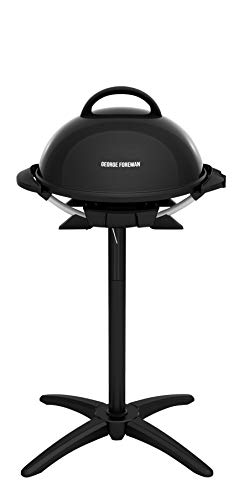
George Foreman Indoor/Outdoor Stand Grill
The George Foreman name arrives with a signature idea: a sloped cooking surface that lets fat run away from food while it grills. This indoor/outdoor model puts that slope on a removable stand and rates the grill at fifteen servings, with five heat settings for control. The indoor/outdoor wording matters more than it might seem, because it frames the grill as a year-round appliance rather than a summer-only one. On a rainy November evening the same unit that handled July’s burgers can work inside, and the removable stand means the grill head is not married to one spot in the garden.
Title facts for this George Foreman:
- Serving rating: 15 servings
- Heat settings: 5
- Stand: removable
- Signature design: fat-removing slope
- Use: indoor and outdoor
- Wattage and square inches: none stated in the title
Strengths
- The slope gives fatty cuts a drainage path that flat electric grates cannot offer.
- Five distinct settings simplify repeatable cooking for less experienced grillers.
- A fifteen-serving rating matches the largest family batches in this roundup.
Trade-offs
- Without a stated wattage, power comparisons against rivals rest on the serving claim.
- A sloped surface suits flat foods better than round items that may drift downhill.
- No lid is mentioned, so thick cuts cook without a covered roasting option.
Imagine a household that grills burgers weekly and has grown tired of flare-free but greasy results on a flat electric plate. The slope is the entire argument here: fat leaves the cooking zone instead of pooling around the food, which the listing frames as healthier grilling. Whether a given family cares about that framing or simply about easier cleanup, the practical effect is a drier cooking surface and patties that fry less in their own drippings. The five heat settings support weeknight cooking by memory, since a setting number is easier to repeat than a dial position estimated by eye.
The removable stand and indoor/outdoor rating combine into a storage story as well. In summer the grill can hold a patio corner on its stand; in winter the head can move to a counter or a garage shelf while the stand folds into the background of household storage. That seasonal flexibility is rare in this list, shared only with the other convertible designs, and it suits cottages that close up for winter. If your grilling calendar runs twelve months and your menu leans toward burgers, sausages and chops, this model’s slope and settings make a coherent case.
Best for: families grilling fatty favourites weekly, indoors in winter and outside in summer. Not suited for: thick roasts that need covered cooking, because no lid appears anywhere in this listing title. Check price on Amazon to weigh the George Foreman Indoor/Outdoor Stand Grill against the flat-grate rivals.
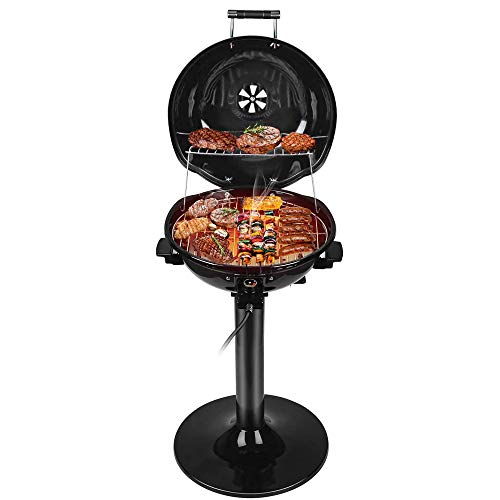
Techwood 15-Serving Indoor/Outdoor Electric
Techwood’s entry matches the George Foreman’s fifteen-serving rating and adds two facts its rival leaves out: a 1600W power figure and a double layer design, all on a portable removable stand in black. The double layer idea deserves unpacking, because layered cooking changes how a family batch flows. While the main surface grills, an upper layer can hold food that is finished, warming, or cooking gently, which effectively stretches a single heating zone into two tempos. For households whose grill sessions involve a rolling cast of eaters rather than one synchronised sitting, that second level can matter more than raw square inches.
Techwood’s stated details:
- Power: 1600W
- Serving rating: 15 servings
- Design: double layer
- Stand: portable and removable
- Use: indoor and outdoor
- Colour: black (stand version)
Strengths
- The double layer gives finished food somewhere warm to wait during long sessions.
- A stated 1600W output lets buyers compare power honestly against rivals.
- The removable stand supports both a fixed patio setup and tabletop relocation.
Trade-offs
- No square-inch figure is given, so surface comparisons rely on the serving rating.
- A second layer adds parts to clean after sticky or fatty cooking.
- Heat-setting detail is absent from the title, unlike the five settings named elsewhere.
Picture a cottage weekend where teenagers drift to the table in waves and dinner stretches across an hour. The main grate keeps producing while the upper layer holds earlier burgers at serving warmth, and nobody eats a cold patty because they were down at the dock when their batch finished. That scene explains the double layer better than any spec line: it is a feature for asynchronous eating. The 1600W element sits mid-pack in this roundup, above the Weber and below the Royal Gourmet, which fits a grill aimed at family throughput rather than maximum searing theatre.
Against its closest rival, the George Foreman, the choice becomes philosophical. The Foreman spends its design budget on a fat-removing slope and five named settings; the Techwood spends its budget on a second layer and a declared wattage. Neither title mentions a lid, so both ask the cook to work open-top. Families who reheat and hold food often will lean Techwood; families focused on draining fat from burgers will lean Foreman. The Techwood’s black stand version also keeps a low visual profile on a deck, a small thing that matters when the grill lives in view of the kitchen window all season.
Best for: households feeding people in waves, where a warming layer prevents cold second helpings. Not suited for: cooks who follow numbered heat settings by habit, since this title names no setting count at all. Check price on Amazon for the Techwood 15-Serving Indoor/Outdoor Electric and its double layer layout.

CUSIMAX Electric Grill Outdoor
The CUSIMAX closes the roundup as the small-space cookout specialist: a portable 1600W grill with a lid, a double layer design, a removable stand and an oil collector, aimed by its own title at cookouts, gatherings and small spaces. The lid is its distinguishing asset here, since only one other model in this group even gestures at covered cooking, and a lid changes what an electric grill can attempt. Covered cooking traps heat around thick chicken pieces and corn in husks, softening the line between grilling and roasting in a way open-top models cannot imitate.
CUSIMAX details from the title:
- Power: 1600W
- Cover: lid included
- Design: double layer, removable stand
- Grease handling: oil collector
- Heat: adjustable
- Intended settings: cookouts, gatherings, small spaces
Strengths
- The lid enables covered cooking for thicker foods that open grills handle poorly.
- An oil collector gives drippings a defined destination, easing cleanup on rented patios.
- Adjustable heat plus a double layer covers both searing and holding duties.
Trade-offs
- No serving count or square-inch area appears in the title, so capacity is unquantified.
- A lidded, layered design has more surfaces to wash than a simple flat grate.
- Temperature is described only as adjustable, with no settings or thermometer named.
Consider a small townhouse patio, barely wider than a picnic bench, where the grill must justify every inch it occupies. The CUSIMAX argues that versatility per inch is its metric: lid down for chicken thighs, lid up for quick vegetables, upper layer holding finished skewers while the main surface works. The oil collector suits rented spaces particularly well, because drippings land in a tray rather than on paving the tenant must eventually hand back clean. Adjustable heat, while less precise on paper than digital rivals, covers the ordinary range of weeknight cooking without a learning curve.
What keeps this model from topping the list is information, not intent. Without a stated area or serving figure, a buyer feeding eight people is guessing, and the roundup’s discipline is to reward titles that quantify capacity. For two to four eaters, though, the guess hardly matters, and the feature mix is genuinely distinctive: no other pick here combines a lid, an oil collector and a double layer in one 1600W package. Small-space cooks who value covered cooking over published capacity numbers will find this the most complete answer in the group.
Best for: small patios and rented outdoor spaces where a lid and oil collector protect both food and paving. Not suited for: hosts who plan menus by headcount, because the title gives neither servings nor square inches to plan against. Check price on Amazon if the CUSIMAX Electric Grill Outdoor matches your small-space brief.
Side-by-side: the six electric grills compared
| Model | Power | Capacity as stated | Stand and extras |
|---|---|---|---|
| Weber Q 1400 Electric | 1560W / 120V | No area figure published | Portable, cast-iron grates, precise control |
| Cuisinart CEG-115 Outdoor Electric | Wattage not stated | 240 sq. in. | Stand or tabletop, non-stick, 550°F claim |
| Royal Gourmet DL2001 Dual-Zone Electric | 1800W | 416 sq. in. | Dual-zone, shelves, digital thermometer |
| George Foreman Indoor/Outdoor Stand Grill | No wattage figure published | 15 servings | Removable stand, slope, 5 heat settings |
| Techwood 15-Serving Indoor/Outdoor Electric | 1600W | 15 servings | Removable stand, double layer |
| CUSIMAX Electric Grill Outdoor | 1600W | Area not stated | Lid, oil collector, double layer, removable stand |
Read down the power column and the roundup’s shape appears: the Royal Gourmet spends the most electricity on the most space, the two 1600W layered models aim at family flow, and the Weber concentrates a modest draw under premium grates. Capacity is stated three different ways across the six titles, which is exactly why the comparison uses each maker’s own wording instead of converting servings into invented square inches.
How do you choose the right outdoor electric grill?
How much cooking space does your household really use?
Start with the largest meal you cook outdoors in a normal month, not the biggest party of the year. A couple grilling two steaks and a skewer of vegetables uses a fraction of the 416 square inches the Royal Gourmet offers, while a family of six cycling burgers will feel the Cuisinart’s 240 square inches as a relay race. Serving ratings help when square inches are missing: both fifteen-serving models promise family throughput, though a serving rating is a manufacturer’s measure rather than a standard. If a title gives neither figure, as with the Weber and the CUSIMAX, assume the grill is aimed at smaller batches and let its other virtues argue the case.
Does a stand matter, or will the grill live on a table?
Stand design decides where the grill sleeps between meals. Removable stands on the George Foreman, Techwood and CUSIMAX let the head move to a table, a tailgate or a storage shelf, while the Cuisinart’s 2-in-1 design builds that choice into the product itself. The Weber, with no stand mentioned, presumes you already own a suitable surface. Measure the spot either way, and remember that a stand grill still needs elbow room for the cook and a safe route for the power cord to reach an outlet without crossing a walkway.
How much heat control do you actually need?
Control styles here range from a plain adjustable dial to five numbered settings, a digital thermometer and a dual-zone layout. Numbered settings suit cooks who repeat favourite meals and want the same result by number. A thermometer suits cooks who judge doneness by internal temperature rather than by time. Dual zones suit mixed menus. Plain adjustability suits everyone else, and honestly covers most weeknight grilling, provided the cook is willing to learn one grill’s habits over its first few outings. Households moving between fuel types may also enjoy our companion guide, Best Two Burner Grills, which compares compact gas models for patios where propane is welcome.
What will you cook most often?
Menu honesty narrows this list faster than any spec. Fatty burgers and sausages argue for the George Foreman’s slope or the CUSIMAX’s oil collector. Thick chicken pieces and covered cooking argue for the CUSIMAX’s lid. Delicate fish argues for the Cuisinart’s non-stick surface. Steak nights for two argue for the Weber’s cast iron. Mixed menus with clashing cooking times argue for the Royal Gourmet’s zones, and rolling family dinners argue for a double layer from Techwood or CUSIMAX. Let the food you cook monthly outrank the food you cook annually.
Outlets, cords and the electrical reality of outdoor cooking
Every grill in this roundup runs from ordinary household power, and that convenience carries homework. An 1800W appliance draws heavily on its circuit, so a porch outlet already feeding a freezer or a string of workshop tools may trip protection mid-cook. Test the intended outlet with the grill alone first, keep the cord run short and visible, and never bury a connection in wet grass. The Royal Gourmet’s waterproof switch acknowledges outdoor moisture at the grill itself, but the plug and socket deserve the same respect: covered outdoor outlets, dry hands when connecting, and storage that keeps the cord off damp ground between sessions. Renters should also confirm that their building’s outdoor sockets are live, since decorative patio outlets in older properties are sometimes disconnected entirely.
Cleaning and storage once the season turns
Electric grills forgive winter neglect less than their owners expect. Cast-iron grates, like the Weber’s porcelain-enameled set, want a dry storage spot so the enamel is not stressed by freeze-thaw moisture. Non-stick surfaces want a soft brush and no metal scouring, ever. Layered designs from Techwood and CUSIMAX come apart into more pieces, which is a blessing for a thorough autumn wash and a chore after every sticky session. Stands that detach let the whole kit shrink onto a garage shelf, while the Royal Gourmet’s collapsible shelves reduce its parked footprint without making it small. A few minutes of cleaning while the grates are still warm, plus a cover or indoor shelf for winter, will keep any of these six ready for the first warm weekend of spring. Readers planning a full outdoor kitchen corner might also browse Best Infrared Patio Grills for a different heat style suited to permanent patio setups.
A season with an electric grill, from first cookout to last
The first outing with any of these six usually teaches the same lesson in different clothing: electric heat rewards a full preheat. Cast iron on the Weber keeps warming long after the indicator suggests readiness, and the reward is a crust on burgers that a rushed start never produces. The Cuisinart’s non-stick surface heats with less mass behind it, so its rhythm is quicker off the mark but less forgiving when a crowd of cold chicken pieces lands at once. New owners who plan the first meal around one protein and one vegetable learn their grill’s tempo without juggling a whole menu, and that calm apprenticeship pays off for the rest of the summer.
By midsummer, habits settle around each design’s personality. The Royal Gourmet’s owners tend to plan menus in pairs, because two zones invite a hot item and a gentle item every single time: sausages beside onions, salmon beside asparagus, burgers beside a foil-free row of mushrooms resting in the cooler zone. Techwood households develop a holding routine instead, where the upper layer becomes the family’s warming shelf and dinner turns into a buffet that refills itself. George Foreman cooks lean on the numbered settings, repeating a favourite burger setting until it becomes muscle memory, while CUSIMAX owners discover which foods genuinely need the lid and which merely tolerate it.
Autumn exposes the storage differences that brochures underplay. A removable stand earns gratitude in October, when the grill head lifts away and the whole kit retreats to a shelf before the first frost. The Weber’s stand-free body was always shelf-shaped, so its owners simply clear a space beside the preserving jars. The Royal Gourmet asks for the largest winter footprint even with shelves folded, which backyard households with a shed will shrug at and balcony households would have resented since June. None of this appears in a title, yet all of it follows logically from the stand, size and layer facts the titles do state.
Winter separates the indoor/outdoor models from the outdoor-only ones. The George Foreman and Techwood titles both claim indoor and outdoor use, so their owners can keep a grilled-chicken routine alive in January without standing in sleet. The CUSIMAX, Cuisinart and Royal Gourmet titles speak the language of cookouts and backyards, and the Weber presents itself as a portable outdoor grill, so those households more likely pause until spring. Neither path is better; the honest question is whether your grilling is a seasonal pleasure or a year-round cooking method, because that answer quietly halves this list.
Which of the six suits which household?
Start with the smallest plausible household: two people, a balcony, a lease that bans flame. The Weber Q 1400 fits because its virtues, cast iron and precise control, scale down gracefully, and its stand-free body matches a balcony that already holds a small table. Add children or regular guests and the arithmetic changes. The Cuisinart’s 240 square inches handles a family of four’s burgers in one pass, and its stand-or-tabletop choice suits a garden that rearranges for birthdays. Its 550°F claim also answers the teenager who insists electric grills cannot brown anything properly.
Graduate to the entertainer’s household, where eight people eat and the menu has courses. Only the Royal Gourmet offers both the area and the zoning that such evenings demand, and its thermometer supports a cook who is also hosting conversations. The fifteen-serving pair serve a different entertainer: the one feeding a crowd the same food. Techwood’s layer keeps a burger production line warm, while the George Foreman’s slope keeps that same line from swimming in fat. Choosing between them is choosing which problem your crowd creates, waiting or grease.
Finally, the small-space household with big ambitions: a townhouse patio, a rented terrace, a cottage deck shared with bicycles and a kayak. The CUSIMAX was titled for exactly this life, pairing a lid and oil collector with a removable stand, so it can cook covered, catch its drippings and still vanish onto a shelf. Its unquantified capacity is the gamble, yet for two to four eaters the gamble is small. Every household in this spectrum can find its grill among the six, provided it shops by its own calendar of meals rather than by the largest number on any single title. Readers furnishing a patio from scratch should shortlist the grill, its shelter and its outlet as one purchase, not three separate afterthoughts.
Weather, shelter and where an electric grill should stand
Electric grills tolerate a covered porch better than flame appliances do, because there are no combustion gases to manage, but tolerance is not indifference. Rain on a hot lid hisses harmlessly enough, yet pooled water around a plug is a genuine hazard, and the Royal Gourmet’s waterproof switch only protects its own control, not your socket. Site any of these six under at least partial shelter, on a surface that drains, with the cord routed where nobody steps. Wind matters too: a gusty corner steals heat from open-top models like the Techwood and George Foreman, while the CUSIMAX’s lid blunts that loss, which is one more reason exposed terraces should weigh covered designs heavily.
Sun exposure shapes storage more than cooking. A black stand in full afternoon sun becomes hot to handle before the grill even switches on, and covers left baking over any of these models trap heat against cords and controls. A shaded corner, a breathable cover and a habit of unplugging after cooking will extend the life of whichever grill you choose. These are unglamorous details, yet outdoor appliances live or die by them far more than by any single dinner’s success.
What wattage can and cannot tell you
Wattage is the number buyers compare first, and it deserves both respect and suspicion. Respect, because an element’s wattage sets the ceiling on how much heat the grill can generate and how quickly the surface recovers after cold food lands. Suspicion, because wattage says nothing about how that heat is distributed, what the grate is made of, or how much surface the element must serve. The Weber’s 1560 watts work a comparatively focused area under cast iron, a material that stores heat and returns it steadily. The Royal Gourmet’s 1800 watts serve 416 square inches across two zones, so its power per inch is actually the more stretched figure, compensated by zoning that lets the cook concentrate demand where it matters.
The two 1600W models show why identical numbers can hide different machines. Techwood spends its watts on a fifteen-serving brief with a double layer, meaning some heat inevitably serves the warming level as well as the main grate. CUSIMAX spends the same 1600 watts under a lid, where trapped air recycles heat back onto the food, so covered cooking can feel stronger than the raw figure suggests. Meanwhile the Cuisinart and George Foreman titles withhold wattage entirely, asking buyers to judge by temperature claim and serving rating instead. A shopper who ranks this list by wattage alone would misorder it badly; wattage is one witness, never the whole testimony.
Recovery is the practical test behind the number. Load any electric grill with a full surface of cold burgers and the temperature dips; the question is how many minutes pass before sizzling resumes at full voice. Higher wattage generally shortens that wait, and heavy grates smooth it, which is why the Weber’s cast iron matters beyond searing. Hosts who cook in relays should favour recovery, meaning power and grate mass, while couples cooking one modest load can ignore the metric almost entirely. Match the number to your batch size and it becomes useful; chase it abstractly and it misleads.
Accessories and habits that change the result
No accessory appears in any of these six titles, so nothing here is bundled by implication, yet a few habits transform outcomes on equipment like this. A wide, flat spatula supports fish on the Cuisinart’s non-stick surface without tearing, and silicone-tipped tongs protect that same coating where metal would scar it. On cast iron, a stiff brush used while the grates are still warm clears residue before it carbonises into next week’s flavour. For the layered Techwood and CUSIMAX, a shallow tray on the upper level catches the juices of resting meat, keeping the lower surface cleaner and giving the cook a ready sauce.
Preheating discipline is the cheapest upgrade of all. Give the Weber’s iron a generous warm-up, let the Royal Gourmet’s thermometer confirm the zone temperatures rather than trusting elapsed minutes, and resist crowding whichever surface you chose, because steam from an overloaded grate defeats searing on any fuel. Resting cooked food for a few minutes, ideally on a warm upper layer where one exists, redistributes juices better than immediate carving. Finally, keep a simple log for the first month: setting, food, minutes per side. Numbered settings on the George Foreman make such a log almost effortless, and dial models reward it just as much, turning guesswork into a personal cookbook by the second month of ownership.
Planning a full menu on each design
Menus expose design differences faster than spec sheets. Take a simple summer plate: grilled chicken thighs, corn on the cob, a pepper-and-onion medley and warm flatbreads. On the CUSIMAX, the lid lets the thighs finish covered while corn steams in its husk beside them, and the peppers can follow in the collected heat. On the Royal Gourmet, the same plate becomes a zoning exercise, thighs holding in the gentle zone while peppers char hard in the hot one, with flatbreads flashing through at the end. Both routes succeed; they simply ask the cook to think in different grammar, coverage versus zones.
The layered pair plan the menu as a timeline instead. Early items, corn and peppers, graduate to the upper layer of the Techwood or CUSIMAX and wait at warmth while the main surface turns to chicken, then flatbreads take thirty seconds each in the final heat. The George Foreman plans by drainage: fatty items go first on the slope, vegetables follow in the seasoned residue, and the five settings give each stage a repeatable number. The Weber plans by restraint, two items at a time cooked beautifully rather than four cooked adequately, which suits households that treat grilling as a craft course within the meal rather than a production line feeding it.
Dessert, often forgotten in grill guides, separates the designs once more. Grilled peaches or pineapple need brief, fierce contact and a clean surface, favouring cast iron that can be brushed hot and the Cuisinart’s high claimed ceiling. A lidded grill can bake a foil-wrapped crumble gently while the main course rests, a trick the open models cannot copy. None of these techniques requires equipment beyond the six titles under review; they require only that the buyer imagine a whole evening, starter to dessert, before choosing which design’s grammar they want to cook in all summer.
Common mistakes when buying an electric grill
Buying by wattage alone. The highest number in this roundup belongs to the largest grill, not automatically the best one; 1800 watts spread over 416 square inches is a different proposition from 1560 watts concentrated under cast iron.
Ignoring the stand question until delivery day. A grill head with no stand and no table to receive it becomes a floor ornament, so settle the furniture question before ordering, not after.
Treating serving ratings as guarantees. Fifteen servings assumes modest portions cooking in sequence-friendly shapes; fifteen thick chicken halves will test any grill in this class.
Forgetting the circuit. Plugging a big electric grill into an outlet that already runs a fridge, lights and a radio invites a tripped breaker halfway through dinner.
Skipping the lid decision. Cooks who roast whole vegetables or thick cuts will miss a lid weekly, yet many buyers only notice its absence after the first covered-cooking recipe fails.
A note on noise, neighbours and shared spaces
One quiet virtue unites all six models: electric grilling is nearly silent and produces no fuel smell, which matters in the shared spaces where these grills will mostly live. A balcony cook can hold a conversation at normal volume, and neighbours receive cooking aromas without the smoke plume a charcoal fire announces. Condo boards that ban flame appliances often do so over fire risk and smoke complaints, and an electric grill sidesteps both objections, though the written rulebook of your own building remains the final authority. Cooking after dark also becomes simpler, since there is no tank to check by torchlight and no ash to dispose of before bed; unplug, let the surface cool, and the evening ends cleanly.
Final recommendation
For most households, the Cuisinart CEG-115 is the easiest recommendation: stand or tabletop flexibility, a stated 240-square-inch surface and the roundup’s boldest temperature claim cover the widest range of real patios. Hosts with room should step up to the Royal Gourmet DL2001, whose dual zones and 416 square inches genuinely change what a mixed menu can do. Small households that care about grate quality above capacity should choose the Weber Q 1400, while families feeding crowds in waves will get the most from the Techwood’s double layer or the George Foreman’s slope and settings. The CUSIMAX remains the small-space wildcard, and the only pick here with both a lid and an oil collector. Whichever direction you lean, the companion reading in Best Manual Espresso Machines for Home Use can round out a cottage kitchen that runs entirely on countertop power.
One last filter deserves weight before any order: the walk from kitchen to grill. A household that must carry raw chicken down exterior stairs will value a stand that stays assembled and a surface that preheats predictably, while a household grilling three steps from the back door can indulge the portable Weber’s tabletop ritual. Count the trips a typical dinner demands, including the forgotten spatula and the second round of corn, and let that small geography confirm or overturn the ranking your spec comparison produced. The best grill here is the one whose daily logistics disappear, leaving only the cooking itself to think about.
Frequently asked questions
Can an outdoor electric grill really sear a steak? The Cuisinart title claims 550°F from a wall outlet, and the Weber pairs 1560 watts with cast-iron grates that retain heat when meat lands, so searing is a realistic aim for the stronger models here, provided the grill preheats fully and the surface is not overcrowded.
Are these grills allowed on apartment balconies? Rules vary by building, but electric models are commonly the only grills permitted where gas and charcoal are banned, since there is no open flame or fuel storage; check your lease wording, because some buildings restrict all outdoor cooking regardless of fuel.
What does dual-zone cooking actually change? On the Royal Gourmet DL2001, two zones let fast and slow foods cook simultaneously at different heats, so vegetables can char while chicken finishes gently, instead of everything compromising on one temperature.
How should I clean a non-stick electric grill surface? Let the Cuisinart’s surface cool until warm rather than hot, wipe with a soft cloth or sponge, and avoid metal tools that would damage the coating; removable parts on layered models can be washed separately once cool.
Is a removable stand worth having? If the grill will ever cook on a table, travel to a cottage or store on a shelf, yes: three picks here offer removable stands, and that flexibility costs nothing when the stand stays attached all summer.
Before the first cookout, walk the whole route once with empty hands: outlet to grill spot, grill spot to table, table back to kitchen, noting every step, threshold and trailing cord on the way. That five-minute rehearsal prevents the classic opening-night fumble of a preheated grill waiting on the wrong side of a locked patio door, and it confirms that the spot you chose on paper works in shoes, in daylight and eventually in the dark with a plate in each hand.
Choose the grill that fits the meals, the outlet and the square footage you actually have, and electric outdoor cooking stops feeling like a compromise at all.


