What's inside
- Where to buy these eight-cup brewers
- Quick picks for the morning counter
- How these picks were chosen
- Six brewers, examined in turn
- The six brewers in one comparison
- How do you pick an eight-cup coffee maker?
- The eight-cup measure, demystified
- Keeping a drip brewer honest over the years
- What pour-over style means inside a drip machine
- Water, grind and the variables no brewer controls
- A week of mornings, told by carafe
- Guest cottages, home offices and other second kitchens
- The quiet economics of drip versus pods
- Choosing between the two Bonavitas
- Common mistakes with eight-cup brewers
- Mixed households: decaf drinkers, tea drinkers and second pots
- The first week with a new brewer
- Steam, noise and the small-kitchen soundscape
- Longevity: what wears out and what does not
- The morning ritual, redesigned
- A note on filters, permanent and paper
- Final recommendation
- Frequently asked questions
As an Amazon Associate I earn from qualifying purchases. This post may contain affiliate links at no extra cost to you.
As an Amazon Associate, cottageverdict.com earns from qualifying purchases.
Eight cups is the Goldilocks capacity of drip coffee: enough for a household’s morning plus a second round for whoever lingers, small enough that the pot is not brewed at dawn and reheated in defeat at noon. Shoppers hunting for the best eight cup coffee makers quickly discover that the class divides along one great fault line, the carafe. Glass carafes show the coffee level at a glance and pour beautifully, yet they need a warming plate that slowly cooks whatever sits on it. Thermal carafes, double-walled and unglamorous, keep coffee hot by insulation instead of electricity and free the brewer from the counter’s hottest corner. The six machines below include both philosophies, plus one famous outlier whose 32-ounce capacity makes it an eight-cup brewer by arithmetic rather than by name.
Certification is the second dividing line. Three of these brewers carry SCA certification in their titles, a standards claim that speaks to brewing temperature and consistency discipline. Two Bonavita models sit in that certified camp with different personalities, one built around one-touch pour-over style brewing with an auto pause, the other an enthusiast model with a removable reservoir and stainless panel. OXO’s entry pairs a glass carafe with podless single-serve flexibility, Melitta’s Aroma Tocco goes programmable with touch controls, Technivorm’s Moccamaster KBTS arrives with a decades-deep reputation and a title that says almost nothing, and the AIRMSEN closes the list as a 12-cup machine whose selector includes a genuine 8-cup mode, a distinction this guide will treat honestly rather than blur.
Where to buy these eight-cup brewers
Glass-carafe loyalists should begin with the OXO Brew 8-Cup Glass Carafe, the flexible brewer that also pours single servings without pods. The Bonavita 8 Cup BV1901TS is the one-touch choice, pairing pour-over style brewing with a stainless thermal carafe. Its sibling, the Bonavita Enthusiast 8 Cup, adds a removable reservoir and a stainless steel panel for easier filling. Households that schedule coffee the night before belong with the Melitta Aroma Tocco 8-Cup and its programmable timer. Minimalists who trust reputation over feature lists will study the Technivorm Moccamaster KBTS 32oz. And larger households that only sometimes brew eight cups should read the AIRMSEN 12-Cup Programmable Select review with its multi-size selector in mind.
Quick picks for the morning counter
| Pick | Best for | Defining detail in the title |
|---|---|---|
| OXO Brew 8-Cup Glass Carafe | Households mixing full pots and single cups | Podless single-serve option, SCA certified, temperature control setting |
| Bonavita 8 Cup BV1901TS | One-touch pour-over style mornings | Auto pause brewing, stainless double-wall thermal carafe, SCA certified |
| Bonavita Enthusiast 8 Cup | Easy filling and a steel-accented counter | Removable reservoir, thermal carafe, stainless steel panel, SCA certified |
| Melitta Aroma Tocco 8-Cup | Programmed wake-up coffee | Programmable, auto shut off, touch control panel, thermal design |
| Technivorm Moccamaster KBTS 32oz | Buyers who value a proven brewer | 32 oz capacity, polished silver finish, model 79212 KBTS |
| AIRMSEN 12-Cup Programmable Select | Variable batch sizes up to twelve cups | 4/6/8/10/12-cup selection, 1100W fast brew, 24H timer, 73oz tank |
How these picks were chosen
Capacity came first, applied strictly. Five titles state eight cups outright or, in the Technivorm’s case, state 32 ounces, which is the same class expressed in fluid measure. The sixth, the AIRMSEN, states twelve cups with a selector that includes eight among its options; it is included transparently as the flexible-capacity choice and labelled as such wherever it appears, because a household that brews twelve cups for guests and eight on weekdays is a real household, not an edge case. Carafe type formed the second filter, and the list deliberately holds both camps: glass for OXO and AIRMSEN, thermal for both Bonavitas and the Melitta, with the Technivorm title silent on carafe construction.
Certification and control formed the remaining filters. SCA certification appears in three titles and is reported as the claim it is. Control styles range from one-touch simplicity to full programmability with a 24-hour timer, touch panels and a temperature control setting on the OXO. Power is stated only by AIRMSEN at 1100W, so no wattage ranking is attempted for the rest. Features like auto pause, auto shut off and keep-warm duration were recorded exactly as titled, because in a category this mature, the honest differences live in precisely those small operational details.
Six brewers, examined in turn

OXO Brew 8-Cup Glass Carafe
OXO’s brewer is the diplomat of this group, refusing to choose between the household pot and the solitary cup. Its title promises podless single-serve and full carafe options in one machine, which means the person who rises at five can brew a single mug without pods or waste, and the household that gathers at eight still gets its full glass carafe. SCA certification and a temperature control setting complete a specification aimed at drinkers who care about extraction, not merely caffeine delivery. The glass carafe keeps the level visible, a small daily pleasure that thermal owners surrender.
Details OXO prints in its title:
- Capacity: 8 cups, plus single-serve brewing
- Carafe: glass
- Certification: SCA certified home brewer
- Control: temperature control setting
- Pods: none used, podless by design
- Programmability: no timer mentioned
Strengths
- Single-serve and full-pot brewing in one footprint serves mixed household schedules.
- Podless design avoids pod cost and waste for the solo cup.
- A temperature setting gives attentive brewers a variable most drip machines hide.
Trade-offs
- Glass needs a warming surface for long holding, with the flavour cost that implies.
- No programmable timer is named, so wake-up coffee needs a manual start.
- Single-serve flexibility adds pathways that purely pot-focused rivals omit.
A household with staggered mornings explains this machine better than any spec can. One partner leaves before dawn with a single brewed mug, a teenager appears at seven wanting one cup before school, and the remaining adults share the carafe at eight. A pot-only machine wastes coffee on the first two acts of that play; a pod machine charges rent on every cup. The OXO threads the needle by treating batch size as a daily decision. Its temperature control setting then serves the household’s coffee enthusiast, who can nudge extraction for a lighter roast without replacing the machine.
The glass carafe is the deliberate compromise. It pours cleanly, shows the level, and suits households that drink the pot within the hour. Households that nurse a pot across a whole morning should read the thermal reviews next, because insulation will serve them better than any warming plate. Within its chosen compromises, though, the OXO is the most adaptable brewer in this roundup.
Best for: mixed households alternating solo cups with shared pots. Not suited for: a wake-up routine requiring coffee already brewed, since no programmable start appears in the OXO title. Check price on Amazon for the OXO Brew 8-Cup Glass Carafe and its podless single-serve mode.

Bonavita 8 Cup BV1901TS
The BV1901TS is Bonavita’s one-touch argument: press once, and the machine brews in a pour-over style, pausing automatically if the carafe is pulled mid-cycle, then delivers into a stainless steel double-wall thermal carafe. SCA certification backs the brewing claim, and dishwasher-safe parts soften the daily cleanup. This is the brewer for households that love pour-over flavour but have surrendered the kettle-and-dripper ritual to the realities of weekday mornings. The thermal carafe then holds the result at drinking temperature without a warming plate stewing it.
The BV1901TS specification as titled:
- Capacity: 8 cups
- Brewing style: one-touch pour over
- Mid-brew access: auto pause brewing
- Carafe: stainless steel, double-wall thermal
- Certification: SCA certified
- Cleanup: dishwasher safe parts
Strengths
- One-touch operation removes every decision except the coffee itself.
- Auto pause lets an impatient first cup leave before the cycle ends.
- Thermal insulation protects a slow morning’s second cup from plate-cooking.
Trade-offs
- No programmability is stated, so the pot cannot be scheduled overnight.
- A steel carafe hides the remaining level from view.
- Single-serve brewing is not offered, unlike the OXO above.
Weekday mornings in a working household run on removed friction, and this Bonavita removes nearly all of it: grounds in, water in, one press, and the machine manages a pour-over style extraction while people dress and pack bags. The auto pause exists for the household member who cannot wait for the full cycle, a small mercy that prevents the drips-on-the-plate mess that older pause mechanisms made famous. By the time the carafe reaches the table, its double wall is already doing the quiet work that defines thermal ownership: the last cup tastes like the first batch, not like a reduction of it.
Compared with its Enthusiast sibling below, the BV1901TS is the simpler instrument: no removable reservoir is claimed, no steel panel is advertised. Compared with the OXO, it surrenders single-serve flexibility and the visible carafe, gaining thermal holding and one-touch calm. Households should choose between these machines by deciding which morning problem is theirs: variable batch sizes, or a pot that must stay good for two hours. For the second problem, this is arguably the roundup’s cleanest answer.
Best for: busy households wanting pour-over style coffee from a single press. Not suited for: solo drinkers who brew one mug at a time, because this Bonavita’s title offers no single-serve mode. Check price on Amazon to look over the Bonavita 8 Cup BV1901TS.

Bonavita Enthusiast 8 Cup
The Enthusiast is Bonavita’s refinement of the same certified eight-cup idea, distinguished in its title by a removable reservoir, a stainless steel panel and a thermal carafe. The removable reservoir is the feature owners feel daily. Instead of carrying the carafe to the sink and then pouring carefully into a fixed tank at an awkward counter angle, the reservoir itself travels to the tap, fills flat and returns. In kitchens where the brewer lives under a wall cabinet, that single change removes the most annoying thirty seconds of the morning routine.
Enthusiast facts from the title:
- Capacity: 8 cups
- Brewing style: pour over
- Reservoir: removable
- Carafe: thermal
- Finish: stainless steel panel
- Certification: SCA certified
Strengths
- A reservoir that travels to the tap solves the under-cabinet filling problem.
- Thermal carafe holding matches the sibling model’s slow-morning advantage.
- The steel panel gives the counter a more finished, appliance-grade look.
Trade-offs
- Auto pause is not named here, though it appears in the sibling’s title.
- No timer or programmability is claimed for overnight scheduling.
- The steel carafe conceals how much coffee remains.
Counter geography decides this model’s fate in most kitchens. A brewer parked beneath low cabinets forces its owner into a daily contortion with a full carafe, tilting and guessing at the tank’s mouth. The Enthusiast’s removable reservoir converts that contortion into a simple carry. Add the thermal carafe, which frees the brewed coffee from the machine entirely, and the whole system shows a design intelligence about kitchens as they are, not as showrooms arrange them. Guests can take the carafe to the table while the reservoir refills for a second pot.
Against the BV1901TS, the Enthusiast trades the explicitly named auto pause for filling convenience and finish. Households should ask which they will touch more often: the pause, used when someone steals an early cup, or the reservoir, used every single brew. For most kitchens the reservoir wins that arithmetic, which is why the Enthusiast wears its name comfortably. Readers comparing machines for a holiday cottage, where different guests brew each morning, might also appreciate how a removable reservoir simplifies the handover between strangers and machine.
Best for: kitchens where the brewer sits under cabinets and filling access is awkward. Not suited for: households devoted to stealing a mid-brew cup, because auto pause is not among the Enthusiast’s titled features. Check price on Amazon for the Bonavita Enthusiast 8 Cup and its removable reservoir.

Melitta Aroma Tocco 8-Cup
Melitta’s Aroma Tocco is the scheduler of the group: an automatic, programmable eight-cup thermal brewer with a touch control panel, auto shut off and stainless steel accents, sold in black with a five-pack of coffee filters in the box. Programmability changes the emotional character of a coffee maker. The machine stops being an appliance you operate and becomes a small promise kept overnight: grounds and water loaded after dinner, coffee ready when the alarm sounds. The touch panel modernises the interface, and auto shut off closes the safety loop for households that leave home in a hurry.
What the Aroma Tocco title lists:
- Capacity: 8 cups, thermal design
- Scheduling: programmable
- Controls: touch control panel
- Safety: auto shut off
- Finish: black with stainless steel accents
- Included: 5-packed coffee filter starter
Strengths
- Overnight programming delivers coffee at wake-up without a smart plug workaround.
- Auto shut off suits households that rush out and second-guess appliances.
- Touch controls wipe clean more easily than creviced buttons after sticky mornings.
Trade-offs
- No SCA certification is claimed, unlike three rivals here.
- A starter pack of filters implies an ongoing paper-filter routine to maintain.
- Single-serve and auto-pause features are absent from the title.
The household that benefits most is the one with a fixed, early start: teachers, nurses, tradespeople, anyone whose morning begins before their brain does. Loading the Tocco the night before converts coffee from a task into an ambience, the smell arriving as part of waking. The thermal design then protects the second half of the pot for a partner on a later shift, and the auto shut off lets the household leave without the traditional doorstep debate about whether the coffee maker is still on. Features like these do not photograph well, yet they govern satisfaction more than any brewing flourish.
Melitta’s long history with drip coffee and paper filtration sits behind this model, and the included filter pack signals the intended routine plainly. Buyers who dislike paper filters on principle should factor that in; buyers who value the clean cup and easy grounds disposal that paper gives will feel at home. For readers stocking a guest cottage, the programmable start has one more virtue: coffee can be set for guests’ departure morning as a parting courtesy, a touch of hospitality the manual machines here cannot schedule. Our wider breakfast reading continues in Best Nitro Cold Brew Coffee Makers, for households that want a cold, kegged alternative beside the morning pot.
Best for: early risers who want coffee brewed before they are fully awake. Not suited for: filter-free households, since the Tocco’s titled routine centres on paper coffee filters. Check price on Amazon to examine the Melitta Aroma Tocco 8-Cup.
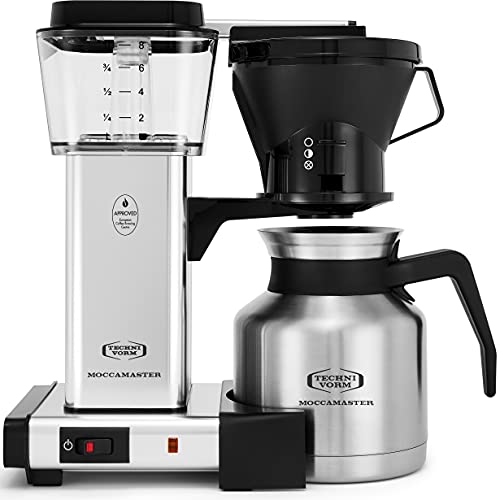
Technivorm Moccamaster KBTS 32oz
The Technivorm title is the shortest in this roundup by a wide margin: a 32-ounce coffee brewer, model 79212 KBTS, in polished silver. No certification is invoked, no feature list unrolls, no carafe material is named. That silence would sink a lesser brand, but the Moccamaster name carries one of the strongest reputations in drip coffee, built on consistent brewing temperatures and machines that owners keep for many years. The 32-ounce capacity places it squarely in the eight-cup class by volume, four fluid ounces to a cup measure, which is how it earns its seat here honestly.
Everything the KBTS title actually says:
- Capacity: 32 oz
- Model: 79212 KBTS
- Finish: polished silver
- Brand line: Technivorm Moccamaster
- Carafe type: not stated in the title
- Programmability and extras: none stated
Strengths
- A 32 oz capacity matches the eight-cup brief exactly, without selector modes.
- The Moccamaster name signals a brewer bought for the long term.
- Polished silver suits counters where appliances stay on display.
Trade-offs
- The title confirms almost nothing about features, so research must go further.
- No timer, pause or single-serve claim competes with modern rivals.
- Carafe construction must be verified outside the title before purchase.
There is a type of buyer this machine exists for: the one who has replaced three mid-range brewers in a decade and has decided to buy the category’s reference point instead. For that buyer, the absence of titled gimmicks is the appeal. The KBTS presents as a tool whose maker expects the brewing itself to be the feature, and the polished silver finish treats the machine as permanent counter furniture rather than a seasonal appliance. Households furnishing a cottage for decades, rather than semesters, tend to understand this logic immediately.
Discipline requires stating the other side plainly: within the rules of this guide, which reads titles as evidence, the Technivorm is the least documented pick in the roundup. A shopper who needs thermal holding, programmability or pause features confirmed before buying will find those confirmations in the Bonavita and Melitta titles, not here. The Moccamaster asks to be chosen on reputation and capacity, and many experienced coffee drinkers will consider that ask reasonable. It is included because an eight-cup guide without it would be dodging the category’s most famous name.
Best for: long-horizon buyers who choose on brewing reputation and exact 32 oz capacity. Not suited for: a checklist requiring programmability or carafe type confirmed in the listing title itself. Check price on Amazon for the Technivorm Moccamaster KBTS 32oz in polished silver.

AIRMSEN 12-Cup Programmable Select
Honesty first: the AIRMSEN is a 12-cup machine, and it appears in an eight-cup guide because its title states a 4/6/8/10/12-cup selection, meaning eight cups is one of its true, selectable batch sizes rather than a guess. Around that selector it builds the most feature-dense title in the roundup: 1100W fast brew, a 24-hour timer, two-hour keep warm, a 73oz tank and a glass carafe, aimed at home and office. For a household whose weekday pot is eight cups but whose Sunday table needs twelve, this machine replaces the usual compromise with a dial.
AIRMSEN’s stated specification:
- Maximum capacity: 12 cups, with 4/6/8/10/12-cup selection
- Power: 1100W, described as fast brew
- Scheduling: 24H timer
- Holding: 2-hour keep warm
- Tank: 73oz, with glass carafe
- Settings: home and office use
Strengths
- Five batch sizes cover solo mornings and guest Sundays in one machine.
- The 24-hour timer matches the Melitta’s wake-up convenience.
- A stated two-hour keep-warm window sets clear expectations for holding.
Trade-offs
- It is not a dedicated eight-cup machine, so its footprint serves a larger brief.
- A glass carafe with plate warming will stew coffee held the full two hours.
- No certification or pour-over claim appears in its title.
The AIRMSEN’s buyer is easy to picture: a household that hosts. Weekdays run at eight cups, but a book club, a work-from-home team day or a family Sunday regularly demands the full twelve, and the 73oz tank supports that swing without a second appliance. The selector also rescues small days, since a four-cup setting brews a half-morning pot properly rather than forcing the drinker to under-fill a fixed machine and hope the extraction behaves. Programmability then ties the whole flexible package to the clock.
Its compromises are the classic glass-and-plate ones, plus a philosophical one for purists of this category: if the brief is strictly a dedicated eight-cup brewer, this is the row’s acknowledged exception, included for flexibility and labelled accordingly in its sources note. Judged on its own terms, though, it is the most accommodating machine here, and offices or guest-heavy homes may rank it first without apology. Shoppers furnishing a rental property could standardise on it precisely because one model covers every party size the calendar produces.
Best for: hosts whose batch size changes with the day of the week. Not suited for: a strictly dedicated eight-cup brief, since this AIRMSEN is a 12-cup brewer with an 8-cup mode. Check price on Amazon to review the AIRMSEN 12-Cup Programmable Select and its cup selector.
The six brewers in one comparison
| Brewer | Capacity | Carafe | Scheduling and extras |
|---|---|---|---|
| OXO Brew 8-Cup Glass Carafe | 8 cups + single serve | Glass | Temperature control setting, SCA certified |
| Bonavita 8 Cup BV1901TS | 8 cups | Stainless thermal, double wall | One-touch, auto pause, SCA certified |
| Bonavita Enthusiast 8 Cup | 8 cups | Thermal | Removable reservoir, SCA certified |
| Melitta Aroma Tocco 8-Cup | 8 cups | Thermal | Programmable, touch panel, auto shut off |
| Technivorm Moccamaster KBTS 32oz | 32 oz | Not stated | No extras stated in title |
| AIRMSEN 12-Cup Programmable Select | 4–12 cups selectable | Glass | 24H timer, 2-hour keep warm, 1100W |
The table’s pattern is the category’s story: three thermal carafes against two glass, one famous minimalist, and programmability appearing exactly where the scheduling household needs it, on the Melitta and the AIRMSEN.
How do you pick an eight-cup coffee maker?
Glass or thermal: which carafe matches your morning?
Decide by the clock. A pot consumed within forty-five minutes loses nothing in glass, and gains a visible level and a graceful pour. A pot stretched across two hours of emails, school runs and second breakfasts belongs in thermal insulation, where the last cup resembles the first. Warming plates keep glass-carafe coffee hot by continuing to cook it, which is why the AIRMSEN’s honest two-hour keep-warm figure should be read as a limit, not an invitation. Households split between fast weekdays and slow weekends should weight the slow pattern, because that is where flavour disappointment accumulates.
Do you need the coffee to start itself?
Programmability divides households by schedule, not by seriousness. Fixed early starts make the Melitta and AIRMSEN timers feel like staff; irregular mornings make them irrelevant. There is also a middle path many owners discover: load the machine at night without the timer, then press one button while the kettle for tea heats. Judge honestly which routine your household will actually perform at 10 p.m., because a timer only serves people who load it. Renters equipping a first kitchen can find the same schedule-first thinking in Best Cordless Vacuums for Cat Litter, where daily habits matter more than headline suction for pet households.
How fussy is your household about brewing itself?
Three titles here claim SCA certification, a standards-based promise about brewing discipline, while the OXO adds a temperature control setting for hands-on adjustment. At the other pole, the Technivorm offers reputation without titled detail, and the AIRMSEN offers convenience without certification claims. None of these positions is dishonest; they are different theories of trust. Certification trusts a standard, the OXO trusts the user, Technivorm trusts its name, and AIRMSEN trusts its feature list. Knowing which theory your household believes in simplifies this purchase more than any taste test could.
Where will the brewer live?
Measure the counter’s depth and the cabinet’s clearance before falling for any model. The Enthusiast’s removable reservoir exists precisely because under-cabinet filling is the daily friction of this category. Thermal carafes also free the coffee to travel to a table or desk, which can shrink the machine’s required footprint to the brewer alone. Glass carafes anchor the pot to the machine’s warming plate, so their counters need a serving spot beside it. Small kitchens should treat carafe mobility as a space feature, not merely a coffee feature.
The eight-cup measure, demystified
Coffee’s cup is a fiction maintained by convention: roughly four to five fluid ounces, not the eight-ounce measuring cup of baking. That is why the Technivorm’s 32 ounces and the other brewers’ eight cups describe the same morning. A household that drinks from large mugs should translate honestly: eight coffee cups fill about four generous mugs, which is either perfect or a reason to consider the AIRMSEN’s twelve-cup ceiling. The fiction also explains why a two-person household can love this class: four mugs between two people is a full, civilised morning with a top-up each, and nothing left to reheat at noon.
Keeping a drip brewer honest over the years
Scale is the slow enemy of every machine here. Mineral deposits insulate heating elements and drift brewing temperatures away from whatever the maker engineered, quietly undoing the very consistency that certification and reputation promise. A descaling rhythm matched to your water hardness, a rinse of the carafe before yesterday’s oils become tomorrow’s flavour, and a wipe of the spray head area keep a brewer tasting like itself. Thermal carafes benefit from an occasional deep soak to clear the coffee film that narrows their necks. None of the six titles makes maintenance claims beyond the Bonavita’s dishwasher-safe note, so treat upkeep as the owner’s contribution to the partnership, repaid in years of consistent mornings.
What pour-over style means inside a drip machine
Two Bonavita titles and the category’s vocabulary lean on the phrase pour over, which deserves translation. Hand pour-over brewing wets grounds gradually, lets them bloom, and distributes water in stages rather than dumping it at once. A machine claiming a pour-over style is claiming to imitate that choreography automatically, showering the bed of grounds in a way that extracts evenly instead of tunnelling through the middle. The practical result a drinker notices is balance: fewer cups that taste simultaneously sour and bitter, the signature of uneven extraction. One-touch operation, as on the BV1901TS, means that choreography runs identically every morning, which is the one advantage a machine holds over a half-awake human with a kettle.
Certification enters the story here as the referee. A standards claim suggests the machine’s temperature and delivery have been measured against an external benchmark rather than asserted by marketing. It cannot rescue stale beans or a filthy carafe, and this guide will not pretend otherwise, yet it does separate brewers engineered for extraction from brewers engineered merely to be inexpensive and hot. Households upgrading from a basic machine usually taste the difference in the first week, then stop noticing it because consistency becomes the new normal, which is precisely the point.
Water, grind and the variables no brewer controls
Every machine in this roundup brews the same raw materials, and those materials set the ceiling on the cup. Water heavy with chlorine will flavour coffee brewed on the finest certified machine; water stripped of all minerals produces a flat cup on any brewer. A simple filter jug or a light hand with bottled water solves most household cases. Grind follows: drip machines expect a medium grind, and a grinder that produces boulders and dust in the same scoop defeats even distribution no matter how elegant the shower head above it. Households that buy pre-ground coffee should buy it in quantities consumed within a couple of weeks, stored airtight and away from the spice rack’s perfumes.
Beans deserve the same honesty. A freshly roasted bag used over ten days will outperform an expensive bag used over three months on every machine here. The eight-cup class quietly helps freshness, because a household that brews the right amount wastes less coffee standing around, and smaller, more frequent pots mean bags turn over faster. This is the unadvertised virtue of correct sizing: the machine’s capacity becomes a freshness strategy. None of the six titles can claim credit for that, but all six enable it, and the AIRMSEN’s selector extends the logic to households whose consumption swings with guests.
Ratios give the household a final lever. A starting point near one part coffee to sixteen parts water suits most drip brewing, adjusted stronger or weaker by taste and then held constant while other variables settle. Changing the brewer, the beans and the ratio in the same week teaches nothing; changing one at a time turns a kitchen into a small, delicious laboratory. The OXO’s temperature setting adds one more controlled variable for households inclined that way, while the one-touch machines deliberately remove variables for households that are not.
A week of mornings, told by carafe
Monday in a glass-carafe kitchen is brisk: the pot brews, the level drops visibly, and the last cup is poured as the front door closes. The glass tells the truth all morning, including the truth that only a swallow remains, which at least ends negotiations honestly. Wednesday in a thermal kitchen runs slower: the carafe migrates from counter to desk to garden bench, and the coffee inside stays itself for hours, though nobody can say exactly how much is left without picking it up and judging the weight, a skill thermal owners develop like sailors reading weather.
Weekend mornings complicate both stories. Guests multiply cups, second pots become likely, and the brewer’s refill routine matters as much as its brewing. The Enthusiast’s removable reservoir shortens the turnaround; the AIRMSEN’s tank and selector enlarge it; the Melitta’s programmability can have pot one ready before the cook even appears. A cottage hosting breakfast for six discovers that eight cups is either exactly right with a second pot brewing during toast, or the argument for the twelve-cup selector made in the AIRMSEN review. Neither answer shames the category; both reward households that counted their real mornings before buying.
Guest cottages, home offices and other second kitchens
Second kitchens judge brewers by different laws. In a guest cottage, the machine must explain itself to a stranger at 7 a.m.: one-touch operation and a visible glass carafe are self-explanatory, while selectors and touch panels need a welcome note. The BV1901TS and the OXO serve guests intuitively, and the Melitta can be pre-programmed by the host so guests wake to coffee without operating anything at all, the most hospitable trick in this roundup. In a home office, the thermal carafe rules, because it travels to the desk and keeps working hours civilised without repeated kitchen trips that dissolve concentration.
Small offices and studio workspaces add a social dimension: a shared eight-cup pot is a meeting waiting to happen, and a machine with a timer can have it ready when the team arrives. The AIRMSEN explicitly names office use in its title, and its selector suits teams whose size varies by day. Hosts should also think about the sink: paper-filter machines make grounds disposal trivially clean for guests, while any brewer benefits from a small instruction card covering water fill, filter size and the descaling contact. Hospitality is mostly the removal of small uncertainties, and coffee is where guests feel uncertainty first.
The quiet economics of drip versus pods
The OXO’s podless single-serve deserves an economic footnote. Pods charge for convenience per cup, forever, and generate a waste stream with every serving. A podless brewer pays for its flexibility once, then brews solo cups from the same bag that fills the family pot. Households that drink one or two solo cups daily will feel that arithmetic within a season, and households that host pod-machine refugees, guests who arrive with their own pods, can simply smile and brew the pot. Drip coffee’s ingredient cost per cup is famously low; the eight-cup class’s real economy is that almost none of it is poured away, unlike the oversized pots whose last third dies on a warming plate.
There is also an equipment economy in buying the right size once. A household that replaces a too-small brewer within a year has bought two machines; a household that counts mugs honestly buys one. The Technivorm’s long-horizon reputation speaks to the far end of that logic, where the cheapest machine is the one never replaced, while the AIRMSEN’s selector insures against the household changing size. Both are rational responses to the same fear of buying twice, aimed at different futures.
Choosing between the two Bonavitas
Because siblings invite confusion, the distinction deserves one plain paragraph. The BV1901TS headlines one-touch brewing, auto pause and a stainless double-wall thermal carafe, with dishwasher-safe parts. The Enthusiast headlines pour-over brewing with a thermal carafe, a removable reservoir and a stainless steel panel. Both claim eight cups and SCA certification. In daily life the difference reduces to two questions: do you steal a cup mid-brew, and do you hate filling a fixed tank? Answer the first yes and the BV1901TS leads; answer the second yes and the Enthusiast leads; answer both and the reservoir usually wins, because filling happens every brew while the stolen cup is an occasional pleasure.
Common mistakes with eight-cup brewers
Buying thermal for a fast household. If the pot empties in half an hour, insulation buys nothing and costs you the visible level that glass gives free.
Ignoring the filling routine. A fixed tank under a low cabinet annoys daily; a removable reservoir is not a luxury but a solution to a measured problem.
Reading keep-warm as a quality feature. Hours on a warming plate reduce coffee to bitterness, whatever the carafe started as.
Assuming eight cups means eight mugs. The coffee cup measure is small; large-mug households should do the mug arithmetic before blaming a brewer’s capacity.
Skipping descaling because the machine still runs. Brewers rarely die dramatically; they drift, and the drift is tasted long before it is diagnosed. Readers who enjoy this kind of unglamorous upkeep thinking may also like Best Retro Toasters for another counter appliance where daily routine outweighs spec sheets.
Mixed households: decaf drinkers, tea drinkers and second pots
Real households rarely march in caffeinated lockstep. One member drinks decaf after ten, another prefers tea, and a third wants a second full-strength pot at noon. The eight-cup class handles this pluralism gracefully because its pots are small enough to brew twice without waste: a morning pot for the household, a smaller afternoon pot for whoever remains. The AIRMSEN’s four and six-cup settings formalise that second, smaller brew, while the OXO’s single-serve mode dissolves the problem entirely for the lone decaf drinker. Thermal carafes help pluralism too, since the first pot can leave the machine and stay warm at the table while a second, different pot brews.
Tea drinkers benefit indirectly: a household whose coffee is handled by one right-sized machine stops commandeering the kettle and the counter around it, and mornings develop parallel tracks instead of queues. It sounds minor until two people, one kettle and a school deadline collide, at which point a self-sufficient coffee corner feels like diplomacy. When choosing among the six, pluralistic households should rank batch flexibility and carafe mobility above almost everything else on the titles.
The first week with a new brewer
Day one should be a rinse and a sacrificial pot, brewed and discarded to clear the machine’s newness. Days two and three establish the household ratio: brew at the standard proportion, taste honestly, and adjust the coffee dose before touching any other variable. By day four the routine’s friction points announce themselves, the awkward fill, the carafe’s pour, the filter size that the cupboard actually holds. Day five is for programming the timer if your model has one, loaded the night before with the ceremony performed at leisure rather than at midnight. The weekend then tests the machine against guests, second pots and slow mornings, the full repertoire.
Owners who keep a few notes during that week, dose, timing, who drank what, end it with a household standard instead of a vague impression. Owners who skip the notes often blame a brewer for what was actually a ratio problem, or credit it for what was simply fresh beans. Every machine in this roundup deserves the fair trial of a documented week; most will pass it, and the ones that fail will at least fail informatively, pointing at the specific feature the household should prioritise in a replacement.
Steam, noise and the small-kitchen soundscape
Drip brewers are gentle housemates: a gurgle, a hiss of steam at the end, and a carafe’s soft clink. In open-plan cottages where the kitchen borders the sleeping loft, that gentleness matters, and a programmed machine can finish before the household wakes, so even its modest sounds go unheard. Steam management is the practical side: a brewer pushed tight under a cabinet will bathe the cabinet’s underside in vapour daily, which is one more argument for the Enthusiast-style layout that lets the machine sit forward, or for leaving a hand’s width of clearance whichever model you choose. Small kitchens forgive small machines, and all six here qualify, provided their steam has somewhere to go.
Longevity: what wears out and what does not
A drip brewer has few moving parts, and its lifespan is governed less by mechanics than by deposits, seals and carafe accidents. Glass carafes break in sinks, which is an argument for handling them by the handle over the basin and for households with stone sinks to consider thermal steel’s forgiveness. Thermal carafes dent rather than shatter and insulate for years, though their lids and seals eventually govern performance. Heating elements drift with scale, as the maintenance section warned, and pumps are absent here, which removes the failure mode that kills many fancier machines. The category’s simplicity is its durability strategy.
Buying with longevity in mind therefore means favouring the machine whose daily routine you will perform kindly for a decade: the fill you do not dread, the carafe you will not chip through carelessness, the controls you can operate half-asleep without forcing anything. Reputation, as with the Technivorm, is one society’s accumulated answer to that question; features, as with the programmable pair, are conveniences whose value compounds daily. Both logics are sound, and the buyer’s task is to decide which kind of decade they are purchasing.
The morning ritual, redesigned
Step back from specifications and the eight-cup decision is really about designing the first twenty minutes of the day. A household that wakes to a programmed thermal pot lives a different morning from one that queues at a kettle, and a household with a podless single-serve option lets its earliest riser move silently without brewing for ghosts. The six machines here are six scripts for that opening scene. Choose the script your household wants to perform a thousand times, in the kitchen you actually have, with the mugs you actually own, and the specification sheet will mostly take care of itself.
A note on filters, permanent and paper
The Melitta’s included filter pack raises a household decision the other titles leave implicit: paper filtration versus a permanent basket. Paper gives a clean, sediment-free cup and turns cleanup into lifting a bundle of grounds straight into the compost, at the cost of a consumable to keep stocked and a flavour some drinkers find slightly muted. Permanent baskets remove the consumable and the shopping anxiety, and ask in return for a rinse-and-shake routine that not every household performs cheerfully at dawn. Neither answer is morally superior; the right one is the one your household will still be content with in month nine. Households choosing a paper-based machine should stock filters beside the beans from day one, because the morning a household runs out of filters is the morning the brewer gets blamed for everything.
Filter size discipline matters more than filter philosophy. The correct size seats flat, folds at the seam if the design asks for it, and never towers above the basket where the shower can fold it over and send grounds cascading into the pot. A single overflow incident teaches this lesson permanently, usually on the morning guests are present. Buy the size the manual names, keep the packet in the same drawer as the beans, and the whole topic retreats to the background where it belongs.
Final recommendation
The Bonavita BV1901TS earns the lead recommendation for most households: one-touch certified brewing, auto pause and a thermal carafe answer the largest number of real mornings. Kitchens with awkward filling access should take the Enthusiast instead, and schedule-driven households should choose between the Melitta’s dedicated eight-cup programmability and the AIRMSEN’s variable capacity with its timer. The OXO remains the flexible favourite where single cups share the week with full pots, and the Technivorm KBTS is the long-termist’s choice, bought on reputation and exact capacity. Every machine here will make a household’s mornings better than the oversized brewer it replaces, provided the carafe decision is made by the clock rather than by habit.
Frequently asked questions
How many mugs does an eight-cup brewer really fill? Using the coffee measure of roughly four to five ounces per cup, expect about four large mugs from a full pot, which suits two people with a refill each or four people with one modest cup.
Does SCA certification guarantee better taste? It is a standards claim about brewing discipline, including temperature consistency, and three titles here carry it; your beans, grind and water still decide most of what lands in the cup.
Is the AIRMSEN really an eight-cup coffee maker? It is a 12-cup machine with a stated 4/6/8/10/12-cup selector, so its eight-cup mode is genuine, but households wanting a dedicated eight-cup footprint should choose one of the five dedicated models.
Why does coffee from a warming plate turn bitter? Continued heat keeps cooking the brewed coffee and concentrating its harsher compounds, which is why thermal carafes and prompt drinking protect flavour better than long plate warming.
What makes the Moccamaster KBTS an eight-cup brewer if its title says 32 oz? Thirty-two fluid ounces equals eight coffee-measure cups, the same class expressed in volume rather than cup count.
One more scenario deserves a verdict before the shopping starts: the household that drinks coffee only on weekends. For them, an eight-cup brewer is a hospitality instrument rather than a daily one, and the buying logic inverts. Freshness of the machine’s routine matters less than guest-proof simplicity, descaling still matters because idle machines scale quietly, and a thermal carafe earns its place by carrying Saturday’s pot to the garden table. The Melitta’s programmability can greet weekend guests before the host descends, and the OXO’s glass carafe shows visitors exactly how much hospitality remains. Weekend-only households should also store beans in small quantities bought often, since a brewer used eight mornings a month cannot rescue a bag opened in spring and finished at midsummer.
Finally, consider the countertop’s other tenants. An eight-cup brewer shares its shelf with the kettle, the toaster and the fruit bowl, and the household that measures honestly will sometimes discover that the winning machine is the one whose carafe can leave the base, freeing the counter’s centre for breakfast itself. Thermal owners live that freedom daily without thinking about it. Glass owners trade it for visibility and a warming plate’s anchoring presence. There is no universal winner in that exchange, only the household’s own choreography, performed every morning whether anyone designed it or not. Designing it once, on purpose, with the right brewer, is the entire opportunity this category offers.
When the box arrives, resist brewing the household’s most precious beans first. Run the rinse, brew a learning pot from the everyday bag, and let the machine introduce itself without ceremony. Note the time a full pot takes, the sound it makes in its final minute and the exact spot on the counter where its steam rises clear of the cabinets. Move it once, decisively, if the steam argues with the woodwork. Then set the household standard, dose, water and timing, and write it on a card kept inside the bean tin, where the next sleepy operator will find it without asking anyone anything.
Share the verdict with the household before ordering, especially the carafe decision, because the person who pours the last cup every day has standing in this purchase that the person who researched it sometimes forgets. A brewer chosen together gets loaded, descaled and defended together, and that shared ownership, more than any certification or selector, is what keeps a coffee routine peaceful for years.
Keep the receipt and the manual together in the drawer beneath the brewer, alongside the spare filters and the descaler, so that the machine’s whole support system lives within arm’s reach of the machine itself and no future problem begins with a search through the house.
Invite the household’s most sceptical coffee drinker to judge the first full pot blind against the old machine’s best effort, poured into matching mugs without ceremony. A verdict delivered without knowing which cup is which settles more arguments than a month of breakfast-table debate, and it gives the new brewer a fair, memorable christening.
Eight cups, a carafe matched to your clock and a machine loaded the night before or pressed once in the morning: that is the whole secret of a household that never argues about coffee again on any weekday morning whatsoever, in any kitchen, in any season of the entire year.


