What's inside
- Key Takeaways
- Quick Picks
- How Did We Choose Among Grind-and-Brew Machines?
- How Do the Six Compare on Grinder, Carafe and Capacity?
- Blade or Burr: How Much Does Grinder Type Matter for Drip?
- Glass Carafe on a Plate or Thermal Carafe: Which Holds Better?
- How Should You Match Capacity to Your Household?
- What Does the Nightly Ritual Actually Involve?
- How Do You Clean a Grinder You Cannot Remove?
- Which Beans and Roasts Suit Grind-and-Brew Machines?
- How Do You Set Up a Grind-and-Brew Machine for Its First Week?
- What Water Temperature and Flow Mean for Drip Quality?
- How Should You Store Beans for a Machine That Grinds?
- What Is the Sensible Way to Serve a Crowd From These Machines?
- How Do Grind-and-Brew Machines Compare With a Separate Grinder and Drip Machine?
- When Is a Grind-and-Brew Machine the Wrong Purchase?
- How Do You Handle Weekends and Guests Differently From Weekdays?
- What Should You Do When the Coffee Suddenly Tastes Worse?
- How Does Grind-and-Brew Fit a Home Office Routine?
- Where Do Owners Go After Their First Grind-and-Brew Machine?
- How Do You Keep the Peace With Housemates Over a 6 A.M. Grinder?
- What Mistakes Do Grind-and-Brew Buyers Make?
- Final Recommendation
- Frequently Asked Questions
- Related Guides
As an Amazon Associate I earn from qualifying purchases. This post may contain affiliate links at no extra cost to you.
cottageverdict.com is reader-supported. When you buy through links on our site, we may earn an affiliate commission.
Where to buy: all six machines below are sold through Amazon, and their names in the Quick Picks table, the detailed sections and the comparison table link to their listings so you can check price on Amazon and confirm grinder type and capacity for the exact model before ordering. The best automatic coffee machines that grind coffee solve the oldest problem in home brewing: ground coffee begins losing its aroma within hours, while most households buy it by the bag and drink it for a fortnight. A machine that grinds beans seconds before water touches them removes that decay from the equation entirely, and it does so inside one appliance, on a timer, while you sleep.
This guide is about drip and single-serve grind-and-brew machines, not espresso. The six picks brew filter-style coffee into glass or thermal carafes — or, in the Horavie’s case, straight into a mug — and they divide along lines that matter more than brand: blade grinder against burr grinder, glass carafe on a warming plate against an insulated thermal carafe, full-batch programming against flexible single-cup brewing. Each pick’s section states its grinder type and carafe arrangement plainly, because those two facts predict the taste in the cup better than any other specification.
Programmability is the second promise of the category. A 24-hour timer on most of these machines means the grinding — the loud part — can happen at the moment of waking rather than before it, and the coffee is freshest exactly when the household is ready for it. The trade is a small nightly ritual of beans, water and filter, repaid every morning. Households that will not perform that ritual should be honest about it now, because such a machine used with stale pre-ground coffee is just a drip machine carrying a grinder it never uses.
Grinder type deserves its headline. Blade grinders chop beans unevenly and are simple, compact and easy to clean; burr grinders crush to a consistent size and extract more evenly, at more cost and size. In drip brewing the difference is real but gentler than in espresso, and this guide weights it alongside carafe style, capacity and how flexibly the machine handles a household’s range from one mug to a full pot.
Finally, a word on noise and mess, the category’s honest costs. Grinding at 6 a.m. is not silent, and ground coffee inside a machine means a brew basket and grinder chamber that need regular wiping. The picks below were chosen partly on how gracefully they manage those costs, and the later sections cover placement, cleaning and bean storage so the freshness advantage is not eaten by its own overheads.
Key Takeaways
- Grinding seconds before brewing is the entire point: every pick here keeps beans whole until the brew cycle starts.
- Blade versus burr is the key grinder divide — the Cuisinart uses a blade for simplicity, the Breville a burr grinder for consistency.
- Thermal carafes (Breville) keep coffee hot without a warming plate’s stewing effect; glass carafes with plates (Cuisinart, Gevi, AIRMSEN, SECPOEDR) suit drink-it-now households.
- Capacity spans from the AIRMSEN’s 5 cups to the Cuisinart’s 12, with the Horavie abandoning the carafe entirely for 6–16oz single servings.
- Programmable timers on most picks let grinding happen at waking time, so freshness and convenience peak together.
- A grind-and-brew machine demands a nightly load-up and a weekly wipe-down; households that accept both get the freshest drip coffee at home.
Quick Picks
| Pick | Badge | Why it earns its place |
|---|---|---|
| Cuisinart Grind and Brew 12-Cup DGB-400 | Best Classic Grind-and-Brew | The category’s reference design: a built-in blade grinder, 24-hour programming and a 12-cup glass carafe in stainless and black. |
| Breville Grind Control Coffee Maker | Best Burr Grinder Control | A burr grinder with adjustable grind and strength, brewing into a thermal carafe — the taster’s grind-and-brew machine. |
| Gevi 10-Cup Grind & Brew Coffee Maker | Best Touchscreen 10-Cup | A touch screen, programmable brewing, a glass carafe and a 90-minute warm plate in a 1.5L all-in-one design. |
| AIRMSEN Coffee Maker with Grinder 5-Cup | Best Small-Household Grind and Brew | Three grind settings, a 24-hour delay brew and two-hour keep-warm in a 5-cup machine sized for one or two drinkers. |
| SECPOEDR Grind and Brew Coffee Maker 10-Cup | Best Stainless 10-Cup Value | A built-in grinder, programmable brewing and a two-hour keep-warm in a stainless 10-cup machine without touchscreen frills. |
| Horavie Single Serve Coffee Maker with Grinder | Best Single-Serve With Grinder | Grinds whole beans for a single 6–16oz cup, also takes grounds and pods, with a 47oz tank and a descaling alert. |
How Did We Choose Among Grind-and-Brew Machines?
We verified from each listing that the machine genuinely grinds in-house — a built-in grinder named in the specification — rather than merely accepting pre-ground coffee, which many drip machines do while wearing similar styling. Grinder type was recorded per pick: blade where the listing says blade, burr where the design is a burr unit, and unspecified where the listing simply says built-in grinder, in which case this guide says exactly that and no more.
Carafe and warming design came next, because brewed coffee’s second hour matters as much as its first: thermal insulation preserves flavour without cooking it, warming plates trade a little flavour for simplicity and visibility, and keep-warm durations from the listings — ninety minutes here, two hours there — were compared against real household drinking patterns.
Finally we weighed flexibility: programmable timers, strength and grind settings, single-cup options and how small a batch each machine brews gracefully. A 12-cup machine that cannot make two decent cups is a poor fit for a couple, whatever its headline capacity, and the recommendations reflect the households each pick actually serves.

Cuisinart Grind and Brew 12-Cup DGB-400 — Best Classic Grind-and-Brew
Cuisinart’s Grind and Brew line essentially defined this category for home kitchens, and the DGB-400 carries the formula in its classic form: a built-in blade grinder above the brew basket, a 24-hour programmable timer, a 12-cup glass carafe, and stainless-and-black styling that has sat comfortably on counters for years. Beans load into the hopper, the timer starts the grind at the appointed hour, and the coffee brews straight through into the carafe — the full promise of the category in one uncomplicated sequence.
The blade grinder is the honest compromise at its heart. Blade grinding is less uniform than burr grinding, and a meticulous taster can find the difference in the cup; what the blade buys is simplicity, compactness and easy cleaning, with no burr assembly to disassemble. For drip brewing — a forgiving method that extracts over minutes rather than seconds — that compromise has satisfied households for a generation of these machines, and the DGB-400’s popularity is the evidence.
Choose it as the default for a family-sized household that drinks a full pot across a morning and values a proven design over adjustability. Drinkers who want grind-size control should look to the Breville; smaller households to the 10-cup and 5-cup picks. As the straightforward answer to ‘grind my beans and have coffee ready at seven’, it remains the benchmark the others are measured against.
Its longevity in the market carries a practical benefit that newer rivals cannot copy: every accessory, carafe and answer about this design already exists. A cracked carafe in year three is a search and a click, not an orphaned appliance. For a category where the machine is a daily appliance rather than a hobby, that ecosystem of the ordinary is a genuine feature, and it is earned only by designs that stayed in production while trends moved around them.
- Built-in blade grinder
- 12-cup glass carafe
- 24-hour programmable timer
- Stainless steel and black finish
- DGB-400 model
Strengths
- Proven category-defining design
- Full 12-cup capacity for families and guests
- Simple blade system is easy to clean
Trade-offs
- Blade grind is less uniform than burr output
- Glass carafe on a plate stews coffee held for hours
- Fewest grind and strength adjustments here
Best for: families wanting a full fresh-ground pot on a timer.
Not suited for: grind-size perfectionists or thermal-carafe devotees.

Breville Grind Control Coffee Maker — Best Burr Grinder Control
The Grind Control is what happens when a company known for espresso machines takes drip seriously. Its listing promises grind-and-brew with adjustable grind and strength settings and a thermal carafe in brushed stainless steel — and each of those phrases carries weight. The burr grinder produces the consistent particle size that even extraction requires, the adjustments let a household tune a bean rather than accept a factory compromise, and the thermal carafe keeps the result hot by insulation instead of by continued cooking on a plate.
Its party trick, well known in this class, is range: the Grind Control is built to brew anything from a single cup to a full carafe with the grind calibrated to the volume, so the two-cup Tuesday and the twelve-cup Sunday come from the same machine without the small batch tasting like an afterthought. That flexibility is the real luxury here, more than any single specification, because household coffee demand is variable and most machines pretend otherwise.
The costs are price within this group, size, and a grinder assembly that rewards the periodic cleaning burr systems ask for. Households that drink one style of coffee in one quantity will pay for adjustments they never touch. Households that taste critically and brew variably will find this the only pick that treats drip coffee with espresso-level respect.
The Grind Control also rewards a particular kind of owner: the one who keeps a coffee notebook, even a mental one. Because its grind and strength settings are explicit and repeatable, a household can converge on a bean’s best preparation within a week and then reproduce it for the life of the bag — a small, civilised pleasure that timer-and-pot machines, for all their virtues, cannot offer with the same precision.
- Built-in burr grinder
- Adjustable grind and strength settings
- Thermal carafe, brushed stainless steel
- Single-cup to full-carafe brewing range
- BDC650BSS model
Strengths
- Burr consistency for even extraction
- Thermal carafe avoids warming-plate stewing
- Genuine small-to-large batch flexibility
Trade-offs
- Premium price and footprint in this group
- Burr assembly needs periodic cleaning
- Adjustability is wasted on set-and-forget drinkers
Best for: critical tasters brewing variable quantities.
Not suited for: households wanting the simplest timer-and-pot routine.

Gevi 10-Cup Grind & Brew Coffee Maker — Best Touchscreen 10-Cup
The Gevi presents grind-and-brew through a modern interface: a touch screen on an all-in-one 10-cup machine with a built-in grinder, a glass carafe, a 1.5L tank, programmable brewing and a reusable filter. The reusable filter deserves its sentence — it removes the paper-filter errand from the household’s life and, rinsed after each brew, keeps the running cost of the freshness habit close to the price of beans alone. Ten cups is the thoughtful middle capacity: a family pot without the 12-cup machines’ tendency to brew more than a morning drinks.
Its warm plate holds coffee for ninety minutes per the listing, a duration matched honestly to how long brewed coffee stays pleasant; the machine is not pretending the third hour is worth drinking. Programmable brewing covers the timer ritual, and the touch interface will suit households that find dials and buttons on older designs fiddly or cryptic.
Against the Cuisinart it trades the proven name and two cups of capacity for the screen, the reusable filter and a fresher design language; against the SECPOEDR at the same capacity it offers the more detailed listing and the specified warm-plate duration. For a household modernising its kitchen and its coffee in the same purchase, the Gevi is the natural candidate.
The Gevi’s touch screen will divide households, and that division is worth respecting rather than arguing with: some users find a screen clearer than a thicket of buttons, others distrust any interface that cannot be operated by feel in the dark. Neither is wrong. The machine underneath the interface is a sound 10-cup grind-and-brew, so let the household’s interface temperament, honestly assessed, make this particular call.
- Built-in grinder, all-in-one design
- 10-cup glass carafe, 1.5L tank
- Touch screen controls
- Programmable brew timer
- 90-minute warm plate
- Reusable filter included
Strengths
- Reusable filter ends paper purchases
- Touch screen suits modern kitchens
- Warm-plate duration matched to drinkable life
Trade-offs
- Listing does not specify grinder type
- Glass carafe rather than thermal insulation
- Brand has a shorter history than Cuisinart or Breville
Best for: modern households wanting a 10-cup fresh-ground routine.
Not suited for: thermal-carafe loyalists or burr-grinder seekers.
AIRMSEN Coffee Maker with Grinder 5-Cup — Best Small-Household Grind and Brew
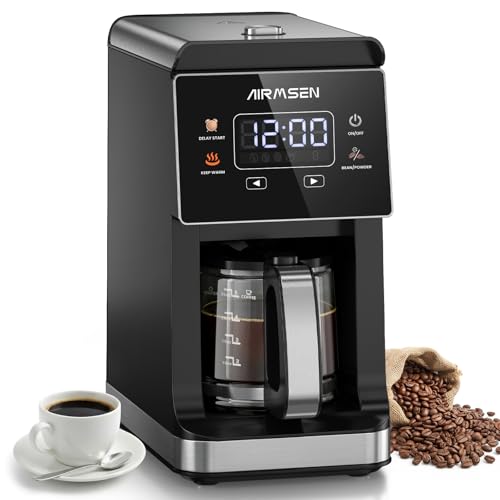
Small households are the grind-and-brew category’s neglected constituency, because grinding fresh for a 12-cup pot you will not drink is waste dressed as virtue. The AIRMSEN answers with a 5-cup machine: a built-in grinder with three grind settings, 24-hour delay brewing, touch controls, a glass carafe and two-hour auto keep-warm, aimed explicitly at homes and home offices. Three grind settings is a meaningful feature at this size — enough to adapt between beans and preferences without the Breville’s full laboratory.
Five cups in coffeemaker measure is two generous mugs and a top-up, which describes the actual morning of a couple far better than a dozen-cup headline does. Coffee brewed in the quantity it will be drunk tastes fresh twice over: fresh-ground, and not reheated. The delay timer preserves the category’s signature pleasure — waking to brewed coffee — at a scale where the nightly load-up takes thirty seconds and a modest scoop of beans.
Its limits are the mirror of its virtues: this is not the machine for a brunch crowd, and its keep-warm plate will hold a small pot past its best if you let it. For singles, couples, dorm-adjacent first flats and the home-office desk that wants real coffee without a kitchen expedition, it is the most honestly sized pick in the group.
There is a environmental honesty to the small machine too: it brews approximately what will be drunk, so its waste is measured in spoonfuls rather than in half-carafes poured away at noon. Across a year, a couple drinking exactly their two mugs saves a surprising quantity of beans and water compared with a large machine’s optimistic over-brewing — freshness and frugality, for once, pointing in the same direction.
- Built-in grinder with 3 grind settings
- 5-cup glass carafe
- 24-hour delay brew programming
- Touch controls
- 2-hour auto keep-warm
- Compact home and office sizing
Strengths
- Right-sized for one or two drinkers
- Grind settings unusual at this capacity
- Full timer convenience in a small footprint
Trade-offs
- Cannot serve a crowd
- Small carafe empties fast with guests
- Grinder type not specified beyond its settings
Best for: singles, couples and home offices brewing small and fresh.
Not suited for: families or anyone hosting brunch regularly.

SECPOEDR Grind and Brew Coffee Maker 10-Cup — Best Stainless 10-Cup Value
The SECPOEDR covers the same 10-cup ground as the Gevi with a plainer philosophy: a built-in grinder, programmable brewing, a two-hour keep-warm function and a stainless steel body. Where the Gevi spends on a touch screen and a specified reusable filter, this machine keeps the interface conventional and the specification focused on the category’s essentials — grind, brew on a timer, hold warm for a realistic window. Households that prefer buttons they can find half-asleep may honestly prefer it.
Two hours of keep-warm is the longest stated hold in this group alongside the AIRMSEN’s, and it suits a particular rhythm: the household whose coffee is brewed at six and finished at eight by people leaving in waves. A glass carafe on a plate will trade a little freshness across those two hours, but for staggered households the alternative — brewing twice — wastes more coffee than the plate stews.
Its listing is sparing with detail beyond the essentials, and this guide mirrors that spareness rather than decorating it: grinder type unspecified, controls conventional. What is documented is a stainless 10-cup grind-and-brew with programming and a long keep-warm, and for buyers whose checklist reads exactly like that sentence, the SECPOEDR is the direct answer at this capacity.
The SECPOEDR’s plainness extends to its failure modes, which is an underrated virtue: conventional controls and a conventional brew path mean that when something eventually wears, the diagnosis is simple and the parts are ordinary. Households that keep appliances for a decade, and repair rather than replace, tend to value exactly this kind of unremarkable engineering over a dazzling interface with a five-year horizon.
- Built-in grinder
- 10-cup programmable brewing
- 2-hour keep-warm function
- Stainless steel body
Strengths
- Long keep-warm suits staggered households
- Conventional controls, no screen to learn
- Stainless finish matches most kitchens
Trade-offs
- Listing detail is the thinnest in this group
- Grinder type unspecified
- Glass carafe rather than thermal
Best for: staggered-schedule households drinking across two hours.
Not suited for: buyers who comparison-shop on detailed specifications.

Horavie Single Serve Coffee Maker with Grinder — Best Single-Serve With Grinder
The Horavie rejects the carafe entirely and asks a sharper question: what if the freshest coffee is the cup ground and brewed for one person, on demand? Its built-in grinder serves single servings from 6 to 16 ounces, and the machine also accepts ground coffee and K-style pods, so a household can grind beans for the enthusiast’s morning cup, run a pod for a guest’s decaf, and never brew a pot nobody finishes. A 47oz water tank keeps refills occasional, and a descaling alert handles the maintenance memory most owners lack.
Single-serve grinding changes the freshness equation’s scale: instead of a pot brewed fresh and then ageing on a plate, every cup is its own brew event, ground seconds before water. For one-person households and couples with different schedules — and different bean preferences, since each cup can draw on different beans tipped into the grinder — that per-cup freshness is the purest form of this category’s promise.
The trade-offs are throughput and ritual: back-to-back cups for a crowd arrive one at a time, and there is no carafe to carry to the table for a lazy brunch. Pod compatibility also tempts households back toward pod costs and waste, which the grinder exists to escape. As the flexible, per-cup answer in a carafe-shaped category, though, the Horavie earns its place by serving the drinkers the other five machines approximate.
Its descaling alert deserves more credit than such features usually get, because scale is the failure mode single-serve machines die of quietly: flow slows, temperatures drift, cups shrink, and owners blame the beans. A machine that announces its own maintenance need converts an invisible decline into a ten-minute task, and for busy solo households — its exact audience — that announcement may be worth more than another ounce of tank capacity.
- Built-in grinder for single servings
- 6 to 16oz cup sizes
- Accepts whole beans, grounds and K pods
- 47oz water tank
- Descaling alert
- Black finish
Strengths
- Every cup ground and brewed individually
- Pod and ground compatibility covers guests and decaf
- Large tank for a single-serve machine
Trade-offs
- One cup at a time frustrates crowds
- No carafe for table service
- Pod option can creep back into the routine
Best for: solo drinkers and mixed-schedule couples wanting per-cup freshness.
Not suited for: households that gather around a shared pot.
How Do the Six Compare on Grinder, Carafe and Capacity?
Three columns decide this category: how it grinds, how it holds, and how much it makes. Read the table in that order and the right machine usually identifies itself.
| Pick | Badge | Specification snapshot | Grinder and holding notes |
|---|---|---|---|
| Cuisinart Grind and Brew 12-Cup DGB-400 | Best Classic Grind-and-Brew | Blade grinder, 12-cup glass carafe | 24-hour programmable, classic design |
| Breville Grind Control Coffee Maker | Best Burr Grinder Control | Burr grinder, adjustable grind and strength | Thermal carafe, single-cup to carafe range |
| Gevi 10-Cup Grind & Brew Coffee Maker | Best Touchscreen 10-Cup | Built-in grinder, 10-cup glass carafe | Touch screen, 90-min warm plate, reusable filter |
| AIRMSEN Coffee Maker with Grinder 5-Cup | Best Small-Household Grind and Brew | 5-cup, grinder with 3 settings | 24-hour delay brew, 2-hour keep-warm |
| SECPOEDR Grind and Brew Coffee Maker 10-Cup | Best Stainless 10-Cup Value | Built-in grinder, 10-cup | Programmable, 2-hour keep-warm, stainless |
| Horavie Single Serve Coffee Maker with Grinder | Best Single-Serve With Grinder | Single-serve grinder, 6-16oz cups | Beans, grounds and pods, 47oz tank |
Blade or Burr: How Much Does Grinder Type Matter for Drip?
Drip brewing is extraction by percolation over several minutes, and it forgives grind unevenness more than espresso does — but forgiving is not the same as indifferent. A blade grinder’s mix of dust and chunks extracts unevenly: the dust over-extracts toward bitterness while the chunks under-extract toward sourness, and the cup averages the two errors. A burr grinder’s uniform particles extract together, producing the cleaner, sweeter cup that tasters describe as the same coffee with the static removed.
The practical gap depends on the drinker. Households moving from pre-ground coffee to the blade-grinding Cuisinart will taste a dramatic improvement, because freshness dwarfs uniformity at that step. Households already grinding fresh in a standalone burr grinder will hear the difference the Breville’s burrs make. Judge the grinder against where you are starting from, not against an abstract ideal.
Maintenance tilts the other way: blade chambers wipe clean in seconds, while burr assemblies ask for periodic brushing and the occasional deep clean. The best grinder is the one whose output you taste and whose upkeep you will actually perform.
Glass Carafe on a Plate or Thermal Carafe: Which Holds Better?
A warming plate keeps coffee hot by continuing to heat it, and coffee responds to that treatment by stewing: volatile aromatics cook off, bitterness concentrates, and the second hour’s cup is a shadow of the first. It is simple, visible and honest technology, and for coffee drunk within the hour — the pattern the Gevi’s ninety-minute plate assumes — the loss is modest and widely accepted.
A thermal carafe like the Breville’s insulates instead of heating, so the coffee cools very slowly without cooking; hour two tastes remarkably like hour one, merely a little less hot. The costs are opacity — you cannot see how much remains — and a carafe that needs pre-warming in winter to perform at its best. Households that brew once and sip all morning should pay for thermal; households that brew and drink should save the money.
Keep-warm durations in the listings are best read as the manufacturers’ own honesty about this: ninety minutes to two hours is the window in which plated coffee remains worth drinking, and any machine implying otherwise is selling the fourth hour of a pot that should have been rebrewed.
How Should You Match Capacity to Your Household?
Coffeemaker cups are small measures, roughly five to six ounces, so translate before comparing: a 12-cup carafe is about two litres of coffee, a 10-cup about a litre and a half, and the AIRMSEN’s 5 cups about two honest mugs. Households routinely overbuy capacity because the headline number sounds like mugs, then brew half-pots in machines whose showerheads and grind doses were tuned for full loads, and wonder why the coffee thins.
The better rule is to buy for the daily quantity and handle gatherings separately — a second brew cycle, or the Horavie’s per-cup patience, covers guests without compromising every ordinary morning. The Breville is the exception that proves the rule, since its design explicitly calibrates grind and water across its range from a single cup upward.
Remember also that freshness scales downward gracefully and upward not at all: a small machine asked to serve six people can simply brew twice, each pot fresh, while a large machine asked to serve one person cannot un-brew the pot it made. Small households should buy small without apology.
What Does the Nightly Ritual Actually Involve?
Ninety seconds, honestly performed: empty yesterday’s grounds, add fresh beans to the hopper or grinder chamber, fill the tank, set out the cup or carafe, confirm the timer. The ritual’s real function is not the tasks but the decision — coffee tomorrow is being chosen tonight, by a person awake enough to choose well. Households that build it into the washing-up routine stop experiencing it as a chore within a fortnight.
Skip the ritual and the category’s promise inverts: the machine grinds nothing because nobody loaded it, and the household drinks emergency pre-ground through the bypass or a scoop, resenting an appliance that did exactly what it was asked. The timer is only as smart as the loading it assumes, which is why this guide keeps returning to the household’s habits rather than the machines’ features.
Weekend mornings deserve a variation: load the machine but leave the timer off, and let the first person awake press the button. The grinding noise becomes the household’s gentle alarm, and the coffee is ten minutes fresher than any timer could make it.
How Do You Clean a Grinder You Cannot Remove?
Integrated grinders collect coffee oils and fine dust in places a cloth barely reaches, and the routine that keeps them sweet is regular and light rather than occasional and heroic. Brush the chamber and chute after each few uses, wipe accessible surfaces with a dry or barely damp cloth — never water into a grinder — and run the machine’s cleaning guidance where provided. Stale oil on old grounds is the flavour that makes owners say an integrated model ‘tastes like the machine’ after six months.
Beans themselves are a cleaning variable: very oily dark roasts coat mechanisms faster, one more reason medium roasts suit this category. If the household loves dark roasts, shorten the brushing interval accordingly and accept it as the roast’s tax.
Descaling remains the water-side counterpart, prompted by the Horavie’s alert and left to the calendar on the others. Scale slows water flow, and slow water over-extracts drip coffee just as surely as a wrong grind — the two maintenance routines, grinder and water, guard the same cup from opposite sides.
Which Beans and Roasts Suit Grind-and-Brew Machines?
Medium roasts again take the practical crown: flavour developed enough to survive drip extraction, oils moderate enough to keep integrated grinders clean-running. Freshness of the bean matters more here than in any other home category, because the machine’s entire premise is freshness; feeding it month-old beans automates disappointment with impressive punctuality.
Buy in quantities the household finishes within a few weeks, store the bag sealed away from the machine’s warmth, and let the hopper hold a few days’ supply rather than the whole bag. Single-origin beans reward the adjustable machines — the Breville’s grind settings, the AIRMSEN’s three steps — while blends flatter the set-and-forget picks by tasting consistent across small variations.
Decaf households face the hopper problem discussed in any grinder category: one hopper, one bean. The Horavie’s pod and ground options quietly solve it for mixed households, while carafe households can run an evening pot of pre-ground decaf through the machine’s scoop path and keep the hopper for the morning’s regular beans.
How Do You Set Up a Grind-and-Brew Machine for Its First Week?
Begin with the manual’s cleaning cycle before the first drink, because manufacturing residues season a first pot memorably. Then brew the household’s standard quantity with a bean you already know, at the machine’s default settings, and taste without adjusting anything: the baseline tells you what the factory intended, and every later change becomes measurable against it. Only then touch grind or strength, one step at a time, across separate brews.
Test the timer on a weekend first, when a mistake costs a lie-in rather than a commute, and confirm the clock, the dose and the carafe position in daylight. The most common first-week failure is not mechanical but choreographic — a carafe slightly askew, a lid not seated — and a rehearsal in calm conditions finds those before they matter.
By the week’s end, perform the grinder brushing and basket cleaning once more than seems necessary. The point is to install the motions while motivation is high; routines learned in week one are the ones still running in year two.
What Water Temperature and Flow Mean for Drip Quality?
Drip coffee wants water hot enough to extract fully but not boiling, delivered evenly over the grounds over several minutes. Machines manage this invisibly when their water paths are clean; scale narrows those paths, slows the flow and cools the delivery, and the cup turns thin and sour in a way owners misattribute to beans or grind. Descaling is therefore a flavour practice disguised as maintenance, and the Horavie’s alert simply makes the disguise official.
Flow interacts with grind: too fine a grind in a drip basket slows drainage until the basket floods and over-extracts, which is why the adjustable machines’ settings should be changed in small steps. The blade-grinder picks sidestep the issue with a fixed, drip-appropriate grind, one more instance of their simplicity being a designed feature rather than a missing one.
If your machine’s coffee suddenly changes character without any change of bean or setting, suspect the water path before the grinder. Machines rarely drift; scale accumulates. That single diagnostic habit will save more cups than any accessory purchase in this guide.
How Should You Store Beans for a Machine That Grinds?
The hopper tempts owners to treat it as storage, and it is the worst storage in the kitchen: warm from the machine, lit, and opened daily. Keep the bulk of the bag sealed in a cool cupboard and the hopper topped with a few days’ worth, so the beans the grinder meets are always near their best. This one habit protects the entire premise of the category, because a grind-and-brew machine fed stale beans is a freshness machine with nothing fresh to work with.
Freezing beans divides opinion; done in sealed, portioned bags it can preserve a bulk purchase respectably, but beans must thaw sealed to avoid condensation, and the hopper should never be filled from a frosty bag. Households that buy in small, frequent quantities avoid the whole debate and drink better coffee for the same total spend.
Label the bag with its opening date in marker. Memory is a liar about dates, and the difference between week two and week five in an open bag is precisely the difference these machines exist to deliver.
What Is the Sensible Way to Serve a Crowd From These Machines?
Brew in sequence and serve the first pot while the second brews; drip cycles are short enough that a rolling service keeps every cup fresher than one giant batch held warm. The 12-cup Cuisinart anchors the first round, and even the 10-cup machines refill quickly. A thermal carafe — borrowed from the Breville’s philosophy if not its product — can hold the overflow without stewing while the next pot runs.
For the Horavie household, crowds invert the logic: line the cups up, grind and brew each to order, and let the process be part of the hospitality. Sixteen-ounce flexibility means each guest’s cup can be sized and strengthened individually, a service no carafe can match, at the cost of the host’s presence at the machine — which, at a brunch, is often where the conversation is anyway.
Whatever the machine, warm the cups for a crowd. Coffee served into cold ceramic for eight people loses its first freshness to the crockery, and a kettle of hot water for rinsing cups is the cheapest upgrade a host can make.
How Do Grind-and-Brew Machines Compare With a Separate Grinder and Drip Machine?
The separate pairing wins on ceiling: a dedicated burr grinder outperforms every integrated unit here except arguably the Breville’s, and it can serve other brewers — French press, pour-over — besides. It loses on the timer: no separate pairing grinds at 6 a.m. unattended, because the grounds must be moved from grinder to basket by a person. The integrated machine’s entire case rests on that unattended freshness, plus one appliance’s footprint instead of two.
Counter economics matter in real kitchens. A grinder and a drip machine occupy two stations, two cords and two cleaning routines; the integrated machine consolidates all three. Households with generous counters and multiple brewing methods should keep the pairing; households buying their first fresh-coffee setup should start integrated and discover, over a year, whether their enthusiasm justifies separating the functions later.
Cost tells the same story from another angle: the integrated picks here deliver grinder, brewer and timer for less than a quality standalone burr grinder alone. The separate route is an upgrade path, not a starting point, and this category is the starting point done properly.
When Is a Grind-and-Brew Machine the Wrong Purchase?
When the household will not load it at night, its timer is a ornament and a simple drip machine serves the same mornings for less money and less cleaning. When the drinkers are espresso people, no drip machine — however fresh its grind — answers their craving, and the espresso guides in this series are the right reading. When the kitchen cannot spare the counter depth for a grinder-topped machine, measure first; these are taller appliances than plain drip makers.
When the household drinks one cup at scattered hours, a carafe machine of any size wastes coffee, and the Horavie’s per-cup model — or a pod machine, honestly chosen — fits the pattern better. And when nobody will brush a grinder chamber monthly, the blade-grinder Cuisinart’s easy-clean design is the only integrated answer that respects that truth.
The category’s promise is real but conditional: fresh grinding, on a timer, in quantities the household drinks. Households that meet the conditions get the best drip coffee of their lives at home; households that do not should buy the machine that matches the life they actually live.
How Do You Handle Weekends and Guests Differently From Weekdays?
Weekdays reward the timer; weekends reward presence. On a Saturday the household is home to hear the grinder and smell the first extraction, so load the machine the night before but start it manually when the first person rises — the coffee is minutes fresher and the sound becomes a pleasant signal rather than an alarm set for nobody. Guests change the arithmetic again: brew the full capacity the machine was bought for, whatever that is, because a crowd forgives a large pot everything except running dry.
Keep a second bean for weekends if the household enjoys variety — a different roast in a sealed bag, loaded fresh on Friday night and finished by Sunday. The hopper’s small working quantity, usually a flaw in bean storage, becomes a feature here: it turns over fast enough to host a rotating cast without any bean lingering long enough to stale.
And keep the weekday settings sacred. Weekend experimentation with grind and strength is healthy; returning the machine to the household’s proven weekday configuration on Sunday night is what makes Monday’s timer coffee the reliable pleasure the whole category promises.
What Should You Do When the Coffee Suddenly Tastes Worse?
Resist changing everything at once. Sudden decline in a grind-and-brew cup has a short suspect list, and it should be interviewed in order: the beans aged or a new bag is a different roast pretending to be the same; the grinder chamber is carrying old, oily grounds; the water path has scaled enough to slow and cool the brew; the carafe or basket was washed with scented detergent that the coffee is now reporting faithfully.
Clean first, because cleaning is free and reversible: brush the grinder, wash the basket and carafe with unscented cleaner, run a descale if one is due. Then brew with a bean you trust. In most households the culprit confesses during that single sequence, and the machine’s reputation is restored without a single setting being touched.
If the decline survives cleaning and fresh beans, examine the grind itself: a blade worn or a burr dulled by a stone in the beans changes particle size permanently. That is a service conversation, and catching it early — by tasting attentively rather than by habitually adding sugar — is the difference between a part and a replacement machine.
How Does Grind-and-Brew Fit a Home Office Routine?
The home office is this category’s natural second habitat, and the AIRMSEN’s listing says so outright. A 5-cup machine on a side counter turns the working day’s coffee from a kitchen expedition into a background pleasure, and its timer can be set for the afternoon slump as faithfully as for the morning. The Horavie serves the same room differently — a fresh cup per break, sized to the break, with no pot ageing beside the keyboard.
Office placement adds two considerations the kitchen forgives: noise carries into calls, so schedule grinding outside meeting blocks, and water refills happen at a sink that may be a corridor away, which argues for the larger tanks where the model offers them. A machine that fits the office’s rhythm gets used daily; one that interrupts it gets unplugged by Friday.
The tax is duplication — beans, filters and cleaning in two stations — and households should accept it knowingly. For the worker whose coffee is a thinking tool, the cost per cup remains trivial against the café alternative, and the freshness at 3 p.m. is a genuine professional advantage disguised as a beverage.
Where Do Owners Go After Their First Grind-and-Brew Machine?
Most households upgrade within the idea rather than away from it: from blade to burr when taste sharpens, from glass to thermal when mornings lengthen, from carafe to single-serve when schedules scatter. Each step in this group answers the previous step’s discovered limitation, which is why the category retains its owners so well — the second purchase is informed by a year of the first one’s honest service.
The alternative path separates the functions: a standalone burr grinder and a beloved drip machine, gaining ceiling and losing the unattended timer. Households take it when brewing becomes a hobby in itself, and they take it knowingly, trading the 6 a.m. automation for a ritual they have come to enjoy performing. Neither path is a verdict on the other.
What almost nobody does, having lived with fresh grinding, is return to pre-ground coffee. That irreversibility is the category’s truest review: once a household has tasted what seconds-old grounds do to a morning pot, the bag of grounds reads as a compromise they can no longer un-taste, and the grinder — in whatever machine — stays.
How Do You Keep the Peace With Housemates Over a 6 A.M. Grinder?
The grinder’s dawn chorus is this category’s only genuinely antisocial feature, and it is manageable with placement and timing rather than apology. A machine on a solid counter, away from the wall shared with a bedroom, sounds half as loud as the same machine in a resonant corner; a folded mat beneath it absorbs the vibration that turns sound into structure-borne thrum. Setting the timer to the household’s actual waking minute — not fifteen minutes before it, out of habit — removes the gratuitous performances nobody is awake to benefit from.
If schedules truly conflict, the compromise with the longest track record is the split routine: the machine is loaded at night and started by whoever rises first, so grinding happens under a awake person’s supervision and sleepers gain the extra minutes. The coffee is fresher for it, the household quieter, and the timer remains in service for the mornings when everyone rises together. Technology started the argument; choreography finishes it.
What Mistakes Do Grind-and-Brew Buyers Make?
The category fails in predictable ways, and nearly all of them are habits rather than hardware.
- Buying a 12-cup machine for a two-mug household, then brewing weak half-pots through a system tuned for full loads.
- Loading the timer at night with pre-ground coffee ‘to save time’, defeating the grinder that justified the purchase.
- Choosing very oily dark-roast beans that coat the integrated grinder, then blaming the machine for the stale flavours the oils produce.
- Letting plated coffee sit through its third and fourth hours and judging grind-and-brew quality by a cup the machine’s own keep-warm limit warned against.
- Never brushing the grinder chamber, so old grounds season every new bean with last month’s roast.
Final Recommendation
Start from your household’s true quantity and grinder preference, and the six resolve quickly. The Cuisinart Grind and Brew 12-Cup DGB-400 is the proven family default, the Breville Grind Control Coffee Maker is the taster’s burr-ground, thermal-carafe upgrade, and the Horavie Single Serve Coffee Maker with Grinder redefines the category one fresh cup at a time for solo drinkers.
Load it tonight, brush the grinder on Sundays and buy beans in quantities your household finishes while they are still alive — do those three small things and the machine will repay you every single morning, in the only currency that matters before eight o’clock: a cup that tastes like the beans deserved.
Frequently Asked Questions
Does grinding fresh really taste different from pre-ground?
Yes, noticeably. Ground coffee loses aromatics within hours, while beans hold them for weeks. A grind-and-brew machine compresses the gap between grinding and brewing to seconds, which is why even the blade-grinder Cuisinart improves on a good drip machine fed from a bag of grounds.
Is a blade grinder good enough for drip coffee?
For most households, yes. Drip extraction forgives the blade’s uneven particles, and the freshness gain dominates. Critical tasters and households upgrading from a standalone burr grinder will appreciate the Breville’s burr consistency.
Can these machines also use pre-ground coffee?
Typically yes, by disabling the grind step or using a grounds option — the Horavie explicitly accepts grounds and pods. It is a useful flexibility for decaf or guests’ coffee, though making it the daily habit wastes the machine’s purpose.
How loud is the grinding on a timer at 6 a.m.?
Audible through a bedroom door in most homes; grinding is a short burst of real noise. Light sleepers set the timer for waking time rather than before it, place the machine away from bedroom walls, or choose the weekend pattern of pressing the button when the first person rises.
Thermal or glass carafe for a household that drinks over three hours?
Thermal, decisively — the Breville’s insulated carafe keeps coffee palatable without cooking it. On a warming plate, coffee in its third hour has stewed past what any grinder can rescue, and brewing two smaller fresh pots beats holding one large one.
What size should a couple buy?
A 10-cup machine brews a comfortable shared morning with headroom, the 5-cup AIRMSEN suits two mugs precisely, and the Horavie suits couples on different schedules. Buy for the daily quantity; guests can always be served a second fresh brew.
Related Guides
Grind-and-brew sits at the centre of this series’ coffee coverage; these guides cover its closest relatives: Best 10-Cup Home Coffee Machines Best Apartment Washing Machines Best Philips Automatic Pasta Makers


