What's inside
- Where to buy a pour-over brewer without a plug
- Quick Picks
- How these picks were chosen
- The six brewers, reviewed one by one
- Six carafes side by side: capacity, filter and temperament
- How do you choose a manual drip brewer that fits your mornings?
- Water, patience and the ninety-second bloom
- Why manual drip survives every kitchen fashion
- Grind, ratio and the measuring habit
- Glass, cork, silicone: caring for the parts that age
- The first fortnight with a new brewer
- Common mistakes
- Final recommendation
- Frequently asked questions
As an Amazon Associate I earn from qualifying purchases. This post may contain affiliate links at no extra cost to you.
As an Amazon Associate, cottageverdict.com earns from qualifying purchases.
A kettle, a filter and gravity: manual drip coffee asks almost nothing of a kitchen, yet the difference between a flat cup and a memorable one hides in the carafe glass, the filter mesh and the shape of the dripper cone. Shoppers comparing the best manual drip coffee makers usually start with capacity, then discover that the real decision is how much daily ritual they want. A reusable steel mesh means no paper to buy and a heavier cup; a classic paper-filter cone means a cleaner finish and a standing grocery item. The six brewers gathered here cover both philosophies, from a 20-ounce glass dripper built for one person to a 52-ounce Melitta set meant for a table of guests, and every one of them works without electricity, a pump or a single line of code.
Because none of these brewers heats its own water, the kettle you already own becomes part of the machine. That sounds like a limitation until the first power cut, the first camping morning or the first time a beloved electric brewer dies on a holiday weekend and the pour-over set on the shelf saves breakfast. Manual drip also scales strangely well: the same slow spiral pour that suits a quiet solo cup stretches, with a bigger carafe, into coffee for a cottage full of visitors. What changes between the six picks below is not the principle, which is identical, but the materials, the filter medium, the grip and the little courtesies — a cork handle here, a silicone base there — that decide which brewer you will still be reaching for in five years.
Where to buy a pour-over brewer without a plug
All six sets are sold through Amazon, and each approaches the same kettle-and-gravity job from a different angle.
- Bodum 34oz Pour Over Coffee Maker: borosilicate glass and a reusable stainless filter wrapped in a cork grip, made in Portugal and sized for a generous household round.
- Chemex Classic 8-Cup Pour-Over: the one-piece hourglass classic of the category, an 8-cup glass coffeemaker sold in exclusive packaging and paired with paper filters bought separately.
- Cosori Pour Over Coffee Maker 34oz: a double-layer stainless filter over a heat-resistant carafe, pitched by its listing at both the kitchen counter and the campsite.
- Coffee Gator Pour Over 27oz: a mid-size borosilicate set with a reusable steel filter and an 800ml clear carafe for drinkers who brew less than a full litre.
- Melitta 52 oz Pour-Over Brewer Glass Carafe: the largest vessel in this line-up, a black-trimmed brewer built for brunches, offices and second helpings.
- Bean Envy Pour Over 20 Oz: the compact single-server, dishwasher safe, with a steel mesh dripper, silicone base and a borosilicate carafe scaled to one devoted drinker.
Pour a first cup, then, and settle in: the six reviews below take each set apart by the details its own listing actually states.
Quick Picks
| Pick | Best for | Standout from the listing |
|---|---|---|
| Bodum 34oz Pour Over Coffee Maker | A family round with no paper filters | High-heat borosilicate glass, reusable stainless steel filter, cork grip, made in Portugal |
| Chemex Classic 8-Cup Pour-Over | Purists who want the category’s icon | Classic Series one-piece glass coffeemaker, 8-cup capacity |
| Cosori Pour Over Coffee Maker 34oz | Home and camping from one set | Double-layer stainless filter, high heat resistant carafe, 34oz |
| Coffee Gator Pour Over 27oz | Two mugs, brewed properly | 27oz borosilicate carafe, reusable stainless filter, 800ml clear glass |
| Melitta 52 oz Pour-Over Brewer Glass Carafe | The biggest gatherings | 52 oz capacity, glass carafe, black brewer top |
| Bean Envy Pour Over 20 Oz | One person, zero fuss afterwards | Dishwasher safe, silicone base, reusable stainless mesh, non-toxic materials |
How these picks were chosen
The first filter applied to the long list was completeness: a candidate had to arrive as a working manual drip set, meaning a carafe or vessel plus the dripper or filter that sits on it. Percolators were set aside because they recirculate brewed coffee through the grounds on a hob, which is a different drink; moka pots went the same way, since pressure, not gravity, drives them; siphon brewers, however beautiful, ask for a burner and a laboratory temperament. What remained were true pour-over sets, and from those, six were kept because their listing titles disagree with each other in interesting ways.
Capacity formed the second sieve. The six survivors spread across 20, 27, 34, 34, roughly 40 and 52 ounces, so a reader can shop by household arithmetic instead of by brand loyalty. Filter medium formed the third: four of the six brew through reusable stainless steel, which removes paper from the weekly shop, while the Chemex represents the paper tradition in its most famous form and the Melitta listing leaves its filter arrangement comparatively open, a point its review states plainly. Materials came last. Borosilicate glass is named in three titles, cork in one, silicone in another, and those small words matter at 7 a.m. when a wet hand meets a hot carafe.
Nothing in this guide relies on a specification the listing itself withholds. Where a title stays quiet about a detail — the Chemex on its filter paper, the Melitta on almost everything beyond size — the review says so in plain language and moves on, because a brewer bought for a decade of mornings deserves an honest inventory of what is actually known about it.
The six brewers, reviewed one by one

Bodum 34oz Pour Over Coffee Maker
Bodum built its name on glass and restraint, and this 34-ounce pour-over set is the company’s argument that a filter cone, a carafe and a band of cork are all the machinery a good morning requires. The carafe is high-heat borosilicate glass, the filter is stainless steel and reusable, and the listing closes with a detail few coffee products bother to print: made in Portugal, in the glassworking tradition Bodum has used for decades. At 34 ounces the vessel holds roughly four ordinary mugs, which lands it exactly on the size a two-adult household brews on a weekday and a small family brews on a weekend.
- Capacity from the listing: 34oz
- Carafe material: high-heat borosilicate glass
- Filter: reusable stainless steel
- Grip: cork
- Origin stated in the listing: made in Portugal
- Handle material beyond the cork grip: the title names no other
Strengths
- The cork grip solves the pour-over category’s oldest annoyance, a hot glass neck, without adding a plastic handle to wash.
- A reusable steel filter ends the paper supply question permanently; there is no Sunday-night discovery of an empty filter packet.
- Borosilicate glass tolerates the thermal shock of kettle water meeting a cool carafe better than ordinary soda glass.
Trade-offs
- Steel mesh passes more fine sediment than paper, so the last swallow carries a little texture some drinkers dislike.
- Cork asks for a wipe rather than a soak, and it will darken with coffee splashes over the years.
- The 34oz ceiling is firm; a house that regularly brews for six should look at the Melitta further down.
The Bodum rewards a particular pouring style. Because its steel filter drains freely, a fast kettle floods the bed of grounds and under-extracts the centre, while a patient spiral keeps the water level modest and the brew even. That makes this the set most likely to improve a drinker’s technique simply by punishing haste, gently, every morning. The glass also shows the coffee’s colour as it collects, a small pleasure paper-filter drinkers behind an opaque cone never get, and the whole apparatus rinses clean in seconds since there are exactly two parts and neither hides a gasket.
Consider how the cork behaves across a winter of daily use. It insulates, it grips even when damp, and it keeps the silhouette unmistakably Bodum on an open shelf. Drinkers who store brewers in a cupboard will care less; drinkers whose kitchen is also their dining room often choose this set for the table presence as much as the cup. Neither reason is foolish. A tool used twice a day for years earns its place partly by being pleasant to look at between uses.
Ownership of the Bodum settles into a rhythm within a fortnight. The steel filter lifts out with the grounds, knocks clean against the compost bin, and rinses under the tap while the carafe is still warm; once a month, a soak in hot water with a spoon of bicarbonate lifts the coffee oils that gradually slow the mesh. Owners who skip that soak eventually blame the coffee for a dullness that belongs to the filter, so treat the monthly soak as part of the purchase. The cork band, meanwhile, should be twisted off before any long immersion of the glass, a ten-second habit that keeps the grip tight and pale for years rather than spongy within one.
Best for: a two-to-four-mug household that wants paper-free brewing in glass handsome enough to carry to the table.
Not suited for: a brunch of eight, where 34 ounces runs dry before the second round of toast lands.
Check price on Amazon — the Portuguese-made Bodum, for mornings that begin with a cork grip and a clear carafe.

Chemex Classic 8-Cup Pour-Over
The Chemex is the rare kitchen object that museums collect and students buy in the same decade. Its listing title is the shortest in this guide — a name, a series, an 8-cup capacity and a note about exclusive packaging — because the design has been explaining itself since the 1940s: one piece of glass, shaped like an hourglass, with a dripper cone formed into its own top half. There is no separate filter basket to store, no mesh to scrub, nothing to assemble at all. You fold a paper filter, rinse it, add grounds and pour.
- Capacity from the listing: 8-cup
- Form: one-piece pour-over glass coffeemaker, Classic Series
- Filter medium: not given in the listing title
- Packaging note: exclusive packaging
- Grip or handle material: the title is silent on this point
- Carafe separate from dripper: no — a single glass piece
Strengths
- One piece of glass means one thing to wash, one thing to store and nothing small to lose down a drain.
- The 8-cup size covers a dinner party’s coffee without a second brewing session.
- Decades in production mean replacement filters and accessories are the easiest in this guide to source.
Trade-offs
- The listing names no filter, so budget and shop for the paper the design requires as a separate, ongoing purchase.
- A single glass vessel offers no insulation; coffee brewed for a lingering brunch cools at room pace.
- The wide cone drinks counter depth, and the flared top is the most fragile silhouette among these six.
Paper is the Chemex’s flavour signature even though the title leaves it unmentioned. The thick bonded filters the design is known for strip out nearly all sediment and much of the coffee’s oil, producing the cleanest, most tea-like cup in this line-up — the cup that lets a bright Ethiopian roast taste like apricots rather than like coffee-flavoured coffee. Drinkers raised on diner drip sometimes find the result thin on first meeting; drinkers who chase clarity in the cup rarely go back. Knowing which palate is yours decides this pick more honestly than any specification can.
The one-piece shape changes the washing-up maths, too. A two-part set hides old grounds in the seam between dripper and carafe; the Chemex has no seam. A bottle brush, warm water and thirty seconds return it to glassware. What it asks in exchange is shelf height and a measure of care, since the same flowing line that makes it beautiful makes it the pick least tolerant of a crowded cupboard door swinging shut.
Brewing on the Chemex for a table teaches a hostly skill the other sets never demand: sequencing. Because the vessel holds eight cups and insulates nothing, the practised owner starts the kettle as guests arrive, brews as coats come off, and pours while the coffee is at its brief peak rather than parking the carafe for a course. That choreography suits dinner parties, where coffee follows dessert within minutes, better than it suits a four-hour brunch, where a second smaller brew halfway through serves the table better than one large brew slowly cooling. Either way, the glass asks to be poured from with two hands at the table — one steadying, one tilting — a small ceremony guests tend to remember kindly.
Best for: clarity chasers who brew up to eight cups and want the simplest possible wash afterwards.
Not suited for: a paper-free kitchen, since the design’s whole cup character depends on filters bought separately.
Check price on Amazon — the hourglass original, still out-arguing machines eighty years on.

Cosori Pour Over Coffee Maker 34oz
Cosori’s set matches the Bodum ounce for ounce at 34, then diverges on one engineering decision: its stainless filter is double-layered. Two meshes, one inside the other, strain the brew twice on its way to the carafe, which narrows the gap between steel-filter coffee and paper-filter coffee — less sediment in the cup, no packet of papers in the drawer. The carafe is described as high heat resistant, the set is sized at eight cups by the listing’s own reckoning, and the title ends with an unusual flourish for a kitchen brand: also for camping, hiking. A pour-over set that expects to travel is a genuinely different product from one that expects to be admired.
- Capacity from the listing: 34oz, described as 8cup
- Filter: double-layer stainless steel
- Carafe: high heat resistant
- Roles named in the listing: drip coffee maker, coffee dripper brewer
- Suggested settings: camping and hiking, alongside home use
- Grip material: the title prints nothing about a grip
Strengths
- The double mesh catches fines a single steel filter waves through, softening the gritty final sip steel drinkers know.
- Thirty-four ounces serves a family breakfast yet the set stays light enough to justify its camping claim.
- Two layers also stiffen the filter cone, which resists the dents that slowly deform single-mesh drippers.
Trade-offs
- Two meshes trap more oil and old coffee between them, so this filter wants a brush and an occasional deep soak.
- Glass at a campsite is still glass; the hiking line in the title assumes a car camping trip more than a backpack.
- Slower drainage through the doubled mesh can stall a fine grind into bitterness if the kettle work is careless.
The Cosori suits the drinker who likes steel’s economy but not its sediment. In practice the double layer changes the last inch of the carafe from a write-off into a drinkable cup, which quietly raises the set’s real yield above its stated 34 ounces — the Bodum’s final pour, by contrast, often stays in the carafe out of politeness. Campers gain something subtler: a filter that needs no paper resupply works at a cabin, a rented cottage or a festival field with equal indifference to the nearest shop.
Heat resistance deserves a plain word. Every glass carafe in this guide meets near-boiling water daily, yet listings phrase their tolerance differently, and Cosori’s choice to print the claim in the title at least tells buyers the glass was specified with the kettle in mind. Treat it as a specification to respect rather than a dare: warm the carafe with a rinse on frosty mornings and the glass, any glass, will thank you with years instead of a crack.
The double mesh also changes how the Cosori ages. Single-layer filters usually fail by denting; a doubled cone holds its shape, so this set’s wear shows up instead as a gradual slowing of the drawdown as microscopic fines lodge between the layers. A stiff brush under a running tap reverses most of it, and a monthly soak in a cafiza-style solution — the same treatment cafés give their steel — restores the rest. Campers should note the flip side of that sturdiness: the cone packs inside the carafe for transport, and a folded cloth between glass and steel keeps the rattle, and the risk, out of the drive to the trailhead.
Best for: steel-filter drinkers who want a cleaner final cup and a set that can ride along on car-based trips.
Not suited for: ultralight backpacking, where a glass carafe and a rigid cone lose to collapsible kit every time.
Check price on Amazon — Cosori’s double-mesh answer to the sediment question.

Coffee Gator Pour Over 27oz
Twenty-seven ounces is the diplomat’s capacity: two generous mugs, or one mug and a thermos for the train, without a leftover half-carafe turning stale by ten o’clock. Coffee Gator builds that size in high-heat borosilicate glass with a reusable stainless filter, and prints both measures in the title — 27oz and 800ml — because its clear carafe is aimed at drinkers who weigh or measure their brews and like the numbers to agree. The set calls itself a dripper set carafe, three words that accurately describe a product with no ambitions beyond doing the pour-over job at a human scale.
- Capacity from the listing: 27oz / 800ml
- Carafe: high-heat borosilicate glass, clear
- Filter: reusable stainless steel
- Form named in the listing: dripper set with carafe
- Grip or collar material: no grip is named
- Colour options in the listing: clear only
Strengths
- The in-between size eliminates the stale-leftover problem that quietly ruins big-carafe coffee by mid-morning.
- Dual-unit capacity printing suits recipe followers who brew by ratio and check yield in millilitres.
- Borosilicate and steel keep the parts count at two and the consumables count at zero.
Trade-offs
- Three adults who all want a full mug will empty it; this is a two-person ceiling in practice.
- The title offers no grip or collar, so plan on a cloth or the carafe’s own shape when pouring the last cup.
- Steel filtration gives the house cup texture; paper loyalists should read the Chemex review again.
There is a freshness argument for brewing small that big-carafe owners rarely hear. Coffee begins losing its brightest aromatics the moment brewing ends, and a 27-ounce batch drunk within the hour tastes closer to the roaster’s intention than a 52-ounce batch nursed until noon. The Gator therefore flatters good beans: buy a smaller bag more often, brew it in this, and the cup quality rises without a single new technique. Households that drink one mug each and then leave for work may find this mid-size set is not a compromise at all but the correct answer they kept overshooting.
Storage follows the same logic. The set occupies the footprint of a teapot rather than a serving jug, fitting the narrow shelf above a cottage stove where the Chemex’s flare would crowd. For a holiday-let kitchen, a boat galley or a desk-adjacent brewing corner, that modest shelf appetite is the specification that decides whether pour-over happens daily or only on virtuous Sundays.
Ratio discipline is where the Gator quietly shines. An 800ml yield divides cleanly by every common brew ratio, so a drinker working at one part coffee to fifteen parts water can weigh out a dose that ends in a round number and repeat it exactly tomorrow. That repeatability turns the set into a measuring instrument for the beans themselves: change roasters and the difference in the cup is the bean’s, not the brewer’s, because nothing else moved. Few kitchen tools under any price teach their owner that much about their own palate in a month of breakfasts.
Best for: two-mug households and ratio brewers who finish what they make within the hour.
Not suited for: a four-person breakfast table, where the second kettle boil interrupts the first conversation.
Check price on Amazon — the 800ml middle path between solo and family brewing.
Melitta 52 oz Pour-Over Brewer Glass Carafe
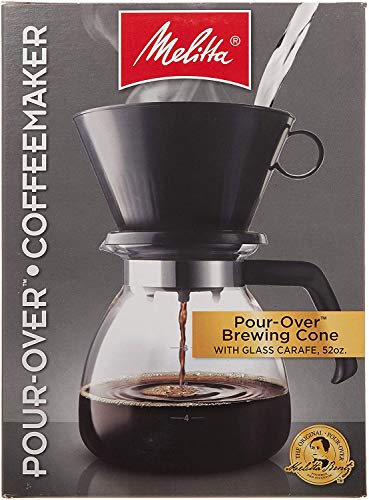
Melitta invented the paper coffee filter in 1908, and its 52-ounce pour-over brewer carries that heritage at the largest scale in this guide. Fifty-two ounces is thirteen cups by the small measure or six very serious mugs, poured from a glass carafe under a black brewer top. The listing title is terse to the point of stubbornness — size, method, vessel, colour, full stop — which means several things a buyer might want to know, including the filter arrangement and the carafe’s glass type, the listing title simply does not supply them, and they are flagged as such below rather than guessed at.
- Capacity from the listing: 52 oz
- Vessel: glass carafe
- Brewer colour: black
- Filter medium: not given in the listing title
- Glass type: the title leaves the glass unspecified
- Grip material: unmentioned in the title
Strengths
- The largest capacity here by a wide margin; one brew covers a brunch table or an office morning meeting.
- A heritage name in drip coffee, from the company that patented the paper filter itself.
- A clear glass carafe lets the host see the level and judge a second brew without lifting anything.
Trade-offs
- Big batches cool and stale if the crowd is smaller than the carafe; capacity unused is flavour wasted.
- The sparse title leaves the filter question open, so confirm what the set expects before the first brew morning.
- A full 52 ounces of water plus grounds makes the heaviest pour in this guide; small wrists will notice.
Scale changes technique on a brewer this size. A kettle that perfectly wets a 20-ounce bed of grounds merely anoints the centre of a 52-ounce one, so the Melitta rewards a slower, wider spiral and a brief pause to let the deep bed bloom. Hosts who master that rhythm gain something no smaller set offers: the ability to put one brewing event, finished before guests sit down, at the centre of a long table and then stop thinking about coffee entirely. That is the social case for capacity, and it is stronger than the arithmetic one.
The black top matters at a table, too. Among five clear-and-steel rivals, the Melitta reads as serveware rather than laboratory glass, which suits dining rooms where a brunch is staged rather than merely eaten. Owners of the company’s paper filters will also feel at home fastest here, since the Melitta name has been printed on filter packets for generations of grocery shoppers — though, to repeat the honest note from the spec box, this particular listing leaves its filter details for the product page to supply.
An office kitchen reveals the Melitta’s other talent: forgiveness at scale. Whoever brews — and in an office it is always someone different — faces a deep bed of grounds that tolerates an uneven pour, a kettle refilled mid-brew and grounds measured by scoop rather than scale. The coffee that emerges will not win tastings, yet it will be hot, plentiful and recognisably coffee at nine in the morning, which is the entire brief. Hosts at home can borrow that robustness for the mornings when family descends in shifts and the carafe must simply stay ahead of demand until the last riser appears.
Best for: hosts, offices and big families who brew once for many people and serve at a table.
Not suited for: a solo drinker’s desk, where 52 ounces guarantees a stale second half every single day.
Check price on Amazon — Melitta’s big-carafe answer for the full-table morning.
Bean Envy Pour Over 20 Oz
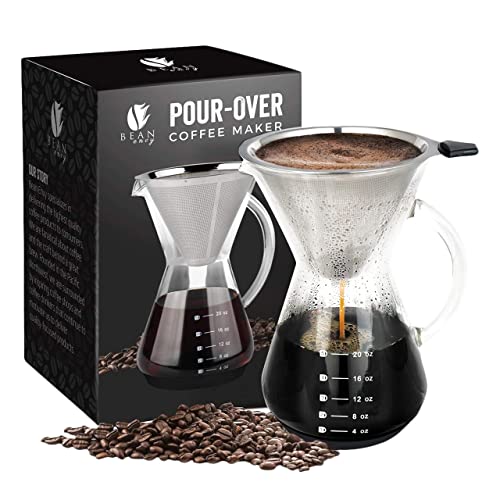
Bean Envy’s 20-ounce set is the introvert of the group and proud of it: a glass dripper with a steel filter over a borosilicate carafe, scaled for one person’s serious mug plus a top-up. Its title is the most forthcoming of the six, volunteering dishwasher safety, a non-toxic materials claim, a reusable stainless mesh and a silicone base that keeps the carafe planted on a wet counter. Where the Chemex title trusts its reputation, the Bean Envy title itemises its courtesies, which makes it the easiest pick here to buy with confidence from the listing alone.
- Capacity from the listing: 20 oz
- Carafe: borosilicate glass
- Filter: reusable stainless steel mesh
- Base: silicone
- Cleaning claim in the listing: dishwasher safe
- Materials claim in the listing: non-toxic
Strengths
- Dishwasher safety removes the last chore from a one-cup ritual; the whole set can join the evening load.
- The silicone base grips slick stone counters and deadens the clink that wakes a sleeping household at six.
- Twenty ounces brewed fresh beats forty ounces reheated, and this set is honest about serving one.
Trade-offs
- A partner who develops a coffee habit turns this into a two-shift brewer overnight.
- The compact carafe offers little headroom for ice, so Japanese-style iced pour-over needs a separate vessel.
- Steel mesh texture in the cup remains, as with every reusable filter here.
Smallness is a discipline as much as a size. With 20 ounces there is no economy in brewing yesterday’s ratio carelessly, because the whole batch is one sitting and every flaw is present in it. Owners tend to become precise: the same kettle path, the same pause after the bloom, the same mug warmed while the dripper drains. The set also travels between rooms gracefully — a silicone-footed carafe on a tray, carried to a desk or a garden chair, sloshes less and lands softer than any rival here, a virtue the listing’s base quietly provides.
Dishwasher safety deserves its emphasis because it changes who should buy steel. The usual objection to reusable filters is the scrubbing; a set rated for the dishwasher answers that objection for the solo drinker whose entire coffee kit must justify its sink time. Bean Envy clearly designed for the apartment kitchen, the studio flat and the office nook, and the 20-ounce ceiling that looks like a limitation in a family guide reads, in those rooms, as the entire point.
The Bean Envy also earns a place in the smallest serious kitchen niche: the rented room, the studio, the narrowboat galley, anywhere a brewer competes for counter with a chopping board and a kettle and nothing else. At 20 ounces it brews a full ritual — bloom, spiral, drain — inside a footprint a mug rug could cover, and when the drinker moves house it packs into a shoebox with the mugs. Buyers furnishing a first flat often start here and graduate to a bigger set years later, keeping the little Bean Envy for travel and guests-of-one; it is the pick most likely to be owned twice in a lifetime, once by necessity and once by nostalgia.
Best for: one committed drinker in a small kitchen who wants fresh coffee and dishwasher-level cleanup.
Not suited for: couples or housemates, since the second person’s mug requires a whole second brew cycle.
Check price on Amazon — the single-server with a silicone foot and nothing to prove.
Six carafes side by side: capacity, filter and temperament
| Brewer | Capacity in the listing | Filter route | Defining detail |
|---|---|---|---|
| Bodum 34oz Pour Over | 34oz | Reusable stainless steel | Cork grip; made in Portugal |
| Chemex Classic 8-Cup | 8-cup | Paper, bought separately (not named in title) | One-piece hourglass glass |
| Cosori Pour Over 34oz | 34oz | Double-layer stainless steel | Camping and hiking named in the title |
| Coffee Gator 27oz | 27oz / 800ml | Reusable stainless steel | Dual-unit sizing for ratio brewers |
| Melitta 52 oz Brewer | 52 oz | Left for the product page to specify | Largest carafe; black brewer top |
| Bean Envy 20 Oz | 20 oz | Reusable stainless mesh | Dishwasher safe; silicone base |
Read the table by lifestyle rather than by ounces alone. The two 34-ounce sets differ in the hand, not the kettle: cork against doubled mesh. The Chemex stands apart as the only paper brewer whose title speaks in cups, and the Melitta apart as the only one whose capacity is measured in guests. Bean Envy and Coffee Gator, the two small sets, split on cleanup — one goes in the dishwasher, the other asks for a rinse and rewards measuring. Anyone torn between two rows should choose by the morning they actually live, not the morning they photograph.
How do you choose a manual drip brewer that fits your mornings?
Start with the honest headcount
Count mugs on your busiest regular morning, not your quietest. A household of two that hosts parents monthly needs either the Melitta’s headroom or the patience to brew the Bodum twice; a single drinker who buys the 52-ounce carafe for someday guests will drink stale coffee on three hundred ordinary days to shine on twelve. Capacity regret runs in both directions, and it is the cheapest regret in this guide to avoid, because the arithmetic takes one minute with a measuring jug and your actual mugs.
Decide what your filter commits you to
Steel frees you from a consumable and charges you in sediment and scrubbing; paper charges you forever, a little at a time, and pays in clarity. Neither is virtuous. The Cosori’s double mesh is the engineered middle, worth its extra rinsing if the gritty last sip is your only quarrel with reusable filters. Whichever route you take, commit fully: the drinker who keeps both a steel set and a paper set usually masters neither and blames the beans.
Weigh the kettle you already own
Manual drip quietly assumes a kettle that can pour in a controlled stream. A wide-spouted stovetop kettle dumps; a gooseneck persuades. If your kettle is the dumping kind, favour the forgiving brewers — the deeper beds of the Melitta and Chemex tolerate a heavier pour better than the Bean Envy’s small cone, where a flood overwhelms the grounds in seconds. Budget honesty matters here: a modest brewer plus a decent kettle outperforms a beautiful brewer fed by a watering can.
Think about where the set will live
Counter, cupboard or open shelf decides more purchases than flavour does. The Chemex needs height and gentleness; the Bean Envy needs almost nothing; the Bodum’s cork and the Melitta’s black top are the two that look intentional on display. Measure the shelf before the box arrives, and remember that a brewer stored in an awkward place becomes a brewer used on weekends only, which is how good sets die.
Finally, picture the set in December, not in the showroom of your imagination. Winter mornings are darker, hands are colder, guests are more numerous and patience is thinner; the brewer that delights in a leisurely June may irritate in the festive crush. The Melitta’s capacity, the Bean Envy’s dishwasher manners and the Bodum’s warm cork all read differently by firelight. Choosing for the hardest month rather than the easiest one is how a set survives to its second year still in daily use.
Water, patience and the ninety-second bloom
Every set in this guide shares one invisible component: the thirty to forty-five seconds after the first pour, when fresh grounds swell and release gas. Skipping the bloom is the fastest route to a sour cup on any of the six, because trapped gas pushes water around the grounds instead of through them, and no filter medium — steel, doubled steel or paper — can rescue a brew that channelled from the start. The ritual is simple enough to learn in a week: wet the grounds with twice their weight in water, watch the bed rise, wait, then continue in slow circles. On the small Bean Envy the bloom nearly fills the cone, which looks alarming and is correct; on the Melitta the same pause prevents the deep bed from cracking into channels. Drinkers who time only one thing should time this, since the bloom forgives more other sins — a kettle a degree too hot, a grind a shade too fine — than any other step in the manual drip process.
Why manual drip survives every kitchen fashion
Electric brewers have gained timers, apps and thermal carafes, yet the pour-over shelf keeps its customers, and the reasons are embarrassingly practical. A glass-and-steel set cannot be bricked by a software update, cannot fail because a heating element scaled up, and works during the outage that cancels the neighbourhood’s alarms. Its parts are visible, so its failures are visible: a crack you can see beats an error code you must search. There is also the matter of pace. Pouring water in circles for three minutes is the one kitchen task that resists multitasking, and many owners protect that small enforced pause the way earlier generations protected a pipe on the porch. The six sets here will not make anyone a slower person, but they refuse to hurry, and for a growing number of households that refusal is the feature they were shopping for all along. That same buy-it-once, maintain-it-simply thinking runs the heating cupboard too, where Best Fiberglass Furnace Filters works through disposable glass-fibre panels, their sizes and their low-restriction airflow for readers who service their own furnace.
There is one more setting where manual drip quietly outclasses every plugged rival: anywhere the power is a promise rather than a fact. Canal boats, shepherd’s huts, festival fields, the cottage at the end of a lane where storms edit the electricity — in all of them the kettle heats on gas or a stove and the brewer asks nothing further. Owners who keep a Bean Envy or a Cosori in a camper van are not being quaint; they are carrying the only coffee system whose failure modes are a cracked carafe and an empty bean jar, both visible at a glance.
Grind, ratio and the measuring habit
Manual drip exposes a truth electric machines conceal: the brewer is only the stage, and the grind performs the play. Too fine, and any of these six turns bitter and slow, water pooling on a bed it cannot penetrate; too coarse, and the stream runs pale and fast, leaving the grounds’ sweetness behind. The useful experiment costs one bag of beans and one week. Brew the same coffee on your chosen set at three grinder settings, two clicks apart, keeping every other habit fixed, and taste the middle cup against the extremes. Most drinkers find their setting on the second day and never move it again, which is precisely the point — a manual brewer converts guesswork into a small, permanent piece of self-knowledge.
Ratio is the second lever, and the simpler one. Weighing coffee sounds like laboratory fuss until a scale the size of a paperback lives beside the kettle; after that it is four seconds and total consistency. Drinkers who refuse scales can still standardise with a dedicated scoop used level every time, accepting a little weather in the cup as the price of romance. What neither group should do is measure by eye from the bag, because the eye is optimistic on sleepy mornings and the resulting cup varies more than any two brewers in this guide differ from each other.
Water completes the triangle. Kettle water that has boiled three times tastes flat because its dissolved gases have fled, and coffee brewed with it tastes oddly tired even from fresh beans. Fill the kettle fresh for each brew, a habit that costs nothing and quietly upgrades every set on this page. In hard-water districts, a filtered jug earns its counter space the same way: scale belongs in the kettle, where it can be removed, not as a mineral haze across a borosilicate carafe you chose partly for its clarity.
Glass, cork, silicone: caring for the parts that age
A pour-over set has no motor to burn out, so its lifespan is decided entirely by how its materials are treated. Glass fails by impact and by thermal shock, in that order; the defence against both is a trivet habit — never set a hot carafe on cold stone or a wet sink — and a drying rack that gives the vessel its own space instead of a crowd of mugs. Cork wants the opposite of care: leave it alone, wipe spills, and never soak it, and it will outlast the glass it grips. Silicone, the Bean Envy’s base, asks only to be peeled off occasionally so the trapped moisture beneath it can dry, a thirty-second task during the monthly filter soak.
Steel filters age by clogging rather than breaking, and their decline is so gradual that owners adapt without noticing, pouring faster to compensate and wondering why the coffee thinned. The monthly hot soak described in the Bodum review applies to every mesh in this guide, Cosori’s doubled one included, and a filter restored to free drainage often feels like a new brewer. Paper, the Chemex’s route, skips that maintenance entirely and replaces it with a shopping habit; neither burden is heavy, yet they suit different temperaments, and choosing the burden you will actually carry is the most practical sentence in this entire guide.
The first fortnight with a new brewer
Every set in this guide has a learning curve measured in days rather than months, and the curve has the same shape for all six. The first three brews teach the vessel: how fast its filter drains, where its carafe wants to drip down its own side, how its grip behaves when wet. Brews four to nine teach the pairing with your kettle, because the pour that suited a neighbour’s gooseneck floods from a wide spout and starves from a timid one. By the second week the motions have sunk below thought, which is when owners start tasting their beans properly for the first time — the brewer has stopped being a variable and become a constant, the precondition for judging anything else in the cup.
Two habits shorten that fortnight. Keep a notebook, even a phone note, of grind setting and ratio for the first ten brews, because memory flatters and paper does not. And change one thing at a time: the drinker who swaps beans, grind and ratio in a single morning learns nothing except that mornings are confusing. Households switching from an electric machine should also expect a brief, unfair disappointment around day two, when the manual cup tastes thinner simply because it is clearer; by day six the palate recalibrates, and the old machine’s cup starts tasting muddy instead. That reversal has sold more pour-over sets than any advertisement.
Common mistakes
Boiling water straight onto the grounds. A rolling boil scorches the bed’s surface and drags bitterness into every cup; let the kettle sit off the boil for half a minute, a pause that costs nothing and rescues more flavour than any grinder upgrade at this level.
Grinding for the machine you used to own. Steel mesh wants a coarser grind than paper, because fines slip the mesh and muddy the carafe. Owners who switch from a Chemex to a Bodum without touching the grinder dial conclude, wrongly, that steel makes bad coffee.
Pouring the whole kettle in one heroic flood. The bed drowns, water finds one channel, and half the grounds never brew at all. Three or four patient pours take ninety seconds longer and taste like a different coffee entirely.
Leaving brewed coffee sitting on the grounds. A dripper left perched over the carafe keeps dripping bitterness into the finished batch. Lift the cone off when the stream breaks into drops, and let the cup be the cup.
Storing beans beside the brewer for the photograph. Warmth, light and kettle steam age beans faster than any other kitchen force. The shelf that displays the Bodum beautifully will quietly stale the bag beside it; keep the beans in a cupboard and the glassware in the light.
Final recommendation
Most households should start where the arithmetic is kindest. The Bodum 34oz is the default recommendation of this guide: paper-free, table-worthy, sized for real families, and honest glass from a named origin. Choose the Chemex instead when clarity in the cup outranks convenience and the paper ritual feels like part of the pleasure, or when eight cups must arrive at once in a single vessel. The Cosori earns its place for steel drinkers bothered by sediment and for anyone whose brewing happens at campsites as well as counters. Coffee Gator’s 27 ounces is the connoisseur’s small batch, Bean Envy’s 20 ounces the solo drinker’s dishwasher-friendly answer, and the Melitta stands alone when the table seats six and the coffee must simply be there, in quantity, before the eggs. None of the six will embarrass a good bag of beans, which is more than many machines with plugs can claim. When the morning moves from coffee to cooking, the blending guide at Best Hand Blenders For Soup covers the next counter over, and households graduating from drip to pressure will find their next shelf in Best Espresso Semi Automatic Machines.
A last word on beans, since no brewer rescues stale ones. Buy half as much, twice as often, from a roaster who prints a roast date, and grind minutes before the kettle boils rather than the night before. The six sets here will repay that freshness immediately and visibly, which is more encouragement than a sealed electric machine ever offers its owner.
Frequently asked questions
Does manual drip coffee taste better than machine drip?
It tastes more controllable, which skilled hands turn into better. The pour decides extraction in a way a machine’s fixed shower head cannot, so a careful drinker with fresh beans usually prefers the manual cup, while a rushed drinker often prefers the machine’s consistency. The six sets here give you the control; they cannot give you the three patient minutes, which remain the cook’s contribution.
What grind suits a stainless steel filter?
Medium-coarse, closer to coarse sand than to caster sugar. Fine grounds migrate through steel mesh and cloud the carafe, and they slow drainage until the brew over-extracts. Paper tolerates a finer grind, one reason the Chemex cup tastes cleaner; if you own both styles, expect to keep two grinder settings in your head and mark them with tape until they become habit.
How long does a pour-over brew take, honestly?
Between three and five minutes of pouring and draining for the sizes here, plus the kettle’s boil. The Bean Envy finishes fastest, the Melitta slowest, and all six beat the cycle of descaling, programming and troubleshooting an electric brewer across a year of mornings. The honest cost is attention, not time: those minutes are spent standing at the counter, kettle in hand.
Can these brewers make iced coffee?
Yes, by brewing at double strength directly over ice in a separate sturdy vessel, which chills the coffee before its aromatics fade. The Bean Envy’s small carafe leaves little room for ice, so its owners should brew into a jug instead; the Bodum, Cosori and Melitta carafes swallow a tray of cubes comfortably. Steel filters suit the method well, since the melt dilutes the sediment impression.
Is borosilicate glass worth seeking out?
For a vessel that meets near-boiling water daily, yes. Borosilicate’s low thermal expansion is the difference between a carafe that tolerates a cold counter in January and one that eventually stars and cracks. Three of these six titles name it outright; where a listing stays silent, as the Melitta’s does, treat the glass kindly — warm it with a rinse — and it will behave as though it were.
Do I need a gooseneck kettle, or will my ordinary kettle do?
An ordinary kettle brews drinkable coffee on all six sets, and a gooseneck brews noticeably better coffee on the smaller three. The narrow spout lets you keep the stream over the grounds instead of the filter walls, which evens the extraction; on the Melitta’s wide bed the advantage shrinks, because the target is larger and the bed deeper. Buy the brewer first, live with your kettle for a month, and let the frustration, if any, make the decision with evidence.
Which of the six keeps coffee warm longest?
None of them insulates, and honesty requires saying so plainly: glass carafes begin cooling the moment brewing ends, the Melitta’s large volume merely slowing the fall by holding more heat in more coffee. The working answers are a warmed mug, a cork or wooden coaster under the carafe rather than cold stone, and brewing closer to the moment of drinking — the strategy the Chemex review calls sequencing. Drinkers who need coffee held hot for hours should decant into a thermal flask and accept the small flavour tax, rather than blaming any of these honest glass vessels for physics.
Tomorrow morning the kettle will whistle either way; the only question this guide leaves open is whether the water falls through glass and steel you chose on purpose.


