What's inside
- Where to buy
- Quick Picks
- How these picks were chosen
- Power, control and kit: the comparison that matters
- How do you choose a hand blender that suits your soup?
- Soup technique that flatters any of these six
- Cleaning, the two minutes that decide everything
- Six soups, and what each one teaches the buyer
- The arm, the guard and the pot: a geometry lesson
- Baby food, sauces and the blender’s second career
- Common mistakes
- Final recommendation
- FAQ
As an Amazon Associate I earn from qualifying purchases. This post may contain affiliate links at no extra cost to you.
As an Amazon Associate, cottageverdict.com earns from qualifying purchases.
Soup exposes every weakness a hand blender has. The pot is hot, deep and full; the ingredients range from silk-soft roasted squash to fibrous leek and the occasional stubborn potato chunk; and the job is not done until the texture is even from the top of the pot to the bottom, without a single splash on the hob or the cook. The best hand blenders for soup are immersion blenders whose titles name soup outright, and they divide along three honest axes: motor power as stated in watts, speed control — two fixed speeds, a turbo boost, a trigger or a dial — and whether the blender arrives alone or as a kit with a processor, whisk and frother competing for drawer space.
Two Turelar models bookend the power range, a 400W two-speed stick and an 1100W five-in-one set, and they are treated here as the different purchases they are. MasterChef offers a second 400W route with variable speed and turbo. Bonsenkitchen keeps its title’s wattage unstated and its design simple. Braun’s MultiQuick 7 brings a three-in-one kit and the category’s most emphatic brand claim, stated in its title and reported as such. KitchenAid’s KHBV53 closes the set with a removable 8-inch blending arm, a lidded jar and a named colour, Empire Red. Every wattage and attachment below comes from the titles; where a title omits power, the review says so.
Where to buy
Six immersion blenders, all titled for soup, split between solo sticks and kits. First orientations follow.
The first Turelar is the straightforward soup stick: corded, 400W, two speeds, stainless steel blades, an ergonomic handle, and BPA-free materials as its title states.
Turelar’s second entry is a different animal — 1100W, five in one, with a trigger variable speed and a food processor, whisk and frother in the box.
MasterChef’s immersion blender matches the first Turelar’s 400W but adds variable speed control and a turbo boost, with easy clean as a titled trait.
Bonsenkitchen’s entry keeps the brief minimal: stainless steel blades, two mixing speeds, and soup named among its uses, with no wattage in the title.
Braun’s MultiQuick 7 is the kit choice — a three-in-one with food processor, beaker, whisk and a 2 cup chopper, adjustable speed and detachable attachments.
KitchenAid’s KHBV53 is the colour-forward classic: variable speed, a removable 8-inch blending arm and a blending jar with a lid for storing what you pureed.
Quick Picks
| Pick | Best for | Standout from the title |
|---|---|---|
| Turelar Immersion Blender 400W Corded | Simple two-speed soup work | 400W, stainless blades, BPA-free |
| Turelar Immersion Blender 1100W 5 in 1 | One tool for five jobs | 1100W, processor, whisk, frother |
| MasterChef Immersion Blender 400W | Turbo boost on a budget format | Variable speed plus turbo boost |
| Bonsenkitchen Immersion Hand Blender | Uncomplicated blending | 2 mixing speeds, stainless blades |
| Braun MultiQuick 7 Immersion Blender | A full prep kit | Beaker, whisk, 2 cup chopper |
| KitchenAid KHBV53 Empire Red | Deep pots and storage | Removable 8-inch arm, jar with lid |
How these picks were chosen
The qualifying test was literal: the listing title had to name soup among the blender’s uses. That single requirement excluded capable blenders marketed only for smoothies, because soup work — hot liquid, deep pots, fibrous vegetables — is a specific discipline and this guide wanted titles that acknowledge it. Within the six that qualified, selection favoured spread across power, speed control and kit content, so the set contains a genuine decision rather than six versions of one stick.
Specifications are reported only as titled. Wattage appears for the two Turelars and the MasterChef; the Bonsenkitchen, Braun and KitchenAid titles state none, and no figure has been borrowed for them from anywhere else. Brand superlatives in titles — one appears in the Braun entry — are reported as the listing’s own claim, in the listing’s own framing. Attachment lists are quoted from titles exactly, because the difference between a blender and a blender system is precisely what is in the box.

Turelar Immersion Blender 400W Corded
Turelar’s 400W corded stick is the purist’s entry: an immersion blender titled as an emulsifier and blender, with two speeds, an ergonomic handle, stainless steel blades and BPA-free materials, presented for soup, smoothies, puree and baby food. Nothing in the box competes with the blender itself for your attention, because there is nothing else in the box as the title describes it. For a cook whose soup-making is a weekly rhythm and whose drawers are full, that restraint is the design.
Listing-stated details — Power: 400W, corded. Speeds: 2. Blades: stainless steel. Handle: ergonomic. Materials: BPA-free as titled. Uses named: soup, smoothies, puree, baby food. Attachments: none stated in the title.
Strengths
- Two speeds are genuinely sufficient for soup: low to start a deep pot without a vortex splash, high to finish the texture smooth.
- Stainless steel blades meet hot liquid without the material anxiety that hangs over all-plastic blending heads in a boiling pot.
- A solo stick stores in a utensil crock or a shallow drawer, asking none of the cupboard negotiation a kit demands.
Trade-offs
- At a stated 400W it is the joint-lowest power here; very fibrous or partially frozen loads will take longer passes than the 1100W sibling needs.
- No whisk, chopper or beaker is titled, so garlic, herbs and small purees stay with the knife and board.
- Two fixed speeds give less finesse than a trigger or dial when emulsifying a dressing that can split if bullied.
Soup technique with a two-speed stick is a rhythm rather than a setting. Start low with the head fully submerged and the pot off the fiercest heat, walk the blender slowly through the quarters of the pot, and tilt it slightly to draw the top layer down. Only when the big pieces are broken should the second speed come in, to polish. The ergonomic handle in the title matters across those minutes more than any specification: a soup pot for a family is a five-minute blend, and grip comfort decides whether the cook finishes the texture or declares it rustic at minute three.
The BPA-free note, stated in the title, addresses the materials question that hot-liquid blending raises more sharply than smoothie work does. Combined with stainless blades, the picture is of a stick designed to live in hot pots rather than visit them. Its stated uses — soup first among equals with puree and baby food — suit a household whose blending is mostly cooked food rather than frozen drinks.
Against its own sibling below, this Turelar is the deliberate subset: same brand language, a third of the stated power, none of the kit. Against the MasterChef, it trades variable speed and turbo for a simpler control. It is the set’s answer for cooks who blend soup and little else.
Best for: a weekly soup maker wanting a corded 400W stick with stainless blades and two speeds, stored in a drawer and used in the pot.
Not suited for: a cook seeking chopping and whisking attachments in the same purchase, or blending frozen fruit daily at a stated 400W.
Check price on Amazon for the solo Turelar, the simplest route into in-pot blending in this set.

Turelar Immersion Blender 1100W 5 in 1
The second Turelar shares a brand with the first and almost nothing else. Its title states 1100W, a five-in-one hand blender set with a trigger variable speed, and an emulsion stick accompanied by a food processor, a whisk and a frother, presented for soup, puree and baby food, with anti-scratch design named. This is a prep system wearing a blender’s name: the stick handles the pot, the processor handles the soffritto, the whisk handles cream, and the frother handles the coffee corner.
Details from the listing title — Power: 1100W, corded handheld. Speed: trigger variable speed. Kit: food processor, whisk, frother — five in one. Design note: anti-scratch. Uses named: soup, puree, baby food.
Strengths
- A stated 1100W is the highest power in this guide by a wide margin, giving fibrous soups and thick purees a shorter, cooler-running job.
- Trigger variable speed ties power to finger pressure, the most intuitive control for starting gently in a full pot and finishing hard.
- The processor attachment moves soup prep itself — onions, carrots, herbs — onto the same motor, collapsing two appliances into one storage decision.
Trade-offs
- Five pieces need washing, drying and storing; the kit’s convenience is paid in cupboard space and sink time after every use.
- High power in a shallow bowl is a splash hazard; the trigger’s finesse must be learned before it is trusted near a white shirt.
- Anti-scratch design is titled without detail, so owners of delicate non-stick pots should still confirm the guard arrangement on the listing.
Power in an immersion blender is not about speed records; it is about behaviour at the bottom of a deep pot of lentil soup in minute four. A weaker motor strains, heats and slows exactly when the mixture thickens, while a strong one holds its pace and finishes before the cook’s arm tires. The 1100W figure in this title, nearly triple its sibling’s, is aimed at that moment. Paired with a trigger — where the squeeze is the speed — it gives the cook a single-hand modulation that two-button sticks cannot imitate: feather the start, lean in for the fibrous core, ease off as the surface calms.
The kit reframes the purchase from blender to system, and systems should be bought by counting their weekly uses. A household that makes soup from raw vegetables twice a week will use the processor constantly and bless the consolidation. A household that buys pre-chopped vegetables and blends only the pot will store four attachments to use one, and the solo stick above is the honester buy for them. The frother, notably, exports the system beyond soup entirely, into morning coffee — a small annexation that some households will use daily.
Against the Braun kit below, the Turelar 5-in-1 counters with stated power and a trigger against Braun’s beaker and chopper format. Against its sibling, it is the maximalist answer. Both are legitimate; the drawer decides.
Best for: a cook who preps soup from raw ingredients and wants one 1100W motor driving a processor, whisk and frother beside the blending stick.
Not suited for: a small kitchen with no storage for a five-piece kit, or a cook blending only finished soup and nothing else.

MasterChef Immersion Blender 400W
MasterChef’s immersion blender pairs the set’s joint-lowest stated power, 400W, with its most layered budget controls: variable speed control and a turbo boost, on a stainless steel blending stick presented as an emulsifier for baby food, soup and more, with easy clean as a titled promise. The proposition is finesse over force — a stick that lets a careful cook modulate, then punch the turbo for the last stubborn chunks.
Stated in the title — Power: 400W motor. Stick: stainless steel blending stick. Controls: variable speed control, turbo boost. Cleaning: easy clean as titled. Uses named: baby food, soup, puree work generally.
Strengths
- Variable speed at this power class is the control the first Turelar lacks, letting emulsions and delicate purees be approached gently.
- Turbo boost answers the end-of-blend problem — the last carrot coin orbiting the blades — without changing the base speed setting.
- Easy clean, as titled, acknowledges the immersion blender’s real ownership cost: the two minutes at the sink after every use.
Trade-offs
- The stated 400W ceiling is real; dense, fibrous or very thick mixtures will need patience and smaller working depths than the 1100W set requires.
- No attachments are titled, so this remains a stick alone, without the kit routes the Turelar set and Braun offer.
- Turbo on a variable dial invites over-blending delicate soups if the cook leans on it; gummy potato soup is the classic result.
Variable speed changes soup outcomes in a way fixed speeds cannot, because texture is a path, not a destination. A cauliflower soup wants a gentle start to keep the pot calm, a middle pace to break the florets, and restraint at the end to keep body rather than foam. A dial walks that path; a two-speed switch jumps it. The turbo then serves as punctuation — a two-second press for the chunk that survived — rather than as the engine of the whole blend. Cooks who think in textures will recognise this control layout as the one designed for them.
The easy-clean claim in the title deserves respect as a design priority. Immersion blenders fail socially when their heads trap soup in seams that yesterday’s washing missed; a stick designed to rinse clean under a tap gets used more often, because the cost of using it is lower. Confirm the head’s construction on the listing — whether the stick detaches, whether parts are dishwasher-safe — since the title asserts the ease without describing the mechanism.
Against the first Turelar at the same stated wattage, the MasterChef is the control upgrade. Against the 1100W set, it is the restraint option. Its natural owner cooks soup thoughtfully and blends nothing frozen.
Best for: a texture-focused soup cook wanting variable speed and a turbo boost at 400W, with easy cleaning as part of the bargain.
Not suited for: a buyer seeking chopping or whisking attachments, or daily frozen smoothie blending at this wattage.
Check price on Amazon for the MasterChef, and confirm whether its stick detaches for washing.

Bonsenkitchen Immersion Hand Blender
Bonsenkitchen’s entry is the set’s quiet minimalist. Its title names an immersion hand blender for smoothie, puree and baby food, an electric handheld mixer and stick with stainless steel blades for soup, and an emulsion blender with two mixing speeds. No wattage is stated, and this review invents none for it. What the title does establish is the essential architecture — corded handheld stick, stainless blades, two speeds, soup among its named work — at what the category usually treats as its simplest tier.
Title-stated specification — Power: wattage not given in the title. Blades: stainless steel. Speeds: 2 mixing speeds. Form: electric handheld stick mixer. Uses named: soup, smoothie, puree, baby food. Attachments: none stated in the title.
Strengths
- Two mixing speeds and stainless blades cover the core soup brief without a control panel to learn or a kit to store.
- The title’s use list — soup alongside smoothie, puree and baby food — marks it as the household generalist of the simple sticks.
- Simplicity itself is a reliability trait: fewer attachments and modes mean fewer parts to lose, crack or misassemble.
Trade-offs
- With no wattage in the title, power comparisons against the stated 400W and 1100W rivals cannot be made from listing data; heavy fibrous work is an open question.
- No variable speed or turbo is titled, so its control matches the first Turelar’s two-step layout without that model’s stated power.
- No attachments are named, keeping prep work with the knife, as with the other solo sticks.
There is a real household for the simplest stick in the guide: the one that blends a pot of soup twice a month, makes baby food for a season, and wants the tool to disappear into a drawer between appearances. For that household, the marginal value of triggers, turbos and processors is low, and the marginal cost — money, space, washing — is paid weekly for benefits used rarely. The Bonsenkitchen’s title speaks to that household without embarrassment, listing the jobs plainly and claiming nothing it does not name.
The unstated wattage should be handled by the buyer rather than lamented. The listing page will carry the figure, and it should be read alongside the two stated rivals: if it lands near 400W, this blender competes directly with the first Turelar and the MasterChef on simplicity; the decision then turns on handle feel and price at the moment of purchase, factors no guide can settle from titles. What the title guarantees is the architecture, and for soup the architecture — submerged stainless blades, two speeds, a stick long enough for a stockpot’s little brother — is most of the story.
Technique flatters simple blenders. Work in a deep pot, keep the head submerged, move slowly, and rest the motor between long blends as any handheld deserves. Treated that way, a basic stick produces soup indistinguishable from a flagship’s; treated carelessly, the flagship splashes just as far.
Best for: an occasional soup maker wanting a simple two-speed stainless stick for soup, purees and baby food, with nothing else to store.
Not suited for: a buyer requiring stated wattage before purchase, or daily heavy blending that justifies the 1100W class.

Braun MultiQuick 7 Immersion Blender
Braun’s MultiQuick 7 arrives as a three-in-one immersion blender and food processor, with adjustable speed control, an ergonomic handle, detachable attachments, a beaker, a whisk and a 2 cup chopper. Its title also carries a brand superlative — “#1 Hand Blender Brand” — which is the listing’s own claim, reported here as such rather than endorsed. Wattage is not stated in the title. What is stated is a mature kit architecture from the category’s most established name, organised around detachable parts that wash and store separately.
From the listing title — Format: 3-in-1 immersion blender and food processor. Controls: adjustable speed control. Handle: ergonomic. Attachments: detachable; beaker, whisk, 2 cup chopper. Power: wattage not given in the title. Brand claim as titled: “#1 Hand Blender Brand”.
Strengths
- The 2 cup chopper is sized for soup’s supporting work — an onion, a handful of herbs, a small batch of breadcrumbs — rather than for show.
- Detachable attachments wash properly and store flat, answering the kit-storage problem more gracefully than fixed systems.
- Adjustable speed gives the emulsion-and-puree finesse that fixed two-speed sticks cannot, on the stick itself.
Trade-offs
- No wattage appears in the title, so raw power cannot be compared with the stated 1100W Turelar set from listing data alone.
- A beaker, whisk and chopper still require a cupboard corner; detachable is tidier, not invisible.
- The kit’s breadth means the soup stick is one role among several, and pure soup specialists may prefer a dedicated solo stick’s simplicity.
The beaker is the attachment newcomers underestimate. Blending directly in a tall beaker suits the small-batch work that pots dwarf: a single portion of soup reheated and re-smoothed, a baby food batch, a sauce for two. With the whisk beside it for cream and eggs and the chopper for aromatics, the MultiQuick 7 covers the whole perimeter of soup-making — before, during and after the pot — in a way the solo sticks structurally cannot. Braun’s long tenure in this category shows in that completeness of the perimeter rather than in any single specification.
Adjustable speed on the Braun plays the same role as the MasterChef’s variable control, with the kit around it. For soup specifically, the winning technique is unchanged: submerge, start low, walk the pot, finish at the speed the texture asks for. The ergonomic handle, named in both this title and the first Turelar’s, is the feature your hand will judge across a winter of weekly pots, long after the specification sheet is forgotten.
Against the Turelar 5-in-1, the Braun trades a stated wattage figure and a frother for a beaker-and-chopper configuration and an established brand’s ecosystem. Households choosing between the two kits are really choosing which attachments their cooking actually summons weekly.
Best for: a cook wanting one established kit — stick, beaker, whisk and a 2 cup chopper — covering soup and all its surrounding prep.
Not suited for: a buyer requiring a stated wattage in the title, or a minimalist never lifting the whisk or chopper from the box.
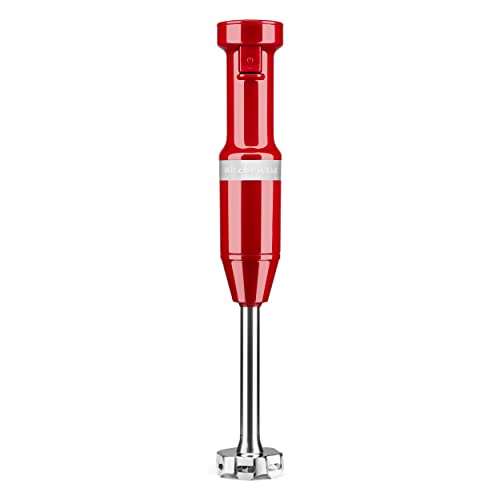
KitchenAid KHBV53 Empire Red
KitchenAid’s KHBV53 closes the set with the only named colour and the only stated arm length: a variable speed corded hand blender in Empire Red, with a removable 8-inch blending arm, a blending jar with a lid, and BPA-free material as titled, presented for smoothies, shakes and soups. The 8-inch arm is the soup-relevant headline — reach into a deep stockpot is the immersion blender’s defining geometry — and the lidded jar turns the blender into a make-and-store system for sauces and single portions.
Stated by the title — Arm: removable 8-inch blending arm. Speed: variable speed, corded. Included: blending jar with lid. Material: BPA-free as titled. Colour: Empire Red. Model: KHBV53. Power: wattage not given in the title.
Strengths
- An 8-inch arm reaches the bottom of deep stockpots where shorter sticks leave an unblended stratum — the classic soup failure this dimension prevents.
- A jar with a lid closes the loop from blending to storage: puree the sauce, lid the jar, refrigerate, without decanting.
- A removable arm washes and stores separately from the motor body, the hygienic arrangement every soup cook eventually wishes for.
Trade-offs
- No whisk or chopper is titled, so the kit breadth of the Turelar set and Braun is not part of this purchase.
- Wattage is unstated in the title, leaving power comparisons to the listing page, as with the Braun and Bonsenkitchen.
- Empire Red is a commitment: this is a counter-visible appliance, and kitchens in another palette should choose with eyes open.
Arm length sounds like a minor dimension until a tall pot of minestrone exposes it. A short stick forces the cook to tilt the pot, lower the level or accept a layered result — smooth at the top, chunky at the base — and tilting a pot of near-boiling soup is a manoeuvre nobody should design into dinner. Eight inches of arm, as titled, keeps the head submerged and the pot upright in the deep vessels soup actually cooks in. That single dimension is why the KHBV53 belongs in a soup guide rather than merely a blender guide.
The lidded jar extends the same practicality past the stove. Soup for one, a pureed sauce for tonight’s pasta, a batch of baby food for the week — each can be blended in the jar and stored in it, saving a wash and a transfer. Variable speed supports that range, gentle for the jar’s small volume, stronger for the pot. The BPA-free note, shared with the first Turelar’s title, addresses the hot-food material question in the same plain terms.
Against the field, the KitchenAid is the solo stick with a storage idea and the deepest reach. It concedes kits to Braun and Turelar, stated watts to Turelar and MasterChef, and wins on geometry and the jar. Deep-pot households should start here.
Best for: a stockpot household needing the titled 8-inch arm’s reach, with a lidded jar for blending and storing sauces and small batches.
Not suited for: a cook seeking chopping and whisking attachments in the box, or a wattage figure from the title before buying.
Check price on Amazon — the KHBV53 listing confirms its power figure for the final comparison.
Power, control and kit: the comparison that matters
| Model | Power as titled | Speed control as titled | In the box as titled |
|---|---|---|---|
| Turelar Immersion Blender 400W Corded | 400W | 2 speed | Stick only |
| Turelar Immersion Blender 1100W 5 in 1 | 1100W | Trigger variable speed | Processor, whisk, frother |
| MasterChef Immersion Blender 400W | 400W | Variable speed, turbo boost | Stick only |
| Bonsenkitchen Immersion Hand Blender | Not stated | 2 mixing speeds | Stick only |
| Braun MultiQuick 7 Immersion Blender | Not stated | Adjustable speed control | Beaker, whisk, 2 cup chopper |
| KitchenAid KHBV53 Empire Red | Not stated | Variable speed | Blending jar with lid; 8-inch arm |
Half the power column is empty because half the titles leave wattage out. That is not a defect in this table; it is the table’s most useful fact, telling you exactly which listings must be opened before a power-based decision can be made.
How do you choose a hand blender that suits your soup?
How deep are your pots, honestly?
Measure the pot you actually make soup in. Shallow, wide pans forgive any stick; a tall stockpot argues for the KitchenAid’s titled 8-inch arm before any other feature is considered. Geometry outranks wattage, because a blender that cannot reach cannot blend, whatever its motor claims.
Do you prep, or only blend?
If onions, herbs and breadcrumbs pass through your hands weekly, the two kits — Turelar’s five-in-one and Braun’s three-in-one — consolidate real work. If vegetables arrive prepped or happily knife-cut, the solo sticks are the honester spend. The same buy-for-real-habits logic governs the hob itself, as our guide to Best Gas On Glass Cooktops argues for burners.
How much control does your cooking use?
Emulsions, baby food and delicate purees reward variable speed — MasterChef, Braun, KitchenAid and the trigger-driven Turelar set. Two honest speeds — the first Turelar, the Bonsenkitchen — cover the hearty-soup majority. Match the control to the most delicate thing you blend, not the heartiest.
Where will it live?
A solo stick lives in a drawer or crock and is therefore used. A kit lives in a cupboard and is therefore planned around. Kitchens with one free drawer should buy the stick and forgive themselves; kitchens with a spare cupboard can let a kit earn its rent.
Soup technique that flatters any of these six
Take the pot off the fiercest heat before blending; a rolling boil throws liquid at the blender’s entry point and at the cook. Submerge the head fully before starting, every time — a head half in the soup is a fountain with a motor. Work the pot in quarters, moving slowly, tilting the stick slightly to pull the surface down into the vortex rather than pushing soup ahead of the blades. Rest a handheld motor in long blends: thirty seconds of pause across a big pot costs nothing and extends the life of every unit in this guide, whatever its stated wattage.
Texture is decided in the last twenty percent of the blend. Stop early for rustic, continue for smooth, and remember that potatoes turn gluey under prolonged high speed on any machine — the MasterChef’s turbo and the Turelar set’s trigger both demand a light hand there. A knob of butter or a splash of cream added in the final seconds emulsifies under the blades into a gloss no stirring achieves; that is the emulsifier role several titles here claim, demonstrated in the pot.
Finally, blend in the cooking pot only when the pot allows it. Thin, lightweight pans can spin or tip under a working blender; a heavy, stable pot is the right vessel, and transferring soup to one is a fair trade for safety. Non-stick interiors deserve the anti-scratch question the Turelar set’s title raises — confirm guard designs on listings, and keep any blender’s head off the coating when in doubt.
Cleaning, the two minutes that decide everything
An immersion blender’s dirtiest place is the underside of its blade guard, where soup dries into a lacquer if the stick is merely waved under a tap. The field method is immediate: fill a jug with hot soapy water, run the blender in it for ten seconds before the soup sets, then rinse and dry. Removable arms — KitchenAid’s, Braun’s detachable system — go further, separating for a proper wash. Do that small ritual and any of these six stays pleasant for years; skip it and the flagship smells like last month’s lentils by winter. Readers equipping the rest of the soup station will find the neighbouring decisions covered in Best Low Divide Kitchen Sinks, where the washing-up itself gets a layout, and Best Stovetop Rice Cookers, for the pot that so often shares the hob with the soup.
Six soups, and what each one teaches the buyer
Butternut squash soup is the immersion blender’s home fixture: soft flesh, sweet liquid, a texture that forgives. Every stick in this guide handles it, and the lesson it teaches is about comfort — across a big batch, the ergonomic handles named in the Turelar and Braun titles decide whether the last litre gets the same care as the first. Leek and potato teaches the opposite lesson, restraint: leeks blend silkily, potatoes punish enthusiasm, and the winning technique is to blend the leeks fully before the potatoes join, then finish with short, gentle bursts on the MasterChef’s variable control or the KitchenAid’s dial rather than a sustained high-speed campaign.
Lentil soup tests endurance. Red lentils dissolve almost unaided, but green and brown lentils keep their skins, and a fully smooth result asks for sustained work at depth — the scenario the Turelar set’s stated 1100W was built for, and the scenario where an unstated-wattage stick should be given rests and patience. Tomato soup tests the splash: thin, acidic and vividly coloured, it leaps at any head raised too near the surface, and it stains pale plastics, quietly arguing for stainless blades and a submerged discipline. Pea soup, especially with ham, tests the guard — fibrous strands wrap a blade housing, and the cook learns to lift, clear and resume rather than force a wrapped head through the pot.
Finally, a chilled soup — gazpacho in summer, or a cucumber soup — tests the beaker more than the pot. Small, cold batches belong in the Braun’s beaker or the KitchenAid’s lidded jar, where a big pot’s shallows would leave the head gasping at the surface. Six soups, six lessons, and together they map exactly onto this guide’s axes: reach, power, control, and what else is in the box.
The arm, the guard and the pot: a geometry lesson
An immersion blender is three geometries in negotiation. The arm sets the working depth; the guard — the bell or skirt around the blades — sets how the soup flows through the cutting zone and how the pot’s base is treated; the pot sets the stage both must fit. A wide guard in a narrow pot starves the flow and rattles the walls. A short arm in a deep pot strands the bottom layer. A light pot on a smooth hob rotates under torque that a heavy pot absorbs without comment. Buyers mesmerised by wattage overlook that the finest motor cannot correct a geometry mismatch, while a modest motor in the right geometry produces soup that tastes designed.
This is why the KitchenAid’s stated 8-inch arm leads its review despite its unstated wattage, and why the anti-scratch note in the Turelar set’s title matters to owners of coated pots: the guard is where blender meets cookware, and that interface decides whether the pot survives the soup. When a listing is silent on guard design, a buyer with expensive non-stick should treat the question as open and blend in a stainless or enamelled vessel instead — a workaround so simple it deserves stating plainly.
Baby food, sauces and the blender’s second career
Nearly every title in this guide names baby food or puree beside soup, and that second career changes the value calculation for young families. A stick bought for a winter of soups becomes, by spring, the tool that turns steamed pear and sweet potato into a freezer tray of portions — work where the KitchenAid’s lidded jar and the Braun’s beaker shine, and where variable speed matters because a baby’s texture progresses from silk to fork-mashed over months the blender can accompany. Households in that season should weight the jar, the beaker and gentle low speeds more heavily than raw wattage.
Sauces extend the same logic to the whole table: a pan sauce smoothed in its own pan, a romesco in the jar, a vinaigrette emulsified in the beaker in fifteen seconds. The emulsifier word that recurs across these titles is earned in that work — oil and acid held together by blades spinning in a small volume — and it is why a hand blender, alone among kitchen motors, tends to be used more in its third year than its first. Buy the one whose shape suits the pot and the jar both, and the second career comes free.
Cord management is the immersion blender’s unlisted specification, and every model here is corded as its title states or implies. A cord trails from the cook’s hand to the socket, crossing the hob’s neighbourhood; route it behind you, never across a live burner or a knife’s path, and give it enough slack that the stick’s full circuit of the pot never pulls it taut. Corded power is also the category’s quiet virtue — no battery fades mid-pot, no charge forgotten before a dinner party — and the stated wattages in this guide are available from the first second to the last in a way battery sticks cannot promise. The trade is the trail; manage it once, consciously, and it stops being a trade at all.
Storage follows from the same realism. A stick stored assembled in a crock is used three times as often as one stored boxed, because soup decisions are made at the stove in the moment. Kits complicate that arithmetic: the Braun’s detachable parts and the Turelar set’s five pieces want a single home — one box, one drawer, one shelf — agreed at purchase, or the whisk will be in the garage by March. Decide the home before the machine arrives and the kit’s breadth stays an asset; skip the decision and breadth decays into archaeology.
Noise, finally, is modest across the category and brief in duration — a pot blends in minutes, not the purifier’s hours — so it rightly ranks last among considerations. What matters more is vibration through the handle across those minutes, which returns the verdict to ergonomics: the titles that name an ergonomic handle are naming the feature your hand will grade, and in a shop, holding the actual stick for thirty seconds teaches more than a specification sheet can.
Freezing soup closes the loop that several of these blenders open. A stick that purees in the pot pairs naturally with a freezer stocked in portions, and the cooks who blend weekly tend to cook double for exactly that reason. Reheating a frozen puree often wants a thirty-second re-blend to restore its texture after ice crystals have roughened it — a second, smaller job where the jar-and-lid KitchenAid and the beaker Braun again earn their keep, smoothing a single portion without dirtying the stockpot. The duo of fresh blend and refresh blend is the category’s hidden rhythm, and it doubles the annual value of whichever machine a household chooses.
Gifting follows the pattern set elsewhere in this batch: match the tool to the recipient’s demonstrated cooking, not their aspirational kitchen. A new parent receives the variable-speed stick with a jar, and blesses it at 3 a.m. purees. A student receives the simple two-speed stick that survives a shared house. A serious cook receives the kit whose attachments mirror the prep they already do by hand. In each case the soup brief is the same; the right answer is the household wearing it.
One safety habit deserves isolation because it prevents the category’s only dramatic accident: never reach into a pot to free a wrapped blade or retrieve a spoon while the blender is plugged in and your other hand is near its control. Unplug first, clear second, resume third. Triggers and buttons are pressed accidentally in kitchens every day, usually by a hip against a counter edge, and the ten seconds an unplug costs is the cheapest insurance in this entire guide. The same discipline applies at the sink — a stick soaking in a washing-up bowl should be an unplugged stick, its cord draped visibly over the tap as a reminder to everyone in the kitchen.
Children learning to cook can join soup-making early and safely around a hand blender if the roles are staged: they choose the vegetables, they stir before blending, an adult blends, they taste and season. That staging teaches the pot’s whole arc while keeping small hands away from the one powered moment, and it turns the blender from a forbidden object — the most attractive kind — into a supervised tool whose turn comes last. Households that cook together keep their blenders longer, because the machine accrues memories alongside its mileage.
Seasonality completes the buyer’s picture. Hand blenders are bought disproportionately in autumn, when soup returns, and regretted disproportionately in summer by households that forgot the beaker work — smoothies, sauces, whipped cream — that carries the machine through the warm months. Every title in this guide names warm-weather work beside the soup: smoothies on the Turelar and Bonsenkitchen, shakes on the KitchenAid, the frother’s coffee on the Turelar set. A buyer in October should purchase for the whole year the title describes, and a buyer in June should not dismiss the category as a winter tool that happens to be on the shelf.
And when a blender finally retires — a cracked housing, a motor that smells tired — its replacement decision is easier than the first, because the household now knows its own answers: the pot depth, the prep habits, the attachments that gathered dust and the one that wore out from use. Buy the second blender from that evidence and it will fit like it was designed for the kitchen, because in every way that matters, it was.
A last word on herbs, the ingredient that separates good blended soup from great. Tender herbs — basil, coriander, parsley — bruise and darken under prolonged blending, turning a vibrant soup the colour of a pond. Add them in the final five seconds of the blend, or stir them through chopped after it, and the soup keeps its colour and its perfume. Hardy herbs, by contrast — rosemary stripped from the stem, thyme, sage — want the full blend or an early simmer, because their fibres need the work. Knowing which herb is which is not a blender specification, yet it decides more plates of soup than any wattage in this guide, and a cook who learns it gets flagship results from the humblest stick here.
Stock plays the same hidden role. A blender can only smooth what the liquid carries; a watery stock yields a thin soup no motor can enrich, while a good stock lets even a chunky, briefly blended soup taste complete. Blend less, season carefully, and let the pot’s foundations do their share.
Leftovers, the soup cook’s dividend, reward one more technique: blend the main batch a shade under your preferred smoothness, because reheating and re-blending across the week will carry the texture further each time, and a soup blended to silk on day one can reach baby-food uniformity by day three. The household that freezes in portions escapes the drift entirely — each portion is refreshed once, briefly, and tastes like its first evening. Either way, the blender’s work is not finished when the pot first goes quiet; it is the same tool, days later, that makes the leftovers worth planning for.
Altitude and ingredient temperature, two variables no title can state, still deserve a buyer’s awareness. At altitude, soup simmers below the usual boiling point and vegetables take longer to reach blending softness, so the patient cook extends the simmer rather than asking the blender to conquer undercooked fibres — a distinction every model here will reward. Frozen vegetables added straight to a pot, meanwhile, should be fully cooked through before the head goes in; a blender asked to smash half-frozen peas will do it loudly, slowly and at cost to its own longevity, whatever its stated watts.
And if the household blends for someone recovering from dental work or illness, texture stops being a preference and becomes the brief itself: blend longer, strain when silkiness truly matters, and choose the variable-speed machines that let you approach that texture gradually rather than overshooting into foam. The same stick that makes a rustic minestrone on Saturday can make a hospital-grade velouté on Tuesday, in the right hands, at the right speed.
Keep the packaging inserts until the first full soup has been made and the stick washed twice. That small probation period is when a handle’s true comfort, a trigger’s true feel and a kit’s true storage cost reveal themselves, and it is the window in which an exchange is painless. After it, commit fully: a blender that lives in the crock, seasoned by weekly use, becomes the kitchen’s habit rather than its experiment.
Mark that probation on the calendar with the soup you most often make, not the soup you most admire; a blender that masters your Tuesday lentil pot has passed the only examination your household is truly setting.
Common mistakes
Starting the blender before it is submerged. The classic soup splash, repainting hob, wall and cook in one second. Head under first, then power, every time.
Blending at a rolling boil. Heat plus agitation equals eruption risk and scorched flavour. Off the fiercest heat, always.
Over-blending potatoes. High speed on cooked potato releases starch into glue. Short bursts, low speed, or a masher for that one soup.
Buying a kit for a drawer that does not exist. Five pieces stored across three cupboards will not be assembled on a tired Tuesday. The solo stick wins that household honestly.
Ignoring the unstated wattage. Three titles here omit power. Open those listings and read the figure before comparing against the stated 400W and 1100W machines.
Letting the head dry dirty. Ten seconds in hot soapy water immediately after blending, or a lacquer of soup under the guard forever. The ritual is the maintenance.
Final recommendation
For pure soup duty with no storage drama, take the first Turelar: 400W, two speeds, stainless blades, done. For texture control at the same power, take the MasterChef and its turbo. For the full prep system, choose between the Turelar 1100W set’s stated power and trigger and the Braun MultiQuick 7’s beaker, whisk and chopper — by which attachments your cooking actually summons. For deep stockpots, take the KitchenAid and its 8-inch arm. And for the occasional blender of soup and baby food who wants the simplest tool in the guide, the Bonsenkitchen is the honest minimum.
FAQ
Can I blend soup directly in the pot with all six? That is the immersion design’s purpose, and every title here names soup. Use a heavy, stable pot, keep the head submerged, and take the pot off the fiercest heat first.
Which is the most powerful? By stated title figures, the Turelar 1100W 5 in 1, by a wide margin. Three titles state no wattage, so their power must be checked on their listings before any full ranking.
Do I need the attachments? Only if your cooking summons them weekly. A chopper earns its place through onions and herbs; a whisk through cream and eggs; a frother through morning drinks. Otherwise a solo stick is the better buy.
Why does my potato soup turn gluey? Over-blending at speed ruptures potato starch. Blend potato soups briefly and gently, or crush the potatoes separately and stir them back.
What makes a blender soup-safe for hot liquid? Stainless blades and suitable materials as titled — two entries state BPA-free materials — plus your own technique: submerged head, off the boil, steady pot.
Submerge first, blend gently, wash immediately — and any of these six will turn a pot of vegetables into soup worth sitting down for.


