What's inside
- Where to buy
- Quick Picks
- How these picks were chosen
- The six sinks laid side by side
- What should a household settle before choosing a low-divide sink?
- How the low divider earns its keep across a cooking week
- Installation realities the titles leave to the listings
- Care rhythms, material by material
- Grids, racks and the second life of the bowl floor
- Sound, splash and the sink after dark
- A sink’s second decade: what ages, what does not
- Common mistakes
- Final recommendation
- FAQ
As an Amazon Associate I earn from qualifying purchases. This post may contain affiliate links at no extra cost to you.
As an Amazon Associate, cottageverdict.com earns from qualifying purchases.
A low-divide sink is a double-bowl sink whose centre wall stops partway up, and that single architectural decision rewrites what a kitchen sink can do: soak a roasting pan across both bowls as if the sink were one wide basin, then return to two separate bowls for washing and rinsing the moment the water drops. The best low divide kitchen sinks all make that promise in their titles — low-divide or, in Kohler’s vocabulary, Smart Divide — and the six gathered here divide further by the choices that actually separate them: bowl split, mounting style, material and corner geometry. Three splits appear across the set, 60/40 in both directions and a level 50/50. Two mounting styles appear, undermount and drop-in. Three material families appear, stainless steel in two gauges, quartz composite, and SILGRANIT, with one listing declining to name its material at all.
Every sink here is a 33-inch-class fixture — five titles say 33 inches outright, and the Kohler stretches the point to 33-1/2 — which makes this a guide for kitchens with a standard wide sink base and a household that cooks enough to fill it. Within that shared footprint the personalities diverge sharply. Ruvati fields two stainless undermounts that are mirror images of each other, one favouring the left bowl, one the right. Kraus answers with the set’s only drop-in stainless model and its only even split. Karran brings quartz composite and a pre-drilled faucet hole. Blanco brings SILGRANIT in Soft White with the only full dimensions printed in any title here. Kohler brings the trademarked Smart Divide name and a matte white finish, and leaves its material for the product page to disclose.
Where to buy
Six wide sinks, one shared trick, and six different ideas about what a kitchen needs around that trick.
Ruvati’s RVH7419 opens the set: a 33-inch undermount with a 60/40 low-divide split, tight radius corners, double bowls in 16-gauge stainless steel.
Its sibling RVH7418 reverses the split to 40/60, softens the corners to rounded, and adds a brushed finish that the title says hides scratches, again in 16-gauge stainless.
Kraus’s Premier KTM102-33 is the drop-in dissenter: a 33-inch top-mount sink with an even 50/50 low divide in 18-gauge stainless, sold with two strainers.
Karran’s entry changes material entirely — a 33-inch quartz composite drop-in in white, 60/40 low-divide, described as heat and scratch resistant, with a faucet hole pre-drilled.
Blanco’s PRECIS pairs SILGRANIT with a 60/40 low divide in an undermount body, Soft White in colour, and the title prints its full footprint: 33 inches long by 18 inches wide.
Kohler’s Cairn closes the set under its Smart Divide trademark: a 33-1/2-inch undermount double-bowl sink in Matte White, model 27786-CM6.
Quick Picks
| Pick | Best for | Defining detail in the title |
|---|---|---|
| Ruvati 33in 60/40 Low-Divide RVH7419 | A large main bowl with tight corners | 60/40 split, tight radius, 16-gauge steel |
| Ruvati 33in 40/60 Low-Divide RVH7418 | The big bowl on the opposite side | 40/60 split, rounded corners, brushed finish |
| KRAUS Premier 33in Low Divide KTM102-33 | Drop-in fitting and an even split | 50/50, 18-gauge, strainers included |
| Karran 33in Quartz Low-Divide 60/40 White | Composite material with the faucet hole ready | Quartz composite, pre-drilled hole |
| BLANCO PRECIS SILGRANIT 60/40 Low Divide | Undermount composite with printed dimensions | SILGRANIT, 33 by 18 inches, Soft White |
| Kohler Cairn Smart Divide Matte White | The trademarked divider in a matte finish | Smart Divide, 33-1/2 inches, Matte White |
How these picks were chosen
Admission required the divider itself to be named in the title — low-divide, low divide or Smart Divide — on a double-bowl sink, because a guide to this category collapses into an ordinary sink roundup the moment that test relaxes. Accessories that borrow sink vocabulary, saddle organisers and sponge holders among them, were excluded at selection; every pick here is a complete sink. The survivors were then checked for genuine variety rather than repetition: two orientations of the asymmetric split, one even split, both mounting styles, and three material families, so that a reader can compare philosophies of sink design rather than six near-identical steel boxes.
Reporting follows the titles with unusual strictness, because sink titles are terse and every word in them is load-bearing. Gauge is quoted only where printed — 16-gauge for both Ruvatis, 18-gauge for the Kraus — and no depth, divider height or bowl dimension is invented for any model, even where a maker’s wider reputation might suggest one. Where a title omits a fact a buyer will certainly want, the review says the title omits it and sends the question to the listing, which is the only honest destination available.

Ruvati 33in 60/40 Low-Divide RVH7419
Ruvati’s RVH7419 is the reference configuration of this category stated cleanly: a 33-inch, 60/40 low-divide undermount kitchen sink, double bowl, tight radius corners, built from 16-gauge stainless steel. The 60/40 split is the design’s argument — one bowl large enough to be the kitchen’s main working basin, one smaller bowl that serves as rinse station, disposal side or soaking annex — and the low divider lets oversized items bridge the two when a sheet pan or a stockpot demands the full 33 inches. Tight radius corners give the bowls their crisp, architectural look, the near-square geometry that photographs like a professional kitchen.
Listing-stated details — Overall size: 33 inch. Split: 60/40 low-divide. Mounting: undermount. Corners: tight radius. Material: stainless steel, 16-gauge. Bowl depth and divider height await the listing.
Strengths
- The 60/40 arrangement gives one genuinely large working bowl instead of two compromised halves.
- 16-gauge steel is the heavier of the two gauges quoted anywhere in this set.
- Tight radius corners deliver the sharp, modern look that suits stone worktops and handleless cabinetry.
Trade-offs
- Tight corners ask more of a cleaning cloth than rounded ones; debris collects where the radius tightens.
- Undermount fitting requires a suitable worktop and a cabinet that accepts the sink’s rim and clips.
- The title prints no bowl depth, so pan clearance under the tap must be confirmed on the listing.
The gauge figure deserves translation for readers meeting it for the first time, because steel gauge runs backwards: the smaller number denotes the thicker sheet. Sixteen-gauge is therefore the more substantial material in this guide, the one that resists denting when a cast-iron pan lands heavily and that answers a knock with a duller, more expensive sound. Whether a household needs that substance depends on its cookware and its habits; a kitchen of heavy pans and hurried washing-up will exercise a sink’s gauge weekly, while a careful household may never learn which gauge it owns. Ruvati prints the number, which at least lets the buyer decide with the fact in hand.
The tight radius is this model’s honest bargain with its owner. Squared corners maximise usable bowl floor — pans sit flat, glasses stand steady — and they look deliberate in a way soft corners cannot. Their price is paid at cleaning time, in the extra seconds a cloth spends persuaded into each corner, multiplied by every day of the sink’s long life. Households that wipe a sink nightly will pay that price without noticing; households that clean in weekly campaigns will find tight corners holding the evidence. Neither temperament is wrong, but they should buy different Ruvatis — which is precisely why the range contains the rounded-corner sibling reviewed next.
Best for: a 33-inch undermount installation wanting a dominant main bowl, tight architectural corners and the heavier 16-gauge steel quoted in this set.
Not suited for: a worktop material that cannot accept undermount fitting, since this sink offers no drop-in alternative in its title.
Check price on Amazon to see the RVH7419’s full bowl dimensions.

Ruvati 33in 40/60 Low-Divide RVH7418
The RVH7418 is the RVH7419 reflected in a mirror and softened at the edges: a 33-inch undermount low-divide sink whose split runs 40/60 — the larger bowl on the opposite side — with rounded corners, double bowls in 16-gauge stainless steel, and a brushed finish that the title says hides scratches. That last phrase is a maker’s claim about the finish’s behaviour, reported here as the title presents it, and it is a plausible one in kind: brushed surfaces scatter light across fine lines rather than spotlighting each mark the way a mirror polish does. The mirror-image split is the substantive point. Kitchens are handed — by the cook’s dominant hand, by the dishwasher’s position, by the window and the hob — and a range that offers both orientations respects that handedness instead of forcing half its buyers to work against their own room.
Details from the listing title — Overall size: 33 inch. Split: 40/60 low-divide. Mounting: undermount. Corners: rounded. Material: stainless steel, 16-gauge. Finish: brushed, described as hiding scratches. Accessories and depth figures: see the listing.
Strengths
- The reversed split serves kitchens whose workflow wants the large bowl on the other side.
- Rounded corners rinse clean quickly, suiting households that clean in campaigns rather than nightly rituals.
- A brushed finish forgives the fine scratching that steel sinks accumulate as a condition of employment.
Trade-offs
- Rounded corners surrender a little bowl-floor area compared with the tight radius of its sibling.
- The scratch-hiding description is a finish claim from the title, not a guarantee against visible wear.
- As an undermount, it inherits the same worktop and cabinet requirements as the RVH7419.
Deciding between the two Ruvatis is the purest decision in this guide, because so much is held equal: same maker, same width, same gauge, same mounting, same divider concept. What remains is orientation and corners, and both should be decided standing in the actual kitchen. Orientation first: picture the dishwasher’s door open and the rack pulled out, picture where a roasting pan naturally gets carried from oven to sink, and the correct split usually announces itself — the big bowl belongs on the side where big things arrive. Corners second: the rounded geometry of the 7418 is the pragmatic choice for a family sink that hosts everything from jam jars to preserving pans, where cleaning speed outranks architectural crispness.
The brushed finish completes the pragmatic pattern. A working steel sink acquires scratches the way a chopping board acquires knife marks — as the record of its employment — and finishes differ mainly in how loudly they announce that record. Brushing whispers it. For a sink bought as a fifteen-year fixture rather than a showroom photograph, that whisper is worth real money, and Ruvati’s title is one of only two in this set to discuss its surface’s ageing at all. Households that entertain in the kitchen and cook with heavy iron will find this the most forgiving steel offer here.
Best for: a kitchen whose layout wants the larger bowl on the side this model provides, with rounded corners and a brushed finish for a hard-working family sink.
Not suited for: a buyer chasing the crisp tight-radius look, which belongs to the RVH7419 rather than to this rounded design.

KRAUS Premier 33in Low Divide KTM102-33
Kraus’s Premier KTM102-33 disagrees with the rest of this set on two fundamentals and agrees on the one that matters. The agreement is the low divide on a 33-inch double-bowl sink. The disagreements are mounting and proportion: this is a drop-in, top-mount design — the only one here — and its bowls split 50/50, the only even division in the guide, in 18-gauge stainless steel, with two strainers included in the listing. Drop-in mounting is the renovation-friendly philosophy: the sink lowers into a cutout and its rim rests on the worktop, tolerating worktop materials and existing cutouts that undermount designs refuse. A household replacing a tired drop-in sink can contemplate this model without also contemplating a new worktop, and that single fact will outweigh gauge arguments for many real kitchens.
Stated in the title — Overall size: 33 inch. Split: 50/50 double bowl with low divide. Mounting: drop in / top mount. Material: stainless steel, 18-gauge. Included: strainers, two. Bowl depths await the listing.
Strengths
- Drop-in fitting suits replacement projects and worktops that undermount sinks cannot use.
- The 50/50 split gives two equal bowls for households that wash and rinse in balanced volumes.
- Two strainers in the box cover both bowls from the first day, a small completeness rivals leave to chance.
Trade-offs
- 18-gauge steel is the lighter sheet of the two gauges quoted in this set.
- Neither bowl is oversized, so the largest pans rely on the low divide’s bridging trick more often.
- The top-mount rim interrupts the worktop’s sweep, which undermount households consider the whole point.
The even split deserves defence, because asymmetric splits dominate this category’s marketing to the point of making 50/50 look like indecision. It is a philosophy, not a failure to choose: two bowls of equal dignity suit the wash-and-rinse rhythm in its classic form, the two-person kitchen where one washes while another dries, and the household whose cookware is uniformly medium-sized. The low divider preserves the escape hatch — a pan too long for one bowl still lies across both — so the even split surrenders less than its critics claim, while gaining a symmetry that some kitchens, and some cooks, simply prefer. Kraus is the only maker here offering that symmetry, which makes this model the set’s representative for a substantial minority taste.
The gauge difference should be kept in proportion. Eighteen-gauge is a standard, serviceable sheet for residential sinks, lighter than the Ruvatis’ sixteen and more inclined to flex and to announce dropped pans audibly; in a drop-in installation, where the rim carries support around the full perimeter, the practical difference narrows further. The included strainers, finally, are a small sentence in the title with an outsized daily meaning — both bowls drain properly from day one, with matched fittings, instead of one bowl waiting a week for a second strainer to be remembered, measured and ordered.
Best for: a replacement project needing drop-in fitting at 33 inches, with two equal low-divide bowls and strainers supplied for both.
Not suited for: a solid-surface worktop planned around undermount fitting, where this model’s rimmed top-mount design defeats the purpose.
Check price on Amazon to confirm the cutout range the KTM102-33’s rim accepts.

Karran 33in Quartz Low-Divide 60/40 White
Karran changes the material conversation: a 33-inch quartz composite drop-in sink, 60/40 low-divide double bowl, in white, described by its title as heat and scratch resistant, with a faucet hole pre-drilled. Quartz composite — stone particles bound in resin, as the material family is generally understood — behaves differently from steel in the hand and the ear: it does not ring when a pan lands, it holds its colour through the body of the material, and in white it gives a kitchen the pale, farmhouse-adjacent look that stainless cannot. The resistance phrases are the listing’s descriptions of that material, reported as such; composite’s reputation in the wider market supports the direction of both claims, but this guide credits the title’s words, not the reputation.
Title-stated specification — Overall size: 33 inch. Split: 60/40 low-divide. Mounting: drop-in, top-mount. Material: quartz composite. Colour: white. Properties as titled: heat and scratch resistant. Faucet provision: pre-drilled faucet hole. Bowl depth: not stated in the listing title.
Strengths
- Quartz composite brings a white, colour-through basin that steel cannot imitate and a quieter landing for pans.
- A pre-drilled faucet hole suits a deck-mounted tap and removes a drilling decision from installation day.
- Drop-in mounting keeps this composite option open to replacement projects, like the Kraus.
Trade-offs
- A pre-drilled hole commits the tap position; kitchens planning a worktop-mounted tap should note the constraint.
- White composite asks for prompt attention to strongly coloured spills, a care habit steel households may not have.
- Heat and scratch resistance are the title’s descriptions, and their limits belong to the listing’s fine print.
The pre-drilled hole is this sink’s most consequential detail after its material, because it decides where the tap lives. A sink-mounted tap travels with the sink, simplifies the worktop — no hole to drill in stone, no tap position to template — and places the spout’s reach by the sink maker’s geometry rather than the installer’s. For many replacement kitchens that is a relief. For a kitchen designed around a bridge tap or a pot filler mounted on the worktop behind, it is a conflict to catch on paper rather than on delivery day. Karran’s title states the hole plainly, which is all a buyer can ask: the commitment is visible before the money moves.
Colour is the other deliberate act here. A white sink in a working kitchen is a statement of intent about housekeeping as much as taste — turmeric, beetroot, black tea and red wine all audition against it — and composite’s defenders answer that the material’s density resists the staining that porous surfaces invite, with prompt wiping as the household’s contribution. That partnership, material resistance plus household habit, is the honest summary of every pale sink in this guide, this one and the two white undermounts that follow it. Kitchens planning their drainage and prep flow alongside new sinks often end up reading about the floor’s side of the same renovation; Best Vacuums For Engineered Hardwood covers the boards that usually surround a new sink run.
Best for: a drop-in replacement wanting a white quartz composite sink with a 60/40 low divide and the faucet hole already drilled for a sink-mounted tap.
Not suited for: a tap plan that mounts on the worktop behind the sink, since this model’s pre-drilled hole fixes the tap on the sink itself.
Check price on Amazon and verify the Karran’s hole configuration against your chosen tap.

BLANCO PRECIS SILGRANIT 60/40 Low Divide
Blanco’s PRECIS is the title this guide wishes the others had imitated for completeness: a PRECIS SILGRANIT 60/40 double bowl undermount kitchen sink with low divide, model 443080, in Soft White, with its footprint printed in full — 33 inches long by 18 inches wide. That second dimension matters more than it might appear, because a sink’s front-to-back depth decides whether it fits the cabinet and leaves room behind for the tap’s plumbing, and most titles in this set leave it unspoken. SILGRANIT is Blanco’s named composite material, presented in the title as the sink’s substance without further properties claimed, and this review accordingly treats it as a material identity to research on the listing rather than a bundle of assumed virtues.
From the listing title — Model: 443080 PRECIS. Overall size: 33 inches long by 18 inches wide. Split: 60/40 double bowl, low divide. Mounting: undermount. Material: SILGRANIT. Colour: Soft White. Bowl depth and divider height await the listing.
Strengths
- Full printed dimensions let a buyer check cabinet fit and tap clearance without leaving the title.
- The 60/40 low-divide layout matches the category’s most popular working arrangement.
- Soft White composite offers the pale-sink look in an undermount body, which the white Karran does not.
Trade-offs
- The title claims no resistance properties for its material, leaving performance questions entirely to the listing.
- Undermount fitting excludes the straightforward replacement projects the drop-in models serve.
- Soft White carries the same prompt-wiping discipline as every pale basin in this set.
The PRECIS name carries a design lineage in the wider market — a bowl geometry associated with a functional ledge and accessory system in some versions — but the title provided here promises none of that, and this guide’s discipline is to sell the reader only what the listing in front of it states: a SILGRANIT undermount, 60/40, low divide, fully dimensioned, in Soft White. That restraint cuts both ways; a buyer who researches the model number may find the listing richer than its title, which is a pleasant direction for a surprise to travel. What the title does guarantee is the information a planner needs first, and there is a respect for the buyer in leading with dimensions rather than adjectives.
Against the Karran, the Blanco stages the composite debate in its purest form: same pale colour family, same 60/40 split, opposite mounting philosophies and opposite disclosure styles — Karran claiming properties and a drilled hole, Blanco claiming dimensions and silence on properties. The choice between them is therefore really two choices: how the sink meets the worktop, and whether the household prefers its assurances as performance language or as measurements. This guide’s sympathies lie with measurements, since a tape measure can verify them in the kitchen before a plumber is booked, but a replacement project on a laminate worktop will vote for the Karran’s drop-in rim regardless of philosophy.
Best for: a planned undermount installation wanting a Soft White composite sink whose full 33 by 18 inch footprint is printed before purchase.
Not suited for: a laminate worktop or an existing drop-in cutout, both of which belong to the top-mount models in this set.
Check price on Amazon to read the cabinet-size requirements of the PRECIS 443080.
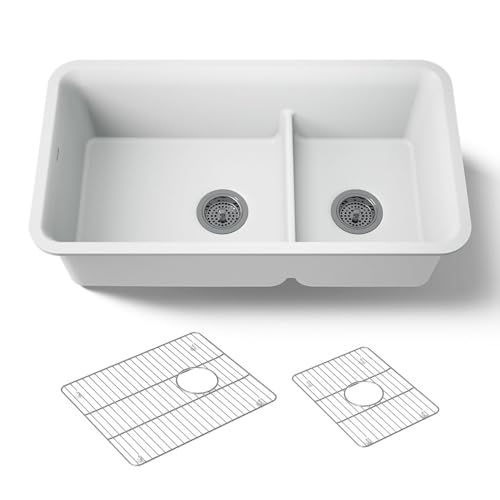
Kohler Cairn Smart Divide Matte White
Kohler’s Cairn enters the category under a trademark: the Smart Divide, Kohler’s registered name for the lowered divider that defines this entire guide, fitted to a 33-1/2-inch undermount double-bowl kitchen sink in Matte White, model 27786-CM6. The extra half inch over its rivals is worth pausing on — cabinet and cutout planning at this width class is exact work, and a household templating from the generic 33-inch assumption could find the Cairn’s rim arguing with its cabinet sides. The title names no material, an omission this guide records plainly: the finish is Matte White, the maker is Kohler, the model is the Cairn, and the substance beneath the finish is a question the listing must answer.
Stated by the title — Model: 27786-CM6 Cairn. Overall size: 33-1/2 inch. Divider: Smart Divide, Kohler’s trademarked term. Mounting: undermount. Configuration: double-bowl. Colour: Matte White. Material and bowl split: see the listing for both.
Strengths
- The Smart Divide trademark identifies the divider design with the maker that named the concept.
- Matte White gives a soft, low-glare finish distinct from both steel and glossier composites.
- Kohler’s model-number precision — 27786-CM6 — makes parts, templates and support conversations exact.
Trade-offs
- The bowl split stays off the title, so a buyer set on 60/40 must confirm the arrangement on the listing.
- The material stays off the title too, leaving care and resistance questions for the product page.
- At 33-1/2 inches it is the widest sink here, and the least forgiving of a nominally sized cutout.
A trademark in a title is a claim about origin rather than performance, and it should be weighed that way. Smart Divide tells a buyer that Kohler considers the lowered divider a designed, named feature of this sink — not an incidental dimension — and a maker that names a feature tends to have engineered its height deliberately, balancing the bridge-the-pans benefit against the two-bowls-separately benefit at a specific water level. The title does not print that height, so the deliberateness must be taken on the maker’s reputation until the listing’s dimensions confirm it. That is a reasonable transaction with a maker of Kohler’s standing, but it remains a transaction, and this guide notes its terms rather than waiving them.
The unnamed material cuts the other way, and the review will not pretend otherwise. Every other sink in this set declares its substance in its title — steel with a gauge, quartz composite, SILGRANIT — because material decides care, repair and ageing. A buyer shortlisting the Cairn should make the listing’s material disclosure the first checkpoint, before falling for the matte finish in a photograph. If the disclosed material suits the household’s habits, the Cairn’s combination of the trademarked divider, the extra half inch of width and the soft white finish is a coherent, design-led offer. If it does not, the Blanco offers the pale undermount alternative with its substance printed on the label.
Best for: a design-led undermount installation with room for 33-1/2 inches, wanting Kohler’s Smart Divide divider in a Matte White finish.
Not suited for: a buyer requiring bowl split and material confirmed before the listing stage, since the Cairn’s title leaves both questions to its product page.
Check price on Amazon — the Cairn listing’s material and split details complete its title.
The six sinks laid side by side
| Sink | Split | Mounting | Material as titled | Distinguishing title fact |
|---|---|---|---|---|
| Ruvati RVH7419 | 60/40 | Undermount | Stainless steel, 16-gauge | Tight radius corners |
| Ruvati RVH7418 | 40/60 | Undermount | Stainless steel, 16-gauge | Rounded corners, brushed finish |
| KRAUS KTM102-33 | 50/50 | Drop-in | Stainless steel, 18-gauge | Two strainers included |
| Karran Quartz | 60/40 | Drop-in | Quartz composite | Pre-drilled faucet hole |
| BLANCO PRECIS | 60/40 | Undermount | SILGRANIT | Full 33 by 18 inch dimensions |
| Kohler Cairn | — | Undermount | — | Smart Divide trademark, 33-1/2 inch |
Two cells in that table are blank, and both belong to the Kohler — a reminder that the most famous name in a category can still publish the sparsest title in it, and that fame is not a specification.
What should a household settle before choosing a low-divide sink?
Which bowl deserves to be the big one?
The split question is really a workflow question wearing a fraction. Households that soak roasting pans, wash oven racks and bathe preserving jars need a dominant bowl and should shop the 60/40 family — choosing its orientation by standing at the sink and rehearsing where large items arrive from. Households whose rhythm is wash-in-one, rinse-in-the-other, with medium cookware, are the Kraus’s natural constituency at 50/50. Nobody should choose a split from a photograph; choose it from a rehearsed Tuesday evening in the actual kitchen, with the dishwasher door open and the oven mitts on.
Can your worktop and cabinet accept the mounting you want?
Undermount sinks — four of these six — need a worktop whose edge can be sealed and exposed, and a cabinet wide enough for the sink’s body plus its clips and the tap’s connections. Drop-in sinks forgive nearly all of that, which is why the Kraus and Karran exist in this set. Measure the cabinet’s internal width, not the door’s, and compare it against the sink’s full footprint where printed — the Blanco’s 33 by 18 is the model of disclosure here — before falling for any design. The wet trades around a sink replacement have their own equipment questions, and Best Steam Vacuums is the companion read for the floors that take a building project’s traffic.
Steel, quartz composite or a named composite?
Material decides the sink’s sound, its ageing and its care rhythm. Steel rings, scratches visibly unless brushed, and shrugs at heat and impact with a durability the category has trusted for decades. Quartz composite and SILGRANIT land pans quietly, hold pale colours that steel cannot offer, and ask for prompter wiping of strong pigments. The Kohler’s material must be learned from its listing before it can join this comparison at all. None of the three families is the correct one; the correct one is the one whose care rhythm matches the household’s actual habits rather than its aspirational ones.
Where will the tap stand?
One sink here drills the question shut — the Karran’s pre-drilled hole puts the tap on the sink — while the undermounts leave the tap to the worktop and the Kraus’s rim offers its own deck possibilities, to be confirmed on its listing. Tap position decides reach, splash geometry and whether a tall pot fits under the spout, and it interacts with the low divider more than buyers expect: a spout centred over the divider serves both bowls and exploits the bridging trick best. Settle the tap plan on paper alongside the sink, not after the sink is sealed into the counter.
How the low divider earns its keep across a cooking week
The divider’s value is easiest to see across time rather than in a single demonstration. Monday’s pasta pot, too tall for either bowl’s comfort in an ordinary double sink, lies across the lowered wall and soaks without monopolising a whole basin. Wednesday’s preserving session uses the same bridge for a rack of jars. Friday’s fish, resting on a tray that spans both bowls, drains without touching water pooled on either side. In each case the trick is identical — the divider stops being a wall exactly when an object is longer than a bowl — and in each case the alternative designs fail differently: a single-bowl sink would force the soaking pot and the rinsing to share water, while a full-height double bowl would refuse the long object outright.
The divider also disciplines ordinary washing-up in a way owners report valuing more than the bridging trick. With the water held below the divider’s crest, the two bowls stay genuinely separate — wash water on one side, rinse water on the other, neither contaminating the other across a full-height wall’s splashes. Let the level rise over the crest and the sink becomes one basin with a submerged ridge, which is sometimes exactly what a stockpot needs and sometimes a quiet defeat for the two-bowl system. Owning a low-divide sink well means developing a feel for that crest as a waterline with meaning, and households that cook in volume tend to develop it within the first month.
Installation realities the titles leave to the listings
A sink is the most plumbed object in a kitchen, and its replacement touches waste lines, traps, the tap’s supplies and sometimes a waste disposal unit whose flange must match the sink’s drain openings. None of the six titles discusses drain diameter, disposal compatibility or template dimensions beyond the Blanco’s footprint, so every one of those checks belongs to the listing and the installer’s site visit. The undermounts add a further reality: they are fitted before or with the worktop in a new kitchen, and retrofitting one under an existing worktop ranges from awkward to impossible depending on the counter’s material and the cabinet’s construction — a constraint that quietly routes many replacement projects to the two drop-in models regardless of aesthetic preference.
Sealing and support deserve their sentence as well. An undermount sink full of water and cast iron carries serious weight on its clips and its sealant bead, and the quality of that installation — not the sink’s gauge or material — is what the household will live with for fifteen years. Budget for a fitter who templates carefully, supports the sink independently of the sealant, and leaves the cabinet floor dry and inspectable. The cheapest installation quote and the most expensive sink in this set are a poor pairing; the reverse pairing serves noticeably better. Kitchens being replumbed at this scale often revisit their cleaning equipment in the same breath, and Best Shop Vacuums For Dust Collection speaks to the workshop end of that conversation.
Care rhythms, material by material
Steel first, since three of the six live there. A stainless sink’s daily care is a wipe and a dry — water left standing in hard districts dries into spots that read as neglect long before they are damage — and its weekly care is a gentle clean along the grain of the finish, never across it, since cross-grain scrubbing is how brushed surfaces acquire their visible swirls. The RVH7418’s brushed finish, described in its title as hiding scratches, is the forgiving end of that discipline; a polished steel would demand more, and no polished model appears in this set. What steel will not forgive is a scouring powder habit or a steel-wool pad left rusting in the bowl overnight, the two classics of sink abuse, and both are household behaviours rather than product flaws.
Composite care runs on different anxieties. Quartz composite and SILGRANIT earn their keep by resisting the daily insults — dropped pans, hot trays, knife slips at the divider — but their pale colours in this set, white and Soft White and Matte White, convert pigmented spills into timed events. Turmeric, beetroot juice, blackcurrant and the dregs of a red wine bottle should meet a cloth within the hour rather than the evening, not because the materials are fragile but because colour sits on any pale surface with intent. In exchange, composite owners are spared the water-spotting regime entirely; a composite bowl dries invisible where steel dries into a map of the local water supply. Each material, in other words, taxes a different household virtue — steel taxes diligence, composite taxes promptness — and the household that knows which virtue it possesses in surplus has its material answer.
Grids, racks and the second life of the bowl floor
No title in this set mentions a bottom grid, yet the grid is the accessory that most changes a sink’s working life, and it deserves a paragraph in any honest guide to these six. A stainless grid resting on the bowl floor absorbs the impacts that would otherwise dent or scratch the steel itself, gives glasses a level, drained standing place, and turns the bowl into a drying rack that keeps items out of standing water. For the composite sinks, a grid plays the same protective role against point impacts, and for all six it slightly raises every item in the bowl — a change in ergonomics that shorter households feel at the tap and taller households barely notice. Because no listing here bundles one in its title, the grid joins the tap and the strainer basket on the list of purchases to price alongside the sink rather than discover afterwards.
Cutting boards and roll-up racks cut from the same cloth: accessories that exploit the sink’s rectangular plan. A board that spans the bowl converts the sink into worktop at the exact station where washing happens, and a roll-up rack over one bowl gives washed items a drained perch that returns the bowl beneath to service. The low divider cooperates with all of these, since its lowered crest lets long boards and racks rest across both bowls without teetering on a full-height wall. Households equipping a new sink should measure the bowl openings from the listing’s template before ordering any of it — accessory sizing is bowl-specific, and the titles here, the Blanco’s outer dimensions excepted, do not print the inner figures the accessories are sized by.
Sound, splash and the sink after dark
A sink is also an instrument, played nightly by running water and dropped cutlery, and the six titles divide audibly even though none prints a word about noise. Steel transmits; a tap running into an empty steel bowl announces itself through a thin-walled house, and the heavier 16-gauge of the Ruvatis answers with a lower, duller note than the Kraus’s 18-gauge sheet, gauge working on sound exactly as it works on dent resistance. Composite absorbs; water landing in quartz or SILGRANIT arrives as a hush rather than a ring, which is why composite sinks are so often chosen for open-plan rooms where the kitchen’s acoustics are the living room’s acoustics. Undermount installation adds its own muffling, the worktop’s mass damping the bowl’s rim, in a way a drop-in rim cannot match.
Splash follows geometry rather than material. A deep bowl contains a high tap’s energy; a shallow one returns it to the worktop as spray, and since no title here prints a depth, splash behaviour joins the listing checks for any household with a tall, arcing tap. The divider plays its part too: water aimed at the lowered crest from a pull-out spray can ricochet across both bowls in a way a full-height wall would have contained, a small, funny, genuinely useful fact that owners learn in their first week and adjust their spray angle for ever after. None of this appears in marketing, and all of it appears in ownership, which is why this guide spends its last specialist section on the sink as it behaves at eleven at night rather than as it photographs at noon.
A sink’s second decade: what ages, what does not
Sinks outlive the kitchens around them, which makes their ageing behaviour a first-order buying question that titles almost never address. Steel ages by accumulation: scratches layer into a patina that brushed finishes absorb gracefully, the bowl’s shine settles from showroom glare to a working lustre, and the material underneath remains structurally the same object in year twelve as in year one. A steel sink can look tired; it rarely stops being a sink. Composite ages by complexion: the body of the material holds, while the surface’s relationship with pigments, limescale and sunlight writes the years onto pale colours in a way dark ones conceal — one more reason the three pale sinks in this set should be bought by households whose wiping habits are proven rather than promised.
The fittings around the sink age faster than the sink itself, and planning for their renewal is part of buying well. Strainers tarnish and their seals perish; the Kraus’s included pair will want replacing on a cycle the sink itself ignores. Sealant beads at an undermount’s rim yellow and eventually surrender, asking to be cut out and renewed by someone patient. Tap washers, hoses and cartridges all live shorter lives than any basin in this guide. A household that understands it is buying a twenty-year basin surrounded by five-year fittings will keep a small fund and a plumber’s number for the fittings, and will judge the basin itself — its gauge, its material, its divider, its corners — by the longer clock. That separation of clocks is the mature way to read every title in this set: ask of the sink only what a sink must answer for, and let the replaceable parts be replaceable.
There is a resale and inheritance angle to close on, because wide double-bowl sinks are among the fixtures a house buyer actually inspects. A low-divide sink in good order photographs as a serious kitchen; a stained, rattling or badly sealed one photographs as a project. The models whose titles document their substance — gauges printed, dimensions printed, materials named — also document better to a future buyer researching the house, a small tailwind for the Ruvati pair and the Blanco in particular. None of that should outrank the daily workflow in the decision, but a fixture expected to serve two decades and then help sell the house deserves to be chosen as the long asset it is.
Children change a sink’s job description in ways worth a sentence of foresight. A low divider is, to a small child standing on a step stool, an invitation to sail things between bowls, and to the household it is also a genuine convenience: a washing-up bowl of warm water on one side, a rinsing bowl on the other, at a height relationship that makes bathtime for dolls and the washing of tiny hands equally manageable. More soberly, the wide single-span that the divider permits is where a baby bath or a bulk of sterilising bottles naturally lands in a young family’s kitchen, and the households that foresee that season should weigh bowl span and tap height accordingly. Fixtures chosen for a decade will serve several versions of the same family; the sink that accommodates the versions gracefully is rarely the one chosen for the showroom alone.
Elderly relatives redraw the map from the other direction: a wide, bridged basin is where a week of dishes can be soaked flat rather than stacked, where a heavy casserole can be slid rather than lifted clear of a high wall, and where a carer helping with the washing-up can work from either side without negotiating a divider at full height. Kitchens that expect to host ageing parents — or to age in place themselves — should count that sliding, soaking, two-sided convenience among the divider’s serious virtues, because strength, not taste, is the variable that changes most across a sink’s twenty-year service.
Common mistakes
Choosing the split from a showroom photograph. Bowl orientation is workflow, not symmetry. Rehearse the kitchen’s actual movements — oven to sink, sink to dishwasher — before deciding which side deserves the larger bowl.
Assuming 33 inches means the same cutout everywhere. One sink here is 33-1/2 inches, one prints an 18-inch depth, and the rest leave their footprints to listings. Template from the chosen model’s own documents, never from the category’s headline size.
Ordering an undermount for a worktop that cannot take one. Laminate edges and existing cutouts route many projects to drop-in designs. Establish the worktop’s verdict before the sink’s, or the sink will be returned at the household’s expense.
Ignoring the tap until the sink is sealed in. A pre-drilled hole, a rim deck and a worktop mounting are three different tap futures. The time to discover which future a sink carries is on its listing, not under a newly sealed counter.
Believing a pale sink stays pale by itself. White and matte finishes across this set reward prompt wiping of pigments and punish the overnight soak of a curry pot. Buy the colour your housekeeping will actually maintain.
Comparing gauges without translating them. In steel gauge, the lower number is the thicker sheet: the 16-gauge Ruvatis are heavier stock than the 18-gauge Kraus. Reading the numbers backwards inverts the comparison entirely.
Final recommendation
For a planned undermount kitchen in steel, the two Ruvatis divide the honours by temperament: the RVH7419 for tight corners and a big bowl in its orientation, the RVH7418 for rounded corners, a brushed finish and the big bowl mirrored. For a replacement project, the Kraus is the set’s practical champion — drop-in fitting, equal bowls, strainers included — while the Karran serves the same project type in white quartz composite with its tap hole ready. The Blanco PRECIS is the planner’s composite: undermount, 60/40, Soft White, with dimensions printed like a maker that respects a tape measure. The Kohler Cairn is the design statement, Smart Divide by name and matte by finish, provided its listing answers the material and split questions its title leaves open.
Every one of the six will bridge a roasting pan across its lowered wall on the first Sunday it is installed; the differences that matter by the fiftieth Sunday are mounting, material and which bowl got to be big — settle those three in the kitchen, with a tape measure, before any of them is ordered.
FAQ
What does low divide actually mean? The wall between the two bowls stops below the sink’s rim, so long items can lie across both bowls and water can unite the basins when filled past the divider, while ordinary washing keeps the bowls separate.
Is 60/40 better than 50/50? Neither is better in the abstract. Asymmetric splits suit households with oversized items and a dominant working bowl; the even split suits a balanced wash-and-rinse rhythm. This set offers both, plus the 40/60 mirror for opposite-handed kitchens.
Which sinks here are drop-in? Two: the Kraus KTM102-33 in stainless steel and the Karran in quartz composite. The other four are undermount designs requiring a compatible worktop and cabinet.
What materials appear in this set? Stainless steel in two gauges, quartz composite, and Blanco’s SILGRANIT. The Kohler Cairn’s title does not name its material, so that fact must be taken from its product page.
Does the divider’s height appear in any title? No title here prints a divider height or a bowl depth. Those dimensions — among the most useful in the category — live on the listings and in the makers’ templates, and should be checked there for any shortlisted model.
How should the divider itself be cleaned? The lowered wall collects the same film as the bowls and one extra deposit: the tide line where ordinary water levels sit against it. A soft brush along the crest during the weekly clean keeps that line from setting, and households with a pull-out spray will find a weekly rinse of the divider’s both faces takes seconds. The divider is also where a scouring habit shows first, so the gentle rule that governs the bowls applies with double force along its edge.
Measure the cabinet, rehearse the workflow, pick the bowl that deserves to be big — and the lowered wall between them will justify itself every week the kitchen cooks.


