What's inside
- Key Takeaways
- Quick Picks
- How Did We Compare Philips Models Against Their Challengers?
- How Do Philips and the Challengers Compare?
- 7000 or Viva: How Do You Choose Inside the Philips Line?
- What Does ProExtrude Actually Change in the Bowl?
- Philips Ownership: Discs, Spares and the Five-Year View
- Why Does Philips Bundle the Same Machine in Different Boxes?
- Extrusion at Home Versus the Dried Pasta of Italy: a Philips Reality Check
- How Should a Philips Buyer Spend the First Fortnight?
- What Do the Roller Rivals Teach a Philips Shopper?
- Accessories Worth Owning, and Those That Can Wait
- Bronze Versus Standard Discs: Does the Philips Buyer Need to Care?
- Flavoured and Wholemeal Doughs in a Philips Machine
- How Does a Philips Fit a Kitchen That Already Owns a Stand Mixer?
- What Should a Philips Buyer Check on Delivery Day?
- Is a Philips Pasta Maker a Good Gift?
- The Philips Buyer Who Cooks for One: a Small Manifesto
- How Altitude, Water and Flour Brands Quietly Change Philips Results
- When the Answer Is Two Machines: Planning a Complete Pasta Kitchen
- A Last Comparison: What Ten Years With Each Pick Looks Like
- What Mistakes Do Philips Pasta Maker Buyers Make?
- Final Recommendation
- Frequently Asked Questions
- Related Guides
As an Amazon Associate I earn from qualifying purchases. This post may contain affiliate links at no extra cost to you.
cottageverdict.com is reader-supported. When you buy through links on our site, we may earn an affiliate commission.
Where to buy: all six machines below are sold through Amazon, and the pick names in the Quick Picks table, the detailed sections and the comparison table link to their listings so you can check price on Amazon before deciding — particularly useful with the best Philips automatic pasta makers, because Philips sells closely related models in overlapping bundles, and the listing in front of you is the only reliable guide to which discs and accessories a given box actually contains.
This guide has a centre of gravity, and it is extrusion. Philips’ pasta reputation rests on machines that take flour and liquid, mix and knead internally, and extrude finished shapes through discs — the 7000 series at the top with its ProExtrude technology, and the compact Viva below it. Three of the six picks are those Philips machines, compared properly against each other, because for most readers the real question is not ‘Philips or not’ but ‘which Philips, at which size, with which discs’.
The other three picks are here as honest foils, and their roles are stated plainly. The VEVOR is a rival extruder challenging Philips on specification and value. The MARCATO Atlasmotor and the Sailnovo are roller machines — a different format entirely, sheeting dough you make yourself — included because a Philips buyer should understand what the roller world offers before committing, especially if lasagne sheets and hand-cut ribbons feature in their cooking. They are comparison points, not Philips alternatives in disguise.
So the structure is simple: Philips extrusion examined closely first, then the challengers measured against it. If you arrive already certain that extrusion is your format, the Philips sections are your decision. If you arrive uncertain, the roller sections may change your mind — and changing it here, on paper, is considerably cheaper than changing it after a machine lands on your counter.
Key Takeaways
- Philips’ line divides by scale: the 7000 series for full households and disc range, the Viva Compact for small kitchens, small batches and three classic shapes.
- The two 7000 listings differ in bundle — eight discs against six — on the same ProExtrude platform, so compare disc lists, not headlines.
- ProExtrude’s job is consistency: even mixing and steady pressure, so the last portion of a batch matches the first.
- The VEVOR extruder challenges with eight shapes, four modes and 500g flour capacity for buyers who weigh carefully and buy on specification.
- MARCATO’s Atlasmotor and the Sailnovo are roller-format rivals: they sheet your own dough for lasagne and ribbons, and do not extrude at all.
- Whichever Philips you choose, the discipline is identical — weigh flour and liquid, trust the dry crumb, clean the discs dry-first.
Quick Picks
| Pick | Badge | Why it earns its place |
|---|---|---|
| Philips 7000 Series Pasta Maker ProExtrude | Best Philips Overall | The flagship: ProExtrude technology, eight discs, portions for a full table and app-guided ratios for every shape in the box. |
| Philips Pasta Maker Series 7000 6 Discs | Best Philips Value in the 7000 Line | The same 7000 platform with six discs — the classic canon covered, the bundle leaner, the listing worth comparing line by line. |
| Philips Viva Compact Pasta and Noodle Maker | Best Compact Philips | The compact Viva: three classic discs, fully automatic extrusion and a recipe book in a small black cabinet for small households. |
| MARCATO Atlasmotor Electric Pasta Machine | Roller Rival — the Sheet-Maker’s Benchmark | Italy’s roller aristocrat, motorised: an Atlas 150 with Pastadrive motor that sheets your dough — the comparison point for sheet-pasta lovers. |
| VEVOR Electric Pasta Maker 150W | Extruder Challenger on Specification | A rival extruder with eight shapes, four intelligent modes and a 500g flour hopper, arguing specification against Philips’ polish. |
| Sailnovo 3-in-1 Pasta Maker | Roller Rival — Nine-Setting Value Sheeting | A 3-in-1 roller with nine thickness settings and cutters in stainless steel — the budget sheet-and-ribbon alternative in this comparison. |
How Did We Compare Philips Models Against Their Challengers?
Philips machines were compared with each other first, on the questions a Philips buyer actually faces: batch size, disc library, footprint and guidance. The 7000 pair share a platform, so their comparison is about bundles and portions; the Viva is a different scale of machine altogether, and comparing it with the 7000s on disc count alone would miss its purpose, which is to put automatic fresh pasta within reach of kitchens and households the flagship cannot fit.
Challengers were admitted on strict terms. A rival extruder had to match the Philips proposition — flour in, shaped pasta out — and beat it somewhere measurable, as the VEVOR attempts with capacity and modes. Roller machines had to be labelled as rollers every time they appear, with their different input — your own made dough — stated alongside their virtues, because a comparison that blurs formats teaches the reader nothing except confusion.
Across all six, we weighted the ownership details Philips is usually bought for: documentation quality, recipe support, the availability of a sensible cleaning routine, and the sense that discs, parts and guidance will still exist in five years. A pasta machine is a decade-long kitchen citizen, and the ecosystem around it matters nearly as much as the motor inside it.

Philips 7000 Series Pasta Maker ProExtrude — Best Philips Overall
Start with the machine Philips built to end arguments. The 7000 Series Pasta Maker with ProExtrude technology runs at 150W, carries eight shaping discs, mixes with technology the listing credits for up to eight portions, and ties into the HomeID app for recipes — model HR2660/03 in white. In a Philips-only conversation this is the reference point: the largest batches, the widest shape library and the most guidance the brand offers in one cabinet.
What the flagship money actually buys is headroom. Headroom in portions, so a dinner party does not require two production runs; headroom in discs, so a child’s demand for a specific shape is a cupboard visit rather than an apology; and headroom in mixing consistency, so the eighth portion extrudes with the same texture as the first. Households that cook pasta as a hobby will use all three kinds of headroom within the first month and stop itemising the purchase price at about the same time.
The disciplines and the taxes are the family’s usual ones, payable at full size: a counter footprint that must be planned rather than improvised, discs that need their dry-first cleaning after every session, and ratios that must be weighed rather than guessed. Philips’ app guidance softens the last of those considerably. For the household that has decided on Philips and cooks for a crowd, this is the end of the decision tree.
One more flagship consideration is social. Eight portions is not only a number; it is the difference between pasta night as a family dinner and pasta night as the thing your house is known for. Hosts who cook for friends monthly will find the headroom transforms the machine from an appliance into a reputation, and reputations, unlike discs, cannot be bought later as an accessory — the batch size has to be there when the table fills.
- Platform: ProExtrude technology, 150W
- Discs: 8 shaping discs
- Portions in listing: up to 8
- Guidance: HomeID app
- Model: HR2660/03, white
Strengths
- The most complete Philips extrusion package available here.
- Batch size suits entertaining without double runs.
- App ratios shorten the learning curve for every disc.
Trade-offs
- Largest counter and cupboard claim of the Philips trio.
- Eight discs mean eight discs’ worth of cleaning rotation.
- Flagship positioning within the brand’s own line.
Best for: committed pasta households of four-plus who want the full Philips repertoire in one purchase.
Not suited for: small kitchens, small appetites and sheet-pasta cooks.

Philips Pasta Maker Series 7000 6 Discs — Best Philips Value in the 7000 Line
Every strong product line contains one buying question that is really an accounting question, and in Philips’ line it is this machine: the Series 7000 in its six-disc bundle, model HR2660/00, fully automatic with ProExtrude technology, standing beside its eight-disc sibling. The platform, the cycle and the pasta that emerges are the family’s own. What differs is the accessory count and the price logic — and the discipline of matching a bundle to a menu instead of to a fear of missing out.
Consider how pasta repertoires actually look after a year of ownership. Most households rotate four shapes with devotion, tolerate a fifth, and own the rest as cupboard archaeology. Six discs, chosen across the classic canon — strands, ribbons, tubes, shells — cover that reality with room to spare. The two-disc gap only bites a cook whose menu genuinely ranges wider, and that cook knows who they are and should buy the flagship with this guide’s blessing.
The six-disc 7000 is therefore the value pick inside the brand, not because it is lesser but because it is honest: the same extrusion experience, the same app-guided ratios, the same cleaning routine, minus two discs that statistics say would have lived in a drawer. Philips buyers who read listings carefully — model number, disc list, portion guidance — will recognise this as the connoisseur’s end of the bargain.
There is also a resale-and-regret asymmetry worth naming. Buyers who choose the six-disc bundle and later crave the missing shapes face a simple accessory question; buyers who choose any 7000 and later find the platform itself too large for their kitchen face a machine-sized problem. When the doubt is about repertoire, the six-disc answers it safely. When the doubt is about scale, neither 7000 does — that doubt belongs to the Viva.
- Platform: ProExtrude technology, fully automatic
- Discs: 6 shaping discs
- Model: HR2660/00, white
- Cycle: internal mixing, kneading and extrusion
- Positioning: leaner bundle of the 7000 platform
Strengths
- Full 7000 extrusion experience without the flagship bundle.
- Six classic discs match a real household repertoire.
- Savings stay in the pantry for flour and good cheese.
Trade-offs
- Two discs fewer for wide-ranging shape collectors.
- Sibling listings are genuinely easy to mix up.
- Identical cleaning and ratio discipline to the flagship.
Best for: Philips loyalists who cook the classic shapes and prefer their bundle lean.
Not suited for: shape collectors and hosts cooking for eight routinely.

Philips Viva Compact Pasta and Noodle Maker — Best Compact Philips
The Viva answers the question the 7000s cannot hear: what does Philips extrusion look like when the kitchen is small, the household is two, and the counter already has a kettle with seniority? The Viva Collection machine — HR2371/05, black, fully automatic — ships with three default classic shaping discs and a recipe book, in a cabinet that stores like a small appliance rather than a commitment. It is the Philips for flats, couples, students with ambitions and anyone whose pasta night is a duet.
Three discs provoke a raised eyebrow only until they are named by role: the strand for weeknights, the ribbon for ragù, the tube for baked and chunky sauces. That is not a reduced repertoire; it is the repertoire, distilled. The Viva’s batches are sized to match — fresh pasta for tonight, eaten tonight, which purists argue is the only honest way to eat it — and the recipe book keeps small-batch ratios exact, where small batches forgive sloppiness least.
Its ceiling is equally clear. The Viva will not cater a christening, its disc world will not expand into the flagship’s, and black shows flour dust like a chalkboard. But as the Philips that fits the most kitchens and the most lives, it may be the most important machine in this guide: the one that turns ‘someday, fresh pasta’ into a Tuesday that already happened.
The Viva has one more audience this guide wants to name: the experienced pasta cook downsizing. A smaller household in a smaller kitchen does not stop loving fresh pasta, and the Viva lets that cook keep the ritual at the scale life now requires, with Philips manners intact. Machines that serve a whole biography — first flat, family house, quieter kitchen — earn a loyalty no flagship can buy.
- Discs: 3 default classic shaping discs
- Operation: fully automatic extrusion
- Included: recipe book
- Format: compact Viva Collection cabinet, black
- Model: HR2371/05
Strengths
- Philips extrusion at a footprint small kitchens can house.
- Three classic discs distilled to the shapes households live on.
- Right-sized batches for one to three eaters.
Trade-offs
- No headroom for parties or batch-freezing sessions.
- Disc library fixed at the classic trio.
- Black finish displays every gram of flour dust.
Best for: couples, singles and small flats wanting genuine Philips extrusion without the flagship’s footprint.
Not suited for: large families and entertainers.
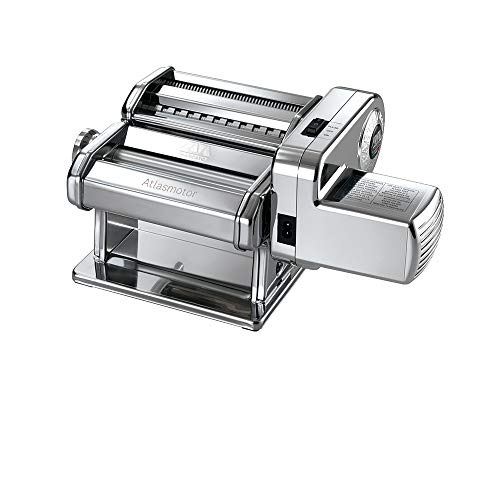
MARCATO Atlasmotor Electric Pasta Machine — Roller Rival — the Sheet-Maker’s Benchmark
Role statement, as promised: the Atlasmotor is not an extruder and does not compete with Philips on Philips’ ground. It is a motorised roller — the set includes the Atlas 150, a hand crank, a clamp, the Pastadrive motor and a manual, in chrome steel, made in Italy — and it exists in this guide because the strongest argument against any Philips is a kitchen whose pasta begins with a sheet. MARCATO is the name roller loyalists measure everything against, and the motorised version removes the crank work while keeping the craft.
What it makes is what extrusion cannot: wide, even sheets, rolled to graduated thicknesses by your own passing of the dough, ready for lasagne, cannelloni, hand-cut ribbons and filled pasta. The dough is yours from the first gram — your flour blend, your eggs, your hydration judgement — which roller cooks regard not as labour but as authorship. The Pastadrive motor simply ensures the sheeting is tireless and even, at a pace hand-cranking rarely sustains across a full batch.
Compare it with the Philips trio honestly and the choice becomes philosophical. Philips sells dinner: flour in, pasta out, minimal authorship, maximal convenience. MARCATO sells craft: dough authored by hand, sheeted by motor, cut and filled by intention. Households should buy the philosophy they will still enjoy in year three — and a lasagne-first household that buys an extruder for its convenience will feel the mismatch at every sheetless Sunday.
Set the MARCATO on a counter beside any Philips and the two philosophies become visible as industrial design: the Italian is all exposed mechanism, chrome and intention, a machine that expects to be understood; the Philips is a sealed, friendly cabinet that expects to be fed. Kitchens have personalities too, and there is no shame in admitting that the machine you will love looking at for ten years has an advantage no specification captures.
- Format: motorised roller — NOT an extruder
- Set: Atlas 150, hand crank, clamp, Pastadrive motor, manual
- Origin and build: made in Italy, chrome steel
- Input: dough you mix and rest yourself
- Output: sheets for lasagne, ribbons and filled pasta
Strengths
- The benchmark sheet quality in home pasta making.
- Motorised drive with hand-crank fallback in the same set.
- Italian-made chrome steel built for decades of service.
Trade-offs
- No extrusion — tubes and shaped pasta are impossible.
- Dough-making skill and time remain entirely yours.
- Premium roller pricing against simpler rivals.
Best for: sheet-first cooks — lasagne, filled pasta, hand-cut ribbons — weighing Philips convenience against roller craft.
Not suited for: anyone whose priority is flour-in, pasta-out automation.

VEVOR Electric Pasta Maker 150W — Extruder Challenger on Specification
Every brand-led guide needs one pick that argues with the brand, and the VEVOR argues in Philips’ own language: extrusion. Its listing offers a 150W automatic noodle maker with eight pasta shapes, four intelligent modes and a 500g flour capacity, with measuring cups and a cleaning brush included. Shape for shape and watt for watt, it stands toe to toe with the 7000 series on the specification sheet — which is exactly the comparison a value-minded Philips shopper will make, and exactly why it belongs in this guide.
The differences live below the headline numbers. Philips’ premium buys an ecosystem: an app full of tested ratios, a recipe tradition, documentation written for kitchens and a disc range with a future. VEVOR’s pitch buys capacity and automation modes at a challenger’s position, with a utility brand’s documentation style and an accessory future that is still being written. Neither argument is dishonest; they appeal to different buyers — the one who wants guidance, the one who wants specification and trusts their own scale and notebook.
Our counsel for the cross-shopper is procedural. Decide which shapes you will actually cook, confirm them on both listings, weigh your first three batches to the gram whichever badge you buy, and judge the machine that arrives by its third batch rather than its first. A challenger extruder, fed exact ratios by a careful cook, can embarrass a flagship fed guesses — the discipline, as ever in extrusion, outranks the badge.
The VEVOR’s four intelligent modes deserve one fair sentence of their own: sequence automation is a real convenience for households that run the machine during a crowded dinner preparation, because every decision the machine takes is a decision a distracted cook cannot take wrongly. Philips answers with app guidance rather than automation — instruction instead of delegation — and cooks should choose the relationship with the machine that suits how their kitchen actually runs at 6 p.m.
- Format: automatic extruder — Philips-format rival
- Power and shapes: 150W, 8 pasta shapes
- Modes: 4 intelligent modes
- Capacity: 500g flour
- Included: measuring cups, cleaning brush
Strengths
- Matches the flagship’s shape count with family capacity.
- Automated modes reduce sequence management.
- Measuring tools in the box support ratio discipline.
Trade-offs
- Thinner recipe and app ecosystem than Philips.
- Utility-brand documentation style.
- Long-term disc availability less established.
Best for: specification-led buyers who weigh ingredients faithfully and want extrusion capacity without brand premium.
Not suited for: cooks who want Philips’ app guidance and recipe hand-holding.

Sailnovo 3-in-1 Pasta Maker — Roller Rival — Nine-Setting Value Sheeting
The second roller foil, and the value end of the sheeting world: Sailnovo’s 3-in-1 pasta maker offers a roller with nine thickness settings and cutters for two widths, in a rust-resistant stainless steel body pitched as easy to clean, for spaghetti, fettuccine, lasagna and more. Nine settings is a genuinely fine ladder for sheet work — finer than many cooks will learn to exploit — and the cutters convert sheets into strands and ribbons without a second appliance joining the counter.
Place it against the Atlasmotor and the roller’s internal hierarchy appears. MARCATO sells heritage, heft and a motor; Sailnovo sells the same fundamental actions — sheet, adjust, cut — in a simpler, hand-driven form at the accessible end of the market. For a household testing whether sheet pasta belongs in its life at all, that accessibility is a rational first step: the investment is small, the skills learned transfer upward, and the lasagne either justifies an upgrade or closes the question cheaply.
Against Philips the contrast is the guide’s recurring one, stated for the last time: this machine extrudes nothing, mixes nothing and kneads nothing. It sheets your dough beautifully and stops there. Buyers who understand that sentence as a promise rather than a warning are this machine’s people, and within its format it gives them nine settings of honest, stainless, washable-down value.
Sailnovo’s nine settings also hide a teaching function. A beginner working down a fine ladder of thicknesses learns sheet judgement setting by setting, feeling the dough’s resistance change in small increments instead of disasters. By the time such a cook graduates to a motorised roller — if they ever feel the need — their hands already know the craft, and the humble set will have been the cheapest pasta education in this entire guide.
- Format: roller and cutter set — NOT an extruder
- Thickness: 9 settings
- Widths: 2 cutter widths
- Build: stainless steel, rust resistant, easy clean per listing
- Output: spaghetti, fettuccine, lasagna and more, from your dough
Strengths
- Nine thickness settings give fine sheeting control.
- Cutters included for strands and ribbons from one set.
- Accessible entry to the roller format’s skills.
Trade-offs
- Hand-driven effort the Atlasmotor’s motor removes.
- No mixing, kneading or extrusion of any kind.
- Simpler build than the Italian benchmark.
Best for: households testing the roller format, and lasagne makers who want nine settings without flagship roller pricing.
Not suited for: automation seekers and shaped-pasta households.
How Do Philips and the Challengers Compare?
| Pick | Badge | Key specification | Watch out for |
|---|---|---|---|
| Philips 7000 ProExtrude | Best Philips Overall | Extruder, 8 discs, app guidance | Flagship footprint and price logic. |
| Philips 7000 6 Discs | Best Philips Value in the 7000 Line | Extruder, 6 discs, same platform | Two discs fewer; check the bundle. |
| Philips Viva Compact | Best Compact Philips | Extruder, 3 discs, compact | Small batches only. |
| MARCATO Atlasmotor | Roller Rival — the Sheet-Maker’s Benchmark | Roller, motorised, Atlas 150 set | No extrusion; dough is yours. |
| VEVOR 150W | Extruder Challenger on Specification | Extruder, 8 shapes, 500g flour | Ecosystem thinner than Philips’. |
| Sailnovo 3-in-1 | Roller Rival — Nine-Setting Value Sheeting | Roller, 9 settings, cutters | Hand-driven; no automation. |
7000 or Viva: How Do You Choose Inside the Philips Line?
Count eaters first, then count cupboards. The 7000 series exists for households whose pasta night seats four to eight and whose shape repertoire roams; its batches, discs and footprint are all scaled to that life. The Viva exists for one to three eaters in kitchens where a flagship would evict the kettle. Neither machine is the other’s upgrade — they are different sizes of the same idea, and a couple who buys a 7000 ‘for later’ usually discovers that later eats less pasta than the Viva would have made them weekly.
Then count discs honestly. A household’s real repertoire reveals itself in a month of cooking, and it is almost always narrower than the repertoire imagined in a shop. The Viva’s three classics and the six-disc 7000 both cover reality for most; the eight-disc flagship serves the minority whose menu genuinely roams. Choose by the counted evidence of your own dinners, and the Philips line stops looking like a ladder and starts looking like what it is: three sizes of one good idea.
What Does ProExtrude Actually Change in the Bowl?
Strip the branding and two engineering behaviours remain: mixing evenness and pressure steadiness. Even mixing means the crumb entering the disc has the same hydration in the last portion as the first, so a batch cooks uniformly instead of producing firm strands and soft ones from the same run. Steady pressure means the emerging pasta’s surface is smooth and compact, which is what gives extruded shapes their pleasant bite and their ability to hold a sauce without disintegrating in it.
You can taste both behaviours without knowing their names, in the difference between a batch that boils into a coherent dish and one that sheds starch, breaks and sauces unevenly. That is what any premium extrusion system — Philips’ here — is selling underneath the vocabulary. Judge a 7000 by its third batch, when your ratios are dialled in, and you are judging the technology itself rather than your own apprenticeship.
Philips Ownership: Discs, Spares and the Five-Year View
A pasta machine’s second year is where brands separate. Discs get lost in house moves, a scraper vanishes into a child’s toy box, a recipe that worked is forgotten — and the Philips owner is cushioned by an ecosystem: model numbers that mean something, listings that specify bundles precisely, an app holding the ratios, and a user base large enough that any question has been asked and answered somewhere. None of that appears on a specification sheet, and all of it appears in year two.
The Viva’s longevity argument is different: simplicity. Fewer discs, fewer parts, a smaller machine with less to lose and less to fail. Owners of both ends of the line report the same core satisfaction for the same core reason — the machine still works, and its pasta is still good, long after the purchase has been forgotten. Buy the Philips whose ecosystem matches your household’s chaos level, and keep its discs in one labelled box from the first day.
Why Does Philips Bundle the Same Machine in Different Boxes?
Because households differ more than machines do. A platform like the 7000 can serve a shape collector, a classic-canon family and a portion-focused entertainer with the same motor and chamber, differing only in the discs and accessories packed around it. Bundling lets each buyer fund the repertoire they will use — and, less charitably, it makes headline comparisons between listings genuinely confusing, which is why this guide has repeated one instruction in several forms: read the disc list and the model number, never the headline.
The habit generalises beyond Philips. Any mature appliance category — and pasta machines are now one — sells platforms in bundles, and the literate buyer shops the bundle contents against a written menu of their own cooking. Ten minutes with a notebook before ordering is worth more than any single feature discussed in this entire guide, because it converts marketing’s favourite question, ‘what might you want?’, into the only useful one: ‘what did you actually cook last month?’
Extrusion at Home Versus the Dried Pasta of Italy: a Philips Reality Check
Philips machines are sometimes sold against a fantasy — that fresh extruded pasta at home renders the great dried brands obsolete. It does not, and the honest comparison flatters both sides. The dried pasta of a good Italian maker is extruded too, often through bronze, then dried slowly into a firmness fresh pasta cannot imitate; it remains the right choice for many sauces and every store cupboard. What the home machine adds is freshness itself: egg-rich batches, wholemeal and flavoured doughs, shapes made for tonight’s sauce, and pasta whose clock from flour to plate is measured in minutes.
Households that understand that division keep both and choose per dinner, which is why the Viva and the 7000s sit comfortably in kitchens that also hold packets from Puglia. The machine is not a replacement for a tradition; it is an extension of the pantry into the present tense. Bought on those terms, a Philips never disappoints, because it was never asked to perform the one trick — being dried pasta — that its format forbids.
How Should a Philips Buyer Spend the First Fortnight?
Week one belongs to the maker’s own recipes, followed to the gram, in the most forgiving shape the bundle offers. Make the same batch twice. Learn the sounds of a healthy mix, the look of a correct crumb, the pace at which shapes should be cut, and the dry-first cleaning ritual while the dough is still in front of you rather than set into the discs. Resist guests, variations and the internet’s ratio opinions until those two batches are done; the machine deserves a fair audition and so do you.
Week two is for one variable at a time: a second flour, a finer disc, an egg dough, a double batch for the freezer. By the fortnight’s end the household will know its real repertoire — which is also the moment to discover whether the bundle bought was the bundle needed, while exchanges are still painless. Philips’ line rewards this methodical start with years of unthinking competence, and punishes improvisation exactly as much as every other extruder does.
What Do the Roller Rivals Teach a Philips Shopper?
That convenience has a price denominated in authorship. The Atlasmotor and Sailnovo households make dough the way bakers do — by feel, by flour, by egg — and regard the Philips owner’s flour-in-pasta-out cycle as a trade they would not make, because the dough is where their cooking lives. Neither side is deceived about the other; they simply value different hours of the process. A Philips shopper should sit with that honestly for one evening before ordering, imagining not the best pasta night but the twentieth.
If the twentieth imagined night still says ‘I want dinner, not a project’, Philips extrusion is your answer and this guide’s top three are your shortlist. If it says ‘I want my hands in the dough and a motor only for the rolling’, the rivals have made their case and the MARCATO or Sailnovo will serve you better than any disc. The worst purchase in this category is the one made by a cook arguing with their own temperament, and no brand — not even this guide’s subject — is worth that argument.
Accessories Worth Owning, and Those That Can Wait
Worth owning from the start: a kitchen scale, because Philips ratios are weighed; a bench scraper, which moves crumb, dough and finished shapes with equal grace; a simple drying rack or tray system for resting strands; and one labelled box where every disc lives. That short list, most of it already in a normal kitchen, is the entire supporting cast a Philips needs to perform nightly.
Able to wait: extra discs beyond the bundle, shaped cutters, ravioli stamps, flavoured-dough experiments and any storage furniture bought in the first month’s enthusiasm. Let the repertoire declare its needs across a season of dinners. The households that accessorise slowly end up owning exactly what they use; the households that accessorise at checkout end up storing a pasta museum beside a machine they use for one shape — and the shape, invariably, was in the original bundle all along.
Bronze Versus Standard Discs: Does the Philips Buyer Need to Care?
Traditional dried pasta boasts about bronze dies because the metal’s slight roughness tears the pasta’s surface microscopically, giving sauces something to grip. Home extrusion works at a different scale and temperature, and the discs supplied with domestic machines — Philips’ included — are engineered for release and durability rather than for that artisanal drag. The practical difference in a home bowl is smaller than the romance suggests, and it is swamped by ratio, flour and cooking water, the variables actually in the cook’s hands.
So the Philips buyer can file disc material under ‘interesting’ rather than ‘decisive’, and spend their attention where this guide keeps pointing: the disc shapes in the bundle, the discipline of the dough, and the minute at the pot where fresh pasta is won or lost. Sauce grip, in a home kitchen, is earned far more reliably by reserving starchy cooking water and finishing pasta in the pan than by metallurgy.
Flavoured and Wholemeal Doughs in a Philips Machine
Once the plain recipes are reflexes, a Philips becomes a small laboratory. Spinach and beetroot turn strands green and crimson for dinners that need theatre; wholemeal flour blends produce a nuttier, sturdier noodle that stands up to beans and greens; a proportion of chestnut or chickpea flour changes both flavour and handling. Each variation moves the hydration target slightly, which is why the apprenticeship matters: a cook who knows the correct crumb by sight can adjust a new flour by feel, a little liquid at a time.
Keep notes like a scientist for the first experiments — flour blend, liquid grams, disc, verdict — because the difference between a discovery and an accident is whether it can be repeated. Philips’ app recipes provide the tested baseline from which variations depart, and households that treat the machine this way find their repertoire quietly becoming personal: the green noodles of birthdays, the wholemeal tubes of January, a house style in pasta that no shop sells.
How Does a Philips Fit a Kitchen That Already Owns a Stand Mixer?
Peacefully, because they divide the labour by format. A stand mixer’s pasta attachments are rollers and cutters — sheeting dough the mixer kneaded — which makes the mixer household a roller household already, whether it knew it or not. A Philips extruder does not duplicate that investment; it completes it, adding the tubes and shapes no roller attachment can produce. Many of the happiest pasta kitchens own exactly this pairing and think of it as one system with two heads.
The division also clarifies upgrades. A mixer household craving shaped pasta should buy extrusion, not a second roller; a Philips household craving sheets should buy a roller — the MARCATO or Sailnovo of this guide — not a second extruder with more discs. Audit the formats you own before the formats you want, and the pasta budget will always be spent on new capability rather than on a shinier version of an old one.
What Should a Philips Buyer Check on Delivery Day?
Three things, before the first flour is weighed. First, the model number on the box against the listing ordered — the 7000 bundles are similar enough that this thirty-second check is the cheapest insurance in the category. Second, the disc count and identity against the listing’s written list, laid out on the counter and counted like cutlery. Third, a dry run of assembly and disassembly, so the cleaning routine is learned with clean parts and a clear head rather than at 9 p.m. with dough setting in the chamber.
Then make the first batch by the book, weigh everything, and keep the maker’s documentation with the discs rather than in a drawer across the house. Delivery day sets the household’s habits, and pasta machines are unusually honest mirrors: the care taken in the first hour predicts, with embarrassing accuracy, whether the machine will be a weekly joy or a cupboard monument by spring.
Is a Philips Pasta Maker a Good Gift?
For the right cook, one of the best in the kitchen — and for the wrong cook, an elegant burden, so the giving requires knowledge of the recipient’s actual dinners. The Viva is the giftable Philips: compact, classic, forgiving of small kitchens, and sized for the couples and singles most often given kitchen machines. The 7000s are gifts for households whose pasta enthusiasm is already proven, ideally chosen with the disc bundle matched to a menu the giver has eaten at their table.
Include the invisible accessories: a bag of proper semolina, a small scale if their kitchen lacks one, and the offer — genuinely meant — to come and eat the first batch. A pasta machine given with its first dinner already imagined lands as an occasion; the same machine given bare, to a cook whose habits were never consulted, lands as homework. The difference is entirely in the giver’s attention, which is, after all, the actual gift.
The Philips Buyer Who Cooks for One: a Small Manifesto
Solo cooking is where fresh pasta machines are most often mocked and most quietly triumphant. The Viva’s small batches answer the solo cook’s eternal problem — recipes scaled for four, leftovers for days — with a portion of fresh pasta made for one, eaten in celebration rather than in repetition. Flour is cheap, the machine is quick, and the difference between a Tuesday alone with fresh ribbons and a Tuesday alone with a packet is a difference in how a life feels from the inside.
The economics work too, in the small currency of morale. A solo household that cooks well for itself spends less on delivery, wastes less on oversized batches, and keeps a skill warm that dinner parties later benefit from. If this guide’s Philips sections have sounded family-sized, let this one correct the balance: the compact end of the line may be its most humane, because it takes one person’s dinner as seriously as a banquet.
How Altitude, Water and Flour Brands Quietly Change Philips Results
Extrusion ratios are written for a test kitchen, and real kitchens conspire against them politely. Flour absorbs differently by brand and by season; a humid August kitchen hydrates dough before the liquid is measured; egg sizes wander. The Philips recipes are the starting grid, not the finish line, and the experienced owner learns to read the crumb — adding liquid by the teaspoon when it powders, a dusting of flour when it smears — the way a driver reads a road rather than a map.
This is not a flaw in the machines; it is the nature of dough, which no app can abolish. It is also why this guide has insisted on weighed beginnings and patient fortnights in every Philips section: the adjustments that look like expertise in month three are simply the memory of small corrections, and every Philips owner accumulates them at the same rate of one dinner at a time.
When the Answer Is Two Machines: Planning a Complete Pasta Kitchen
Some households, having read this far, will recognise themselves as both cooks — the weeknight extruder and the weekend sheet-maker — and wonder whether owning both formats is indulgence. Judged by use rather than by count, it is simply a complete kitchen, no more excessive than owning both a kettle and a coffee maker. The sequence matters: one format first, mastered across a season, the second added when its absence has been felt at actual dinners rather than imagined in a shop.
Space planning makes the pair practical: the extruder lives where weeknight cooking happens, discs boxed beside it; the roller lives where weekend projects spread out, with the flour library between them. Households that build the pasta kitchen in that order — capability, mastery, then breadth — end with two machines that are both used weekly, which is the only definition of ‘worth it’ this guide has ever recognised.
A Last Comparison: What Ten Years With Each Pick Looks Like
Project each machine forward a decade and the personalities sharpen. The Philips pair become fixtures whose discs are a family archive — the shape of birthdays, the tube of a particular winter’s ragù — supported by an ecosystem that still answers questions. The Viva becomes the machine that moved house four times and never missed a Tuesday. The MARCATO becomes an heirloom with opinions, loaned to adult children under supervision. The VEVOR becomes the hard-working challenger whose value was proven in batches, and the Sailnovo the honest teacher whose former pupils now sheet by feel.
None of those futures is available to a machine bought against its owner’s temperament or a kitchen’s real dimensions, which is why this guide has spent as many words on the buyer as on the bought. Ten years is the correct horizon for a pasta machine. Choose for the cook you will still be then, and every pick on this page — Philips first among them — has a future worth projecting.
What Mistakes Do Philips Pasta Maker Buyers Make?
Confusing the bundles is the Philips-specific first mistake, and it is an easy one: two 7000 listings, similar photographs, different model numbers and disc counts. The remedy is bureaucratic and total — decide by the model number and the written disc list on the listing you order from, and screenshot nothing, assume nothing. The machine that arrives will be exactly the one whose number you read.
Judging the first batch is the second. A first extrusion, made by a first-time hand with unweighed flour, tells you about the apprenticeship, not the machine. Philips buyers who return a 7000 after one gummy batch have usually fired the teacher for the student’s homework. Two weighed batches, made by the book, are the minimum fair trial any extruder deserves.
Third, storing discs loose in a drawer of sharp neighbours. A bent disc extrudes badly forever, and a lost disc is a shape amputated from the repertoire. One box, discs cleaned dry-first and filed the same evening, is the entire maintenance philosophy — cheap, boring and decisive across a decade of ownership.
Finally, buying against temperament: the project-loving cook who purchases extrusion for its speed and mourns the dough they never touch, or the weeknight cook who buys a roller for its romance and uses it twice. This guide has placed rollers beside Philips precisely so that choice is made awake. Make it awake, and either family of machine will feel like the right one for years.
Final Recommendation
Inside the Philips line, the decision is scale: the eight-disc 7000 for the full repertoire and the full table, the six-disc 7000 for the same platform honestly bundled, the Viva for the small kitchen and the small, perfect batch. Around the line, the challengers keep Philips honest — the VEVOR pressing on specification and capacity, the MARCATO and Sailnovo reminding every buyer that sheets exist and some cooks live for them.
Choose with your menu in one hand and your temperament in the other, weigh your flour like you mean it, and the machine you bring home — Philips or rival — will stop being an appliance and start being the reason Tuesday tastes like a small holiday in your own kitchen.
Our Philips shortlist would crown the Philips 7000 ProExtrude for most households, point smaller kitchens to the Philips Viva Compact, and send sheet-first cooks to study the MARCATO Atlasmotor before they spend anything at all.
Buy the Philips that fits your table and your Tuesdays, and fresh pasta becomes a habit instead of an event.
Frequently Asked Questions
What is the difference between the two Philips 7000 listings?
Bundle and disc count on the same ProExtrude platform. The HR2660/03 edition lists eight discs and portions up to eight with HomeID app support; the HR2660/00 lists six shaping discs. Compare the written disc list and model number on each listing against the shapes you actually cook, because the headlines are easy to confuse.
Is the Philips Viva powerful enough for regular use?
For its intended scale, yes — it is a fully automatic extruder designed for small households, with three classic discs and a recipe book. Regular use for one to three eaters is precisely its brief. What it will not do is scale up to parties or a wide disc repertoire; that is the 7000 series’ job.
Can a Philips pasta maker make lasagne sheets?
No — extrusion produces shaped and strand pasta through discs, and sheets are the roller format’s work. That is why this guide includes the MARCATO Atlasmotor and Sailnovo as comparison points. If lasagne is central to your cooking, buy a roller, or accept a two-format kitchen over time.
Why does Philips pasta dough look so dry?
Because extrusion dough is supposed to: a coarse crumb, roughly a third liquid to flour by weight following the maker’s recipes, that the machine’s pressure consolidates into pasta. Wet dough smears and clogs. Weigh the ingredients, trust the recipe book or app, and judge the result at the disc, not in the mixing chamber.
How do I clean Philips shaping discs?
Let the residue dry until it turns pale and brittle, flick it out with a pick or the cleaning tool, then wash and dry thoroughly. Soaking a disc with wet dough in its holes creates a paste that sets hard. The dry-first routine takes minutes and is the single habit that keeps Philips ownership pleasant.
Should I buy the VEVOR instead of a Philips?
If you weigh ingredients carefully, want 500g batches and eight shapes, and are comfortable with a thinner recipe ecosystem, the VEVOR’s specification argues well. If you value Philips’ app guidance, documentation and established accessory world, the brand premium buys real things. Decide which kind of support your cooking actually uses.
Related Guides
Pasta night sorted, the rest of the home’s projects await, and these guides cover the machines that furnish the other rooms: Best Affordable Sewing Machines Best Affordable Heavy Duty Sewing Machines Best Affordable Coffee Machines



[…] start with the dedicated comparison, and then browse the neighbouring guides while the dough rests: Best Philips Automatic Pasta Makers Best Affordable Embroidery Machines Best 10-Cup Home Coffee […]