What's inside
- Key Takeaways
- Quick Picks
- How We Chose These Picks
- Which of the Best Air Cleaners and Purifiers Fits Your Home?
- How Do the Six Compare Side by Side?
- What Do the Words on the Box Actually Mean?
- How Should You Size a Machine for a Whole Living Level?
- What Mistakes Do Buyers of Flagship Machines Make?
- Why Does Fan Noise Matter More Than the Specification Suggests?
- What Does It Cost to Run a Flagship Machine All Year?
- How Do You Maintain the Machine Itself, Beyond Its Filters?
- When Does a Home Outgrow One Flagship Machine?
- How Should You Judge a Purifier During Its First Month?
- What Role Do Windows and Ventilation Play Alongside a Flagship?
- Why Do Some Households Swear By Their Machine While Others Shrug?
- How Does a Flagship Behave Around Children and Animals?
- What Should You Look for in Warranty and Support Before Buying?
- How Green Is a Flagship Habit, Honestly?
- What Separates a Good Night’s Running From a Disturbed One?
- How Do You Read a Room Before the Machine Arrives?
- What Happens When the Power Goes Out or the Routine Breaks?
- Final Recommendation
- Frequently Asked Questions
- Related Guides
As an Amazon Associate I earn from qualifying purchases. This post may contain affiliate links at no extra cost to you.
cottageverdict.com is reader-supported. When you buy through links on our site, we may earn an affiliate commission.
Where to buy: all six machines are sold through Amazon; follow the linked names in the table and the detailed reviews to each listing, check price on Amazon there, and note the exact replacement filter before you order. Two names for the same box cause endless confusion in this category, so let us settle it at the door: an air cleaner and an air purifier are the same household appliance wearing different labels, and shoppers searching for the best air cleaners and purifiers are really asking one question, which machines genuinely clean a home’s air well, at a size and sound a family can live with, from brands that will still sell the filters in five years.
This is the flagship version of that question, the guide for the main living space rather than a niche problem room. The six machines below are the category’s proven heavyweights and its strongest modern all-rounders, chosen to cover the realistic spread of homes: the pet-heavy family room, the open-plan space that defeats lesser machines, the allergy-conscious household that wants monitoring it can trust, and the big room where air must be moved in serious volume without turning conversation into a shouting match. If a smaller or stranger room is your problem, the related guides at the end go deeper into those corners; here, the brief is the best general answer money can sensibly buy.
Expect candor about what separates these machines, because at this level the filtration cores are all respectable and the differences live elsewhere: in how much air each moves at the speed you will actually use, how intelligently it reacts when life gets dusty, how its filters are priced and stocked, and how gracefully it occupies a room’s floor and soundscape for years. Those ownership qualities, not a laboratory percentage, are what owners praise or curse in year three, and they decided the order below.
Key Takeaways
- Air cleaner and air purifier are interchangeable labels; judge machines by delivered airflow, filter quality, and ownership costs instead.
- The Coway Airmega Mighty AP-1512HH remains the category’s benchmark all-rounder after years of scrutiny.
- The Levoit Vital 200S is the pet household’s flagship, with a wide intake built for hair and dander loads.
- The Blueair Blue 211i Max moves the most air for big rooms while staying composed at everyday speeds.
- The Winix 5520 pairs a serious deodorizing carbon filter with a clear air quality monitor for reactive households.
- The Honeywell HPA304 AllergenPlus is the no-nonsense large-room workhorse, and the Medify MA-40 the smoke-and-odor bruiser.
Quick Picks
| Pick | Badge | Why it earns its spot |
|---|---|---|
| Levoit Vital 200S | Best for Pet Households | A broad U-shaped intake swallows hair before it settles, with smart control and a proper sleep mode for bedrooms too. |
| Coway Airmega Mighty AP-1512HH | Benchmark All-Rounder | The long-proven standard of the category, with polished auto behavior and coverage framed to 1,748 square feet. |
| Winix 5520 | Best Monitoring and Odor Work | A high-deodorization carbon filter and a legible quality display for homes whose air changes by the hour. |
| Blueair Blue 211i Max | Best for Large Rooms | Huge verified reach up to 3,235 square feet with quiet composure and a washable pre-filter in fabric finishes. |
| Honeywell HPA304 AllergenPlus | Large-Room Workhorse | A familiar name, simple controls, and coverage framed at 2,250 square feet for families wanting zero fuss. |
| Medify MA-40 | Best for Smoke Events | The rapid-recovery specialist when wildfire drift, fireplaces, or cooking regularly test a home’s air. |
How We Chose These Picks
A flagship guide earns its authority by refusing weak candidates, so the first pass eliminated any machine whose maker could not demonstrate sustained delivery in real rooms: a credible clean-air delivery story, a sealed filtration path, and a filter supply with a track record. Brand age was not worshipped for its own sake, but in a category where the appliance is only as good as its next filter, a decade of stocked replacements is evidence no launch-day specification can match. Every survivor uses a high-efficiency particulate filter as its core, because that technology’s performance on the particles households actually generate is the settled ground of this industry.
Airflow at livable speeds decided the ranking more than any other factor. Manufacturers quote coverage at maximum settings that few families tolerate during dinner, so we weighted what each machine delivers in its middle register, where it will spend its life. That discipline favors generous machines, the Blueair and Honeywell with their large-room frames, the Medify with its throughput, and it explains why no compact appears here despite several being excellent in bedrooms. A flagship living-space machine must hold a big, busy room at a conversational volume, and that is a sterner test than any single laboratory capture figure.
Intelligence was scored as a household feature rather than a gadget count. A trustworthy sensor and a well-mannered auto mode save their owners a thousand small decisions a year, reacting to the vacuum cleaner’s dust, the dog’s entrance, the frying pan’s announcement, then subsiding before the fan becomes the room’s main sound. The Winix and Coway implementations are the polished examples here. App control counted when it added scheduling and remote sense, and counted for nothing when it merely duplicated the front panel behind a login screen.
Finally, we considered the room as furniture and the decade as a budget. These machines will be looked at daily for years, so finish, footprint, and the choreography of a filter change, one panel, one element, no tools, no wrestling, all carried weight. Filter pricing was compared across the group with the assumption of faithful replacement, because the cheapest machine to buy can be the dearest to keep. The six that remained are not the six most advertised; they are the six we would defend in an argument with a skeptical owner three winters from now.
Which of the Best Air Cleaners and Purifiers Fits Your Home?

Levoit Vital 200S — Best for Pet Households
Levoit designed the Vital 200S by watching where pet hair actually goes: it floats low, drifts along floors, and accumulates at the room’s edges, so the machine answers with a broad U-shaped intake that draws from a wide frontage rather than a polite grille. Framed for rooms up to 1,875 square feet and independently verified, it has the capacity to hold a family room’s air in order at speeds that let the television stay at normal volume, and its pet focus is engineered into the airflow rather than pasted onto the marketing. For households where a dog’s shake can visibly redecorate the sunlight, that intake geometry is the difference between a purifier that copes and one that merely participates.
The smart layer is equally considered: an air quality monitor, app control with scheduling, and a sleep mode quiet enough for the machine to moonlight in a bedroom when the household’s needs rotate. Filter access is a front-panel affair, important when the pre-filter needs its frequent hair interventions, and Levoit’s filter pipeline is among the most reliable in the business. It is a substantial box and asks for a real footprint, and its talents are wasted on a small, pet-free room. But as the main machine for an animal household’s main room, it is the most purpose-built answer in this guide.
- Filtration: multi-stage with wide pet-focused intake design
- Coverage anchor: verified framing up to 1,875 square feet
- Controls: app, scheduling, air quality monitor, sleep mode
- Ownership: front-access filters for frequent hair checks
Strengths
- Intake geometry genuinely suits hair and dander
- Strong capacity at conversational speeds
- Smart features that serve a busy household
Trade-offs
- Substantial footprint in the main room
- Pet households will check pre-filters often
- More machine than small homes need
Best for: pet-heavy family rooms and open living spaces. Not suited for: compact, animal-free apartments.

Coway Airmega Mighty AP-1512HH — Benchmark All-Rounder
Every category has a machine against which the others are quietly measured, and for a decade that machine has been the Mighty. Its formula sounds plain, a four-stage path with a washable pre-filter, true HEPA, and carbon, wrapped around a fan and sensor package tuned by people who clearly lived with their own product, but the execution is what made it the benchmark: an auto mode that behaves with unusual judgment, an eco behavior that rests the fan when the air stays clean, a filter indicator that respects the owner’s intelligence, and coverage framed to 1,748 square feet that translates into serene middle speeds in ordinary rooms.
The Mighty also carries the ownership virtues that never make headlines: a three-year warranty, replacement filters that any search finds in seconds, and a design restrained enough to sit in a living room without dating it. Newer rivals beat it in individual events, more app glitter here, more raw reach there, yet as a single purchase expected to serve a household’s main room for years with minimal thought, it remains the answer reviewers reach for when a friend asks without a complicated brief. If your home has no special condition, no giant floor plan, no smoke saga, this is the machine the rest of the list must argue you out of.
- Filtration: four stages with washable pre-filter
- Coverage anchor: framed up to 1,748 square feet
- Controls: auto and eco modes, timer, filter indicator
- Ownership: three-year warranty, ubiquitous filters
Strengths
- The most polished all-round behavior available
- Washable pre-filter keeps running costs sane
- Longevity of support is unmatched
Trade-offs
- No app in a connected age
- Design is conservative beside Blueair
- Very large rooms may want the 211i Max instead
Best for: most households wanting one dependable main machine. Not suited for: buyers who demand full app control.
Winix 5520 — Best Monitoring and Odor Work
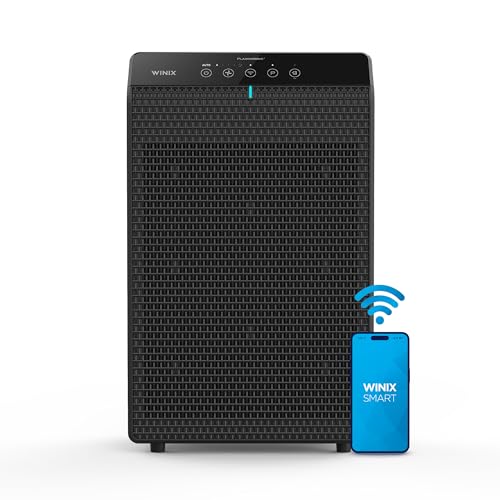
The 5520 is Winix’s answer to households whose air changes character by the hour: cooking projects, a wood stove’s moods, a teenager’s candle phase, a home business with materials that smell like themselves. It pairs true HEPA filtration with a high-deodorization carbon filter, giving odors a more serious opponent than the token carbon sheets many rivals fit, and its air quality monitor presents the room’s story legibly enough that owners actually change behavior because of it, cracking a window at the right moment, raising the fan before guests arrive rather than after the room embarrasses them.
Capacity is framed generously, up to 1,881 square feet in an hour in the brand’s terms, and the auto mode puts that capacity under the sensor’s command so the machine spends its effort when the room earns it. App support arrives with this generation, answering the one criticism leveled at its predecessors. PlasmaWave remains available as Winix’s switchable extra stage for those who want it. In a busy, reactive household, the 5520 feels less like an appliance and more like an instrument the home consults, and that quality, rare at any price, earns it the monitoring crown in this company.
- Filtration: true HEPA plus high-deodorization carbon
- Coverage anchor: framed to 1,881 square feet per hour
- Controls: air quality monitor, auto mode, app support
- Character: reactive, information-forward design
Strengths
- Carbon depth outclasses token odor stages
- Display teaches better household habits
- Sensor deploys capacity intelligently
Trade-offs
- Information-rich panel may glow in dark rooms
- Carbon filters are a real replacement cost
- Busy households benefit most; calm ones less
Best for: cooks, stove owners, and reactive households. Not suited for: minimalists wanting a silent, invisible box.

Blueair Blue 211i Max — Best for Large Rooms
Scale is this Blueair’s argument, made elegantly. Verified reach extends to 3,235 square feet, the largest territory in this guide, yet the machine delivers it with the brand’s HEPASilent composure, blending electrostatic and mechanical capture so that big airflow does not demand a big racket. In an open-plan living level, a converted barn space, or a family room flowing into a kitchen, the 211i Max is the one machine here that can plausibly hold the whole volume at speeds a dinner party can talk over, and its washable fabric pre-filter, offered in finishes that look like upholstery rather than equipment, catches the coarse load that large, lived-in spaces generate.
Connected features match the scale: Wi-Fi, app control, and an auto mode that lets the machine govern a space too large for its owner to monitor by feel. The footprint is honest about the physics involved, this is not a machine that hides, but the design language makes a virtue of presence, and owners in big rooms consistently report the same experience: the purifier stops being a topic. For sprawling spaces it is not merely the best pick in this list; it is close to the only pick that respects the problem, and smaller-room households should admire it from a distance and buy its little siblings instead.
- Filtration: HEPASilent with washable fabric pre-filter
- Coverage anchor: verified reach to 3,235 square feet
- Controls: Wi-Fi, app, auto mode
- Form: large, design-led, upholstery-like finishes
Strengths
- Largest verified territory in this guide
- Quiet composure at family-room speeds
- Pre-filter washes instead of being replaced
Trade-offs
- Premium pricing across machine and filters
- Too large for ordinary bedrooms
- Fabric cover needs its own cleaning rhythm
Best for: open-plan levels and very large living rooms. Not suited for: small homes or tight budgets.

Honeywell HPA304 AllergenPlus — Large-Room Workhorse
Honeywell sells this machine the way it sells thermostats: as a familiar, unglamorous answer that will simply work. The HPA304 is framed for rooms up to 2,250 square feet, uses true HEPA filtration aimed at the allergen load its name advertises, and presents controls a grandparent can master without the manual, which in a family home is a feature with real value. There is no app to pair, no account to create, no firmware to update; there is a dial, some speeds, a turbo for events, and a filter reminder, and for a large share of households that is the entire desired relationship with an air cleaner.
The ownership ecosystem matches the philosophy: Honeywell filters are stocked by everyone from hardware stores to pharmacies, the pre-filter can be cut and replaced cheaply, and the machine’s plain white box offends no decor because it aspires to none. Its fan at higher speeds is purposeful rather than hushed, and design lovers will walk past it to the Blueair, but families who want a large room handled by a name their parents trusted, with parts available in their own town, will find the HPA304 the most reassuring purchase in this guide. It is the workhorse pick, and workhorses win their followings honestly.
- Filtration: true HEPA with replaceable pre-filter
- Coverage anchor: framed up to 2,250 square feet
- Controls: simple dial, turbo setting, filter reminder
- Ownership: filters stocked in ordinary stores
Strengths
- Zero learning curve for any household member
- Large-room capacity from a household name
- Replacement parts available almost anywhere
Trade-offs
- No sensor, app, or auto finesse
- Higher speeds are audible and unapologetic
- Plain styling beside design-led rivals
Best for: big family rooms wanting simplicity and reach. Not suited for: smart-home enthusiasts.

Medify MA-40 — Best for Smoke Events
When a home’s air problem arrives as weather, wildfire drift settling over the valley, a neighbor’s burn pile, a fireplace that draws badly on windy nights, the MA-40 is the machine in this guide built to answer in minutes rather than hours. Its quoted throughput, 1,793 square feet in an hour, gives it the recovery speed that event-driven households need: close the windows, set the Medify working, and the room returns to itself while lesser machines are still making their first impression on the problem. That capacity, loafing at moderate settings on ordinary days, also makes it a calm background machine between events.
Medify’s design priorities are frankly functional: substantial filter media, touch controls, a timer, and a child lock, without the design theater or app ecosystem of the fashion-forward brands. Smoke and odor work rewards exactly that bluntness, because clearing a room quickly is a matter of air volume through media, and the MA-40 moves air like it means it. Households in fire-prone regions, homes with enthusiastic cooks, and anyone whose street hosts a wood stove on every corner should shortlist it first and forgive its workmanlike looks, which fade from notice the first evening the room smells like itself again.
- Filtration: high-volume HEPA filtration for smoke and odors
- Coverage anchor: 1,793 square feet per hour claimed
- Controls: touch panel, timer, child lock
- Character: throughput first, decoration later
Strengths
- Fastest recovery after smoke events here
- Generous headroom for calm ordinary days
- Controls any household member can run
Trade-offs
- Utilitarian appearance in styled rooms
- Fewer smart features than Levoit or Winix
- Top speed is built for work, not whispers
Best for: smoky regions, fireplaces, and serious cooks. Not suited for: design-first living rooms.
How Do the Six Compare Side by Side?
| Model | Coverage anchor | Standout trait | Watch out for |
|---|---|---|---|
| Levoit Vital 200S | Up to 1,875 sq ft | Pet-focused wide intake | Large footprint |
| Coway Airmega Mighty AP-1512HH | Up to 1,748 sq ft | Benchmark auto behavior | No app control |
| Winix 5520 | Up to 1,881 sq ft per hour | Deep carbon, clear monitor | Panel glow at night |
| Blueair Blue 211i Max | Up to 3,235 sq ft | Scale with composure | Premium cost |
| Honeywell HPA304 AllergenPlus | Up to 2,250 sq ft | Simplicity and store-stocked filters | No auto mode |
| Medify MA-40 | 1,793 sq ft per hour | Smoke event recovery | Workmanlike looks |
What Do the Words on the Box Actually Mean?
Air cleaner, air purifier, air scrubber in a domestic costume: the labels are marketing weather, not engineering categories, and the specifications beneath them are what deserve reading. Clean air delivery describes how much filtered air a machine produces, and it is the number that decides whether a room’s air actually turns over. HEPA names a filtration grade for fine particles, and the word true in front of it signals the genuine standard rather than a HEPA-style approximation. CADR figures, where published, express delivery for smoke, dust, and pollen separately, which is why a machine can be mighty against dust and merely adequate against smoke. Activated carbon is the odor and gas department, measured in depth and weight rather than in stage counts, and a pre-filter is the sacrificial screen that keeps hair and lint from spending the main filter’s life early.
Everything else on the box should be translated before it is believed. Coverage figures assume a speed and a time frame that may not resemble your evenings. Stage counts reward machines for dividing one job into many named layers. Ionization and plasma features are optional extras with their own debates, best treated as switchable bonuses rather than core filtration. A household that learns this small vocabulary becomes immune to most of the category’s theater and can read any future model, including the successors of these six, with the same calm skepticism this guide applied on its behalf.
How Should You Size a Machine for a Whole Living Level?
Start with the volume the machine must actually govern, which in open-plan homes is larger and leakier than the room where the sofa sits. Measure the connected space the air freely travels, discount the rooms behind doors that stay closed, and then choose capacity with headroom, because the connected kitchen, hallway, and dining area all draw on the same cleaned pool. The Blueair’s scale exists for exactly this geography, while the Mighty and Vital 200S serve the more common case of one generous room with modest connections. When in doubt between two sizes, the larger machine run gently almost always ages better than the smaller machine run desperately.
Placement completes the sizing. A purifier governs the air that reaches it, so a central position along the level’s natural circulation, rather than a forgotten corner of the least-used room, multiplies whatever capacity you bought. Keep doors to priority rooms open when you want them included and closed when you do not, and treat the machine’s territory as a decision you remake seasonally: bedrooms matter more during pollen months, the living level more during smoky ones. Sizing is not a number on a box; it is a match among volume, placement, and the household’s actual map of its own life.
What Mistakes Do Buyers of Flagship Machines Make?
The flagship tier has its own characteristic errors, beginning with buying for the largest room the home might ever host and then living with an oversized, overpriced machine in an ordinary flat. The second is neglecting the filter budget at the moment of purchase, because premium machines carry premium elements, and a household surprised by its first replacement bill is a household tempted to stretch the old filter into uselessness. Third is sensor superstition in both directions: dismissing auto mode as a gimmick and running a smart machine like a fan, or trusting a display so completely that obvious sources, a smoldering pan, a dusty renovation, go unaddressed while the owner waits for the number to fall.
The quietest mistake is placement by decor, exiling the machine to the one spot where it cannot be seen and therefore cannot work, behind the sofa’s bulk or inside a media cabinet’s shadow. These are substantial appliances that breathe for a living; give them air and they repay it. Finally, remember that even the best machine on this page cleans only the air that passes through it. Source habits, open windows on bad days, an unvented cooking marathon, set the ceiling on what filtration can achieve, and the flagship owners who get flagship results are the ones who treat the machine as the strongest member of a household team rather than its only employee.
Why Does Fan Noise Matter More Than the Specification Suggests?
Two machines can measure alike and live completely differently, because noise is a character, not just a volume. A smooth, broadband hush disappears into a room’s awareness within minutes, while a whine, a rattle at one particular speed, or a fan that hunts up and down under sensor control keeps announcing itself all evening. Flagship machines earn their prices partly in this invisible department: better bearings, better-balanced impellers, and auto modes tuned to change speed gradually rather than theatrically. When you audition a machine, listen at the speed it will actually use during dinner, and listen for tonal annoyances rather than mere loudness, because your household will forgive volume long before it forgives a whine.
Placement can redeem or ruin a voice as well. A machine standing on a hollow floor or against a thin wall borrows the building as a sounding board, while a solid floor and a few centimeters of clearance let it speak only for itself. Rubber feet, a level stance, and a filter seated properly all silence the small vibrations that owners often blame on the motor. The flagship tier’s promise is not silence, which physics forbids in machines that move this much air, but a sound with good manners, and good manners at the dinner table are worth money.
What Does It Cost to Run a Flagship Machine All Year?
Electricity is the least of it. A purifier’s fan at the middle speeds of daily life draws power on the scale of a bright lamp, and running it continuously for a year typically costs less than the filters it will consume in the same period. That arithmetic should liberate owners from the false economy of switching the machine off whenever the room empties: the air does not pause its accumulation for your absence, and the machine’s steady work is precisely what prevents the catch-up blasts that use more energy and patience. Continuous gentle running is both the effective and the economical strategy, which is a rare alignment in household management.
Filters are the true subscription, and flagship filters are priced like flagship parts. Budget for them at purchase, comparing the group’s elements honestly: combined packs that replace everything at once, separate carbon stages that can be renewed on their own rhythm, washable pre-filters that remove one item from the bill entirely, as on the Coway and Blueair. A household that treats the annual filter as a known household expense, like the boiler service, never faces the temptation to stretch a spent element, and a purifier fed on time performs in year five as it did in month one.
How Do You Maintain the Machine Itself, Beyond Its Filters?
A flagship purifier asks for a few minutes of care that owners often never learn it wants. The sensor window that drives auto mode clouds slowly with the very dust the machine exists to catch, and a gentle wipe with a dry cotton bud, as most manuals quietly instruct, restores its judgment when the display starts behaving strangely. The intake grilles and the cavity behind the pre-filter accumulate a felt of coarse material that a vacuum brush removes in a minute during each pre-filter check. Exterior surfaces near kitchens gather a film that a damp cloth lifts, and keeping it lifted keeps the machine’s own materials from becoming an odor source.
Once a year, give the machine the inspection you would give a bicycle: cord sound, plug cool after running, feet intact, filter door sealing without a gap that whistles, fan free of the wobble that announces a bearing’s old age. None of this requires a technician, and all of it protects the two things a flagship purchase really buys, performance and quiet. A machine maintained this way rarely surprises its owner, and in the appliance world, the absence of surprises is the definition of quality.
When Does a Home Outgrow One Flagship Machine?
The honest answer is usually architectural rather than mechanical. A renovation that opens the kitchen into the living room doubles the flagship’s territory overnight; a finished basement adds a second center of life; a baby’s arrival promotes a bedroom from occasional to critical. In each case the flagship has not failed, its map has changed, and the correct response is to redraw the map: the big machine takes the largest connected territory, and a smaller sibling, chosen from the same discipline of honest sizing, takes the closed room. Households that plan this way end up with a system that feels inevitable rather than accumulated.
The reverse journey matters too. Downsizing, children leaving, a move from house to apartment: a flagship that served a family level can serve a flat’s entirety, and its overcapacity becomes the quietest possible running. These machines are among the few appliances that travel well between life stages because their job, moving room air through a serious filter, is the same job at every address. Buy the flagship for the home you have, maintain it like the long-term equipment it is, and it will likely still be on duty, unremarked and effective, in the home you have next.
How Should You Judge a Purifier During Its First Month?
Give a flagship a structured month before forming the verdict that will follow it for years. Week one belongs to placement and sound: try the machine in its two most plausible positions, live with each through a full evening and a full night if a bedroom is involved, and let the household’s ears vote. Week two belongs to the sensor’s education, yours rather than its: watch how the readings or the auto fan respond to cooking, cleaning, guests, and open windows, and learn the room’s rhythms through the machine’s eyes. By week three the novelty has faded, which is precisely when the real assessment begins, because a purifier’s success is measured in the complaints that stop occurring.
Keep the evidence humble and concrete. Dust a dark shelf on a fixed day and compare its film across the month. Notice whether the room’s morning greeting has changed, whether the dog’s corner announces itself less, whether visitors remark on anything at all, since fresh air is one of those qualities guests sense without naming. If the month ends with the machine forgotten in the corner and the room quietly improved, the flagship has passed the only examination that matters, and the remaining work is the calendar discipline of filters and pre-filter checks.
What Role Do Windows and Ventilation Play Alongside a Flagship?
A purifier recirculates and cleans the air it is given; ventilation replaces that air wholesale, and a wise household uses both with judgment rather than treating them as rivals. On a clean, mild day, opening the house up is a pleasure and a genuine airing that no machine should be asked to imitate. On a smoky, pollen-heavy, or traffic-thick day, the same open window imports the very load the flagship exists to remove, and the machine’s hardest, most valuable work happens behind closed windows. The skill is reading the outdoors daily, the way sailors read weather, and letting each system do the work it is good at.
Kitchen and bathroom exhausts belong in the same strategy, capturing moisture and cooking effluent at their source before the purifier ever meets them. A flagship downstream of good source habits lives an easier life and shows it in filter longevity and in the room’s baseline freshness. The households with the best indoor air are rarely the ones with the most equipment; they are the ones whose windows, vents, and purifier operate as one considered system, each covering the others’ blind spots.
Why Do Some Households Swear By Their Machine While Others Shrug?
The divergence usually traces to expectations set before the box was opened. Households that bought filtration as one layer, alongside ventilation judgment, cleaning habits, and source control, report transformation, because the machine was allowed to finish a job the household was already half doing. Households that bought a rescue, expecting an appliance to outrun an unvented stove, a damp wall, and windows open onto a smoky street, report disappointment with the same hardware. The machine did not change between those homes; the assignment did. This guide has tried to set the assignment honestly for every pick it recommends, because a flagship bought with clear eyes is the one that gets praised at dinner parties.
There is also the matter of fit, which no specification captures. A machine whose sound suits the family, whose size suits the room, whose controls suit the least technical person in the house, will be run faithfully, and faithful running is the whole secret of this category. The six machines above differ less in their laboratory virtue than in the households they fit, and choosing by fit, rather than by the largest number on the page, is the decision this entire guide has been quietly arguing for.
How Does a Flagship Behave Around Children and Animals?
Large purifiers in family rooms become furniture in the eyes of the small: a surface, a climbing temptation, a fascinating grille. The flagship tier generally answers with stability, weight, and controls that lock or sit out of casual reach, and owners should complete the job with placement that discourages mountaineering and cords routed out of the play map. Animals contribute a different pressure, the hair load this guide has discussed, plus the occasional direct investigation of an interesting-smelling intake. A pre-filter checked on a pet household’s rhythm keeps both the machine and the investigation harmless.
Set the household’s expectations plainly for the small residents, in whatever language their age requires: the box cleans the air, it is not a toy, a stool, or a hiding place for treasures, and its filter door stays closed. Machines treated as respected furniture survive childhoods gracefully, and more than one flagship in this guide will still be running, in a teenager’s room or a first flat, long after the household that bought it has rearranged itself entirely.
What Should You Look for in Warranty and Support Before Buying?
A flagship purchase is a relationship with a manufacturer measured in filter orders, so the support story deserves the same scrutiny as the specification sheet. Read the warranty for what it actually covers and how a claim travels: a maker that expects you to ship a large appliance at your expense is telling you something about the relationship. Check that the exact filter for the exact model is listed by multiple sellers today, and that the maker’s own store stocks it without a waiting list, because a purifier whose element is back-ordered is a fan with furniture ambitions. The Coway and Honeywell ecosystems in this guide set the standard the others are measured against.
Also consider the knowledge base around the machine: manuals that can be found, filter-change guidance that a new owner can follow without a video call, and a community of owners whose accumulated answers solve the small mysteries, the blinking light, the unfamiliar hum, before they become support tickets. Flagship money buys that infrastructure as surely as it buys airflow, and households that value it choose accordingly. In a decade-long ownership, the support layer will be touched far more often than the specification sheet ever is.
How Green Is a Flagship Habit, Honestly?
The honest accounting has two columns. Against the machine: a steady trickle of electricity, a periodic filter destined for landfill, and a large plastic appliance manufactured and shipped across an ocean. For it: washable pre-filters on several picks here remove the most frequent consumable from the waste stream, long service lives measured in decades rather than product cycles keep whole appliances out of that stream, and right-sized running at gentle speeds keeps the energy column modest. The greenest choice in this category is rarely the smallest machine; it is the durable one, bought once, sized correctly, maintained faithfully, and never replaced on a whim of novelty.
Owners can improve the ledger further with small disciplines: cleaning pre-filters instead of replacing them early, ordering filters in a rhythm that avoids expedited shipping, and passing a working machine along when a household’s needs change rather than storing it toward obsolescence. A flagship treated as long-term infrastructure rather than a gadget is, by the standards of household appliances, a reasonably virtuous object, and its longevity is the strongest argument in its environmental case.
What Separates a Good Night’s Running From a Disturbed One?
Households that host their flagship in or near sleeping quarters learn to distinguish fan sounds the way musicians distinguish instruments. The desirable night sound is featureless, a low, even breath that the brain files under weather and forgets, and the flagship tier’s sleep modes are engineered to produce exactly that while still turning the room’s air over through the night. The undesirable sounds are events: a speed change that swells and fades, a sensor’s overreaction to a passing car’s headlights through a sensor’s eye, a display that brightens a dark wall. Test for events, not volume, during the first nights, because events are what wake people.
Where the machine must serve both a living room’s day and a bedroom’s night, the schedule becomes the diplomacy: hard work during the empty or noisy hours, a pre-bed hour of strong cleaning, then the long gentle night setting. Several picks here automate that arc through their apps or timers, and households that set the arc once report the peculiar satisfaction of a machine that seems to understand the house’s day. Sleep is where air quality stops being a specification and becomes a felt mercy, and a flagship that respects it earns its place beside the bed as surely as in the family room.
How Do You Read a Room Before the Machine Arrives?
A ten-minute survey saves a flagship from being blamed for a room’s geography. Stand where the machine would go and look for its enemies: the curtain that will drape its intake, the radiator whose rising heat will confuse its sensor, the doorway whose traffic will keep stirring the dust it just settled, the rug whose deep pile marks the room’s true particle reservoir. Note where the household actually sits and sleeps, because cleaned air delivered to an empty corner is a wasted harvest, and note the room’s smell at its worst hour, late on a closed, cooking-heavy evening, since that is the baseline the machine must beat to be loved.
Then measure, honestly, and let the measurement argue with the marketing. Length, width, and the connections to other spaces decide whether the Mighty’s territory or the Blueair’s is the relevant one, and whether one machine or a flagship-plus-sibling map is the truthful plan. Households that survey first buy once; households that guess buy twice and blame the category. The survey costs nothing but attention, and it converts the purchase from a hope into a design.
Finally, decide in advance what success will look like in your rooms, in sentences a skeptic could check: the shelf dusted weekly instead of twice, the dog’s corner demoted from announcement to footnote, the morning air in the bedroom no longer carrying last night’s dinner. A flagship measured against its household’s own sentences will be judged fairly, and judged fairly, the machines in this guide tend to be kept, fed, and quietly recommended to friends for years.
What Happens When the Power Goes Out or the Routine Breaks?
Real households interrupt their appliances: storms cut power, holidays empty the house, a cleaner unplugs the humming box to reach an outlet and forgets the reunion. A flagship should resume its duties without a ceremony, and owners should build the small habit of a glance during the weekly round, confirming the machine is on, its display sane, its intake unblocked by whatever migrated during the week. After any long interruption, give it an hour at a strong setting to pull the room back down, the same commissioning trick used on its first day, and the household’s air returns to its managed state without drama.
Travel deserves the same calm planning. A machine left running gently in a closed house keeps the return home from smelling like an absence, while a machine switched off for safety or economy simply needs its strong first evening back. Neither choice is wrong; the mistake is only the unconsidered one, discovered weeks later when someone asks why the purifier has been dark since August. Appliances serve routines, and routines survive when they include the exceptions in advance.
One last piece of flagship etiquette: when the machine eventually moves on, to a relative’s first flat, a charity shop, or a grown child’s new home, send its filter model and its habits with it in a note. A great appliance’s second life begins with the same information its first life needed, and the five minutes that note takes are the difference between a hand-me-down that serves for another decade and one that gathers dust in a garage, defeated by a filter nobody could identify.
That continuity, from household to household and room to room, is the quiet argument for buying from this tier at all. These are not seasonal gadgets; they are pieces of domestic infrastructure, and infrastructure bought well tends to disappear into the background of a life, doing its work while the life gets on with more interesting things.
So choose the machine whose habits match your household’s habits, install it where the air actually travels, and let a year of unremarkable freshness make the argument no brochure can. The best air cleaner in a home is ultimately the one still running, still fed, and still unnoticed long after the shopping is forgotten, and every pick above was chosen to be exactly that machine for somebody’s real rooms.
Bring a tape measure, the room’s worst-hour honesty, and the household’s real filter budget to the decision, and the choice among these six tends to make itself, because each was built for a recognizably different home. Trust that recognition more than any single specification, and you will buy the way experienced owners buy: once, calmly, and for keeps.
The rest is simply living in the room and letting the machine keep its side of the bargain, season after season, while the house fills with the ordinary, welcome evidence of a family breathing easier in its own home.
Start tonight, and let the first quiet week do the persuading.
Your rooms, your people, and your evenings deserve nothing less than that.
Final Recommendation
For most homes, start and very possibly finish with the Coway Airmega Mighty, the benchmark whose behavior, support, and manners have been proven across a decade of main rooms. Pet households should take the Levoit Vital 200S and its hair-hungry intake, reactive cooks and stove owners the Winix 5520 with its deep carbon and honest display, and genuinely large spaces the Blueair Blue 211i Max, the only machine here scaled for them. The Honeywell HPA304 serves families who want a famous name, simple controls, and filters from the local store, while the Medify MA-40 stands ready wherever smoke arrives as an event rather than a background.
Any of the six, sized honestly and fed on schedule, will hold a home’s main air in a condition its occupants can feel within the first week and take for granted within the first month. That taking-for-granted is the true flagship experience, and it is worth buying from the tier of machines built to deliver it for years.
Frequently Asked Questions
Is an air cleaner different from an air purifier?
No meaningful difference exists in the home market; the terms are used interchangeably by brands and retailers for the same fan-and-filter appliances. Judge any model by its delivered airflow, filter grade, and replacement costs rather than by which label its box happens to wear.
How long do flagship machines last?
The appliance itself should serve for many years, since the working parts are a fan, sensors, and a housing, while the filters are consumables replaced on schedule. Longevity in practice depends on the maker’s filter supply, which is why this guide favored brands with deep, proven pipelines.
Do I need an app to get the best from these machines?
No. The benchmark pick in this guide has no app at all and loses nothing essential, because a good auto mode makes the right decisions locally. Apps add scheduling and remote control, valuable for irregular households, but they are a convenience layer rather than a filtration one.
Can one flagship machine serve a whole house?
It can serve the connected space it sits in, sized generously and placed centrally, with the Blueair built for the largest such territories. Rooms behind closed doors, upstairs bedrooms especially, live in their own air and eventually justify their own smaller machines.
What is the first sign a flagship needs attention?
Usually a behavioral one: the auto mode working harder than it used to for ordinary days, a filter indicator lighting, or dust returning to surfaces at its old pace. Check the pre-filter first, since a clogged coarse stage impersonates a failing machine remarkably well.
Related Guides
From this flagship overview, readers branch toward the damp-room problem in Best Air Purifiers for Mold, the nursery question in Best Air Purifiers for a Baby’s Room, and the design-led corner of the market in Best Dyson Air Purifiers.


