What's inside
- Key Takeaways
- Quick Picks
- How Did We Choose These Air Purifiers?
- How Do the Six Air Purifiers Compare Side by Side?
- What Is CADR, and Why Does the Two-Thirds Rule Matter?
- HEPA, H13 and True HEPA: What Do the Words Mean?
- Where Should a Purifier Stand, and How Many Do You Need?
- What Do Noise Figures Really Promise?
- How Do Filters, Washing and Replacement Shape Running Costs?
- What Can a Purifier Not Do?
- How Do Auto Modes and Sensors Actually Behave?
- What Changes During Wildfire Smoke or High-Pollen Weeks?
- How Should You Clean and Maintain the Machine Itself?
- What Do Timers and Scheduling Actually Buy You?
- How Do You Tell If It Is Working?
- How Do Pets Change the Purifier Equation?
- What Should Renters and Shared Houses Consider?
- How Does Ceiling Height Rewrite the Maths?
- What Is a Sensible Upgrade Path?
- How Do You Compare Two Finalists Honestly?
- What Should You Do in the First Fortnight?
- How Does Season Shape Settings and Placement?
- How Do You Handle a Machine That Seems Too Loud?
- What Does Ownership Look Like After Three Years?
- How Do You Read a Listing Like an Engineer?
- What Mistakes Do Air Purifier Buyers Make Most Often?
- Final Recommendation
- Frequently Asked Questions
- Related Guides
As an Amazon Associate I earn from qualifying purchases. This post may contain affiliate links at no extra cost to you.
cottageverdict.com is reader-supported. When you buy through links on our site, we may earn an affiliate commission.
Where to buy: the six best air purifiers for 1500 sq ft in this guide are sold through Amazon, and the names in the Quick Picks table, the detailed reviews and the comparison table link to the matching listing, where you can check price on Amazon and confirm the filter type, the stated coverage and the noise figures before ordering. Begin with the scepticism this category has earned: a manufacturer’s coverage number is the most optimistic sentence in the listing, usually calculated at a fan speed you would never tolerate and a ceiling height you may not have. The working rule used throughout this guide is the AHAM two-thirds rule — a purifier’s smoke CADR should be at least two-thirds of the room’s square footage — which turns a 1500 square foot claim into a question: what CADR, at what speed, verified by whom?
Two picks here are labelled honestly as STEP-UP models: the BLUEAIR Blue 211i Max, whose listing claims coverage up to 3,235 square feet with AHAM verification behind it, and the FreAire, claiming up to 2,600 square feet. They sit in this guide because a genuine open-plan 1500 square feet often needs step-up machinery, and pretending a compact unit’s headline number settles the question would be a disservice. One boundary is absolute: this guide discusses particle capture — dust, pollen grains, pet dander, smoke particles — as a matter of filtration and air movement. It makes no medical claims, promises no relief from any condition, and treats these machines as appliances, not treatments.
Key Takeaways
- Manufacturer coverage figures are optimistic: apply the AHAM two-thirds rule, matching smoke CADR to at least two-thirds of your room’s area.
- BLUEAIR (up to 3,235 sq ft, AHAM verified) and FreAire (up to 2,600 sq ft) are STEP-UP picks for genuinely large open-plan spaces.
- Filter language matters: H13 HEPA and true HEPA describe tested particle capture; a washable pre-filter in front of any of them extends the main filter’s life.
- Noise figures such as 20 to 23 dB describe sleep modes at low speed, where CADR is also lowest — the trade is always speed for quiet.
- PM2.5 displays and auto modes, fitted to several picks, adjust fan speed to measured particle levels instead of your guesses.
- Running costs live in the replacement filters; check each listing’s filter type and replacement rhythm before choosing.
Quick Picks
| Pick | Badge | Why it earns its place |
|---|---|---|
| Afloia 1500 Sq Ft Purifier | Best Straightforward 1500 Pick | A four-stage design with a washable pre-filter and a 22dB sleep mode, aimed squarely at the stated room size. |
| FreAire 2600 Ft2 Purifier Step-Up | Best Step-Up With Display | STEP-UP: coverage claimed to 2,600 sq ft, a real-time PM2.5 display and a washable filter layer. |
| YARIKI 1500 Sq Ft H13 Purifier | Best H13 Pet-Home Pick | An H13 HEPA filter with washable pre-filter, in black, pitched at homes with pets and the hair they contribute. |
| WESTHEY 1650 Sq Ft Purifier | Best Sensor-Led Mid-Size | Coverage claimed to 1,650 sq ft with a PM2.5 display, auto mode and a fragrance sponge for scent, if wanted. |
| BLUEAIR Blue 211i Max | Best Verified Step-Up | STEP-UP: AHAM verified, coverage claimed to 3,235 sq ft, WiFi and auto mode in a quiet-running tower. |
| WINIX 5520 Purifier | Best True HEPA With Carbon | True HEPA plus a high-deodorisation carbon filter and an air quality monitor, rated by its maker to 1,882 sq ft in one hour. |
How Did We Choose These Air Purifiers?
We started by translating every listing’s coverage claim into the same sceptical language. Where a maker published CADR or an AHAM verification, that evidence outranked raw square footage; where only a square-foot figure existed, we treated it as the maker’s best-case scenario and said so. The field was then split deliberately: four models aimed at or near the 1500 square foot brief, and two step-up machines for readers whose open-plan reality exceeds what the brief’s headline implies.
Filtration architecture formed the second sort — the number and type of stages, whether a washable pre-filter protects the main filter, and whether carbon plays a real role for odours and smoke rather than appearing as a token sheet. We also weighed the living-with-it details listings document: sleep-mode noise figures, timers, displays that report PM2.5, auto modes that respond to the air rather than to a schedule, and the replacement filter each machine will ask for. No pick was credited with any health effect, because none is ours to claim.

Afloia 1500 Sq Ft Purifier — Best Straightforward 1500 Pick
The Afloia Kilo, in white, is the guide’s baseline answer: a purifier whose listing states coverage up to 1500 square feet, built on an upgraded four-stage filtration path whose first stage is a washable pre-filter. That washable layer is worth more than its modesty suggests — it catches the hair, lint and coarse dust that would otherwise blind the main filter, and it rinses clean under a tap instead of joining a replacement schedule. For pet-owning households, whose pre-filters load fastest, it is the difference between monthly filter anxiety and a two-minute rinse.
The living details are bedroom-literate: a sleep mode the listing rates at 22dB, a timer offering 2, 4, 8 and 16 hour settings, and a seven-colour light that can serve as a night light or be judged a gimmick and ignored. Apply the guide’s scepticism to the headline coverage — expect the honest working area at comfortable speeds to be smaller than 1500 square feet — and the Afloia remains a sensibly specified machine for a large bedroom or a modest open-plan living space, which is what most buyers typing this search actually own.
- Stated coverage: up to 1500 sq ft
- Filtration: 4-stage with washable pre-filter
- Sleep mode: 22dB as listed
- Timer: 2/4/8/16 hour options
- Extras: 7-colour light; Kilo model in white
Strengths
- Washable pre-filter cuts running costs and upkeep.
- Quiet sleep mode suits large bedrooms.
- Flexible timer range fits overnight and away-from-home runs.
Trade-offs
- Coverage figure is a best-case headline, as across the class.
- No PM2.5 display to show the air’s current state.
- Coloured light will not be to every taste.
Best for: households wanting a simple, washable-first-stage purifier for a big bedroom or modest living space. Not suited for: true 1500 square foot open plans, which should look at the step-up picks.

FreAire 2600 Ft2 Purifier Step-Up — Best Step-Up With Display
STEP-UP: the FreAire HAP605 claims coverage up to 2,600 square feet, which is why it sits in a 1500 square foot guide — as the honest answer for readers whose space is a genuine open-plan 1500, with high ceilings, a kitchen at one end and a staircase at the other. Its distinguishing instrument is a real-time PM2.5 display: instead of a coloured ring asking to be trusted, the machine shows a number for the fine-particle concentration it is measuring, and a household can watch that number fall after cooking, vacuuming or a window opened onto a smoky evening.
The filtration pitch pairs a HEPA filter with a washable filter layer, again shifting the coarse load onto the part you rinse rather than replace. A sleep mode rated at 20dB is the quietest figure in this guide, with the usual caveat that quiet and maximum cleaning never coexist, and a turbo mode addresses pet hair, dust and smoke events at full voice. If your 1500 square feet is real and connected, this step-up’s headroom and its honest display make it the pragmatic centre of the guide.
- Stated coverage: up to 2,600 sq ft — STEP-UP class
- Display: real-time PM2.5 readout
- Filtration: HEPA with washable filter layer
- Sleep mode: 20dB as listed; turbo mode for events
- Model: HAP605, white
Strengths
- Numeric display replaces guesswork about air state.
- Step-up headroom suits true open-plan areas.
- Washable layer reduces main-filter loading.
Trade-offs
- Oversized for a single bedroom; buy for your real space.
- Turbo mode is audible, as all full-speed cleaning is.
- Coverage remains a maker figure; judge by CADR where stated.
Best for: genuine open-plan 1500 square foot homes wanting headroom and a numeric display. Not suited for: small single rooms, where its capacity and cost are wasted.

YARIKI 1500 Sq Ft H13 Purifier — Best H13 Pet-Home Pick
The YARIKI P280, in black, states its filtration grade where others gesture: an H13 HEPA filter, the class of HEPA media rated for very fine particle capture, fronted by a washable pre-filter that takes the first hit from pet hair and household dust. The listing aims it at homes with pets covering up to 1500 square feet — living rooms, bedrooms and kitchens — and the black finish is a small mercy in pet households, where a white tower shows every scuff and hair it has heroically collected.
A 22dB quiet sleep figure matches the Afloia’s bedroom manners. What the YARIKI asks you to accept is the class-wide bargain in its clearest form: the H13 media is the substance, the coverage number is the hope, and the pre-filter’s washability is the running-cost mercy. Pet households should also note what no purifier does — it captures the dander and hair that become airborne; it does not vacuum the sofa, and the machine works best in a home whose soft furnishings are cleaned as if the purifier were a partner, not a replacement.
- Stated coverage: up to 1500 sq ft
- Filtration: H13 HEPA with washable pre-filter
- Sleep mode: 22dB as listed
- Finish: black; model P280
- Aimed at: pet hair, dander and smoke particles
Strengths
- H13 grade stated rather than implied.
- Washable pre-filter suits hair-heavy homes.
- Black finish hides the evidence of pet life.
Trade-offs
- No air-quality display is headlined on the listing.
- Coverage is a maker figure at unstated conditions.
- Main filter replacement remains a running cost.
Best for: pet households wanting a specified H13 filter in a large room. Not suited for: buyers wanting sensor displays or verified CADR documentation above all.
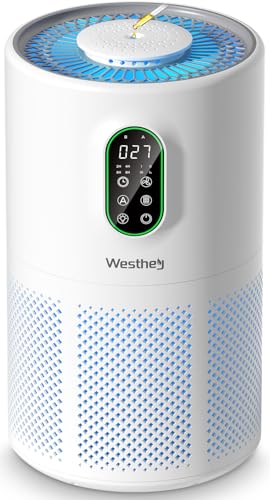
WESTHEY 1650 Sq Ft Purifier — Best Sensor-Led Mid-Size
The WESTHEY splits the difference between the brief and the step-ups: coverage claimed up to 1,650 square feet, an H13 HEPA filter with a washable pre-filter, and a PM2.5 display feeding an auto mode that raises and lowers the fan as the measured particle level changes. Auto mode is the feature that changes ownership from a chore to a background service — the machine answers cooking smoke and a dog shaking off the garden without being asked, then settles back to a whisper when the air clears.
Two lifestyle extras divide opinion and are listed here neutrally: a night light, useful in hallways and children’s rooms, and a fragrance sponge, which scents the outgoing air for households that want it and can simply be left empty by those who do not. The listing speaks to wildfire smoke, dust and pet dander as its particle targets. Judge the WESTHEY as the sensor-led middle path: more feedback and autonomy than the Afloia or YARIKI, less verified headroom than the BLUEAIR step-up.
- Stated coverage: up to 1,650 sq ft
- Filtration: H13 HEPA with washable pre-filter
- Sensing: PM2.5 display with auto mode
- Modes: auto and sleep; night light
- Extras: fragrance sponge (optional use)
Strengths
- Auto mode responds to real particle events.
- Display makes the machine’s work visible.
- Slightly more claimed coverage than the brief’s number.
Trade-offs
- Fragrance feature is unwanted by purist buyers.
- Still a maker coverage figure without AHAM framing.
- Auto sensors need occasional lens cleaning to stay honest.
Best for: households wanting set-and-forget operation with visible feedback. Not suited for: buyers who distrust sensors or want verified CADR as the deciding document.

BLUEAIR Blue 211i Max — Best Verified Step-Up
STEP-UP: the BLUEAIR Blue 211i Max is the documentation pick of this guide. Its listing claims coverage up to 3,235 square feet and — the phrase that separates it from the field — AHAM verified performance, meaning its CADR figures have been through the industry association’s testing programme rather than resting on the maker’s own arithmetic. For a true 1500 square foot open plan, that verification is exactly what the two-thirds rule asks for: a smoke CADR you can set against your floor area with a straight face.
BLUEAIR’s HEPASilent filtration combines electrostatic and mechanical capture, a hybrid approach the maker pairs with quiet running — 23dB at its low end as listed — and the machine adds WiFi, auto mode and a washable pre-filter fabric around the main filter. It is also the pick most likely to be oversized for the reader who came here with a 1500 square foot house of separate rooms; in that house, several smaller units placed where people sleep and sit will usually serve better than one giant in a hallway. Buy the 211i Max for the space it was verified for: one large, connected volume of air.
- Stated coverage: up to 3,235 sq ft — STEP-UP class
- Verification: AHAM verified per listing
- Filtration: HEPASilent with pre-filter
- Noise: from 23dB as listed
- Connectivity: WiFi with auto mode
Strengths
- AHAM verification anchors its performance claims.
- Huge verified headroom for open-plan spaces.
- Quiet low-speed running for its size class.
Trade-offs
- Step-up size and cost exceed most single rooms’ needs.
- Replacement filters for large machines cost more.
- One big unit cannot serve closed-off rooms equally.
Best for: genuine open-plan 1500 square foot homes and buyers who shop by verified CADR. Not suited for: houses of small separate rooms or tight budgets.
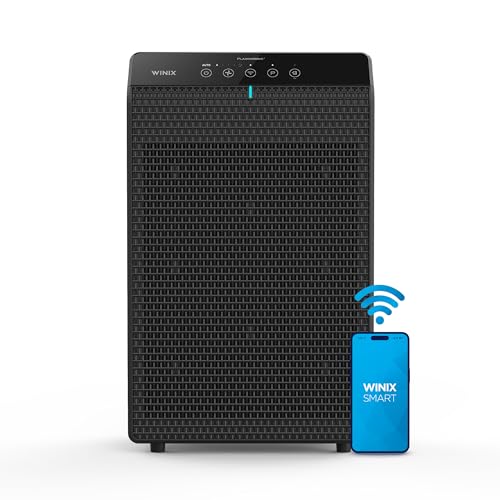
WINIX 5520 Purifier — Best True HEPA With Carbon
The WINIX 5520 builds its case on two filters doing two different jobs: a true HEPA element for particles, and a high-deodorisation carbon filter aimed at odours — cooking smells, household chemicals, the lingering evidence of a smoky evening — which particle filters alone barely touch. Its listing frames coverage as up to 1,882 square feet cleaned in one hour, a more informative formulation than a bare area claim, because it ties the area to a rate and lets a careful reader reason about air changes rather than admire a number.
An air quality monitor with auto mode closes the loop, sensing the room and setting the fan’s response, so the carbon and HEPA stages work hardest exactly when events — frying, cleaning sprays, a door opened onto traffic air — load the room. For households whose complaint is as much about smells as about dust, the WINIX is the only pick here that treats odour as a first-class problem rather than an afterthought, and that focus earns it the final seat in the guide.
- Stated coverage: up to 1,882 sq ft in 1 hour
- Filtration: true HEPA plus high-deodorisation carbon filter
- Sensing: air quality monitor with auto mode
- Targets: pet-related particles, smoke and dust per listing
Strengths
- Serious carbon stage addresses odours, not just particles.
- Coverage stated with a time rate, aiding honest maths.
- Auto mode ties effort to measured air quality.
Trade-offs
- Two filter types mean two replacement rhythms to track.
- Carbon saturates over time and cannot be washed back.
- Still requires the two-thirds rule check for your room.
Best for: homes where cooking and household odours matter as much as dust. Not suited for: buyers wanting the simplest single-filter upkeep.
How Do the Six Air Purifiers Compare Side by Side?
| Pick | Stated coverage | Filtration | Defining feature |
|---|---|---|---|
| Afloia 1500 Sq Ft Purifier | Up to 1500 sq ft | 4-stage, washable pre-filter | 22dB sleep mode, long timer range |
| FreAire 2600 Ft2 Purifier Step-Up | Up to 2,600 sq ft (STEP-UP) | HEPA, washable layer | Real-time PM2.5 display |
| YARIKI 1500 Sq Ft H13 Purifier | Up to 1500 sq ft | H13 HEPA, washable pre-filter | Pet-home focus, black finish |
| WESTHEY 1650 Sq Ft Purifier | Up to 1,650 sq ft | H13 HEPA, washable pre-filter | PM2.5 display with auto mode |
| BLUEAIR Blue 211i Max | Up to 3,235 sq ft (STEP-UP) | HEPASilent, pre-filter | AHAM verified, WiFi |
| WINIX 5520 Purifier | Up to 1,882 sq ft in 1 hr | True HEPA plus carbon | Deodorisation carbon stage |
What Is CADR, and Why Does the Two-Thirds Rule Matter?
CADR — clean air delivery rate — is the volume of filtered air a purifier actually delivers, measured for tobacco smoke, dust and pollen in standard testing. It is the only number in this category that describes work rather than hope, because a coverage claim can assume any fan speed and any air-change rate its maker finds flattering, while CADR is a measured output. AHAM, the association that verifies CADR for models like the BLUEAIR here, publishes the two-thirds rule as the sizing shortcut: choose a unit whose smoke CADR is at least two-thirds of the room’s square footage, assuming standard ceiling height.
Run the rule against this guide’s brief and its honesty becomes bracing: a true 1500 square foot space wants a smoke CADR around 1000, a figure few single machines reach at tolerable noise, which is precisely why the step-up picks exist and why many real 1500 square foot houses are better served by two purifiers placed in the rooms where people spend their hours. A bedroom of 300 square feet, by the same rule, wants a CADR near 200 — well inside the honest working range of the standard picks here when run at a medium speed you can sleep beside.
HEPA, H13 and True HEPA: What Do the Words Mean?
HEPA began as a performance standard: media that captures at least 99.97 percent of particles at the most penetrating size, around 0.3 microns, in the American definition. The H-classes come from the European grading of similar media, with H13 sitting at a comparably high capture efficiency, which is why the YARIKI and WESTHEY state H13 as their grade. True HEPA, the WINIX’s language, is the market’s way of claiming the original standard rather than a HEPA-type or HEPA-style filter that resembles the real thing in construction but not in tested performance.
The practical reading for a buyer is simple: a named grade or a true HEPA claim is a promise you can hold a maker to, while unqualified HEPA-style language is a shrug in a lab coat. None of these grades says anything about gases or odours — that is carbon’s department, and the reason the WINIX pairs its filters — and none of them licenses any claim about your health. They describe what happens to particles passing through a machine, full stop, and that is quite enough to choose on.
Where Should a Purifier Stand, and How Many Do You Need?
Placement follows the air. A purifier cleans the room it stands in, in proportion to how freely air reaches its intake and leaves its outlet, so give it clearance on all sides rather than entombing it behind a sofa, and put it in the room where the people and the particle sources actually are — the bedroom at night, the living room by day, near (not beside) the litter tray or the kitchen doorway rather than in a distant hallway chosen for tidiness. Doors matter: a closed bedroom door makes a modest purifier sovereign over a small kingdom of air, which is why one well-placed standard unit often outperforms a step-up marooned in an open hall.
Count by rooms, not by house. A 1500 square foot home of separate rooms is not one 1500 square foot problem; it is four or five smaller problems sharing a corridor, and the honest fleet is usually a capable unit in the main bedroom, another in the living space, and the step-up reserved for homes whose 1500 square feet is genuinely one connected volume. The guide’s picks divide exactly along that line, and choosing along it will matter more than any difference between neighbouring models.
What Do Noise Figures Really Promise?
Every dB figure in this guide — 20, 22, 23 — describes the machine at its gentlest, which is also its slowest, which is also its lowest CADR. That is not deception so much as physics wearing a name badge: moving air makes sound, and cleaning a large room quickly is loud in any machine ever built. The skill in ownership is scheduling the trade — turbo or high while the room is empty or the household is awake and dressed, medium as the evening default, sleep mode when the lights go out — and the timers and auto modes on these picks exist to automate exactly that rhythm.
Bedroom buyers should also weigh the character of the sound: a low, steady fan note disappears into sleep for most people, while cycling, rattles or a sensor that keeps waking the fan to chase its own readings can disturb more than volume suggests. Auto modes are wonderful servants in living rooms and occasionally fidgety ones beside a bed; several owners end up running auto by day and a fixed gentle speed by night, and the machines here all permit that truce.
How Do Filters, Washing and Replacement Shape Running Costs?
The purchase is the down payment; filters are the mortgage. A washable pre-filter — fitted across most of this guide — absorbs the coarse load for free, rinsed and dried on a monthly rhythm in busy homes. The main HEPA element behind it wants replacement on the maker’s schedule, which stretches or shrinks with your air: a home beside a busy road or with three shedding dogs will spend a filter faster than a quiet flat with one cat, whatever the box promises. Carbon, where fitted as in the WINIX, saturates on its own clock and cannot be revived by washing or sunlight rituals, however fond the internet is of them.
Before choosing, price the replacement filter for each finalist and multiply by your honest replacement rhythm; that figure, over three years, is the machine’s true cost and occasionally reverses the order the purchase prices suggested. Also check whether the filter is a common size stocked by the maker, because an orphaned purifier with an unobtainable filter is a fan with memories.
What Can a Purifier Not Do?
It cannot clean the air of a room it is not in, cannot keep up with a particle source that outproduces it — a smoker in a closed room, a renovation’s dust storm — and cannot substitute for removing sources: the mouldy wall, the unvented hob, the carpet that needs professional attention. It does nothing for gases without carbon, nothing for carbon dioxide ever, and nothing for a stuffy room except move its air in a circle; ventilation remains a window’s job. Households that understand these limits buy purifiers happily and use them well; households sold a miracle tend to return the machine and keep the grievance.
And the boundary stated at the top bears repeating in plain words: these machines capture particles. What that means for any individual’s health is a question for that individual’s clinician, not for a buying guide, and any listing or review that promises more than filtration should be read with the same scepticism this guide applies to coverage numbers.
How Do Auto Modes and Sensors Actually Behave?
An auto purifier is only as honest as its sensor, and most in this price class sense particles optically — a small laser or infrared beam counting what drifts through it. That is genuinely useful for the events that dominate home air: cooking plumes, dust raised by vacuuming, smoke wandering in from outside. It is less useful as an absolute measurement, which is why the FreAire’s numeric PM2.5 readout should be read as a trend instrument — excellent for watching a number fall after an event, approximate as a laboratory figure.
Sensors also have housekeeping needs nobody mentions at purchase: their little intake lenses gather the very dust they measure, and a gentle wipe on the maker’s schedule keeps an auto mode from growing jumpy or complacent with age. If a machine begins racing its fan in an empty, still room at 3 a.m., clean the sensor before condemning the motor. Households that prefer predictability over reactivity can simply fix a speed and ignore the sensor entirely; the filters work identically either way, because the air does not care who chose the fan setting.
What Changes During Wildfire Smoke or High-Pollen Weeks?
Event seasons rewrite the operating manual. When outdoor air carries smoke, the purifier’s job flips from tidying the room’s own dust to defending it against infiltration, and the winning settings are unglamorous: doors and windows closed, the machine on a higher speed in the room you occupy, and patience, because a purifier lowers indoor levels over tens of minutes, not seconds. Carbon earns its keep in these weeks for the odour fraction of smoke, which is the WINIX’s home ground, while HEPA stages handle the particles themselves.
Pollen weeks argue for placement near the bedroom and a habit of changing out of outdoor clothes before sitting on the bed, since the machine can only capture what becomes airborne near it. In both seasons, expect filters to load faster and replacement intervals to shrink; a household in a fire-prone or high-pollen region should keep one spare main filter in the cupboard as a matter of policy, the way it keeps spare batteries for a torch.
How Should You Clean and Maintain the Machine Itself?
Beyond the filters, the appliance asks for very little, delivered regularly: vacuum or wipe the pre-filter on its rhythm, wipe the exterior and the intake grilles where dust mats form, clean the sensor lens as described above, and keep the outlet path unobstructed by curtains or shelving. Never run the machine with its main filter removed to “rest” it — unfiltered air simply loads the motor and the room — and never wash a HEPA element unless the maker explicitly labels it washable, because water destroys the fibre structure that makes HEPA media work, quietly and permanently.
Keep a note of installation and filter dates on the machine itself, in pencil on a label inside the filter door. Memory is the least reliable component in any appliance system, and the date label converts every future judgement — is it due? is it underperforming? — from an argument into a reading.
What Do Timers and Scheduling Actually Buy You?
The Afloia’s unusually granular timer — 2, 4, 8 or 16 hours — points at the two rhythms purifiers serve best. The first is the empty-house cleanse: run a higher speed while the family is out, so the machine’s loudest, most effective hours coincide with nobody needing quiet. The second is the bedroom bridge: start the machine an hour before bed so the room’s air is already settled when heads reach pillows, then let the timer or sleep mode carry it through the night at a murmur.
Households with smart plugs or the BLUEAIR’s WiFi can build the same rhythms by schedule, but the principle predates the app: match the machine’s effort to the room’s occupancy, and both the noise complaint and the electricity complaint mostly evaporate. A purifier run intelligently at the right hours will out-clean a larger one run resentfully at random.
How Do You Tell If It Is Working?
Resist judging by the first day. The honest instruments are indirect and cumulative: dust settling more slowly on a dark surface near the machine, the PM2.5 trend on a display model falling after events and recovering its calm, cooking smells clearing on a schedule you can set a watch by where carbon is fitted. A tissue held at the outlet confirms airflow; a room that smells of nothing in particular, week after week, confirms the system.
If nothing seems to change, work the checklist before the verdict: filter unwrapped and seated, intake unobstructed, machine in the room it is meant to serve, speed appropriate to the hour, sensor lens clean. Most “it does nothing” stories resolve at one of those five stations, and the remainder usually trace to a room far larger than the machine’s honest CADR — which returns the conversation, as everything in this category does, to the two-thirds rule and the tape measure.
How Do Pets Change the Purifier Equation?
Animals are particle factories with opinions: hair and dander shed continuously, litter areas contribute their own weather, and a dog returning from the garden imports the outdoors in bulk. The purifier’s share of the response is airborne capture, and it performs best when the household handles the settled fraction — vacuuming soft furnishings, washing bedding, grooming the animal in a room the machine serves. Placement near the pet’s main territory, rather than near the humans’ chairs, usually collects more at source, though a bedroom unit still earns its place for the eight hours its owners spend breathing there.
Pre-filter discipline is the pet household’s whole game: the washable layers on the Afloia, YARIKI, WESTHEY and FreAire exist precisely for this load, and rinsing them on a short rhythm keeps the expensive HEPA behind them working on the fine fraction instead of suffocating under a felt of hair. Pet owners who adopt that rhythm routinely get the filter life the boxes promise; those who do not, do not, and the difference is a tap and ten minutes a month.
What Should Renters and Shared Houses Consider?
Purifiers are among the friendliest appliances a renter can own: no installation, no landlord negotiation, an immediate effect on the room you actually rent, and full portability when the lease ends. In shared houses, the social placement question dominates — a machine in a communal living room serves everyone and belongs to whoever bought it, which argues for agreeing its running costs and filter splits in the same conversation as the purchase, while goodwill is high and the amounts are small.
Noise diplomacy matters in thin-walled buildings: a turbo hour scheduled while housemates are out is a kindness that costs nothing, and the sleep-mode figures across this guide exist partly as neighbour policy. When you move, the purifier moves — one of the few home-improvement purchases of which that can be said — which is why renters rationally buy a better machine than their current room strictly needs, within the step-up logic this guide has already defended.
How Does Ceiling Height Rewrite the Maths?
Every coverage figure and the two-thirds rule itself quietly assume a standard ceiling of about eight feet, because CADR is matched against floor area as a proxy for volume. A room with a vaulted or double-height ceiling holds half again or twice the air of its floor plan, and the purifier experiences it as a larger room wearing a smaller room’s name. Open-plan lofts — precisely the homes drawn to the step-up picks — should scale their CADR target by the ceiling ratio: divide the actual volume by eight feet to get the effective square footage the machine must serve.
Stairwells compound the effect by marrying two floors’ air into one slow circulation. Households in such spaces often find that a step-up on the main floor plus a standard unit in the principal bedroom outperforms any single placement, because the bedroom door restores the small-kingdom effect at night when it matters most. Volume, like coverage, rewards being measured rather than assumed.
What Is a Sensible Upgrade Path?
Start where you sleep. A standard pick in the main bedroom delivers the most hours of benefit per purchase, because a third of life happens there with the door closed and the machine sovereign. Add the living-space unit second — sensor-led if the household cooks and gathers there — and reserve the step-up decision for the day an open-plan renovation actually merges your rooms. This sequence also spreads filter anniversaries across the year instead of concentrating them in one expensive month.
Resist the opposite path, one giant machine bought first for a house of doors, because its disappointment teaches the wrong lesson: the technology works, the geography did not. Purifiers reward households that think in rooms, and punish, gently and expensively, those that think in headlines.
How Do You Compare Two Finalists Honestly?
Put the two listings side by side and read only four lines of each: the CADR or its verified equivalent, the filter stack by name, the sleep-mode noise, and the replacement filter’s identity. Ignore the photography, the lifestyle paragraphs and the coverage headline you have already learned to discount. If one finalist documents CADR and the other does not, that asymmetry is itself the comparison — a maker who has measured a machine tells you; a maker who has not, hopes. Then price three years of filters for each and let the arithmetic finish the argument the features began.
Finally, picture each machine in the actual corner it will occupy, at the actual hour you will resent it most — 2 a.m., a hot night, a light sleeper beside you — and ask which one’s sound and glow you would rather negotiate with. Specifications choose the shortlist; that small hours thought experiment, honestly conducted, chooses the machine.
What Should You Do in the First Fortnight?
Unwrap the filter — the step whose omission has embarrassed more owners than any other — seat it correctly, and date it. Run the machine in its intended room on auto or a medium speed for the full fortnight rather than judging it by an afternoon, because the effects this category trades in are cumulative: dust deposition slows over days, and a room’s background smell resets over a week. Note the pre-filter’s loading at the end of week two; that observation calibrates your household’s real rinsing rhythm better than any schedule printed on a box.
Register the warranty, photograph the model label, and put the spare-filter question on the calendar for a month before the first change falls due. Households that build these tiny systems around the machine in its first fortnight are the ones still praising it, accurately, in its third year.
How Does Season Shape Settings and Placement?
Winter closes houses and concentrates everything they produce — cooking, candles, wood stoves, the dust of heating systems waking after summer — so the purifier’s busiest season is the one when its noise is most forgiven by a household already wrapped in indoor life. Spring and autumn open windows, which is ventilation doing the purifier’s job for free on clean days and undoing it entirely on smoky or high-pollen ones; the discipline is knowing your local air well enough to choose, and the display models in this guide exist to make that choice an informed one rather than a sniff at the doorstep.
Summer’s contribution is humidity and the mustiness it feeds in soft furnishings, against which a purifier is only ever a supporting actor — source control and ventilation lead. Owners who adjust expectations seasonally, rather than demanding one year-round verdict from the machine, tend to rate their purifiers highest, because they are grading the appliance against the work it can actually do in each weather.
How Do You Handle a Machine That Seems Too Loud?
First, locate the loudness honestly: a purifier on a hard floor in a bare corner will always sound brighter than the same machine on carpet in a furnished room, and a rattling note usually traces to a panel, a filter not fully seated, or a floor that drums — all fixable in minutes. Second, re-time the effort rather than reducing it: schedule the high-speed hours for absence or activity, and protect the sleeping hours with the sleep mode the machine was designed around, accepting the lower CADR as the correct price of silence at that hour.
If the sound still offends after placement and scheduling have had their say, the mismatch is usually size, not brand: a standard unit straining at full speed to govern too large a room will always lose the argument to a step-up cruising at half effort in the same space. That is the quietest argument in this entire guide for buying headroom — a bigger machine, loafing, is frequently the least audible purifier in the house.
What Does Ownership Look Like After Three Years?
The machines that survive happily to year three share a biography: their pre-filters were rinsed on a rhythm, their main filters changed on evidence rather than on panic, their sensors wiped when auto mode grew theatrical, and their owners never asked them to be anything but particle appliances. The disappointments share the opposite biography, and notably, almost none of them are stories about the fan or the motor, which are the most durable parts of the design. Longevity in this category is a housekeeping outcome wearing an appliance’s clothes, and the households that understand that in month one are still, in year three, breathing air that a small, quiet machine has been tidying without ever once being thanked at breakfast.
How Do You Read a Listing Like an Engineer?
Strip any purifier listing to its load-bearing lines and a pattern emerges. The coverage figure tells you the maker’s ambition; the CADR, where published or verified, tells you the machine’s capacity for work; the filter names tell you what the work consists of; the noise figure tells you the price of the gentlest hour, not the busiest one; and the replacement filter’s existence tells you whether the machine has a future. A listing that supplies all five has been written by a maker expecting to be audited, and the BLUEAIR’s AHAM line is the fullest example in this guide. A listing that supplies only the first is asking to be believed, and belief is not a specification.
Apply the same reading to the photographs. A purifier shown in a vast loft with the machine in a distant corner is staging a claim its CADR may not support; a purifier shown beside a bed, with its intake visible and its clearances honest, is usually describing its real job. Marketing departments everywhere prefer the loft. Buyers who have read this far will buy the bedroom photograph’s machine for the bedroom and the verified step-up for the loft, and will be right both times.
What Mistakes Do Air Purifier Buyers Make Most Often?
The founding mistake is believing the box: taking a 1500 square foot headline into a 1500 square foot open plan and expecting the machine’s whisper mode to govern it. Run the two-thirds rule, respect the step-up class, and place units where people live. The second mistake is sealing the machine into a corner behind furniture and then reviewing its performance — purifiers breathe, and a starved intake makes every specification in this guide fictional.
Third is neglecting the pre-filter until the main filter is blinded with hair, then concluding the machine has failed when it has merely been fed. Fourth is buying for a whole house of closed rooms with one unit and a hope. And fifth, quieter than the rest, is leaving the protective plastic on a filter inside a brand-new machine — a rite of passage so common that support lines ask about it first. Open the machine, free the filter, register the date, and let the appliance begin the work it was actually built for.
Final Recommendation
Measure your real air, not your address. Count the doors, note the ceiling height, and write down the two or three rooms where your household actually spends its breathing hours, because those three observations — not the estate agent’s total — are the specification your purifier must meet. A machine chosen against real rooms will be believed in; a machine chosen against a headline will be argued with, and appliances, like the rest of us, do their best work in homes that are not arguing with them. If your 1500 square feet is one connected volume, the verified step-up is the honest centre of this guide: the BLUEAIR Blue 211i Max, with the FreAire 2600 Ft2 Purifier Step-Up beside it when a numeric PM2.5 display matters more than certification paperwork. If your home divides into rooms, buy for the rooms: the WINIX 5520 Purifier where odours share the complaint, the sensor-led WESTHEY for set-and-forget living spaces, the washable-first-stage Afloia or the H13 YARIKI for bedrooms and pet territory. Choose that way and the purifier becomes what it should be — a quiet appliance doing measurable work in the background, asking only for a rinsed pre-filter, an honest replacement schedule, and no faith at all.
Frequently Asked Questions
Will one purifier really cover my 1500 sq ft home?
Only if the 1500 square feet is one open, connected space and the machine’s CADR satisfies the two-thirds rule for that area — which is why the step-up picks exist. A home of separate rooms needs a purifier per key room, because doors defeat airflow more thoroughly than any filter defeats particles. Measure rooms, apply the rule to each, and buy for the spaces where people spend their hours.
What does AHAM verified actually mean?
It means the model’s CADR figures for smoke, dust and pollen have been tested under the Association of Home Appliance Manufacturers’ programme rather than merely asserted by the maker. Verified CADR lets you apply the two-thirds sizing rule with confidence. It is a measurement credential, not a health endorsement, and it is the strongest documentation any pick in this guide carries.
How often do the filters need changing?
Washable pre-filters want rinsing roughly monthly in busy or pet-owning homes. Main HEPA filters follow the maker’s stated interval, shortened by dusty environments and lengthened by gentle ones; a machine that grows louder or a room that stays dusty despite higher speeds is the filter asking in its own language. Carbon filters saturate on their own schedule and are replaced, not washed.
Should I run it all day or only sometimes?
Particles arrive all day — through doors, on clothes, from cooking and cleaning — so continuous running at a low or auto setting generally keeps a room’s levels steadier than heroic bursts. Use higher speeds for events and empty rooms, and let sleep or auto modes carry the quiet hours. The energy draw of a modern purifier at low speed is modest beside the appliances it shares a house with.
Do I need the fragrance or light features?
No — they are lifestyle extras that some households enjoy and others disable on day one, and neither affects filtration. The WESTHEY’s fragrance sponge can simply be left empty, and coloured lights on several picks can be switched off for sleeping. Judge machines on CADR, filters and noise; let garnish break ties, never make them. If a fragrance feature is used, treat it as a scent choice for the room rather than as cleaning, because perfumed air and filtered air are different achievements, and only one of them shows up on a PM2.5 display falling after the toast burns. Households with scent-sensitive members, small children or birds — whose keepers are usually advised to be conservative about added fragrances in enclosed air — can simply leave the sponge dry and lose nothing the machine was bought for, which is the correct test of any extra: whether its absence diminishes the appliance, and in this case it plainly does not.
Related Guides
Outfitting the rest of the home with the same evidence-first approach? These companions cover the kitchen workhorses that share your air and your mornings: Best Dishwashers With Sanitize Cycle, Best Dutch Ovens That Are Not Cast Iron and Best Cozy Slippers.


