What's inside
- Where to buy these 36-inch radiant cooktops
- Quick picks for the big kitchen
- How these picks were chosen
- Five zones at a time: the reviews
- The installation ledger
- How to choose a 36-inch radiant cooktop?
- Living on radiant glass: heat, pans, and patience
- Two cooks, one top: sharing five zones without friction
- The first week on a new radiant top
- Cleaning ceramic glass without ruining it
- Power totals, translated into kitchen meaning
- Common mistakes when replacing a big cooktop
- Final recommendation
- Frequently asked questions
As an Amazon Associate I earn from qualifying purchases. This post may contain affiliate links at no extra cost to you.
As an Amazon Associate, cottageverdict.com earns from qualifying purchases.
A 36-inch cooktop is a commitment measured in cabinetry, and the best radiant cooktops 36 inch wide earn that commitment by giving a serious cook five burners under a sheet of ceramic glass that wipes clean in seconds. Radiant technology — elements glowing beneath the glass, heating the pan through the surface — remains the most forgiving electric cooking there is: it accepts every flat-bottomed pan you already own, from cast iron to the oldest stainless skillet, without the compatibility questions induction raises. The six cooktops below all state 36 inches, five burners or zones, and radiant ceramic or ceramic glass construction in their titles. All six are built-in, hardwired units in the 220–240V class with no plug, which means every one of them is an installation project involving an electrician, not an appliance you unbox at breakfast.
One more shared trait deserves emphasis before the reviews: every model here is a drop-in or built-in unit, which means it becomes part of the kitchen’s architecture rather than a guest on it. That permanence raises the value of everything else in this article — the cut-out figures, the control interface, the frame or its absence — because none of it can be swapped next season without another installation. Buyers accustomed to countertop appliances should slow down accordingly; this is a decision in the same family as the countertop material itself.
Within that shared frame, the differences are the ones a cook touches daily. Three models steer by knobs, two by touch controls, and one by a circular slide control. Total power runs from 8400W to 9200W as stated. Two titles name a hot surface indicator, two name timers and safety locks, one names expandable zones and a pause function, and one publishes its cut-out dimensions outright — a gift to anyone planning cabinetry. Read the control style first, because your hand will meet it ten thousand times; read the installation figures second, because your cabinet will meet them once and permanently.
Where to buy these 36-inch radiant cooktops
Each model is sold through Amazon, with a purchase link waiting in its own review.
- Cusinesync’s ceramic glass model opens the list at a stated 9200W with touch control and five radiant zones.
- ThermoMate’s knob-controlled entry follows at 9000W, with nine heat levels and a hot surface indicator in its title.
- Cooksir’s knob model publishes its cut-out size — 34.25 by 19.3 inches — alongside 8400W of stated power.
- Karinear’s touch model adds expandable zones, a timer, a pause function, and a lock at 9200W.
- NOXTON’s knob design protects its glass with a metal frame and states a hot surface indicator at 8400W.
- Hobsir’s circular slide control model closes the set with a timer, a safety lock, and a glass metal frame at 9200W.
Quick picks for the big kitchen
| Pick | Best for | Title highlight |
|---|---|---|
| Cusinesync 36in Ceramic Glass Radiant 9200W | A sleek touch-controlled five-zone layout | 9200W, ceramic glass, touch control, 220–240V wiring stated |
| ThermoMate 36in Ceramic Radiant Knob 9000W | Knob loyalists wanting defined heat steps | 9000W, 9 heat levels, hot surface indicator, hard wired |
| Cooksir 36in Radiant Ceramic Knob 8400W | Renovators planning cabinetry from stated figures | Cut-out 34.25×19.3 inches published, 8400W, knob control |
| Karinear 36in Glass Radiant Ceramic Touch 9200W | Bridge cooking on expandable zones | Expandable zones, lock, timer, pause, sensor touch, no plug |
| NOXTON 36in Radiant Ceramic Knob 8400W | Glass protection with classic knobs | Metal frame glass protection, hot surface indicator, no plug |
| Hobsir 36in Ceramic Glass 5 Burner 9200W | Slide-control fans wanting a framed glass top | Circular slide control, timer, safety lock, glass metal frame |
How these picks were chosen
The filter was strict and literal: the title had to state 36 inches and radiant, ceramic, or glass construction. That rule excluded at least one famous 36-inch name whose technology is induction rather than radiant, and another whose title says only smoothtop without the radiant or ceramic wording — good cooktops both, but outside this article’s stated premise. All six survivors are five-burner or five-zone built-ins, and all six state hardwired installation in the 220–240V range with no plug, so the electrical conversation is uniform across the list: a dedicated circuit and a qualified installer.
Brand maturity was deliberately not used as a filter, which is why newer names stand beside the format’s conventions here. For hardwired appliances the honest consequence is homework: warranty terms, service coverage in your region, and the availability of a replacement glass panel a decade from now are all full-listing and manufacturer questions, and they matter more for a built-in than for any countertop gadget. Asking them before installation is not being difficult; it is being a homeowner.
Balance came from control philosophy and stated extras. Knob, touch, and slide interfaces each have devoted cooks, and the list holds all three rather than crowning one. Stated power clusters tightly between 8400W and 9200W, so no pick wins on wattage theatre; the separators are the extras each title chooses to publish — indicators, timers, locks, expandable zones, a pause function, a metal frame, a cut-out dimension. Where a title stays silent on a feature another model headlines, the reviews record the silence rather than assuming parity. A cooktop is a fifteen-year decision, and fifteen-year decisions deserve evidence over vibes. Homeowners planning the whole kitchen’s air alongside its heat can consult Best Air Purifiers That Don T Produce Ozone for the purifier titles that address ozone in plain words.
Five zones at a time: the reviews
Cusinesync 36in Ceramic Glass Radiant 9200W
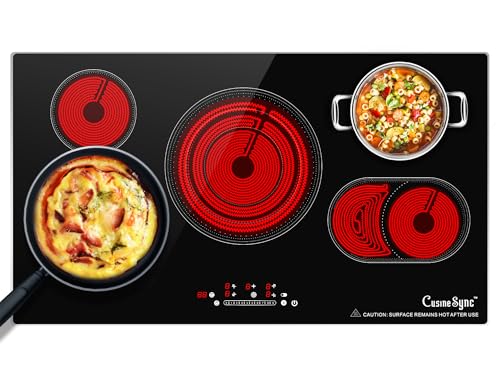
Cusinesync’s entry is the list’s most completely narrated title, because its listing spells the proposition out twice: a 36-inch built-in ceramic glass stove top at 9200W, and then again in sentence form — a radiant cooktop with five zones, ceramic glass, touch control, and 220–240V wiring. Touch control on a radiant top means a completely flat surface with no knobs interrupting the glass, which is the easiest possible wipe-down after a boil-over and the most contemporary look of the six. Five zones at a stated 9200W total places it at the top of this list’s power cluster alongside the Karinear and Hobsir. The brand is a newer name in Western kitchens, which places the burden of verification on the full listing for figures the title omits, such as cut-out dimensions and zone diameters.
Spec mini box — Size: 36 inch, stated. Zones: 5, stated. Total power: 9200W, stated. Surface: ceramic glass. Controls: touch. Wiring: 220–240V, stated. Cut-out size: a spec-sheet figure, absent here. Timer or lock: neither is named.
Strengths
- A fully flat touch surface is the simplest of the six to wipe clean after messy cooking.
- 9200W matches the highest stated total power in this list.
- The title states its wiring class plainly, easing the electrician conversation from the start.
Trade-offs
- Cut-out dimensions are unpublished in the title, so cabinetry cannot be planned from it alone.
- Touch controls demand dry, bare fingers — a real consideration mid-service with wet hands.
- No timer, lock, or indicator feature is claimed in the title to compare against rivals.
The touch-versus-knob question is this cooktop’s whole identity, so it deserves a frank paragraph. Touch panels reward cooks who value a seamless surface and precise taps, and they punish cooks who work with wet hands, wear gloves, or like adjusting heat by feel without looking down. Radiant cooking involves a lot of mid-boil adjustment — a sauce caught at the last second, a pan moved off a zone — and each adjustment style has a rhythm. Cusinesync’s flat glass also changes the kitchen’s visual temperature: with no knobs and no frame, the cooktop reads as a dark mirror plane in the counter, the most minimal object in this list. Buyers drawn to that minimalism, cooking mostly with dry hands and deliberate movements, will find the stated specification — five zones, 9200W, ceramic glass — entirely sufficient. Everyone else should test their habits against the knob models below before committing a cabinet to this one.
Zone geometry is the Cusinesync’s largest unknown, and it is worth naming precisely what to look for in the full listing: the diameter of the largest zone, because a 12-inch skillet on a small zone cooks with a cool rim; the position of the strongest zone, because right-handed and left-handed cooks reach differently; and whether any zone is elongated for a griddle, which the title does not claim. None of that diminishes the stated package — five zones, ceramic glass, touch, 9200W — but a cooktop is bought for its map as much as its total, and this brand’s map is drawn in the listing rather than the title. Shoppers comparing it against the Karinear should note the contrast: Karinear spends its title words on features, Cusinesync spends its on the core specification twice over.
Best for: a design-led kitchen wanting a flat touch-controlled five-zone top at full stated power. Not suited for: wet-handed heat adjustment with oven mitts as a matter of routine. Check price on Amazon and verify the Cusinesync cut-out.

ThermoMate 36in Ceramic Radiant Knob 9000W
ThermoMate flies the flag for knobs. Its title describes a 36-inch electric cooktop with five burners under knob control, a ceramic built-in body, 9000W of power, nine heat levels, a hot surface indicator, and 220-240V hard-wired installation. Nine defined heat levels suit cooks who think in repeatable steps — the simmer that lives at level three, the sear that starts at nine — rather than in infinite sliders. The hot surface indicator is the safety feature radiant tops most need, because a radiant zone stays dangerous long after its glow fades, and the title’s inclusion of it signals a safety-conscious spec. One wording curiosity deserves recording: the title also carries a 30-inch radiant reference amid its 36-inch framing, so buyers should confirm the exact model dimensions in the full listing before cabinetry is cut.
Spec mini box — Size: 36 inch cooktop, stated; the title also carries a 30-inch radiant reference — verify exact dimensions in the full listing. Burners: 5. Power: 9000W, stated. Heat levels: 9, stated. Controls: knob. Safety: hot surface indicator, stated. Wiring: 220-240V hard wired.
Strengths
- Knobs give tactile, glance-free heat adjustment that touch panels cannot imitate.
- Nine heat levels make repeatable settings easy to teach and to return to.
- A stated hot surface indicator addresses radiant heat’s invisible-danger problem directly.
Trade-offs
- The title’s mixed size wording demands a dimension check before any cabinet is cut.
- Knobs interrupt the glass, adding crevices to the cleaning routine.
- No timer or lock feature is claimed in the title.
Knob cooking is a muscle-memory craft. A cook tending four pans does not want to look at a panel, tap a zone selector, then tap a level; they want to reach, turn, and feel the click of a known position. ThermoMate’s nine levels formalise that craft into steps the whole household can share — a partner can be told “the rice sits at three” and reproduce it exactly. The hot surface indicator extends the same clarity to safety, turning an invisible hazard into a lit fact that children and guests can read without instruction. Against those virtues sits the housekeeping cost: five knobs mean five stems where boil-overs creep, and the glass around them asks for a cloth rather than a single sweep. Households that cook by feel and host often will pay that cost gladly; the dimension wording is the only genuine homework, and it is a five-minute check.
The 9000W figure sits in an interesting middle: above the 8400W pair, below the 9200W trio, and spread across five burners whose individual ratings the title does not split out. For the ThermoMate’s intended cook, that arithmetic matters less than the nine-level staircase, because radiant cooking is managed by stepping between known levels rather than by chasing raw power. A household graduating from a coil or gas range will find the levels a translation dictionary — old habits like “medium-low” become “level three” within a fortnight, and the dictionary is shared by everyone who cooks in the house. That shared language is an underrated safety feature in itself: a teenager told to keep the soup at three cannot misread a flame’s height.
Best for: a knob-loyal household wanting nine repeatable heat levels and a stated hot surface indicator. Not suited for: a renovation cutting cabinetry this week, until the title’s size wording is confirmed in the full listing. Check price on Amazon to confirm the ThermoMate’s exact dimensions.

Cooksir 36in Radiant Ceramic Knob 8400W
Cooksir does something no other title here attempts: it publishes the hole. The listing leads with a 34.25-inch cooktop figure and a cut-out size of 34.25 by 19.3 inches, then frames the unit as a 36-inch built-in with five burners, 8400W of high power, five large radiant ceramic zones under knob control, and 220V hard-wired installation. That cut-out figure is renovator’s gold, because the cut-out — not the nominal 36 inches — decides whether a cooktop drops into an existing counter or demands a new one. A household replacing a failed 36-inch unit can measure its current opening against Cooksir’s stated numbers in a minute, a comparison most rival titles make impossible without a trip to a spec sheet. The 8400W total matches the NOXTON at the lower end of this list’s tight power cluster.
Spec mini box — Nominal size: 36 inch built-in, stated. Cut-out: 34.25×19.3 inches, stated in the title. Burners: 5. Power: 8400W, stated. Controls: knob. Surface: radiant ceramic. Wiring: 220V hard wired, stated. Hot surface indicator: the title names none.
Strengths
- Published cut-out dimensions make replacement planning possible from the title alone.
- Knob control keeps the tactile workflow knob cooks prefer.
- Five large zones are claimed in the title, speaking to big-pan households.
Trade-offs
- 8400W is the joint-lowest stated total here, though the cluster is tight.
- No hot surface indicator is named, a safety feature two rivals state outright.
- The dual size figures in the title reward careful reading before ordering.
Replacement is the scenario this cooktop was born for. Cooktops fail on their own schedule, usually mid-renovation-free decade, and the replacement buyer shops under duress with a hole in the counter and a family to feed. Cooksir’s stated cut-out collapses the riskiest question — will it fit — into a tape-measure check, while the knob interface keeps the household’s cooking habits undisturbed. The five large zones wording matters to the same buyer, whose existing pan collection includes the wide skillet and the stockpot that smaller zones embarrass. What the title does not give is the indicator reassurance the ThermoMate and NOXTON offer, so a household with young children should weigh that silence. As a planned-purchase cooktop it is equally coherent; as an emergency replacement with a known hole to fill, it is the list’s most considerate design.
The phrase five large zones deserves one more moment, because zone diameter is where 36-inch tops justify their width. A 30-inch top crowds five burners into compromise circles; a 36-inch top can give the centre or rear zone genuine stockpot room while the front zones stay skillet-sized. Cooksir’s title claims largeness without printing diameters, so the full listing’s zone map remains the confirming document — but the claim at least shows the brand knows which question a 36-inch buyer is asking. Paired with the published cut-out, the Cooksir package reads as the work of a maker courting informed renovators rather than impulse buyers, and informed renovators are exactly the people a hardwired appliance should be sold to.
Best for: a replacement project with an existing counter opening to match against the stated cut-out. Not suited for: a household ranking a hot surface indicator as non-negotiable, since the title names none. Check price on Amazon and take your opening’s measurements first.

Karinear 36in Glass Radiant Ceramic Touch 9200W
Karinear’s title is the feature-richest of the six: a 36-inch drop-in, built-in glass radiant ceramic cooktop with five burners, expandable zones, a lock, a timer, a pause function, 9200W, 220–240V hardwire installation, no plug, and sensor touch controls. Expandable zones are the headline for cooks with oblong cookware — a zone that stretches to meet a griddle or a large oval pan turns a five-burner top into a flexible field rather than five fixed circles. Pause is the connoisseur’s feature: one touch suspends cooking to answer the door, and the settings resume where they left off, a small mercy during the exact interruptions real kitchens specialise in. The lock serves households with children or with cats that regard warm glass as a napping invitation.
Spec mini box — Size: 36 inch, drop-in built-in, stated. Burners: 5. Power: 9200W, stated. Zones: expandable, stated. Controls: sensor touch. Features named: lock, timer, pause. Wiring: 220–240V hardwire, no plug, stated.
Strengths
- Expandable zones answer the griddle and oval-pan problem no fixed circle solves.
- Pause preserves a whole top’s settings through an interruption, unique in this list’s titles.
- Lock plus timer gives the fullest stated family-safety and convenience set here.
Trade-offs
- Sensor touch shares the wet-finger limitation of all touch interfaces.
- Feature density means a learning curve before the top feels intuitive.
- No hot surface indicator is named in the title despite the safety-leaning feature set.
Karinear’s pool history, recorded in the sources, is worth a sentence: the brand fielded several near-identical 36-inch listings in the research cache, and this touch model with expandable zones was selected as the single representative, so buyers comparing within the brand should expect siblings with different control styles. The expandable zone deserves the deepest consideration, because it changes what a radiant top can host. A Sunday griddle spanning two burners usually sits over one hot circle and one cold edge; an expandable zone heats the whole footprint, and pancakes stop arriving in two shades. The same flexibility serves oval Dutch ovens and fish pans, the cookware that fixed geometry punishes. Add pause for the doorbell, a timer for the rice, and a lock for the toddler, and the Karinear emerges as the list’s moderniser — the cooktop for a household seeking radiant tradition with contemporary manners.
Pause has a second use beyond the doorbell: the tasting pause. A cook managing a sauce at the edge of splitting can suspend the whole top, taste and think without the sauce advancing, then resume every zone at its prior setting in one gesture. On knob tops that manoeuvre means memorising five positions; on the Karinear it is a single touch each way. Features like this do not appear in wattage tables, yet they are the difference between a cooktop that collaborates and one that merely heats. The timer completes the collaboration for the set-and-supervise dishes — rice, grains, braises started on the top — freeing the cook to leave the kitchen without leaving the cooking unattended in spirit.
Best for: a griddle-and-oval-pan household wanting expandable zones, pause, timer, and lock in one touch top. Not suited for: a knob-committed cook, since sensor touch is the only interface offered. Check price on Amazon with expandable zones in glass in mind.

NOXTON 36in Radiant Ceramic Knob 8400W
NOXTON’s proposition is protection. The title leads with a glass protection metal frame around a knob-controlled, built-in 36-inch radiant ceramic stove top with five burners, a hot surface indicator, 8400W, and 220-240V hardwired installation with no plug. The metal frame addresses the ceramic glass cooktop’s one structural anxiety: the edge chip. A heavy pan set down carelessly, a cast iron skillet slid too far, a jar dropped from the cupboard above — the frame takes the perimeter damage that would otherwise star or crack the glass edge. For households whose cooking is vigorous and whose pans are heavy, that border is not decoration but insurance, and it gives the top a finished, deliberate look in the counter.
Spec mini box — Size: 36 inch built-in, stated. Burners: 5. Power: 8400W, stated. Controls: knob. Frame: glass protection metal frame, stated. Safety: hot surface indicator, stated. Wiring: 220-240V hardwire, no plug.
Strengths
- The metal frame guards the glass edge, the surface’s most vulnerable line.
- A stated hot surface indicator matches the ThermoMate’s safety clarity.
- Knob control preserves tactile adjustment for traditional cooks.
Trade-offs
- A frame creates a lip where spills can gather, adding a cleaning edge.
- 8400W shares the lower end of this list’s stated power cluster.
- No timer, lock, or expandable zone is claimed in the title.
Think about who chips cooktop edges. It is rarely the careful weekday cook; it is the holiday helper lifting a loaded roaster, the teenager sliding a skillet to the cool side, the jar of jam descending from an over-cabinet. A frame converts those moments from potential cracks into harmless clinks, and over a fifteen-year life the probability of at least one such moment approaches certainty. The NOXTON also pairs its frame with the indicator, making it the safety-double of the list: protection against the pan you drop and the heat you cannot see. The lip’s cleaning cost is real but modest — a frame edge wants a fingernail’s attention with the cloth once a week. Kitchens that cook hard, host clumsy, and plan to keep the same top for a decade should rank this pick higher than its wattage suggests.
The frame also changes how the cooktop ages visually. Bare glass edges accumulate micro-chips that catch light and read as wear even when the surface cooks perfectly; a metal border hides that entire category of ageing behind a deliberate trim line, the way a picture frame hides a canvas edge. Ten years in, a framed top can look newer than a frameless one with identical cooking history, which matters in kitchens that are also the home’s social centre. NOXTON’s choice to headline the frame rather than bury it suggests the brand understands it is selling longevity of appearance as much as protection — and pairing that with knob control keeps the whole proposition aimed at cooks who value the traditional and the durable over the novel.
Best for: a heavy-pan household wanting a protective frame and a stated hot surface indicator with knobs. Not suited for: prizing a perfectly flush glass plane for one-sweep cleaning. Check price on Amazon — framed glass, knob control.

Hobsir 36in Ceramic Glass 5 Burner 9200W
Hobsir closes the list with the interface nobody else here offers: a circular slide control. The title describes a 36-inch built-in ceramic stove with a glass metal frame, five burners, a timer, a safety lock, 9200W, and 220V-240V hard-wire installation with no plug. Slide control occupies the thoughtful middle between knobs and taps — a finger drags along a circular track to raise or lower heat, combining the touch family’s flat surface with something closer to a knob’s continuous, eyes-busy-elsewhere adjustability. The frame echoes the NOXTON’s edge protection, the timer and safety lock echo the Karinear’s convenience set, and the 9200W total ties the list’s highest stated power. It is, in effect, the compromise candidate assembled from the list’s own best ideas.
Spec mini box — Size: 36 inch built-in, stated. Burners: 5. Power: 9200W, stated. Controls: circular slide, stated. Frame: glass metal frame, stated. Features named: timer, safety lock. Wiring: 220V-240V hard wire, no plug.
Strengths
- Circular slide control blends flat-glass cleaning with drag-to-adjust tactility.
- A metal frame plus timer plus safety lock gathers three rivals’ headline extras together.
- 9200W matches the highest stated total power in the list.
Trade-offs
- Slide tracks can be finicky with wet or greasy fingers, like all touch-family interfaces.
- No hot surface indicator is named in the title.
- No expandable zone is claimed, so griddles rely on bridging two burners the old way.
The slide interface deserves a fair trial in the reader’s imagination. Tapping a plus symbol six times to reach a simmer is the touch experience at its most bureaucratic; dragging a finger along an arc to the felt position is closer to how cooks actually think about heat — as a sweep, not a number. Hobsir’s circular variant keeps that sweep on a flat, wipeable plane while adding the frame that guards the glass and the lock that guards the household. For a family replacing a knob top but dreading pure touch, this is the negotiated settlement. The absence of a named indicator is the one gap to weigh, particularly with children, though the safety lock covers the idle-hours half of the child-safety problem. As the list’s synthesiser — power at the top of the cluster, protection, timing, locking, and a humane interface — the Hobsir makes a strong closing argument.
Circular slide geometry has one more subtle benefit: the control’s shape can mirror the zone layout, so the hand learns positions spatially — this arc for the front-left, that arc for the centre — rather than reading labels. Spatial memory survives distraction better than numeric memory, which is why drivers reach for familiar stalks without looking. A cooktop that borrows that principle respects how kitchens actually run at 6 p.m. Hobsir’s combination of the slide with a safety lock also suits households where the top sits at counter height within a toddler’s exploratory reach: the lock guards the idle top, the slide serves the cooking one, and the frame guards the glass throughout.
Best for: a household moving from knobs toward glass that wants slide control, a frame, a timer, and a lock together. Not suited for: a griddle-first cook, since no expandable zone is stated in the title. Check price on Amazon to try the slide-control layout.
The installation ledger
| Cooktop | Controls | Stated power | Extras named in title |
|---|---|---|---|
| Cusinesync 36in Ceramic Glass Radiant 9200W | Touch | 9200W | 220–240V wiring stated; no extras named |
| ThermoMate 36in Ceramic Radiant Knob 9000W | Knob | 9000W | 9 heat levels, hot surface indicator |
| Cooksir 36in Radiant Ceramic Knob 8400W | Knob | 8400W | Cut-out 34.25×19.3 in published |
| Karinear 36in Glass Radiant Ceramic Touch 9200W | Sensor touch | 9200W | Expandable zones, lock, timer, pause |
| NOXTON 36in Radiant Ceramic Knob 8400W | Knob | 8400W | Metal frame, hot surface indicator |
| Hobsir 36in Ceramic Glass 5 Burner 9200W | Circular slide | 9200W | Metal frame, timer, safety lock |
How to choose a 36-inch radiant cooktop?
Knobs, touch, or slide — which hand do you cook with?
Decide by watching yourself cook this week. If you adjust heat while looking at the pan, knobs (ThermoMate, Cooksir, NOXTON) serve that habit. If you cook with dry hands, value a seamless wipe, and like a timer on the top itself, touch (Cusinesync, Karinear) fits. If you want the flat surface but resent tapping, Hobsir’s slide is the middle path. Households split between two cooks with opposite loyalties should weight the slide and knob options heavily, since both give a tactile anchor that a reluctant touch user can learn without resentment. There is no objectively best interface in this list — there is only the one your wettest, busiest, most distracted cooking moment will still operate correctly. Choose for that moment, not for the showroom.
How should the five zones be assigned on day one?
Give the top a constitution before habits improvise one. Designate the largest zone — wherever the finalist’s zone map places it — as the stockpot and pasta station, the front zones as the attended frying and sauce positions, and one rear zone as the permanent warm-and-landing post. Households that agree the map aloud find that two cooks can share the top without negotiation, each knowing which territory a pan may enter. The map can evolve, but starting with one prevents the five-zone top from behaving like a one-zone top with four spectators.
What must be settled before the counter is cut?
Three figures: the cut-out, the circuit, and the clearance. Only Cooksir publishes its cut-out in the title, so every other finalist requires a spec-sheet check before cabinetry is touched — do not let a countertop be cut on a nominal 36 inches. All six are hardwired 220–240V units with no plug, so an electrician and a suitable circuit are part of every budget here. Photograph the existing installation before removal day as well; the old top’s wiring and seating are the best reference the installer can be handed.
And because radiant zones throw heat downward as well as up, the cabinet and drawer clearances in the manual deserve the same respect as the glass dimensions. Kitchens adding serious ventilation or a grill station alongside should also read Best Smokeless Grills with Cover, which covers indoor grills whose titles put lids and smokeless designs in writing.
What does the rest of the kitchen demand from the top?
A 36-inch top rarely arrives alone; it anchors a wall of decisions. The oven beneath or beside it, the hood above it, and the cookware already owned all vote on the choice. Even the lighting votes: under-cabinet lights reflect in ceramic glass, flattering a clean top and exposing every crumb on a neglected one, which is either motivation or warning depending on the household’s cleaning temperament. Five zones invite big-batch cooking that generates serious steam and splatter, so ventilation capacity is a genuine companion question even though no title here addresses it. The counter material matters too: a dark glass top disappears into dark stone and glows out of pale quartz, changing the room’s whole register. And the household’s pan inventory should be audited for flat bottoms, because radiant glass forgives every metal but still asks for contact — a warped pan rocks, spins, and heats in patches on any of these six.
Which stated extras will your household actually use?
Expandable zones matter only if oblong cookware exists in your kitchen. A pause function matters only if your cooking is interruptible — which, with children or a doorbell, it is. A hot surface indicator matters most where guests and children touch things. A metal frame matters where heavy pans move fast. Rank the extras by your household’s real incidents over the past year, and the list reorders itself: the feature that would have prevented your last kitchen mishap is worth more than three features addressing mishaps you never have. Write the ranking down before visiting a showroom, because polished glass under bright lights has a way of reordering priorities that the written list resists.
Living on radiant glass: heat, pans, and patience
Five zones change a household’s hosting geometry in ways worth picturing. A holiday meal that once queued — sauce waiting on the roast, greens waiting on the sauce — runs in parallel: the large zone under the stockpot, two skillets at the front, a sauce holding at the back, and one zone kept dark as the landing strip for anything that threatens to boil over. That parallel capacity, more than any wattage figure, is what the extra six inches over a 30-inch top actually buy, and it is why keen cooks defend the 36-inch format so stubbornly once they have lived with it. The cost is counter run: a 36-inch top consumes the workspace beside it, so kitchens should plan the landing counters deliberately rather than discovering their absence during the first feast.
Radiant cooking has a temperament new owners should meet honestly. The elements cycle to hold a temperature, so a zone pulses rather than burning steady, and the glass retains heat after the pan leaves — a virtue for keeping a sauce warm, a hazard for a forgotten hand, and the reason indicators appear in two titles here. Response to adjustment is gentler than gas or induction: turn the heat down and the pan coasts rather than braking. Experienced radiant cooks pre-empt that coast, sliding a boiling pot to a cooler zone — which is precisely what five zones are for, one of them always waiting as the cool landing spot. Pan choice is gloriously unrestricted compared with induction: any flat-bottomed vessel works, including the cast iron and copper-bottomed veterans other technologies sideline. The glass asks one thing in return — lift rather than drag the heaviest pans, and clean spills before they bake through another meal’s heat.
Two cooks, one top: sharing five zones without friction
Kitchens with two confident cooks expose a cooktop’s social design. Knob tops divide naturally, because each zone’s control sits at its own station and a hand never crosses a partner’s pan to adjust heat. Touch tops centralise control, which can mean one cook’s tap changes another’s zone if the panel is misread in haste — a risk the Karinear’s pause discipline and the Hobsir’s spatial slide arcs both mitigate in different ways. The zone map agreed on day one matters more than the interface, though: when both cooks know the stockpot lives at the back and the landing zone stays empty, five burners feel generous; without the map, the same top feels contested. Households shopping together should each name their non-negotiable — one partner’s knob loyalty, the other’s hatred of cleaning around stems — before the shortlist hardens, because a cooktop, uniquely among appliances, is operated by committee every single day.
The first week on a new radiant top
New owners misjudge radiant heat for about a week, and planning for that week prevents the scorched sauces that sour people on the technology. Boil water on each zone once, just to watch how the elements cycle and how long the glass stays warm afterwards; the experiment costs nothing and calibrates every later instinct. Cook the familiar dishes first — the soup, the eggs, the pasta whose behaviour you know in your bones — because familiar food exposes the top’s response curve honestly, while a new recipe confuses the evidence. Keep one zone permanently empty during that week as the landing strip, until sliding a pan sideways becomes reflex. By the second weekend the top will feel less like a new appliance and more like the kitchen’s centre of gravity, which is the moment its fifteen-year service actually begins.
Cleaning ceramic glass without ruining it
A radiant glass top’s beauty survives on a small discipline. Daily, the cooled surface wants a wipe with a damp cloth and a dry buff, which takes under a minute and prevents the gradual haze that makes owners think the glass itself is failing. Sugary spills are the emergency case: sugar caramelises into the surface under heat and can pit the glass as it cools, so a sugary boil-over should be moved off the heat and dealt with as soon as the zone is safe to approach, rather than left for the evening wash. Burned-on rings yield to a scraper made for glass tops and a dedicated cleaner, used patiently at a shallow angle — never to steel wool or abrasive powders, which trade today’s stain for a thousand permanent micro-scratches. The framed models here, the NOXTON and Hobsir, add one step: the frame’s inner edge collects a line of residue that a cloth folded to a point reaches easily. Knob models ask for the knobs to be lifted or wiped around weekly, since grease migrates down stems invisibly. None of this is onerous, but it is a rhythm, and households unwilling to keep it should expect any glass top — from any brand, at any wattage — to look tired within two years.
Power totals, translated into kitchen meaning
The six titles publish totals of 8400W, 9000W, and 9200W, and the honest translation is that all six live in the same performance neighbourhood. A total is the sum a top can draw across its zones, not the force behind any single pan, and no title here splits the total by zone. What the totals do tell a buyer is class: these are full-power residential tops on serious circuits, not derated apartment units. The practical differences in boiling speed between one household’s big zone and another’s will be decided by zone diameter and pan fit — a wide pan on a matched zone heats evenly, while the same pan overhanging a small zone wastes its rim. Anyone boiling enormous stockpots weekly should hunt the full listings for the largest zone’s diameter and rating on their finalist, because that single zone, not the headline total, is their workhorse. Everyone else can treat the wattage cluster as a tie and let controls, frames, and extras settle the choice, which is what the rest of this article has been arranged to do.
Common mistakes when replacing a big cooktop
- Cutting the counter from the nominal size. Thirty-six inches is a category, not a cut-out; only one title here publishes the hole’s dimensions, so verify the rest before any saw moves.
- Treating hardwired as a detail. Every pick here is a 220–240V hardwired, no-plug installation — the electrician belongs in the budget from the first day.
- Choosing controls by photograph. A flat touch top photographs beautifully and frustrates wet hands nightly; choose by your busiest cooking moment instead.
- Summing wattage into a quality score. The stated totals cluster between 8400W and 9200W across five zones; zone layout and control quality will shape your cooking far more than the cluster’s small spread.
- Forgetting the landing zone habit. Radiant glass holds heat, so a kitchen never keeping a cool zone free will fight boil-overs the technology was ready to solve.
- Dragging the stockpot. Sliding heavy, gritty-bottomed pans across ceramic glass engraves the surface over months; lift, even when it takes two hands and a breath.
- Leaving sugar to bake. A sugary spill ignored through the next meal can bond with the glass itself, turning a thirty-second wipe into a scraper session.
Final recommendation
A word for renovators sequencing the work: order the cooktop decision before the countertop fabrication, not after, because the cut-out is a one-way cut. If your finalist is the Cooksir, its title hands the fabricator a number immediately; for every other model, the spec sheet must reach the fabricator before the stone or timber is touched. The same sequencing applies to the electrician, who needs the chosen model’s stated voltage class — uniformly 220–240V hardwired across this list — while walls are still open. Renovations punish appliances chosen last, and a 36-inch hardwired top is the least forgiving appliance to choose last.
Let the interface decide first and the extras break the tie. Knob households should start with the ThermoMate for its nine levels and stated indicator, unless edge protection matters more, which promotes the NOXTON, or the project is a replacement with a known opening, which promotes the Cooksir and its published cut-out. Touch households split between the Cusinesync’s minimal flat plane and the Karinear’s expandable zones with pause, timer, and lock — the griddle decides between them. The Hobsir stands as the synthesis for households torn between the families: slide control, a frame, a timer, a lock, and top-cluster power in one top. Whichever name lands in your counter, confirm its cut-out and circuit before ordering, and spare a thought for the heating system working beneath the same renovation — Best Furnace Filters 20x20x1 covers the square furnace size in the detail a filter change deserves.
Frequently asked questions
Are all six really hardwired with no plug?
Yes, per their titles. Each states hardwired or hard wired installation in the 220–240V class, and the Karinear, NOXTON, and Hobsir say no plug outright. Budget for an electrician and a suitable circuit with any pick here. Renters should note the consequence plainly: none of these six is a move-in-weekend appliance, and a landlord’s written permission belongs in the project file before the counter is cut.
What is an expandable zone, and which pick states one?
It is a cooking zone that can extend to heat a larger or oblong pan evenly. The Karinear is the only title in this list that names expandable zones, which is why griddle and oval-pan households should look at it first. On the other five tops, a griddle must bridge two separate zones and accept the seam between them, which experienced cooks manage but nobody prefers.
Does 9200W cook noticeably faster than 8400W?
These are total figures across five zones, not single-burner ratings, and no title here publishes per-zone wattage. The spread between the cluster’s ends is modest; control style and zone layout will influence daily cooking more than the total does. One exception to that shrug: households running several large zones simultaneously for hours — preserving days, feast days — should confirm in the full listing how the top manages its total draw, since some designs share power between paired zones under peak demand.
Why do only some titles mention a hot surface indicator?
Because titles are selective. The ThermoMate and NOXTON state one; the other four do not mention it, which this article records as unstated rather than absent — the full listing is where to confirm before treating it as a deciding factor. The same logic applies to child locks and timers in reverse: the Karinear and Hobsir name them, and the knob models’ silence on the subject should be checked rather than assumed in either direction.
What clearance and cabinet questions should be asked?
The titles give widths and, in Cooksir’s case, a cut-out, but the vertical story — clearance to the hood or microwave above, heat tolerance of the cabinet and drawer below, ventilation gaps the design assumes — lives in each model’s manual. Ask for those pages before the design is frozen, particularly where a drawer is planned directly beneath the top, since radiant units shed heat downward and not every drawer of utensils appreciates the arrangement. A shallow utensil drawer with a heat-conscious layout can still work, but it should be a decision, not a discovery.
How long should a cooktop like this last?
A built-in radiant top is infrastructure rather than gadgetry, and households should plan on it serving across a decade or more of daily cooking. That horizon is why this article weights installation figures, frames, and control habits so heavily: a feature used ten thousand times outweighs a specification admired once. It is also why the electrician’s installation quality — correct circuit, correct clearances, level seating in the cut-out — deserves the same care as the model choice itself. Keep the manual, the circuit details, and the installer’s name together in the house file; the next owner, or the next repair visit, will be grateful for all three.
Is radiant a step down from induction?
It is a different trade, not a lesser one. Radiant accepts every flat-bottomed pan, costs less complexity beneath the glass, and responds more gently; induction responds faster and keeps the surface cooler. This list exists for cooks who value the radiant side of that trade — and every title here states radiant or ceramic construction so the choice is made with open eyes. A household inheriting a beloved set of non-magnetic pans, from copper-bottomed classics to older aluminium, will find radiant the only electric technology that seats the whole collection without a compatibility audit.
Can I use cast iron on ceramic glass radiant tops?
Radiant glass accepts flat-bottomed pans of any metal, including cast iron, with the handling habit of lifting rather than dragging heavy pieces across the surface. The framed NOXTON and Hobsir add edge protection for exactly that style of cooking. Rough, unseasoned cast iron bases deserve a quick palm-check for burrs before their first slide across any glass top in this list; a smooth base is a safe base.
Measure the hole twice before anything is cut, respect the circuit as a first-class budget line, choose the interface your busiest hand trusts at the worst moment of your busiest meal, and a 36-inch radiant top will anchor the kitchen for a decade of dinners.


