What's inside
- Where to buy a two-burner gas cooking surface
- Quick picks across both classes
- How these picks were chosen
- All six, reviewed in class order
- Built-ins and portables, side by side
- How do you choose between these two-burner options?
- Installing a 12-inch cooktop without regrets
- Cooking well on exactly two flames
- Life in an RV galley, specifically
- Simmering, searing and the physics of small flames
- Cleaning steel and glass without damaging either
- Mistakes buyers make in the two-burner gas class
- The outdoor kitchen middle ground
- Gas safety in small rooms, stated once and clearly
- A decision worksheet for the 12-inch buyer
- What two burners teach a household about cooking
- Resale, rental and the temporary installation question
- Menus that prove the class: three dinners on two flames
- Seasonal maintenance calendar for a small gas top
- Final recommendation
- Frequently asked questions
As an Amazon Associate I earn from qualifying purchases. This post may contain affiliate links at no extra cost to you.
As an Amazon Associate, cottageverdict.com earns from qualifying purchases.
A 12-inch, two-burner gas cooktop is the smallest serious cooking surface a kitchen can install, and shoppers looking for the best two burner gas cooktops are usually solving one of three problems: a tiny apartment kitchen where a full range will not fit, a cottage or RV galley that needs real flame in a narrow counter, or a household adding a second cooking station beside a main range. Four of the six products below answer that brief directly as built-in 12-inch cooktops, in stainless steel or tempered glass, convertible between natural gas and LPG, with flame-out or thermocouple protection. The final two are a different species wearing similar words: portable outdoor camp stoves with two burners, included honestly because many shoppers cross-shop them for cabins and tailgates, and labelled clearly wherever they appear so nobody mistakes a camp stove for a countertop installation.
Within the built-in four, the differences are materials and details rather than size, since all four share the 12-inch footprint. ThermoMate names SABAF burners, a premium component claim, plus CSA certification. VEVOR publishes a maximum output of 12,250 BTU and repeats its convertible, protected brief. Bestfire keeps its title lean: stainless, dual fuel, thermocouple safety. Karinear swaps steel for a tempered glass surface aimed at apartments and RVs. The portables then change the conversation entirely: Gas One’s double burner camp stove runs high-pressure propane through an adjustable regulator with removable legs, while Barton’s deluxe model claims 40,000 BTU across ceramic infrared burners with auto ignition, numbers no built-in here attempts.
Where to buy a two-burner gas cooking surface
Built-in shoppers wanting named burner quality should start with the ThermoMate 12in 2 Burner SABAF and its CSA-certified, flame-protected design. The VEVOR Gas Cooktop 12in 12250BTU suits buyers who want a published maximum output on a stainless built-in. Bestfire’s 12in Stainless 2 Burner is the minimalist stainless option with thermocouple protection. The Karinear Gas Cooktop 2 Burner 12in brings a tempered glass surface to apartments and RVs. Outdoor cooks should then read the Gas One Double Burner Camp Stove review for high-pressure portable power, and the Barton Deluxe 40000 BTU 2-Burner for infrared camp cooking at tailgate scale.
Quick picks across both classes
| Pick | Best for | Headline fact from the title |
|---|---|---|
| ThermoMate 12in 2 Burner SABAF | Built-in quality in a small kitchen | SABAF burners, NG/LPG convertible, 304 stainless, flame-out protection, CSA certified |
| VEVOR Gas Cooktop 12in 12250BTU | A stated output on a built-in | Max 12,250 BTU, built-in stainless, thermocouple protection |
| Bestfire 12in Stainless 2 Burner | Simple stainless dual-fuel cooking | Stainless steel, LPG/NG convertible, thermocouple safety |
| Karinear Gas Cooktop 2 Burner 12in | Apartments and RVs wanting glass | Tempered glass surface, dual fuel, thermocouple protection, built-in |
| Gas One Double Burner Camp Stove | Portable high-pressure outdoor cooking | Adjustable PSI regulator, 4ft hose, removable legs — camp stove, not built-in |
| Barton Deluxe 40000 BTU 2-Burner | Tailgate and outdoor countertop power | 40,000 BTU, ceramic infrared burners, auto ignition — portable, not built-in |
How these picks were chosen
The built-in four were selected on a strict shared brief: 12-inch width, two burners, built-in installation, dual-fuel convertibility between natural gas and LPG, and a named flame safety system, because a small cooktop in a small dwelling needs its safety engineered rather than assumed. All four titles confirm each of those points, which makes the class unusually coherent. Materials then separated them: three stainless surfaces against Karinear’s tempered glass, with ThermoMate specifying 304-grade stainless and SABAF burners as its distinguishing claims.
The two portables were admitted under a transparency rule rather than the built-in brief. Shoppers researching two-burner gas cooking for cabins, camps and outdoor kitchens encounter these stoves constantly, and excluding them would leave the guide unable to answer the question many readers are actually asking. They are therefore reviewed fully, with their class stated in every table and verdict: powerful, useful, and not cooktops in the installed sense. Output figures were recorded only where titles state them, which is why VEVOR’s 12,250 BTU and Barton’s 40,000 BTU appear in this guide while the other four carry no invented numbers.
All six, reviewed in class order
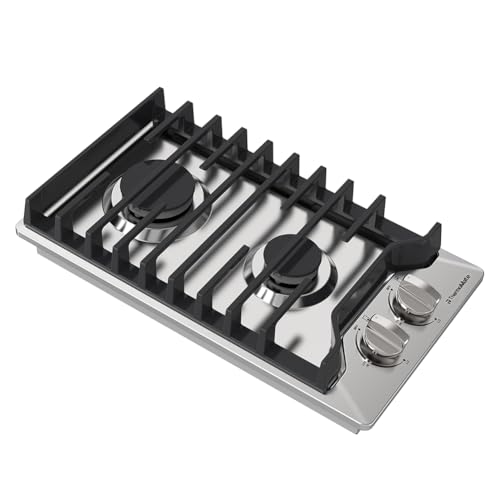
ThermoMate 12in 2 Burner SABAF
ThermoMate’s cooktop makes the most component-conscious pitch in the built-in class: high-efficiency SABAF burners, a named Italian burner maker, set into a heavy built-in rangetop of 304 stainless steel, convertible between natural gas and LPG, with flame-out protection and CSA certification. In a 12-inch appliance, burner quality is not a detail; with only two burners, each one carries half the kitchen’s entire flame capacity, and a well-made burner lights reliably, simmers evenly and survives years of kettle bases. The heavy built-in language and the 304 grade specification speak to buyers furnishing a small kitchen permanently rather than temporarily.
ThermoMate’s titled specification:
- Size and type: 12 inch, built-in gas rangetop
- Burners: 2, high-efficiency SABAF
- Fuel: NG/LPG convertible
- Surface: 304 stainless steel
- Safety: flame-out protection, CSA certified
- Output: no BTU figure stated in the title
Strengths
- Named SABAF burners give the two flames a quality pedigree rivals do not claim.
- Flame-out protection suits small dwellings where a dead flame matters most.
- CSA certification documents the safety case in a verifiable way.
Trade-offs
- No BTU output is published, so power comparisons rest on burner reputation.
- Stainless shows every splash and fingerprint in a compact kitchen.
- Its heavy, permanent brief is wasted on a renter who cannot cut a counter.
A studio apartment with a serious cook inside it is this cooktop’s natural home. The counter run is short, the two burners are the whole stove, and breakfast eggs, a kettle and a weeknight curry all pass across the same 12 inches. In that life, burner reliability is not a luxury; a burner that lights first time at 6 a.m. and simmers a sauce without scorching earns gratitude daily. The convertible fuel brief also future-proofs the installation, since a move from a natural-gas flat to an LPG-fed cottage does not orphan the appliance.
Against the VEVOR, the ThermoMate trades a published output figure for named components and certification. Against the Karinear, it trades glass elegance for steel durability. It is the built-in for buyers who read component names the way other buyers read wattage, and in a two-burner kitchen that instinct is well placed.
Best for: small permanent kitchens where burner quality carries the whole cooking load. Not suited for: renters who cannot cut a countertop, because this ThermoMate is a heavy built-in rangetop by design. Check price on Amazon for the ThermoMate 12in 2 Burner SABAF.

VEVOR Gas Cooktop 12in 12250BTU
VEVOR does what VEVOR usually does: publishes the number. Its 12-inch built-in stainless cooktop states a maximum of 12,250 BTU across two burners, LPG/NG convertibility and thermocouple protection, and then widens its claimed habitats to outdoor, kitchen, camping and RV use. That habitat list should be read carefully: the product is a built-in stove top, and the outdoor and camping language describes settings where such a unit might be installed, in an outdoor kitchen or a camper’s galley, rather than a promise that it packs into a rucksack. Judged as a built-in, it is the output-transparent choice of the four.
The VEVOR title, itemised:
- Size and type: 12 inch, built-in stainless gas stove top
- Maximum output: 12,250 BTU across 2 burners
- Fuel: LPG/NG convertible, dual fuel
- Safety: thermocouple protection
- Claimed settings: outdoor, kitchen, camping, RV
- Burner brand: none named
Strengths
- A stated maximum output lets buyers compare power without guessing.
- Thermocouple protection matches the safety standard of the whole built-in class.
- The wide habitat list suits RV and outdoor-kitchen installations.
Trade-offs
- No burner brand or certification is named in the title.
- Its camping language can mislead skimmers into expecting a portable.
- Stainless requires the same splash-by-splash upkeep as its steel rivals.
An RV refit shows the VEVOR’s strengths clearly. The galley counter accepts a 12-inch cutout, the fuel system is LPG with a possible conversion story, and the cook wants a published output to be sure a kettle boils in reasonable time at a windy campsite. The thermocouple protection matters doubly in a vehicle, where a flame blown out by a draught through the door should not keep feeding gas into a small air volume. For that buyer, the VEVOR’s transparency about its ceiling is more useful than a rival’s component pedigree.
Kitchen buyers should simply note the same facts with different emphasis: a known maximum, dual fuel, protection, steel. The absence of a certification claim in the title is worth a pause for the most cautious installers, who may prefer the ThermoMate’s CSA line, yet the VEVOR remains the built-in that tells you its power outright, a virtue this guide consistently rewards.
Best for: RV, outdoor-kitchen and apartment installations where a published BTU ceiling matters. Not suited for: shoppers wanting a freestanding camp stove, because despite its title’s camping word, this VEVOR is a built-in unit. Check price on Amazon to review the VEVOR Gas Cooktop 12in 12250BTU.
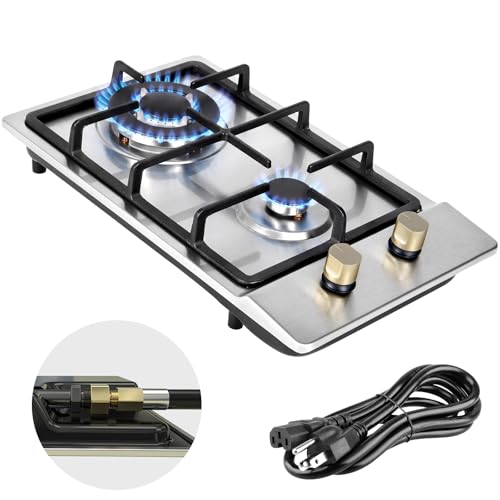
Bestfire 12in Stainless 2 Burner
Bestfire’s title is the shortest among the built-ins, and its brevity is almost a philosophy: a 12-inch gas stove, two burners, propane cooktop in stainless steel, dual-fuel LPG/NG convertible, with thermocouple safety protection. Everything the class requires is present, and nothing extra is claimed. No burner brand, no output figure, no certification line, no habitat poetry. For buyers exhausted by feature inflation, that restraint can read as honesty; for buyers who comparison-shop by specification, it means the Bestfire must be chosen on its essentials and its fit rather than on any headline.
Bestfire’s complete titled case:
- Size: 12 inch, 2 burner
- Surface: stainless steel
- Fuel: LPG/NG convertible, dual fuel
- Safety: thermocouple protection
- Output and burner brand: neither stated
- Installation: cooktop format, as titled
Strengths
- The full class brief, dual fuel plus thermocouple safety, in a clean stainless unit.
- No inflated claims means the essentials can be judged without decoding marketing.
- Stainless suits both apartment kitchens and utility spaces equally.
Trade-offs
- With no output figure, power-hungry cooks cannot verify its ceiling from the title.
- No certification is named for the most cautious installers.
- It offers no distinguishing flourish against three close rivals.
Consider a granny-flat conversion at the bottom of a family garden: a bed-sit kitchen for a parent, plumbed for LPG, needing a safe two-burner top beside a sink and a kettle. The Bestfire fits that brief without drama. Its thermocouple protection addresses the family’s real concern, an unattended flame in a small dwelling, and its dual-fuel nature lets the flat start on bottled gas and convert if a mains line ever arrives. The cooktop will boil, fry and simmer across two burners, which is the whole job description, and its plainness keeps the small kitchen visually calm.
In the four-way built-in comparison, Bestfire is the baseline against which the others’ extras are priced: SABAF burners and certification above it, a published output beside it, glass elegance across from it. Some buyers will pay for those extras gladly; others will look at the baseline and conclude it already contains everything they will ever use. Both conclusions are available honestly from the titles, which is how a mature category should present itself.
Best for: straightforward small-dwelling installations that need the class essentials and nothing theatrical. Not suited for: a buying decision requiring a verified output figure, since Bestfire’s title publishes none. Check price on Amazon for the Bestfire 12in Stainless 2 Burner.

Karinear Gas Cooktop 2 Burner 12in
Karinear changes the built-in class’s material story: where its three rivals wear stainless steel, this 12-inch cooktop is built into a tempered glass surface, dual-fuel LPG/NG, with thermocouple protection, and titled for apartments, indoor use and RVs. Tempered glass changes the daily experience of a small cooktop in two ways. Visually, it reads as a sleek black plane that disappears into a modern counter rather than announcing itself as an appliance. Practically, a flat glass surface wipes down in one pass, with no steel grain to chase sauce out of, though it asks for reasonable care with heavy cast-iron cookware set down hard.
Karinear’s titled details:
- Size and type: 12 inch, built-in gas stove top
- Surface: tempered glass
- Fuel: LPG/NG dual fuel
- Safety: thermocouple protection
- Settings named: apartment, indoor, RV
- Output: not stated in the title
Strengths
- Tempered glass gives the smallest kitchens the sleekest possible cooking plane.
- One-pass wipe-down suits cooks who tidy as they go.
- The full dual-fuel, protected brief matches its steel rivals point for point.
Trade-offs
- Glass demands gentler handling of heavy pans than stainless does.
- No output or burner brand is published in the title.
- Dark glass shows dust and water spots between cooks in bright kitchens.
A new-build apartment with a design-conscious owner is the Karinear’s stage. The kitchen is a single wall of cabinetry in a living space, and every appliance is also furniture. A steel cooktop would read as catering equipment; the black glass plane reads as part of the counter, flame appearing almost from the surface itself when lit. Cooking performance rests on the same class fundamentals, two burners, dual fuel, protection, so the choice is honestly aesthetic and practical at once: the easiest surface to wipe, in the finish that flatters the room.
RV buyers get a different dividend from the same material: glass lightens the visual clutter of a tiny galley and cleans fast in a space where the cooktop sits inches from the bed. Households that cook with heavy cast iron daily, sliding pans across the surface in the French manner, should weigh steel’s forgiveness more heavily. Our notes return to the glass-versus-steel question in the choosing section, since it is the built-in class’s defining fork. Readers planning the matching big surface for a main kitchen can continue at Best Thirty Inch Electric Cooktops, where the same material debate plays out at family scale.
Best for: design-led apartments and RV galleys wanting a glass cooking plane. Not suited for: cooks who slam heavy cast iron down without thinking, because tempered glass prefers gentler handling than steel. Check price on Amazon to see the Karinear Gas Cooktop 2 Burner 12in in glass.
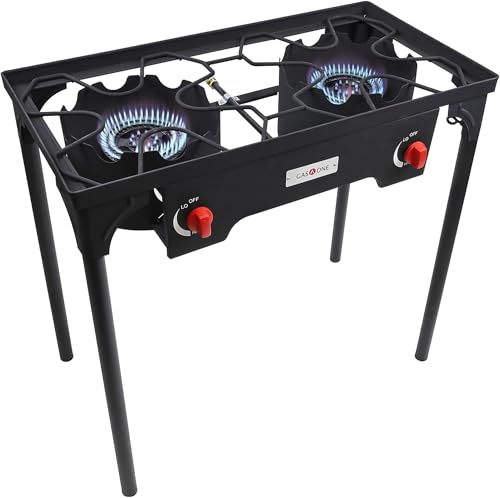
Gas One Double Burner Camp Stove
Class change, stated plainly: the Gas One is not a built-in cooktop. It is a propane double-burner camp stove for outdoor use, built around high-pressure burners, an adjustable PSI regulator and a four-foot hose, standing on removable legs. That architecture serves a completely different life. High-pressure propane delivers fierce heat for big pots, crab boils, canning kettles and camp breakfasts for a crowd, and the regulator lets the cook govern that pressure directly. Removable legs mean the stove packs for transport and stands at working height on site, over grass, gravel or a tailgate.
Gas One’s titled facts:
- Class: portable outdoor camp stove, not built-in
- Burners: 2, high-pressure propane
- Control: adjustable PSI regulator
- Connection: 4ft hose included in the title’s description
- Legs: removable
- Indoor use: not claimed; outdoor by design
Strengths
- High-pressure output handles stockpots and boils that humble indoor burners.
- An adjustable regulator gives direct command over the flame’s muscle.
- Removable legs make it a traveller rather than a fixture.
Trade-offs
- It cannot be installed in a counter, full stop.
- High-pressure burners are wasted on delicate indoor-style simmering.
- Outdoor-only duty means weather still governs the cooking calendar.
The scene here is a lakeside campsite feeding nine people: a pot of corn and potatoes the size of a bucket, a griddle of bacon working beside it, coffee perpetually imminent. No 12-inch built-in could attempt that menu, and no camp cook would ask it to. The Gas One exists for scale and portability outdoors, and judged on that brief its features align beautifully, pressure for the boil, a hose long enough to place the tank safely aside, legs that level the operation on rough ground. Households with a cabin too small for a fitted kitchen sometimes adopt it as a porch stove, which is a legitimate life for it, provided it stays outdoors where its design intends.
Its presence in this guide is a signpost, not a confusion. If your search for two-burner gas cooking was really about feeding people outdoors, your shortlist is this stove and the Barton below. If it was about a kitchen, return to the four built-ins above and let this one go with respect.
Best for: campers, cabin porches and outdoor cooks boiling big pots. Not suited for: any kitchen installation whatsoever, because the Gas One is a freestanding camp stove with removable legs. Check price on Amazon for the Gas One Double Burner Camp Stove.

Barton Deluxe 40000 BTU 2-Burner
The second portable closes the list with the largest number in it: a deluxe two-burner propane stove claiming 40,000 BTU, with ceramic infrared burners and auto ignition, framed as an outdoor countertop cooktop for camping, barbecues and tailgating. Again, the class label matters: countertop here means it sits on an outdoor table or stand, not that it drops into a kitchen counter. Ceramic infrared burners are its technological signature, radiating intense, even heat that suits griddling and searing, and auto ignition removes the lighter ritual that the Gas One leaves to the user.
Barton’s titled specification:
- Class: portable outdoor stove, not a built-in cooktop
- Total output: 40,000 BTU across 2 burners
- Burner type: ceramic infrared
- Ignition: auto ignition
- Fuel: LPG propane
- Settings named: BBQ, tailgating, outdoor cooking, camping
Strengths
- Forty thousand BTU is the biggest stated output anywhere in this guide.
- Ceramic infrared burners deliver fierce, even heat for searing and griddling.
- Auto ignition starts the stove without matches or a separate lighter.
Trade-offs
- Like the Gas One, it has no place in a fitted kitchen counter.
- Infrared intensity is overkill for gentle sauces and delicate simmering.
- Its deluxe outdoor brief still leaves it weather-dependent.
Tailgating is the Barton’s home turf: a parking-lot kitchen feeding a circle of folding chairs, burgers and sausages moving across a hot surface, breakfast hash crisping in a wide pan before a noon game. Infrared heat rewards that menu, searing fast and evenly, and auto ignition keeps the operation one-handed while the other hand holds tongs or a coffee. The 40,000 BTU headline, read across two burners, explains the pace such a stove can sustain when the queue is long and the appetite is louder than the crowd.
Between the two portables, the choice is character: the Gas One is the high-pressure boil specialist with a regulator to govern it, the Barton is the infrared searing station with push-button starts. Between the portables and the built-ins there is no choice at all, only a category decision the buyer must make first, indoors or outdoors, installed or travelling. This guide’s comparison table keeps that line bright.
Best for: tailgaters and outdoor hosts wanting infrared heat and auto ignition. Not suited for: apartment kitchens seeking a drop-in cooktop, because the Barton is a portable outdoor stove through and through. Check price on Amazon to inspect the Barton Deluxe 40000 BTU 2-Burner.
Built-ins and portables, side by side
| Model | Class | Fuel and safety | Stated output |
|---|---|---|---|
| ThermoMate 12in 2 Burner SABAF | Built-in 12 inch | NG/LPG, flame-out protection, CSA certified | Not stated |
| VEVOR Gas Cooktop 12in 12250BTU | Built-in 12 inch | LPG/NG, thermocouple protection | 12,250 BTU max |
| Bestfire 12in Stainless 2 Burner | Built-in 12 inch | LPG/NG, thermocouple protection | Not stated |
| Karinear Gas Cooktop 2 Burner 12in | Built-in 12 inch, glass | LPG/NG, thermocouple protection | Not stated |
| Gas One Double Burner Camp Stove | Portable camp stove | Propane, adjustable PSI regulator | High-pressure, figure not stated |
| Barton Deluxe 40000 BTU 2-Burner | Portable outdoor stove | LPG, auto ignition, ceramic infrared | 40,000 BTU |
Read the class column first and the output column last. The Barton’s huge figure does not make it a better kitchen cooktop, because it is not one; it makes it a stronger outdoor stove, which is a different honour entirely.
How do you choose between these two-burner options?
Built-in or portable: which life is this burner living?
Answer this before all other questions, because it deletes half the list. A fitted kitchen, galley or outdoor kitchen counter wants a built-in, with its fuel conversion and flame protection engineered for enclosed spaces. A campsite, porch or tailgate wants a portable, with legs, hoses and pressure designed for open air. The two classes share burners and little else, and a buyer who blurs them ends up either cutting a counter for a camp stove’s fantasy or carrying a built-in to a picnic that never happens. Let the setting choose the class, then let the details choose within it.
Steel or glass on a 12-inch surface?
Among the built-ins, material is the honest fork. Stainless steel, in three grades of presentation here, forgives heavy pans, hot spills and decades of scrubbing, and shows its gratitude by showing every splash in the meantime. Tempered glass wipes clean in a single pass and flatters a modern room, in exchange for gentler treatment of cookware and a tolerance for visible dust between cooks. Kitchens that cook daily with cast iron should lean steel; kitchens that are also living spaces should lean glass. The Karinear stands alone on the glass side, so the decision is also a shortlist of one if glass wins.
What does flame protection actually protect?
Flame-out and thermocouple systems share one job: if the flame dies while gas is open, from a draught, a boil-over or a simmer turned too low, the gas supply closes instead of filling a small room with unburned fuel. In a 12-inch cooktop installed in a studio flat or an RV, that job is not a luxury feature; it is the feature on which the whole installation’s safety rests. All four built-ins here name such a system, and the ThermoMate adds CSA certification over the top. Buyers should treat protection as non-negotiable indoors and then argue happily about burners and finishes. Ventilation-minded readers planning a whole small kitchen may also consult Best Air Purifiers With UV Light for the air side of compact living.
Which fuel will the burner actually burn?
All four built-ins convert between natural gas and LPG, which sounds like a footnote and behaves like insurance. A cooktop installed today on mains gas can follow its owner to a bottled-gas cottage; an RV fitted for LPG is not locked out of a future conversion. Conversion should be performed properly, with the correct jets and a leak check, ideally by a qualified fitter, because dual-fuel on the title means convertible with the right procedure, not magically indifferent to fuel. The portables, by contrast, are propane creatures entirely, matched to tanks and outdoor regulators.
Installing a 12-inch cooktop without regrets
A built-in cooktop is a hole in a counter plus a gas connection, and both deserve respect. The cutout must match the unit’s specified dimensions with the clearances the maker requires from walls and cabinetry, because a 12-inch top in a small kitchen often sits closer to its surroundings than a full range would. Gas work belongs to qualified hands in most jurisdictions, full stop; the savings from improvising a connection are imaginary compared with the risks. Ventilation matters in miniature too: a small flat with a gas flame needs its extractor or window routine taken seriously, and carbon monoxide awareness is part of owning any combustion appliance, however small.
Think also about the pans. Two burners in 12 inches means two pan bases sharing a narrow stage, and a household whose favourite skillet is enormous will find the second burner crowded whenever that skillet performs. Measure your two most-used pans side by side against the 12-inch reality before ordering any model here. The right pairings, a medium pan and a kettle, a saucepan and a small skillet, cook beautifully in this class; the wrong pairings fight daily, and no burner brand can referee them.
Cooking well on exactly two flames
Two-burner cooking is a sequencing art. Start the item that holds, rice, a sauce, a pot of potatoes, on the back or gentler burner, then give the front flame to the item that demands attention, the fry, the sear, the omelette. Kettles live happily in the gaps. Batch cooking scales by rhythm rather than area: soup first, stored in the serving pot, then the main, then a quick vegetable in the residual pan heat. Households that adopt the rhythm stop experiencing the cooktop as small within a month, because most real dinners, examined honestly, only ever used two burners of the big range anyway, a truth this class quietly exploits.
Life in an RV galley, specifically
Three of the built-in titles name RV use, and the galley imposes rules a flat never meets. Everything aboard moves, so a cooktop’s companions, pans, kettle, utensils, must be stowable in seconds, and the cooktop itself must tolerate a life of vibration without its grates wandering. Cooking underway is not the plan; cooking at anchor, with the vehicle levelled and ventilated, is. Flame protection earns its keep doubly in a vehicle, where the air volume is tiny and a draught through a roof vent can kill a low flame without anyone noticing. LPG is the native fuel of the road, and the dual-fuel brief of all four built-ins means a galley unit can later retire to a static caravan or a cottage without conversion drama beyond the proper jets and checks.
Weight and power budgets shape the rest. An RV cooktop competes with everything else for payload, and a compact 12-inch unit is inherently kind to that arithmetic. Boiling times stretch at altitude, a fact of physics no burner brand escapes, so mountain travellers should plan kettles accordingly rather than blaming the appliance. The Karinear’s glass and the ThermoMate’s steel both travel in this world; the choice between them aboard a vehicle is mostly about which surface the crew will clean cheerfully in a space where the sink is eighteen inches from the pillow.
Simmering, searing and the physics of small flames
Small cooktops are judged unfairly by a single test, the rolling boil, when their daily work is mostly simmering. A good two-burner top must hold a sauce at a bare tremble without the flame dying into its own protection system, and that low-end manners matter more to a sauce-making household than any maximum figure. The VEVOR’s published ceiling tells only the top of its range; the ThermoMate’s burner pedigree hints at control across the range; the honest position is that titles rarely document simmer quality, so buyers who live by slow cooking should weight burner reputation and return policies accordingly.
Searing on a small top is a pan discipline: preheat the pan properly, dry the food’s surface, and resist crowding, because two burners offer no third stage for overflow. A heavy skillet stores heat and forgives the modest output of a compact burner, effectively lending the cooktop muscle it does not have. Households that master that partnership find the 12-inch class entirely sufficient for steaks and chops; households that load a cold pan with wet chicken will blame any cooktop in the world, starting with whichever one is installed.
Cleaning steel and glass without damaging either
Stainless cooktops reward immediacy: a wipe while the surface is warm removes most splashes before they bake into the grain, and a soft cloth along the grain keeps the finish even. Abrasive pads will scar steel permanently, a particular sorrow on a small top where every mark is visible. Glass rewards a different patience: let it cool before wiping to avoid thermal shock to spills and cloth alike, lift sugary boil-overs with a suitable scraper held flat, and polish with a dry cloth to defeat the water spots its dark surface loves to display. Both materials forgive a daily two-minute ritual and punish a monthly excavation, which is the real maintenance divide in this class.
Burner caps and grates, whatever the surface, want a periodic soak and a thorough dry before returning to duty, since a damp cap can colour a flame and confuse the cook about the appliance’s health. Keep the igniter area and the thermocouple tip clean as well; many a service call for a burner that will not stay lit is resolved by a cloth rather than a part. Cleaning claims appear in none of the six titles, so treat this discipline as the owner’s half of the bargain on every model.
Mistakes buyers make in the two-burner gas class
Mistaking a camp stove for a cooktop. The Gas One and Barton are excellent outdoor stoves that cannot be installed in a counter, and their reviews here say so in every section.
Comparing portable BTU to built-in BTU. Forty thousand outdoor BTU and a built-in’s unstated output belong to different worlds of pressure, purpose and safety design.
Skipping the pan measurement. Twelve inches is a promise about the counter, not about your largest skillet fitting beside a stockpot.
Treating conversion as a shrug. NG-to-LPG conversion needs the correct jets and a leak check, performed carefully or professionally.
Ignoring flame protection in small dwellings. The smaller the room, the more the protection system matters; happily, every built-in here includes one. Designers of compact bathrooms face the same space logic and may enjoy Best Unfinished Bathroom Vanities for another small-room fitting decision.
The outdoor kitchen middle ground
Between the fitted indoor kitchen and the campsite sits the outdoor kitchen, a counter under a roof where a built-in cooktop sometimes lives a second life. The VEVOR title gestures at this world directly. An outdoor installation changes the appliance’s enemies: pollen, leaves, damp and curious wildlife replace kitchen grease as the daily deposit, and a cover becomes as essential as the gas line. Flame protection matters outdoors too, since a gust through the pergola can kill a burner mid-sauce. Households building such a station should choose steel for its indifference to weather, site the top where rain cannot pool on it, and plan the gas supply, bottled usually, with the same formality as an indoor line. Done properly, a 12-inch built-in outdoors becomes the summer kitchen’s heart, close to the garden table and far from the house’s heat.
The portables serve this same space more casually, arriving for the party and leaving for the garage. Neither approach is superior; they are commitments of different depths, and the household that knows its entertaining calendar can choose between a fixture and a guest performer with confidence.
Gas safety in small rooms, stated once and clearly
Any flame in a small dwelling asks for three companions: ventilation, a working carbon monoxide alarm, and the habit of never leaving a burner unattended at a whisper. The protection systems in all four built-ins guard against gas flowing without flame; they do not ventilate the room or supervise the cook. Keep the space above the top clear of stored items, teach every household member where the gas shutoff lives, and treat any persistent gas smell as a stop-everything event: flames out, windows open, no switches touched, and the supplier or emergency line called from outside the smell’s reach. These rules are not a comment on any product here; they are the standing terms on which gas cooking, at any size, earns its place in a home.
For the portables, the equivalent discipline is distance and open air: tanks upright and away from the burners’ heat, hoses inspected for cracking each season, and never, under any weather excuse, moving a camp stove indoors or into a tent. The Gas One’s hose length and the Barton’s countertop stance are designed for outdoor geometry; respecting that geometry is the whole of their safety contract.
A decision worksheet for the 12-inch buyer
Write down the room’s fuel, the counter’s available run, the two pans used most, the cookware material loved most, and whether the installation is forever or for a season. Those five answers select among the four built-ins almost mechanically: LPG or NG both work everywhere here, a design-led room points to glass, heavy cast-iron habits point to steel, a forever installation justifies the ThermoMate’s component premium, and a season in an RV justifies the VEVOR’s published practicality or the Bestfire’s simplicity. If the worksheet instead describes a porch, a pitch or a parking lot, it has selected the portable class, and the remaining question is merely boil versus sear, Gas One against Barton.
What two burners teach a household about cooking
Constraints reorganise technique. A household limited to two flames plans mise en place without being told to, because there is nowhere to hide an unprepared ingredient once cooking starts. Sauces are made first and held; vegetables are cut before the pan heats; the cook reads the whole recipe before lighting anything, a habit that four-burner abundance never forced. Within a season, most two-burner households report that their cooking became calmer and, unexpectedly, better, because attention concentrated on two pans instead of diffusing across four. The cooktop deserves only partial credit, yet the class’s many devoted owners are not imagining the effect.
The same constraint disciplines shopping. A 12-inch top cannot host a unitasker pan collection, so households keep the skillet, the saucepan and the kettle that earn their storage and release the rest. In a small dwelling that discipline is liberation disguised as limitation, and it is one reason the tiny-kitchen veterans who write about this class sound almost evangelical. Buyers who fear the size should borrow that perspective: the question is not whether two burners can cook dinner, which they demonstrably can, but whether the household will enjoy the tidier cooking culture they impose.
Resale, rental and the temporary installation question
Built-ins are commitments, and households in transition should price that honestly. A renter who cannot cut a counter has no built-in option at all and should look at the portables only for outdoor life, or leave this category for a plug-in alternative elsewhere. A landlord fitting a small rental flat, by contrast, gets durable value from a protected, convertible built-in, since the appliance serves tenant after tenant and converts if the flat’s fuel ever changes. A homeowner planning to sell within a few years should favour the finish that photographs as the room demands, glass in a modern flat, steel in a traditional one, because a 12-inch top is small enough that its visual effect outweighs its culinary specification in a buyer’s first impression.
Temporary households, students in a first studio, a family in a stopgap cottage, often ask whether the class can be installed cheaply and removed later. A built-in can be uninstalled and the counter patched, but the exercise rarely justifies itself for a single season; those households are better served by patience and a simpler interim arrangement than by cutting stone for a year. The category rewards the settled, and there is no shame in recognising a temporary season for what it is.
Menus that prove the class: three dinners on two flames
First dinner: a curry and rice for four. The rice pot claims one burner and finishes early, resting happily in its own steam under a lid. The curry takes the second flame in stages, spices bloomed, onions softened, sauce simmered, and the two vessels meet at the table with a salad made cold in parallel. Second dinner: steak, potatoes and greens for two. The potatoes parboil on one flame, then drain and crisp in the steak pan’s fat after the meat rests, while the greens wilt in thirty seconds in the potato pot’s residual heat. One pan, one pot, no juggling. Third dinner: a full breakfast for guests, eggs to order in one pan while sausages and tomatoes hold in a low oven or a covered second pan, with the kettle cycling through every gap. None of these menus is a compromise performance; each is simply cooked in the order its components prefer.
The pattern across all three is identical: one vessel holds, one vessel performs, and the cook’s attention is the scarcest resource being managed. Households that internalise the pattern stop counting burners entirely. Households that insist on four simultaneous pans will never be happy in this class, and they should buy the bigger surface without self-reproach, because the goal is a kitchen that suits its cook, not a medal for minimalism.
Seasonal maintenance calendar for a small gas top
Monthly, wipe the surface with the method its material prefers and check that every burner lights promptly and burns with a steady, mostly blue flame. Quarterly, lift the caps and grates for a soak, dry everything thoroughly, and confirm the protection system responds when a flame is deliberately blown out at a low setting, performed carefully and briefly. Annually, inspect the gas connection area for damage or disturbance, test the room’s carbon monoxide alarm, and review whether the household’s pans still fit the two-burner stage as cooking habits evolve. Portables follow a parallel calendar: hoses inspected each season, regulators kept dry in storage, legs and fasteners checked before the first trip of the year.
None of this is specialised labour; it is the ordinary attentiveness that keeps a flame appliance boring, and boring is the highest praise a gas appliance can earn. The four built-ins, with their named protection systems, are designed to be boring in exactly this way for many years, provided their owners hold up the small half of the arrangement described here.
Final recommendation
For a permanent small kitchen, the ThermoMate earns the lead recommendation on component quality and certification: SABAF burners, flame-out protection and CSA documentation in 304 stainless. Buyers who want their output in writing should take the VEVOR, glass devotees the Karinear, and minimalists the Bestfire, each a coherent answer within the same safe class. Outdoor cooks should choose between the Gas One’s high-pressure boiling muscle and the Barton’s infrared tailgate power, in full knowledge that both are stoves, not cooktops. The category rewards buyers who decide the setting first; every model here is the right answer to one clearly stated life.
Frequently asked questions
Can a two-burner cooktop really serve as a kitchen’s only stove? Yes, for households that cook in sequence: one holding pot and one active pan covers most dinners, and generations of small flats have run entire cuisines on two flames.
What is the difference between flame-out and thermocouple protection? Both describe safety systems that shut the gas when the flame fails; titles use the terms as their makers chose, and all four built-ins here include one of the two wordings.
Is tempered glass safe around gas flames? The Karinear is purpose-built as a glass gas cooktop with thermocouple protection; treat it as engineered for the job while handling heavy cookware with reasonable care.
Why are camp stoves in a cooktop guide? Because shoppers cross-shop them constantly for cabins and outdoor cooking; they are included with their class stated plainly, so a reader can choose them knowingly or dismiss them confidently.
Does a 12-inch cooktop need professional installation? The counter cutout is within a competent DIYer’s reach, but gas connections should follow local rules, which in most places means a qualified fitter and a leak check.
A final word belongs to the households furnishing a first small home, for whom this purchase often arrives alongside a mattress on the floor and a kettle borrowed from a parent. A two-burner top, a single good pan and a saucepan will cook more real food than a grand range surrounded by gadgets, and the money not spent on unused burners becomes the table, the chairs and the first winter’s heating. Choose the protected built-in that fits the room, have it connected properly, and let the little kitchen begin its work. Small cooking spaces have fed families, writers, students and grandparents for centuries; the equipment in this guide simply continues that honourable tradition with better safety systems than any previous generation enjoyed.
When the fitter has left and the counter has been wiped of its installation dust, light both burners and simply watch them for a minute. Learn their sound, their colour, the travel of their knobs from spark to whisper. Boil a kettle, then cook the simplest dinner you know, something whose success cannot be blamed or credited to novelty. That first unremarkable meal is the true commissioning of a small cooktop: it proves the kitchen works, it teaches the cook the flames’ manners, and it turns a purchase into a household tool. Every later feast, from the first guests to the thousandth weeknight, builds on that quiet beginning.
It is worth saying explicitly, for the buyer hesitating between the built-in four, that none of them is the wrong purchase in absolute terms. They share a size, a fuel flexibility and a safety philosophy; they differ in emphasis, and emphasis is a matter of taste and circumstance rather than correctness. A household that chooses the Bestfire for its plainness has not settled for less cooking than the ThermoMate household; it has declined certain documented extras and accepted the same two flames. That perspective should relax the decision considerably. Pick the emphasis that matches your room and your habits, install it properly, and spend the energy saved on the cooking itself, which was the point of the entire exercise from the first search onwards.
Share the shortlist with whoever else cooks in the household before the counter is cut, because the person who makes soup every Sunday has evidence about simmer behaviour and pan fit that a specification sheet cannot supply. Small kitchens are shared theatres with no room for a miscast appliance, and a ten-minute conversation at the counter, pans in hand, measuring tape out, has prevented more regret than any review ever written, this one included. Then commit, cut once, and cook.
Keep the fitter’s paperwork, the conversion jets not in use and the manual together in the drawer nearest the cooktop, labelled if the household is the labelling kind. Years later, when the flat changes fuel, a tenant asks a question or a burner needs a part, that small archive will answer in seconds what memory would take a week to reconstruct. Appliances outlive the recollection of their purchase; a drawer of documentation is how a household keeps faith with its future self.
And for the outdoor pair, a matching courtesy: store them dry, legs folded, hoses coiled without kinks, in a place where they will be found in the first hour of the first camping weekend rather than the last. Portable equipment fails socially before it fails mechanically, forgotten in a loft while a borrowed stove does its work. The Gas One and the Barton both deserve better, and so does the household that bought them for exactly the weekends they might otherwise miss.
Measure the cutout twice, photograph the counter before anyone cuts it, and keep the removed counter piece in the loft if storage allows, because a future owner, a future tenant or your own future remodel may thank you for the option of restoration. Permanence chosen thoughtfully is a pleasure; permanence stumbled into is merely a surprise deferred.
Invite the first guests only after the second or third ordinary dinner, when the flames’ habits are known and the pans have found their places, and the little kitchen will present itself as it truly is: composed, capable and entirely sufficient for the evening ahead.
Before the first meal, run one deliberate practice session on the new installation: boil water on both burners, then cook a single familiar dish while a second person watches the flames and learns their sound. Note which burner suits the kettle, which suits the wide pan, and where the knobs rest for a true simmer. That half hour of rehearsal converts an appliance into a known tool, and it gives every cook in the household the same starting map of the little surface they will share for years.
Two flames, honestly chosen for the room they will serve, cook a household’s whole life without apology, in flats, cottages, caravans and cabins of every description and size imaginable, through breakfasts, birthdays, blackouts, harvest suppers and all the ordinary Tuesdays in between them, year after year after year, without fuss or fanfare at all, in any weather, in any postcode, anywhere.


