Our Top Picks


What's inside
- How to read this guide
- The three families: countertop, cordless and faucet-attached
- Pressure ranges in PSI, and how to read them
- Pulsation rates and stream modes
- Tank capacity and realistic session time
- The tip system: classic, orthodontic, plaque and periodontal
- Waterproofing ratings and charging systems
- Cleaning the reservoir and preventing mould
- Neutral notes for braces, bridges and other dental work
- Water flossing and string floss: a neutral comparison of roles
- Technique: angle, temperature and session order
- Noise, splash and the realities of shared bathrooms
- Travel, storage and ownership costs
- Handpiece controls, hoses and everyday ergonomics
- Water quality, additives and what should not go in the tank
- Household fit: children, older users and shared routines
- Warranty, parts and end-of-life thinking
- Troubleshooting the faults owners actually meet
- Four archetypes worth shortlisting
- Reading a specification sheet without being misled
- Check prices on Amazon
- A buying checklist grounded in specifications
As an Amazon Associate I earn from qualifying purchases. This post may contain affiliate links at no extra cost to you.
How to read this guide
Readers should know upfront that this site takes part in an affiliate programme, and qualifying purchases made through links here — including those leading to Amazon — help fund the research behind guides like this one. No manufacturer supplied products or influenced the comparisons that follow; the article is assembled from published specifications, instruction manuals and stated performance figures, so every pressure range, tank volume and battery claim can be traced to documentation you can request or download yourself. Where a number is a manufacturer’s own measurement rather than a standardised one, that is flagged, because pulse rates and pressure figures are not yet reported under one shared protocol across the category.
A water flosser — also sold as an oral irrigator — directs a stream of water, steady or pulsating, along the gumline and between teeth to dislodge loose debris and rinse areas that brushing reaches poorly. It is a bathroom appliance with plumbing, a pump, a reservoir and a set of interchangeable tips, and choosing one well is mostly an exercise in matching those mechanical specifications to your sink space, your water habits and the dental work in your mouth. This guide therefore spends little time on appearance and a great deal on pressure ranges, tank capacities, tip systems, waterproofing and cleaning routines, because those are the details that determine whether the device becomes a daily habit or a cupboard relic.
One boundary should be stated plainly at the start. This article compares appliances and describes their published specifications and care requirements; it does not offer medical or dental advice, diagnose anything, or promise health outcomes. Notes about braces, bridges and similar dental work are kept deliberately neutral and practical — how tips fit around hardware, what manufacturers state, what dentists commonly advise patients to ask about — and individual decisions belong in a conversation with your own dental professional, who knows your mouth and this category of device only as it applies to you.
The three families: countertop, cordless and faucet-attached
Countertop models are the original format: a base unit housing the pump and motor, a generously sized reservoir that usually doubles as the unit’s footprint anchor, a coiled hose and a handpiece with its own pause or on-off control. They draw mains power, so pressure stays consistent from the first second to the last, and the large tank supports long, unhurried sessions. The costs are counter space and a permanent cord. In a bathroom with a wide vanity and a spare outlet, those costs are trivial; in a small ensuite with a pedestal sink, they can rule the format out before any other specification is read.
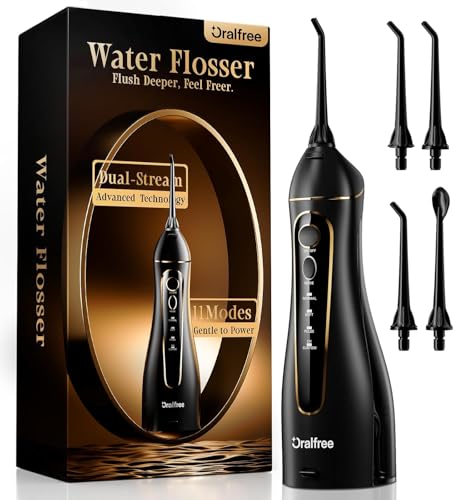
Cordless handheld models integrate pump, small reservoir and rechargeable battery into a single wand that stands in a charging base or on its own foot. Their tanks are small — a deliberate trade for portability — and they excel in showers, in travel bags and in bathrooms where counter space is the scarcest resource. Pressure typically falls as the battery discharges on simpler models, and the tank may need refilling partway through a thorough session. The format’s quality spread is wide: the best cordless units hold pressure respectably and seal their charging ports well, while the cheapest leak, rattle and lose their batteries within a year.
Faucet-attached models divert water directly from the tap through a small aerator fitting, using household water pressure instead of a pump. They need no electricity, no charging and no refilling, and their stream is effectively unlimited for as long as the tap runs. In exchange, they depend on tap compatibility — the diverter must match your faucet’s threading, and some modern or pull-down faucets cannot accept one — and their pressure is whatever your plumbing delivers, adjusted crudely at the tap handle. They also tether the user to the sink by a hose and complicate sharing, since the fitting stays on the tap for everyone.
A fourth, smaller family deserves mention: travel and mini units, usually cordless designs shrunk further, with collapsible or very small tanks and modest pressure. They solve a packing problem rather than a cleaning one and are best judged as supplements to a home unit rather than replacements. Whichever family you shortlist, the comparison framework in the next sections — pressure, pulsation, tank, tips, sealing and cleaning — applies unchanged, and it is more reliable than any single headline number.
Pressure ranges in PSI, and how to read them
Published pressure ranges for countertop models commonly span from around 10 PSI at the gentlest setting to somewhere in the region of 90 to 100 PSI at maximum, adjusted by a dial with either stepped settings or continuous travel. Cordless models usually publish a narrower and lower band, often roughly 30 to 80 PSI across two or three modes, and faucet models publish nothing at all, since their pressure is your plumbing’s. The first reading skill is recognising that these figures are measured at the tip under manufacturer conditions; they describe the pump’s capability, not a recommendation. More pressure is not inherently better — it is a range to work within, starting low.
Why a range matters becomes clear with sensitive situations. New users, people with tender gums, and anyone cleaning around recent dental work are directed by manuals to begin at the lowest setting and increase gradually over days as comfort allows. A machine whose lowest setting is still forceful fails those users, whatever its maximum. Conversely, users whose goal is flushing debris from around orthodontic brackets or wide bridge spans may genuinely use the upper settings. Judge a pressure specification by both ends: the floor tells you who can start safely, the ceiling tells you the headroom, and the number of steps between tells you how finely a user can find a personal comfort point.
Pressure consistency is the hidden third dimension. Pump-driven countertop units hold a setting steadily because mains power does not sag. Battery units may deliver their published maximum only at full charge, tapering as the cell empties — a behaviour some manufacturers acknowledge in manuals and others leave for owners to discover. Faucet units vary with household demand; a shower starting elsewhere in the house can drop the stream noticeably mid-session. None of these behaviours makes a format wrong, but they shape daily satisfaction, and they are exactly the kind of detail that specification tables omit and manuals reveal.
A note on units and marketing: a minority of listings quote pressure in kilopascals or bar, and a few quote the pump’s internal rating rather than tip pressure. Convert before comparing — one bar is roughly 14.5 PSI — and treat any listing that will not state where its figure is measured as a listing to set aside. Reputable documentation also states the pressure tolerance, acknowledging that individual units vary slightly, which is normal for small pumps and no cause for concern.
Pulsation rates and stream modes
Most pump-driven flossers pulse their stream rather than delivering it continuously, and published pulsation rates for the category commonly fall between about 1,200 and 1,800 pulses per minute, with many countertop models stating a figure near the middle of that band. The pulsing action alternates compression and release phases at the gumline, and manufacturers describe it as central to how the stream loosens and sweeps away debris. As with pressure, the figure is a manufacturer measurement without a single cross-brand protocol, so treat small differences between rival listings as noise and large differences as a prompt to read the manual rather than as a ranking.
Stream modes multiply the picture. Beyond straightforward flossing pressure, many units offer a massage mode with slower, stronger pulses aimed at gum stimulation, a soft or sensitive mode that caps both pressure and pulse intensity, and on some models a pulse-modulated pattern that varies rhythm automatically. Handpieces may add a rotating tip — some tips swivel 360 degrees — which changes how easily the stream can be angled at the back teeth and along the inner gumline. Mode lists read impressively in marketing copy; the practical question is whether the two or three modes you will actually use are reachable without cycling through the rest every session.
Continuous-stream models exist at the edges of the category, particularly among faucet-attached designs where the tap delivers steady flow. Users migrating from a pulsating unit often report that a steady stream feels harsher at equivalent pressure, which is one reason faucet setups benefit from starting with the tap barely open. If a listing does not state whether its stream pulses, that omission usually signals a continuous design or a very low pulse rate, and the manual will settle it.
Tank capacity and realistic session time
Reservoir size is the specification users feel most directly. Countertop tanks commonly hold somewhere between about 600 millilitres and one litre, which manufacturers translate into roughly 90 seconds or more of continuous use at typical settings — enough for a complete, unhurried session including pauses. Cordless tanks are far smaller, commonly in the 150 to 300 millilitre region, translating to around 30 to 60 seconds of stream, which many users find means one refill for a full session. Neither figure is a flaw; they are the physical price of each format’s footprint, and the honest comparison is against your own routine’s length.
Session-time claims deserve the same scepticism as pressure claims. A stated runtime assumes a particular pressure setting — usually not the maximum — and continuous flow, while real sessions involve pauses, tip repositioning and the handpiece’s pause button. Treat published seconds as a relative index between models rather than a stopwatch promise. What matters practically is whether the tank empties before you finish your usual circuit of the mouth; if it does, every session gains a mid-routine refill that quietly discourages the habit.
Tank design details matter beyond volume. A reservoir that lifts off its base for filling at the tap beats one that must be filled in place with a jug. A wide mouth admits a brush for cleaning and a hand for drying; a narrow neck does neither. Lids should seal well enough that the unit can be moved without sloshing, and some countertop reservoirs invert over the base for storage, protecting the tank interior from bathroom dust between uses. Translucent walls with visible volume markings help users judge whether what remains will finish a session — a small mercy at a groggy morning sink.
Vanity planning ties these choices to the room itself. A countertop unit’s footprint, its cord route to the outlet and the splash zone around it all compete with everything else a bathroom counter holds, and households speccing a remodel will find the sizing discussions in best 48 bathroom vanities relevant to how much working surface a flosser station truly needs. Measure your own counter with the unit’s published footprint before ordering; returns for ‘larger than expected’ are a recurring theme in this category for a reason.
The tip system: classic, orthodontic, plaque and periodontal
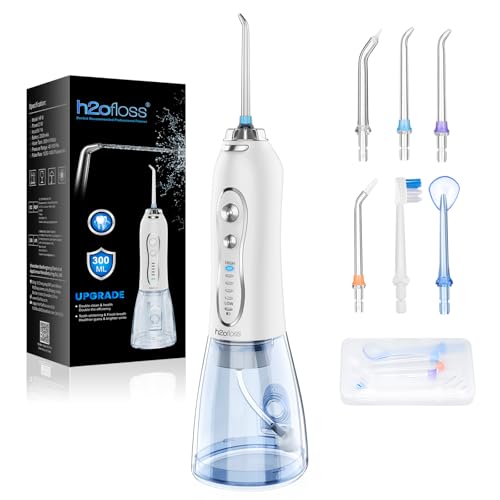
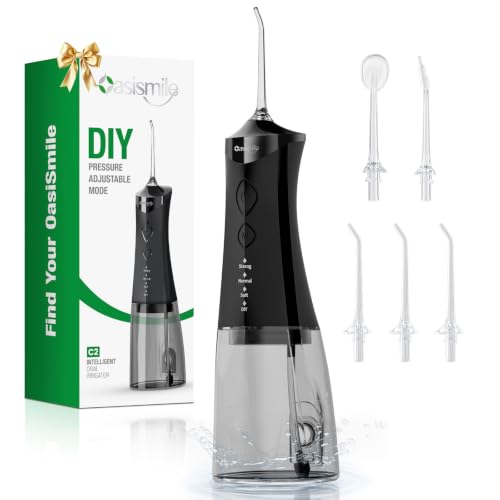
Tips are where a general appliance becomes specific to a mouth, and most systems use a simple push-and-click mount with an ejector button, colour-coded rings so household members can tell their tips apart, and a recommendation to replace tips at intervals — commonly every three to six months depending on type, since jet orifices erode and brush bristles splay. Confirm that replacement tips for any model you shortlist are sold in your market and in multipacks, because a flosser whose tips vanish from sale becomes unusable long before its pump fails.
The classic jet tip is the default: a plain angled nozzle delivering the standard stream for general between-teeth and gumline work, and the tip against which a unit’s pressure figures are usually measured. Most users need nothing else, and multi-packs of classic tips are the sensible consumable for households sharing one base unit with separate tips per person.
Orthodontic tips add a small tapered brush at the end of the nozzle, so the stream and a gentle brushing action work together around brackets, wires and bands. The brush sweeps the surfaces where food lodges against hardware while water flushes what loosens. These tips wear faster than plain jets — the bristles deform with use — and their replacement interval sits at the shorter end of the published range. Technique notes for braces appear later in this guide; the specification point here is that the tip exists as a distinct tool rather than a technique, and orthodontic households should confirm a model includes it or sells it separately before purchase.
Plaque-seeking tips carry a small cluster of soft tufts — often three — designed to rest against tooth surfaces at the gumline while the stream runs through the middle, directing water at areas where plaque accumulates along margins and around implant-supported or crowned teeth, as described in manufacturer literature. Periodontal or pocket tips take the opposite approach to force: a soft, tapered rubber end that delivers a deliberately gentle stream and is used at the unit’s lowest pressure settings, placed at an angle at the gumline as the manual directs. Both specialty tips underline the category’s central principle — tip and pressure are chosen together, and the specialist tips exist precisely because the classic jet at full pressure is the wrong tool for those sites.
Two further tips appear in many ranges. Tongue-cleaner tips are shaped scoops with a low-pressure stream intended to rinse the tongue’s surface, and toothbrush tips mount a small brush head that delivers water through the brush — a hybrid that some users like and others find neither a good brush nor a good flosser. Neither is essential, but their presence in a bundle signals the breadth of the manufacturer’s tip ecosystem, which is the real purchasing consideration.
Waterproofing ratings and charging systems
Cordless models live in wet hands over wet sinks, and many are used in the shower, so their ingress protection rating is a genuine purchasing specification rather than fine print. Ratings follow the IPX scale for water resistance: IPX4 indicates splash resistance from any direction, IPX5 covers low-pressure water jets, IPX6 strong jets, and IPX7 immersion in up to a metre of water for a stated duration. Manufacturers commonly publish IPX7 for cordless handpieces intended for shower use and lower ratings for countertop bases that only ever face splashes. Match the rating to the habit: a unit that will live in the shower should carry the immersion-grade figure, and any unit’s rating applies with its charging port cover properly closed — an open cover voids the protection in practice whatever the box claims.
Charging systems divide into inductive bases, magnetic connectors and plain USB or proprietary plugs into a sealed port. Inductive and magnetic systems keep water away from contacts entirely and age best in a steamy bathroom. Plug-in systems depend on the port cover’s seal, which is a small rubber part that hardens and cracks over years; check whether replacements exist. Published charge times for cordless units commonly run three to five hours, with claimed usage per charge ranging from about a week to several weeks of once-daily sessions depending on battery size and pressure habits — claims again best read as relative indices. Models that can run while charging, or that take a fast partial charge, forgive forgetfulness better than those that cannot.
Battery chemistry and replacement policy decide a cordless unit’s lifespan. Most use sealed lithium-ion cells that are not user-replaceable, which means the appliance’s life is the battery’s life, typically measured in years of daily charging cycles before capacity fades noticeably. Countertop units sidestep this entirely with mains power — one of their least advertised and most durable advantages. If longevity matters to you, weigh a replaceable-battery design or a countertop format heavily, and treat any cordless unit as a multi-year rather than decade-long purchase.
Bathroom electrical safety frames all of this. Mains-powered countertop units should be used on the protected circuits that modern bathroom codes require, kept far enough from the bath that they cannot be pulled in, and unplugged before internal cleaning. Chargers belong outside splash range where the local code requires it. These are unglamorous sentences, but a buying guide for water-and-electricity appliances that skipped them would be negligent.
Cleaning the reservoir and preventing mould
A water appliance stored in a warm, humid room will grow a biofilm if its wet parts are never dried or cleaned, and the reservoir is where neglect shows first: a slippery film on the walls, a stale smell, and in time visible dark spots in seams and under the lid. Prevention is mostly drying. Empty leftover water after each session rather than topping up yesterday’s remainder, leave the lid off or ajar between uses so the interior dries, and store detachable tanks inverted where the design allows. These habits cost nothing and address the cause — standing water in darkness — rather than the symptom.
Periodic washing supplements drying. Manufacturers commonly direct users to wash the reservoir with warm soapy water on a regular cycle, rinse thoroughly, and dry fully before refilling; many reservoirs are rated for a dishwasher’s top rack, which the manual will state or withhold. Valves and the small suction tube at the tank’s base deserve attention, since residue collects where water enters the pump. The handpiece and hose on countertop units can be flushed by running a tank of clean water through the system to waste after any cleaning solution has been used in the tank, following the specific sequence the manual gives.
Descaling is the second maintenance axis wherever water is hard. Mineral deposits narrow tip orifices, roughen pump seals and cloud tank walls. Manuals for the category commonly describe a vinegar-and-water cycle — run a diluted solution through, let it sit briefly, then flush with plain water — performed every month or few months depending on local hardness. Households with very hard water will descale more often and should favour models whose tanks and tips disassemble fully, since scale hides in joints. White flakes in the stream or a tip that sprays crookedly are the usual announcements that descaling is overdue.
Tips themselves are cleaned by soaking in water with a little vinegar or in a denture-cleaning solution as manuals variously suggest, rinsed, and air-dried, and they are replaced on the published interval regardless of appearance once their time is up, because worn orifices distort the stream in ways the eye cannot judge. A flosser kept clean delivers the pressure its dial promises; a neglected one quietly delivers less, through a dirtier path, which is the opposite of the appliance’s purpose.
The bathroom that houses all this also sets the background conditions — ventilation that clears steam quickly slows mould on every surface, the flosser included — and remodel planners comparing wider vanity tops for a two-person routine will find the layout reasoning in best 72 inch bathroom vanities a useful companion when deciding where a countertop unit and its drying tank can honestly live. Wherever it lives, a unit stored dry between sessions and washed on schedule stays a cleaning appliance rather than becoming a cleaning problem.
Neutral notes for braces, bridges and other dental work
Water flossers are frequently bought by households managing orthodontic appliances, fixed bridges, crowns and implants, and the appliance-level facts can be stated without promising outcomes. Fixed braces create shelves and shadow zones around brackets and along wires where a toothbrush’s bristles reach poorly; a directed water stream, especially through an orthodontic tip, can rinse loose debris from those zones, which is the mechanical basis on which manufacturers describe the pairing. Users are directed by manuals to work slowly along the wire line, pausing at each bracket, at moderate pressure — a technique matter, not a therapeutic claim.
Bridges present a different geometry: a span of artificial teeth joined to supports, with a space beneath the span where debris collects and where threader floss is traditionally used to pass beneath. A water stream angled under the span rinses that space without threading, which many users find easier to sustain as a daily habit. The neutral caution is that ease of use is not evidence about comparative results for any individual, and dentists’ guidance for a specific bridge — its material, its age, the health of its supporting teeth — outranks any general guide, including this one.
For implants and crowns, manufacturer literature emphasises gentle settings and soft-tipped accessories around margins, and warns against directing maximum pressure at healing tissue after recent procedures. Anyone with recent dental surgery, active gum problems, or a condition their dentist is monitoring should treat the flosser as a question to raise at the next appointment rather than as a self-prescribed addition. Children using these devices need supervision, age-appropriate low settings and tips sized for small mouths where the range offers them — again, points the manuals themselves make and this guide simply repeats.
Water flossing and string floss: a neutral comparison of roles
The two tools do different mechanical work, and a level-headed comparison starts there. String floss, drawn between teeth and curved against each tooth’s side, physically scrapes the surfaces it touches and passes through the tight contact points where neighbouring teeth meet. A water stream cannot pass a truly tight contact and does not scrape; it rinses, flushing loose material from the gumline, from wider spaces, from around hardware and from under bridge spans. Their territories overlap along the gumline and diverge elsewhere, which is why dental professionals commonly describe water flossing as an adjunct within a routine rather than a like-for-like substitute, and why product packaging in many markets is worded as ‘helps remove’ debris rather than as equivalence.
Practical adherence is the other honest axis of comparison. String floss costs little, needs no counter space, no charging and no descaling, and travels anywhere; its drawback, documented in every survey of dental habits, is that many people simply do not do it consistently or with good technique. A water flosser demands money, space and maintenance, and in return many users find it easier to sustain daily — a consideration about behaviour, not biology. Neither fact settles what any individual should do; both belong in a decision made with a dentist’s knowledge of the specific mouth involved.
Interdental brushes occupy the middle ground and deserve a sentence in any neutral account: small brushes sized to the gaps between teeth, widely recommended where gaps permit them, cheap and effective in their niche. A household choosing between devices is really choosing a combination — brush, plus one or more interdental methods matched to its members’ teeth and hardware — and the water flosser’s role in that combination is the subject of the rest of this guide.
Technique: angle, temperature and session order
Manufacturer technique guidance is remarkably consistent across the category. Fill the tank with lukewarm water — cold water is unpleasant for sensitive teeth and very hot water is outside every manual’s advice — lean over the sink, place the tip in the mouth before switching on, and keep lips mostly closed to contain spray while letting water drain. The tip is held at roughly a right angle to the tooth at the gumline, or at the slight angle a periodontal tip’s manual specifies, and moved slowly along the gumline, pausing briefly between teeth where the stream does its main work. Sessions typically proceed around the mouth in quadrants so no region is skipped, finishing with the inner surfaces and the backs of the rear molars, which are the easiest to neglect and the most awkward to angle.
Beginners are advised to start on the lowest pressure, outside the mouth over the sink if necessary, to learn the handpiece controls before the first in-mouth attempt — the category’s classic beginner mishap is switching on with the tip pointing at the mirror, the ceiling or a companion. Pressure is increased over the first week or two as comfort allows. The handpiece pause control, where fitted, is the session’s best friend: pausing to reposition beats spraying the bathroom. Most manuals also advise flossing before brushing or after, consistently within the maker’s own stated routine, and the honest summary is that consistency of the overall routine outweighs the ordering debate.
Session length settles with practice into a minute or two. Longer is not automatically better: overlong sessions at high pressure can leave gums feeling tender, which manuals list as a signal to reduce pressure or duration. Bleeding on early sessions is commonly mentioned in manuals as something that can occur when gums are already irritated, with the advice to consult a dental professional if it persists — advice this guide endorses verbatim rather than paraphrasing into reassurance.
One further habit separates settled users from strugglers: keeping a small log during the first fortnight. Note the pressure setting used each day, any tenderness afterwards, and the point at which the tank needed refilling, and patterns emerge quickly — most users discover their comfortable setting sits one or two steps below their first guess, and that their real session length is shorter than the anxious first attempts suggested. The log also gives a dental professional something concrete to react to at the next check-up, turning a vague ‘I bought a water flosser’ into a specific routine that can be adjusted intelligently rather than approved or questioned in the abstract.
Noise, splash and the realities of shared bathrooms
Pump noise varies more between models than most specifications admit. Countertop pumps produce a steady mechanical hum that carries through a quiet house at night; cordless units whine at a higher pitch but usually for less time. Published noise figures are rare, so households with a light sleeper beyond a thin wall should favour models whose manuals or listings state a decibel figure, and should expect early-morning sessions at the kitchen sink to enter the conversation otherwise. Vibration travels too: a countertop unit on a hollow vanity top amplifies itself, and a folded hand towel beneath the base is the traditional, effective fix — a small domestic detail that connects to the wider world of bathroom textiles surveyed in best absorbent bathroom hand towels, where the towels doing that duty might as well be chosen to dry quickly in a steamy room.
Splash management improves with technique — lips closed, head over the basin, tip in place before power — but the first week with any model redecorates the mirror. Units with a handpiece pause control and a sensible power switch position shorten that learning curve. Countertop hose length decides whether the user can stand comfortably or must hover; cordless units avoid the hose entirely and are the natural choice for shower use where their sealing permits. Households sharing one bathroom between several people should also plan tip storage: colour-coded tips in a ventilated holder, not loose in a drawer, and a base unit position that does not migrate into the splash zone of the taps.
Travel, storage and ownership costs
Cordless units travel if their batteries and chargers travel well. USB charging suits international trips with a single adapter; proprietary mains chargers add bulk and voltage questions. Some units include a travel case and a tip cap, small inclusions that matter in a wash bag where a tip’s orifice can pick up lint. Water quality on the road argues for bottled or boiled-then-cooled water where the local supply is doubtful, and for drying the tank fully before packing — a sealed, damp tank in a warm suitcase is the mould scenario from the cleaning section, compressed into a weekend.
Ownership cost is the unit price plus a predictable consumables stream: replacement tips several times a year per user, descaling solution or vinegar, and eventually, for cordless models, the battery’s end of life. Countertop units shift cost toward longevity — no battery to fade, larger pumps that are rarely stressed — while faucet models have almost no running costs beyond replacement diverters and tips. None of these sums is large next to dental bills in the abstract, but a buying decision made with the three-year cost in view differs from one made on the box price, and the arithmetic is simple enough that every shopper can run it for their household size.
Storage between homes — students, separated households, seasonal residents — favours the cordless format again, with the caveat that a battery left discharged for months ages faster than one stored partly charged, a point better manuals state plainly. Countertop units stored for a season should be run dry, washed, and packed with the tank lid ajar so no trapped moisture works on the seals in the dark.
Handpiece controls, hoses and everyday ergonomics
The handpiece is the part of the appliance a user actually operates with wet hands and a mouth full of water, so its control layout deserves the scrutiny usually reserved for pressure figures. Countertop handpieces carry either a sliding switch, a rotary dial or a pause button that temporarily halts the stream without changing the base unit’s setting; the pause control is the most useful of the three because repositioning the tip mid-session is constant, and reaching for the base dial with wet hands, eyes on the mirror, is how settings get changed accidentally. Check whether the control can be worked by the thumb of the holding hand alone — a small detail that separates handpieces designed by users from those designed by committees.
Grip and weight interact with session length. A cordless wand concentrates its water, battery and pump in the hand, and its balance shifts as the tank empties; users with reduced grip strength or arthritis in the hands should weigh published unit weights carefully and favour lighter tanks filled more often over heavy tanks filled once. Countertop handpieces are featherweights by comparison, tethered by a hose whose stiffness matters: a supple hose that coils back into its dock without fighting is a daily pleasure, while a stiff one drags the base unit across the counter and eventually pulls it toward the sink’s edge. Hose lengths in the category commonly allow standing a comfortable distance from the base, but compact units shorten the tether, so check the stated length against your sink’s geometry.
Docking and storage complete the ergonomic picture. Some countertop lids incorporate tip storage — a covered compartment that keeps spare tips clean and visible — while others expect tips to live in a separate holder. Cordless units stand on a charging base that should grip the counter rather than skate on it when the wand is lifted one-handed. Wall-mounting kits exist for a few models and suit bathrooms where the counter must stay clear; they commit the user to a position, so they reward a week of countertop use in the intended spot before any screws are driven.
Water quality, additives and what should not go in the tank
Plain water is the default medium in every manual for this category, and departures from it need the manual’s explicit blessing. Some manufacturers permit a small proportion of mouthwash diluted in the tank for users who like the taste, with instructions to run a plain-water tank through the system afterwards so sugars and alcohols from the rinse do not linger in the pump and seals. Others prohibit additives entirely. Essential oils, undiluted antiseptics and home-mixed solutions are outside published guidance across the category: oils coat pump components, strong solutions attack seals, and residues in a warm tank feed exactly the biofilm the cleaning section works to prevent. The appliance is a water device; treat anything else as an exception requiring written permission from its manual.
Source water quality shapes maintenance more than performance. Hard water scales tips and tanks as described earlier. Very soft water changes nothing operationally. Well water with sediment argues for letting the tap run briefly before filling and for inspecting the tank’s inlet screen, where fitted, since grit that reaches a small pump shortens its life. Users in areas with boil-water advisories should follow the advisory for an appliance that aerosolises water at the face — cooled boiled water in the tank is the conservative reading of public guidance — and travellers face the same logic with unfamiliar supplies.
Temperature has already been mentioned, but its boundary deserves emphasis: manuals specify lukewarm fill water, and hot tap water can exceed the temperature ratings of plastic tanks and seals over time, as well as being genuinely unpleasant against teeth and gums. A tank filled from the cold tap and left to stand while teeth are brushed reaches a tolerable temperature in most bathrooms; kettles and microwaves have no role in this appliance’s routine.
Household fit: children, older users and shared routines
Children encounter these devices in two ways — as orthodontic patients, where the appliance addresses real cleaning difficulty around braces, and as imitators of adults. Manufacturer age guidance varies, but the consistent manual themes are adult supervision, the lowest pressure settings, and tips kept personal. A child who cannot yet manage the pause control will paint the bathroom; a household that accepts a supervised learning week usually ends with a competent young user whose brace-cleaning routine is more thorough than the threader-floss routine it supplements. School-age children sharing a countertop base need their own colour-coded tips and a storage position they can reach without climbing.
Older users and anyone with limited dexterity benefit from the category in specific, mechanical ways: no fine threading motion is required, the handpiece is larger than a floss pick, and the session can be done seated at a suitable sink. The counterweights are the cordless wand’s weight, small charging connectors that challenge stiff fingers, and dial markings too small to read without glasses. For these households, a countertop unit with a large, positive dial, a light handpiece and a pause button is usually the kindest specification set, and inductive charging beats fiddly plugs wherever a cordless model is preferred. Large-print quick-start cards, which some manufacturers include, are worth more than a tenth pressure setting.
Shared routines run on logistics. Two users with different pressure preferences on one countertop unit will change the dial back and forth daily; models with detented settings make this painless because each user learns a number rather than a dial position. Morning congestion argues for the format that needs no warm-up and no filling ceremony, and for a tank large enough that the second user is not refilling the first user’s leavings. Households that plan these small things in advance report the appliance becoming invisible infrastructure; households that do not, report it becoming a negotiation.
Warranty, parts and end-of-life thinking
Warranty terms in this category commonly run one to three years depending on format and maker, with cordless batteries sometimes covered for a shorter period than the appliance itself — a distinction worth finding in the fine print before purchase rather than after a capacity complaint. Registration requirements vary; some warranties are effective from purchase with proof of receipt, others ask for registration within a window. Keep the receipt with the manual, because the manual is also the document that defines the cleaning routine the warranty quietly assumes was followed.
Parts availability separates durable purchases from disposable ones. The wear parts are known in advance: tips, reservoir valves and lids, handpiece hoses on countertop units, charging port covers on cordless ones, and faucet diverters. A manufacturer that lists these as orderable spares, with the tip ecosystem in ordinary retail channels, is signalling an intention that the appliance be kept. A model whose only spare is a complete new unit should be priced in your mind as a consumable with a multi-year life, which may still be a rational purchase — but it should be a knowing one.
End of life, when it comes, is usually the battery or the pump rather than the plastic. Electrical waste channels in most regions accept these devices, with batteries removed where the design permits removal for disposal even if not for replacement. Draining and drying the unit before it enters storage or the waste stream is the last act of the same hygiene discipline that governed its working life, and it closes the loop on an appliance whose entire purpose, from first fill to final rinse, was keeping one small corner of a household clean.
Troubleshooting the faults owners actually meet
A stream that weakens gradually over months is the category’s most common complaint, and its causes queue in a predictable order. First, the tip: scale or debris narrowing its orifice, cured by the soaking and descaling routine described earlier, or by replacement if the tip is at its interval. Second, the tank valve and suction path, where a perished valve seal lets air into the pump’s intake and turns the stream sputtery. Third, on cordless units, a battery whose capacity has faded, which shows as a unit that starts strongly and sags within seconds. Working through that order with the manual in hand resolves most cases without any service involvement, and each step costs minutes rather than money.
Leaks localise their own diagnosis. Water under a countertop base usually traces to the reservoir valve not seating — remove the tank, check the valve’s small seal for grit, reseat firmly — or to a hose connection weeping at the handpiece, which a replacement hose or a reseated fitting addresses. A cordless unit leaking from its body seams is a different matter: water has crossed a seal it should not cross, the unit should be retired from use, and the warranty conversation should start. Leaks at a faucet diverter mean the washer stack needs replacement or the diverter was cross-threaded at installation, and patience with a fresh washer beats force with a wrench.
Motor noise that changes character — new grinding, rattling or intermittent cutting out — suggests debris in the pump, a failing bearing or a loose internal mount, and continued use rarely improves any of them. A unit that will not start at all invites the boring checks first: outlet, charge state, the tank seated so its valve opens, and the handpiece switch actually in the running position rather than paused. Manuals carry a troubleshooting table for exactly these cases, written by the people who receive the warranty returns, and it deserves reading before the appliance is condemned — a surprising share of ‘dead’ units are paused, unseated or simply empty.
Four archetypes worth shortlisting
The full-size countertop station
The flagship archetype pairs the largest tanks in the category with the widest pressure ranges, the richest tip bundles and mains-powered consistency. It suits households where two or more people will use the appliance daily, where braces or bridges make the specialty tips relevant, and where the counter can host it permanently. Its specifications to verify are the low end of the pressure range, the included tip count per type, and whether the reservoir is dishwasher-rated for the cleaning routine described earlier. This is the format against which the category’s published numbers are usually benchmarked.
The compact countertop unit
A smaller base and a mid-sized tank — often around half the flagship’s volume — trade session length for a footprint that fits a modest vanity. Pressure ranges usually mirror the larger units’ lower two-thirds, which covers most users’ working settings. This archetype suits single users and couples in smaller bathrooms, and its deciding details are hose length, lid design for drying, and whether its tip mount accepts the full specialty range or only the basics, since compact lines sometimes run a reduced ecosystem.
The full-featured cordless wand
The serious cordless archetype offers multiple pressure modes, an immersion-grade waterproof rating, a tank at the generous end of the handheld range and a tip mount shared with its maker’s countertop line. It is the traveller’s and the shower-user’s choice, and the small-bathroom default. Verify the charging system’s sealing, the claimed weeks per charge at your likely setting, and the replacement-tip supply before committing, because this archetype’s ownership experience is defined by its battery and its consumables long after its stream is judged adequate.
The faucet-attached minimalist
The plumbing-powered archetype suits users who distrust batteries on principle, have a compatible threaded faucet, and value an endless stream over adjustable precision. Its entire specification sheet is mechanical: diverter quality, hose length, tip mount and the ease of switching the tap back to normal flow for other users. Households with modern designer faucets should confirm compatibility in writing before purchase, since this archetype has the category’s highest rate of ‘would not fit’ returns — a compatibility fact, not a quality judgement.
Reading a specification sheet without being misled
Assemble the figures that matter on one line per candidate: pressure floor and ceiling, pulse rate if stated, tank volume, session seconds at a mid setting, tip types included and their replacement interval, waterproof rating for anything cordless, charge time and claimed sessions per charge, and warranty length. Where a figure is missing, write ‘not stated’ rather than assuming the category average; the pattern of what a manufacturer declines to state is itself information. Convert units before comparing, discount any figure quoted without a measurement point, and check the manual — most manufacturers publish manuals openly — for the cautions section, which is where real limitations live in plain language.
Finish preferences intersect with specifications in one underappreciated place: a bathroom finished in pale timber and soft tones tends to be photographed, sold and lived with alongside appliances whose colours either blend or clash, and the vanity styling surveyed in best bathroom vanities light wood shows how dominant those pale surfaces are in current remodels. A white or light-grey unit disappears into such a scheme; a black unit becomes an accent whether you planned one or not. This is a legitimate selection factor — an appliance left out and visible gets used more than one banished to a cupboard — provided it is weighed after pressure, tank and tips, not before them.
Check prices on Amazon
Live listings for the shortlist in this guide are pulled from Amazon below, so prices and availability are always current at the moment you look.


A buying checklist grounded in specifications
Start with the mouths, not the machines. List who will use the device, what dental hardware they have, who has sensitive gums, and who travels. That list selects the tip bundle, the pressure floor and the format family before any brand comparison begins. Next, measure the bathroom: counter footprint, outlet position, shower-use intentions and storage for tips and a drying tank. Then compare candidates on the one-line specification summary described above, confirm replacement-tip availability in your market, and read the manual’s cleaning section to be sure the maintenance routine fits your tolerance — a device whose upkeep you resent will not be maintained, and an unmaintained water appliance defeats itself.
Set expectations in the household before the box arrives: the first week involves splashed mirrors and low settings, the tank gets emptied and dried after sessions, tips are personal and colour-coded, and the device joins a routine rather than replacing the parts of it that only a brush and a dentist’s instruments can do. Bought on specifications, kept clean and used at the pressure its manual intends, a water flosser earns its counter space quietly — one unhurried, well-aimed minute at the sink each day, asking nothing more glamorous than fresh water and a dry place to rest.