Our Top Picks




What's inside
- How to read this guide
- Three kinds of light under one category name
- Wavelength: the 365 and 405 nanometre pairing
- Power claims and the geometry of bulbs
- Cure times, layer by layer
- Heat spike, explained without drama
- Sensors, timers, and displays
- Removable bases and the pedicure question
- Corded reliability versus cordless freedom
- Archetypes: matching lamp shapes to real routines
- Longevity: diode life, tube life, and honest replacement talk
- Safety and comfort, stated plainly
- A decision sequence that avoids the common regrets
- How each gel family behaves under the light
- Troubleshooting in prose: symptom, cause, correction
- Reading a lamp listing the way an engineer would
- The two-hand question and session rhythm
- Check prices on Amazon
- Questions shoppers ask most
As an Amazon Associate I earn from qualifying purchases. This post may contain affiliate links at no extra cost to you.
How to read this guide
Transparency note: this guide may earn a commission when readers buy through links to Amazon, and that support never changes which specifications get compared here. Everything that follows rests on published manufacturer information: stated wavelengths, bulb counts, timer settings, chamber dimensions, battery figures, and the curing schedules that gel producers print for their own formulas. Where makers describe the same feature with different vocabulary, this guide translates the claim into plain terms and flags what the number can and cannot promise.
A gel curing lamp looks simple from the outside, yet the category hides real technical variety. Three light technologies share shelf space, two wavelengths do different chemical work, and the wattage figure printed largest on the box is often the least informative number on it. Readers who understand what initiates a cure, how thick each gel layer may be, and why a lamp can feel hot on one hand and gentle on another will read any product listing with far sharper eyes. The sections below work through the physics first, then the hardware, then the daily habits that decide whether cured gel lasts or lifts within a week.
Terminology deserves a moment before the hardware. Curing means the liquid gel turning solid through polymerization, a chain reaction started when photoinitiator molecules absorb light of the right wavelength. Tacky layer, sometimes called the inhibition layer, is the slightly sticky surface left on many gels after curing because oxygen at the surface slows the reaction there. A lamp described as dual light source combines two emitter types in one housing. None of these terms implies quality on its own; each simply names a mechanism that the rest of this guide keeps returning to.
Three kinds of light under one category name
Pure ultraviolet lamps are the oldest design in this category. They use compact fluorescent tubes that emit a broad band of ultraviolet energy, strongest in the UVA region, and that breadth is their defining virtue. Because the output spreads across many wavelengths, older gel formulas with varied photoinitiator packages usually find something in that spectrum they can respond to. The trade-offs are equally clear: tubes warm up rather than switching on instantly, output fades gradually across the tube lifespan, and curing cycles run longer than modern diode designs, commonly two minutes per layer in published schedules.
Pure light-emitting diode lamps take the opposite approach. Each diode emits a narrow band of energy, and lamp makers choose diode wavelengths to match the photoinitiators used in current gel systems. Diodes switch on instantly, hold their output far longer than fluorescent tubes, and draw modest power. Their weakness is narrowness: a gel formulated for a wavelength the diodes do not emit may cure slowly, cure only at the surface, or stay soft underneath a hardened skin. Compatibility, rather than raw power, is the first question a diode lamp raises.
Hybrid designs, sold as combined UV and LED units, place both emitter families inside one chamber, or use diodes engineered to cover the two wavelengths gel chemistry relies on most. In practice the hybrid label usually means the lamp can address a wider range of formulas than a single-band diode unit. That breadth explains why hybrids dominate home and small-studio listings. It also explains why the label alone settles nothing: two hybrids can differ completely in diode placement, timer logic, and how evenly light reaches the sides of the nails.
Why the distinction matters at the manicure table
Gel chemistry decides which lamp a person actually needs, and hands rarely use one formula forever. A household that rotates between soak-off colour gels, rubber bases, builder gels in a bottle, and hard gels for extensions is effectively asking one lamp to serve four related but distinct materials. Broad-spectrum and dual-wavelength designs forgive that variety. Narrow designs reward loyalty to a single gel system whose maker publishes matching lamp guidance. Neither approach is wrong; the mistake is buying the lamp first and discovering the chemistry afterwards.
Studios that serve clients add another layer, because product lines walk in with the client. A lamp that handles the widest published range of gel families reduces the chance of a soft, under-cured layer on an unfamiliar formula. Home users who buy every layer from one system can safely choose a narrower, faster lamp tuned to that system. The guide returns to this matching exercise several times, because nearly every disappointment in this category traces back to a mismatch between light and formula rather than to a defective machine.
Wavelength: the 365 and 405 nanometre pairing
Most dual-wavelength lamps publish two figures, 365 nanometres and 405 nanometres, and those numbers deserve more attention than the wattage headline. The 405 nanometre band sits at the violet edge of visible light and drives the photoinitiators used in many modern colour and top gels. The 365 nanometre band reaches deeper into UVA and supports initiators found in numerous builder and hard gel formulas. A lamp offering both bands covers the common ground of contemporary gel chemistry; a lamp offering only one band asks the shopper to confirm that every gel in the drawer answers to that band.
Depth of cure is where wavelength stops being abstract. Light loses energy as it travels through pigmented gel, so the bottom of a thick or dark layer receives less than the surface. Formulas are engineered with that falloff in mind, and their published cure times assume a lamp emitting the intended wavelengths at reasonable intensity. When the wavelength is wrong, extra time compensates poorly, because photons of the wrong energy do not start the reaction efficiently no matter how long they shine. When the wavelength is right but the layer is too thick, time and thinner coats solve the problem instead.
Shoppers should also notice what listings omit. A lamp that publishes neither wavelength nor diode count is asking for trust without evidence, and gel makers cannot confirm compatibility with an unspecified light. By contrast, a maker who prints both wavelengths, the number of emitters, and the timer presets gives the buyer everything needed to cross-check against gel instructions. That transparency pattern repeats across this whole category: the most useful listings read like specification sheets, while the vaguest lean on lifestyle photographs and superlatives.
Reading gel labels against lamp labels
Gel packaging and lamp packaging speak slightly different dialects, and the translation is straightforward once seen. When a gel states it cures under LED in thirty seconds and under UV in two minutes, it is naming the two lamp families and giving each a schedule. When a gel states a wavelength range, the lamp must emit inside that range. When a gel says nothing at all, the conservative reading is that the formula predates narrow-band lamps and expects broad ultraviolet output, which points toward a fluorescent or hybrid unit rather than a single-band diode design.
White and pale pink builder gels deserve a footnote of their own, because dense pigment reflects and absorbs light aggressively. Published guidance for such shades often doubles the cure time or recommends curing from both sides where the lamp design allows. Dark colours behave similarly at the surface: the top hardens quickly while the base of the layer lags. Thin coats, patient timing, and a lamp whose diodes reach the nail edges matter more for these shades than any headline wattage figure.
Power claims and the geometry of bulbs
Wattage on a gel lamp listing usually describes electrical draw or a marketing equivalence, not the optical energy landing on the nail. Two lamps with identical wattage figures can deliver very different curing results because diode efficiency, reflector design, and placement differ. A useful mental model treats wattage as a rough size class: compact travel units at the low end, full hand chambers in the middle, and wide two-hand or foot-friendly designs at the top. Within a class, geometry separates the thorough lamps from the frustrating ones.
Bulb layout decides whether the thumb cures at the same rate as the fingers. Diodes clustered only on the ceiling of the chamber leave the sides of the nails, and especially the thumb resting at an angle, in weaker light. Better layouts wrap emitters across the ceiling and down the side walls, and reflective interior surfaces bounce light into the remaining shadows. Listings that publish a diode count in the thirties or forties, spread across a wide chamber, generally describe that wraparound approach, while very low counts signal a lamp intended for occasional single-colour use rather than full sets with extensions.
Chamber dimensions carry practical consequences that spec sheets state plainly and shoppers skim. Interior height determines whether long extensions clear the ceiling diodes without touching them. Interior width decides whether a whole hand rests flat, because a hand curled to fit exposes nail edges unevenly. Depth matters for feet, where toes must sit far enough inside for the light to reach them squarely. A lamp can be electrically strong and still awkward if the chamber forces the hand into a claw.
Reflectors, floors, and the underside question
Some chambers line the floor with a reflective or removable plate, and that detail influences the cure of the free edge and underside of extensions. Light bouncing upward helps set the tip area that ceiling diodes strike only at a glancing angle. A mirror-finish floor also reveals placement: the user can see whether fingertips sit centred under the diode field. Matte dark interiors absorb stray light and rely entirely on direct emission, which makes diode placement even more decisive in those designs.
Heat inside the chamber is a by-product worth understanding rather than fearing. Diodes convert some energy to warmth, and a long session of back-to-back cures raises the interior temperature noticeably. That warmth is separate from the heat spike discussed later, which originates inside the gel itself. Chamber warmth mostly affects comfort and, in cordless models, battery behaviour, since cells deliver their stated capacity more reliably at moderate temperatures than in a cold room or a hot car.
Cure times, layer by layer
Published curing schedules share a common skeleton even though brands phrase them differently. Base coats, being thin and usually clear, sit at the short end, often ten to thirty seconds under diode light. Colour coats follow at thirty to sixty seconds per coat, with two thin coats expected rather than one thick one. Builder layers, applied more generously to create structure, commonly call for sixty seconds or longer, and top coats land in the thirty-to-sixty range depending on whether the formula leaves a tacky layer to wipe or cures to a hard gloss directly.
Those figures assume the lamp the gel maker had in mind, so home users should treat them as starting points anchored to their own lamp class. A compact lamp with few diodes may need the longer end of every range, while a wide dual-wavelength chamber often meets the shorter end. What should never happen is shortening below the published minimum to save time, because under-cured gel is not merely soft; uncured material trapped against the nail and skin is the outcome every instruction sheet is written to prevent. Adding time to a compatible lamp is the safe direction of error.
Flash curing deserves its own explanation, since modern nail art depends on it. A flash cure is a brief exposure, often five to ten seconds, that sets the surface of placed art, chrome powder borders, or carefully positioned decorations just enough to hold them while work continues. Lamps support this through short timer presets or a sensor mode that lights while the hand is present. The flash is never the final cure; the full schedule still applies once the design is complete, and guides that blur that distinction do readers a disservice.
The thick-layer trap and the two-coat habit
Nearly every curing failure story shares one ingredient: a layer applied too generously. Thick gel insulates its own lower region from light, traps reaction heat, and can wrinkle at the surface as the top sets and the base stays mobile. Builders solve this with a thin slip layer followed by a controlled apex bead, and colour work solves it with two coats so thin the first looks almost disappointing. A lamp cannot rescue a flooded cuticle line or a pooled sidewall; technique and lamp are partners, and the lamp half of the partnership is simply delivering the right light for the stated time.
Flooding matters beyond appearance. Gel that touches skin and then cures creates a ledge that lifts as the nail grows, and repeated skin contact with uncured gel is precisely what safety guidance warns against. A bright chamber helps here in an unexpected way: good interior lighting before the cure starts lets the user spot a flooded edge and clean it with a brush while correction is still easy. Some lamps include a low white inspection light for exactly this stage, a small feature that experienced users praise out of proportion to its cost.
Heat spike, explained without drama
Heat spike is the sharp warmth, occasionally a sting, felt a few seconds into curing certain gels, especially builder formulas applied over thin or sensitive nail beds. The cause is the polymerization reaction itself, which releases energy as molecular bonds form. When many bonds form at once, because the layer is thick, the lamp is intense, or the formula reacts quickly, the released energy arrives as a pulse of heat faster than the nail bed can shed it. The gel is not malfunctioning, and the lamp is not broken; the reaction rate is simply outrunning comfort.
Low-heat modes exist to slow that pulse. In such a mode the lamp ramps intensity gradually, often over thirty to sixty seconds, or pulses the diodes so the reaction proceeds in steps with pauses for heat to dissipate. Published descriptions frame this as a comfort feature, and it doubles as a quality feature, because a controlled reaction also reduces the surface wrinkling that sudden setting can cause in thicker layers. Shoppers with thin natural nails, recent nail damage, or a preference for builder gel services will rank this mode near the top of the feature list.
Technique lowers heat spike risk before any mode is engaged. Thinner builder layers release less energy per cure. Keeping the hand still and flat spreads light evenly so no single nail races ahead. Removing the hand briefly when the pulse peaks, then returning it to finish the schedule, is a widely published coping step that does not compromise the cure as long as the total exposure is completed. What matters is returning for the remaining time rather than treating the interrupted cure as finished.
Who feels it most, and which gels trigger it
Sensitivity varies by person and by nail condition, which is why one user calls a lamp gentle and another calls the same lamp fierce. Thin nail plates transmit heat to the bed quickly. Nails recently filed, lifted product removed roughly, or naturally flexible plates all lower the threshold. Clear builder gels in generous layers are the classic trigger, while thin colour coats rarely produce more than mild warmth. A lamp buyer who mainly wears colour may never meet a serious spike; a buyer building extensions at home should plan for it as a routine variable, not an emergency.
Room temperature plays a quiet supporting role. Gel stored in a cold room flows thicker, tempts thicker application, and then reacts briskly under the lamp, a chain that ends in both heat and an uneven finish. Gel kept at ordinary room temperature levels more predictably and self-levels into thinner, more even layers. Storage guidance on gel labels, often skimmed, therefore belongs in any complete account of curing outcomes.
Sensors, timers, and displays
Automatic sensors detect the hand entering the chamber and start the light without a button press. The convenience is real during art work, when the other hand is holding a brush or a striping tool. Sensor quality varies: some designs trigger reliably for small hands and darker skin tones alike, while cheaper units hesitate or fire when a tool, rather than a hand, crosses the beam. Listings rarely publish sensor specifications, so this is one feature where return policies matter more than marketing language.
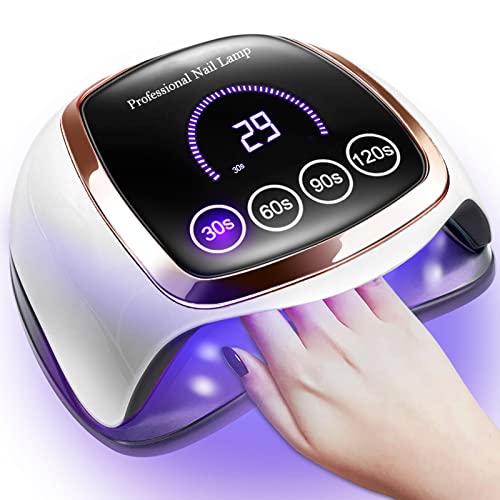
Timer presets translate gel schedules into one-touch choices. Common lineups offer short, medium, and long settings, often ten, thirty, sixty, and ninety-nine seconds, with the longest doubling as the low-heat option on many models. A countdown display that faces the user, rather than the ceiling, removes the guesswork of counting silently while gel sets. Memory functions that repeat the last setting suit assembly-line colour work, while a simple beep at completion serves users who look away during longer builder cures.
Button placement sounds trivial until gel is wet. Controls on top of the lamp invite an accidental press from a hovering wrist; controls at the rear keep the top clear but hide the display. Touch panels wipe clean easily yet can register a stray droplet, while physical buttons give tactile confirmation with product on the fingertips. None of these designs wins universally, which is why the honest comparison names the trade-off instead of crowning a style.
Pedal and hands-free variants
A minority of studio-oriented lamps add a foot pedal or a continuous mode for back-to-back client work. At home, the same features serve a different purpose: keeping freshly painted fingers away from every surface, including the lamp itself. Continuous sensor mode, where light runs while any hand is present and stops on withdrawal, suits flash-cure-heavy art. The shopper’s question is not whether these extras are impressive but whether the weekly routine involves enough art or extension work to use them at all.
Removable bases and the pedicure question
A removable bottom plate changes a lamp from a hand-only tunnel into a flat light bed. With the base detached, the lamp arches over a foot resting on the table or floor, which keeps toes level and lets the light meet them squarely. Magnetic bases detach with a tug and reattach without alignment fuss; clipped bases feel more secure in transport but slower in daily swapping. For anyone who does pedicures with gel polish, this single feature often decides the purchase, because angling a foot into a fixed tunnel twists the ankle and leaves the little toe in shadow.
The base also governs cleaning. Gel smears, dust, and lint collect on the floor of the chamber, and a plate that lifts out can be wiped at a sink rather than scrubbed inside a tunnel. Reflective removable plates combine both roles, bouncing light upward during cures and leaving the lamp for washing afterwards. Buyers comparing two otherwise similar lamps will find the base design quietly predicts long-term satisfaction more reliably than small wattage differences.
Stability deserves a sentence here. A lamp used without its base must still sit level on four contact points, and wide designs occasionally rock on uneven tables once the plate is off. Checking that the housing itself, not just the base, carries rubber feet is a detail listings sometimes state and shoppers rarely note. A lamp that shifts mid-cure moves the light relative to the nails, and even small movements during a builder cure can leave one sidewall softer than the other.
Corded reliability versus cordless freedom
Corded lamps draw steady power and deliver identical output on the first cure of the day and the fiftieth. Their limitations are placement and tidiness: the work area needs an outlet within cable reach, and the cable crosses a surface where bottles and brushes also live. Cable length, published in better listings, ranges from short desk-friendly leads to generous studio runs, and the difference decides whether the lamp sits where the user wants or where the wall dictates.
Cordless lamps carry a rechargeable cell and promise a clean table, easy travel, and pedicures far from an outlet. Published battery figures usually describe hours of intermittent use or a count of curing cycles per charge, and both metrics shrink as the cell ages. Output on some cordless designs steps down as charge falls, which lengthens effective cure times late in a session; better designs regulate output flat until the battery is nearly empty, then say so with an indicator rather than silently weakening. That regulation detail, when a listing states it, is worth more than a large headline capacity.
Charging behaviour completes the picture. Some cordless lamps work while plugged in, effectively becoming corded during a charge, while others lock out during charging and demand planning. Standardised charging connectors simplify replacement cables, and charge-time figures in listings range from a couple of hours to most of a working day. A home user who does one set at a time will barely notice these differences; a user doing back-to-back sets for family members will feel every one of them.
Weight, travel, and storage realities
Portability claims should be read against chamber size, because a lamp wide enough for two hands is luggage, not a handbag item. Compact lamps that fold or accept a flat hand position travel well and cure more slowly, a fair exchange for holiday maintenance rather than full sets. Weight figures in listings occasionally exclude the power adapter, which matters for the corded designs carried between rooms. Storage at home favours lamps whose chambers resist dust: a design that sits open collects lint on its reflective floor, and lint baked under gel is a flaw no top coat hides.
Anyone setting up a small salon corner at home will recognise the value of tidy cable routing, and our companion guide to shared workspaces is a useful detour: for readers arranging laundry support for that same corner, see best washers and dryers for a salon and spa before the first client towels pile up.
Archetypes: matching lamp shapes to real routines
The compact single-hand lamp is the entry archetype: a modest diode count, a small chamber, short presets, and a footprint that vanishes into a drawer. It suits colour-only wearers who refresh a set every couple of weeks and value storage over speed. Its limits appear with builder gel, long extensions, and pedicures, three jobs that ask for chamber room and wraparound light it does not claim to have.
The wide dual-wavelength chamber is the household workhorse archetype. Diode counts climb, side walls carry emitters, timers include a long low-heat setting, and the base detaches for feet. Most home users who mix colour, rubber base, and the occasional builder overlay will find this class covers every published schedule in their gel drawer without drama. It is also the class where listings compete hardest on geometry details, so comparison shopping here rewards close reading.
The studio-leaning archetype adds two-hand width, higher diode counts, reinforced housings, and controls designed for all-day repetition. At home it earns its footprint only in multi-person households or where nail work is a serious weekly craft. Everyone else pays in storage space for capacity used twice a year. Salon seating and washing arrangements belong to a different buying conversation entirely, and readers furnishing a proper treatment room can explore best ceramic salon chairs and shampoo bowls as a starting point for that separate project.
The cordless travel archetype trades chamber size and raw diode count for freedom from the wall. Judged as a primary lamp it asks for patience; judged as a second lamp for travel, repairs, and pedicures on a sofa, it is often the most-loved object in the kit. Households frequently end with two lamps for this reason, and there is no failure in that outcome: the category naturally splits into a bench tool and a portable tool, much as other crafts split theirs.
What salon use adds to the specification list
Professional routines stress different specifications than home routines. Duty cycle matters, because a lamp curing forty layers a day ages its diodes on a different clock than a lamp curing forty layers a month. Housing materials must survive daily disinfection wipes without clouding, and sensor reliability across every skin tone and hand size stops being a nicety. Replaceable parts, published service channels, and consistent output across a long day all move from footnotes to headline criteria, while decorative finishes and novelty shapes move the other way.
Hygiene supplies scale with that workload too, and the humble towel is a genuine consumable in any treatment setting; readers stocking a home studio can compare options through best salon towels when the laundry arithmetic starts to matter.
Longevity: diode life, tube life, and honest replacement talk
Diode lifespan figures in listings often reach tens of thousands of hours, a number so large relative to home use that other parts of the lamp will age first: hinges, sensors, batteries, and housing plastics. The practical meaning is that a diode lamp is effectively a sealed appliance; when output eventually fades or a section of emitters fails, the whole unit is replaced rather than serviced. Shoppers should therefore weight build quality and control reliability as heavily as emitter specifications, because the electronics around the diodes set the real service life.
Fluorescent tube lamps invert that logic. Tubes are consumables with published lives in the hundreds to low thousands of hours, output declines noticeably before outright failure, and experienced users replace tubes on a schedule rather than waiting for a cure to fail. The advantage is maintainability: a tube swap restores full output in minutes. The disadvantage is vigilance, since a fading tube announces itself through longer cures and tackier surfaces that a user may misread as a gel problem. Anyone choosing the fluorescent route should confirm tube availability for the specific lamp before buying, because an orphaned lamp with dead tubes is simply waste.
Battery cells in cordless models follow their own aging curve, losing capacity across charge cycles and calendar time alike. Listings rarely promise cell replaceability, so a cordless lamp should be bought with a realistic horizon in mind: several years of home service, with gradually shorter untethered sessions. Keeping the lamp partly charged in storage, rather than fully charged or fully flat, is the storage advice battery guidance repeats across device categories, and it applies here unchanged.
Signs that output is fading
Under-curing creeps in gradually, so its signs deserve explicit listing. Colour coats that once set in thirty seconds begin to feel slick after sixty. Top coats lose their glassy finish or wrinkle at the edges. Builder layers stay dentable with firm pressure after their full schedule. When several gels change behaviour together, suspicion belongs on the lamp, not the bottles. Checking hand placement and layer thickness first costs nothing; if technique is sound and symptoms persist across formulas, the lamp has delivered its verdict.
Residue inside the chamber can imitate fading output. A film of dust, glitter, and cured smears on the diode covers scatters light before it reaches the nail. A gentle wipe of the interior with a dry or barely damp cloth, once the lamp is unplugged and cool, restores more performance than shoppers expect. Solvents strong enough to dissolve gel can cloud plastic covers, so cleaning guidance in the manual outranks improvisation here.
Safety and comfort, stated plainly
Curing lamps emit UVA and violet light at intensities designed for brief, repeated exposures of the hands. Published guidance across the category converges on a few calm practices: avoid staring into the lit chamber, keep exposure to the scheduled seconds rather than idling hands under light, and let anyone with a diagnosed light sensitivity or a medication known to increase it consult their clinician before adopting gel manicures. Sunscreen on the backs of the hands, or fingerless protective gloves sold for this purpose, are options some users adopt for peace of mind during frequent services.
Skin contact with uncured gel is the more emphasised caution in gel makers’ own literature. Keeping product off the cuticle and sidewalls, cleaning floods before curing, and removing uncured residue promptly are habits that protect both the manicure and the wearer. Under-cured layers extend that contact invisibly, which loops back to the central theme of this guide: correct wavelength, adequate time, and thin layers are safety practices as much as cosmetic ones.
Electrical safety is unglamorous and brief. Adapters should match the voltage of the region, cables should not run under chair legs or across wet pedicure areas, and a lamp that has been dropped hard enough to crack its housing deserves inspection before further use. Cordless models add one line: swollen batteries end a lamp’s service immediately, and disposal follows local battery guidance rather than household rubbish.
Ventilation and the smell of a manicure session
Gel products carry a mild odour during application that some households notice more than others. A lamp does not create that smell, but a small workspace concentrates it, and the standard advice is ordinary room ventilation rather than special equipment. Users who work at a bedroom desk often schedule gel sessions away from sleep hours for the same reason painters air a room; readers who keep late hours with desk lamps and early alarms may enjoy browsing best alarm clocks bedside lamps for the nightstand side of that routine.
A decision sequence that avoids the common regrets
Start with the gel drawer, not the lamp shelf. List the formulas actually used, note the wavelengths and schedules their makers publish, and let that list define the lamp’s required bands. Follow with the hand: extensions and pedicures demand chamber room and a removable base, while colour-only routines forgive compact designs. Then decide the power philosophy, corded steadiness or cordless freedom, with an honest count of weekly sets. Only after those three filters should diode counts, displays, and finishes enter the comparison, because they refine a shortlist rather than create one.
Check the timer lineup against real schedules before purchase. A lamp whose longest preset falls short of a builder gel’s published cure invites the error of stacking two presets and losing count. Confirm the low-heat mode exists if builder work is planned, and confirm it is a genuine ramped mode rather than simply a longer timer at full intensity; listings that describe gradual power increase are describing the real thing. Verify sensor behaviour claims against the return window, since sensor feel is the least specifiable property in the category.
Finally, read the unglamorous lines: adapter specifications, cable length, chamber interior dimensions, cleaning instructions, and warranty length. These lines predict daily friction with an accuracy that lifestyle photography never attempts. A lamp that fits the gel drawer, fits the hand, fits the room, and states its specifications plainly is the lamp this category rewards.
How each gel family behaves under the light
Rubber base coats, the flexible tinted foundations of the modern manicure, cure quickly and forgive minor lamp weaknesses because they are applied thin and carry modest pigment. Their flexibility after curing is a formulation trait, not a sign of under-curing, and users sometimes misread that designed flex as softness and extend cure times unnecessarily. The published schedule remains the authority: a rubber base that feels slightly pliable at its stated time is behaving as engineered, gripping the natural nail through movement rather than despite it.
Builder gel in a bottle occupies the middle ground where lamp quality starts to show. The material must build an apex, hold a shape against gravity while the hand turns, and cure through a depth that colour coats never attempt. Flash curing to freeze the apex, followed by a full scheduled cure, is the published rhythm for this family. Lamps with weak side coverage betray themselves here first, because the apex may set beautifully on top while a sidewall near the stress area remains comparatively soft, a flaw that announces itself days later as a crack exactly where the nail flexes.
Traditional hard gels in pots are the least forgiving family. They are denser, often more heavily pigmented in their white and cover-pink shades, and their makers publish the longest schedules in the category. A lamp that handles hard gel confidently will handle everything else in the drawer; the reverse does not hold. Shoppers whose routine centres on hard gel extensions should shop from the lamp’s wavelength and geometry specifications downward, treating every lesser gel as automatically covered.
Gel polish systems sold as coordinated lines simplify all of this by publishing lamp guidance for their own bottles. The base, colour, and top in such a line share assumptions about wavelength and time, so a lamp meeting the line’s stated requirement cures the whole sequence predictably. Mixing one outside bottle into a coordinated routine is common and usually harmless, but the outside bottle brings its own schedule, and the careful user cures it by its own label rather than by the line’s habit.
Soak-off versus file-off, and why the lamp cares indirectly
Removal method does not change curing physics, yet it changes how errors surface. An under-cured soak-off layer reveals itself at removal time as gummy residue that resists the remover and smears, while an under-cured file-off layer hides until it lifts or cracks in wear. Both trace back to the same causes rehearsed throughout this guide: wavelength mismatch, rushed timing, excessive thickness. Removal day is therefore a quiet audit of lamp habits from two weeks earlier, and users who keep brief notes on which lamp settings served which products diagnose patterns that memory alone blurs.
Nail preparation interacts with curing more than marketing admits. A dehydrated, dust-free nail plate lets base gel form the intimate contact that curing then locks in place. Oils or moisture sealed under a perfectly cured layer still undermine adhesion, producing lifts that get blamed on the lamp. The lamp’s responsibility ends at delivering the specified light; everything touching the nail before the hand enters the chamber belongs to preparation, and no emitter upgrade compensates for a hurried prep.
Troubleshooting in prose: symptom, cause, correction
When colour wrinkles like skin on hot milk, the layer was too thick or the lamp’s initial intensity shocked the surface into setting before the bulk could move. The correction is thinner coats and, where available, a gentler opening mode for the first seconds. When edges lift within days while the centre holds, suspicion falls on side coverage and on flooded cuticles cured into ledges; the correction is placement, cleanup before curing, and a lamp whose diodes genuinely reach the sidewalls. When the whole set feels soft hours later, the wavelength conversation returns, because time cannot substitute for photons the formula cannot use.
When one nail consistently underperforms while its neighbours cure well, geometry is speaking. The thumb is the usual narrator: rested at an angle, it presents its surface obliquely to ceiling diodes and receives a fraction of their energy. Curing thumbs separately, flat and centred, is the published workaround in many lamp manuals, and lamps with side emitters reduce the problem rather than eliminating it. Pinky fingers drift to chamber walls in wide lamps and can shadow themselves against the housing, a placement detail solved by centring the hand rather than spreading it wide.
When a lamp seems to weaken seasonally, the room is often the variable. Cold gel flows thick, cold batteries sag, and cold hands tense into curled positions that shadow nail edges. Warming the workspace to ordinary room temperature, storing gel away from chilly windowsills, and letting a cordless lamp charge indoors rather than in an unheated porch remove most of the pattern. Seasonal troubleshooting rarely ends with a purchase; it ends with a thermometer and a relocated bottle.
Keeping a simple cure log
Serious home users borrow one habit from studios: a brief log pairing each product with the lamp setting that served it. Three columns suffice — product, layer, seconds — and after a month the log becomes a personal compatibility chart no listing can provide. It settles arguments about whether a particular top coat needed sixty or ninety seconds, records which shades demanded double time, and turns the next lamp purchase into an evidence-based errand. The log also protects against a subtle trap: changing two variables at once, a new gel and a new lamp in the same week, which leaves every later symptom unexplained.
Studios formalise the same instinct as a lamp check, curing a test swatch on a tip whenever a new product line arrives and filing the result with the line’s paperwork. Home users can copy the swatch habit in miniature, curing one tip before committing a favourite new shade to all ten nails. A swatch costs two minutes and occasionally saves an evening of removal.
Reading a lamp listing the way an engineer would
A disciplined pass through any listing takes under five minutes and follows the order of this guide. Wavelengths first: both common bands named, or a clear statement of the single band offered. Diode count and placement second: a number exists, and the description or photographs show emitters wrapping the chamber rather than crowding its centre. Timer lineup third: presets that cover the schedules in the buyer’s gel drawer, including a genuinely long setting for builder work. Chamber dimensions fourth, in figures rather than adjectives, checked against hand size and extension length. Base design fifth, with the pedicure question answered plainly. Power details last, because by then the lamp has either earned attention or lost it.
Red flags accumulate quietly rather than dramatically. A listing that leads with wattage and never mentions wavelength is selling appetite instead of light. Photographs that show the chamber only from outside hide the diode layout that decides real performance. Cure-time promises dramatically shorter than every gel maker’s published schedule suggest the copywriter, not the chemist, set the numbers. None of these flags proves a lamp poor; together they describe a seller unwilling to be specific, in a category where specificity is the entire product.
Green flags are equally recognisable. Manuals published openly, with per-family cure tables and cleaning instructions, signal a maker expecting scrutiny. Stated sensor behaviour, stated low-heat ramp behaviour, and stated battery regulation behaviour all describe engineering decisions rather than adjectives. Warranty terms that name a duration and a contact route complete the picture of a lamp sold as an appliance rather than a novelty.
Accessories that genuinely help, and those that merely decorate
A short list of accessories earns its drawer space beside any lamp. Spare lint-free wipes and a dedicated cleanup brush protect the chamber floor and the cuticle line respectively. A set of practice tips supports the swatch habit described earlier. Fingerless protective gloves serve users who want them without affecting the cure. A small timer, redundant beside a good display, still helps when two lamps or a soak-off bowl compete for attention during the same session.
Beyond that list, accessory value thins quickly. Decorative lamp skins change nothing under the diodes. Oversized carrying cases for lamps that never travel solve an invented problem. Bundled polishes of unknown formulation can actively mislead, because their curing behaviour reflects their own chemistry rather than the lamp’s quality; judging a new lamp through unfamiliar gel is the two-variables trap wearing a gift ribbon. The lamp should be judged with known products, on known schedules, before any bundled novelty joins the routine.
One organisational accessory deserves a kind word: a shallow tray that corrals bottles, brush, and wipes within reach of the lamp. Manicure quality is partly choreography, and a hand with wet gel should travel inches, not across a room. The tray never appears in lamp listings, yet experienced users mention it alongside their lamp when describing a setup that works, which is a reminder that the best tool in a category often succeeds because of the modest company it keeps.
The two-hand question and session rhythm
Wide lamps that accept both hands at once promise to halve curing time across a full set, and for colour-only routines the promise mostly holds: ten nails cure together, and the session moves briskly. Builder work complicates the arithmetic, because each hand’s apex is usually sculpted and flash-cured one hand at a time anyway, so the wide chamber saves less than its width suggests. Users should also consider that two hands curing together means two hands unavailable together, a small choreography point that matters when a phone rings or a child calls mid-session.
Session rhythm shapes satisfaction more than any single specification. A lamp whose sensor starts instantly and whose display counts down visibly keeps a rhythm that feels unhurried even at identical total seconds, while a lamp demanding button hunts and guesswork makes the same schedule feel longer. When two candidate lamps match on wavelength, geometry, and base design, rhythm is a legitimate tiebreaker, and it is best judged by imagining the tenth cure of an evening rather than the first.
There is also a social dimension to lamp width in shared households. A two-hand lamp on a kitchen table announces a long occupation of shared space, while a compact lamp at a desk keeps the ritual private and brief. Neither is better; they simply suit different homes. Buyers who underestimate the footprint question often discover that the technically superior lamp lives in a cupboard because setting it up feels like an event, while a modest lamp that stays out gets used weekly and therefore delivers more value across a year.
Check prices on Amazon
Live listings for the shortlist in this guide are pulled from Amazon below, so prices and availability are always current at the moment you look.


Questions shoppers ask most
Can one lamp cure every gel in a mixed collection?
A dual-wavelength hybrid with wraparound diodes comes closest, because it addresses both common bands and reaches nail edges evenly. Even then, an unusual formula with a narrow published requirement deserves a check against the lamp’s stated wavelengths. The lamp that cures almost everything, used with attention to each gel’s own schedule, outperforms a theoretically perfect lamp used carelessly.
Does higher wattage always mean faster curing?
No, because wattage describes electrical appetite rather than delivered light of the right wavelength in the right places. Diode placement, reflector design, and wavelength match move real cure times more than the headline number. Wattage is useful only as a rough class marker separating travel units from full chambers.
Why does the top of a manicure stay sticky after curing?
Many colour and top gels are formulated to leave an oxygen-inhibited surface layer that the next coat bonds to, or that a cleanser wipe removes at the end. Stickiness after the final scheduled cure, in a no-wipe formula, signals something else: insufficient time, a fading lamp, or a layer applied too thickly. Distinguishing design from failure starts with reading which kind of top coat is in hand.
How long should a home lamp last?
A diode lamp used for weekly home sets should serve for years, with controls and housing aging before the emitters do. A cordless model will show battery aging sooner, expressed as fewer sets per charge rather than sudden failure. A fluorescent model lasts indefinitely as a housing, provided its tubes remain available and are replaced on schedule.
Choosing among gel UV light machines is ultimately an exercise in matching: light to chemistry, chamber to hand, and features to the routine that will actually happen on an ordinary weeknight. A lamp bought on that basis disappears into the routine, which is the highest praise any tool in this category can earn, leaving attention where it belongs — on steady hands, thin coats, and the quiet satisfaction of a finish that hardens exactly when the timer says it should.