Our Top Picks




What's inside
- A handheld home ultrasound device is not a smaller version of a hospital scan
- 1 MHz and 3 MHz: what the frequency choice is about
- Intensity, pulsed and continuous modes, and how long a session lasts
- Coupling gel: the unglamorous item the whole method depends on
- Moving the sound head: slow, even, and always in motion
- The areas manuals say to avoid, stated plainly
- Who should ask a clinician first, and what manuals list as contraindications
- Reading the specification sheet: head size, BNR, certification, and what is in the box
- Check prices on Amazon
- Realistic expectations, and storing the device so it stays as documented
As an Amazon Associate I earn from qualifying purchases. This post may contain affiliate links at no extra cost to you.
A handheld home ultrasound device is not a smaller version of a hospital scan
The word ultrasound simply means sound pitched above the range of human hearing, and two very different kinds of equipment share that word. A diagnostic ultrasound machine sends sound into the body and listens for the echoes returning from internal structures, building a picture on a screen that a trained clinician interprets. A home therapeutic ultrasound device does something far simpler and far less informative: it delivers sound energy through a handheld probe, called a sound head or applicator, into a small area of tissue, following settings for frequency, intensity, and time that the user selects. It produces no image, it diagnoses nothing, and it cannot show the user what is happening inside a knee, a shoulder, or a lower back.
That distinction shapes everything a buyer should expect from the category. A diagnostic scan answers a question: what does this structure look like? A home therapeutic session answers no question at all; it is a routine performed on the outside of the body, over a specific area, for a set number of minutes, using gel and a moving probe. Anyone shopping in this category because they hope to see inside a joint, confirm a diagnosis, or monitor an injury the way a clinic does is shopping for a capability these devices do not have, at any specification level, and no reading of a product page should be allowed to blur that line.
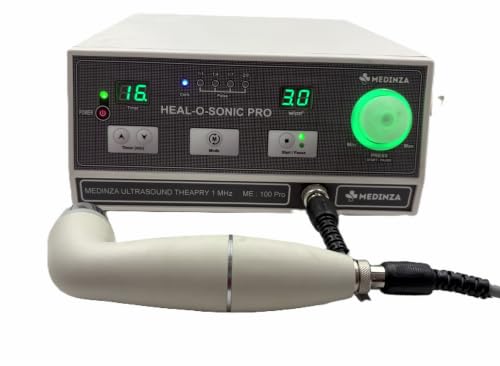
The physical form of the devices is consistent across the category. There is a base unit or a single handheld body, a cable leading to a sound head with a flat metal treatment face, controls for power and timer, and on many models a choice between two frequencies or between continuous and pulsed output. The treatment face is the part that contacts the skin, always through a layer of coupling gel. The area treated in one session is small, roughly related to the size of that face, which is why manufacturer instructions describe treating one defined region at a time rather than sweeping a whole limb.
Home devices also sit in a different regulatory and instructional world from clinic equipment. Professional units in a physiotherapy department are operated by clinicians who select parameters as part of a treatment plan for an assessed patient. A home device arrives with a consumer manual that sets out the manufacturer’s own stated uses, exclusions, session lengths, and warnings, and that manual, not a video, not a forum thread, and not a review page, is the document that governs how a particular model should be used. This guide explains how to read the specifications and manuals in this category; it does not replace them, and it makes no promise about what any device will do for any individual’s condition.
It helps to place the device in the room where it will actually live. A home ultrasound session needs a chair or bed where the user can sit or lie still with the target area exposed and reachable, a small table for the unit and the gel bottle, and ten undisturbed minutes. Households often group this kind of equipment into a corner devoted to sore backs and stiff shoulders, and readers furnishing that corner more broadly may also be comparing best massage chairs with stretch for the seating side of the same room, while this guide stays with the ultrasound device itself, its settings, and its manual. Keeping the categories distinct matters, because a chair is furniture and this is an electrical device applied to the body, and the caution appropriate to each is not interchangeable.
Finally, a note on language that runs through the whole guide. Where this article describes what a frequency is intended to reach, what an intensity setting means, or which areas manuals say to avoid, it is reporting how manufacturers and their documentation describe these devices. Describing an intended target is not the same as confirming an outcome. Readers should hold that distinction firmly, particularly in a category where marketing language often travels much further than the evidence a manual actually presents.
1 MHz and 3 MHz: what the frequency choice is about
Frequency, measured in megahertz, describes how many sound cycles the device produces each second, and in therapeutic ultrasound the two frequencies that dominate home devices are 1 MHz and 3 MHz. According to manufacturer documentation across the category, the difference between them is presented as a difference of depth. Lower-frequency sound at 1 MHz is described as penetrating more deeply before its energy is absorbed, and manuals associate it with deeper structures: the muscles of the thigh, the hip region, the deeper tissues of the lower back, and other areas where the target lies beneath a substantial layer of tissue. Higher-frequency sound at 3 MHz is absorbed more quickly and is therefore described as acting more superficially, with manuals associating it with shallower areas such as the wrist, the ankle, the elbow, and smaller joints where the structures of interest sit close to the skin.
The logic is the same logic that governs how sound behaves in any medium. Each cycle of the wave interacts with the tissue it passes through, and higher frequencies interact more often per centimetre of travel, surrendering their energy sooner. A useful everyday comparison is sound through a wall: the bass from a neighbour’s music, the low-frequency component, is what reaches the next room, while the higher details are absorbed on the way. Manufacturer literature applies the same principle in reverse to the body, selecting the frequency whose energy is described as being absorbed in the layer the user intends to treat, rather than passing through it or never reaching it.
Some home devices offer only one frequency, and others offer both, switchable from the control panel. A single-frequency 1 MHz device is aimed, on its maker’s account, at users whose areas of interest are the deeper, larger muscle groups. A dual-frequency device adds the 3 MHz setting for shallower areas, which suits a household where one person is interested in a thigh or back area and another in a wrist or ankle. What a second frequency does not do is make the device stronger or more advanced in any general sense; it widens the range of areas the manual describes the device as addressing, and a buyer who will only ever treat one deep area gains nothing from paying for a superficial setting that will sit unused.
Manuals tie the frequency choice to specific body areas with tables and diagrams, and those tables deserve more attention than the headline specification. Two devices can both offer 1 MHz and still differ in the areas their manufacturers list, the session times they recommend for each area, and the intensity ranges they permit there. A buyer comparing models should read the area table in each manual, where one is published, and check that the body area they actually care about appears in it, at the frequency the device provides. A specification that matches in the abstract is worth little if the manual’s own area guidance does not cover the knee, shoulder, or forearm the buyer had in mind.
Frequency also interacts with the size of the area being treated. A deep area such as the front of the thigh is also a large area, and treating it with a small sound head takes longer and more overlapping passes than treating a wrist, whatever the frequency. Manufacturer session guidance usually scales time to the treatment area, often expressed in relation to the size of the sound head itself. A buyer who imagines a two-minute session for a whole thigh is misreading the format; the manual’s arithmetic of area and time, covered in the next section, is where realistic expectations about session length are set.
One more caution belongs here, because frequency language is where marketing most often overreaches. Statements that a frequency reaches a named internal structure should be read as the manufacturer’s description of intended energy delivery, not as a verified map of what happens in a particular person’s body, where tissue depth varies with the individual. Two people treating the same named area may have quite different amounts of tissue overlying it. The manual’s categories are necessarily general, and a clinician who has assessed the individual is the only person positioned to say more than the manual does.
Intensity, pulsed and continuous modes, and how long a session lasts
Intensity describes how much power the sound head delivers per unit of its treatment area, and it is expressed in watts per square centimetre, written W/cm². A home device might offer a range beginning at a fraction of one watt per square centimetre and rising to a maximum that varies by model, with steps the user selects on the control panel. The number is a rate of energy delivery at the face of the probe, not a measure of how the tissue will respond, and manufacturer instructions consistently frame intensity selection conservatively: begin at the lower settings the manual specifies for the area, and follow the manual’s progression rather than treating the maximum as a default. More intensity is not presented in responsible documentation as more benefit; it is presented as a parameter with an appropriate range for each area and mode.
The distinction between continuous and pulsed output is the second control that matters. In continuous mode, the device emits sound for the whole session, a duty cycle of one hundred percent. In pulsed mode, the device emits in bursts separated by silent intervals, and the proportion of time spent emitting is the duty cycle: a setting described as twenty percent emits for one fifth of the session and rests for four fifths, while fifty percent splits the time evenly. Manuals across the category describe pulsed settings in the ten to fifty percent range, and they associate lower duty cycles with delivering less total energy over the same session length, which is why pulsed modes are commonly specified where the manual advises a gentler application, including areas where tissue is shallower or closer to bone.
Total energy is the product of these choices together, and thinking of them separately misleads. Ten minutes at a given intensity in continuous mode delivers roughly five times the energy of ten minutes at the same intensity with a twenty percent duty cycle. A user who extends a pulsed session and raises its intensity at the same time has changed the dose twice without necessarily noticing. This is the practical reason manuals present settings as combinations, a named mode, an intensity range, and a time for a named area, rather than inviting users to assemble their own extremes from each dial independently.
Session time in manufacturer guidance is typically expressed per treatment area, and commonly falls in a band of roughly five to ten minutes for an area a small multiple of the sound head’s size, with explicit maximums per area and per day stated in the manual. The timer on the device is therefore a safety and consistency feature, not a convenience: it ends the session at the planned point even when the user loses track while reading or watching television. Models that beep at intervals help the user pace the movement of the probe across the area, dividing it into zones so that no single patch receives the whole session while another receives none.
Sensation during a session is a subject manuals address directly, and their guidance should be followed literally. Documentation commonly states that the user may feel mild warmth or nothing at all, and instructs the user to stop and consult the manual or a professional if there is pain, sharp heat, or discomfort at the treatment site. A sensation of strong heating is treated in manuals as a signal to stop, not as evidence that the device is working well. Buyers should be wary of any marketing that reverses that relationship and presents intense sensation as proof of quality; in the manufacturers’ own safety text, comfort within the stated parameters is the goal and discomfort is a stop signal.
Frequency of sessions is the last parameter, and again the manual is the authority. Documentation typically specifies how often a session may be repeated on the same area and advises against exceeding the stated schedule, sometimes with rest intervals between treatment days. A home device makes it physically easy to ignore such limits, since no appointment system rations its use, and that ease is precisely why the written schedule matters. A buyer should check, before purchase, that the manual for a model under consideration actually states a schedule clearly; vagueness about repetition is a mark against a device whose other parameters are stated precisely.
Coupling gel: the unglamorous item the whole method depends on
Ultrasound does not cross an air gap. Sound at these frequencies reflects almost entirely at a boundary between the metal face of the probe and air, and again between air and skin, so a probe pressed dry against the body delivers very little of its output to the tissue beneath. Coupling gel exists to eliminate that air layer. A water-based gel fills the microscopic unevenness of the skin, maintains continuous contact as the probe moves, and gives the sound a continuous medium from the treatment face into the body. Every manual in the category treats gel as mandatory, and a session attempted with a dry probe, or with a household substitute the manual does not name, is not a weaker version of the intended session; on the physics the manufacturers describe, it is barely a session at all.
The gel specified is ultrasound coupling gel, a water-based preparation made for this purpose, typically clear or lightly tinted, viscous enough to stay where it is spread, and formulated to be wiped or washed off skin and equipment afterwards. Manuals generally warn against substituting oils, creams, or lotions, which may transmit sound poorly, may degrade the treatment face or its seal over time, and may contain ingredients never intended to sit under a moving probe for ten minutes. A device supplied with a starter tube will need replacement gel eventually, and buyers should confirm that standard coupling gel is compatible with the model and easy to obtain, because a device without gel is a device that cannot be used as directed.
Quantity and reapplication are technique points in their own right. The layer should be generous enough that the probe glides without ever catching on dry skin, and as the probe moves, gel is pushed ahead of it and spread thin behind it, so the far side of a treatment area can quietly run dry partway through a session. Manuals advise reapplying during the session as needed, and the practical rhythm is to pause, add gel, and resume, rather than dragging a drying probe over skin to finish the last minute. A user who hears the probe begin to squeak or feel it grip the skin is receiving a clear signal that the coupling layer has failed at that spot.
Temperature and comfort deserve a sentence, because gel stored in a cold room applied to a warm back produces a startle that has nothing to do with the device. Keeping the bottle at room temperature, or warming the tube briefly in the hands, makes the start of a session calmer, particularly for an older user or for treatment areas such as the neck and shoulder where a cold shock tightens the very muscles the person is about to sit still with for ten minutes. Some manuals mention gel warmers used in clinics; at home, room-temperature storage achieves most of the same comfort without extra equipment.
Cleaning the sound head after each session protects both the device and the next session. Gel left to dry on the treatment face forms a film that interferes with the next coupling layer and can work into the seam between the face and the probe body. Manufacturer instructions typically direct the user to wipe the face with a soft cloth, using water or a mild cleaning agent the manual names, and to avoid immersing the sound head, scratching the face with abrasive materials, or using solvents the manual does not approve. The treatment face must stay smooth: a scratched or corroded face couples unevenly and is a reason to seek the manufacturer’s service guidance rather than to polish the surface at home.
Gel hygiene completes the picture. The bottle nozzle should not be pressed against skin and then returned to the bottle’s stock in a way that contaminates the supply, and gel decanted for a session should not be poured back. Skin under the probe should be clean and intact, and manuals direct users away from broken or irritated skin, a point the safety section of this guide returns to. These are small disciplines, but they are the difference between a device that is used as its documentation describes and one that merely resembles the description.
Moving the sound head: slow, even, and always in motion
The single technique instruction that appears in every manual in this category is to keep the sound head moving. The probe is drawn slowly and steadily across the treatment area, in overlapping strokes or small circles, covering the area evenly for the duration of the session. The reason, as documentation explains it, is distribution: a moving probe spreads the delivered energy across the whole area, while a stationary probe concentrates the entire output on one small patch of tissue for as long as it sits there. Holding the head still is therefore not a way to treat a troublesome spot more thoroughly; in the manuals’ framing it is the principal misuse the technique instructions exist to prevent, and several manufacturers state plainly that a stationary application can cause discomfort or harm and must be avoided.
Speed is specified in approximate terms that reward a concrete image. Manuals commonly describe a pace of a few centimetres per second, slow enough that crossing a forearm takes several seconds, fast enough that the probe is plainly travelling rather than dwelling. Users new to the device often move far too quickly at first, skating the head over the area in the rhythm they would use to rub in a cream, and thereby giving each patch of tissue only a fraction of the intended exposure. Counting slowly while moving, or using the device’s interval beeps to change direction, helps establish the deliberate pace the manual describes until it becomes habitual.
Pressure is the second common error. The probe should rest on the gel layer with light, consistent contact, enough to maintain coupling and no more. Pressing hard adds nothing to sound delivery, because the gel layer, not force, is what couples the face to the skin, and hard pressure tires the hand, distorts the soft tissue under the face, and encourages the user to brace the probe in one place. A hand that aches after a session has usually been gripping and pressing rather than guiding. Where the treatment area is the user’s own forearm or thigh, the temptation to press is strongest, because the holding hand is working at an awkward angle; repositioning the chair or supporting the elbow removes the cause rather than the symptom.
Angle is the third error, quieter than the other two. The treatment face must sit flat against the skin so that the whole face couples through the gel. A tilted probe lifts one edge of the face, narrows the contact to a strip, and delivers the session through a fraction of the intended area while the lifted edge couples to air. Flat contact is easy on a thigh and harder on the curved surfaces of an ankle, a wrist, or the side of a knee, which is one reason manuals associate those smaller, curved areas with smaller sound heads and with the higher frequency. Working slowly around a curve, re-establishing flat contact as the surface changes, is the correct adaptation; tilting the probe to hurry around it is not.
Coverage pattern completes the technique. A treatment area larger than the face should be divided mentally into a grid, each cell roughly the size of the face, and the probe moved so that every cell receives a comparable share of the session. Overlapping strokes by about half the face’s width avoids untreated stripes between passes. Users who treat the same area regularly benefit from a consistent routine: same starting point, same pattern, same direction of strokes, so that coverage does not depend on memory or mood. Seating that supports this routine matters more than it first appears, and a person who will sit for a ten-minute session treating a knee or a foot may want to look at best folding chairs for bad backs for a seat that keeps the rest of the body settled while the probe hand does its slow work.
Self-treatment has anatomical limits that no technique can overcome. Areas such as the middle of one’s own back cannot be reached with flat contact, a relaxed hand, and a steady pace all at once, and a session performed with a twisted shoulder and a tilted probe satisfies none of the manual’s conditions. Some households solve this by treating each other, which introduces its own requirement that the helper read the manual too. Others accept that the device serves the areas they can reach properly: thighs, knees, forearms, shoulders with care, and the accessible parts of the lower leg. A buyer whose main area of interest is one they cannot reach should weigh that fact before purchase, not discover it with the gel already open.
The areas manuals say to avoid, stated plainly
Manufacturer safety documentation for home ultrasound devices lists areas of the body where the device must not be applied, and this section reports those lists in general terms. Individual manuals vary, and the manual supplied with a specific device governs that device, but the exclusions recur across the category with enough consistency that a buyer should expect to find every one of them in any responsibly documented product. The eyes are excluded absolutely: ultrasound is not to be applied over or near the eyes. The front and side of the neck over the thyroid gland are excluded. Application over the chest in the region of the heart is excluded. These are not areas for reduced settings or shorter sessions; in the manuals’ language they are areas the probe does not go.
Pregnancy brings a further exclusion that documentation states without qualification: the abdomen, pelvis, and lower back of a person who is pregnant are not to be treated, because of the possibility of exposing the developing baby. Manuals commonly extend the caution to advising that anyone who is or might be pregnant should not use the device without medical direction. Similarly, the areas over growth plates in children and adolescents, the regions near the ends of long bones where growth occurs, are listed as areas to avoid, and many manufacturers state that their home devices are intended for adults only. A household with teenagers should store the device with the same seriousness as medication, not on a shared bathroom shelf where experimentation is easy.
Implanted electronic devices form another category-wide caution. Manuals instruct that the device must not be used over or near an implanted electronic device such as a cardiac pacemaker, and that a person who has such an implant should not use a home ultrasound device without explicit medical advice about their specific implant and circumstances. The same consult-first instruction commonly applies to other implants and to metal hardware in a treatment area, where documentation directs the user to seek professional guidance rather than to improvise a judgment. The consistent theme is that an implant changes the situation from one the manual can govern to one it explicitly hands over to a clinician.
Certain local conditions at the treatment site are also listed as exclusions or stop conditions. Broken skin, wounds, rashes, and areas of infection should not be treated. Areas with impaired sensation are a particular concern, because the user’s own feedback, discomfort that would normally signal a problem, cannot be relied on where feeling is reduced, and manuals treat such areas with explicit caution or exclusion. Areas over known tumours or malignancy, areas with active bleeding, and areas with a history of blood clots or significant circulatory problems appear in manufacturer contraindication lists as places the device must not be applied or as conditions requiring medical direction first. A user who cannot confidently say that none of these apply to an intended treatment area has the answer the manual intends: ask a professional before proceeding.
Two situational rules complete the safety picture. The device is for use on the body areas and for the purposes its manual states, and using it on the head, over the spine in ways the manual excludes, or on any area simply because it aches, without checking the manual’s area guidance, is outside the documented use. And the device is never to be used while the user is in a bath or shower, or with wet hands on the controls, because it is a mains-connected or charger-connected electrical appliance in most home formats, and its manual’s electrical warnings carry the same weight as its treatment warnings. Safety text is not decoration around the interesting pages of a manual; for this category of device, it is the part of the manual that matters most.
Who should ask a clinician first, and what manuals list as contraindications
The consult-first list in manufacturer documentation is long, and its length is itself information about the category. People with implanted electronic devices, as the previous section noted, are directed to seek medical advice. So are people who are pregnant. So are people with a history of cancer or a tumour in or near an intended treatment area, people with circulatory conditions including a history of blood clots, people with diabetes where sensation in the feet or lower legs may be reduced, and people whose intended treatment area has reduced or absent sensation for any reason. A person recovering from surgery on the area, with stitches, staples, or healing wounds, is likewise directed to wait and to ask, rather than to treat the manual’s general session guidance as permission.
People taking medication that affects sensation, circulation, or bleeding may also be directed by a manual to consult a professional, as may people with active infections, fever, or inflammatory flare-ups in the intended area. The point of listing these categories here is not to assemble a complete medical register, which only a device’s own manual and a clinician can do for an individual, but to correct a common assumption: that a device sold for home use must therefore be suitable for every home user. Manufacturer documentation does not make that assumption. It sells the device for home use by adults to whom the exclusions do not apply, on the areas the manual names, within the parameters the manual sets.
Children and adolescents are excluded or restricted in most home-device documentation, both because of the growth-plate caution and because the devices are designed, sized, and documented for adults. A parent considering using a home device on a teenager’s sports injury is outside the documented use of most models and should seek professional care for the injury instead. The same applies to using the device on another adult who cannot describe their own medical history clearly: the operator of the probe takes on the manual’s responsibilities, and helping a spouse or an elderly parent is a reason for more care with the exclusions list, not less.
There is also a diagnostic caution that sits above all the specific categories. Pain that is new, unexplained, worsening, accompanied by numbness, weakness, fever, swelling after an injury, or any change a person cannot account for is a reason to seek assessment, not a reason to begin a home routine and watch what happens. A home ultrasound device cannot identify the cause of a symptom, and time spent applying it to an unassessed problem is time not spent finding out what the problem is. Manuals state versions of this in their warnings, and it deserves emphasis here because the purchase decision itself can create a false sense that the situation is already being handled.
Readers should also understand what a contraindication list is. It is the manufacturer’s statement of situations in which the device should not be used, drawn up for the product’s documented use, and it is a floor rather than a ceiling: a clinician may advise a particular individual against use for reasons no general list anticipates, and that advice overrides any reading of a manual or of a guide such as this one. Conversely, the absence of a personal circumstance from a short summary in an article like this one proves nothing about that circumstance. The full manual, read before the first session rather than after the first question arises, is the minimum standard for this category.
Reading the specification sheet: head size, BNR, certification, and what is in the box
The effective radiating area of the sound head, usually abbreviated ERA and expressed in square centimetres, tells the buyer how much tissue the face addresses with each pass. A larger head covers a thigh or a back area in fewer passes and suits the deeper, larger areas associated with 1 MHz. A smaller head manoeuvres around an ankle or a wrist, maintains flat contact on curves, and suits the shallower areas associated with 3 MHz. Head size and frequency should therefore be read together, as a matched pair describing where the device is meant to work. A large head on a device marketed for wrists, or a small head on one marketed for backs, is a mismatch worth questioning before purchase.
BNR, the beam nonuniformity ratio, is the specification most buyers have never heard of and the one that says most about the quality of the output. It compares the highest intensity at any point in the sound beam with the average intensity the device reports, because the energy leaving a sound head is not perfectly even across its face. A lower BNR describes a more uniform beam; a higher BNR means some point in the beam carries several times the average intensity, a hot spot that the moving-probe technique exists partly to manage. Manufacturers who publish a BNR are giving the buyer a real basis for comparison, and a specification sheet that omits it while dwelling on maximum intensity is emphasising the number that sells over the number that informs.
Maximum intensity and the available pulsed settings should be read in the same spirit. What matters for documented home use is whether the device offers the moderate ranges and duty cycles its manual prescribes for its listed areas, with steps fine enough to follow the manual’s progressions. A headline maximum far above the settings the manual actually directs anyone to use is not a benefit; it is unused and potentially misusable headroom. A timer with an automatic shut-off, clear display of the selected mode, and controls that cannot be knocked from pulsed to continuous by an accidental brush of the hand are worth more, in daily use, than any additional increment of output.
Certification and documentation separate serious products from anonymous ones in this category more reliably than any other signal. A buyer should look for the regulatory markings and standards references appropriate to their country, a named manufacturer with a real address and service channel, a manual that includes the exclusions and contraindications described in this guide, and a warranty whose length and terms are stated in writing, including what it covers on the sound head and cable, the parts under most mechanical stress. A device whose documentation contains no contraindications section is not a device without contraindications; it is a device whose maker did not document them, which is a reason to choose a different device.
The contents of the box determine whether the device can be used as directed from the first day. The essentials are the unit and sound head, the power supply intended for the buyer’s region, at least a starter supply of coupling gel, and the manual itself in a language the user reads confidently. A carry case is more than a luxury for a device whose treatment face must stay smooth and whose cable should not be kinked in a drawer. Replacement gel availability, replacement cable policy, and the manufacturer’s stated service route should all be checkable before purchase, because a device that cannot be re-supplied with gel or repaired under warranty has a shorter useful life than its build quality suggests.
Rest and recovery furniture often gets bought in the same season of life as a device like this, and the comparisons are worth doing separately and on their own terms: best memory foam contour pillows for back sleepers addresses support during sleep for back sleepers, and best mattresses type for back and side sleeper addresses the larger question of a mattress suited to mixed sleeping positions, while neither has any bearing on how an ultrasound device should be selected or used. Keeping equipment decisions and furniture decisions in their own lanes prevents a comfortable bed from being mistaken for a treatment plan, and a device from being mistaken for furniture.
Setting up two concrete sessions: a knee and a wrist
A session on one’s own knee shows how the general rules become physical. The user sits in a chair with the foot supported so the knee is relaxed and slightly bent rather than locked straight, because a tense leg is hard to keep still for ten minutes and a dangling foot swings the target area away from the probe. The gel goes on the area the manual names, the chair height is arranged so the probe hand approaches the knee from above with a supported elbow, and the timer is set before the probe touches the skin, not after. The strokes are short, because the kneecap and the curves around it keep changing the surface, and flat contact has to be re-established constantly; the area immediately over the kneecap itself is treated only as the specific manual directs, since bone close to the surface is exactly the situation where manufacturer guidance, not general habit, decides what is appropriate.
A wrist session is a different exercise in miniature. The forearm rests on a table on a folded towel, palm positioned as the manual’s diagram shows, so that the hand holding the probe is not also responsible for holding the wrist in place. The smaller area means the grid of coverage has fewer cells, the strokes are shorter still, and the temptation to speed up because the area looks trivially small must be resisted: the manual’s session time for the area already accounts for its size. Jewellery and a watch come off first, both because metal at the treatment site has no place under a moving probe and because a watch strap tempts the user to treat around an obstruction instead of clearing the area properly. When the session ends, gel has usually migrated further up the forearm than expected, which is a normal consequence of overlapping strokes and a reason the towel belongs under the arm from the start.
Sharing one device in a household, and keeping a session record
Two adults in one household may both use the same device, for different areas and at different settings, and sharing introduces disciplines a single user can skip. The sound head is cleaned between users as the manual directs, without exception, because gel residue and skin contact make the treatment face a shared surface in the literal sense. Settings are reset deliberately at the start of each session rather than inherited from the previous user’s, since a device left in continuous mode at a higher intensity by one person is a poor starting point for another person’s shallower treatment area. The exclusions list applies to each user separately: one partner’s clear history says nothing about the other’s implant, medication, or sensation in a foot, and a household that treats sharing casually has misunderstood what the manual’s cautions attach to, which is the person under the probe, not the owner of the device.
A brief written record is the habit clinicians would recognise fastest. Noting the date, the area treated, the frequency, mode, intensity, and session length the manual prescribed, and any sensation worth remembering, takes less than a minute and converts a vague routine into an accountable one. The record shows at a glance whether the stated schedule is being kept or quietly exceeded, whether the same area is being treated far more often than intended, and whether a symptom is changing over weeks in a way that should prompt an appointment. A person who later consults a professional can hand over that record instead of a recollection, and the difference between the two is often the difference between a useful consultation and a vague one.
Battery and mains models divide on a practical point that affects technique. A cordless device frees the user to sit where the chair and the light are best, but its output depends on the state of its charge, and manuals commonly direct that sessions be run with adequate battery rather than at the point of exhaustion. A mains-powered unit removes that variable and adds a cable to manage, which must be routed so it neither pulls the sound head sideways nor crosses the treatment area. Neither format is superior in principle; the better one is the one whose constraints the household will actually respect at nine in the evening, tired, with the gel already open.
The first session with any new device should be treated as a rehearsal rather than a performance. The manual is open at the area table, the chair and table are arranged before the gel is opened, the timer is located and understood, and the user confirms that the display shows the intended frequency and mode before the probe touches the skin. A rehearsal pace exposes the practical questions a specification sheet never mentions: whether the cable reaches the chosen chair, whether the gel bottle can be set down without rolling off the table, whether the user can see the timer without twisting toward the unit and dragging the probe off its path. Solving those questions once, deliberately, is what allows later sessions to keep the slow, even technique the manual describes instead of improvising around a badly arranged room.
A household that keeps a spare tube of gel, a soft cloth reserved for the sound head, and the manual in the same case as the device has removed every ordinary excuse for improvising, and improvisation is where documented technique in this category most often quietly falls apart.
Check prices on Amazon
Live listings for the shortlist in this guide are pulled from Amazon below, so prices and availability are always current at the moment you look.


Realistic expectations, and storing the device so it stays as documented
The most realistic expectation a buyer can hold is a procedural one: a home ultrasound device will deliver the settings its panel displays, through a gel layer, to a small area, for a timed session, and the experience of using it will be quiet, warm at most, and undramatic. Nothing about a correctly performed session feels powerful, and buyers who expect a strong sensation, an immediate visible change, or a single session to settle a long-standing problem are expecting things the manufacturers’ own documentation does not describe. Where manuals discuss courses of use, they describe repeated sessions over days or weeks within stated limits, and they frame the device as one element alongside rest, activity modification, and professional care where that care is indicated.
It is equally realistic to expect limits. A home device cannot assess an injury, cannot confirm that an area is suitable, cannot adjust itself to the individual, and cannot substitute for the judgement of a clinician who has examined the person. A buyer whose symptoms persist, worsen, or change character during any period of home use has reached the boundary of what self-directed equipment is for, and the correct next step is an appointment, not a higher setting. Holding that boundary firmly is not a disappointing conclusion to a buying guide; it is the conclusion that every responsible manual in this category reaches in its own warnings section.
Value for money in this category should be judged on documentation and durability rather than on output claims. A device with a published BNR, a clear area table, a complete contraindications section, a timer that cannot be overridden casually, a sound head sized for the buyer’s actual area of interest, and a warranty with a working service route is a better purchase than a device with a higher headline intensity and a leaflet that says almost nothing. The first device can be used as directed for years; the second cannot be used as directed at all, because its directions barely exist.
Storage protects the two vulnerable components: the treatment face and the cable. The sound head should be cleaned as its manual directs, dried, and stored with its face protected from knocks, ideally in the case the device came in, away from a bathroom’s steam and from any shelf where it can be pulled down by its own cable. The cable should be looped loosely rather than wound tightly around the unit, because repeated tight bending at the point where the cable enters the probe is the most common mechanical failure in handheld equipment of every kind. The gel bottle stored alongside should be checked for its expiry or discard guidance, and a spare tube bought before the current one runs out prevents the temptation to improvise a substitute mid-course.
Periodic checks take a minute and catch the failures that matter. Inspect the treatment face for scratches, clouding, or a lifting edge on its seal. Inspect the cable for cracks or a point where it has been pinched in a drawer. Confirm that the timer ends a session when it should and that the controls select the mode the display claims. A device that fails any of these checks, heats unevenly, produces an unusual sensation, or behaves differently from its established pattern should be taken out of use and referred to the manufacturer’s service channel, not used cautiously at a lower setting while its fault is unknown.
Disclosure: Some links on this page are affiliate links, and a purchase made through one of them may support this site at no extra cost to the person buying. As an Amazon Associate we earn from qualifying purchases. The specifications discussed in this guide, including frequencies, intensities, duty cycles, and session times, are the ranges manufacturers publish for this category of device and describe in their manuals; they are information for reading product documentation, not medical advice, and they are not a recommendation that any individual use such a device.
For the buyer who reads the manual first, checks the exclusions honestly, and treats the timer as a boundary rather than a suggestion, a home ultrasound device is a small, quiet, carefully bounded piece of equipment, and that boundedness, understood before purchase, is the truest feature it offers.