What's inside
- Quick picks: best detergent for top loading washers powder or liquid
- Powder or Liquid: What Is the Best Detergent for a Top Loading Washer?
- Quick Comparison: Powder vs Liquid for Top Loaders
- How to Choose Between Powder and Liquid for a Top Loader
- Mistakes That Waste Detergent and Damage Clothes
- Frequently Asked Questions
- Conclusion
As an Amazon Associate I earn from qualifying purchases. This post may contain affiliate links at no extra cost to you.
Quick picks: best detergent for top loading washers powder or liquid
| # | Product | Where to buy |
|---|---|---|
| 1 | Tide Original Powder Laundry Detergent | Check on Amazon |
| 2 | Tide Original Liquid Laundry Detergent | Check on Amazon |
| 3 | Persil ProClean Power-Liquid Original | Check on Amazon |
| 4 | Gain Original Powder Laundry Detergent | Check on Amazon |
| 5 | Arm & Hammer Powder Laundry Detergent | Check on Amazon |
Powder or Liquid: What Is the Best Detergent for a Top Loading Washer?
A top loading washer asks a different question of detergent than a front loader does. The drum fills with water, the clothes move through a full bath, and the detergent has plenty of water and time to dissolve and reach the fabric. That forgiving wash action means both powder and liquid can work well in a top loader, which is why the powder-or-liquid debate never settles: the honest answer depends on the water, the machine, and the kind of dirt in the load. A household with hard water, a machine with an agitator, and a pile of muddy sports kit will not get the same answer as a household with soft water, an impeller machine, and mostly office clothes.
Powder detergent is the older form, and it has real strengths that liquid cannot copy. Powder is usually the better value per load, because the box holds more washes for the money and the format carries no water weight. Powder also handles ground-in dirt, clay, grass stains, and everyday grime well, because its builders and oxygen-based brighteners work through the wash to lift soil and keep whites looking white. A powder that is measured into the drum or the dispenser and given warm or hot water dissolves fully and cleans hard. The weakness of powder shows up in cold water and in short cycles: a powder that never fully dissolves can leave a chalky residue on dark clothes, and a top loader with a short quick-wash cycle may not give it enough time.
Liquid detergent is the more convenient form, and its strengths are the mirror image of powder. Liquid dissolves instantly, even in cold water, so it never leaves undissolved granules on dark fabric. It is easy to measure, easy to pour into a dispenser, and easy to use as a pre-treater: a small amount rubbed into a stain before the wash can lift marks that a wash alone would leave behind. Liquid is also the better choice for a household that washes mostly in cold water, which is increasingly common as energy costs rise and as fabrics get more delicate. The weakness of liquid is that it can be overused: because it pours freely, many people pour far more than the load needs, and the extra detergent leaves a film on clothes and inside the machine.
The machine itself changes the answer. A traditional top loader with a tall central agitator churns the load through the water and gives detergent a good workout, so powder has time to dissolve and work. An impeller top loader, the low-water design with a small disc at the bottom of the drum instead of an agitator, uses less water and relies on the clothes rubbing against each other, so a detergent that dissolves fast matters more, and a powder that needs a lot of water can struggle. A high-efficiency top loader, whether agitator or impeller, needs a detergent made for high-efficiency machines, because those machines use less water and a regular detergent would foam too much. The label on the detergent box matters: a high-efficiency machine should always get a high-efficiency detergent, in powder or liquid form.
Water hardness is the factor most people overlook. Hard water is full of dissolved minerals, and those minerals grab detergent and stop it working, so a hard-water household needs more detergent, or a detergent with stronger builders, to get the same clean. Powder detergents usually carry more builders than liquids, which is one reason powder has a reputation for working better in hard water. Soft water needs far less detergent, and in soft water a liquid is often the easier choice, because a small measured dose dissolves instantly and rinses clean. A household that does not know its water hardness can ask the local water supplier, and the answer will change how much detergent to use more than any brand choice will.
Each product below is described with its strengths, its trade-offs, and the household it fits, followed by a guide to choosing between powder and liquid, the mistakes that waste detergent and damage clothes, and answers to the questions top-load washer owners ask most. No product here has been used in a laboratory for this guide: the descriptions are based on the formulations, the formats, and the way each product is designed to be used, and the recommendations are about matching the product to the machine, the water, and the load.
Quick Comparison: Powder vs Liquid for Top Loaders
| Product | Form | Machine type | Best for | Watch out for |
|---|---|---|---|---|
| Tide Original Powder | Powder | Standard and HE top loaders | Ground-in dirt, whites | Dissolves best in warm water |
| Tide Original Liquid | Liquid | Standard and HE top loaders | Everyday loads, cold water | Easy to over-pour |
| Persil ProClean Power-Liquid | Liquid | Standard and HE top loaders | Stains, odours, cold water | Strong scent for some |
| Gain Original Powder | Powder | Standard top loaders | Everyday dirt, fresh scent | Scent lingers on clothes |
| Arm & Hammer Powder | Powder | Standard and HE top loaders | Value loads, odours | Needs warm water to dissolve |
| Molly's Suds Laundry Powder | Powder | Standard and HE top loaders | Sensitive skin, simple formula | No scent, no brighteners |

Tide Original Powder Laundry Detergent
the classic powder for top loaders, and the strongest choice for ground-in dirt, muddy kit, and whites that need brightening.
Tide Original Powder is the benchmark that other powders are measured against, and it has been the default powder in American laundry rooms for decades. The formula combines surfactants that lift soil with builders that soften hard water and oxygen-based brighteners that keep whites from going grey, and that combination is why it is so often recommended for households that wash work clothes, sports kit, and school uniforms. In a top loader with an agitator, the powder has a full bath of water and plenty of agitation to dissolve, and it uses that time well.
The strength of the powder form is the dose. A scoop of powder is easy to measure, hard to overdo by accident, and cheap per load compared with liquid, because the box is mostly active ingredients and very little water. A household that does a lot of laundry will notice the difference in cost over a year, and a household with hard water will notice that the builders in the powder keep the minerals in the water from dulling the wash. The powder also stores well: a box kept dry in a laundry room will last for months without losing strength, and it does not leak, spill, or leave a sticky residue on the shelf.
Powder needs warm or hot water to do its best work. In a cold wash, especially a short quick-wash cycle, some granules may not fully dissolve, and the undissolved powder can settle on dark clothes as a pale residue. The fix is simple: use warm water for the dirtiest loads, give the machine a full cycle rather than a quick wash when the load is heavily soiled, and pour the powder into the drum or the dispenser before adding clothes so that it meets the water first. A top loader that fills with water before the clothes go in is the ideal home for a powder.
Tide Original Powder is made for both standard and high-efficiency top loaders, and the box carries the high-efficiency mark, so it can be used in either machine. The scent is the familiar Tide scent, which many households like and some find strong, and the formula is not marketed as free of dyes or perfumes, so a household with sensitive skin should look at a free-and-clear product instead. For a household that wants the strongest general-purpose powder for a top loader, this is the one to measure the others against.
Strengths:
- Strong on ground-in dirt, clay and grass stains
- Builders help it work in hard water
- Low cost per load; easy to measure a scoop
- Keeps whites bright with oxygen-based brighteners
Trade-offs:
- Needs warm or hot water to dissolve fully
- Can leave residue on dark clothes in cold, short washes
- Scent is strong for some households; not a free-and-clear formula
Who it fits: Households with a standard or high-efficiency top loader, hard water, and dirty loads such as work clothes, sports kit, and school uniforms.
Check price on Amazon: Tide Original Powder Laundry Detergent
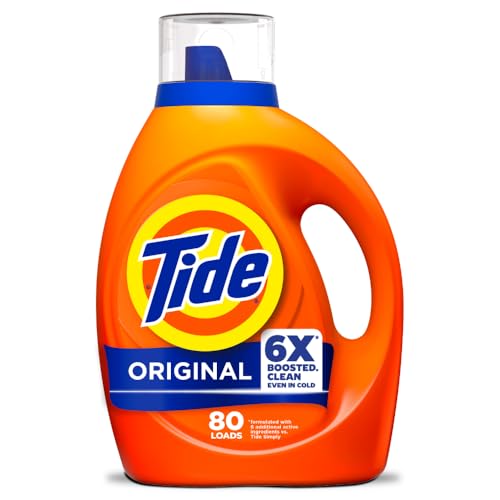
Tide Original Liquid Laundry Detergent
the liquid version of the same classic formula, and the easiest choice for cold washes and everyday loads in a top loader.
Tide Original Liquid is the same cleaning idea in a form that dissolves instantly, and that single difference changes when it is the right choice. Liquid detergent meets the water and disperses at once, so it starts working in the first minute of the wash, even in cold water, and it never leaves undissolved granules on dark fabric. For a household that washes mostly in cold water, either to save energy or to protect delicate fabrics, that instant dissolving is a real advantage, and it is the main reason liquid has become the default format in many homes.
The liquid form is also the most convenient to use. The cap doubles as a measuring cup, the detergent pours neatly into a dispenser drawer, and a small amount can be rubbed into a stain as a pre-treater before the load goes in. That pre-treating step is something powder cannot do without being mixed into a paste first, and it makes liquid the better choice for a household that deals with a lot of individual stains: food on a shirt, grass on a knee, or a mark on a collar. A top loader with a dispenser drawer takes liquid easily, and a top loader without one takes it just as well poured into the drum.
The weakness of liquid is overuse. Because it pours freely and the cap is generous, many households pour far more than the load needs, and the extra detergent does not make clothes cleaner: it leaves a film on fabric, a residue inside the machine, and a smell that builds up over time. The fix is to measure with the cap and to use the smallest dose the load needs, and to remember that a high-efficiency top loader needs a high-efficiency liquid, which is made to foam less in low water. Tide Original Liquid is available in a high-efficiency version, and the bottle should be checked for the high-efficiency mark before it goes into a high-efficiency machine.
Liquid also costs more per load than powder, because the bottle is mostly water, and a household that does many loads a week will pay for that convenience. The trade is between cost and convenience: powder is cheaper and stronger on the dirtiest loads, liquid is easier and better in cold water. A household that washes a mix of loads can keep both on the shelf and use powder for the dirty loads and liquid for the everyday cold loads, which is a common and sensible split.
Strengths:
- Dissolves instantly, even in cold water
- Doubles as a stain pre-treater
- Easy to measure and pour into a dispenser
- No undissolved granules on dark clothes
Trade-offs:
- Costs more per load than powder
- Easy to over-pour, which leaves film and residue
- High-efficiency machines need the HE version
Who it fits: Households that wash mostly in cold water, deal with individual stains, or want the most convenient everyday detergent for a top loader.
Check price on Amazon: Tide Original Liquid Laundry Detergent

Persil ProClean Power-Liquid Original
a liquid with a strong stain-fighting reputation, and a good choice for top loaders that face food, grease, and everyday odours.
Persil ProClean Power-Liquid is the liquid that many households reach for when stains are the problem rather than general dirt. The formula is built around a higher level of stain-fighting surfactants than most liquids, and it is designed to work in cold water, which makes it a natural fit for a top loader that washes mostly cold. Persil has a long history in Europe, where it is one of the best-selling detergents, and the American version carries the same focus on stain removal, with a scent that is fresh and noticeable without being overpowering for most households.
The practical advantage of Persil in a top loader is that it handles the stains a household actually meets: food, grease, grass, and the everyday marks that accumulate on cuffs and collars. The liquid disperses quickly, so it reaches the fabric early in the wash, and the cold-water performance means that a household can wash in cold without worrying that the detergent will not work. For a high-efficiency top loader, the high-efficiency version of Persil is the right one, because it is made to foam less in the low water levels those machines use.
Persil is a premium liquid, and it costs more per load than the budget liquids, so a household that does a great deal of laundry will feel that difference. The scent is also a real consideration: it is stronger and longer-lasting than many other detergents, which some households love and others find too much, especially on bedding and towels. A household that prefers a light scent or no scent should look elsewhere, but a household that wants a strong clean and a fresh smell will find Persil hard to beat.
One honest point is that no detergent, however strong, can remove every stain on its own. A stain that has been dried in a hot dryer is set, and a stain that has sat for days will need pre-treating as well as a good wash. Persil works best as part of a routine: pre-treat the worst stains, use the right dose, wash in the warmest water the fabric allows, and dry only when the stain is gone. Used that way, it is one of the strongest liquids for a top loader.
Strengths:
- Strong on food, grease and everyday stains
- Works well in cold water
- Disperses fast in a top loader
- Fresh scent that lasts
Trade-offs:
- Costs more per load than budget liquids
- Scent is strong for some households
- High-efficiency machines need the HE version
Who it fits: Households that wash a lot of stained clothes, wash mostly in cold water, and want a liquid with a strong stain-fighting reputation.
Check price on Amazon: Persil ProClean Power-Liquid Original

Gain Original Powder Laundry Detergent
a powder with a famously fresh scent, and a good value choice for everyday loads in a standard top loader.
Gain Original Powder is the powder that many households choose for the smell as much as for the clean. The scent is bright, fresh, and long-lasting, and it stays on clothes, towels, and bedding after the wash, which is the reason Gain has such loyal buyers. Behind the scent is a straightforward powder formula that handles everyday dirt well: it lifts soil, brightens whites, and works through a full top-load wash cycle with an agitator, where the powder has time and water to dissolve and work.
The value of Gain powder is real. It is sold at a lower cost per load than the premium powders, and the box lasts a long time in a household that does a normal number of loads a week. The powder measures easily with a scoop, and it is hard to overdo by accident, which keeps the cost per load low and the machine free of the residue that overuse causes. For a household that wants a powder that smells good and costs little, Gain is the obvious choice.
The trade-offs are the same as for any powder, plus the scent. Gain powder needs warm or hot water to dissolve fully, and in a cold, short wash it can leave a residue on dark clothes, so the dirtiest loads should be washed warm. The scent, which is the main attraction, is also the main risk: it lingers, and a household with sensitive skin or a dislike of strong fragrance will find it too much, especially on bedding. Gain is not a free-and-clear product, and a household that needs one should choose a different detergent.
Gain powder is made for standard top loaders, and a high-efficiency machine needs a high-efficiency detergent, so a household with a high-efficiency top loader should check the box for the high-efficiency mark. Used in the right machine, with warm water for the dirty loads and a measured scoop, Gain is a reliable, good-value powder that does the everyday job well and leaves the laundry smelling fresh.
Strengths:
- Low cost per load; good value
- Fresh scent that lasts on clothes and bedding
- Easy to measure; hard to overdo
- Handles everyday dirt well in a top loader
Trade-offs:
- Needs warm water to dissolve fully
- Scent is strong and lingers; not for sensitive skin
- Standard machines only unless the HE version is used
Who it fits: Households with a standard top loader that want a low-cost powder with a fresh, long-lasting scent for everyday loads.
Check price on Amazon: Gain Original Powder Laundry Detergent

Arm & Hammer Powder Laundry Detergent
a baking-soda powder that fights odours, and the best value choice for households that wash a lot of laundry.
Arm & Hammer Powder Laundry Detergent is built around baking soda, and baking soda is there for one reason: it neutralises odours. Sweat, smoke, cooking smells, and the stale smell that builds up in a laundry basket are all odours that baking soda helps to remove, and a top loader that washes sports kit, work clothes, and towels will benefit from that. The powder also cleans everyday dirt well, and it is sold at a low cost per load, which makes it a natural choice for a large household that does many loads a week.
The baking soda in the formula also helps in hard water, because it softens the water and lets the surfactants work instead of being grabbed by minerals. A household with hard water that finds its clothes going dull or stiff may find that a baking-soda powder helps, and the low cost means that using a full scoop does not feel wasteful. The powder is available in a Clean Burst scent and in a free-and-clear version, so a household that wants the odour-fighting without the scent has an option.
As with any powder, the dissolving matters. Arm & Hammer powder needs warm or hot water to dissolve fully, and in a cold, short wash it can leave a residue, especially on dark clothes. The fix is the same as for any powder: warm water for the dirty loads, a full cycle rather than a quick wash, and the powder in the drum before the clothes. The powder is made for both standard and high-efficiency top loaders, and the box should be checked for the high-efficiency mark.
The trade-off is cleaning power on the toughest stains. Arm & Hammer is a good everyday powder and a good odour fighter, but it is not the strongest stain remover in this guide, and a household that faces a lot of ground-in stains may want a stronger powder for the worst loads and Arm & Hammer for the everyday ones. For a large household that wants low cost and fresh-smelling laundry, it is a sensible default.
Strengths:
- Baking soda neutralises odours
- Low cost per load; good for large households
- Helps in hard water
- Free-and-clear version available
Trade-offs:
- Needs warm water to dissolve fully
- Not the strongest stain remover
- Can leave residue in cold, short washes
Who it fits: Large households that wash a lot of laundry, deal with odours from sports kit and work clothes, and want a low-cost powder.
Check price on Amazon: Arm & Hammer Powder Laundry Detergent
Molly's Suds Original Laundry Powder
a simple, unscented powder with a short ingredient list, and the best choice for sensitive skin and for households that want no fragrance at all.
Molly's Suds Original Laundry Powder is the opposite of the big-brand powders: it has a short ingredient list, no fragrance, no dyes, and no optical brighteners, and it is made for households that want the simplest detergent that still cleans. The powder is based on washing soda and plant-derived surfactants, and it is designed to work in both standard and high-efficiency machines, in warm or cold water, which makes it a flexible choice for a top loader of either type. It is also a popular choice for cloth nappies and for baby clothes, where a simple formula matters most.
The strength of a simple powder is what it leaves out. There is no scent to irritate sensitive skin, no dye to stain pale fabric, and no brightener to leave a film on clothes. A household with eczema, allergies, or a baby in the house will often find that switching to a simple powder solves a skin problem that a scented detergent was causing, and the powder rinses clean, which helps in a top loader that uses a lot of water. The powder is also concentrated, so a small scoop does a full load, and the bag lasts a long time.
The trade-off is that a simple formula is not the strongest cleaner. Molly's Suds handles everyday dirt well, but it does not have the stain-fighting surfactants or the brighteners of a premium powder, so ground-in stains and grey whites will need pre-treating, or a stronger detergent for the worst loads. The powder also needs to be measured carefully: too little and the load will not be clean, too much and the powder may not rinse fully in a low-water high-efficiency machine. The bag should be kept dry, because the powder clumps if it gets damp.
For a household that puts sensitive skin first, those trade-offs are worth it. Molly's Suds is a genuine simple powder, not a marketing claim, and it is the product to choose when the priority is a clean rinse and no fragrance, rather than the strongest stain removal. A household that wants both can use it for everyday loads and keep a stronger powder for the dirtiest work.
Strengths:
- No fragrance, dyes or brighteners
- Good for sensitive skin, babies and cloth nappies
- Concentrated; a small scoop does a load
- Works in standard and HE top loaders
Trade-offs:
- Not the strongest stain remover
- Needs careful measuring to rinse clean
- Powder clumps if the bag gets damp
Who it fits: Households with sensitive skin, allergies, or a baby, and anyone who wants a simple, unscented powder for a top loader.
How to Choose Between Powder and Liquid for a Top Loader
Start with the machine. A standard top loader with an agitator can use either form, and the choice is about water, dirt, and cost. A high-efficiency top loader, whether it has an agitator or an impeller, must use a high-efficiency detergent, and the box or bottle must carry the high-efficiency mark. An impeller top loader uses less water, so a liquid or a fast-dissolving powder is the safer choice, because a slow-dissolving powder may not have enough water to dissolve fully. Check the machine manual if the type is not clear: the manual will say whether the machine is high-efficiency and whether it needs a high-efficiency detergent.
Then look at the water. Hard water needs a powder with strong builders, or a larger dose of liquid, because the minerals in the water steal detergent. Soft water needs far less detergent of either form, and a household with soft water that uses a full scoop is wasting detergent and leaving residue. The local water supplier can say whether the water is hard or soft, and a simple test strip from a hardware store can confirm it. The answer changes the dose more than the brand does.
Then look at the loads. A household that washes mostly dirty work clothes, sports kit, and school uniforms will get more from a powder, because powder handles ground-in dirt and keeps whites bright. A household that washes mostly office clothes and everyday wear in cold water will get more from a liquid, because liquid dissolves instantly and works well cold. A household that deals with a lot of individual stains will get more from a liquid, because it can be used as a pre-treater. A household that wants the lowest cost per load will get more from a powder.
Then look at the people in the house. A household with sensitive skin, eczema, or a baby should choose a free-and-clear product, in either form, and should avoid strong scents. A household that loves a fresh scent can choose a scented product, but should remember that scent lingers on bedding and towels as well as on clothes. A household with a septic system should check that the detergent is septic-safe, which most mainstream detergents are, and should avoid overuse, because excess detergent is harder on a septic system than a correct dose.
Finally, think about storage and use. Powder stores well in a dry laundry room, costs less per load, and is easy to measure with a scoop, but it needs a dry scoop and a dry box, and it can clump if it gets damp. Liquid is easier to pour and to pre-treat with, but it can spill, it can leave a sticky residue on the bottle and the shelf, and it is easy to over-pour. A household that keeps both on the shelf, powder for the dirty loads and liquid for the everyday cold loads, gets the best of both forms without committing to one.
One more point is worth making: the dose matters more than the brand. Most households use far more detergent than the load needs, and the extra detergent does not make clothes cleaner. It leaves a film on fabric, a residue inside the machine, and a smell that builds up over time, and it can make a top loader smell musty. The measuring lines on the cap and the scoop are there for a reason, and using the smallest dose that cleans the load is the single best thing a household can do for its clothes and its machine.
Mistakes That Waste Detergent and Damage Clothes
The most common mistake is using too much detergent. A full cap or a heaped scoop feels like it must clean better, but it does not: the extra detergent leaves a film on clothes, a residue in the machine, and a musty smell that builds up over months. Use the measuring lines, start with the smallest dose for the load size, and add more only if the load is genuinely dirty. A high-efficiency machine needs even less, because it uses less water.
The second mistake is using a regular detergent in a high-efficiency machine. A regular detergent foams too much in low water, and the excess foam can leave residue on clothes, confuse the machine sensors, and, in the worst case, overflow. The high-efficiency mark on the box or bottle is not a marketing detail: it means the detergent is made to foam less in low water. Check the label before buying, and do not use a regular detergent in a high-efficiency top loader.
The third mistake is putting powder on top of the clothes in a cold, short wash. Powder that lands on dry fabric and never meets enough warm water will not dissolve, and it will leave a pale residue on dark clothes. Put the powder in the drum or the dispenser before the clothes, use warm water for the dirty loads, and give the machine a full cycle rather than a quick wash when the load is heavily soiled. Liquid does not have this problem, which is one reason it is the better choice for cold, short washes.
The fourth mistake is washing in cold water with a powder and expecting the same result as a warm wash. Powder needs warmth to dissolve and to work at its best, and a cold wash with a powder will clean less well than a cold wash with a liquid. That does not mean cold washing is wrong: it saves energy and protects fabrics, but the detergent should match the temperature. Use liquid for cold washes, powder for warm and hot washes, and the laundry will come out cleaner for it.
Frequently Asked Questions
Is powder or liquid better for a top loading washer?
Both work well in a top loader, because the machine fills with water and gives the detergent time to work. Powder is cheaper per load, stronger on ground-in dirt, and better in hard water, but it needs warm water to dissolve fully. Liquid dissolves instantly, works well in cold water, and can be used as a pre-treater, but it costs more per load and is easy to over-pour. Many households keep both and use powder for dirty loads and liquid for everyday cold loads.
Can I use regular detergent in a high-efficiency top loader?
No. A high-efficiency machine uses less water, and a regular detergent foams too much in low water, which can leave residue on clothes and confuse the machine sensors. Always use a detergent with the high-efficiency mark in a high-efficiency machine, whether it is a powder or a liquid.
Why does powder leave white marks on dark clothes?
Undissolved powder leaves a pale residue on dark fabric, and it happens most often in cold water, in short cycles, and when the powder is poured on top of the clothes. Put the powder in the drum before the clothes, use warm water for the load, and give the machine a full cycle. If the problem continues, switch to a liquid for dark loads.
How much detergent should I use in a top loader?
Use the measuring lines on the cap or the scoop, and use the smallest dose for the load size. Most households use far more than the load needs, and the extra detergent leaves a film on clothes and a residue in the machine. Soft water needs less than hard water, and a high-efficiency machine needs less than a standard machine.
Does powder work in cold water?
Powder dissolves slowly in cold water, and in a short cold cycle it may not dissolve fully, which can leave residue and clean less well. Liquid is the better choice for cold washes. If a powder must be used cold, dissolve it in warm water first, or use a full-length cycle rather than a quick wash.
Conclusion
The best detergent for a top loading washer is the one that matches the machine, the water, and the load. Powder is the stronger, cheaper choice for dirty loads, hard water, and warm washes, and Tide Original Powder is the benchmark to measure other powders against. Liquid is the easier, more flexible choice for cold washes, everyday loads, and stain pre-treating, and Tide Original Liquid is the default liquid for a reason. Persil ProClean is the strongest liquid for stains, Gain is the best-value powder with a fresh scent, Arm & Hammer is the best powder for odours and large households, and Molly's Suds is the best simple powder for sensitive skin. Use the right dose, match the detergent to the machine, and the top loader will do the rest.