What's inside
- Key Takeaways
- Quick Picks
- What Did We Require Before Calling a Machine Integrated?
- Integrated and Adjacent, Compared Without the Adjectives
- Zero-Clearance, Panels and Doors: What Must You Actually Check?
- How Does an Integrated Machine Change a Room’s Design?
- What Does Installation Day Look Like for a Built-In Combo?
- Which Mistakes Ruin Integrated Laundry Projects?
- How Much Capacity Does an Integrated Household Give Up, and Is It Worth It?
- What Plumbing Lives Inside a Cabinet Run?
- How Does an Integrated Machine Sound Inside Furniture?
- Resale, Renovation Value and the Next Owner
- What Should the Product Page Confirm Before Cabinetry Is Cut?
- Integrated Laundry in Kitchens Versus Bathrooms Versus Hallways
- How Long Does an Integrated Machine’s Life Run, and What Ends It?
- What Does a Day’s Laundry Look Like Behind a Cabinet Door?
- Who Should Walk Past This Category Entirely?
- What Does Integrated Laundry Ask of a Household’s Habits?
- Final Recommendation
- Frequently Asked Questions
- Related Guides
As an Amazon Associate I earn from qualifying purchases. This post may contain affiliate links at no extra cost to you.
cottageverdict.com is reader-supported. When you buy through links on our site, we may earn an affiliate commission.
Where to buy: four of the machines below are sold on Amazon, and two further entries discuss classes of built-in laundry that the marketplace pool does not represent with a verifiable listing; for the four, the title’s built-in language — fully built-in, 0-clearance — is the specification that decides everything, so read it the way a cabinetmaker reads a cut sheet; check price on Amazon only after your cabinetry measurements have had their say.
An integrated washer dryer is a laundry machine designed to disappear. Where a freestanding combo stands in a room as an appliance, an integrated unit slides into cabinetry — under a counter, behind a door, flush with the run of cupboards around it — and does its washing and drying from inside the furniture. The best integrated washer dryers are therefore judged by two standards at once: the laundry standard every combo must meet, and the cabinetry standard that decides whether the machine can truly vanish — its width, its depth, its clearance requirements and whether its maker designed it for enclosure at all.
This guide must begin with an honesty that most roundups of the category avoid. In the verified pool available to us, the genuinely integrated class — machines whose titles claim fully built-in, zero-clearance design — is essentially one brand family: Equator’s built-in combos. Alongside them stand convertible compact combos that can serve in a built-in role’s neighbourhood without claiming the full integration specification. The European built-in tradition, where integrated laundry is a mature category, is discussed in prose because its machines are not represented in this pool. A guide that padded the integrated label across ordinary compact combos would be lying with adjectives; this one keeps the label where the titles earn it and says so.
That narrowness is itself useful information. It tells a buyer planning a kitchen or utility renovation that true integrated laundry, bought through this marketplace, is a specialist purchase with a short shortlist — and that the wider European class must be shopped through appliance dealers with cabinetry drawings in hand. Both paths are mapped below, with the checks that keep an integrated install from becoming an expensive gap in a run of cabinets.
Key Takeaways
- Integrated means designed for enclosure: fully built-in, zero-clearance machines that live inside cabinetry — not compact combos merely placed under a counter.
- In this guide’s verified pool, the true built-in class is essentially one brand family — Equator’s built-in combos — plus convertible compacts in an adjacent role.
- Zero-clearance is the decisive claim: it means the machine is engineered to run enclosed without the air gaps a freestanding machine needs.
- European integrated laundry is a mature class discussed here in prose; shop it through dealers against your cabinetry drawings.
- Every integrated purchase is a cabinetry purchase first: width, depth, door swing and service access all precede features.
Quick Picks
| Integrated option | Badge | Why it earns its place |
|---|---|---|
| Equator All-in-one Washer Dryer Ventless Fully Builtin 0-Clearance | The true built-in | The pool’s clearest integration claim: fully built-in, 0-clearance, ventless, 1.62 cu. ft. on 110V. |
| Equator 24in Ventless Compact Combo Fully Built-in | The black built-in | The same fully built-in design in black at 24 inches and 1400 RPM. |
| Equator 24in Convertible Compact Combo Black | The convertible neighbour | A convertible compact that serves beside cabinetry without claiming the full built-in specification. |
| All-in-One Vented Ventless Washer-Dryer 2.5 110V | The larger adjacent combo | A 2.5 cu. ft. vented-or-ventless combo for under-counter roles where full integration is not claimed. |
| The European integrated laundry class | The dealer-channel tradition | Europe’s mature built-in category, discussed in prose — shopped through appliance dealers, not this pool. |
| The panel-ready design approach | The cabinetmaker’s route | Planning laundry around a cabinet front, discussed in prose as a design discipline. |
What Did We Require Before Calling a Machine Integrated?
The maker’s own words. A machine qualified as integrated here only if its listing title claims the built-in design outright — fully built-in, 0-clearance — because enclosure is an engineering property, not a placement choice. Any compact combo can be pushed under a counter; only a machine designed for enclosure manages its heat, its moisture and its vibration in a sealed cabinet without cooking itself or the cabinetry around it. Two listings in this pool make that claim, both from Equator, and this guide’s structure respects the fact rather than disguising it: two true built-ins, two convertible compacts honestly framed as adjacent, and two prose entries covering the class’s wider world.
Ventless design turned out to be the integrated class’s natural partner, and both built-ins here are ventless. A machine inside cabinetry has no honest way to run a vent duct through furniture, so condensing drying — moisture collected and drained, heat managed internally — is the physics that makes integration possible at all. The 110V supply shared across these listings completes the picture: integrated laundry in this pool is a low-infrastructure category, asking a renovation only for water, drainage and a standard outlet inside the cabinet run.
Everything else in the selection followed the combo discipline this site applies everywhere: capacities as titled, spin speeds as titled, and no specification borrowed from a sibling model. Where a title is terse — and one below is very terse — the spec box records the silence and assigns the product page its homework.
The reviews below are ordered by honesty of integration rather than by drum size, deliberately. The two machines that claim the built-in specification lead, because they are the guide’s actual subject. The two convertibles follow in their adjacent frame, useful and clearly labelled. The two prose entries close the detailed reviews because a buyer of integrated laundry deserves the full map — including the territories this marketplace does not stock — before committing a renovation to any single shelf.

Equator All-in-one Washer Dryer Ventless Fully Builtin 0-Clearance — The true built-in
This is the listing the whole guide is organised around, because its title makes the category’s defining claim in full: an all-in-one washer dryer, ventless, fully built-in, 0-clearance, 1.62 cu. ft. and 15 lbs, on 110V, spinning at 1400 RPM. Zero-clearance is the phrase to understand. A conventional machine needs air space around it — for heat, for vibration, for the hoses’ bend. A zero-clearance machine is engineered to run correctly with its cabinet neighbours touching its world on every side: the enclosure is part of the design brief, tested by the maker rather than improvised by your carpenter.
That engineering changes what a renovation can do. A laundry point can be designed into a kitchen run, a hallway cupboard wall or a bathroom’s vanity line with the machine’s front sitting flush, and the room reads as furniture from every angle. For small homes — where the laundry must live inside a designed room rather than in a utility space of its own — that flush disappearance is not an aesthetic luxury; it is what makes in-home laundry compatible with the home’s only available wall.
The laundry specification beneath the cabinetry claim is the compact combo standard this site knows well: a 15 lb drum serving one or two people, a 1400 RPM spin that lightens the ventless dry stage, and 110V power that spares the renovation an electrical project. Nobody should mistake the drum for family capacity. The buyer of this machine is trading drum size for disappearance, knowingly, and the trade is the category’s founding bargain.
One buyer’s detail belongs in this review because it decides between this machine and every freestanding alternative: the door. An integrated install lives or dies by how the machine’s own door and the room’s cabinetry meet — whether the machine stands behind a cabinet door that opens first, or presents its own front flush in the run. This listing’s fully built-in design is made for enclosure, but the exact door arrangement of your scheme must be settled with the maker’s installation documents in hand, because hinge sides, opening arcs and control access are geometry, and geometry does not forgive assumptions made at the ordering stage. Settle it on paper and the daily experience is seamless: open, load, close, furniture.
Service access is the planning point this machine most demands. A built-in appliance will one day need a technician, and a zero-clearance install must still allow the machine to be withdrawn — which means the cabinetry design, the flooring beneath and the hose lengths all conspire in advance. Design the extraction path when you design the enclosure, and the machine’s built-in life will include its maintenance; neglect it, and the first repair becomes a carpentry job.
- Integration: fully built-in, 0-clearance, per the listing title
- Drum: 1.62 cu. ft. / 15 lbs, all-in-one combo
- Drying: ventless
- Power: 110V; spin: 1400 RPM
- Where to buy: the Equator All-in-one Washer Dryer Ventless Fully Builtin 0-Clearance listing on Amazon — check price on Amazon
Strengths
- The genuine integrated specification — enclosure engineered, not improvised.
- Ventless drying suits cabinetry, which has no honest vent path.
- Flush installation returns the room to furniture from every angle.
Trade-offs
- A 15 lb drum — one-to-two-person laundry, permanently.
- Built-in permanence: the machine belongs to the renovation’s timescale.
- Service extraction must be designed into the cabinetry from the start.
Best for: renovators designing laundry into a kitchen, hallway or bathroom cabinet run. A poor fit for: renters, movers, and any household whose laundry outgrows 15 lbs.
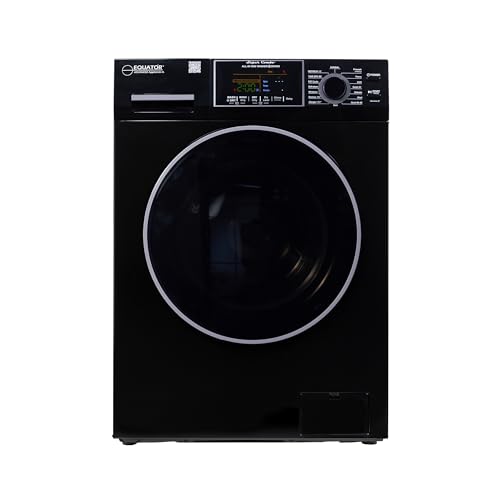
Equator 24in Ventless Compact Combo Fully Built-in — The black built-in
The second true built-in in the pool is the first one’s sibling in black: a 24-inch ventless compact combo, 1.6 cu. ft. and 15 lbs, fully built-in, spinning at 1400 RPM on the maker’s original 110V platform. Two listings for what is essentially one design in two finishes might look like pool-padding; in the integrated category it reads differently, because finish is a cabinetry decision. A black machine behind a dark cabinet front, or standing flush in a run of dark kitchen units, disappears by colour where the standard finish disappears by enclosure alone.
The title’s word Original deserves a moment’s respect. Equator has sold compact convertible and built-in combos into the North American small-space market for years, and an original-platform designation signals the mature version of the design — the one whose enclosure behaviour, condenser habits and parts story are known quantities rather than launch-year questions. In a category where the machine will be sealed into furniture, maturity is not a boring virtue; it is the virtue.
Everything said about the zero-clearance model applies here in substance — the same capacity class, the same ventless logic, the same service-access planning — with the width stated outright at 24 inches, which simplifies the cabinetmaker’s conversation: the standard compact aperture, the standard compact machine, the finish chosen to match the room. Buyers whose cabinetry is already designed around a 24-inch opening will find this the most legible listing in the guide.
Black, as a finish inside cabinetry, has one more argument worth hearing. Where an integrated machine’s front does remain visible — flush in the run rather than behind a door — black reads as a deliberate design material alongside dark handles, dark stone and the shadow gaps that modern cabinetry uses as punctuation. A white machine in that elevation reads as an appliance that wandered in. Renovations are full of such small coherences, and they are rarely accidental in the rooms that feel designed; this listing exists for the rooms where the coherence is planned.
Choose between the two built-ins on finish and on the first model’s explicit 0-clearance wording. If your enclosure is tight and tolerance-free, the zero-clearance claim is the specification to hold; if your design is a standard 24-inch cabinet with a black scheme, this machine’s title already speaks your cabinetmaker’s language.
- Integration: fully built-in, per the listing title
- Width: a stated 24 inches
- Drum: 1.6 cu. ft. / 15 lbs, compact combo
- Drying: ventless
- Spin: 1400 RPM; power: 110V, per the listing title
- Finish: black
- Where to buy: the Equator 24in Ventless Compact Combo Fully Built-in listing on Amazon — check price on Amazon
Strengths
- Fully built-in design in a black finish for dark cabinetry schemes.
- Width stated outright — the cabinetmaker’s conversation is short.
- A mature platform in a category where the machine is sealed into furniture.
Trade-offs
- The same 15 lb capacity ceiling as its sibling.
- The title does not repeat the 0-clearance wording — confirm enclosure tolerances on the product page.
- Black inside a light cabinet run will read as an appliance, not as furniture.
Best for: renovations with a standard 24-inch aperture and a dark finish scheme. Not the right match for: tolerance-critical enclosures, where the sibling’s explicit 0-clearance claim is the safer document.

Equator 24in Convertible Compact Combo Black — The convertible neighbour
Honesty requires this entry’s framing in its first sentence: this machine does not claim to be fully built-in. It is Equator’s 24-inch convertible compact combo in black, on 110V — a freestanding compact that can dry vented or ventless, included here because integrated projects so often end with one position in the cabinet run that behaves like a neighbour rather than a resident: the machine at the run’s end, the unit under an open counter section, the laundry point in a utility wall where a door was planned and then value-engineered away. For those positions, a convertible compact in the matching finish serves the design without pretending to an enclosure specification it does not carry.
Convertibility is its own argument in a renovation context. Renovations change their minds: a vent appears in the drawings, then disappears in the build; a cabinet run gains a door, then loses it. A machine that dries either way survives the project’s revisions, and a machine in the same black finish and the same 24-inch family as the built-ins above keeps the room’s design coherent through those revisions. There is a furnishing parallel that small-home owners will recognise — the reading corner assembled around one anchor chair, with the pieces beside it chosen to harmonise rather than to match exactly; the discipline of the considered arrangement, applied to a whole room, is the subject of Best Curl-Up-and-Read-a-Book Chairs, and it applies to cabinet runs as faithfully as to corners.
The title is terse — width, type, finish, voltage, and little else — so the drum size, spin and program list live on the product page, and this review assigns them there rather than borrowing figures from the sibling listings. What the family resemblance does entitle a buyer to expect is the compact class’s standard scale; what it does not entitle anyone to is a number in a spec box, and none appears.
Buy this machine as what it is and it serves beautifully: the flexible black compact that completes an integrated scheme at its edges. Buy it as a built-in and you will have enclosed a machine that never promised to be enclosed — the one error this guide’s structure exists to prevent.
- Integration status: convertible compact — not a fully built-in model
- Width: 24 inches, stated in the listing title
- Drying: convertible — vented or ventless
- Power: 110V
- Finish: black
- Drum and programs: not stated in the title — confirm on the product page
- Where to buy: the Equator 24in Convertible Compact Combo Black listing on Amazon — check price on Amazon
Strengths
- Convertible drying survives a renovation’s changing drawings.
- Matches the built-ins’ finish and width family for a coherent run.
- Freestanding flexibility — it can leave the scheme if the room changes.
Trade-offs
- Not an integrated machine — do not enclose it as one.
- A very terse title; most specifications require the product page.
- Its value is contextual — it shines beside an integrated scheme, less so alone.
Best for: the open or end position in a cabinet run, and projects whose venting is undecided. Poorly suited to: a sealed enclosure — that is the built-ins’ job, and this machine does not claim it.

All-in-One Vented Ventless Washer-Dryer 2.5 110V — The larger adjacent combo
The fourth linked machine widens the adjacent category: an unbranded all-in-one washer-dryer of 2.5 cu. ft. and 26 lbs, spinning at 1400 RPM on 110V, drying vented or ventless. Its drum is half again the built-ins’ size, and that size is its argument for the under-counter roles where full integration is not claimed but capacity matters — the utility room counter run, the kitchen’s appliance garage end, the laundry wall where machines stand visible beneath a worktop and nobody pretended otherwise. Not every under-counter machine is integrated, and this guide’s refusal to call this one integrated is precisely what makes its genuine virtues legible.
Vented-or-ventless flexibility at 2.5 cu. ft. covers the two utility-room archetypes: the room with a duct, where vented drying runs briskly, and the interior room without one, where the ventless mode keeps the project free of building work. On 110V, the machine asks the renovation for nothing electrical beyond an outlet, which in older homes — where integrated laundry is so often a retrofit into a house that predates laundry rooms — is frequently the difference between a project and a fantasy.
The unbranded title gives the buyer less to verify from, and the review should say so plainly: configuration, capacity, spin and voltage are stated; brand, programs and dimensions beyond capacity are not. For a machine that will live visibly under a counter rather than sealed in cabinetry, that thinner paper trail is a smaller risk than it would be for a built-in — access is easy, replacement is simple — but the product page check remains the buyer’s duty, and dimensions in particular must be confirmed against the counter’s height before ordering.
Position this machine correctly and the integrated scheme around it benefits: the built-ins disappear into the fine cabinetry, and the workhorse combo with the bigger drum stands at the utility end where visibility costs nothing. Many real renovations are exactly that hybrid, and a guide that admitted only pure integration would serve them worse than this honest adjacency does.
- Integration status: freestanding all-in-one — adjacent to integrated schemes, not built-in
- Drum: 2.5 cu. ft. / 26 lbs
- Drying: vented or ventless
- Power: 110V; spin: 1400 RPM
- Brand and dimensions: not stated in the title — confirm on the product page
- Where to buy: the All-in-One Vented Ventless Washer-Dryer 2.5 110V listing on Amazon — check price on Amazon
Strengths
- The largest drum among this guide’s linked machines.
- Vented-or-ventless flexibility on a standard 110V supply.
- Suits visible under-counter roles where integration is not required.
Trade-offs
- Not a built-in — enclosing it would repeat the error this guide warns against.
- Unbranded listing with a thin specification trail.
- Dimensions must be verified before it is promised a counter’s height.
Best for: utility rooms and hybrid schemes needing capacity beside the integrated run. A weak match for: sealed cabinetry, or buyers who need a brand’s service network documented.
The European Integrated Laundry Class — The Dealer-Channel Tradition
Cross the Atlantic and integrated laundry stops being a niche. European kitchens have enclosed their appliances for decades, and the continent’s makers build washer dryers and separates specifically for cabinetry: standardised widths, hinges engineered to carry a cabinet door on the machine’s own front, depths calculated against the continent’s counter standards. That class is discussed here without links because this guide’s pool contains none of it — the marketplace listings available to us simply do not represent it — and a class this established deserves better than a borrowed listing pinned to its name.
What a buyer should take from the class is a set of expectations. A true European integrated machine expects the cabinet door to mount to it, expects its clearances to be specified in millimetres by a maker who has tested enclosure, and expects to be bought through a dealer who works from your kitchen drawings. Its capacities are typically compact by North American standards, its cycles unhurried, its finish irrelevant — the machine is never seen. Households renovating a kitchen to a European design language will find this class through their kitchen studio, and should judge it there, with drawings in hand, rather than through any marketplace roundup.
The class also sets the honesty benchmark this guide has applied to its own pool. When a European title says integrated, a hinge specification and a clearance diagram stand behind the word. Measured against that standard, most marketplace uses of built-in language are casual — which is why the two Equator listings above, with their explicit fully built-in and 0-clearance claims, earned this guide’s respect, and why the convertible compacts were kept in the adjacent frame where they belong.
- Class traits: cabinet-door mounting, millimetre clearance specifications, dealer-channel sales
- Typical capacities: compact by North American standards
- Availability: through kitchen studios and appliance dealers, against cabinetry drawings
- Verification standard: hinge and clearance documentation from the maker
Strengths
- The most mature integrated engineering in the category.
- Door-mounted fronts achieve total visual disappearance.
- Dealer process builds the cabinetry check into the purchase.
Trade-offs
- Not represented in this guide’s marketplace pool — a separate shopping channel.
- Compact capacities and unhurried cycles are the class’s norms.
- Depths and widths follow European counter standards; North American cabinetry must be checked against them.
Best for: full kitchen renovations in a European design language, bought through a studio. Not suited for: a quick marketplace purchase or a retrofit into existing North American cabinets without measurement.
The Panel-Ready Design Approach — The Cabinetmaker’s Route
The final entry is not a machine but a discipline, included because integrated projects fail more often on design than on appliances. The panel-ready approach starts from the cabinet front and works backwards: the room’s doors, drawers and panels are designed as one elevation, and the laundry point is assigned its place in that elevation — its width module, its door style, its handle line — before any machine is chosen. The machine is then selected to serve the elevation, which reverses the usual order in which an appliance is bought and a room is asked to absorb it.
Practised properly, the approach generates the checklist this guide closes with. The aperture’s width and height, measured in the finished cabinetry rather than the drawings. The depth available once the counter’s overhang and the hoses’ bend are spent. The door’s swing or the panel’s hinge side, checked against the machine’s own door. The service path: how the machine leaves its enclosure in year six without a saw. And the floor inside the enclosure, finished and level, because a built-in machine stands on the room’s floor, not on a cabinet’s imagination.
Households that have furnished other rooms this way — designing the elevation first and the objects second — will recognise the method immediately. It is how a dining wall earns its coherence, with chairs chosen against a table’s measure rather than accumulated, a discipline the dining guides on this site apply when they match seating to a table’s geometry in Best Dining Chairs for a Round Table. Cabinetry is simply the same thinking with hinges.
- Method: design the cabinet elevation first, select the machine second
- Checklist generated: finished aperture, true depth, door and hinge geometry, service path, floor
- Pairs with: the built-in listings above, whose makers publish enclosure specifications
- Failure mode addressed: appliances bought before the room that must absorb them
Strengths
- Produces rooms that read as designed rather than assembled.
- Forces every measurement before money moves.
- Makes the service path a design decision instead of a future crisis.
Trade-offs
- Demands design time before the satisfying part — choosing machines.
- Locks the room’s laundry position early; late changes are carpentry.
- Overkill for a freestanding laundry corner that was never going to be cabinetry.
Best for: renovators working with a cabinetmaker or kitchen studio. A poor fit for: incremental projects where the laundry must stay flexible — keep the convertible compacts in view instead.
Integrated and Adjacent, Compared Without the Adjectives
| Integrated option | Built-in status, honestly | Drum | Venting | What to verify |
|---|---|---|---|---|
| Equator All-in-one Washer Dryer Ventless Fully Builtin 0-Clearance | Fully built-in, 0-clearance claimed | 1.62 cu. ft. / 15 lbs | Ventless | Finished aperture and service extraction path |
| Equator 24in Ventless Compact Combo Fully Built-in | Fully built-in claimed | 1.6 cu. ft. / 15 lbs | Ventless | Enclosure tolerances on the product page |
| Equator 24in Convertible Compact Combo Black | Convertible compact — adjacent | Not stated in title | Convertible | Drum, spin and programs on the product page |
| All-in-One Vented Ventless Washer-Dryer 2.5 110V | Freestanding all-in-one — adjacent | 2.5 cu. ft. / 26 lbs | Vented or ventless | Dimensions against counter height |
| The European integrated laundry class | Integrated by design tradition | Compact, varies | Usually ventless | Hinge and clearance documents, via a dealer |
| The panel-ready design approach | A method, not a machine | — | — | The finished elevation, before any purchase |
Zero-Clearance, Panels and Doors: What Must You Actually Check?
Start with the claim itself. Zero-clearance, as the lead listing uses it, asserts the machine can operate enclosed without the ventilation gaps freestanding machines demand — but the assertion to verify on the product page is its scope: which sides, what tolerances, and whether a minimum plinth or vent grille is still expected in the cabinet design. A claim read carefully is a specification; a claim read casually is a hope. Next, the front. Machines in this pool present their own fronts flush in the run; the European class mounts your cabinet door to the machine. Those are different aesthetics and different carpentry, and a renovation must choose which disappearance it wants — flush appliance front, or total door-front invisibility — before the cabinetry is drawn.
Then the unglamorous trio: depth, swing and extraction. Depth inside an enclosure is the cabinet’s depth minus the hoses’ bend and the plug’s body, and it is routinely less than the brochure’s room. Swing is the machine door’s arc against the cabinet door’s arc, two hinges negotiating one opening. Extraction is the future tense of both: the machine will leave this enclosure one day, and the design either allows that journey or charges a carpenter for it. Check all three on paper and the integrated install becomes the calmest part of a renovation; skip them and it becomes the story the renovation is remembered by.
How Does an Integrated Machine Change a Room’s Design?
It returns a wall to the room. A freestanding laundry point is a visual event — a machine, its hoses’ shadow, its detergent skyline — and in a small home that event colonises whatever room hosts it. An integrated point is a non-event: a run of cabinet fronts, behind one of which laundry happens. The kitchen stays a kitchen, the hallway stays a hallway, and the bathroom’s vanity line runs unbroken. For open-plan and small homes, that non-event is worth a renovation line item, because the alternative — an appliance standing in a designed room — taxes the room every day it is looked at.
The design consequence cuts the other way for one household type: the proud laundry room. Some homes celebrate their utility spaces, all tile and shelving and visible machinery, and for those rooms integration solves a problem nobody has. Know which home yours is before paying for disappearance. The same self-knowledge governs the kitchen’s other built-in decisions — a range chosen to sit inside a designed run is judged by fit and fuel before features, exactly the order applied to the electric ranges in Best 30-Inch Electric Ranges.
What Does Installation Day Look Like for a Built-In Combo?
Slower and more deliberate than a freestanding install, by design. The cabinet aperture is checked against the machine one final time; the floor inside is confirmed level; water, drain and outlet are roughed to the positions the enclosure allows rather than the positions a wall would prefer. The machine travels its extraction path in reverse — the route it will one day leave by — and is levelled in place, connected, and run empty while still accessible, because a leak discovered after the panels are fitted is a leak discovered late. Only then does the cabinetry close around it and the room perform its disappearing act.
Keep the documentation with the kitchen’s other papers: the enclosure specifications, the clearances as built, the extraction instructions. An integrated machine’s future technician, owner or buyer will bless the folder’s existence, and the folder costs one envelope on one afternoon.
Which Mistakes Ruin Integrated Laundry Projects?
Enclosing a machine that never claimed enclosure — the convertible compact sealed into cabinetry on the assumption that compact means built-in — heads the list, and this guide’s structure is built to prevent it. Second: designing the aperture from a brochure’s nominal width instead of the finished cabinetry’s measured opening. Third: forgetting the service path, so the first repair requires demolition. Fourth: choosing the machine after the cabinets, when the elevation’s module sizes have already silently excluded the category. Fifth: treating the European class and the marketplace pool as one shelf, and expecting dealer-channel engineering at marketplace convenience. Every one of these is a sequencing error, and sequencing is the one thing a renovation fully controls.
How Much Capacity Does an Integrated Household Give Up, and Is It Worth It?
State the trade in numbers first. The true built-ins in this guide wash 15 lbs at a time; a full-size freestanding pair washes two to three times that in a load. A household of four generates laundry at a rate the built-in drum meets only by running far more often — daily, in small loads, as a background process rather than a weekly event. For the households integrated laundry serves — one or two people in a designed small home, a couple in a flat where the kitchen is the laundry — that rhythm is not a sacrifice; it is how they already live, and the drum’s size simply matches the wardrobe’s scale. For a family, the same drum is a life sentence of perpetual washing, and no amount of cabinetry elegance compensates. The category’s honesty begins with admitting that its founding bargain — capacity for disappearance — is worth it to exactly the households whose laundry was never large.
There is a middle household worth naming: the couple expecting to become a family. An integrated machine installed in a renovation is a decade-scale fixture, and a drum sized for two will meet the third person’s laundry in year two with no upgrade path short of carpentry. Households on that trajectory should either size the laundry point for a freestanding compact’s future arrival or accept, eyes open, that the integrated years are the small-household years. Renovations outlast the life stage that designs them; the wise ones leave a door — sometimes literally — for the next stage.
What Plumbing Lives Inside a Cabinet Run?
The same trio as any laundry point — supply, drain, power — arranged under furniture’s constraints. The supply valves must remain reachable, which in cabinetry means an access decision: a removable panel, a neighbouring cupboard’s shared void, a valve position the enclosure’s design deliberately exposes. The drain must sit where the machine’s hose reaches without kinking inside a space nobody can see into. The outlet must live inside the run yet outside the machine’s own heat story. None of this is exotic plumbing; all of it is plumbing that must be drawn rather than improvised, because the improvisation space inside a finished cabinet is zero. This is the practical reason integrated laundry belongs to renovations rather than to weekends: the infrastructure is furniture-grade work, done once, correctly, in the right order.
Water protection deserves its sentence in a cabinet context above all others. A leak inside cabinetry is a leak inside furniture, discovered late and dried never; a drain pan shaped to the enclosure and a water alarm inside the cabinet are, in an integrated install, not accessories but part of the design’s basic competence. Budget them when the cabinets are drawn, not after the first damp smell.
How Does an Integrated Machine Sound Inside Furniture?
No title in this guide states a noise figure, so the honest discussion is structural. Cabinetry changes a machine’s acoustics in both directions: an enclosure muffles the mid-range wash sounds behind a door, and a badly fitted enclosure can couple the machine’s vibration into a whole run of cabinets, turning furniture into a sounding board. The difference between those outcomes is installation craft — the machine levelled on the room’s floor, clearances respected where the maker asks for them, panels fitted so nothing touches under load. A zero-clearance rating addresses heat and safety tolerances; it does not repeal physics, and a cabinetmaker who treats the enclosure as an acoustic design as well as a visual one earns their fee on the first spin cycle.
Scheduling completes the acoustic picture, as it does throughout small-space laundry. A machine behind a door in a kitchen run will be heard at dinner if it spins at dinner; run the heavy stages in the day’s working hours and the integrated machine achieves the only silence that matters — the kind nobody notices.
Resale, Renovation Value and the Next Owner
Integrated laundry is one of the few appliance choices that reads as architecture to a buyer. A kitchen or utility wall with its laundry invisibly resident signals a renovation done to a standard, and estate agents know the photograph it makes. But the value cuts with the same edge as the capacity trade: the next owner’s household may be larger than yours, and a 15 lb drum behind beautiful cabinetry can read to a family buyer as a beautiful problem. The renovation that hedges this honestly — a laundry point whose aperture and services could also accept a freestanding compact, an enclosure designed to open up rather than only to close — keeps the architecture’s value without mortgaging the room’s future. Design the disappearance, by all means; design its reversibility too, and the room serves both its present and its next household.
What Should the Product Page Confirm Before Cabinetry Is Cut?
Everything the furniture will be built around, in writing, from the maker. The machine’s exact external dimensions — not the nominal module, the millimetres. The clearance specification behind any built-in claim: which sides may touch, what the plinth must provide, whether a vent grille belongs in the design. The door’s swing and the control panel’s position, because a machine whose controls hide behind a cabinet door’s swing is a machine operated through a gap. The hose and cord lengths and their exit positions, which decide where the cabinet’s service voids must be. And the extraction procedure, ideally from the maker’s own installation document, since that document is the one your cabinetmaker should be designing against. A listing that cannot produce these documents is a listing for a freestanding machine whatever its adjectives claim — and the two built-ins in this guide earned their places precisely because their makers publish enclosure language specific enough to build against.
Integrated Laundry in Kitchens Versus Bathrooms Versus Hallways
The room changes the design’s centre of gravity. In a kitchen run, the laundry point joins the home’s most serviced wall — water and drainage are present, the cabinetry language is established, and the machine’s disappearance is total; the cautions are food-space hygiene habits and the dinner-hour acoustics discussed above. In a bathroom, the machine joins the vanity line and the room’s existing relationship with water, and the caution is humidity: a bathroom is already the wettest room, and the enclosure’s ventilation story matters more there than anywhere. In a hallway cupboard wall — the small flat’s classic solution — the laundry point is pure architecture, a door among doors, and the cautions are extraction and sound, since hallways connect bedrooms. All three rooms reward the same machine virtues: ventless drying, standard voltage, enclosure-rated design. All three punish the same error, which is treating the placement as a shopping decision after the renovation’s drawings have hardened.
How Long Does an Integrated Machine’s Life Run, and What Ends It?
The machine’s mechanical life follows the compact combo’s usual arithmetic — load discipline, filter and condenser care, honest capacities — with one addition unique to the category: the cabinetry’s life and the machine’s life become entangled. A freestanding machine is replaced in an afternoon whenever its economics fail. An integrated machine’s replacement is a small renovation, which tempts owners to nurse a dying machine years past its sense, and tempts renovators to seal in a machine whose remaining life is shorter than the cabinets’. The discipline that prevents both traps is the one this guide has repeated: design the extraction, keep the documents, and when the machine’s repair bills cross its value, let it go through the path you built for it. An integrated install done properly makes replacement a day of work. That, more than any finish or feature, is the mark of the category done well.
What Does a Day’s Laundry Look Like Behind a Cabinet Door?
Ordinary, which is the point. The door opens on a machine; a small load goes in; the door closes on furniture again, and the room resumes being a kitchen or a hallway while the laundry happens inaudibly elsewhere in the house’s attention. The integrated rhythm suits the small household’s pattern — a load every day or two, started when the basket reaches the drum’s honest size rather than when a weekly mountain demands it — and it rewards the scheduling habits this site preaches for all compact laundry: cycles run in the day’s working hours, loads sized for the dry stage, filters kept on their calendar. What owners report, consistently, is that the laundry’s visual disappearance changes their relationship to the chore more than its mechanics do. A machine you cannot see is a machine you do not apologise for, work around or close a door on in embarrassment; the chore shrinks to its true size, which is a basket, a door and twenty unhurried seconds.
Who Should Walk Past This Category Entirely?
Four households, honestly named. Renters, whose renovations are their landlord’s and whose machines should be as portable as their tenancies. Families at full laundry volume, for whom a 15 lb drum is not a trade but a sentence. Owners of homes with a genuine utility room, where disappearance buys nothing the room does not already provide. And improvisers — households whose rooms change yearly, whose furniture migrates, whose laundry point has moved twice in three years; integrated laundry is a commitment to a wall, and it should be made by households prepared to keep it. For everyone else — the renovators, the small-home designers, the couples building a flat around its cabinetry — this category is the rare appliance purchase that is really an architecture purchase, and it deserves to be made with an architect’s patience and a cabinetmaker’s tape measure.
What Does Integrated Laundry Ask of a Household’s Habits?
Gentleness, mostly — the habits of people who know their machine lives inside furniture. Loads sized to the drum rather than to optimism, because an overloaded machine vibrates against its enclosure in ways a freestanding one never has to answer for. Filters and condensers kept on their calendar, because a machine that cannot be casually pulled forward for inspection rewards owners who maintain by schedule instead of by symptom. Doors closed softly, panels treated as the furniture they are, and a household-wide understanding that the laundry point is a piece of the room’s architecture that happens to wash. None of these habits is burdensome; all of them are the domestic manners of a home where appliances and furniture have merged, and households that adopt them find the arrangement ageing gracefully — the cabinetry unmarked, the machine unresentful, the room still reading as a room a decade after the renovation’s photographs were taken.
Final Recommendation
If your project is a true built-in — cabinetry designed, enclosure intended — the shortlist is the honest one this guide opened with: the Equator 0-clearance model where tolerances are tightest, its black fully built-in sibling where a standard 24-inch aperture and a dark scheme rule, and the European dealer class where the renovation is a full kitchen in that tradition. Let the convertible black Equator serve the run’s open positions, and let the larger 2.5 cu. ft. combo carry capacity at the utility end where visibility costs nothing. Design the elevation first, verify the clearance claims on the page, plan the extraction path before the panels close — and the laundry will vanish into your home’s furniture so completely that guests will ask, years from now, where on earth you do the washing.
Frequently Asked Questions
What does 0-clearance actually mean for a washer dryer?
It means the maker has designed and rated the machine to operate enclosed in cabinetry without the air gaps a freestanding machine needs around it for heat and vibration. Verify the claim’s scope — which sides, what tolerances — on the product page, because the enclosure you build must match the conditions the claim was made under.
Can I put a regular compact combo inside a cabinet?
Not safely, unless the maker rates it for enclosure. A freestanding combo manages heat and moisture assuming open air; sealed into cabinetry it can overheat itself and dampen the furniture around it. That is why this guide separates the two fully built-in listings from the convertible compacts so carefully.
Why are there so few true integrated models to choose from?
Because in the North American marketplace the category is genuinely small — this guide’s verified pool produced essentially one brand family making the explicit built-in claim. The mature integrated market is the European dealer channel. A short shortlist is not a failure of the guide; it is an accurate map of the shelf.
Does an integrated washer dryer need a vent?
The built-ins here are ventless condensers, which is the natural physics for cabinetry — a cabinet run has no honest duct path. Their moisture drains as water. If your design somehow offers a real duct, a convertible machine can use it, but ventless is the integrated default for a reason.
How do you service a machine sealed into cabinetry?
By withdrawing it along the extraction path the design should have provided — which is why this guide insists the path be planned when the enclosure is drawn: hose lengths, floor finish and aperture tolerances all conspire to make withdrawal possible. If a design offers no extraction path, redesign it before the machine goes in.
Is integrated laundry worth it for a small home?
For a small home where laundry must live inside a designed room, it is often the enabling choice — the difference between laundry in the home and laundry as an eyesore the home works around. For a home with a utility room, the premium buys disappearance nobody needs. The room decides, as it does everywhere in this category.
Can an integrated combo go in a kitchen island?
Only with unusual care. An island offers no wall for services, so water, drainage and power must arrive through the floor, and the extraction path must be designed into the island’s construction from the first drawing. It has been done in high-end small kitchens, but it is a specialist variation, not a starting point — a perimeter run against a serviced wall is where integrated laundry belongs for almost every project.
Related Guides
Integrated machines are one answer to laundry in a designed home; connected machines are another, trading invisibility for information. If your renovation’s ambitions run towards appliances that report, schedule and coordinate, continue with Best Smart Washers and Dryers — and notice how few machines, even now, manage to be both invisible and intelligent at once, in one cabinet, behind one quiet door.


