What's inside
- Key Takeaways
- Quick Picks
- How Did We Police the Word Dryer in This Guide?
- Two Classes, One Table: What Each Machine Actually Does
- Combo or Twin-Tub: How Do You Choose Between the Classes?
- How Should You Load a Mini Combo So It Actually Dries?
- What Does a Twin-Tub Ask of Its Owner That a Combo Does Not?
- Which Buying Mistakes Define This Category?
- What Plumbing and Power Do Mini Machines Really Need?
- How Do Mini Machines Behave in an RV, Specifically?
- Keeping a Mini Machine Alive: Filters, Condensers and Small Habits
- What Is the Real Cost Difference Between the Classes?
- A Short History of the Word Combo, and Why It Misleads
- How Do the Four True Combos Divide Among Themselves?
- What Should You Verify on the Product Page for a Mini Machine?
- Living Small With Laundry: The First Month’s Lessons
- Why Does This Category Reward Careful Readers More Than Any Other?
- Final Recommendation
- Frequently Asked Questions
- Related Guides
As an Amazon Associate I earn from qualifying purchases. This post may contain affiliate links at no extra cost to you.
cottageverdict.com is reader-supported. When you buy through links on our site, we may earn an affiliate commission.
Where to buy: the machines below are sold on Amazon under titles that use the words washer dryer combo very loosely, so this guide reads each title twice — once for what it claims, once for what it describes — and sorts the machines by what they physically are before ranking anything; check price on Amazon once you know which class you are actually buying.
The phrase mini washer dryer hides two completely different machines, and separating them is the entire job of this guide. The first machine is the true all-in-one combo: a single front-load drum that washes your clothes and then, with heated air, dries them in the same tub. The second machine is the twin-tub: a washing tub beside a spin tub, where the second tub extracts water by centrifugal force and nothing is heated at all. A spin tub leaves clothes damp and ready for a line or a rack. It does not dry them, whatever a listing’s headline says, and any guide that lets the word dryer float between those two meanings is setting its readers up for a wet disappointment.
So the best mini washer dryers, honestly sorted, are four true combos followed by two twin-tubs — and the twin-tubs are not here as booby prizes. They are cheaper, simpler, lighter and nearly unbreakable, and for dorms, camping and off-grid corners they are often the right machine. They are simply not dryers, and this guide reviews them as what they are: washer-and-spin machines of real merit, clearly labelled, so that a buyer who needs heated drying buys a combo and a buyer who needs a spin buys a twin-tub, and nobody’s laundry hangs damp in a misunderstanding.
The four combos divide by temperament: an established silver all-in-one from Magic Chef, a steam-equipped ventless CONTOURE built for RVs and apartments, a program-rich Furrion with a condenser dryer, and a small pink Equator convertible that treats colour as a feature. The class above them all — machines built into cabinetry itself — is a different guide’s subject, taken up in Best Integrated Washer Dryers.
Key Takeaways
- This category contains two machine classes: true all-in-one combos that wash and heat-dry in one drum, and twin-tubs that wash and spin only.
- A spin tub is not a dryer. Clothes leave a twin-tub damp and need air — a line, a rack or a separate dryer — and this guide never describes spinning as drying.
- The four true combos here are the Magic Chef, CONTOURE, Furrion and Equator 1.6 — all front-load, all single-drum, all genuinely drying.
- The two twin-tubs, from INTERGREAT and Pataku, earn their places on simplicity, portability and a soaking function — judged as washer-spinners.
- Combo drying is always the smaller capacity: load a combo for the load you want dried, not the load the drum can wash.
Quick Picks
| Mini machine | Badge | Why it earns its place |
|---|---|---|
| Magic Chef All in One Washer Dryer Combo 2.7 | The established all-in-one | A 2.7 cu. ft. front-load combo with five temperature settings and two dry cycles, in silver. |
| CONTOURE 2.7 Ventless Washer Dryer Combo with Steam | The steam-equipped ventless combo | Ventless drying with steam on 120V, built for RVs and apartments, no external venting. |
| Furrion 2.7 RV Front Load Washer Condenser Dryer Combo | The program-rich RV combo | Sixteen wash programs, five spin speeds and three soil levels behind a condenser dryer. |
| Equator 24in 110V Convertible Compact Combo Pink | The colourful compact combo | A 1.6 cu. ft. convertible combo on 110V with a pet cycle — in pink, unapologetically. |
| INTERGREAT 25lbs Compact Portable Washer and Dryer Combo | The timer-knob twin-tub | A 25 lb twin-tub washer-spinner with timer knobs — simple, portable, and a spinner, not a dryer. |
| Pataku 25.3 Lbs Mini Washer and Dryer Combo Twin Tub | The soaking twin-tub | A 25.3 lb twin-tub with a soaking function — judged, like its classmate, as a washer-spinner. |
How Did We Police the Word Dryer in This Guide?
With a single physical test: does the machine heat air and apply it to the load until the load is dry? The four combos pass — each is a front-load all-in-one whose title describes a drying function with temperatures, cycles or a condenser. The two twin-tubs fail the test by design, and their own titles, read fully, admit it: the Pataku title ends in the words spin cycle, and the INTERGREAT title’s second half calls the machine a twin tub mini laundry washer. The dryer language lives in both titles’ headlines, which is exactly the marketing pattern this guide exists to correct. We kept both machines, because they are good washer-spinners; we reclassified them, because a review’s first duty is to the physics.
Beyond the class test, the combos were graded on the usual small-machine virtues: drum size within the mini class, drying method and its building implications, program depth where a title states it, and the honesty of the listing itself. The twin-tubs were graded on their own class’s virtues — capacity in pounds, control simplicity, portability, and any function, like soaking, that a basic twin-tub omits. At no point were the two classes graded against each other on drying, because only one of them dries.
One more discipline: capacities are reported in the units each title uses, and no conversion magic is performed between a combo’s cubic feet and a twin-tub’s pounds. They are different measures of different machines, and pretending otherwise would repeat, in numbers, the same blur this guide refuses in words.
Read the six reviews below with that classification in hand and the guide’s judgements will make sense: the combos are praised or faulted as dryers, because they are dryers; the twin-tubs are praised or faulted as washer-spinners, because that is what they are. A buyer who finishes this guide knowing which class their home needs has already made the purchase decision that matters — the model choice that follows is, by comparison, a matter of taste, temperament and the colour of the corner the machine will stand in.

Magic Chef All in One Washer Dryer Combo 2.7 — The established all-in-one
Magic Chef’s combo is the reference machine of the mini class: a 2.7 cu. ft. front-load all-in-one, described in its title with the plainest specification in this guide — a 2-in-1 design, five temperature settings and two dry cycles, in silver. There is a virtue in that plainness. A buyer can hold the whole machine in mind from one sentence: it washes, it dries with heat, it offers a small honest choice of temperatures and two drying programs, and it does not promise a steam cloud or an app. For the apartment and small-home households this class serves, that legibility is worth as much as a feature.
Five temperature settings matter more on a combo than on a washer alone, because the same drum handles both halves of the job and the household’s whole wardrobe passes through it. The delicates that need a cool wash and the towels that want a hot one are not two machines’ problems here; they are one program dial’s, and a dial with genuine range is what stands between a combo household and a wardrobe slowly homogenised to whatever temperature the machine happens to offer.
Two dry cycles is the honest minimum, and the review should frame it that way: a standard dry and a gentler or shorter alternative covers most loads, while households with strong opinions about drying — heavy denim one day, synthetics the next — will feel the smallness of the library and should look at the Furrion’s deeper program list below. What two cycles does guarantee is that drying is a designed function with settings, not a single heated tumble; the distinction between this machine and a twin-tub is not degree but kind.
Longevity thinking suits this machine’s buyer, so one paragraph belongs to it. A combo concentrates two appliances’ worth of components in one cabinet, and its lifespan is governed by the habits this guide repeats across the category: honest load sizes, a clean filter path, a door left ajar between washes. The Magic Chef’s plain specification is an asset in that long view — fewer exotic systems means fewer exotic failures, and a machine whose whole design can be described in a sentence can usually be serviced by anyone who services the category at all. Buyers keeping a machine for the long haul, rather than for a lease’s duration, should weigh that serviceability as heavily as any program on the dial.
The silver finish and the portable framing in the title place the machine where it belongs: visible small spaces. A combo in a studio or a kitchen corner is furniture whether it wants to be or not, and silver appliances sit more quietly in a room than white ones under warm light. Small point, daily dividend.
- Class: true all-in-one combo — washes and heat-dries in one drum
- Drum: 2.7 cu. ft., front load
- Settings: 5 temperature settings, 2 dry cycles, per the listing title
- Finish: silver
- Where to buy: the Magic Chef All in One Washer Dryer Combo 2.7 listing on Amazon — check price on Amazon
Strengths
- The class’s reference specification, stated in one legible sentence.
- Genuine temperature range for a one-drum wardrobe.
- A full 2.7 cu. ft. drum — the joint-largest combo size here.
Trade-offs
- Two dry cycles is a small library for drying perfectionists.
- Venting arrangement is not stated in the title — confirm on the product page.
- No spin speed in the title, so dry-stage pace is unquantified at title level.
Best for: apartment households wanting the straightforward, established combo. A poor fit for: buyers who need a named ventless system confirmed at title level — the CONTOURE states its ventless design outright.
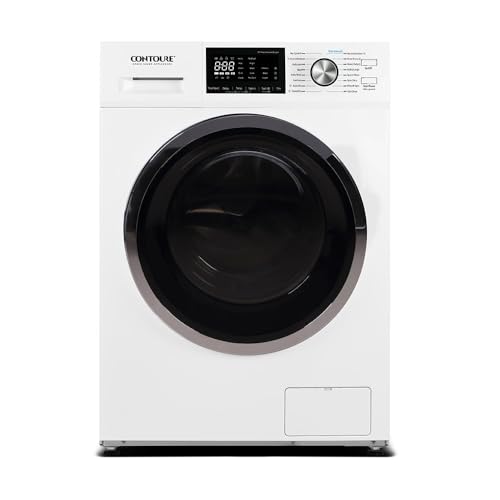
CONTOURE 2.7 Ventless Washer Dryer Combo with Steam — The steam-equipped ventless combo
CONTOURE builds for the RV and apartment world, and this combo’s title reads like that world’s checklist: 2.7 cu. ft., ventless, steam, 120V, white, all-in-one washing and drying in a single unit with no external venting required, model RV-WD900W. Ventless is the load-bearing word. A condenser combo needs no duct, no exterior wall and no landlord’s permission for a penetration, which makes it installable in the interior closets and RV bays where laundry is hardest to place — the exact spaces named in the title.
Steam, on a ventless combo, is a load-management feature as much as a fabric one. A steam refresh handles the worn-but-not-dirty load — the shirt from one evening, the trousers from one flight — without a full wash-and-dry cycle, and on a machine whose dry capacity is its scarcest resource, every refreshed-instead-of-washed garment is capacity returned to the week’s real laundry. RV households, whose wardrobes travel with them and whose machines are small, feel that economy first.
The 120V supply completes the placement argument. Between the standard voltage and the absent vent, this machine asks a building for water and drainage and nothing else — the lightest demand a true dryer can make. In an RV, where power is metered by the pedestal and venting means cutting a hole in a vehicle, that lightness is not convenience; it is feasibility.
One more placement virtue deserves naming, because RV and small-apartment buyers discover it only after installation: a ventless machine can stand against an interior wall, in a closet with no exterior face at all. Vented machines chain their owners to the building’s skin; the condenser frees the floor plan, letting the laundry claim the dead corner by the bathroom — where water and drainage already live — instead of competing for the scarce exterior-wall footage that windows and doors also want. In a small home, that freedom is worth measurable rent, and it is the deepest reason the ventless class dominates the mini category.
Ventless drying’s known cost applies and should be planned for rather than discovered: condensing is the patient drying method, and loads finish on the machine’s schedule. The steam refresh and sensible load sizes are how owners of this class keep the patience from ever being tested.
- Class: true all-in-one combo — washes and heat-dries in one drum
- Drum: 2.7 cu. ft.
- Drying: ventless condenser, no external venting required
- Power: 120V
- Features named in title: steam
- Model: RV-WD900W; finish: white
- Where to buy: the CONTOURE 2.7 Ventless Washer Dryer Combo with Steam listing on Amazon — check price on Amazon
Strengths
- Ventless and 120V — the lightest building demands of any true dryer here.
- Steam refresh stretches the machine’s effective capacity.
- Built and badged for RV and apartment installation.
Trade-offs
- Condenser drying is the slow method — plan loads around it.
- Dry capacity will be smaller than the 2.7 cu. ft. wash drum suggests; the title does not split the figures.
- White finish in an RV bay shows road-life grime honestly.
Best for: RV owners and apartment dwellers whose space has no vent and no prospect of one. Not the right match for: households in a hurry — ventless drying rewards planners, not the impatient.

Furrion 2.7 RV Front Load Washer Condenser Dryer Combo — The program-rich RV combo
Furrion’s combo is the specification maximalist of the four true combos: a 2.7 cu. ft. RV front-load washer with a condenser dryer, sixteen wash programs, five spin speeds and three soil levels. Those three numbers describe a machine designed for tailoring — the title’s own word — and tailoring is what a single-drum household needs most, because one drum must be all things to one wardrobe: gentle enough for the good knitwear, serious enough for the mud-season jeans, patient enough for the load that is barely dirty at all.
Three soil levels deserve their moment. Soil selection is the unglamorous control that decides whether a machine wastes an hour on a load that needed twenty minutes, and on a combo — where the cycle’s length is the household’s standing complaint — matching the program to the dirt is the single most effective speed upgrade available. Five spin speeds work the same lever from the other end: spin harder and the condenser dryer inherits a lighter load; spin gently and delicate fabrics survive to be dried slowly. The program library is not decoration on this machine; it is the throttle and the brake of the whole laundry process.
The condenser dryer places it in the ventless family alongside the CONTOURE, with the same building manners: no duct, no penetration, water out through the drain. Furrion’s RV specialisation shows in the proposition’s completeness — this is a machine specced for a vehicle that must carry its laundry through vibration, variable power and confined bays, and that severity of brief tends to produce honest engineering.
What the title does not state — voltage, a steam claim, the dry program count — should be verified on the product page, and the absence of a voltage in the title is the one gap an RV buyer must close before anything else, because RV power arrangements vary more than household ones.
- Class: true all-in-one combo — washes and heat-dries in one drum
- Drum: 2.7 cu. ft., front load
- Drying: condenser (ventless family)
- Programs: 16 wash programs, 5 spin speeds, 3 soil levels, per the listing title
- Intended setting, per the title: RV
- Voltage: not stated in the title — confirm on the product page
- Where to buy: the Furrion 2.7 RV Front Load Washer Condenser Dryer Combo listing on Amazon — check price on Amazon
Strengths
- The deepest program control here — soil levels and spin speeds that genuinely manage cycle time.
- Condenser drying with no vent requirement.
- An RV-severity design brief behind a full 2.7 cu. ft. drum.
Trade-offs
- Voltage unstated in the title — a mandatory page check, especially for RV power systems.
- Program richness is wasted on households that use one cycle forever.
- Condenser pace applies, as with all ventless drying.
Best for: RV households and meticulous apartment launderers who will actually use soil and spin tailoring. Poorly suited to: one-cycle households — the Magic Chef’s plain dial serves them with less to ignore.

Equator 24in 110V Convertible Compact Combo Pink — The colourful compact combo
Yes, it is pink — and the colour is doing honest work. This Equator is the 1.6 cu. ft. convertible combo sold across this site’s small-space guides in white; here it appears in pink, at 24 inches, on 110V, spinning at 1400 RPM, with the pet cycle its siblings carry, aimed at apartments, condos, RVs and tiny homes. In small-space living, appliances are visible in a way suburban laundry never is, and a machine that admits it is furniture — that offers a colour at all — respects the room it will stand in. Buyers furnishing a small home as a designed whole, rather than as a warehouse for white boxes, will understand the proposition immediately; it is the same instinct that chooses an oversized chair as a room’s anchor instead of hiding seating along walls, a furnishing logic explored in Best Oversized Leather Chairs.
Beneath the colour, the specification is the serious small-combo template this guide has met before: convertible venting, so the machine dries vented where a duct exists and ventless where it does not; 110V power, so no circuit work; a 1400 RPM spin, so the dry stage inherits a light load; and a 15 lb, 1.6 cu. ft. drum that serves one or two people honestly and a family not at all. The pet cycle flushes hair from the drum — a feature whose value scales with how small the home is, since in a tiny home the pet’s hair is everywhere the machine’s drum is the last place it should accumulate.
The convertible venting deserves its emphasis in the mini class specifically. Small spaces are the least predictable installation environments — a closet that might have a duct, an RV bay that might have a vent, a corner that has neither — and a machine that adapts to whichever it finds removes the mini category’s most common purchase error at a stroke.
Capacity honesty, as ever: 1.6 cu. ft. is the smallest true-combo drum in this guide, and its buyer should be a person or a couple with a little-and-often rhythm. What they get in exchange for the small drum is a real dryer — heated, convertible, fully automatic — in the footprint class where most machines are only pretending to dry.
- Class: true all-in-one combo — washes and heat-dries in one drum
- Drum: 1.6 cu. ft. / 15 lbs
- Width: 24 inches, as its title states
- Venting: convertible
- Power: 110V; spin: 1400 RPM
- Programs note: PET cycle named in the title
- Finish: pink
- Where to buy: the Equator 24in 110V Convertible Compact Combo Pink listing on Amazon — check price on Amazon
Strengths
- A true heated dryer at the smallest footprint in the guide.
- Convertible venting and 110V — maximum placement freedom.
- Colour offered as the legitimate feature it is in small-space living.
Trade-offs
- The smallest combo drum here — strictly one-to-two-person duty.
- Pink is a commitment; the room must want it.
- Bedding beyond sheets will overwhelm the drum.
Best for: singles and couples in tiny homes who want real drying and a machine that suits the room. A weak match for: families, or minimalists whose small space is a study in white.

INTERGREAT 25lbs Compact Portable Washer and Dryer Combo — The timer-knob twin-tub
Now the class changes, and the language must change with it. The INTERGREAT is a 25 lb twin-tub: one tub washes, the other spins, and the title’s own second half says so — twin tub mini laundry washer for apartments, dorm, RV and camping, in gray, with timer knobs. Its headline borrows the words washer and dryer combo, and this guide declines the loan: the spin tub extracts water by spinning, applies no heat, and leaves laundry damp. What you are buying is a washer-spinner of admirable simplicity, and judged as that, it is a good machine. Judged as a dryer, it would be a fraud — so it will not be judged as one here.
Timer knobs are the design’s whole philosophy, and in the right settings the philosophy wins. A knob has no menu, no error code, no firmware; it can be operated with wet hands, by a guest, in a dorm at midnight, after a power cut, forever. Twin-tubs ask their owner to participate — move the load to the spinner, set the timer, hang the result — and repay the participation with mechanical simplicity that borders on the immortal. There is almost nothing in a twin-tub that a handy owner cannot understand, and very little that can brick itself.
The 25 lb rating places it at the generous end of twin-tub capacity: a small household’s load washes in one fill, and the spinner, run in batches, keeps pace. Camping and dorm settings in the title are honest — the machine is light, undemanding of plumbing, and content with a tap and a drain — provided its owners understand the ending of every wash: a line, a rack, or a window’s worth of air, because the laundry comes out damp by design.
Buy this machine with its class in mind and it delights. Buy it expecting dry clothes from the second tub and no review’s warning will reach you in time — which is why this one is printed in the review itself, twice.
- Class: twin-tub washer-spinner — NOT a heated dryer
- Capacity: 25 lbs, per the listing title
- Controls: timer knobs
- Intended settings, per the title: apartments, dorm, RV, camping
- Drying reality: spin extraction only — laundry leaves damp and needs air
- Finish: gray
- Where to buy: the INTERGREAT 25lbs Compact Portable Washer and Dryer Combo listing on Amazon — check price on Amazon
Strengths
- Mechanical simplicity — knobs, timers, almost nothing to fail electronically.
- Generous 25 lb wash capacity for the twin-tub class.
- Light, portable and undemanding of plumbing — true dorm and camping equipment.
Trade-offs
- It does not dry. The spin tub leaves clothes damp; air finishing is mandatory.
- The owner is the transfer mechanism between tubs.
- The headline’s dryer language oversells the machine’s physics.
Best for: dorms, campers and minimalists who value simplicity and have somewhere to hang laundry. Not suited for: anyone whose requirement is clothes dry from the machine — that requirement is the four combos above, full stop.

Pataku 25.3 Lbs Mini Washer and Dryer Combo Twin Tub — The soaking twin-tub
The Pataku is the second twin-tub, a fraction larger than its classmate at 25.3 lbs, in grey, with two features its title names and this review will treat precisely: a spin cycle and a soaking function. Spin cycle is the honest phrase in the title, and it should be read as the machine’s own correction of its headline — the second tub spins. It does not dry with heat, it does not leave clothes cupboard-ready, and the laundry that comes out of it needs air, exactly as with the INTERGREAT. Within that truth, the Pataku adds something genuinely useful: soaking.
Soaking is the twin-tub feature that punches above the class. A soak stage loosens the ground-in dirt of work clothes, sports kit and camping gear before the wash begins, and on a simple machine without a program library, a soak is the closest thing to a heavy-duty cycle the format offers. Households whose laundry is genuinely dirty — not office-worn but field-dirty — get more from a soak than from any number of named programs on a combo they would have to load gently anyway.
The rest of the proposition matches the class: compact, portable, aimed at apartments, dorms, RVs and camping, asking for a tap, a drain and an owner’s participation. The two twin-tubs in this guide differ by margins — a fraction of capacity, knobs against this machine’s arrangement, the soak — and the choice between them is properly made on those margins and on which listing’s details you can verify more completely on its product page.
End the twin-tub discussion where it began: these are washer-spinners, and in a guide titled with the word dryer, their presence is justified only by the clarity of their labelling. A buyer who reads this far knows exactly what a Pataku does. That knowledge, carried into the purchase, is what makes the machine a good buy instead of a grievance.
- Class: twin-tub washer-spinner — NOT a heated dryer
- Capacity: 25.3 lbs, per the listing title
- Functions named in title: spin cycle, soaking function
- Intended settings, per the title: apartment, dorms, RVs, camping
- Drying reality: spin extraction only — laundry leaves damp and needs air
- Finish: grey
- Where to buy: the Pataku 25.3 Lbs Mini Washer and Dryer Combo Twin Tub listing on Amazon — check price on Amazon
Strengths
- A soaking function that serves genuinely dirty laundry — rare in this class.
- The joint-largest twin-tub capacity here.
- The title’s own spin-cycle wording keeps the machine’s physics honest.
Trade-offs
- It does not dry. Air finishing is part of the machine’s routine, permanently.
- Manual transfer between tubs, as with all twin-tubs.
- Program depth is minimal by design.
Best for: dorm, RV and camping households with dirty laundry and drying space. A poor fit for: anyone in a windowless interior unit with no line or rack — buy a true combo and let it finish the job.
Two Classes, One Table: What Each Machine Actually Does
| Mini machine | True class | Drum or load | Drying method, honestly stated | Power as titled |
|---|---|---|---|---|
| Magic Chef All in One Washer Dryer Combo 2.7 | All-in-one combo | 2.7 cu. ft. | Heated drying, 2 dry cycles | Not stated in title |
| CONTOURE 2.7 Ventless Washer Dryer Combo with Steam | All-in-one combo | 2.7 cu. ft. | Ventless condenser drying, with steam | 120V |
| Furrion 2.7 RV Front Load Washer Condenser Dryer Combo | All-in-one combo | 2.7 cu. ft. | Condenser drying | Not stated in title |
| Equator 24in 110V Convertible Compact Combo Pink | All-in-one combo | 1.6 cu. ft. / 15 lbs | Convertible — vented or ventless heated drying | 110V |
| INTERGREAT 25lbs Compact Portable Washer and Dryer Combo | Twin-tub | 25 lbs | None — spin extraction only | Not stated in title |
| Pataku 25.3 Lbs Mini Washer and Dryer Combo Twin Tub | Twin-tub | 25.3 lbs | None — spin cycle only, plus soaking | Not stated in title |
Combo or Twin-Tub: How Do You Choose Between the Classes?
Ask where your laundry finishes. If the honest answer is a line, a rack or a sunny balcony that you use happily, the twin-tub’s simplicity is a bargain and its damp output is a step in a routine you already own. If the answer is a drawer — if laundry must emerge finished because your space, climate or schedule gives damp clothes nowhere to go — only a true combo answers, and the twin-tub’s lower price is a saving on the wrong machine. Climate votes heavily: humid regions and winter seasons punish air-drying indoors, while dry climates make a spinner plus a rack into a complete laundry system for most of the year.
Space votes too, in a subtler way. A twin-tub household must own drying space — the rack’s footprint, the line’s run — and in the smallest homes that space can exceed the machine’s own. A combo household owns no drying space at all; the drum is the whole story. Furnishing small rooms teaches the same accounting everywhere: the object’s footprint is never the whole footprint, and the honest comparison includes the accessories a choice drags with it — as true of a patio chair’s cushions and cover as of a twin-tub’s rack, a point the outdoor guides on this site make when they size seating for real decks in Best Outdoor Patio Rocking Chairs.
How Should You Load a Mini Combo So It Actually Dries?
Load for the dry, always. A combo’s drum washes more than it can dry in one pass, so the household habit that makes these machines beloved instead of blamed is simple: fill the drum to the level you want dried, which looks like two-thirds of a wash fill, and let one cycle finish the whole job. Sort by fabric weight where you can — a drum of similar fabrics dries evenly, while a duvet cover wrapped around three T-shirts dries as a damp parcel with dry sleeves. Shake items out as you load; a combo drum rewards loose loading more than any other laundry format, because the same air must reach everything without a transfer or a fluff in between.
Then give the machine its schedule. Ventless and condenser drying is patient, and the households that thrive with combos start loads before work, before bed, before the school run — appointments the laundry keeps without an audience. Standing in front of a combo waiting is the one user error no specification can survive.
What Does a Twin-Tub Ask of Its Owner That a Combo Does Not?
Presence. The twin-tub’s wash finishes and waits for you: lift the load, distribute it in the spinner, run the spin, hang the result. The whole participation takes minutes and some owners genuinely prefer it — the laundry is handled, inspected, sorted by hand at every stage, and nothing sits forgotten in a drum. But it is a real cost, and it compounds with frequency: a household washing daily is volunteering daily. The combo’s counter-offer is absence: load, program, leave, return to finished laundry. Neither machine is better in the abstract; they are answers to different relationships with the chore, and the buyer’s self-knowledge is the specification that decides between them.
Twin-tubs also ask for water management — fills and drains are often manual or semi-manual at this class level — and for a floor that tolerates the occasional splash. A bathroom siting answers most of it. Verify the exact fill and drain arrangement of either twin-tub on its product page, since the titles do not enumerate it.
Which Buying Mistakes Define This Category?
The first is the one this guide opened with: buying a twin-tub under the belief that its second tub dries. The second is its mirror — dismissing twin-tubs as fake dryers when their owners never asked them to dry, and missing a simple, durable washer-spinner at a fraction of a combo’s price. The third is sizing a combo by its wash drum and living with the dry split unplanned. The fourth is ignoring venting until installation: two of these combos are ventless by design, one is convertible, and one’s arrangement lives only on its product page — know yours before the box arrives. The fifth is forgetting that mini machines serve mini households, and asking any of the six to absorb a family’s growth spurt.
What Plumbing and Power Do Mini Machines Really Need?
Less than any other laundry category, and the details differ by class. The true combos behave like small appliances: a water supply, a drain and an outlet, with the ventless and convertible models asking for nothing beyond that trio. Confirm each combo’s voltage on its product page where the title omits it — two of the four combos here state their voltage outright (120V and 110V), and the other two keep the fact on the page, where an RV buyer in particular must retrieve it, because a vehicle’s power system is a designed environment with no tolerance for assumptions.
Twin-tubs ask for even less infrastructure and slightly more of you. Their fills and drains are the manual end of laundry — a tap, a hose, a sink or floor drain — and their electrical demand is modest. That lightness is why they colonise dorms and campsites: anywhere water can be poured and drained, a twin-tub can wash. The trade is the owner’s labour at every transfer, priced into the machine’s simplicity from the start.
How Do Mini Machines Behave in an RV, Specifically?
An RV is a laundry environment with four extra constraints: motion, vibration, metered power and bays measured in centimetres. Machines badged for it — the CONTOURE and the Furrion in this guide, with the Equator naming RVs among its settings — are built to be secured in a bay, to run on the vehicle’s supply without drama, and to dry without a vent hole in the vehicle’s shell, which is why condenser and ventless designs dominate the RV shelves. Weight matters underway in a way it never does in an apartment: every appliance is payload, and the mini class’s lightness is a travelling virtue as much as a spatial one.
The twin-tubs serve a different RV pattern — the seasonal site, the long stay, the hookup with a laundry corner outside the vehicle — where their portability and indifference to installation make them the wash-day appliance and the site’s lines do the drying. Both patterns are legitimate; the mistake is buying for one pattern while living the other, and the titles here, read fully, tell you which pattern each machine was built for.
Keeping a Mini Machine Alive: Filters, Condensers and Small Habits
Mini machines forgive much, but they keep three accounts. The first is lint: combos condense moisture through components that lint loves to coat, and a condenser or filter neglected for a season is the usual explanation when a ventless machine’s drying slows from patient to geological. The maker’s cleaning interval, found on the product page and in the manual, is a calendar appointment, not a suggestion. The second account is the door seal on the front-load combos, which wants the same wipe-and-air courtesy as any front-loader’s, compressed into a smaller gasket. The third is load discipline, the mini class’s standing sermon: a drum run at its honest capacity spins balanced and dries evenly, while a drum stuffed in optimism wears its suspension and leaves its loads damp in the middle.
Twin-tubs keep simpler accounts — a tub rinsed, a spinner balanced, hoses drained before storage — and their owners’ testimony across the category is consistent: the machines die of neglect and drops far more often than of worn-out washing. Simplicity is its own maintenance plan.
What Is the Real Cost Difference Between the Classes?
This guide prints no prices, by its standing rule, but the cost structure of the two classes is a fact a buyer should carry into the listings. A true combo concentrates a washer, a heater, a condenser or vent system and a control board in one small cabinet, and its price reflects that concentration — as does its repair profile, where one machine’s failure is the whole laundry’s failure. A twin-tub distributes almost nothing: two tubs, a motor arrangement, timers. Its purchase price is a fraction of a combo’s, its repairs are mechanical, and its running costs are water, a little power and the owner’s time. The honest comparison is never combo price against twin-tub price; it is combo price against twin-tub price plus the value of your transfers, your drying space and your climate’s patience, summed over the years you will own the machine. Households that run that sum honestly rarely regret either answer.
A Short History of the Word Combo, and Why It Misleads
Combo began as a precise term: one drum, two functions, washing and heated drying in a single cabinet — the machine the Magic Chef, CONTOURE, Furrion and Equator in this guide actually are. Marketplace language then did what marketplace language does, stretching the word over anything with two tubs, two functions or two of anything, until twin-tub washer-spinners could headline themselves with it and mean only that washing and spinning coexist in one housing. The stretch is not a conspiracy; it is the ordinary inflation of catalogue English. But laundry is physics, and physics does not inflate. The buyer’s defence is the one this guide has modelled throughout: read past the headline to the title’s own descriptive half, where the truthful phrases — spin cycle, twin tub, condenser, ventless — are printed by the same sellers who wrote the headline. Both halves are the listing; the second half is the specification.
How Do the Four True Combos Divide Among Themselves?
Strip the class question away and the four combos sort by the constraint each treats as primary. The Magic Chef treats legibility as primary: a known size, a counted set of temperatures and dry cycles, nothing to decode. The CONTOURE treats placement as primary: ventless and 120V, installable anywhere water reaches. The Furrion treats control as primary: programs, spins and soil levels for owners who tune their laundry. The Equator treats adaptability as primary: convertible venting at the smallest size, for spaces whose rules are unknown or changing. A buyer who can name their own primary constraint — comprehension, placement, control or adaptability — has effectively chosen their combo, and the remaining differences are the kind that owners adapt to within a month and forget within a year.
What Should You Verify on the Product Page for a Mini Machine?
Four verifications, in the order they bite. First, the class itself: if a listing’s photographs or description reveal two tubs where you expected one drum, you are looking at a washer-spinner regardless of its headline — the single most valuable check in this category, and the one this guide exists to teach. Second, the drying specification of a true combo: its dry capacity where stated, its venting arrangement, and its voltage, because those three facts decide whether the machine fits your space, your circuit and your schedule. Third, dimensions against your bay or corner, measured with the door’s swing and the hoses’ needs included. Fourth, for twin-tubs, the fill and drain arrangement — how water gets in, how it gets out, and how much of that work is yours. A mini machine verified on those four points arrives as the machine you intended; a mini machine bought on its headline alone arrives as a lesson, and the lesson’s tuition is a return shipment.
Living Small With Laundry: The First Month’s Lessons
New mini-machine owners converge on the same discoveries. The first is that load size is a rhythm, not a maximum: the households that thrive wash smaller and oftener, and find their laundry has dissolved from a weekly event into a background process, while the households that fight their machines are usually running a full-size household’s schedule through a mini drum. The second discovery is that drying, in every class here, is the appointment to plan around — the combo’s long heated cycle or the twin-tub’s line time — and that planning backwards from dry clothes, rather than forwards from dirty ones, reorganises the whole chore pleasantly. The third is how quickly the machine becomes furniture: a combo in the corner, a twin-tub under a cover, as unremarkable as the kettle. That ordinariness is the category’s true product. Mini laundry does not sell capacity; it sells the disappearance of the laundromat from a small home’s life, and by the second month, that disappearance is complete.
Why Does This Category Reward Careful Readers More Than Any Other?
Because its marketing language and its physics part company more completely than anywhere else in laundry. In most categories a careless reader loses a feature or misjudges a size; in this one a careless reader buys an entirely different machine from the one they believe they bought — a spinner wearing a dryer’s name, delivered to a home with nowhere to hang a wet shirt. The careful reader, by contrast, is rewarded twice: once with the right class of machine, and again with prices and simplicity that the headline-chasers overlook while they chase the word dryer into the wrong listings. Everything in this guide has been an exercise in that careful reading, and the habit transfers to every category a small home will ever shop.
Final Recommendation
Decide the class first and the machine second, and this category stops being a trap. If your laundry must finish inside the machine, the Magic Chef is the established all-in-one to beat, the CONTOURE is the ventless answer where no duct exists, the Furrion is the tailor’s choice with its soil and spin control, and the little pink Equator is the convertible for the smallest spaces and the boldest rooms. If your laundry finishes happily in the open air, the INTERGREAT and the Pataku are honest washer-spinners — the Pataku’s soak giving it the edge for genuinely dirty loads — and they will out-simplify and likely outlast machines three times their complexity. What no buyer should do is split the difference in their head and expect a spin tub to dry. Choose the physics you need, and the mini machine you bring home will do exactly what its review promised, load after load, in the small bright corner of your home it was built for.
Frequently Asked Questions
Does a twin-tub washing machine dry clothes?
No. A twin-tub’s second tub spins water out of the load; it applies no heat and the clothes come out damp. They finish drying in air — on a line, a rack or a balcony. Listings that headline a twin-tub as a washer dryer combo are using dryer loosely, and this guide classifies both twin-tubs here as washer-spinners.
Why are twin-tubs in a guide to mini washer dryers at all?
Because shoppers meet them under that name, and a guide that omitted them would leave buyers to decode the marketing alone. They are included with their class stated plainly, judged on washer-spinner virtues — simplicity, portability, soaking — and never credited with drying.
How long does a ventless combo take to dry a load?
Longer than a vented dryer — condensing is the patient method, and low-voltage machines are gentler heaters. Exact times depend on load size and fabric, which is why this guide’s advice is procedural rather than numerical: load for the dry capacity, sort by fabric weight, and schedule cycles into hours you are not waiting on them.
Can a mini combo handle bedding?
Sheets and pillowcases, yes, in sensible loads on the 2.7 cu. ft. combos. A full duvet or heavy blanket will overwhelm the mini drums — the 1.6 cu. ft. Equator most of all — and is better laundered occasionally at a facility than used as the sizing argument for a machine that must also fit a tiny home.
Which of these machines suits an RV best?
The CONTOURE and Furrion are badged and built for RV life, with ventless or condenser drying that needs no hole in the vehicle; the Equator convertible names RVs among its settings too. Confirm voltage and dimensions against your RV’s bay and power system on the product page before ordering.
Is the pink Equator the same machine as the white one in other guides?
It is the same compact convertible platform — 24 inches, 110V, 1.6 cu. ft., pet cycle — in a pink finish, with its own listing and ASIN. Treat the colour as the difference and the specification as shared, and verify the details on this listing’s page as you would any other.
How much space do I need around a mini combo?
Enough for its door to open fully, its hoses to connect without being crushed, and its owner to load it without contortion — in practice, the machine’s footprint plus working room in front, with a little air at the back and sides. Ventless models are the most forgiving of tight corners since no duct competes for the space behind them; convertible models run vented need the duct’s bend accounted for, exactly as a full-size dryer would, only smaller.
Related Guides
Mini machines serve the smallest laundry briefs. Apartment households with a dedicated laundry closet and room for a full compact appliance should compare these minis against the apartment-sized field in Best Compact Clothes Washers for Apartments before deciding how small their laundry really needs to be.


